
You're eating well most of the time. You're moving your body. Your weight may even be fairly stable. Yet the same small area still bothers you every time you get dressed. For some people it's the lower tummy. For others it's the flanks, thighs, upper arms, or under the chin. That experience is common, and it doesn't mean you've done anything wrong.
In clinic, this is often the point where people stop asking, “Why can't I be more disciplined?” and start asking a better question. “Do I need a more targeted approach?” That's where a fat reduction treatment can make sense. These treatments aren't designed to create major weight loss. They're used to contour localised areas that haven't responded in the way you hoped.
This category is no longer niche. The global non-invasive fat reduction market was valued at USD 1.3 billion in 2022 and is projected to reach USD 4.3 billion by 2030, with a 16.2% CAGR from 2023 to 2030, according to Grand View Research's market overview of non-invasive fat reduction. That growth matters because it shows many people are looking for surgery-free body contouring, not because they want a shortcut, but because they want precision.
If you're also trying to separate body contouring from overall fat loss goals, a practical tool like this fat loss calculator can help you think clearly about what lifestyle change can realistically do, and where a localised cosmetic treatment sits in that bigger picture.
Table of Contents
- Introduction Why Diet and Exercise Arent Always Enough
- Understanding How Non-Surgical Fat Reduction Works
- Your Guide to the Leading Fat Reduction Methods
- Comparing Your Treatment Options Side-By-Side
- Are You a Good Candidate for Fat Reduction Treatment
- Your Journey From Consultation to Final Results
- How to Choose a Trusted Clinic in Leamington Spa
- Frequently Asked Questions About Fat Reduction
Introduction Why Diet and Exercise Arent Always Enough
A typical client story goes like this. Someone has already made good changes. They're walking more, drinking more water, being more mindful with food, and feeling stronger overall. But one area still looks out of proportion, and that can feel surprisingly disheartening.
The key thing to understand is that body contouring and weight loss are not the same goal. A fat reduction treatment is usually about shape, not the number on the scales. It's for the person who feels generally comfortable in their body, but wants help with a specific area that seems resistant.
What people often get wrong
Many people assume that if a healthy lifestyle isn't fully shifting a stubborn area, they must be failing. In reality, localised fat can behave differently from overall body fat. The tool needs to match the job.
Practical rule: If your goal is broad health improvement or significant weight reduction, start there first. If your goal is to refine a localised area, non-surgical contouring may be the more relevant conversation.
That's also why choosing a treatment by gadget name alone can be unhelpful. One person may need debulking in a pinchable area. Another may need more attention on skin firmness and texture. Someone else may need no fat treatment at all, and better support around weight management. In situations like that, reading about approaches such as Blue Haven RX medical weight loss can be useful, because it helps draw a clear line between cosmetic contouring and medically supervised weight-loss care.
Understanding How Non-Surgical Fat Reduction Works
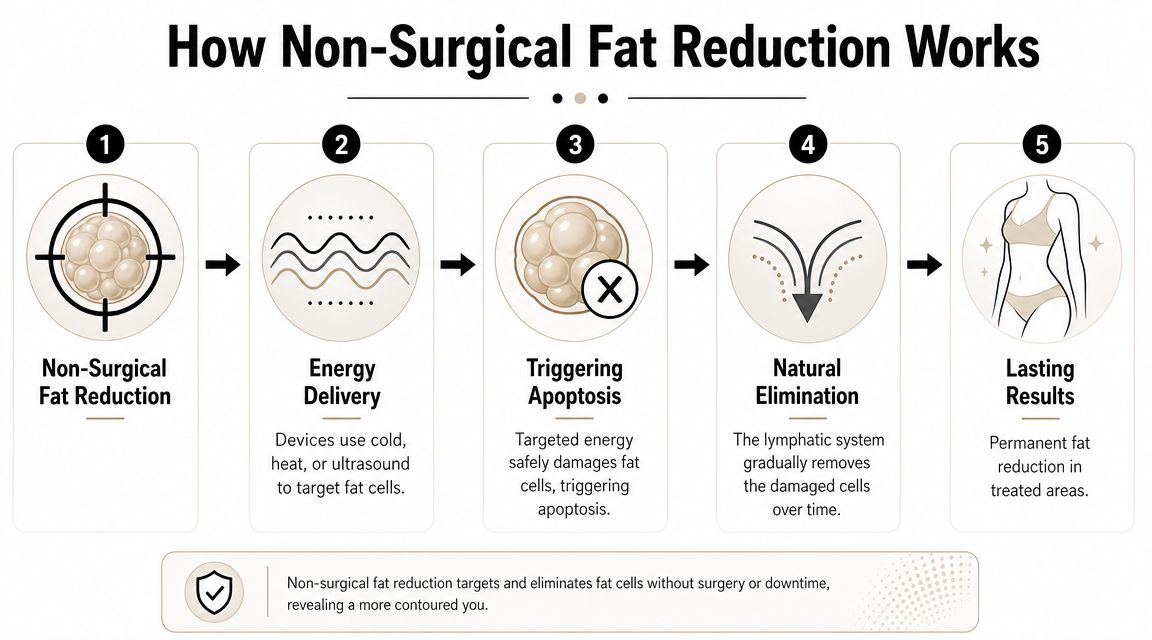
Most non-surgical fat reduction methods follow the same broad idea. They target fat cells without surgery, encourage those cells to break down, and then your body clears them gradually over time. That gradual pace is one reason people often feel more comfortable with these treatments. You're not walking out looking suddenly different. Your shape changes progressively.
A simple way to think about it is this. The treatment gives selected fat cells an early retirement notice. Those cells stop functioning normally, and your body then tidies them away through natural processes.
The basic process in plain language
The device delivers focused energy
That energy may be cold, heat, ultrasound, or another modality depending on the treatment.Fat cells are affected more than surrounding tissue
The aim is selective targeting, not general damage.The treated cells break down
In clinical language, this is often described as apoptosis, or programmed cell death.Your body clears the waste naturally
This happens over weeks rather than overnight.The area looks slimmer or more refined
The change is usually measured in contour, not dramatic weight reduction.
Why results take time
That delay can confuse people. They assume no instant change means no effect. Usually, it means the treatment is working in the way it's supposed to.
Cryolipolysis is one clear example. Cleveland Clinic explains that fat freezing works by cooling subcutaneous fat enough to trigger apoptosis, with the treated fat typically cleared over about 2 to 3 months, visible change often by 3 weeks, and maximal effect around 3 to 4 months in its cryolipolysis overview from Cleveland Clinic.
Non-surgical fat reduction is less about instant removal and more about controlled change.
How this differs from liposuction
Liposuction physically removes fat through a surgical procedure. Non-surgical options don't do that. They work more gently, usually with less disruption and less downtime, but also with more modest, gradual results.
That's why the right comparison isn't “Which one is stronger?” It's “Which approach fits your goals, your anatomy, your tolerance for downtime, and your expectations?”
Your Guide to the Leading Fat Reduction Methods
A common starting point is this. You look in the mirror, notice one area that never seems to shift, and start searching for the “best” machine. Then the options blur together. Fat freezing, cavitation, HIFU, RF, shockwave. The names sound technical, but the core question is simpler. Which treatment matches your body, your goals, and the tissue sitting under your skin?
That is why a good clinic starts with assessment, not a device menu. The aim is not to pick a gadget off a list. The aim is to work out what is creating the shape concern, whether that is a localised fat pocket, loose skin, uneven texture, or a mix of all three. Tools such as 3D body scans can help with that process because they turn a vague frustration into something measurable and easier to plan for.
Fat freezing or cryolipolysis
Cryolipolysis is often the easiest treatment to understand because it is designed for a very specific type of concern. It works best on fat you can pinch. In practice, that usually means a defined bulge on the lower abdomen, flanks, thighs, or upper arms, rather than general body weight.
The handpiece applies suction and controlled cooling to the area. If you are considering this option, a useful first question is not “Does fat freezing work?” but “Is my concern the kind of fat this method can grip and target?” That is exactly the kind of detail a consultation should check. If you want a treatment-specific overview, you can read these fat freezing treatment details.
The sensation usually follows a pattern. First comes pulling or pressure. Then a strong cold feeling. Then numbness, which is why many clients find the rest of the session easier than the first few minutes.
Cryolipolysis often suits someone with a clear, localised area who is happy to wait for gradual change. It is less suitable when the tissue is hard to pinch, spread broadly across an area, or mixed with significant skin laxity.
Ultrasound cavitation
Ultrasound cavitation is commonly chosen for broader contour work and inch-loss style plans. Instead of focusing on one very discrete bulge, it is often used where the area feels softer and more spread out.
Clients often ask whether this means it is “milder” than fat freezing. A better way to look at it is fit. A spanner is not worse than a screwdriver. It is the wrong tool for some jobs and the right one for others. Cavitation can make sense for someone who prefers a course of treatments and wants body contouring to be part of a wider plan.
Treatment usually feels warm, buzzy, or gently active. Some people hear a high-pitched internal sound during the session. That can feel odd the first time, but it is a known part of how ultrasound is perceived.
Body HIFU
Body HIFU uses focused ultrasound at specific depths under the skin. That depth is part of its appeal. It allows a practitioner to treat selected areas with precision, which can be helpful when contouring needs a targeted approach rather than broad coverage.
This is often where professional assessment matters most. Two clients can point to the same “stubborn area” and need different treatments because the thickness of the fat layer, the firmness of the tissue, and the skin quality are different. Body HIFU may suit one of them well and be a poor match for the other.
Clients usually choose HIFU when they want shape refinement without surgery and understand that change develops over time. It is not an instant shrink-wrap treatment. The goal is measured contour improvement in the right area.
Radio frequency
Radio frequency is often part of the conversation when the issue is not fat alone. Many body areas look better when the skin also feels firmer. That is where RF can have a role.
It uses controlled heat, and the sensation is usually easier to tolerate than the name suggests. Many clients describe it as a hot stone massage or a heated massage head moving across the skin. Comfortable treatment does not mean it is casual. It means the technology is being used for a different purpose.
RF is commonly selected when the treatment plan needs contour refinement with skin support. That is why it is often recommended alongside another modality instead of replacing it. If a clinic only talks about reducing fat volume and never assesses skin quality, the plan may miss half of the reason the area bothers you.
A short explainer can also help if you prefer to see treatment concepts visually.
Shockwave therapy
Shockwave therapy sits slightly differently from the other options because it is often used to improve the look and feel of the tissue rather than target fat alone. It can be useful when cellulite, texture, and circulation support are part of the concern.
Body contouring is rarely just a fat question. A smaller fat layer does not always look smoother if the skin above it still appears uneven. In those cases, the treatment plan may need to address both the volume underneath and the surface texture above.
The feeling is rhythmic and active, often described as tapping or pulsing. It is not usually a relaxing treatment, but it is manageable for many clients.
Why combination plans are common
Single-treatment answers are appealing because they sound simple. Real bodies are less simple.
One area may need reduction in fat volume, better skin firmness, and improvement in surface texture at the same time. That is why experienced practitioners often build combination plans after assessment rather than forcing every client into one headline treatment. A clinic with several body-contouring options, including fat freezing, ultrasound cavitation, 3D Powersculpt, shockwave, body HIFU, and radio frequency, can assess the concern first and choose the method second. That consultation-first approach is often more useful than chasing whichever machine is most heavily advertised.
Comparing Your Treatment Options Side-By-Side
A table can help, but it's only a starting point. The same treatment may suit one person beautifully and disappoint another if the tissue type, treatment area, or expectation is off.
Non-Surgical Fat Reduction Treatment Comparison
| Treatment | Best For | Avg. Sessions | Results Timeline | Sensation |
|---|---|---|---|---|
| Cryolipolysis | Pinchable, localised fat bulges | A few sessions | Gradual over weeks to months | Strong cold, suction, then numbness |
| Ultrasound | Localised contouring and inch-loss style plans | 1 to 3 | Gradual | Warmth or buzzing |
| Radio frequency | Skin tightening support and contour refinement | 4 to 10 | Gradual | Warm, heated massage feel |
| Body HIFU | Targeted contouring in selected areas | Personalised | Gradual | Deep warmth or brief intensity |
| Shockwave therapy | Texture support, cellulite-focused contour plans | Personalised | Gradual | Rhythmic tapping or pulsing |
The session guidance above reflects one of the clearest practical points in current consumer guidance. The American Board of Cosmetic Surgery notes that non-invasive technologies differ in session requirements, with cryolipolysis typically needing a few sessions, ultrasound 1 to 3, and radiofrequency 4 to 10, in its overview of non-surgical fat reduction options. That's why “fat reduction treatment” isn't one standard service.
Device names matter less than assessment
A device can be popular and still be wrong for you. Good planning looks at:
- Your actual concern rather than the trend. Is it bulk, softness, skin laxity, or texture?
- The type of fat present. Soft pinchable tissue behaves differently from deeper fullness.
- Your patience for gradual change. Some people are happy with subtle progression. Others want a different route.
- Whether a combination is smarter. One modality may target fat while another supports tissue quality.
If your concern is really overall weight reduction rather than local contouring, it can also help to read a broader expert analysis of GLP-1 treatments so you don't compare a cosmetic body treatment with a medical weight-management pathway as if they're the same thing.
For people who want muscle-focused contour support as part of a body plan, 3D Powersculpt information is another example of how clinics may build beyond fat reduction alone.
Are You a Good Candidate for Fat Reduction Treatment
The best candidate usually isn't the person trying to solve a whole-body weight issue. It's the person who is already fairly close to their target shape and wants help with a specific localised area.
That distinction matters in the UK. Public guidance highlighted in the American Society of Plastic Surgeons article notes that 64% of adults in England were overweight or obese in 2022, and makes the point that non-surgical fat reduction is aimed at small, stubborn pockets of fat rather than high BMI or general weight loss in its public explainer on non-surgical fat reduction. In other words, these treatments are cosmetic contouring procedures, not medical weight management.
Signs you may be a strong fit
- You can identify one or two clear areas that bother you more than your overall size.
- The fat feels pinchable under the skin.
- Your weight is relatively stable and your expectations are realistic.
- You want a non-surgical route and you're comfortable with gradual change.
Signs the conversation may need to go in a different direction
If your main goal is substantial weight reduction, a body contouring treatment may leave you disappointed. The treatment hasn't failed. It's been used for the wrong goal.
The same applies if the concern is mostly visceral fat, which is the deeper fat stored around internal organs. Non-surgical body contouring devices are generally used for subcutaneous fat, the softer layer beneath the skin. If you can't really pinch the area, that's an important clue.
Good candidate test: If your main thought is “I want to reshape this area,” you may be in the right category. If it's “I need to lose a lot of weight,” start with medical or lifestyle support first.
Safety still comes first
Suitability also depends on health history, skin condition, treatment area, and the specific device being used. During consultation, a therapist or clinician should ask about medical issues, previous procedures, sensitivity to heat or cold where relevant, and what result you want.
That honesty is a good sign, not a barrier. A trustworthy clinic won't try to fit every body into the same treatment.
Your Journey From Consultation to Final Results
You book a treatment because one area has bothered you for months, then a new worry appears. What if you choose the wrong method, misread normal side effects, or expect change too quickly? A clear process helps with all three.
The strongest clinics guide you through this in stages. The goal is not to match you to a machine on day one. It is to understand your body, your priorities, and what kind of change is realistic. That is why a consultation matters so much. It sets the plan, the timeline, and the way progress will be measured.
A proper first appointment should feel more like mapping than selling. Your therapist is assessing the treatment area in the same way a builder checks the structure before choosing tools. They need to know what sits under the skin, how localised the pocket is, whether skin quality may affect the result, and whether one technology or a combination plan makes more sense. A 3D body scan can help here because it gives you a starting point you can return to later, instead of relying on memory alone.

What happens at consultation
You will usually cover:
- The area you want to improve, and what you want it to look or feel like in clothes or in the mirror
- What you have already tried, so the therapist can understand the bigger picture
- Whether the tissue is suitable for fat reduction, or whether the concern is more about loose skin, muscle tone, or general weight loss
- Which treatment approach fits best, including whether combining methods would be more sensible than using one device alone
- How results will be tracked, such as photos, measurements, or body scanning
This part matters because body contouring is rarely about finding a universally best treatment. It is about finding the right fit for your body and your goal.
What treatment day feels like
The session itself depends on the technology selected at consultation. Some treatments use cooling, some use heat, and some create a pulsing or contracting sensation. If you are unsure what that means, a simple way to picture it is this. Different devices try to influence fat cells in different ways, but the appointment should still feel controlled and manageable rather than dramatic.
Many people return to normal routines soon after treatment. The area can feel numb, tender, firm, tight, or a little bruised for a while. That does not automatically mean something has gone wrong. It usually means the tissue has been treated and is settling.
When results usually show
This is the part that often tests patience.
Non-surgical fat reduction is a gradual process, not an instant one. As noted earlier in the article, visible change can take weeks to months, depending on the method used and how your body responds. That delay is exactly why follow-up should be built into the plan from the start. Without a baseline, people often forget where they began and judge progress too harshly.
The body needs time to deal with the treated fat and for the area to settle into its new shape. That is different from weight loss on the scales, and it is different from the immediate swelling changes people sometimes expect after surgery. You are looking for a contour change over time.
A good review appointment compares your current shape with your starting point and asks a practical question. Have you reached a result that feels worthwhile, or would another treatment stage improve the outcome? That kind of decision is much easier when the clinic has assessed you properly from the beginning.
How to Choose a Trusted Clinic in Leamington Spa
By the time you start comparing clinics, the smartest question isn't “Who has the cheapest fat freezing?” It's “Who is likely to assess me properly and recommend the right plan?”
That shift protects you from being sold the wrong treatment.
A practical checklist
- Look for consultation-first care. You want a clinic that assesses your body and goals before mentioning packages.
- Ask what technologies they offer. A wider toolkit makes it easier to match treatment to the problem.
- Check who performs the treatment. Training, experience, and confidence with the device matter.
- Listen to the language they use. Honest clinics talk about contouring, timelines, and suitability. They don't imply dramatic weight-loss results.
- Ask how progress is measured. Photos, measurements, and body scanning are far more useful than vague impressions.
If you want to understand the background of one local provider, the about page for 3D Aesthetics explains its consultation-led approach and treatment range.
The real green flag
The best sign is restraint. A clinic that tells you a treatment isn't right for you is often showing exactly the judgement you want.
Frequently Asked Questions About Fat Reduction
How long do the results of fat reduction last
If treated fat cells are successfully reduced, the contour change can last. But long-term appearance still depends on lifestyle, weight stability, and what happens in the untreated fat cells that remain. Think of treatment as reshaping a specific area, not making you immune to future body changes.
Can I combine different fat reduction treatments
Yes, sometimes that's the most sensible plan. One treatment may target localised fat, while another may support skin firmness or the look of cellulite. Combination plans should be based on assessment, not on adding more for the sake of it.
Are these treatments painful
The treatments are generally considered tolerable rather than painful. The sensation depends on the modality. Cooling treatments can feel intensely cold at first. RF often feels warm. Shockwave is more active and percussive. During consultation, ask what the treatment feels like minute by minute. That gives you a much more useful picture than a simple yes or no.
Are fat reduction treatments suitable for men
Absolutely. Men often seek treatment for the abdomen, flanks, chest-area contour concerns, and under the chin. The principles are the same. The plan should be based on anatomy, goals, and tissue type, not gender.
What should I focus on before booking
Focus on assessment. Don't start by choosing a device name from social media. Start by choosing a clinic that will evaluate whether a fat reduction treatment is appropriate, which technology fits your concern, and how your results will be measured over time.
If you'd like a personalised opinion on whether a fat reduction treatment is right for you, 3D Aesthetics Leamington Spa offers consultation-led assessment to help you compare options, understand what's realistic, and build a plan around your body rather than a one-size-fits-all device.