

You've probably looked at a tattoo recently and felt something between irritation and resignation. It might be a name, a design from another phase of life, or work that never healed or aged the way you hoped. That feeling is common, and it doesn't mean you were careless when you got it. It usually means your life has moved on.
Laser tattoo removal gives people a practical way to change that without resorting to harsh, outdated methods. The difficulty is that the industry is full of simple slogans, and the most common one is that pico is automatically the best tattoo removal laser for everyone. It isn't that straightforward.
A good treatment plan depends on three things more than marketing: your ink colours, your skin type, and the quality of the practitioner using the device. In many cases, a top-end Q-switched system is a very sensible option. In some cases, picosecond technology has real advantages. The right answer comes from matching the laser to the tattoo, not from choosing the most expensive machine in the room.
Table of Contents
- Introduction Regretting a Tattoo Is More Common Than You Think
- How Laser Tattoo Removal Actually Works
- The Great Debate Picosecond vs Q-Switched Lasers
- Matching the Laser to Your Tattoo and Skin Colour
- Your Treatment Journey Explained From Start to Finish
- Choosing Your Clinic A Safety and Quality Checklist
- Why Choose 3D Aesthetics Leamington Spa for Your Journey
Introduction Regretting a Tattoo Is More Common Than You Think
Tattoo regret rarely arrives all at once. More often, it creeps in. You stop liking the placement. The colour changes. The meaning fades. Or you don't want that part of your past announcing itself every time you wear short sleeves.
That doesn't make tattoo removal an overreaction. It makes it a normal decision about your appearance, just like changing your hair colour, correcting old cosmetic work, or treating pigmentation that no longer suits you. The difference is that tattoo ink sits deeper in the skin, so removing it safely needs the right technology and the right judgement.
A lot of clients start by asking a very direct question: what's the best tattoo removal laser? The honest answer is that there isn't one single machine that wins in every situation. Some lasers are better for darker inks. Some wavelengths are better for reds or greens. Some settings are safer on deeper skin tones. Some systems can be effective but come with a much higher price tag.
Practical rule: If a clinic tells you one device is perfect for every tattoo and every skin type, that's a sign to ask more questions.
The useful way to think about tattoo removal is this. You're not buying a machine. You're buying a treatment strategy. A skilled practitioner looks at ink colour, ink density, tattoo age, layering, body area, and your skin response before deciding how to proceed.
That's where balanced advice matters. There's a lot of hype around newer lasers, especially picosecond systems. Some of that hype is justified. Some of it is sales language. A clear UK-focused view should leave you with realistic expectations about safety, timeline, cost, and which type of technology is likely to suit your tattoo.
How Laser Tattoo Removal Actually Works
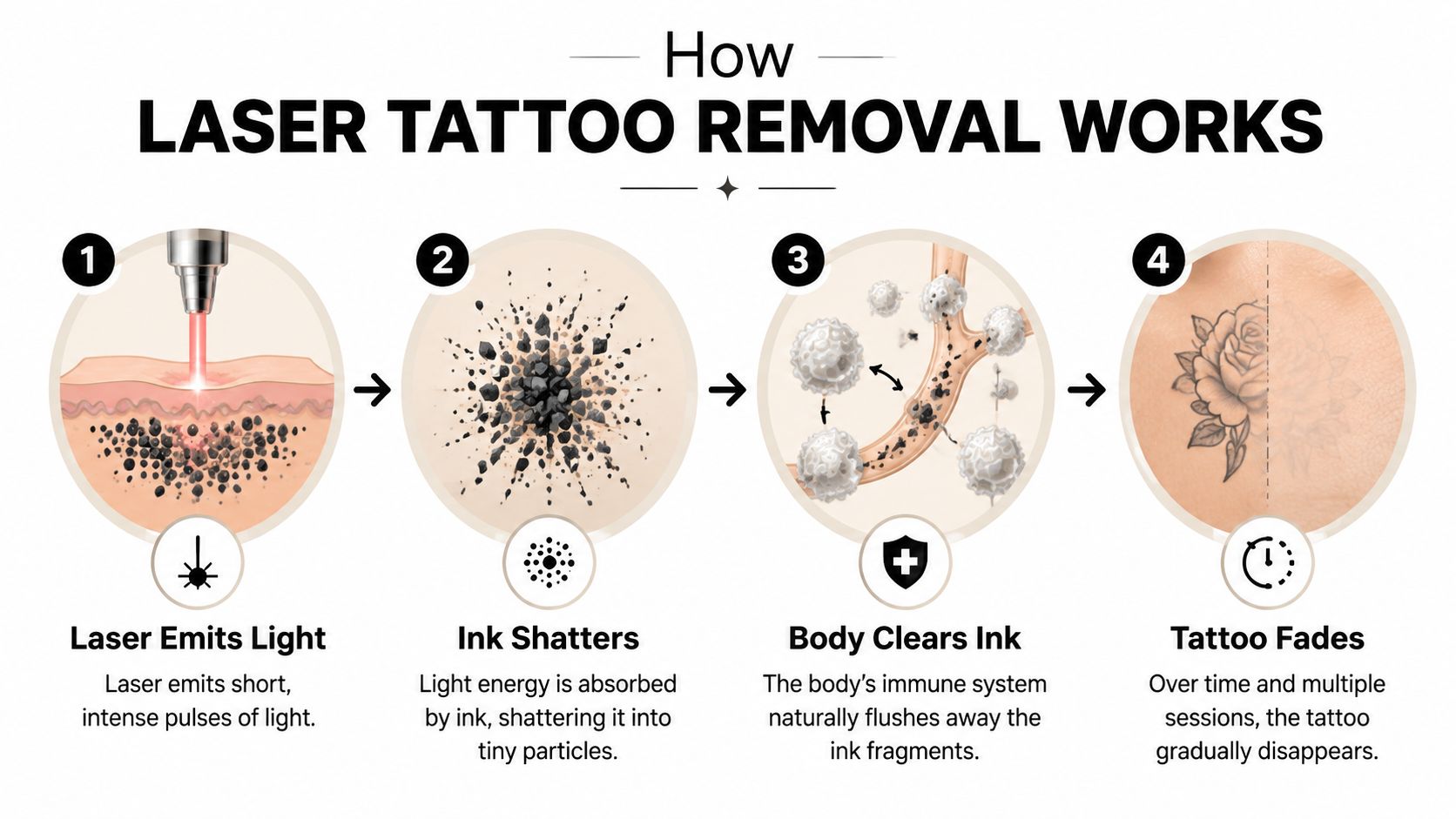
Laser tattoo removal sounds technical, but the basic idea is simple. The laser sends very short bursts of light into the skin. The tattoo pigment absorbs that light far more readily than the surrounding skin does. That energy breaks the ink into smaller fragments, and then your body clears those fragments away over time.
The laser targets ink, not the whole skin surface
A useful way to picture it is to think of the tattoo ink as a cluster of stones under the skin. The laser's job is to strike those stones hard enough to crack them into much smaller pieces. It isn't peeling the tattoo off the surface. It's breaking pigment apart underneath the skin while trying to protect the surrounding tissue.
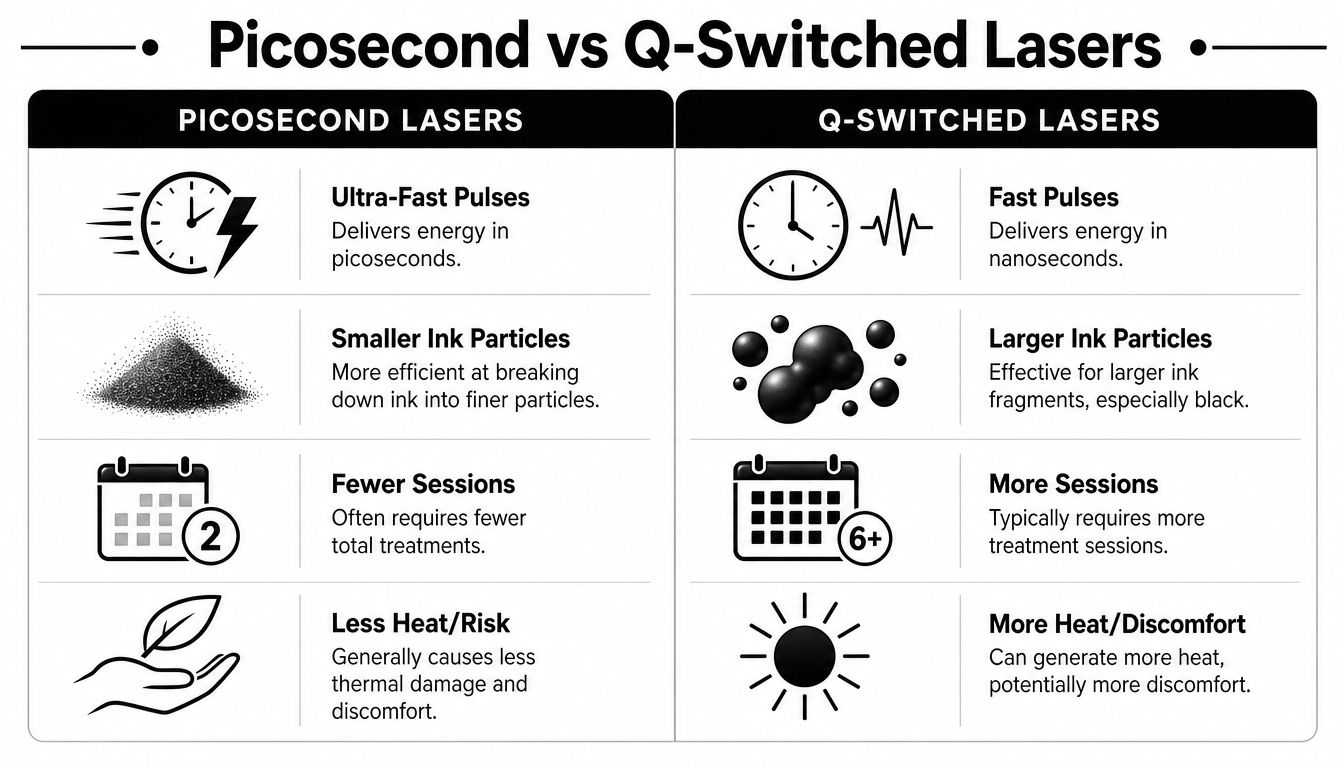
Two terms often come up here. Q-switched lasers deliver energy in nanoseconds. Picosecond lasers deliver energy in picoseconds, which is a shorter pulse duration. In plain English, that means both are very fast, but picosecond systems fire even faster. That shorter pulse can help create a stronger photoacoustic effect, meaning the ink is disrupted with less reliance on heat.
That distinction matters, but it's often oversimplified. Faster pulse duration doesn't automatically mean better outcomes in every real clinic setting. The tattoo's colours, depth, and your skin type still shape the result.
A short visual explainer can make the sequence easier to follow.
Why fading happens gradually
The laser does the breaking. Your body does the clearing.
After treatment, your immune system begins carrying away the fragmented ink particles. That's one reason removal takes time and why multiple sessions are needed. Even if the laser has done its job well, your body still needs a healing period to process what's been disrupted.
The session starts the work. The weeks afterwards are when your body finishes that stage of it.
This is also why aftercare and spacing matter so much. Rushing sessions doesn't give the skin enough recovery time, and it doesn't speed up the biological clearance in the way clients often hope.
A few practical points help make sense of what you see after a treatment:
- Immediate whitening: Some tattoos briefly look frosted or pale straight after the laser pulse.
- Short-term skin reaction: Redness, swelling, and local sensitivity can happen as the area settles.
- Delayed fading: The tattoo usually lightens gradually over the following weeks rather than disappearing in a dramatic instant.
That gradual pattern is normal. It's also why a proper consultation matters more than dramatic before-and-after claims.
The Great Debate Picosecond vs Q-Switched Lasers
The debate matters because many clinics present it as settled. It isn't. Picosecond technology can be excellent, but the claim that pico is always the best tattoo removal laser doesn't hold up well when you look at real treatment trade-offs in the UK.
Quick comparison table
| Feature | Picosecond lasers | Q-switched lasers |
|---|---|---|
| Pulse duration | Picoseconds | Nanoseconds |
| Main appeal | Very short pulses aimed at breaking ink into finer particles | Established tattoo removal technology used widely in practice |
| Cost position | Often higher cost per session | Often more affordable |
| Best use case | Can be useful for some stubborn or multicoloured tattoos | Strong all-round option, especially when matched well to ink and skin type |
| Marketing reality | Often promoted as the premium choice | Sometimes unfairly framed as outdated |
| Clinical reality | Can be effective, but not automatically superior in every case | Often comparable for common tattoo colours when used well |
Where picosecond lasers can help
Picosecond systems have attracted attention for good reason. Clinical data reviewed in this paper on laser tattoo removal outcomes found that 9 out of 12 patients with darkly pigmented tattoos achieved over 75% clearance after only 2 to 4 treatments using a 755 nm picosecond alexandrite laser, and 75% clearance of blue or green tattoos was obtained after just 1 or 2 sessions in a separate study. The same review also notes that, in the UK, the average number of sessions for significant fading or complete removal is between 7 and 10 treatments.
That tells you two useful things. First, picosecond technology can perform very well in selected cases. Second, clients still need realistic expectations because even strong results in studies don't mean every tattoo vanishes quickly.
Why Q-switched lasers still matter
The strongest argument for Q-switched treatment is that it remains highly effective when chosen properly and used by someone who understands wavelengths, settings, and skin safety. It's also the point where marketing often drifts furthest from reality.
Dr. Samantha Hills of Lynton Lasers states there is “limited evidence to conclusively prove” that picosecond lasers offer faster or more effective clearance than a top-end Active Q-Switch laser, and adds that many people find a good Q-Switch “comparable” and “much more affordable”. The same UK discussion notes that clearance rates for common tattoo colours are often comparable, despite pico systems costing 3–4× more per session. You can read that comparison in Lynton's discussion of PicoSure versus Q-Switch tattoo removal.
That's the part many clients don't hear clearly enough. A more expensive device isn't automatically the better value.
For a closer look at this decision from a treatment perspective, this guide on pico laser vs Q-switched options is a useful starting point.
If your tattoo is mostly dark ink, your skin needs a conservative approach, or your budget matters, a good Q-switched treatment plan may be the smarter choice.
So which is better? Sometimes pico. Sometimes Q-switched. The better question is whether the practitioner can explain why that specific device and wavelength fit your tattoo.
Matching the Laser to Your Tattoo and Skin Colour
The machine category matters, but wavelength is what often decides whether a treatment is efficient and safe. That's because different ink colours absorb different wavelengths of light more effectively.
For patient safety in UK practice, the evidence-based benchmark for darker skin types is very clear. The QS Nd:YAG 1064-nm laser is the workhorse for Fitzpatrick 4 to 6 because its longer wavelength is less competitively absorbed by melanin, which helps reduce pigmentary change and epidermal injury risk. The same clinical review also notes that this wavelength is the preferred choice for blue-black tattoos across skin types, while red pigments require 532 nm and green tattoos respond best to 694-nm ruby or 755-nm alexandrite wavelengths. That guidance is set out in this review of laser tattoo removal and skin-type safety.
Laser wavelength guide for ink colours and skin types
| Laser Wavelength | Best For Ink Colours | Best For Skin Types (Fitzpatrick Scale) |
|---|---|---|
| 1064 nm QS Nd:YAG | Blue-black and dark inks | All skin types, especially 4–6 |
| 532 nm | Red inks | Requires careful practitioner judgement depending on skin type |
| 694 nm ruby | Green inks | Selected cases based on skin and tattoo assessment |
| 755 nm alexandrite | Green and some blue tones | Selected cases based on skin and tattoo assessment |
That's why a colour tattoo often needs a more specific plan than a simple black design. One wavelength won't treat every pigment equally well. A clinic that talks only about the machine name and never about wavelength is leaving out one of the most important parts of treatment planning.
For readers dealing with mixed pigments, this page on coloured tattoo removal approaches is relevant because it focuses on the challenge that multicoloured tattoos create.
Why skin type changes the plan
Darker skin isn't a barrier to treatment, but it does make proper laser selection more important. Melanin can compete for laser energy, and if the wrong wavelength or settings are used, the risk of unwanted skin reaction rises.
A careful practitioner doesn't just ask, “What colour is the tattoo?” They also ask:
- How much melanin is in the surrounding skin: This affects which wavelength is safest.
- Is there previous scarring or textural change: Existing skin trauma changes how cautiously treatment should proceed.
- Has the tattoo been reworked or layered: Cover-up work often behaves differently to a single-pass professional tattoo.
The best tattoo removal laser is the one that suits both the ink and the skin carrying it.
This is also where experience matters more than hype. An advanced laser in poor hands can produce poor decisions. A well-chosen wavelength in experienced hands is what tends to produce steady, safe fading.
Your Treatment Journey Explained From Start to Finish
You come in hoping the tattoo will look dramatically lighter after one appointment. What usually happens is more measured than that. The session itself is short, but progress happens over a series of treatments and in the healing time between them.
A proper plan starts with assessment. The practitioner looks at the tattoo's age, ink density, colours, layering, body area, and how your skin has healed from previous injuries or treatments. They should also ask what outcome you want. Full removal, enough fading for a cover-up, or lightening one stubborn section can each call for a slightly different approach.
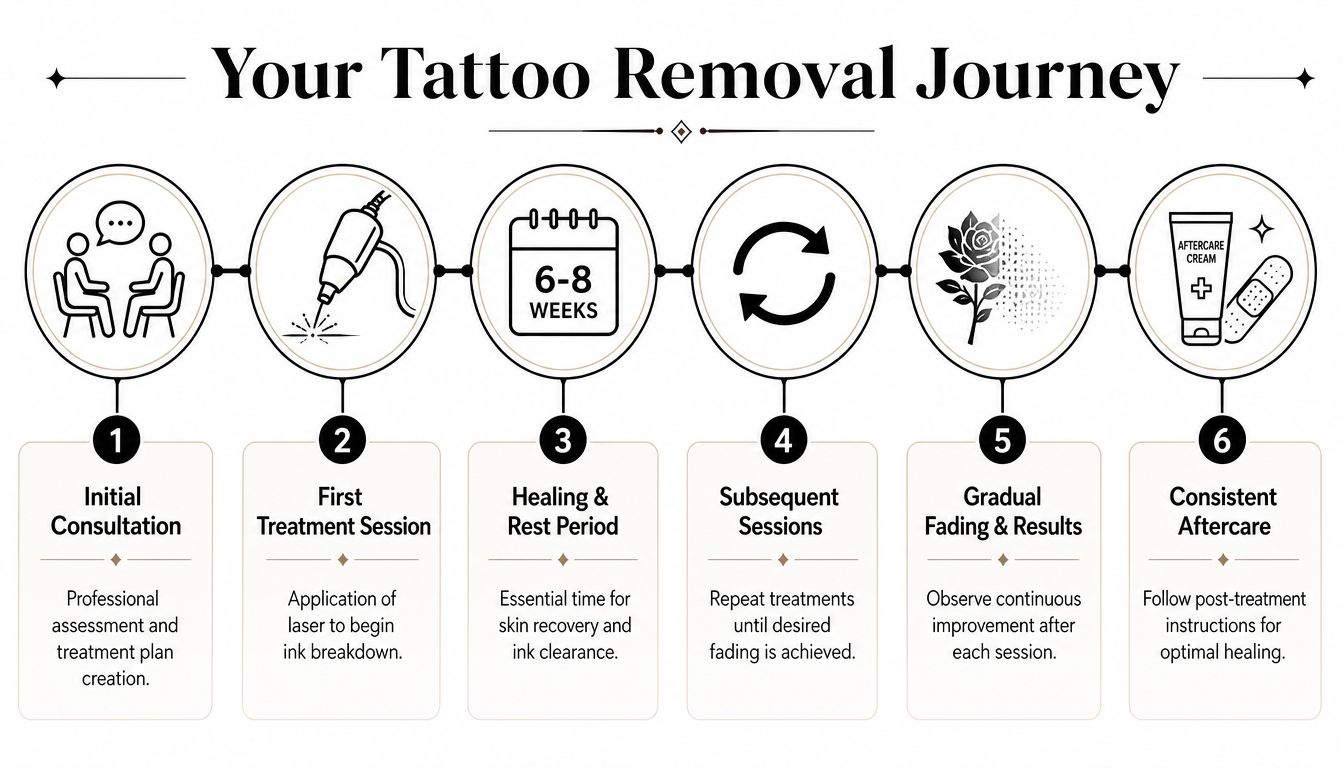
The treatment appointment is often quicker than clients expect. The consultation and consent process usually take longer than the laser work itself, especially for small tattoos. Speed should never be confused with simplicity, though. The important part is not how fast the pulses are delivered, but whether the settings are appropriate for the ink, the skin type, and the stage of fading.
Most tattoos need a course of treatments rather than a single fix. In practice, I advise clients to expect a gradual process, with review points along the way, because ink response is rarely perfectly predictable. This is one reason I am cautious with claims that one machine, especially a picosecond platform, will always clear a tattoo faster. Sometimes it does. Sometimes a Q-switched laser remains a sensible and cost-effective choice for the tattoo in front of you.
Healing time matters as much as treatment time.
After a session, it is normal to see whitening, redness, swelling, tenderness, and, in some cases, small blisters or pinpoint crusting. Those reactions do not automatically mean something has gone wrong. They usually mean the skin has responded to the laser and now needs calm, sensible aftercare. Keeping the area clean, dry, protected from friction, and out of the sun gives the skin the best chance to recover well.
The fading itself develops between sessions. Your body needs time to clear fragmented pigment, and that biological clearance cannot be rushed by booking treatments too close together. Aggressive scheduling often adds irritation without adding better clearance.
A sensible journey usually follows this pattern:
- Consultation and patch test if appropriate. This helps identify how your skin is likely to respond before a full treatment.
- First session with measured settings. Caution is often the right choice, especially for darker skin, cover-up tattoos, and areas with previous scarring.
- Healing and aftercare. The skin settles first. Fading continues after the visible reaction has calmed down.
- Review of response. The next settings should be based on how the tattoo behaved, not on a fixed protocol.
- Adjustment over time. Wavelength, fluence, spot size, and intervals may need to change as the tattoo lightens.
That step-by-step method usually gives better long-term clearance than chasing an aggressive result early on.
Cost also needs honest discussion. Picosecond treatment can be useful, but it is not automatically the better buy if a Q-switched laser is likely to do the job well on your ink and skin type. A clinic should explain why a certain platform is being recommended, what trade-offs come with that choice, and how many sessions may still be needed. If you are comparing local options, this overview of laser tattoo removal in Leamington Spa shows what a treatment pathway should look like in practical terms.
Good communication behind the scenes also affects the client experience. Clinics that use tools such as med spa call handling solutions can usually manage enquiries, bookings, and follow-up more consistently, which makes the overall process smoother for the client.
The best treatment journey is steady, informed, and realistic. Clients tend to do well when they understand that progress comes from accurate assessment, the right laser choice for their tattoo, and enough healing time between sessions.
Choosing Your Clinic A Safety and Quality Checklist
A client can sit in front of two tattoo removal lasers and have very different outcomes depending on who is setting the treatment plan. Machine type matters, but judgment matters just as much. I would always rather see a well-trained practitioner using the right settings cautiously than someone relying on a fashionable device name and a generic protocol.
In the UK, ask directly about training, insurance, and local compliance. Reputable practitioners should be able to explain their laser qualifications clearly, including recognised training routes for core laser and light treatments such as VTCT qualifications, and they should not be vague about who carries out your treatment. The Health and Safety Executive guidance on lasers at work also gives useful context on why formal controls, eyewear, and safe operating procedures matter in any laser setting.
Questions worth asking before you book
Use the consultation to assess the clinic's standards, not only your tattoo.
- What laser systems and wavelengths do you use? A good clinic explains why one wavelength suits black ink and another may be needed for colour, instead of saying one platform is best for everyone.
- How do you decide between Q-switched and picosecond treatment? The answer should include tattoo age, ink colour, skin type, and cost. In practice, "pico is always better" is too simplistic.
- How do you treat darker skin tones safely? Look for a careful explanation about pigment risk, conservative settings, and patch testing where appropriate.
- Who performs the treatment, and what training do they hold? The person doing the consultation should be clear about practitioner experience, not hide behind the clinic brand.
- What result are you expecting for this tattoo? Good clinics talk in terms of fading, likely session ranges, and limits. They do not promise complete clearance without seeing how your skin and ink respond.
What a well-run clinic looks like
Strong clinics are organised before the first pulse is fired. Consent forms are clear. Aftercare is written down. Contraindications are checked properly. Pricing is explained in a way that helps you compare value, not just headline session cost.
Communication is part of safety too.
If a clinic is slow to answer basic questions, vague about healing advice, or inconsistent about who will treat you, that usually shows up later in the process as well. For practices improving how they manage enquiries and follow-up, tools such as med spa call handling solutions can support a smoother client journey and reduce missed calls or mixed messages.
It also helps to review how a clinic describes its treatment pathway in public. A detailed laser tattoo removal service in Leamington Spa should explain consultation, patch testing or assessment, likely session spacing, aftercare, and realistic expectations in plain language.
A trustworthy clinic gives balanced advice. That means explaining when a Q-switched system may be perfectly appropriate, when picosecond treatment may offer an advantage, and when your skin type or ink mix makes caution more important than speed.
Why Choose 3D Aesthetics Leamington Spa for Your Journey
A client usually reaches this stage with two practical questions. How long is this likely to take, and will the clinic give honest advice if the answer is longer or more expensive than expected.
That is the standard I would use for any provider, and it is the standard 3D Aesthetics Leamington Spa appears to meet. The clinic presents tattoo removal as a course of treatment rather than a quick fix. That matters because fading depends on ink density, colour mix, depth, immune response, and skin type. Session spacing also needs to respect healing, not just convenience. Guidance from the NHS on tattoo removal reflects the same cautious approach, with repeated treatments and realistic expectations forming part of safe care.
The clinic's use of Q-switched technology through the 3D-NanoSure system also fits the balanced view clients need. Picosecond machines can be useful in the right case, but they are not automatically the best choice for every tattoo. In practice, outcomes improve when the practitioner matches the laser to the ink, the tattoo age, and the client's skin rather than selling speed as the main benefit.
That UK-centred, case-by-case approach is what clients should look for.
3D Aesthetics Leamington Spa highlights consultation, personalised planning, and laser-based removal without promising the same result for everyone. That is reassuring. A good clinic should be willing to explain where progress may be steady rather than fast, where partial clearance is more realistic than complete removal, and why some colours or cover-up tattoos can need more patience.
If you're ready to discuss your options with 3D Aesthetics Leamington Spa, book a consultation and get a treatment plan based on your tattoo colours, skin type, and realistic goals, not just the latest laser marketing.