

Body contouring is a group of treatments that reshape and refine the body's silhouette, not a method for losing body weight. In non-surgical practice, it targets small, localised pockets of fat and skin laxity, and with cryolipolysis, a commonly cited benchmark is up to 20% reduction of subcutaneous fat in a treated area per session, with changes often starting around 6 weeks and peaking at about 12 weeks.
If you're reading this, there's a good chance you're already doing many of the right things. You eat reasonably well, you move your body, and yet a lower tummy pouch, soft inner thighs, upper arms, or a double chin still seem to ignore your efforts. That's usually where the confusion starts. People ask whether body contouring is weight loss, whether it's the same as liposuction, or whether one machine can somehow “melt” everything away.
The honest answer is simpler and more useful. Body contouring is a collection of aesthetic procedures designed to sculpt, shape, and tone the body's outline. Some treatments reduce stubborn fat. Some tighten skin. Some improve cellulite texture. Some work best in combination. The key is not picking a trendy treatment name first. It's having a proper consultation, ideally with objective measurements such as a 3D body scan, so the plan fits your body rather than a generic package.
Table of Contents
- What Is Body Contouring and Who Is It For
- Surgical vs Non-Surgical Options A Clear Comparison
- Your Guide to Leading Non-Surgical Treatments
- Which Body Contouring Treatment Is Right for You
- Your Consultation The First Step to a Personalised Plan
- How to Choose a Body Contouring Clinic in Leamington Spa
- Answering Your Body Contouring Questions
What Is Body Contouring and Who Is It For
People often start looking into body contouring after the same frustrating experience. Their weight may be fairly stable, but one area still doesn't match the rest of them. That could be the lower abdomen after pregnancy, the bra-line area, inner thighs, arms, or skin that feels looser after weight loss.
What is body contouring? It's an umbrella term for treatments that improve shape and proportion in specific areas of the body. It is not designed to treat obesity, and it isn't a replacement for nutrition, movement, or medical weight management.
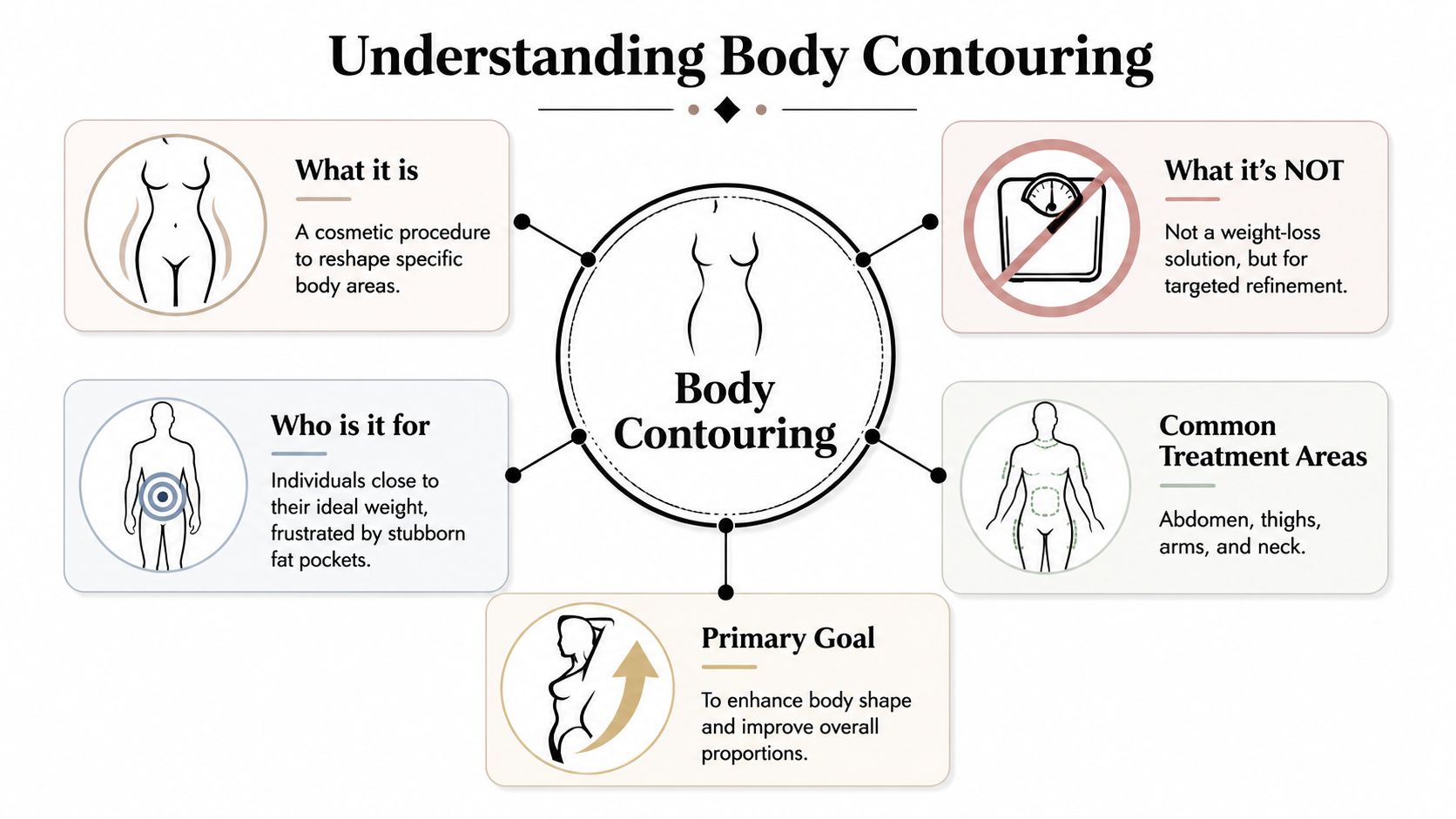
In UK practice, body contouring often falls into two broad groups:
- Surgical contouring such as liposuction, tummy tucks, arm lifts, or thigh lifts.
- Non-surgical contouring such as cryolipolysis, ultrasound, radio frequency, and HIFU, which aim to reduce localised fat or tighten skin without surgery.
A good candidate is usually someone who wants refinement rather than dramatic weight reduction. They may be close to their preferred size but still have pinchable fat, mild to moderate skin laxity, or cellulite concerns. If you're unsure where you sit, tools like RepStack's body fat tool can help you understand body composition at a basic level before you even book a consultation.
One reason this category matters in the UK is that it isn't just a beauty trend. In England, 64.0% of adults were classified as overweight or living with obesity in 2022, including 25.9% with obesity, and body contouring is increasingly recognised after major weight change, especially where redundant skin affects comfort and confidence, as outlined in this UK body contouring statistics overview.
Practical rule: If your main goal is to lose a significant amount of weight, body contouring probably isn't the first step. If your main goal is to improve the shape of one or two stubborn areas, it may be.
Typical reasons people consider it
- Diet-resistant areas: The stomach, flanks, thighs, and upper arms often hold on to fat differently from the rest of the body.
- Post-weight-loss changes: Some clients are less bothered by fat than by loose, crepey, or folded skin.
- Shape rather than size: Many people want clothing to sit better, waistlines to look cleaner, or a smoother profile in fitted outfits.
Surgical vs Non-Surgical Options A Clear Comparison
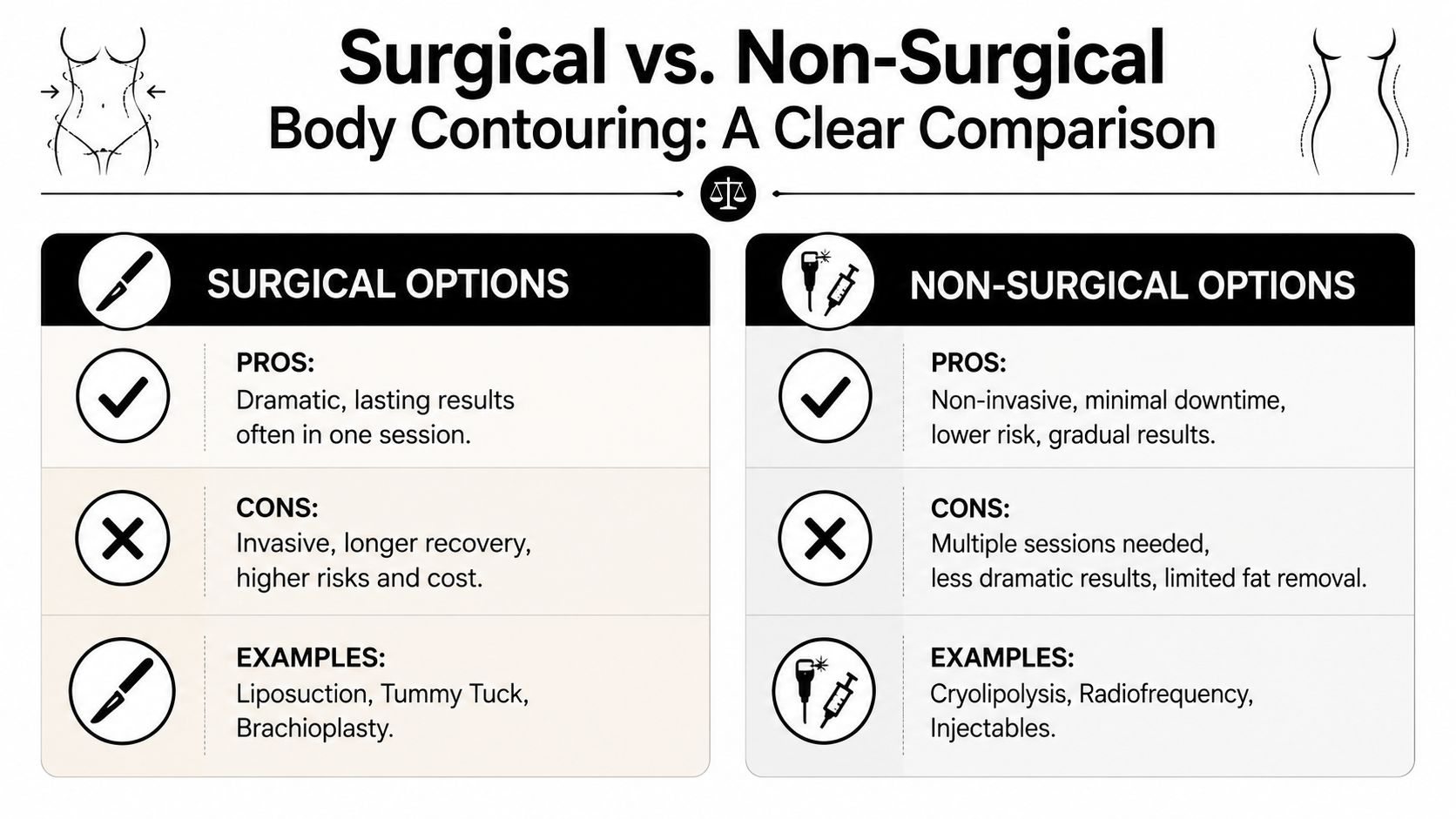
There are two very different routes under the body contouring umbrella. One involves surgery, incisions, and a longer recovery. The other uses external applicators or energy-based devices with much less disruption to daily life. Neither is “better” in every case. They solve different problems.
The UK market has clearly moved towards lower-downtime options alongside traditional surgery. The British Association of Aesthetic Plastic Surgeons recorded 33,596 cosmetic procedures in 2022, including 441 abdominoplasties and 310 liposuction procedures, while non-surgical methods such as cryolipolysis and HIFU have grown sharply in discussion and demand, as described in this UK trend review on liposuction and body contouring.
What surgery does better
Surgical procedures such as liposuction and abdominoplasty are usually chosen when someone wants a more dramatic change, has a larger volume concern, or has excess skin that machines can't meaningfully address. Surgery can remove tissue directly. That's the major difference.
The trade-off is obvious. Surgery usually brings anaesthetic considerations, dressings, a more involved recovery, and a higher overall commitment in both time and cost.
What non-surgical treatment does better
Non-surgical contouring fits people who want something more gradual and less invasive. You attend an appointment, have the area treated, and return to normal life far more quickly than you would after an operation. The result is usually subtler, but for the right client that's exactly the appeal.
This short overview gives a useful visual explanation of how the two pathways differ:
| Approach | Typical use | Main advantage | Main limitation |
|---|---|---|---|
| Surgical | Larger fat reduction, major skin excess, post-weight-loss reshaping | More dramatic change | More downtime and greater invasiveness |
| Non-surgical | Small fat pockets, mild skin laxity, gradual shaping | Minimal downtime | Less dramatic and often needs a course of treatment |
The right comparison isn't “Which one works?” It's “Which one matches the amount of change you want, the downtime you can manage, and the type of tissue you actually need to treat?”
A simple way to choose your starting path
- Choose a surgical consultation first if loose skin hangs significantly, daily comfort is affected, or you want one larger change rather than a gradual course.
- Choose a non-surgical consultation first if you have pinchable fat, mild laxity, or cellulite, and you want to avoid incisions.
- Keep your expectations matched to the method. Non-surgical contouring can refine a silhouette. It won't reproduce a tummy tuck.
Your Guide to Leading Non-Surgical Treatments
When clients hear “body contouring”, they often assume every machine does the same thing. It doesn't. Some technologies focus on fat cells. Others stimulate tightening. Others are used to improve the look of cellulite or support a smoother finish.
The easiest way to understand them is by asking one question: What is this treatment trying to change? Fat volume, skin firmness, surface texture, or muscle tone all need different tools.
Cryolipolysis fat freezing
Cryolipolysis uses controlled cooling to target subcutaneous fat. In simple terms, the applicator draws fatty tissue into a cup, cools it in a measured way, and the body gradually clears the affected fat cells afterwards.
The technical benchmark often quoted in training literature is up to 20% reduction of subcutaneous fat per treatment area, with results typically appearing from around 6 weeks and peaking near 12 weeks, as explained in this cryolipolysis treatment overview.
This is most suitable for:
- Pinchable pockets of fat: Lower tummy, flanks, inner thighs, banana roll, or under the chin in appropriate cases.
- Clients with patience: The change is gradual. You won't leave looking instantly smaller.
- People near a stable weight: It's a sculpting treatment, not a reset button.
Ultrasound cavitation
Ultrasound cavitation is commonly used for inch loss and localised fat softening. It uses sound energy to work on superficial fat in targeted areas. Clients often choose it when they want a non-surgical option that feels more like a treatment course than a one-off intervention.
It's usually discussed for:
- Softer areas of localised fat
- People who want gradual shaping
- Combination plans, especially where overall smoothing matters as much as volume reduction
Some clients exploring skin quality alongside body treatments also like reading around broader skin-support habits, including ingredients used in home care. If that interests you, this guide to anti-aging peptides for skin gives a useful overview of topical peptide categories.
Body HIFU
HIFU stands for high-intensity focused ultrasound. On the body, it's typically used where a therapist wants more than simple fat reduction. It can be useful when there's a need to address contour and tissue firmness together.
Think of it as a treatment for areas where the question isn't only “Can we reduce this?” but also “Can we improve how this area sits?” That often matters around the abdomen, flanks, or above the knees.
Radio frequency
Radio frequency uses heat to work within the tissue and is commonly chosen for skin tightening and support where the skin feels looser or less springy. If someone is slim but feels their skin has become softer after pregnancy, ageing, or weight fluctuation, RF often makes more sense than a fat-focused treatment alone.
The sensation is usually described as warm rather than cold or intense. It's often used for:
- Mild skin laxity
- Finishing work after fat reduction
- Areas where texture matters as much as size
Sometimes the “fat problem” is partly a skin problem. Treating only the volume and ignoring skin quality can leave the area looking under-corrected.
3D Powersculpt
3D Powersculpt is generally chosen when the goal includes a firmer, more athletic-looking result rather than fat reduction alone. It's often discussed for clients who say, “I don't want to be smaller everywhere. I want better shape and definition.”
At 3D Aesthetics Leamington Spa's fat reduction treatment page, you can see how body contouring plans may combine several technologies rather than relying on one device to do every job.
3D Shockwave
Shockwave is often added when cellulite texture and circulation support are part of the picture. It's not the same thing as reducing a pocket of fat. Instead, it's more about improving the look and feel of the skin's surface and helping a contouring plan appear smoother overall.
This makes it useful for:
- Thighs and buttocks
- Areas with visible dimpling
- Combination protocols, especially after or alongside volume-focused treatment
Why combinations often work better than single treatments
A lower abdomen can have three separate issues at the same time: a layer of pinchable fat, reduced skin elasticity, and a slight uneven texture. One machine rarely addresses all three equally well.
That's why personalised planning matters. A therapist may recommend:
- A fat-focused treatment for volume.
- A tightening treatment for laxity.
- A texture-focused treatment for cellulite or surface finish.
Which Body Contouring Treatment Is Right for You
A quick comparison can make this much easier to digest. If you already know what bothers you most, you can usually narrow the field quite fast. The final decision still needs a proper assessment, but this gives you a more practical starting point.
If you're mainly researching fat-freezing specifically, this overview of fat freezing treatment options is a useful next step.
Non-Surgical Body Contouring Treatment Comparison
| Treatment | Best For | How It Works | Downtime | Results Timeline |
|---|---|---|---|---|
| Cryolipolysis | Pinchable fat pockets | Controlled cooling targets localised subcutaneous fat | Minimal | Gradual. Often starts around 6 weeks and peaks around 12 weeks |
| Ultrasound Cavitation | Soft, localised fatty areas | Ultrasound energy is used to target fat in selected areas | Minimal | Gradual over a treatment course |
| Body HIFU | Localised fat with some laxity concerns | Focused ultrasound energy is used deeper in tissue | Minimal | Progressive over time |
| Radio Frequency | Mild skin laxity and tissue firmness | Heat-based treatment supports tightening | Minimal | Gradual over a treatment course |
| 3D Powersculpt | Shape, tone, and more defined contours | Used where contour and body definition are the focus | Minimal | Progressive with repeated sessions |
| 3D Shockwave | Cellulite texture and smoothing | Mechanical energy supports surface texture improvement | Minimal | Gradual over a treatment course |
Match the treatment to the concern
- If you can pinch it: Cryolipolysis or cavitation may be more relevant.
- If the area looks loose rather than full: RF or body HIFU may be the better match.
- If the surface looks uneven: Shockwave may be the missing piece.
- If you want shape and tone: Powersculpt may be part of the conversation.
A treatment can be good in general and still be wrong for you. The target matters more than the trend.
Your Consultation The First Step to a Personalised Plan
The most valuable part of body contouring isn't the machine. It's the decision process before the machine is ever switched on.

A proper consultation should feel calm, detailed, and specific to you. You should leave understanding not only what's possible, but also what isn't. That honesty is what protects clients from wasting time and money on the wrong protocol.
What happens in a proper consultation
First, the therapist listens. Not in a rushed way, but properly. They need to know what area bothers you, how long it's bothered you, whether your weight has been stable, whether the issue is fat, laxity, texture, or a combination, and what kind of downtime you can realistically manage.
Then comes assessment. Good providers don't just look at the area front-on for ten seconds and start selling a package. They assess the tissue with movement, posture, pinch thickness, skin quality, and symmetry in mind.
Authoritative guidance also supports this careful matching process. The FDA classifies non-invasive body contouring technologies by energy source, including cryolipolysis, radiofrequency, laser, and ultrasound, and notes that these devices are designed to change the silhouette of small, localised fat pockets or circumference, not treat obesity, which is why treatment choice should follow a proper non-invasive body contouring consultation framework.
Why a 3D body scan changes the plan
A 3D body scan adds objectivity. That matters more than many people realise. When someone looks at themselves every day, small changes are hard to judge fairly. Lighting changes. Clothing changes. Mood changes. The mirror isn't a measurement tool.
A 3D scan helps by showing body shape and circumference in a more structured way. It gives a baseline, which means your treatment plan isn't built on guesswork. It also helps identify where your eye may be focusing on one concern while the scan shows the actual issue is slightly different. For example, a client may think their waist is the problem when the bigger visual contributor is tissue fullness at the flanks.
The scan also supports combination planning. If the measurements and visual mapping suggest that one area has more volume and another has more laxity, the therapist can build a sequence rather than applying the same treatment everywhere.
A thoughtful consultation should answer these questions clearly:
- What are we treating: Fat, skin laxity, cellulite, or a mix?
- Why this device: What does it do that another option doesn't?
- How will we measure change: Photos, tape measures, and ideally 3D body scan data.
- What is realistic: Improvement, not fantasy.
How to Choose a Body Contouring Clinic in Leamington Spa
Choosing a clinic is partly about technology, but mostly about standards. Two places can both offer “fat freezing” and deliver a very different experience because the consultation, assessment, safety checks, and treatment planning aren't equal.
What to look for
- Qualified therapists: Ask who performs the treatment and what specific training they've had with the device.
- Clear consultation process: You want a clinic that assesses properly before recommending a package.
- Treatment range: A clinic with several contouring tools can match the method to the concern rather than forcing every client into one machine.
- Transparent pricing: You should understand what is included, whether follow-up reviews are part of the plan, and whether there are extra charges.
- Realistic language: Be wary of clinics that promise weight loss or instant transformation.
What often separates a stronger provider
A better clinic usually gives you a reason for each recommendation. It can explain why cryolipolysis would suit one area but RF would suit another. It can also tell you when a concern is unlikely to respond well to non-surgical treatment.
If you want to understand how one clinic presents its background, treatment philosophy, and service range, this page about the Leamington Spa clinic team and treatment approach is worth reviewing before you book.
Ask the clinic how they decide between fat reduction, tightening, and cellulite work. If the answer is vague, the plan probably will be too.
Answering Your Body Contouring Questions
How much does body contouring cost
Costs vary because body contouring isn't one treatment. The price depends on the area, the technology, how many sessions are advised, and whether you need one modality or a combined plan. A good clinic should explain the reasoning behind the quote rather than giving a one-size-fits-all figure.
Are results permanent
Expectation-setting matters. Some treatments target fat cells in a lasting way, but your body and lifestyle still matter. If overall body composition changes significantly later, the area can change too. Skin quality also continues to age over time, so tightening results are better viewed as long-term improvement rather than a permanent freeze-frame.
Does body contouring work for man boobs
Sometimes yes, sometimes no. It depends on what the fullness is.
A 2025 report from the UK Royal College of Surgeons indicated that 55% of UK men seeking non-surgical fat reduction for this area had a glandular tissue component, meaning true gynecomastia rather than simple fatty fullness. In those cases, fat freezing is ineffective. That's why diagnosis comes before treatment choice.
How many sessions will I need
There isn't one honest answer for everyone. Some areas suit a single fat-focused treatment followed by review. Others respond better to a course, especially when skin tightening or cellulite improvement is involved. The number of sessions depends on your starting point, your tissue quality, and how much change you want.
A sensible plan should include:
- An initial assessment
- A defined review point
- Progress measurements
- Adjustment if needed, rather than blindly repeating sessions
The best body contouring plans are tailored, measured, and revised if your response shows you need a different approach.
If you'd like clear advice on what's suitable for your body, 3D Aesthetics Leamington Spa offers consultations with a full 3D body scan, so your treatment plan can be based on your actual shape, tissue type, and goals rather than guesswork.
← Back to Home