
You've probably already done the mirror test. Front-facing in normal light, your chin looks fine. Then a side photo appears, or you catch your profile on a video call, and suddenly the fullness under the chin is all you can see. That's usually the moment people start searching for a non-surgical fix that feels effective but not drastic.
Cryolipolysis for a double chin sits in that middle ground. It isn't surgery, it doesn't rely on willpower alone, and it can be a good option when the problem is a defined pocket of under-chin fat rather than general weight gain or very loose skin. The key is knowing what it can do, what it can't do, and how a proper consultation separates the right candidates from the disappointed ones.
Table of Contents
- How Cryolipolysis Targets a Double Chin
- Your Double Chin Treatment Journey Session by Session
- Are You a Good Candidate for Double Chin Fat Freezing
- Cryolipolysis vs Other Double Chin Treatments
- Aftercare Risks and Typical Costs
- Your Consultation at 3D Aesthetics Leamington Spa
- Frequently Asked Questions
How Cryolipolysis Targets a Double Chin
A double chin treatment only works well when it matches the tissue that's causing the fullness. Cryolipolysis is designed for fat, not for heavy bands of muscle and not for significant loose skin. Under the chin, that distinction matters.
What the cooling is actually doing
Think of under-chin fat cells as the weak link in cold temperatures. Skin, nerves, and the structures around them can tolerate controlled cooling better than fat cells can. Cryolipolysis uses that difference on purpose. A small applicator draws the tissue into place, cools it in a controlled way, and triggers a natural cell-death process in the targeted fat cells. Your body then gradually clears those damaged cells over time.
That's why results are delayed rather than instant. Nothing is being cut out on the day. The treatment starts a process, and your body does the clearing afterwards.
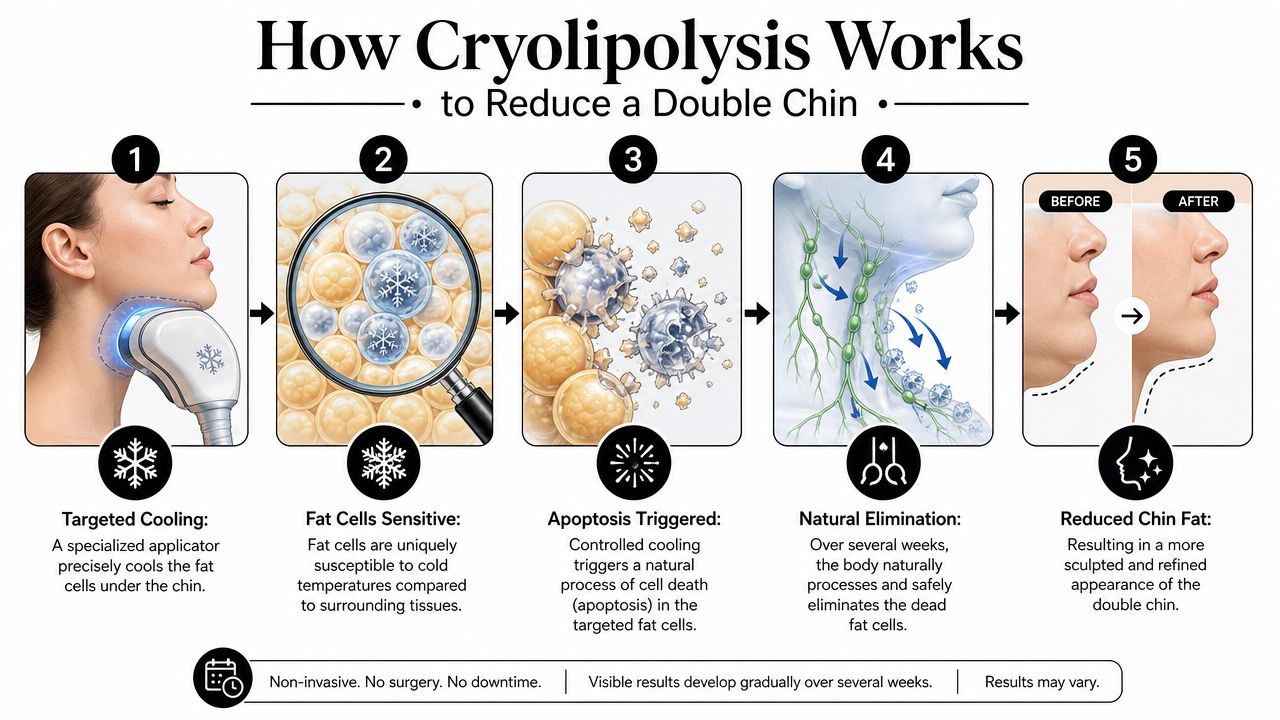
A useful benchmark comes from Harvard Health's review of cryolipolysis effectiveness, which notes that cryolipolysis later gained clearance for double chins, and an analysis of more than 1,000 treated people found fat in the treated area was reduced by about 25% on average.
Practical rule: If you can pinch a soft pocket under the chin, cryolipolysis may be relevant. If the concern is mostly loose skin, the plan usually needs more than fat freezing alone.
For patients comparing options, fat freezing treatments are usually most appealing when they want a non-surgical route and can accept gradual change rather than an immediate dramatic shift.
Why the under-chin area needs a different approach
The chin isn't treated with the same setup used on larger body areas. It needs a smaller applicator that can sit neatly under the jaw and target a compact treatment zone without grabbing more tissue than intended. That sounds like a technical detail, but it changes comfort, fit, and precision.
The other point patients often miss is that jawline contour depends on proportion. A smaller under-chin fat pocket can make a visible difference because the area is so central to the profile. At the same time, small treatment zones leave less room for vague promises. A good practitioner should be able to tell you whether the issue is a treatable fat pad, lax skin, posture, or a mix of all three.
Your Double Chin Treatment Journey Session by Session
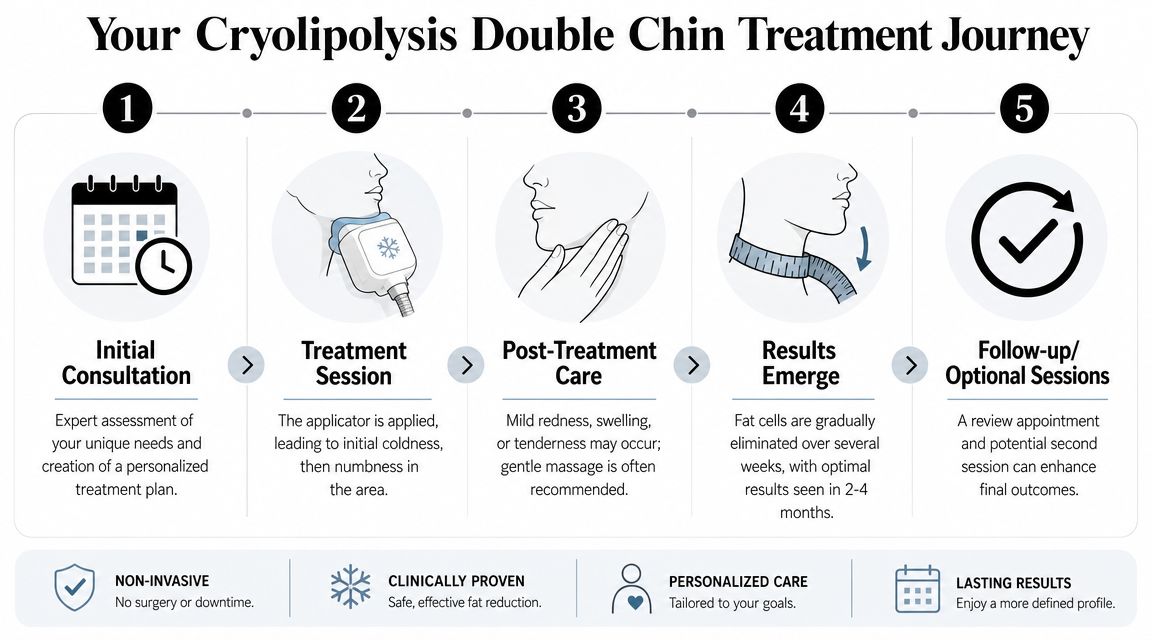
You book the appointment because the fullness under your chin bothers you in photos, then the practical worries start. How cold does it feel. Will you look swollen after. How long before anyone can see a difference. A clear treatment timeline usually settles those doubts better than vague promises.
What treatment day usually feels like
The session starts with assessment and marking. I check the exact area of fullness, confirm how much soft tissue the applicator can safely draw in, and make sure we are treating fat rather than chasing loose skin or an anatomical feature that cooling will not change.
Once the handpiece is in place, the first few minutes are the strangest part. Patients usually describe intense cold, firm suction, and pressure under the chin. That settles as the area goes numb. After that, the treatment is usually very manageable.
A targeted under-chin session often takes around 35 minutes with this style of applicator, and some patients need more than one appointment spaced several weeks apart, as described in this clinician discussion of chin cryolipolysis protocols.
Straight after treatment, the skin can look red or slightly raised. The area may feel cold, firm, tender, numb, or oddly thick to the touch. Those short-term changes are expected because the tissue has been cooled and held under suction.
Later in the process, it helps to see a visual walk-through:
How results usually build over time
This treatment rewards patience. You do not walk out with a new jawline on the same day.
The first week is usually about settling. Swelling, firmness, numbness, tingling, or tenderness can make the area feel temporarily fuller or uneven. That can be unsettling if you were expecting an immediate slimming effect, but it is a normal part of the process.
By the first review stage, many patients notice small changes rather than a dramatic reveal. The under-chin angle may look cleaner in profile, your collar may sit differently, or photos may start to look more balanced from the side. Those are often the first signs that the treated fat is reducing.
Over the following weeks, the result tends to sharpen gradually. This is also the point where the second benefit becomes relevant. As fullness reduces, some patients feel the area looks a little tighter and less heavy, particularly if the skin quality was reasonably good to begin with. An 18-week clinical study supporting clearance for submental skin laxity improvement reported visible laxity improvement in many treated patients, according to the report summarising that study.
What a realistic journey looks like from session one onward
A good consultation should explain the journey in practical terms.
- Session one: treat the defined fat pocket under the chin and set expectations for gradual change
- Early recovery: expect temporary numbness, tenderness, firmness, or mild swelling
- First review: assess whether the contour is improving enough to stop, or whether a second session would add worthwhile refinement
- If a second session is needed: repeat treatment only if there is still a clear treatable fat pad and the skin response supports it
- Final outcome: a lighter under-chin profile, a cleaner transition from jaw to neck, and in some cases a modest improvement in how firm the area looks
That session-by-session approach matters because cryolipolysis sits in the middle ground. It is slower than injectable fat-dissolving options such as Aqualyx in some cases, and less skin-focused than HIFU, but it appeals to patients who want a non-surgical plan with no needles and a gradual, natural-looking change. The right choice depends on whether the main issue is fat, skin laxity, or a mixture of both.
Some patients ask for a sharp jawline. In clinic terms, the more useful goal is usually less heaviness under the chin and better definition where the face meets the neck. That is a realistic result to assess, and it is the point where initial doubt often shifts into confidence.
Are You a Good Candidate for Double Chin Fat Freezing
The strongest candidates are rarely the people asking for the most dramatic result. They're the ones whose concern matches the treatment.
The best candidate has pinchable fat
If I had to reduce suitability down to one phrase, it would be this: soft, pinchable submental fat. That's the tissue cryolipolysis is built to target. When the pocket under the chin is clearly fatty rather than loose, crepey, or structurally heavy, treatment tends to make more sense.
That's also why one session shouldn't be sold as a miracle. An important clinical study of submental cryolipolysis showed a mean 2.0 mm reduction in submental fat thickness, corresponding to an average 20% reduction in the treated fat layer after a single session, as reported in this published clinical study. That's meaningful contour improvement, not total erasure.
When another treatment may suit you better
Some people have very little actual fat under the chin. Instead, they have:
- Skin laxity
- A softer jawline due to anatomy
- Neck posture that pushes tissue forward
- General fullness linked to overall weight changes
In those cases, fat freezing alone may disappoint. If the main issue is loose skin, tightening-focused options may be more suitable. If the area is tiny and fibrous, injectable approaches may be discussed. If someone wants the fastest and most dramatic removal, surgery is usually the benchmark they compare everything else against.
The wrong patient doesn't get a worse version of a good result. The wrong patient often gets the wrong treatment entirely.
You also need a proper medical screen. A responsible clinic will ask about pregnancy, cold-related contraindications, and relevant health history before deciding whether to proceed. This treatment is for contouring a localised pocket. It isn't a substitute for weight loss, and it won't change the rest of the neck if the anatomy points elsewhere.
Cryolipolysis vs Other Double Chin Treatments
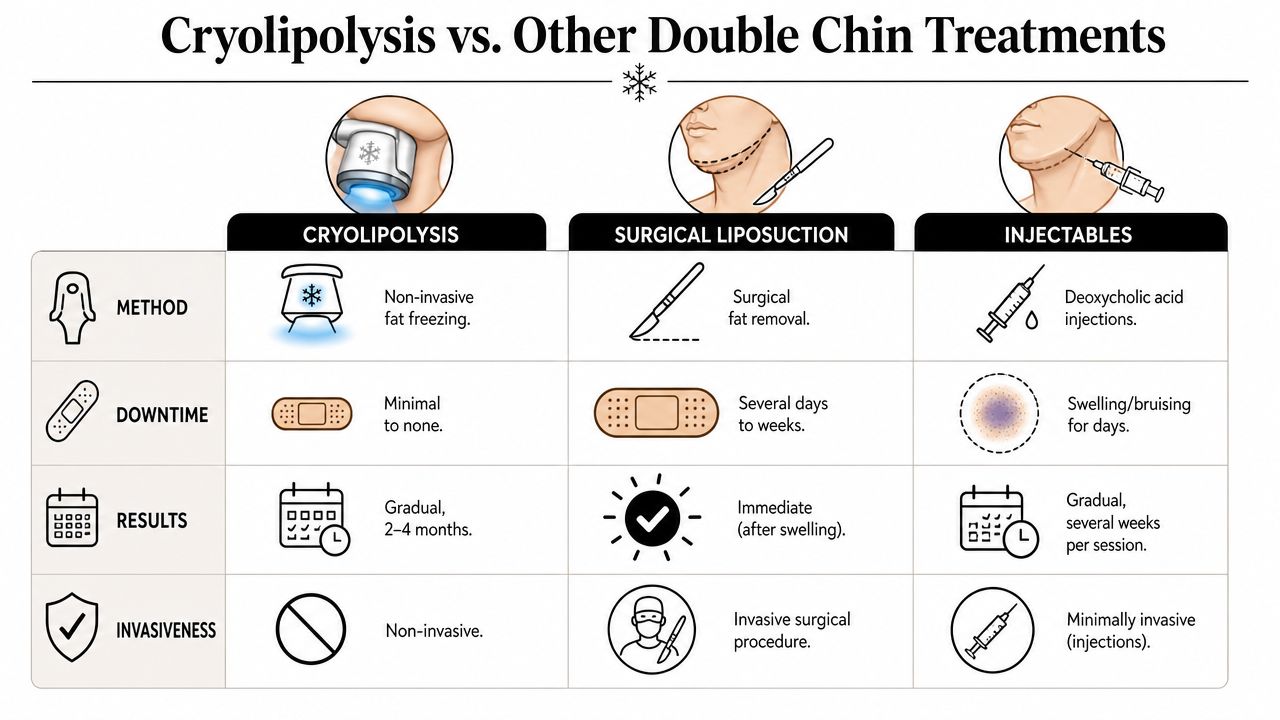
A common consultation starts like this. Someone says, “I hate this fullness under my chin, but I do not want surgery, and I do not want to look obviously treated at work next week.” That is exactly why comparison matters. The right option depends on whether you are trying to reduce fat, tighten skin, avoid needles, or get the biggest change in the shortest time.
Where cryolipolysis sits in the treatment mix
Cryolipolysis is usually the middle ground. It is non-surgical, there are no injections, and downtime is usually light. The trade-off is patience. Results build gradually, so it suits clients who are happy with steady change rather than a dramatic overnight shift.
It also sits in an interesting position for the under-chin area because some clients notice two benefits at once. The main aim is fat reduction, but if the tissue contracts well and the skin quality is reasonable, the area can look a little firmer as the fullness reduces. That does not make it a dedicated skin-tightening treatment, but it is one reason some people feel their profile looks cleaner rather than smaller.
Aqualyx and similar fat-dissolving injectables are different. They can work well for a small, localised pocket, especially if the tissue is awkward for an applicator or needs a more targeted approach. The downside is that swelling can be more obvious, tenderness can last longer than clients expect, and the treatment experience is more invasive because it involves multiple injections.
HIFU belongs in a separate category. I discuss it when the jawline has softened mainly because the skin and supporting tissue need tightening. If there is a clear fat pad under the chin, HIFU on its own may leave a client disappointed because tightening and fat removal are not the same job.
Liposuction remains the benchmark for patients who want the biggest one-step reduction and accept surgery, recovery, and the risks that come with an operation. It is more direct. It is also a bigger decision.
For a broader look at fat reduction treatments for localised pockets of stubborn fat, I compare the goal first, then the practical realities: how the treatment feels, how visible the recovery is, and whether fat or skin is really driving the concern.
A simple decision guide
| Priority | Cryolipolysis | Injectables such as Aqualyx | HIFU | Liposuction |
|---|---|---|---|---|
| No needles or incisions | Strong fit | No | Yes | No |
| Main issue is fat under the chin | Strong fit | Often suitable | Usually not the main tool | Strong fit |
| Main issue is loose skin | May help appearance if fullness reduces, but often not enough alone | Usually not first choice | Often more relevant | Depends on surgical plan |
| You want gradual change | Yes | Yes | Yes | Less so |
| You want the biggest single-step change | Limited by non-surgical approach | Limited by treatment plan | Limited if fat is the problem | Usually the clearest option |
The practical difference is the journey. Cryolipolysis tends to suit the client who starts out unsure, wants a lower-commitment option, and is comfortable reviewing progress over time. Injectables may suit the client who accepts swelling in exchange for a more targeted approach. HIFU suits the client whose mirror shows looseness more than bulk. Liposuction suits the client who wants the strongest correction and is prepared for a surgical route.
Good consultations make that distinction clear. They do not ask, “Do you want your double chin gone?” They assess whether the area needs fat reduction, skin tightening, or a combination, then match the treatment plan to that reality.
Aftercare Risks and Typical Costs
This is the practical part patients usually ask about once they've decided the treatment sounds suitable. What do I need to do afterwards, what can go wrong, and how much should I budget?
What to do after treatment
Aftercare is usually straightforward. You don't need a long recovery plan, but you do need to treat the area sensibly.
- Follow the clinic's instructions: If your practitioner recommends gentle massage, do it exactly as advised.
- Keep expectations steady: The area may feel strange before it looks improved.
- Stay consistent with your routine: Normal daily activity is usually possible, which is one reason people choose this option.
- Protect your review appointment: Progress is easier to judge when the timing is consistent and photos are comparable.
Side effects and safety questions
Most side effects are short-term and localised to the treatment zone. Common concerns after under-chin cryolipolysis include redness, swelling, tenderness, firmness, altered sensation, and temporary numbness. These effects can be unsettling if you weren't warned about them, but they're usually part of the normal recovery pattern.
A good consultation should also explain the less common risks in plain language. No aesthetic treatment is risk-free, even when it's non-surgical. The safest clinics don't brush past that. They assess your medical history, look at tissue quality properly, and tell you when a different plan would be smarter.
If a consultation skips side effects and only talks about “snatched” results, that's not a clinical conversation. It's sales copy.
What affects the price
Costs in the UK vary by clinic, practitioner experience, treatment plan, and whether one session is likely to be enough. The under-chin area is small, but that doesn't automatically make it cheap. Precision work, consultation time, review visits, and the possibility of repeat treatment all affect the overall spend.
The fairest way to look at price is by value, not by headline cost alone. Ask:
- What's included: Consultation, photos, review, and aftercare support
- How many sessions might be realistic: Not what sounds attractive
- Whether another treatment would suit you better: Especially if skin laxity is a large part of the concern
The cheapest quote can become the expensive option if it buys you the wrong treatment.
Your Consultation at 3D Aesthetics Leamington Spa
A proper consultation should leave you clearer, not more confused. By the end of it, you should know whether you're dealing with fat, laxity, or a combination, what treatment makes sense, and what level of change is realistic for your face.
What a proper consultation should include
At 3D Chin Cryofreeze treatment information, the under-chin treatment is presented as a targeted non-surgical option for the double chin area. That's useful, but the most significant benefit comes from assessment, not from a treatment page alone.
A high-quality consultation should cover:
- Tissue assessment: Is the fullness fat, and is there enough to treat?
- Skin quality: Will reducing the fat improve the profile, or expose laxity?
- Medical screening: Are there reasons not to proceed?
- Photography and measurement: So progress is judged properly, not emotionally
- A treatment plan with alternatives: Including when cryolipolysis isn't the best fit
Why measurement matters
One thing I always value in clinic systems is objective tracking. It reduces the “I think I see something” stage and replaces it with clearer comparison. That matters even more with gradual treatments, where small profile changes can be easy to miss day to day.
A consultation process that includes a 3D body scan can help document baseline shape and monitor change over time. It also makes the review conversation more honest. If the first session has delivered a subtle but real improvement, you can discuss whether that's enough or whether another session, or a different treatment category, would move you closer to the result you want.
For clinics looking at ways to support that consultation journey outside opening hours, tools such as a chatbot for medspa clinics can help answer basic pre-booking questions before the in-person assessment. That doesn't replace a therapist's judgement, but it can reduce confusion and help patients arrive better prepared.
Frequently Asked Questions
Is the fat loss permanent
The treated fat cells that your body clears don't switch back on later. What can change the area again is future weight gain, skin ageing, or a shift in overall tissue quality. That's why maintenance is less about “topping up frozen fat” and more about keeping weight and skin support stable.
Can cryolipolysis be combined with other jawline treatments
Yes, sometimes it should be. If a patient has both under-chin fat and skin laxity, combining treatment categories may make more sense than repeating the same one blindly. The order and choice depend on anatomy, not trends.
How long should I wait between sessions
Follow the schedule your practitioner recommends for that device and treatment plan. In clinical use, additional sessions for the chin are often spaced about a month apart when more reduction is needed, but timing should be based on review rather than impatience.
Will it tighten loose skin on its own
It may improve the look of the area for some patients, particularly when reducing the fat pocket makes the chin-neck transition look cleaner. But it isn't a dedicated skin-tightening treatment in the way HIFU or radio frequency approaches aim to be. If laxity is your main complaint, that should be identified before you book.
Does treatment hurt
Most patients describe intense cold at the start, then numbness. Afterwards, tenderness or altered sensation can linger for a while. “Painful” isn't a commonly used description, but “unusual” often is.
What if my double chin is small
Small areas can respond well if there's a clear pocket of pinchable fat and the applicator fits the anatomy properly. Very small or awkward treatment zones sometimes push the conversation towards injectables or another approach, which is why in-person assessment matters.
If you'd like a professional opinion on whether cryolipolysis fits your chin profile, skin quality, and goals, book a consultation with 3D Aesthetics Leamington Spa. A measured assessment is the fastest way to tell whether fat freezing is the right route, whether you'll likely need more than one session, and whether another treatment would give you a cleaner jawline result.
← Back to Home