

You catch your reflection in a shop window or your phone camera and notice something subtle has changed. Your jawline looks a little softer. The skin around your neck, cheeks, arms or tummy doesn't bounce back quite the way it used to. Nothing looks dramatically different, but your skin feels less firm than it did a few years ago.
That's usually the point when people start looking into non-surgical treatments and immediately run into a wall of confusing claims. One page says radio frequency skin tightening is effortless. Another makes it sound almost like surgery without surgery. Then there are home gadgets, salon offers, clinic packages, and a lot of vague promises about collagen.
Radio frequency skin tightening sits in the middle of all of that. It's a well-established aesthetic treatment that uses controlled heat to encourage firmer-looking skin without an operation. In UK aesthetics, it has been around since 2001, and RF-based non-surgical treatments accounted for approximately 35% of treatments in 2021, according to a UK industry source on radio frequency skin tightening in the UK market.
The important part is this. It can help, but it isn't magic. The best results usually happen when the right person chooses the right device, with the right practitioner, for the right level of skin laxity. That's where expectations matter.
Table of Contents
- Introduction What Is Radio Frequency Skin Tightening
- How Radio Frequency Rebuilds and Tightens Your Skin
- Your Radio Frequency Treatment Journey from Start to Finish
- RF Skin Tightening vs HIFU Lasers and Microneedling
- Is Radio Frequency Treatment Right for You
- UK Costs and Essential Aftercare for Best Results
- Your Questions Answered and Your Next Step
Introduction What Is Radio Frequency Skin Tightening
You catch your reflection in bathroom lighting and notice a change that is hard to name at first. Your skin does not look dramatically different, but it feels a little less firm around the jawline, neck, or eyes. That is often the point where people start looking into radio frequency skin tightening.
Radio frequency, usually shortened to RF, is a non-surgical treatment that uses controlled heat in the deeper layers of the skin. The aim is to improve firmness over time, not to create the kind of lift you would expect from surgery. A good comparison is warming wax just enough to soften and reset its shape. The skin is far more complex than wax, of course, but the idea helps. RF is about encouraging structure and support, not pulling skin tight in one session.
This is also where expectations matter most.
RF tends to suit people with mild to moderate skin looseness, early crepiness, or a gradual loss of bounce. It is commonly used on the face, neck, abdomen, upper arms, thighs, and around the eyes. If you want improvement without stitches, scars, or a lengthy recovery, it can be a sensible option. If you are hoping for a dramatic lift in heavier, more advanced sagging, the result may feel modest rather than profoundly different.
That distinction gets blurred online, especially when clinic treatments are discussed alongside home gadgets. They are not the same category. Professional systems are designed to deliver controlled energy at levels that can produce visible change, with settings adjusted for your skin and treatment area. Home devices are usually lower powered for safety reasons, so results are often subtler and slower, if they appear at all. If you want an example of a professionally delivered treatment, this page on 3D face and eye RF treatment shows the kind of clinic-based approach people are usually referring to.
A useful way to judge RF is not by asking whether it works in every case. The better question is what kind of result is realistic for your skin, your age, and the degree of laxity you have now.
Good results usually mean skin that looks a little firmer, a little fresher, and better supported. Friends may say you look well rested, not that you look like a different person. That is often the sweet spot with RF. It can improve the look of mild laxity and soften that crepey, tired quality, but it does not replace surgery and it does not overcome every kind of skin ageing.
The people who are happiest with RF are usually the ones who go in with a clear picture of what it can and cannot do. Treatment quality matters. Suitability matters. Honest assessment matters just as much.
How Radio Frequency Rebuilds and Tightens Your Skin
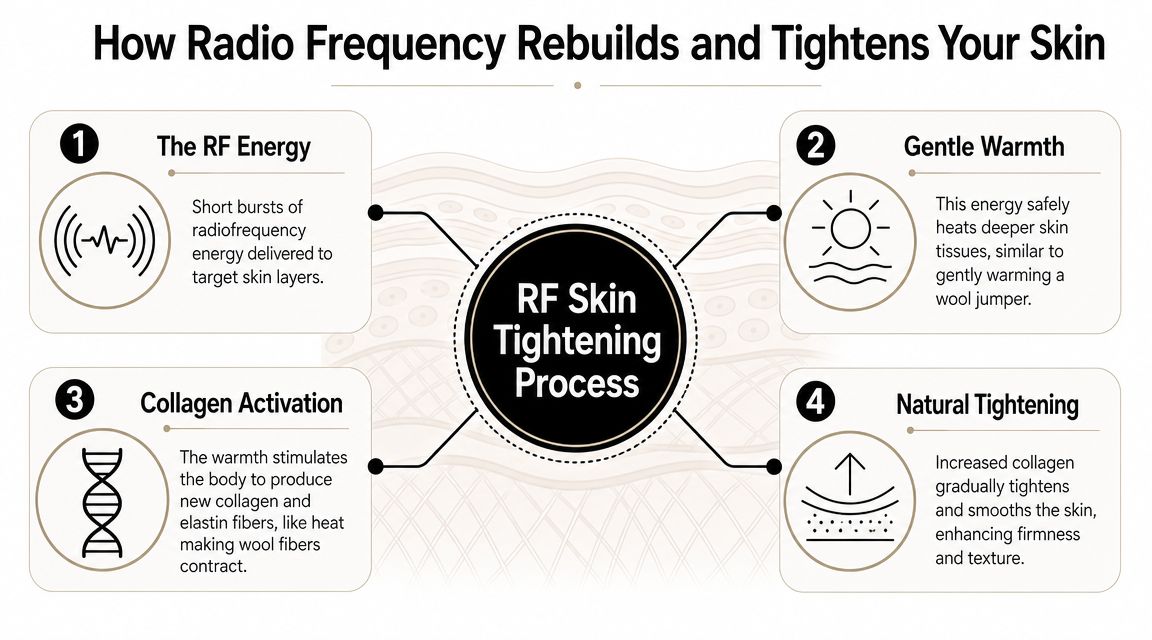
Radio frequency works by warming the deeper layers of skin in a controlled way. The surface is protected while the tissue underneath reaches the temperature range where collagen fibres respond. That matters because collagen is part of the skin's support structure. As that structure becomes looser with age, skin can start to look less firm and less springy.
What the heat is doing
A helpful way to picture collagen is as a supportive mesh under the skin. Over time, that mesh becomes less tidy and less efficient at holding everything in place. RF applies measured heat to that mesh. Part of the response is immediate, with existing collagen fibres tightening slightly. Part of it is delayed, as the skin repairs and remodels itself over the following weeks.
That is why results usually come in two stages:
- An early firming effect as existing collagen responds to heat.
- A gradual rebuilding phase as collagen remodelling develops over time.
This also explains why RF tends to suit mild to moderate laxity better than heavy sagging. If the support structure only needs a nudge, warming it can improve how it behaves. If the tissue has dropped more significantly, the change is often modest, even with a good device and a skilled practitioner.
Visible improvement is possible, and studies on RF facial rejuvenation have reported better skin firmness and good patient satisfaction. The key point is not the headline number. It is that results vary with skin quality, treatment area, device type, and how advanced the laxity is when you start.
A short visual explanation can make the process easier to follow.
Why device design matters
Not all RF systems deliver energy in the same way. You may hear terms like monopolar, bipolar, or multipolar. You do not need to memorise the engineering, but the distinction matters because it affects how far energy travels and how precisely heat can be controlled across the treatment area.
Precision is one of the biggest differences between clinic treatment and home use. Professional systems are built to deliver consistent energy at settings that can create a meaningful tissue response, while the practitioner monitors comfort and skin reaction throughout. Home devices are usually much lower powered for safety, which is why they often produce subtler results and need much more patience.
Clinical literature on RF rejuvenation describes the importance of keeping skin within a controlled thermal window instead of making it feel very hot, as discussed in this study on thermal control in RF rejuvenation. In practical terms, a good treatment is about even heating, constant handpiece movement, and choosing the right depth for the area being treated.
Practical rule: Judge RF by control and consistency, not by how intense the heat feels on the surface.
This is also why consultation matters. The practitioner should assess whether your concern is mainly skin looseness, crepey texture, or something RF is less likely to improve. For smaller or more delicate facial areas, some clinics use focused options such as 3D Face & Eye RF to treat with more control.
Good RF results usually look like better support, a smoother crepey appearance, and a little more definition. They do not usually look dramatic after one session, and they do not replace a surgical lift. For the right person, though, that quieter kind of improvement is exactly the point.
Your Radio Frequency Treatment Journey from Start to Finish
For many people, the most reassuring part is knowing what will happen on the day and what won't. A radio frequency appointment is usually calm, methodical, and far less dramatic than the internet can make it sound.
What happens at the consultation
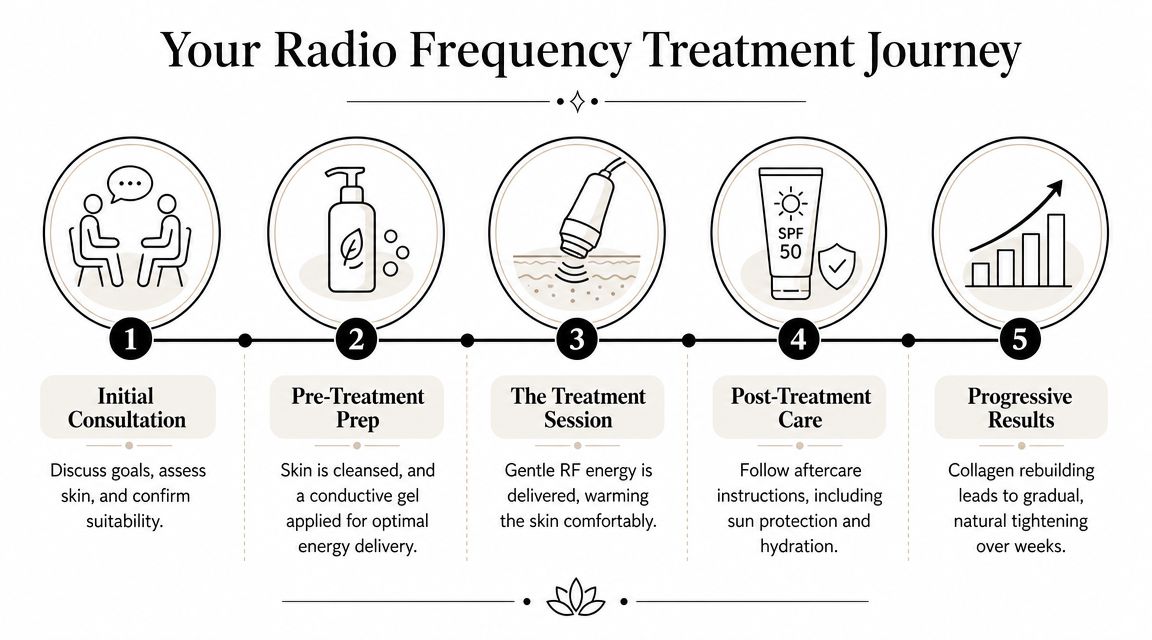
A proper consultation should start with your concern, not the machine. You might say your neck feels looser, your lower face looks less defined, or the skin on your abdomen hasn't tightened after weight loss or pregnancy. The practitioner should then assess the area, talk through your medical history, and decide whether RF is suitable or whether another treatment would make more sense.
This is also the moment when expectations should be set clearly. Mild laxity often responds better than heavier, more advanced sagging. If your skin needs more lift than tightening, you should be clearly informed.
What the session feels like
On treatment day, the skin is usually cleansed and a conductive product may be applied to help the handpiece glide and deliver energy evenly. The device is then moved methodically across the treatment area.
The sensation is typically described as warm and tolerable rather than painful. A well-delivered session should feel controlled, not erratic. If you're having a body area treated, such as the tummy or thighs, the practitioner will usually work in sections rather than rushing through the whole area.
For body laxity or cellulite-related concerns, some clinics offer options such as 3D Body RF, which uses radio frequency on larger areas where firmness and skin texture are the main goals.
When you'll see change
Patients often feel either informed or disappointed regarding the specifics of RF treatment. RF effects are temporary and build gradually over weeks to months. One clinic-facing medical source notes that a full course is often around 6 sessions spaced 3 to 4 weeks apart, and some sources say results may last one to three years, but they are not permanent, as explained in this overview of RF treatment timing and duration.
That means the practical timeline looks more like this:
- Early stage with possible subtle freshness or mild tightening soon after treatment.
- Middle stage where improvement becomes easier to notice as collagen remodelling develops.
- Maintenance stage where results soften over time and may need follow-up sessions.
The people happiest with RF are usually the ones who expect a gradual, natural shift rather than an overnight transformation.
If you go in expecting surgery-level lift from one appointment, you'll probably feel underwhelmed. If you want measured improvement in firmness without downtime, the treatment often makes more sense.
RF Skin Tightening vs HIFU Lasers and Microneedling
Radio frequency is only one tool. It's useful, but it isn't automatically the right one. The best treatment depends on whether your main issue is laxity, deeper structural drooping, texture, scars, pigment, or a mixture of concerns.
Quick comparison table
| Treatment | Primary Target | Mechanism | Best For | Downtime |
|---|---|---|---|---|
| RF skin tightening | Mild to moderate laxity, crepey skin, firmness | Controlled heat in deeper skin layers to stimulate collagen remodelling | People who want gradual firming with little interruption | Usually low |
| HIFU | Deeper lifting support | Focused ultrasound energy targets deeper structural layers | Those more concerned with lift than surface texture | Usually low |
| Lasers | Texture, pigment, resurfacing concerns | Light-based energy targets skin chromophores or controlled resurfacing zones | People focused on tone, texture, pigmentation, or scars | Varies by laser and intensity |
| Microneedling | Texture and collagen stimulation | Tiny controlled micro-injuries trigger repair | Fine lines, pores, acne scarring, texture refinement | Usually mild to moderate |
How to choose based on your main concern
If your skin feels a bit loose and crepey, especially on the cheeks, jawline, neck, arms or tummy, radio frequency often fits the brief well. It's particularly appealing when you want improvement without obvious downtime and you're comfortable with a gradual result.
If your concern is more about lift, HIFU often enters the conversation. It targets deeper structures than standard RF skin tightening, so some people prefer it for areas where they want stronger support rather than mainly surface-level firming. For readers comparing both approaches, 3D HIFU Face is one example of a non-surgical lifting option used in clinics.
Lasers are different again. If the mirror is showing uneven tone, sun damage, acne marks, or rough texture, a laser may be more relevant than RF. A laser-focused plan can improve the skin's surface in a way RF alone usually won't.
Microneedling sits somewhere else in the decision tree. It's often chosen when the priority is texture, pores, superficial lines, or acne scarring. RF microneedling is a hybrid category, but standard microneedling and surface RF skin tightening are not interchangeable.
A simple way to think about it is this:
- Choose RF first when firmness is the headline concern.
- Consider HIFU when deeper lifting is the main aim.
- Look at lasers when colour and texture bother you more than laxity.
- Think about microneedling when scarring, pores, or skin texture sit at the top of the list.
No treatment wins every comparison. The right one is the one that matches the problem you have, not the one with the loudest marketing.
Is Radio Frequency Treatment Right for You
The best candidates for radio frequency skin tightening are usually not the people with the most severe sagging. They're the people in the middle. Their skin has started to soften, loosen, or look crepey, but it still has enough structure to respond to collagen remodelling.

Who tends to get the best outcome
You're often a good fit if you want improvement rather than perfection. Typical examples include early jowl softness, mild neck laxity, post-weight-loss looseness that isn't extreme, or body skin that feels less taut than it used to.
People who struggle most with RF are often those hoping it will replace surgery. It won't. If skin is significantly heavy, hanging, or very lax, RF may improve quality and firmness to a degree, but it may not create the lift you want.
When to pause or avoid treatment
A consultation should screen for contraindications and timing issues. Pregnancy, some implanted medical devices such as pacemakers, and active skin irritation or infection in the treatment area are common reasons to delay or avoid treatment. Good practitioners will also be cautious if your skin barrier is compromised or if another procedure has left the area sensitised.
You should also pause if you feel pushed into treatment before you understand the plan. A clinic should be able to explain why RF suits your concern, what the likely endpoint looks like, and what the alternatives are.
Professional clinic treatment and home devices are not the same thing
Many people are misled. Home RF devices are often marketed with language that sounds very close to clinic treatment, but that doesn't mean they offer the same energy delivery, depth control, or safety systems.
A recent peer-reviewed review notes that RF safety depends on the device and operator, and incorrect use can cause burns, while device design, energy modulation, and depth control materially affect both efficacy and risk, as discussed in this review of RF safety across devices and skin types.
If a device can't control depth and heat properly, you may get less result, more irritation, or both.
That doesn't mean every home device is automatically dangerous. It does mean you shouldn't assume a budget gadget and a professional clinic platform belong in the same category. For cautious clients, that difference matters more than glossy before-and-after photos.
UK Costs and Essential Aftercare for Best Results
You book a consultation, see one clinic quoting a low price and another charging much more, and the treatment names sound almost identical. That is where many people start to feel unsure.
Price matters, but value matters more. With radio frequency, you are not only paying for time in the treatment room. You are paying for the device quality, the practitioner's judgement, the suitability check, and a treatment plan that matches the level of laxity you have. A lower price can still be fair, but only if the assessment is careful and the treatment parameters are appropriate for your skin and goals.
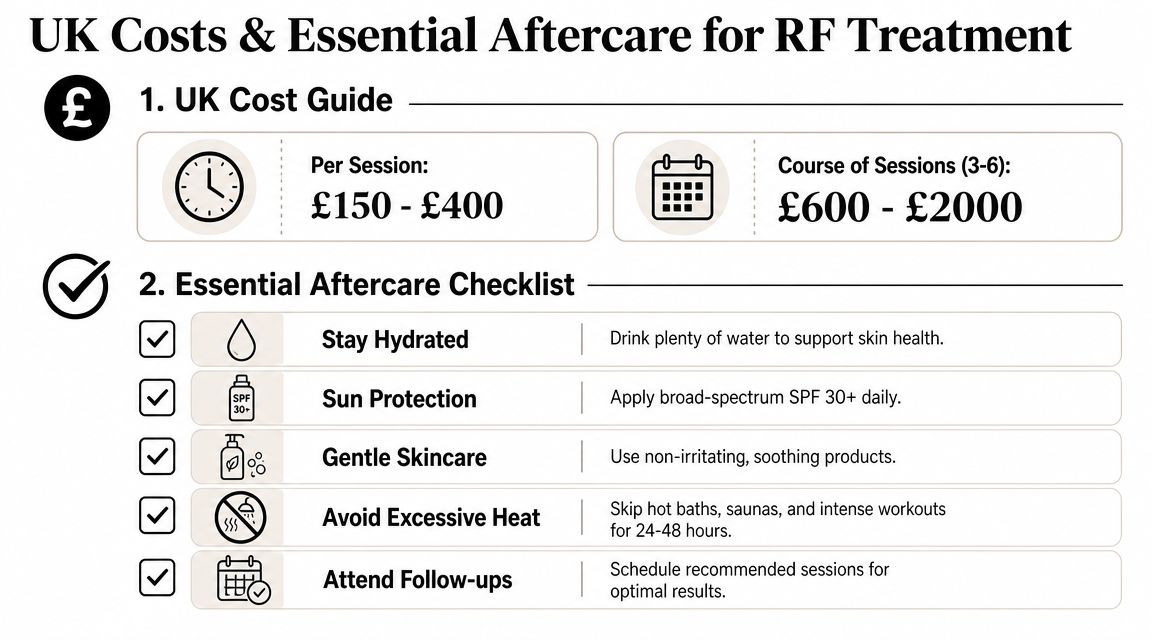
In the UK, cost usually changes based on four things. The size of the area, the type of RF platform used, whether treatment is a single session or a course, and how experienced the clinician is. Face treatments often sit in a different price range from body areas because treatment time and energy delivery are different.
A useful question is not “What is your cheapest session?” but “What does your quoted price include?” A good answer should cover consultation, patch or suitability checks if needed, the recommended number of sessions, spacing between appointments, and aftercare advice. If a clinic cannot explain why your plan looks the way it does, that is a warning sign.
What good results look like
Good results usually mean skin that feels a bit firmer, looks smoother, and has a modest lift in the right areas. For the right person, this can make the face look fresher or the body skin look tighter in clothing. It does not usually create the kind of dramatic change people associate with surgery.
Expectations need careful handling. The best results are often seen in people with mild to moderate skin laxity, not severe sagging. If your skin still has some spring but has started to loosen, RF often has more to work with. If laxity is advanced, the improvement may still be worthwhile, but it is more likely to be a soft improvement in skin quality than a major repositioning of tissue.
Professional clinic treatments and at-home devices also need to be kept in separate categories. Home gadgets may suit people who want a gentle maintenance routine and are happy with subtle change over time. Clinic systems are designed to deliver more controlled energy, with settings chosen for your skin and treatment area. That difference affects both the likely result and the level of supervision.
Aftercare that supports your investment
Aftercare is usually straightforward. The goal is to keep the skin calm while it settles.
- Use gentle skincare for the first day or two if the area feels warm, pink, or a little dry.
- Wear daily sun protection on treated areas that are exposed, especially on the face, neck, and chest.
- Skip extra heat for a short time if your practitioner advises it. Saunas, steam rooms, and very hot showers can make flushed skin feel more reactive.
- Follow the schedule you were given if your treatment plan involves a course. RF works more like building strength through repeated training than getting everything from one gym session.
- Contact the clinic promptly if you have unusual discomfort, prolonged redness, or anything that feels outside the aftercare advice you were given.
Aftercare does not create tightening on its own. It helps you protect the treatment you paid for and reduces the chance of avoidable irritation.
Your Questions Answered and Your Next Step
A common scenario is this: you can see a bit of looseness in the mirror, you want a fresher look, and you are trying to work out whether RF is truly suitable or merely popular. That is a sensible place to pause, because good treatment choices start with clear expectations.
Quick answers to common questions
Does radio frequency skin tightening hurt?
People usually describe it as a steady warming sensation. A well-delivered treatment should feel controlled and comfortable enough to tolerate. If it feels sharp, intense, or uneven, the settings or technique need checking.
How long do results last?
Results are not permanent. Many people need maintenance because your skin keeps ageing after treatment. A better way to think about it is upkeep rather than a one-time fix.
Can RF help the body as well as the face?
Yes, in the right case. RF is often used on the face, neck, abdomen, arms, and thighs where the main goal is improving mild to moderate skin laxity rather than removing a large amount of loose skin.
Is it established or still a newer trend?
RF has been part of non-surgical aesthetics for many years, which is one reason it remains a familiar option in clinics. What varies is the device quality, the practitioner's training, and how appropriate the treatment is for your concern.
Will it work for severe sagging?
Usually, results are best when laxity is mild or moderate. If the skin is heavily lax, a good result may look like a small improvement in firmness and texture rather than a dramatic lift. That distinction matters because disappointment often comes from expecting surgical-type change from a non-surgical treatment.
The people who tend to be happiest with RF are those who want subtle but visible improvement, can commit to the recommended course if needed, and understand that skin tightening often means firmer, smoother, slightly more supported skin. It does not usually mean a major repositioning of tissue.
It also helps to separate professional RF from at-home devices. They sit in different categories. Home devices may appeal if you want gentle maintenance and are comfortable with modest change. Clinic treatments use stronger, more controlled energy, with settings chosen for your skin and treatment area, which gives you a better chance of seeing worthwhile results and having proper supervision if your skin reacts.
If you are still unsure, that is normal. The next step is a proper assessment, not booking on impulse. A good consultation should tell you whether your concern is mainly laxity, volume loss, facial shape change, skin texture, or a mix of those, because RF only works well when it is matched to the right problem.
If you want a personalized assessment, 3D Aesthetics Leamington Spa offers a complimentary consultation with a full 3D scan to assess concerns, personalise a treatment plan, and track changes over time. That gives you a clearer way to decide whether radio frequency skin tightening is suitable for your skin, or whether another non-surgical option would be a better fit.
← Back to Home