
You've probably done some version of this already. You stand in front of the mirror, pull your T-shirt tight, turn sideways, then search for terms like “man boobs”, “chest fat”, or gynecomastia treatment without surgery. One website says fat freezing will sort it. Another says exercise is enough. A third jumps straight to surgery.
That confusion is understandable, because two very different problems often look similar in clothes. One is mainly fat. The other is mainly glandular breast tissue. If you don't know which one you're dealing with, it's easy to spend months, or even years, trying the wrong approach.
A lot of men aren't asking for perfection. They just want to stop thinking about their chest every time they get dressed, go on holiday, or step into the gym. The good news is that some non-surgical options can help. The less comfortable truth is that they only help when they match the tissue causing the problem.
That's why the first step isn't choosing a treatment. It's getting a proper diagnosis. A complimentary 3D body scan can help separate fat-led chest fullness from true gynecomastia, and that single distinction changes everything that comes next.
Table of Contents
- Tired of Hiding Your Chest
- True Gynecomastia vs Pseudogynecomastia What Is the Difference
- Treatments That Target Chest Fat Pseudogynecomastia
- Addressing Glandular Tissue and Lifestyle Approaches
- Setting Realistic Expectations for Non-Surgical Results
- Your First Step A Definitive Diagnosis
- Frequently Asked Questions
Tired of Hiding Your Chest
For many men, this isn't just a cosmetic annoyance. It affects what they wear, how they move, and what they avoid.
You might keep a towel around your shoulders at the pool. You might choose dark tops because they show less chest shape. You might train hard, lose weight, and still feel disappointed that the chest area hasn't changed in the way you expected. That's often the moment frustration turns into proper concern.
The most common mistake is assuming all chest enlargement is the same. It isn't. A soft, pinchable chest behaves differently from a firm lump beneath the nipple. One may respond to fat-targeting treatments. The other usually won't.
Most failed treatment journeys start with the wrong label, not the wrong effort.
That's why a clear, honest conversation matters more than marketing claims. If your chest concern is largely pseudogynecomastia, which means fat-only enlargement, there may be a useful non-surgical route. If it's true gynecomastia, which involves glandular tissue, your options are different and more limited.
A lot of online advice blurs those two together. That's where people lose time and money. They read that weight loss helps, then feel confused when the chest still projects. Or they book fat-freezing because it sounds less invasive, only to find it doesn't touch the underlying cause.
Here's the practical takeaway. Before you ask, “What treatment do I need?”, ask, “What tissue is causing the shape of my chest?” That question gives you a path forward.
True Gynecomastia vs Pseudogynecomastia What Is the Difference
This distinction is the centre of the whole subject. If you remember one thing from this article, make it this: effective gynecomastia treatment without surgery depends on identifying whether the chest fullness is mostly gland or mostly fat.
Why the tissue type matters
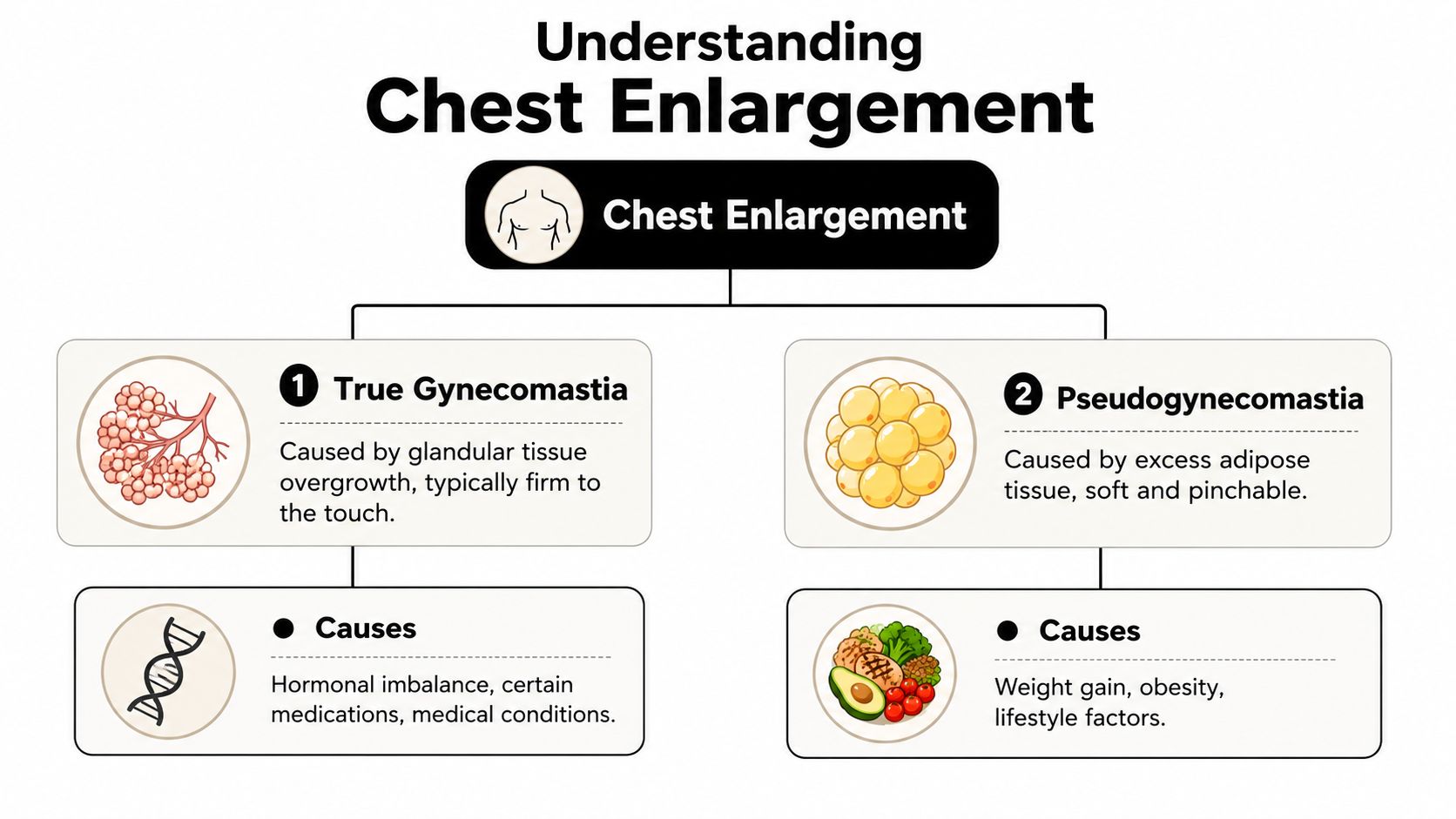
True gynecomastia means there is glandular breast tissue behind or beneath the nipple area. In simple terms, this tissue is denser and more fibrous. Men often describe it as a firm button, disc, or rubbery mound under the nipple.
Pseudogynecomastia means the fullness is caused mainly by fat. This tissue usually feels softer, more spread out, and easier to pinch.
A simple analogy helps. Fat is a bit like a soft sponge. Glandular tissue is more like a firm grape. Treatments designed to reduce fat can work on the sponge. They won't dissolve the grape.
That's why this statement matters so much. For true gynecomastia, dense fibrous glandular tissue “does not shrink with diet, exercise, or fat-reduction treatments”, as explained in this clinical review of non-surgical gynecomastia treatment limits.
What a proper assessment should look for
A decent assessment doesn't just ask whether your chest looks enlarged. It tries to work out why.
Signs that point more towards a fat-led issue can include:
- Soft texture: The fullness feels soft rather than firm.
- Diffuse shape: The area isn't concentrated just under the nipple.
- Weight-related change: Your chest tends to enlarge or reduce with overall body fat changes.
Signs that raise more suspicion of glandular tissue include:
- Firm central lump: There's a denser area directly behind the nipple.
- Persistent projection: The nipple area still pushes forward despite weight loss.
- Uneven contour: The chest may look puffy even when the rest of the torso is leaner.
Practical rule: If a clinic recommends treatment before working out whether the tissue is fat or gland, the process is backwards.
Many men have a mixture of both. That makes diagnosis even more important. If a chest has some excess fat sitting over a glandular base, a fat-reduction treatment may improve one layer while leaving the deeper projection untouched. Without that explanation up front, the result can feel disappointing even when the treatment itself worked exactly as intended.
This is why a 3D body scan matters. It gives a more structured starting point, helps measure contour accurately, and supports a more realistic treatment plan. It's not a luxury add-on. It's the first filter between a sensible plan and a guessed one.
Treatments That Target Chest Fat Pseudogynecomastia
If your chest enlargement is mainly fat, non-surgical treatment can make sense. This is the group most likely to benefit from body contouring treatments that target stubborn chest fat.

When fat reduction can help
For men with pseudogynecomastia, non-invasive fat freezing using cryolipolysis can produce a 20–25% reduction in treated chest fat after 2–3 months, according to this review of non-surgical treatments for chest fat reduction. That same review also makes the key point that cryolipolysis does not affect glandular tissue.
That difference changes expectations completely. If your chest concern is soft and fatty, fat freezing may flatten the contour. If the problem is a dense gland behind the nipple, the same treatment won't address the main cause of projection.
A non-surgical chest treatment plan for fat-led cases often works best when it combines more than one goal:
| Focus | What the treatment is trying to do |
|---|---|
| Reduce fat volume | Lower the amount of pinchable tissue in the chest |
| Improve contour | Create a flatter, more even outline under clothing |
| Support skin quality | Help the skin sit more smoothly after fat reduction |
How non-surgical body contouring works
Cryolipolysis (fat freezing) targets fat cells using controlled cooling. It's most suitable for localised, pinchable fat rather than a hard central gland.
Ultrasound cavitation is used in body contouring to target superficial fat in selected areas. Patients usually think of it as an inch-loss treatment rather than a gland treatment, and that's the right way to frame it.
Body HIFU is another non-surgical option used for focused body contouring. In chest-fat cases, it may be considered when the goal is reducing localised fat while keeping downtime minimal.
These aren't interchangeable with surgery, and they shouldn't be sold that way. Their role is narrower. They can help reshape a fat-heavy chest. They can't remove firm breast gland tissue.
A short explainer may help if you're comparing options:
Why timelines matter
Men often expect the chest to look different within days. That usually isn't realistic with non-surgical fat reduction.
Cryolipolysis results are gradual. The chest contour changes over time, which is one reason treatment planning matters so much. If the area is mainly fat, that delay is normal. If the area is mostly glandular and there's little visible change, the issue may not be timing at all. It may be diagnosis.
A useful way to think about pseudogynecomastia treatment is this:
- Good fit: Soft chest fullness, localised fat, realistic expectations
- Poor fit: Hard tissue under the nipple, longstanding puffiness that hasn't changed with fat loss
- Mixed fit: Some fat reduction is possible, but a remaining gland may still shape the chest
That last group is common. It's also why men can say, “The treatment helped, but my chest still doesn't look right.” In many of those cases, the treatment worked on fat. It just wasn't designed for the deeper tissue causing the remaining bulge.
Addressing Glandular Tissue and Lifestyle Approaches
A common pattern looks like this. A man loses weight, his waist gets smaller, his shirts fit better, and the chest still looks puffy under the nipple. At that point, the question is no longer “How do I burn more fat?” It is “What tissue is causing the shape?”
That distinction matters most in true gynecomastia, where glandular tissue plays a central role. Fat-reduction treatments are built for fat. Lifestyle changes improve health and body composition. Neither approach reliably removes established gland tissue.
The UK pathway for recent-onset cases
For recent-onset or pubertal Grade I gynecomastia, UK guidance often starts with observation rather than immediate treatment. As noted earlier, the usual pathway includes watchful waiting for 6 to 12 months, many pubertal cases settle during that period, and any medicine used is off-label because no medication is MHRA-licensed specifically for gynecomastia in males.
Tamoxifen is the medicine most often discussed in this setting. It is prescribed and monitored medically, not offered as a cosmetic treatment. That difference is important. A clinician first needs to ask why the tissue developed, how long it has been present, whether it is tender, and whether the pattern suggests a temporary hormonal change or established gland.
A practical comparison helps here. Chest fat behaves like stored energy. It can shrink as body fat drops. Glandular tissue behaves more like a fixed structure. If it has formed and persisted, it usually does not melt away because training has improved or calories have fallen.
A firm lump under the nipple calls for diagnosis first, then treatment planning.
This is also why our complimentary 3D body scan matters so much. Before anyone talks about non-surgical options, we need to see whether the chest is fat-dominant, gland-dominant, or mixed. Many articles skip that step and jump straight to treatments. That is how men spend time and money on the wrong solution.
Where lifestyle changes help and where they don't
Lifestyle changes still deserve a place in the conversation. They can improve metabolic health, reduce overall body fat, and change how the chest sits on the frame. In pseudogynecomastia, that may make a meaningful difference because fat is the main issue. In true gynecomastia, the surrounding fat may reduce while the gland remains.
That result can feel discouraging. Some men notice the nipple area more after weight loss because the softer fat around it has thinned out, leaving the firmer tissue easier to see.
A simple way to read the role of lifestyle is this:
- Good for general health: Better nutrition, lower alcohol intake, and regular exercise support long-term wellbeing.
- Helpful for fat-led fullness: If the chest enlargement is mainly fat, body composition changes can improve shape.
- Limited for persistent gland tissue: Diet and training do not usually remove established gland beneath the nipple.
Honest advice needs to reflect that reality. Weight loss is often useful. It is not a dependable answer for glandular enlargement. The next step is to confirm what you are dealing with first, because treatment only works well when it matches the tissue causing the problem.
Setting Realistic Expectations for Non-Surgical Results
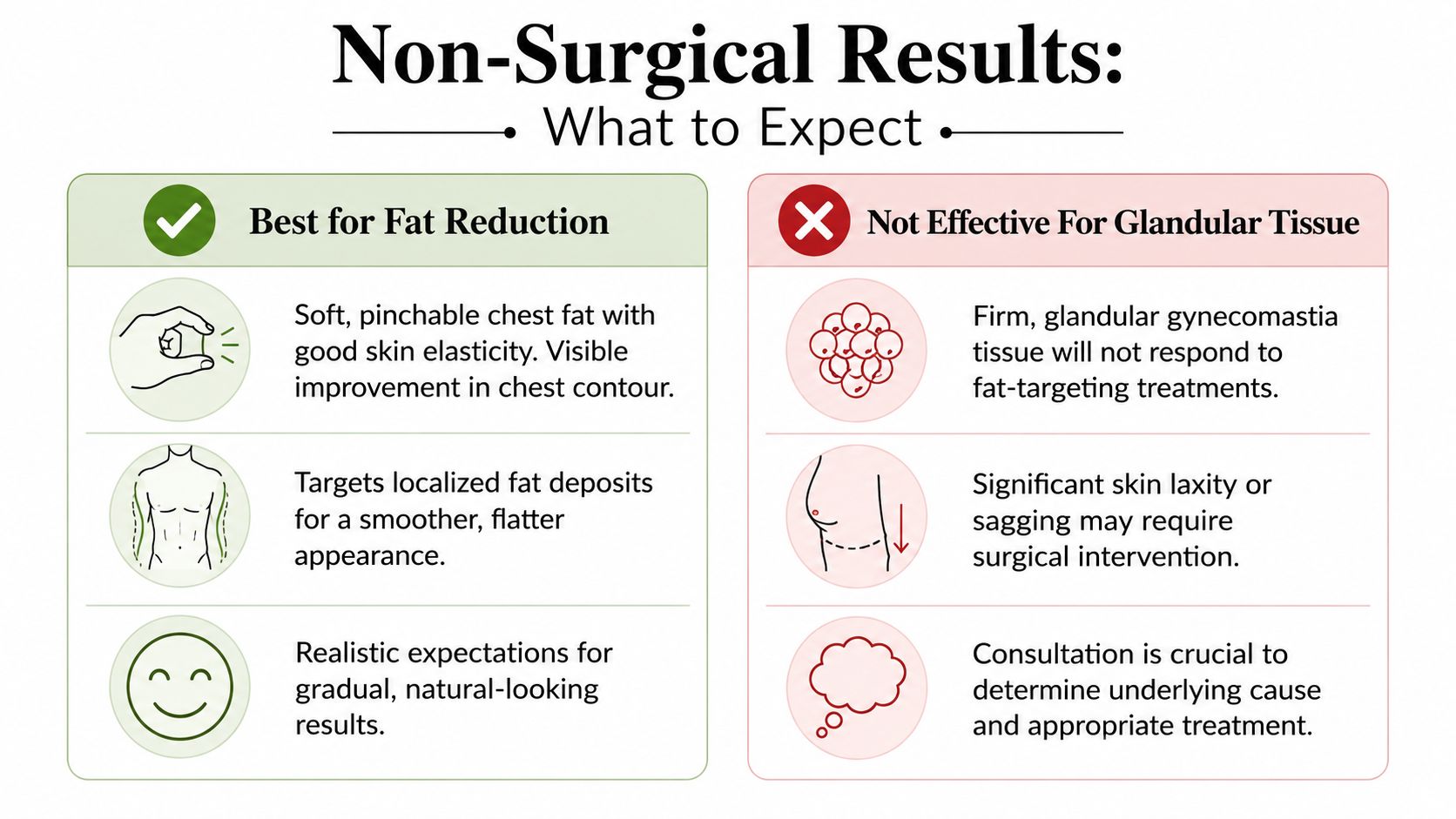
Non-surgical treatment works best when expectations match the tissue being treated. Most disappointment comes from expecting a fat-targeting treatment to behave like a gland-removal procedure.
A simple way to think about candidacy
For adult men with persistent gynecomastia, non-surgical treatments such as fat-freezing generally fail to remove dense glandular tissue. A 10–15% body weight reduction can help with fat, but the gland remains. The same review notes that UK pathways often require six months of unsuccessful non-surgical attempts before surgery is considered, and private surgery commonly costs £3,500 to £5,500 in the UK, as outlined in this discussion of non-surgical limits and surgical eligibility.
That gives you a practical framework:
| Chest feel and shape | Most likely interpretation | Non-surgical outlook |
|---|---|---|
| Soft and pinchable | More likely fat-led | Better candidate for body contouring |
| Firm behind the nipple | More likely glandular | Limited non-surgical improvement |
| Soft outer chest with firm centre | Mixed tissue | Partial change possible, but not always complete flattening |
What improvement usually looks like
For fat-led cases, improvement tends to be gradual rather than instant. The chest may look flatter in clothing first, then more balanced shirtless later. That's a very different journey from surgery, which is why it's important not to compare them as if they're equivalent.
For men who also have some skin looseness, radio frequency skin tightening may be considered as a complementary step. The purpose isn't to treat gland tissue. It's to help the skin contract and sit more neatly after fat volume has reduced.
Some men don't need a bigger treatment plan. They need a more accurate explanation of what non-surgical treatment can and cannot change.
There's another point readers often miss. “Visible improvement” and “complete correction” aren't the same thing. If your concern is mild pseudogynecomastia, a non-surgical approach may be enough to make you feel comfortable in fitted clothing again. If your concern is firm, persistent glandular projection, non-surgical treatment may still leave the shape you dislike most.
That's why candidacy matters more than enthusiasm. The best outcome often starts with hearing a limitation early, rather than after several treatments.
Your First Step A Definitive Diagnosis
If you take one action after reading this, make it an assessment that answers the right question. Not “What package should I buy?” but “What is causing my chest shape?”

Why a scan comes before a treatment plan
A complimentary 3D body scan should be treated as the starting point, not an optional extra. It helps create a clearer picture of the chest contour, supports accurate measurements, and gives a baseline that can be reviewed over time.
That matters because chest concerns are easy to misread. A man may assume he has true gynecomastia because the area is embarrassing and persistent. Another may assume it's just fat because he's gained weight. Both guesses can be wrong. The scan helps bring structure to what would otherwise be opinion.
It also changes the tone of the consultation. Instead of hearing generic advice, you should come away with a more personalised explanation of whether the issue appears to be:
- Predominantly fat-based
- Predominantly gland-based
- A mixed picture that needs careful expectation setting
What you should leave with
A useful consultation shouldn't pressure you into treatment. It should give you clarity.
You should leave understanding which non-surgical options are suitable, which ones probably won't help, and whether you may need a medical opinion instead of an aesthetic one. That brings clarity, even if the answer isn't the one you hoped for.
This is not optional. Without a real attempt to differentiate tissue type, any plan is mostly guesswork.
If you've spent months searching for gynecomastia treatment without surgery, this is the cleanest next step. Get the chest assessed properly. Get the tissue type explained in plain language. Then make a decision based on what your body is showing, not on what an advert promises.
Frequently Asked Questions
Can gynecomastia go away without surgery?
Sometimes, depending on the type and timing. In recent-onset pubertal cases, watchful waiting is part of the standard UK pathway. In persistent adult glandular cases, spontaneous improvement is much less likely.
Does the NHS pay for treatment?
It usually doesn't fund male breast reduction surgery routinely. Private surgery in the UK commonly falls in the £3,500 to £5,500 range, as noted earlier in the article.
Is weight loss enough?
It can help if the problem is mostly chest fat. It won't reliably remove established glandular tissue. That's why some men get leaner everywhere else but still dislike the nipple area.
Are non-surgical results permanent?
Treated fat cells don't behave the same way as untreated tissue, but maintaining your result still depends on weight management and lifestyle. Non-surgical fat reduction isn't a free pass against future fat gain.
How do I know if I'm suitable for fat freezing?
You're more likely to be a suitable candidate if the chest feels soft, pinchable, and fat-led. If there's a firm disc-like area under the nipple, a scan and assessment are far more important than booking treatment quickly.
What if I have both fat and gland tissue?
That's common. In mixed cases, non-surgical treatment may improve the fatty layer while leaving some central projection. The key is knowing that in advance so you can judge success properly.
If you want clear answers before committing to any treatment, 3D Aesthetics Leamington Spa offers a complimentary consultation with a full 3D body scan. It's a practical, no-obligation way to understand whether your chest concern is likely fat-based, gland-based, or mixed, and what realistic non-surgical options may suit you.
← Back to Home