

You're sitting in a consultation room because your jawline looks softer, your neck feels crepey, or your abdomen hasn't regained its previous firmness after pregnancy. The clinic offers HIFU and radio frequency, and both promises sound familiar: tighter skin, more collagen, little or no downtime. The difficult part is knowing which treatment is aimed at your actual problem.
The useful question isn't which machine has the strongest marketing. It's how deep the laxity sits, what your skin needs, how much discomfort you'll accept, and whether the practitioner has assessed your facial or body structure properly. HIFU and RF can both be valuable, but they don't work in the same tissue layer and shouldn't be prescribed as interchangeable treatments.
Table of Contents
- The Tightening Decision Most Patients Face
- How HIFU and Radio Frequency Work
- Side by Side Across the Criteria That Matter
- Which Technology Suits Which Age and Skin Type
- What the Clinical Evidence Really Shows
- Why the UK Provider Matters as Much as the Device
- Choosing Between HIFU and Radio Frequency for Your Goals
The Tightening Decision Most Patients Face
A typical consultation starts with a patient pointing to the lower face and saying, “I want this lifted, but I don't want surgery.” Sometimes the concern is early jowling. Sometimes it's a brow that has gradually descended, a thin and crepey neck, or loose abdominal skin following pregnancy. The patient may already have saved videos comparing HIFU with RF, but social media rarely explains why the same treatment can suit one person and disappoint another.
The decision usually comes down to three practical questions:
- Where is the problem? Deep descent around the jawline needs a different approach from fine lines and surface texture.
- What does the tissue look like? A thin face with little subcutaneous volume needs more caution than a fuller face with moderate laxity.
- What treatment experience can you tolerate? HIFU can feel sharper and more intense. RF usually feels like controlled warmth, although the experience varies by device and settings.
Consultation rule: A treatment plan should follow the tissue problem, not the machine currently being promoted.
Price also influences the conversation, but a cheaper session isn't a saving if it targets the wrong layer or is delivered without adequate clinical governance. The provider should examine skin thickness, laxity, volume distribution, previous procedures, pigmentation history and any relevant medical factors before recommending either modality.
The evidence base supports a measured view. A 2025 systematic review identified 45 HIFU clinical trials and cohort studies published between January 2010 and October 2024, describing HIFU as an established non-invasive option for facial rejuvenation and body contouring in the evidence reviewed by UK clinicians and patients (clinical review data). RF also has a substantial published history, including a clinical evaluation of a non-ablative RF device for the neck and jowls (RF clinical evaluation).
That history doesn't create a universal winner. It gives us a better way to match the treatment to your age, anatomy and priority.
How HIFU and Radio Frequency Work
The right choice depends on the layer causing the concern. HIFU directs energy deeper for structural support, while radio frequency, or RF, spreads controlled heat through the dermis and nearby tissue. Both encourage remodelling, but they do not produce the same treatment experience or address identical changes.
HIFU, or high-intensity focused ultrasound, sends sound-wave energy through the skin and concentrates it at selected depths. Depending on the cartridge and treatment plan, the practitioner can target tissue at 1.5 mm, 3 mm or 4.5 mm beneath the surface. Rather than warming the whole treatment area evenly, HIFU creates small, precise thermal coagulation points.
One possible target is the SMAS, a supportive tissue layer also addressed during a surgical facelift. HIFU does not reproduce surgery and cannot remove substantial excess skin. Its deeper focus is why practitioners may select it for mild to moderate jowl descent, brow heaviness or neck laxity, where support and lift matter more than surface texture alone.
RF uses electrical energy. The applicator passes current through tissue, and resistance generates controlled heat. Instead of placing isolated points at chosen depths, RF generally warms a broader area of the dermis and surrounding tissue. Energy level, number of passes and temperature are adjusted for the device, treatment area and skin response.
That wider heating pattern can support collagen contraction, dermal remodelling and texture improvement. RF often suits crepey skin, fine lines or laxity across a larger body area. The label covers several systems. Some concentrate on the superficial dermis, while others are designed to reach deeper tissue, so the device and settings affect both the result and sensation.
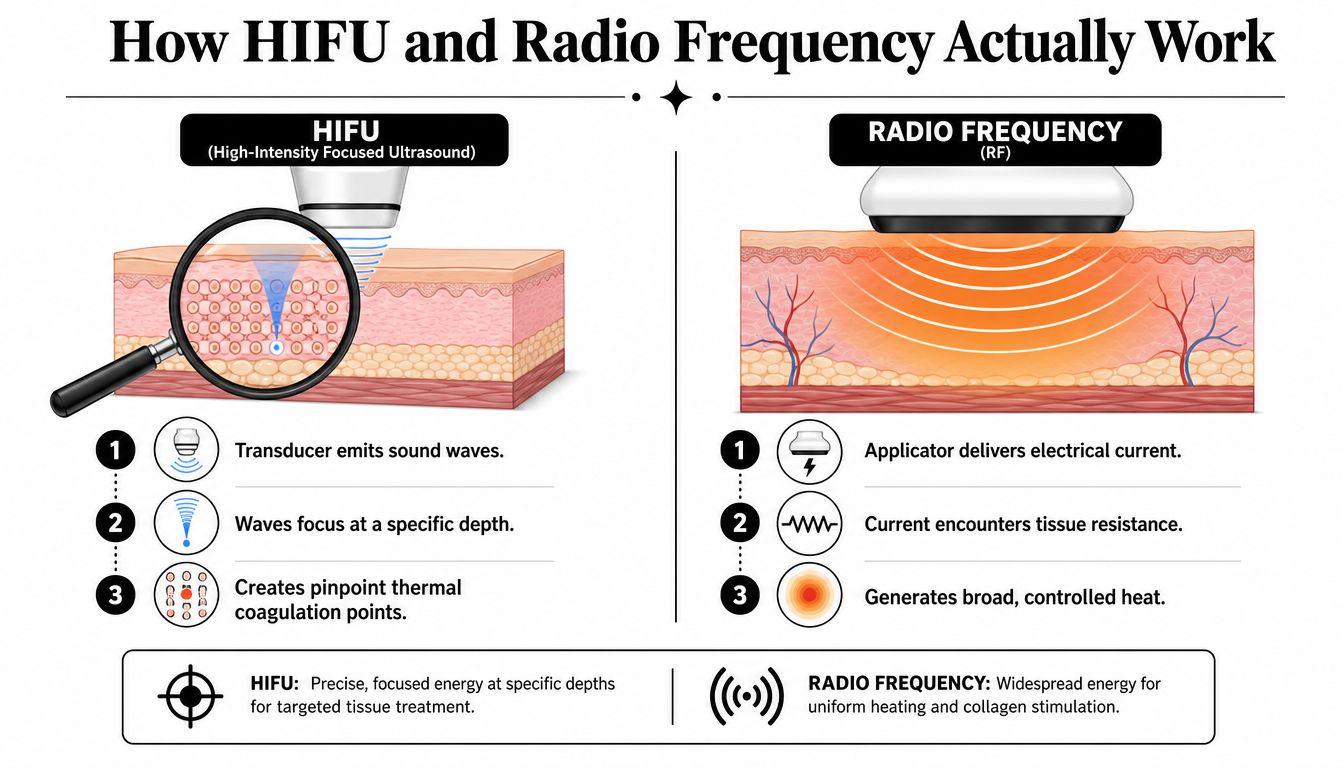
HIFU commonly feels like brief prickling, warmth or sharper pulses as energy reaches its focal points. RF usually feels warmer and more evenly distributed. RF microneedling is different and more invasive, because needles deliver energy into the skin.
For a non-surgical facial option, the practical distinction is clear: HIFU is chosen for depth and lift, while RF is chosen for surface quality and gradual tightening. The operator's assessment still matters more than the treatment label. A HIFU non-surgical facelift treatment example can show how clinics position this deeper-focused approach.
Side by Side Across the Criteria That Matter
The phrase “HIFU vs radio frequency” can make the choice sound like a competition. In practice, each modality has a different job. The table below is a clinical starting point, not a substitute for an assessment.
HIFU vs Radio Frequency Criteria Comparison
| Criterion | HIFU | Radio Frequency |
|---|---|---|
| Treatment depth | Focused points can be selected at 1.5 mm, 3 mm or 4.5 mm, including deeper supportive tissue | Broad controlled heating, commonly focused on the dermis, with depth dependent on the RF system |
| Best indications | Mild to moderate facial laxity, jowls, brow descent and selected neck concerns | Crepey texture, fine lines, general tightening and larger body areas |
| Expected results | More targeted lifting and contour refinement | Gradual improvement in firmness, texture and skin quality |
| Pain experience | Can produce brief, sharper pulses or tenderness | Usually experienced as warmth, though settings and device type affect comfort |
| Downtime | Usually limited, but temporary tenderness or redness can occur | Usually limited, with the response depending on the device and treatment intensity |
| Number of sessions | Often selected when a patient wants a more intensive, less frequent facial treatment | Frequently planned as a course because remodelling is cumulative |
| Longevity | Can provide a longer interval between facial treatments in suitable candidates | Maintenance is commonly part of the plan |
| Cost | Depends on area, cartridge selection and practitioner expertise | Depends on device, treatment area and whether a course is prescribed |
| Skin suitability | Requires careful energy and depth selection, particularly where facial volume is limited | Often useful for surface laxity, but thermal treatment still needs careful adjustment for pigmentation risk |
HIFU suits the patient whose main complaint is mild jowl descent or loss of definition, provided there's enough tissue for the selected depth and energy. It's less convincing as a single answer for a sun-damaged, crepey neck where the dominant problem is surface quality rather than deep descent.
RF is usually more adaptable for broad areas. The applicator can treat cheeks, neck, abdomen, arms or thighs with a consistent heating pattern, making it practical for post-pregnancy abdominal laxity or diffuse textural change. It won't create the same focused deep effect as HIFU when the issue is primarily structural lifting.
Body contouring adds another layer to the decision. If your concern includes localised fullness as well as laxity, ask whether the proposed treatment is tightening skin, addressing fat, or attempting both. A clinic's explanation of non-surgical fat removal in the UK should distinguish those goals rather than treating every change in circumference as skin tightening.
The honest answer is that neither modality guarantees a dramatic lift. Both are most useful for mild to moderate laxity, and advanced sagging or major volume loss may need a surgical or structural solution instead.
Which Technology Suits Which Age and Skin Type
Age gives us a useful starting point, but it isn't a prescription. Two people of the same age can have very different skin thickness, facial fat distribution, sun exposure history and degree of laxity. I'd rather assess the tissue than select a treatment from a birthday alone.
Patients in their late twenties through mid-thirties often present with early laxity, reduced skin resilience or post-pregnancy changes rather than significant descent of the deeper facial structures. In that setting, RF may be the more logical first option because it concentrates on dermal quality and can build a gradual tightening plan without automatically pursuing a deep lifting effect.
HIFU becomes more relevant when the visible concern is moderate jowling, brow descent or neck laxity. The deeper-focused mechanism is useful when the patient still has reasonable soft-tissue volume and the treatment can be adjusted to avoid excessive heating of areas where volume is already limited.
HIFU vs Radio Frequency by Age and Skin Type
| Patient profile | Better suited technology | Reason |
|---|---|---|
| Early laxity with fine lines and crepey texture | Radio frequency | Broad dermal heating targets surface firmness and texture |
| Moderate jowling with adequate facial volume | HIFU | Focused energy can address deeper supportive tissue |
| Post-pregnancy abdominal laxity | Radio frequency | Larger treatment areas and repeatable heating suit diffuse skin laxity |
| Marked volume loss or significant tissue descent | Neither as a standalone answer | Structural support and a fuller clinical assessment may be needed |
| Very dark skin or a history of post-inflammatory hyperpigmentation | Either only with cautious, personalised settings | Thermal energy can aggravate pigmentation risk, so the protocol and operator matter |
| Rosacea-prone, recently tanned or compromised skin | Delay or modify treatment | The skin barrier and inflammatory response need assessment before heat-based treatment |
Very dark Fitzpatrick V to VI skin, recently tanned skin, rosacea-prone skin and acne-scarred skin all require a more cautious consultation. Lower-energy protocols may be appropriate, or treatment may need to wait until the skin is stable. “Non-invasive” doesn't mean risk-free, particularly when heat is delivered to reactive skin.
Facial volume deserves particular attention. A lean face with hollow temples, thin cheeks or existing lower-face volume loss may not benefit from aggressive deep heating. HIFU can be poorly matched when the patient needs support or volume rather than further contraction.
The practical distinction: If the tissue problem is mostly shallow, start with a surface-focused strategy. If it's mostly descent, assess whether a deeper treatment can lift without sacrificing useful volume.
The best treatment plan may also change over time. A person who responds well to RF for early texture concerns may later need a different approach as laxity becomes more pronounced. That's why a good clinic records baseline photographs, discusses realistic endpoints and reassesses rather than selling the same course indefinitely.
What the Clinical Evidence Really Shows
Clinical evidence supports both technologies, but it does not support the broad promises common in advertisements. HIFU has a growing research base for facial rejuvenation. The 2025 systematic review of 45 clinical trials and cohort studies described HIFU as an established non-invasive option in the available evidence, while also highlighting the need to discuss side effects and treatment experience with patients. The same evidence set included a facial and neck study of 75 patients, in which physicians assessed improvement in more than 80% of facial-area assessments and patient satisfaction exceeded 78%. Pain occurred in 25.3% of cases and transient erythema in 6.7%, showing why “no downtime” should not be confused with no sensation or skin reaction (HIFU evidence review).
RF has a longer non-ablative skin-tightening record. In a 2013 clinical evaluation of 49 subjects, patients received two RF sessions one month apart, with the dermis heated to 41 to 43°C during five heat cycles. Three-dimensional photograph review recorded overall improvement in 74% of subjects. Patient-reported results included 85% reporting an improved appearance, 81% rating laxity as improved and 85% rating smoothness as improved (2013 RF evaluation).
Clinical Evidence Summary for HIFU and Radio Frequency
| Metric | HIFU | Radio frequency |
|---|---|---|
| Evidence base | A 2025 review identified 45 relevant trials and cohort studies | Published non-ablative clinical evidence extends back more than a decade |
| Facial improvement | More than 80% of facial-area assessments improved in one study | Overall improvement was reported in 74% of subjects in a 2013 evaluation |
| Patient response | Satisfaction exceeded 78% in one facial and neck study | 85% reported appearance improvement, 81% laxity improvement and 85% smoothness improvement |
| Treatment experience | Pain occurred in 25.3% and transient erythema in 6.7% of the cited study | The cited protocol used dermal heating at 41 to 43°C |
| Main strength | Focused treatment for deeper facial laxity | Broader dermal remodelling and surface quality |
| Combination evidence | HIFU can contribute the deeper component | A UK-authored split-face study found added objective improvements when bipolar RF was combined with HIFU (split-face study) |
The UK-authored split-face research compared HIFU alone with HIFU combined with bipolar RF. The combined approach significantly improved several objective measures, including pore number, elasticity, wrinkle depth around the eyes and skin moisturisation at a 2.5 mm depth. The finding supports a layered treatment plan, since surface quality and deeper laxity may respond to different forms of energy. It does not mean every patient needs both treatments.
The practical conclusion is measured. HIFU may suit mild or moderate laxity where deeper tissue contraction is the priority. RF may be more appropriate when dermal remodelling, texture and surface quality are the main concerns. Neither replaces surgery for advanced sagging, substantial excess skin or major structural volume loss. Results also depend on patient selection, treatment settings and the depth being treated, rather than on the device name alone.
Why the UK Provider Matters as Much as the Device
Patients often ask which brand a clinic uses before asking who will perform the treatment. That order needs reversing. The same technology can produce a sensible result with careful patient selection and a poor result when the operator chooses unsuitable depth, energy or treatment coverage.
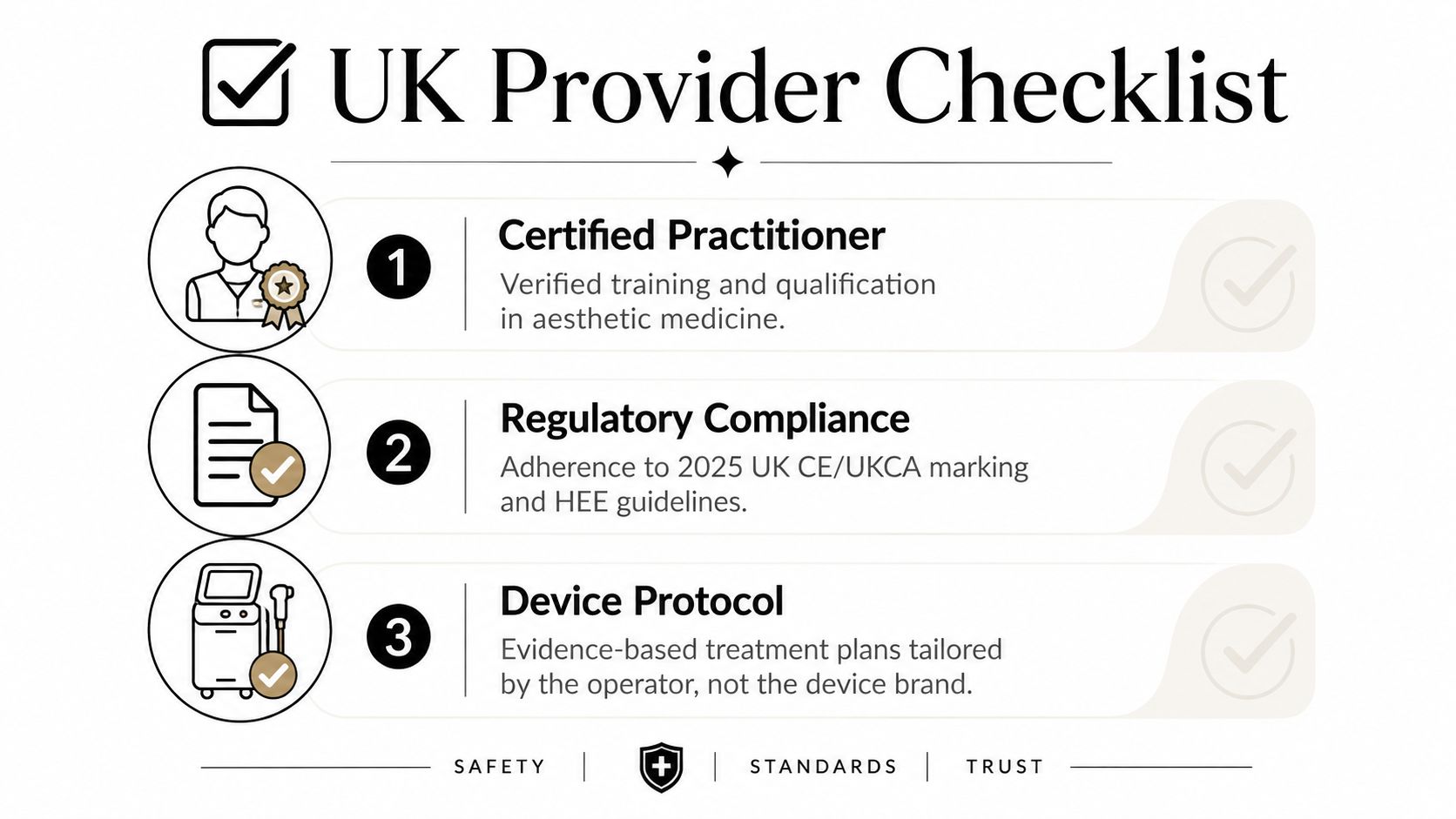
The UK government's proposed licensing regime explicitly groups HIFU and radiofrequency among non-surgical cosmetic procedures requiring trained practitioners, indemnity cover, hygiene standards and, for higher-risk procedures, healthcare-professional oversight (UK government licensing proposals). Scotland's risk-based framework also places these treatments into regulated or supervised categories, so governance is becoming a central part of the buying decision.
This is important because complications usually relate to patient selection, settings, technique and aftercare rather than the name printed on the handpiece. Excessive or poorly directed thermal energy can contribute to burns, nerve irritation, unwanted fat loss or post-inflammatory pigmentation. A responsible practitioner should discuss those possibilities without using fear to sell you an alternative.
Questions to ask before booking
- Who performs the treatment? Ask for the practitioner's name, relevant training and the identity of the healthcare professional responsible for oversight where required.
- What is the treatment plan? The clinic should explain the target layer, energy settings, treatment area and why that plan suits your anatomy.
- How is risk managed? Ask about contraindications, patch testing where relevant, emergency procedures, follow-up and the clinic's approach to burns, pigmentation or nerve symptoms.
- What happens to your records? Before-and-after photographs and written consent support safe monitoring and make exaggerated promises easier to challenge.
- Is the device properly governed? Device compliance, maintenance and operator-specific protocols matter more than a brand name alone.
A clinic that won't explain who is responsible for your care, what happens if you react badly or why one depth has been selected is giving you incomplete information. Guidance on introducing machine-based treatments should also be part of a clinic's wider safety culture, not an afterthought. A practical discussion of machine-based treatments in a clinic can help you recognise the questions a proper consultation should answer.
Provider rule: Don't buy a device name. Buy a documented assessment, trained hands, appropriate insurance and a clear route to follow-up.
A very low-price offer from a beauty-only setting deserves careful scrutiny. The treatment may still be presented as cosmetic, but the energy delivered into tissue carries clinical responsibilities. Regulation is changing, and patients should expect clinics to explain how they meet the applicable standards rather than relying on vague claims of being “fully qualified”.
Choosing Between HIFU and Radio Frequency for Your Goals
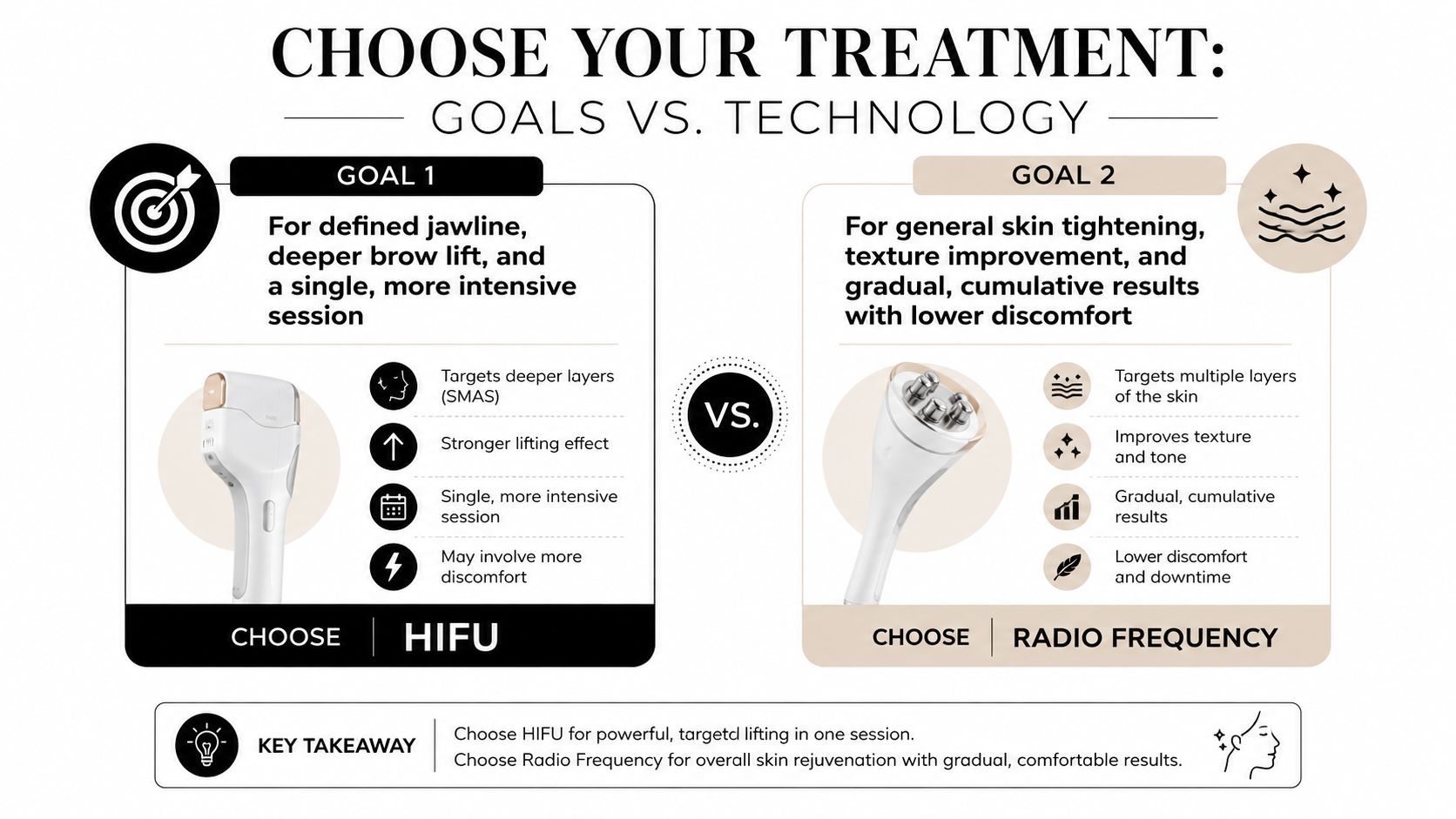
Start with the outcome, not the treatment menu. If you want a more defined jawline, a deeper brow lift or one intensive facial session rather than a gradual course, HIFU may be the better primary choice when your tissue assessment supports it. The deeper target makes sense for descent that sits below the surface, but the result should still be described as refinement, not a surgical facelift.
RF is usually the more sensible direction for crepey cheeks, early fine lines, diffuse skin laxity or a larger body area. It's also useful when surface quality matters more than a concentrated lifting effect. Some clinics offer systems such as Thermage, Morpheus8 or Endymed, but those names don't remove the need to assess the treatment type, depth, settings and operator.
Post-pregnancy abdominal laxity is a good example of why RF can be practical. The concern often covers a broad area and involves skin quality rather than one sharply defined lifting point. RF can be incorporated into a staged plan, provided the practitioner confirms that the issue is suitable for non-surgical tightening and isn't primarily excess skin or another condition requiring medical assessment.
Three decision rules
- Choose HIFU when depth and a longer interval between facial treatments matter most. This is most relevant to selected patients with mild to moderate jowling, brow descent or neck laxity.
- Choose RF when surface quality, gradual tightening and broad-area treatment matter most. It can suit crepey texture, early laxity and selected body concerns.
- Consider a combined plan when the concern spans both layers. HIFU can address deeper support while RF focuses on dermal texture and elasticity. The UK-authored split-face evidence supports the logic of combining these effects, although your practitioner still needs to decide whether the extra treatment is justified.
Combination treatment should be staged rather than improvised. A clinician may recommend separate appointments with recovery and response assessment between them, instead of treating every layer aggressively in one visit. The schedule should be based on your skin response and the treatment area, not a fixed promotional package.
If you're researching clinics, professional resources such as Recepta.ai's Med Spas and Aesthetic Clinics guide can provide broader context on how modern aesthetic practices organise treatment information and patient journeys. It shouldn't replace checking a specific clinic's credentials, insurance, consultation process and follow-up arrangements.
The final choice should come from a regulated, prescriber-led consultation where someone examines your skin and soft tissue in person. Ask what improvement is realistic, what risks apply to your skin type, whether the provider would recommend HIFU, RF, both or neither, and what happens if the result falls short.
At 3D Aesthetics Leamington Spa, you can discuss HIFU face and body treatments alongside radio frequency skin tightening during a complimentary consultation that includes a 3D body scan for personalised planning and progress assessment. Visit the clinic to receive a recommendation based on your skin, tissue depth and goals, rather than choosing between HIFU and RF from an online advert.
← Back to Home