
You catch your reflection in daylight and notice a brown mark that wasn't there before. Or perhaps it's been there for months, but lately it seems darker, broader, or more obvious under makeup. The immediate question that often arises is: is this just sun damage, or is it something more stubborn?
That confusion is completely understandable. Melasma and sun spots can both look like “dark patches”, but they don't behave the same way, and they shouldn't be treated the same way either. That distinction matters more than is generally understood. A treatment that suits a straightforward sun spot can irritate melasma and make it flare.
If you've been comparing your skin to photos online, trying brightening serums, or wondering whether laser is the answer, the most useful place to start is diagnosis. Once you know what type of pigmentation you're dealing with, the next steps become much clearer.
Table of Contents
- Understanding the Dark Spots on Your Skin
- Defining Sun Spots or Solar Lentigines
- Unpacking the Complexity of Melasma
- Melasma vs Sun Spots A Side by Side Comparison
- Effective Treatments for Pigmentation Concerns
- Prevention The Best Long Term Strategy
- Your Pigmentation Questions Answered
Understanding the Dark Spots on Your Skin
When a new patch of pigment appears, it's common to lump everything into one category: ageing, sun damage, or “just hyperpigmentation”. In practice, that's where people get stuck. Two marks can both be brown, both sit on the face, and still need completely different treatment plans.
The most important distinction in the melasma vs sun spots conversation is this: appearance tells a story, but pattern and trigger tell the truth. Melasma usually shows up as larger, blotchy brown or grey-brown patches with irregular borders, mainly on the central face. Sun spots are usually smaller, more defined, round or oval dark marks on sun-exposed areas, as described by Healthy Image's guide to melasma and sun spots.
Why people confuse them
A lot of pigmentation starts subtly. You may first notice:
- A patch on the upper lip that looks like shadowing
- A cluster on the cheek that seems freckly at first
- A single darker dot on the hand that doesn't fade
- Marks that worsen in summer and calm down later
That overlap is exactly why self-diagnosis can be misleading.
Practical rule: If a treatment is chosen before the pigmentation type is identified, you're guessing with your skin.
Why correct diagnosis matters
This isn't only about getting faster results. It's also about avoiding the wrong kind of irritation. Aggressive laser treatments often work well for isolated sun spots, but the same approach can trigger a melasma flare. That's one of the clearest reasons professional assessment matters.
A simple way to think about it is this. Sun spots are usually more localised and straightforward. Melasma is more reactive and more complicated. If you treat both as if they're the same, the skin often lets you know very quickly that they aren't.
Defining Sun Spots or Solar Lentigines
A true sun spot is usually the simpler diagnosis. In clinic, it tends to behave like a tidy ink mark left behind after years of ultraviolet exposure. The pigment sits in a more localised pattern, which is one reason treatment is often more straightforward than it is with melasma.
Sun spots, also called solar lentigines, develop gradually rather than appearing all at once. They are a visible sign of cumulative sun exposure, which is why they often become more obvious over time on the areas that catch light most often. In a clinical setting, they are often described as freckles that no longer fade seasonally.
What sun spots usually look like
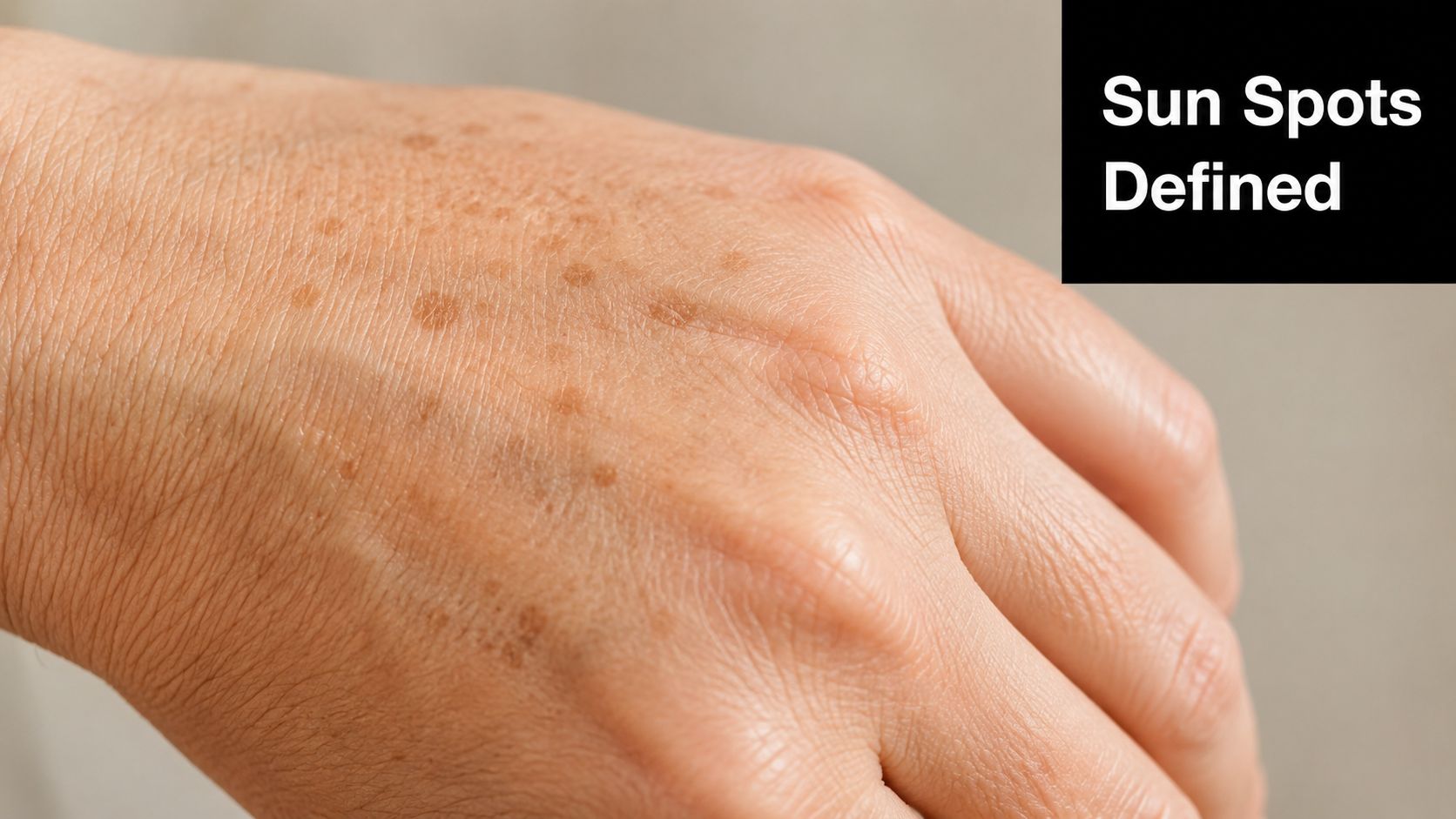
Sun spots are typically:
- Small and flat, rather than raised
- Round or oval
- Clearly defined at the edges
- Even in colour, usually tan to brown
- Scattered individually or in small groups, rather than mirrored across the face
They usually appear on chronically sun-exposed areas such as the cheeks, forehead, backs of the hands, chest, and forearms.
Who tends to get them
Anyone can develop solar lentigines with enough ultraviolet exposure, but they are especially common in lighter skin tones and often become more noticeable with age. The British Association of Dermatologists describes them as benign flat brown marks linked to sun exposure and commonly seen on the face and hands in later adult life, particularly in fairer skin types, in its overview of solar lentigines.
That said, skin tone does not rule them in or out. Darker skin can develop sun spots too, although the pattern and differential diagnosis may be less straightforward. Therefore, a proper assessment becomes useful, especially if the pigmentation is on the face.
What they are not
Sun spots are not usually driven by hormones, and they do not typically appear in a broad symmetrical pattern. A single well-defined brown mark on the hand, temple, or cheek points more strongly towards cumulative sun damage than toward melasma.
That distinction matters in practice. Isolated sun spots often respond well to targeted pigment treatments because the pigment pattern is more contained. Melasma does not follow those rules, which is why treating a reactive facial patch as if it were a simple sun spot can create irritation and make the colour look darker rather than lighter.
Unpacking the Complexity of Melasma
A common clinic scenario goes like this. Someone notices a patch of colour across both cheeks, assumes it is ordinary sun damage, books a pigment treatment, and a few weeks later the area looks darker or more stubborn than before. That pattern is one of the reasons melasma needs careful identification before treatment starts.
Melasma is a reactive pigment disorder with several drivers acting at once. Hormones can play a part. Genetics can make pigment cells more easily triggered. Sunlight matters, but it is only part of the story. In some patients, visible light and heat also add fuel.
That is why melasma behaves so differently from a straightforward sun spot. A sun spot is often a localised mark. Melasma is more like a pigment system that has become over-alert. Once switched on, it can flare repeatedly, even when the skin is being looked after in other ways.
How melasma tends to appear
Melasma usually presents as:
- Larger patches rather than separate individual spots
- Brown, grey-brown, or mixed-toned discolouration
- Soft or uneven borders
- A mirrored pattern across the face
- Pigmentation on the cheeks, forehead, upper lip, or jawline
The symmetry is often the giveaway. If the pigment seems to answer itself from one side of the face to the other, melasma moves much higher up the list of likely diagnoses.
Why melasma is often mistaken for sun damage
The confusion is understandable. Both conditions involve excess pigment, both can worsen with light exposure, and both often show up on the face. The difference is in the pattern and the skin's behaviour over time.
Melasma tends to wax and wane. It may become more obvious after pregnancy, while using hormonal contraception, during warmer months, or after irritation from the wrong active products or procedures. That reactivity matters because treatments that suit isolated sun spots, such as aggressive heat-based or injury-based approaches, can sometimes aggravate melasma instead of clearing it.
In practice, this is one of the biggest risks of self-diagnosis. Treating melasma as if it were a simple lentigo can push already sensitive pigment cells into producing more colour.
Heat matters more than many people realise
Ultraviolet light is still a major trigger, but it is not the whole picture. UK clinicians are paying closer attention to heat as a melasma trigger as well. Guidance from the British Association of Dermatologists overview of melasma notes that sunlight is not the only factor and that heat can worsen the condition in some people.
This helps explain a frustrating pattern seen in clinic. A patient wears SPF every day, avoids direct sun, and still finds the pigmentation lingering. The missing piece may be repeated heat exposure from saunas, steam rooms, hot yoga, cooking over a hot stove, hair tools near the face, or even a preference for very hot showers.
Melasma management often works like lowering the volume on several triggers at once, rather than trying to erase one mark and be done with it.
That is also why treatment plans usually need more patience and more precision. The goal is to calm pigment production, protect the skin barrier, and choose methods that reduce excess colour without provoking more of it.
Melasma vs Sun Spots A Side by Side Comparison
If you're trying to work out what you're seeing in the mirror, a direct comparison is often the quickest way to make sense of it.
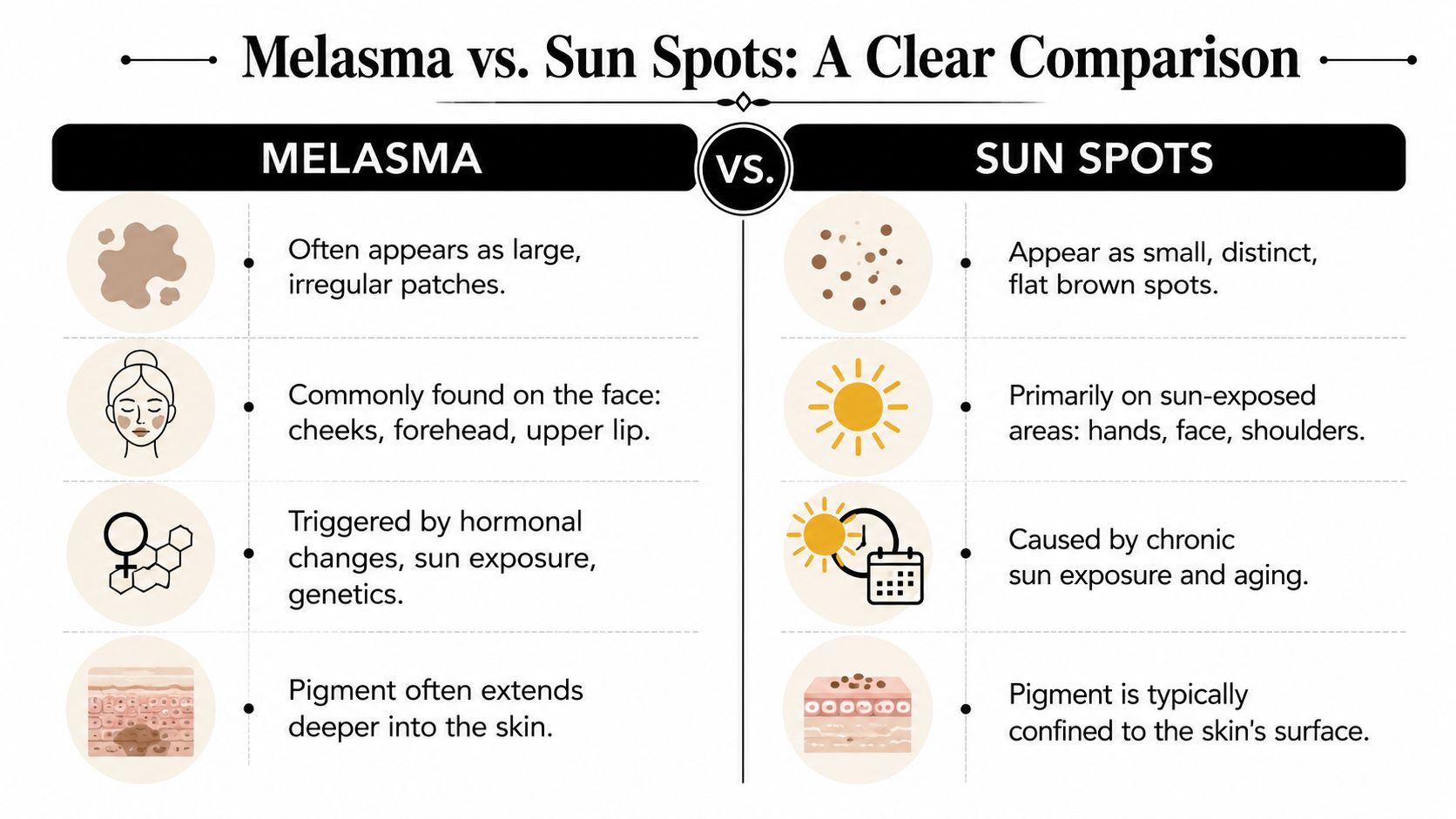
| Feature | Melasma | Sun Spots (Solar Lentigines) |
|---|---|---|
| Main cause | Hormonal changes, genetics, sun/light exposure, and sometimes heat | Chronic UV exposure |
| Usual appearance | Larger blotchy patches | Small defined spots |
| Borders | Irregular or soft-edged | Sharp and clear |
| Pattern | Often symmetrical | Usually asymmetrical and scattered |
| Common locations | Forehead, cheeks, upper lip, central face | Face, hands, chest, arms |
| Typical onset | Can appear quite suddenly | Develops gradually over time |
| Who commonly gets it | More common in women and in medium to darker skin tones | Often seen in fairer skin and on chronically sun-exposed areas |
| Treatment approach | Careful, combined management | Often responds well to targeted pigment treatment |
The visual clue most people miss
In clinic, symmetry is often the first thing I look for. Melasma commonly mirrors itself across the face. Sun spots usually don't. UK dermatological summaries describe melasma as symmetrical brown or grey-brown patches on the forehead, cheeks, and upper lip, while sun spots are smaller asymmetrical dots. Those summaries also note melasma is more common in Fitzpatrick skin types III-VI, while sun spots are often seen in Fitzpatrick types I-II, according to this dermatology comparison article.
The timing clue
The second clue is how the pigmentation arrived.
If someone says, “It came on quite suddenly after pregnancy, changing contraception, or around menopause,” that leans towards melasma. If they say, “I've noticed more spots over the years, especially on my hands and cheeks,” that leans more towards sun spots.
The trigger clue
Both conditions dislike sun exposure, but they don't relate to it in the same way.
- Melasma: sun is a trigger, but not usually the whole story
- Sun spots: sun is usually the story
- Melasma: often needs broader trigger control
- Sun spots: often responds to local pigment-focused treatment
A quick self-check
Ask yourself these questions:
- Is it patchy or dot-like?
- Are both sides of my face involved in a similar pattern?
- Did it seem to appear after a hormonal shift?
- Is it on the upper lip, cheeks, or forehead in a broad stain-like shape?
- Or is it a small, sharply edged mark on a sun-exposed area?
This won't replace a proper assessment, but it helps you avoid treating every brown mark as though it's the same thing.
Effective Treatments for Pigmentation Concerns
A common clinic scenario goes like this. Someone books in wanting a few brown marks “removed,” assuming all pigmentation behaves the same way. If those marks are sun spots, a targeted treatment may work very well. If they are melasma, the same approach can irritate the skin and drive the pigment darker.
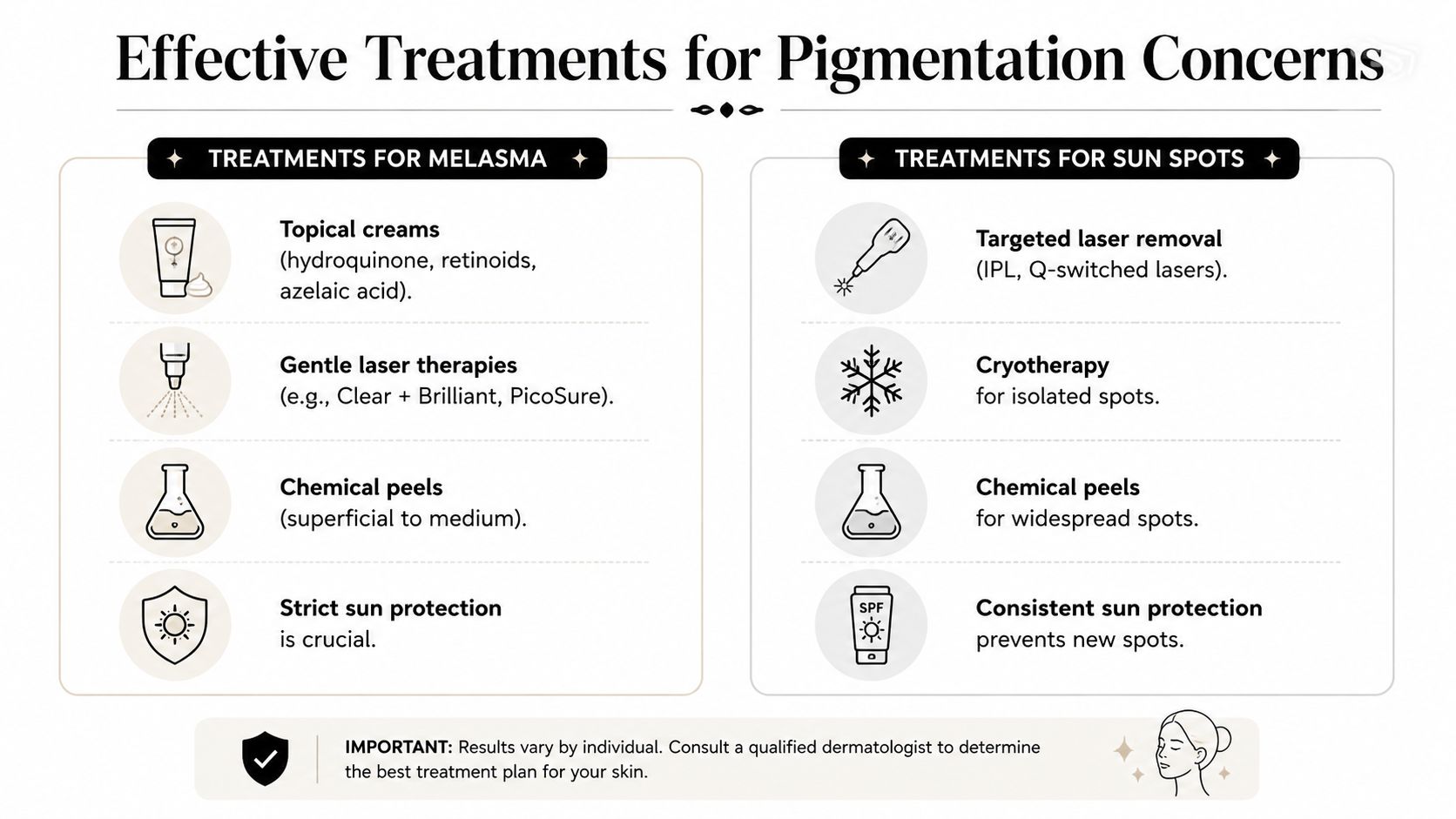
Correct diagnosis shapes the whole treatment plan. Sun spots are often like isolated marks sitting in one place, so treatment can focus on each lesion. Melasma behaves more like an overactive pigment network. It is reactive, easily stirred up by inflammation, and often needs control rather than aggressive removal.
Treatments that often suit sun spots
Because sun spots are usually well-defined and more localised, they often respond to targeted in-clinic correction. Common options include:
- IPL and laser therapy for selected superficial pigment
- Cryotherapy for suitable individual lesions
- Retinoids to improve turnover and support fading
- Chemical peels for broader surface-level pigmentation
This is why sun spots can feel more straightforward to treat. The pigment is often easier to isolate, and the treatment goal is usually removal of a specific mark rather than long-term suppression of a trigger-prone condition.
Treatments that need more caution for melasma
Melasma usually needs a layered plan. A single strong treatment is rarely the smartest first step.
A sensible medical pathway may include:
- Prescription topicals such as hydroquinone, tretinoin, corticosteroid combinations, or azelaic acid
- Carefully selected chemical peels at conservative strengths
- Laser or light treatments only in appropriate cases and with very cautious settings
- Medical-grade skincare to reduce irritation and support pigment control
- Oral tranexamic acid for selected patients under medical supervision
There is good evidence for tranexamic acid in melasma, but it is not a casual add-on. A systematic review and meta-analysis published in the Journal of the American Academy of Dermatology32518-3/fulltext) found that tranexamic acid improved melasma severity, whether used orally, topically, or by microinjection. In practice, oral use needs proper screening because it is not suitable for everyone, particularly where clotting risk is a concern.
Why wrong treatment can backfire
This is the point many people miss. A treatment that clears a sun spot can worsen melasma.
Melasma is closely linked to inflammation. Heat can matter. Hormones can matter. The skin barrier can matter. So if you use a high-heat or highly inflammatory treatment on skin that is already pigment-reactive, the skin may respond by producing more pigment after the procedure. That is one reason some patients see rebound darkening after treatments that looked promising at first.
Sun spots usually do not behave this way to the same degree. With melasma, the practitioner has to ask a different question. Not “How do we remove this quickly?” but “How do we calm the pigment pathway without provoking it?”
Here's a useful explainer on treatment approaches:
What a sensible plan looks like
A careful practitioner will usually assess several things before recommending treatment:
- What type of pigmentation is it, exactly?
- Is there a hormonal pattern or recent trigger?
- Does heat seem to make it worse?
- How reactive is the skin overall?
- Would a staged approach reduce the risk of post-inflammatory darkening?
Melasma treatment works like turning down an overresponsive system, not a straightforward erasure of a mark. That is why the best results often come from combining brightening ingredients, trigger control, sun and heat protection, and measured in-clinic treatment rather than chasing one dramatic session.
The best pigmentation treatment is the one that improves colour without provoking more pigment.
Prevention The Best Long Term Strategy
A common pattern in clinic goes like this. Someone has worked hard to lighten pigmentation, the skin looks clearer for a while, then the colour slowly returns. Usually, that is not because treatment failed completely. It is because the triggers that created the pigment in the first place are still active.
Prevention is part of treatment for both melasma and sun spots. It protects the progress you have made and lowers the chance of new discolouration settling in.
For both conditions, daily broad-spectrum sunscreen is the starting point. UK dermatology guidance also supports practical barriers such as hats, sunglasses, protective clothing, and limiting strong sun exposure where possible.
The foundational basics
These habits tend to make the biggest difference over time:
- Daily broad-spectrum SPF: wear it every day, not only on bright summer days or holidays
- Protective accessories: hats and sunglasses reduce direct facial exposure
- Shade and timing: limit strong midday sun where you can
- Consistency: pigment prevention works best as a daily routine, not an occasional reset
For sun spots, this level of prevention often does a great deal of the heavy lifting. It helps slow the development of new marks and supports the results of treatment already completed.
Why melasma prevention needs a wider view
Melasma behaves less like a simple stain and more like an overreactive pigment system. That is why correct diagnosis matters so much. If a person assumes every brown patch is a sun spot, they may choose treatments that create extra heat or inflammation and end up stirring melasma back up.
Sun protection still matters enormously. But melasma prevention often has to go beyond UV alone.
As noted earlier, heat can be a meaningful trigger for some people with melasma, so prevention may also include managing thermal exposure. This is the part many people miss. They protect their skin carefully outdoors, yet still notice flare-ups after repeated facial flushing, hot environments, or heat-based routines.
Practical heat awareness for melasma-prone skin
If your pigmentation behaves like melasma, it is sensible to be cautious with:
- Steam rooms and saunas
- Very hot yoga classes
- Thermal spa circuits
- Prolonged indoor heat exposure
- Anything that repeatedly leaves your face flushed
This does not mean avoiding all warmth or becoming anxious about normal daily life. It means noticing patterns. If pigment deepens even though sunscreen use is good, heat is one factor worth discussing with a practitioner.
Some cases of melasma stay unsettled because the skin is being protected from sunlight but still exposed to triggers that keep the pigment pathway active.
A realistic maintenance mindset
Long-term control is usually more successful when you aim for steadiness rather than perfection. Protect the skin daily. Learn your personal triggers. Choose treatments carefully, especially if your pigmentation may be melasma rather than sun spots.
That last point matters more than many people realise. Prevention is not only about what you put on the skin. It is also about avoiding the wrong treatment for the wrong diagnosis.
If the pigment changes in shape, depth, or behaviour, have it reassessed before trying something stronger. That cautious approach often keeps results more stable over time.
Your Pigmentation Questions Answered
I think I have melasma. What should I do first
Start with a professional assessment before booking a pigment treatment. Melasma can look deceptively simple, but the plan often needs to account for hormones, skin tone, reactivity, and possible heat triggers. If you jump straight into a treatment designed for sun spots, you could make it worse.
Can I have both melasma and sun spots
Yes, absolutely. This is very common, especially on faces that have both a hormonal pigmentation pattern and a long history of sun exposure. Someone may have melasma across the cheeks and upper lip, plus separate sun spots on the temples or hands.
Can skincare alone help
It can help, especially when the products are well chosen and used consistently. Topical options such as azelaic acid, hydroquinone, retinoids, and other brightening formulas can form part of a useful plan. But skincare works best when it matches the correct diagnosis.
Are lasers always the best answer
No. For isolated sun spots, laser or IPL can be excellent. For melasma, the wrong laser approach can trigger more pigmentation. That's why assessment comes first and treatment second.

Can at-home products replace a consultation
Sometimes they support good results. They don't replace diagnosis. If the pigmentation is new, changing, resistant, or emotionally bothering you, it's sensible to get expert eyes on it.
What kinds of treatments might be considered in clinic
That depends on the diagnosis and the skin itself. Treatment pathways may include targeted pigmentation correction, fractional CO2 resurfacing, Dermalux LED support, microneedling-based options, or an individualized skincare plan. The right choice depends far more on the pigment type than on what's popular online.
If you're unsure whether you're dealing with melasma, sun spots, or a mix of both, the safest next step is a proper consultation. 3D Aesthetics Leamington Spa offers a complimentary, in-depth consultation with a full 3D scan, so you can understand what your pigmentation is doing and which treatment path makes sense for your skin. It's a thoughtful way to get clarity before committing to products or procedures that may not be right for you.
← Back to Home