
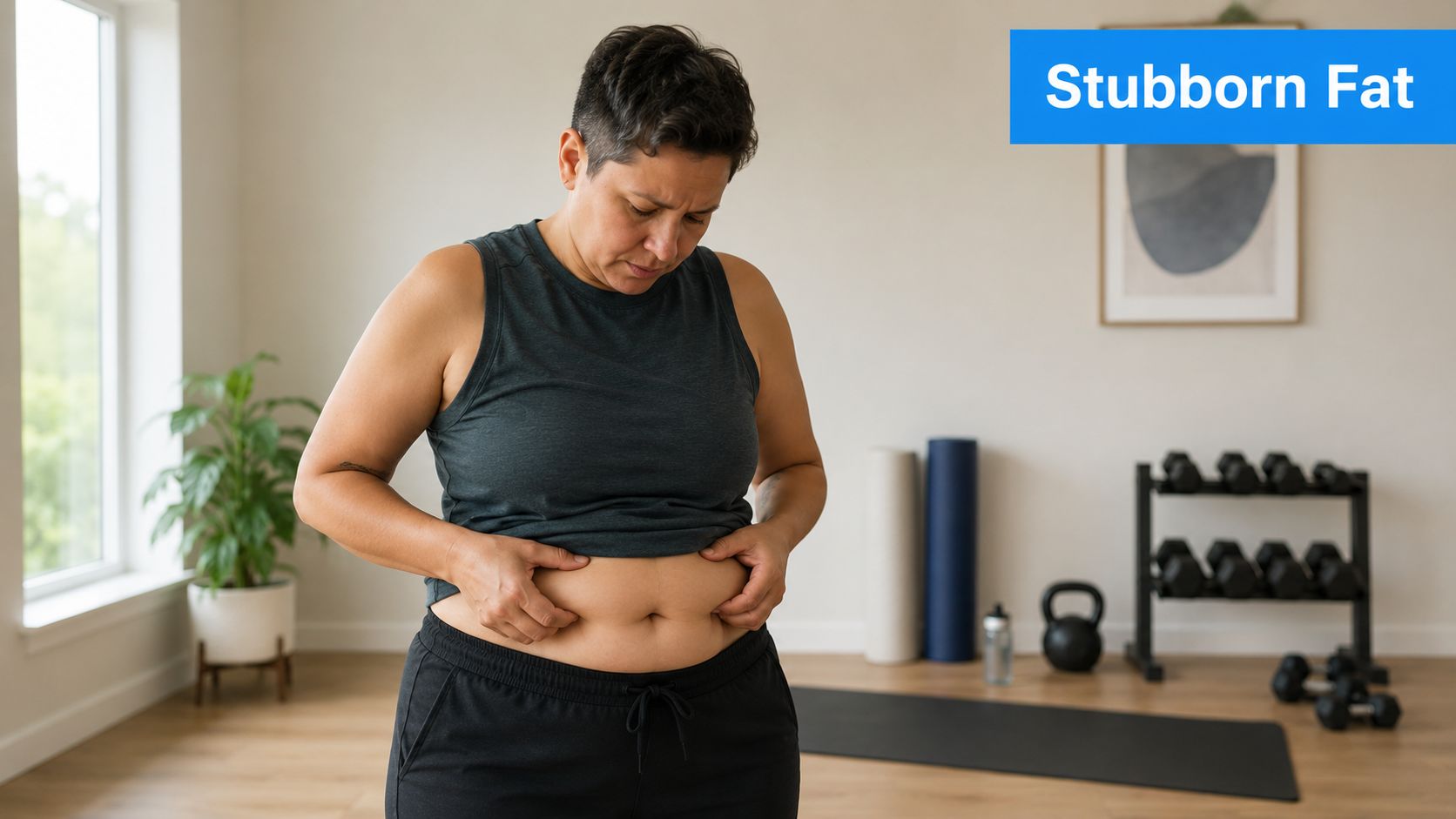
You've cleaned up your diet. You're moving regularly. Your clothes may even fit better in some places. Yet when you look down, that soft layer across the lower stomach still seems to be there, unchanged and irritatingly loyal.
That situation is common. It's often the point where people start searching for non surgical fat removal from stomach treatments, hoping for something that finally targets the area that healthy habits haven't shifted. In clinic, I meet people in exactly this position. They aren't looking for dramatic surgery or a quick fix. They want a more refined waistline, a smoother silhouette in fitted clothes, or less fullness across the lower abdomen.
That's where modern body contouring can help. Not as a replacement for weight management, and not as a shortcut around the basics, but as a targeted approach for the right person. If the concern is a localised pocket of fat under the skin, non-invasive treatments can sometimes improve shape in a very useful way.
It also helps to understand that body change doesn't always show up clearly on the scales. If that sounds familiar, Strive Workout Log's guide to body changes gives a helpful explanation of why inch loss and weight loss don't always move together.
The key is knowing whether you're a suitable candidate. That matters far more than the machine name on the treatment menu.
Table of Contents
- Introduction The Last Inch You Can't Shift
- First Are You a Good Candidate
- Your Non Surgical Stomach Fat Removal Options Explained
- What to Expect The Treatment Journey and Timeline
- Safety Downtime and Potential Side Effects
- The 3D Aesthetics Leamington Spa Advantage
- Frequently Asked Questions
Introduction The Last Inch You Can't Shift
A typical example is someone who's reached a stable routine but still feels frustrated by one area. They may be happy with their arms, their legs, even their overall fitness. Then they put on jeans or a fitted dress and feel that same little overhang or rounded lower tummy.
That last inch can be stubborn for reasons that have nothing to do with laziness. Genetics, hormones, age, body-fat distribution, and skin quality all influence how the stomach area looks. Two people can eat and train in similar ways and still store fat very differently.
Non-surgical body contouring works best when the problem is specific and localised, not when the goal is broad weight loss.
Online, people often get mixed messages. One page says fat freezing “melts belly fat”. Another suggests ultrasound can replace surgery. A third implies that any tummy fullness can be treated if you book enough sessions. Reality is more selective than that.
Some stomach fullness is subcutaneous fat, which sits under the skin and can often be pinched. Some is visceral fat, which sits deeper around the organs and changes the shape of the abdomen from the inside. These are not the same thing, and they don't respond in the same way.
Understanding that difference is the foundation of good decision-making. If you get that part right first, every treatment conversation becomes much clearer.
First Are You a Good Candidate
The first question isn't which device is best. It's whether the fullness on your stomach is the kind that these treatments can address.
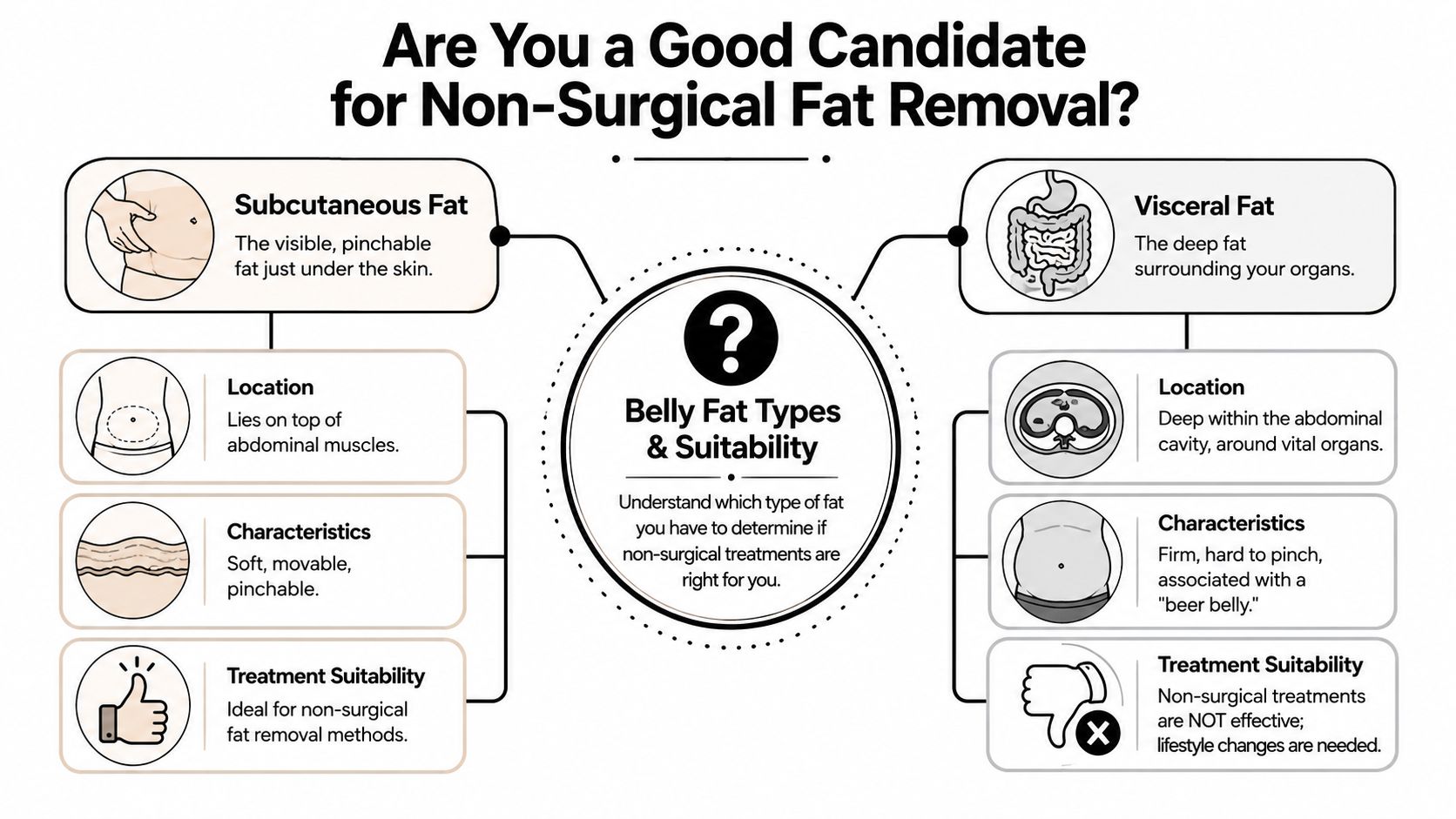
Think of abdominal fat like layers. The outer layer is the one just beneath the skin. That's subcutaneous fat. It tends to feel soft, mobile, and pinchable. Deeper inside the abdomen is visceral fat. That's the internal fat around the organs, and it usually creates a firmer, more projected belly that you can't easily grasp between your fingers.
The pinch test matters more than most people realise
Non-surgical fat reduction is designed for localised subcutaneous fat, not weight-loss treatment. Some protocols recommend treatment for people with a BMI under 30, and that's one reason proper assessment matters. This is especially relevant in England, where 26% of adults were living with obesity and 38% were overweight in 2022 to 2024 according to the verified summary based on guidance on non-surgical fat reduction candidacy.
If your stomach feels soft and you can gather a fold of tissue, that's often the sort of concern body contouring is aimed at. If the abdomen feels firm, rounded, and difficult to pinch, the issue may be deeper and less suited to these treatments.
A simple analogy helps. Subcutaneous fat is the coat. Visceral fat is the stuffing underneath. Non-surgical devices can work on the coat. They can't reach in and remove the stuffing.
Later in this section, this short video helps visualise the difference more clearly.
Who tends to do well
Good candidacy usually comes down to a handful of practical features:
- A specific area bothers you: You're not trying to change your whole body shape. You're focused on one pocket across the upper or lower abdomen.
- The fat is pinchable: This is one of the most important clues that the target is subcutaneous.
- Your weight is relatively stable: Big fluctuations make it harder to judge results and maintain them.
- Your skin still has reasonable elasticity: Fat reduction and skin tightening are not the same thing. If skin laxity is the main issue, another approach may fit better.
- Your expectations are measured: You want contour improvement, not a surgical transformation.
Practical rule: If your main goal is to become lighter overall, start with weight management. If your main goal is to refine one resistant bulge, contouring may be worth assessing.
Some people are better served by a different plan altogether. That might mean nutrition support, exercise progression, medical weight management, or in some cases a surgical consultation if there is a large volume of fat or loose skin. Good clinics should tell you that plainly.
Honest candidacy advice protects you from disappointment. It also saves you from spending time and money on treatments that were never likely to match your goal.
Your Non Surgical Stomach Fat Removal Options Explained
Once candidacy is clear, the next step is understanding how the main technologies differ. They all sit under the umbrella of non surgical fat removal from stomach, but they don't work in the same way and they aren't ideal for the same type of client.
How the main technologies differ
Cryolipolysis, often called fat freezing, is the most recognised option for localised stomach fat. The treatment uses vacuum suction to draw a pinchable bulge into an applicator and cool the tissue to create selective fat cell injury. The body then clears those damaged fat cells gradually over roughly 2 to 3 months, as described by the FDA overview of non-invasive body contouring technologies. That's why it suits a defined bulge rather than general abdominal fullness.
Radio frequency, usually shortened to RF, uses controlled heat. In body contouring, it's often chosen when a person has some soft abdominal fullness but also wants support for skin texture or mild laxity. The sensation is usually warm rather than intense, and treatment plans are often built as a course.
Ultrasound cavitation uses sound energy to target localised fat. It's commonly selected for clients who want gradual inch-loss style contouring and are comfortable with a series of sessions. If you're trying to support your wider routine alongside treatment, practical home changes matter too, and this guide to best fitness gear to lose abdominal fat can help you think about the exercise side realistically.
Body HIFU uses focused ultrasound energy at depth. In body settings, it's often used where a therapist wants more targeted delivery into a defined zone. It can be useful in shaping treatment plans for clients with localised pockets, though suitability depends on tissue depth and the exact concern.
One clinic-based option for people exploring local services is fat reduction treatment in Leamington Spa, which includes technologies such as cavitation for abdominal contouring.
The machine name matters less than the match between your anatomy and the treatment method.
Comparison of Non-Surgical Fat Removal Technologies
| Technology | How It Works | Best For | Typical Sessions | Results Timeline |
|---|---|---|---|---|
| Cryolipolysis | Cools a pinchable bulge after suction draws it into an applicator | Defined, pinchable stomach fat | Often more than one session | Gradual change over the following months |
| Radio Frequency | Delivers controlled heat into the tissue | Soft fullness with skin quality concerns | Usually a course of sessions | Builds progressively with repeated treatments |
| Ultrasound Cavitation | Uses ultrasound energy to target localised fat | Clients seeking non-invasive contouring over a series | Usually a course of sessions | Gradual and cumulative |
| Body HIFU | Uses focused ultrasound energy at depth | Smaller, more targeted abdominal areas | Varies by plan | Gradual reshaping rather than immediate change |
A final point often gets missed. These treatments are body contouring tools, not a way to treat internal belly fat or obesity. That's why two people with the same clothing size can be very different candidates. One may have a soft, treatable lower-abdominal pocket. The other may carry more internal abdominal fat and need a completely different strategy.
What to Expect The Treatment Journey and Timeline
The treatment journey is usually calmer and slower than people expect. That's a good thing. There's no dramatic recovery period, but there also isn't an overnight transformation.
From consultation to treatment day
The first appointment should assess the stomach in detail. A therapist will usually look at whether the tissue is pinchable, how the fat is distributed, whether the skin has good recoil, and whether the concern is localised. During this assessment, unrealistic plans should be filtered out.
On treatment day, what you feel depends on the method. With fat freezing, there is often firm suction and intense cold at the start, followed by numbness. With RF or ultrasound-based treatments, people more commonly describe warmth, pressure, or a mild vibrating sensation.
Some clients need a short course arranged over time rather than a single visit. For those considering freezing specifically, it helps to read a clinic page focused on fat freezing treatment details so the process feels less unfamiliar before consultation.
Why results take time
The most important expectation to set is patience. The American Academy of Dermatology notes that results from non-invasive fat removal are permanent because the fat cells are destroyed, but the change is usually subtle, with more than one session often being necessary. It also states that cryolipolysis usually requires 2 treatments, ultrasound 1 to 3, radiofrequency 4 to 10, and injections typically 2 sessions spaced 6 to 8 weeks apart, with full results usually visible 3 to 6 months after the last treatment according to the AAD guide on what to expect.
That timeline surprises people. They often assume that because the treatment itself is quick, the result should be quick too. Biologically, that isn't how it works. The body needs time to process and clear the affected fat cells.
Most disappointment comes from checking too soon, not from a complete lack of response.
Tracking matters here. Clothing fit, waist measurements, photos in consistent lighting, and sometimes body scanning are all more useful than staring in the mirror every day and hoping to spot a change.
Safety Downtime and Potential Side Effects
For most healthy, suitable clients, these treatments fit easily around normal life. People often return to work, school runs, errands, or desk-based jobs straight afterwards.
What's normal after treatment
Common short-term effects can include redness, mild swelling, tenderness, tingling, temporary numbness, or bruising in the treated area. These are the kinds of responses you'd expect when tissue has been cooled, heated, or mechanically handled.
With abdominal treatments in particular, the area may feel strange before it feels normal. Some people describe the stomach as firm, numb, or slightly tender for a period afterwards. That doesn't automatically mean something has gone wrong.
A sensible clinic won't dismiss these reactions, but it also won't dramatise them. Most are temporary and manageable.
Why provider judgement matters
Safety isn't just about the machine. It's about deciding who should not be treated, selecting the right area, using a suitable protocol, and avoiding promises that push someone into the wrong option.
That matters most with the abdomen because not all tummy fullness is a treatment target. If a therapist can't distinguish between localised subcutaneous fat, bloating, poor skin tone, muscle separation, or deeper visceral fullness, the plan can go wrong before the first session starts.
Good outcomes usually begin with saying no to the wrong candidate.
The 3D Aesthetics Leamington Spa Advantage
A thoughtful body contouring plan should be based on measurement, not guesswork. That's one reason structured assessment makes such a difference.
A more precise way to plan treatment
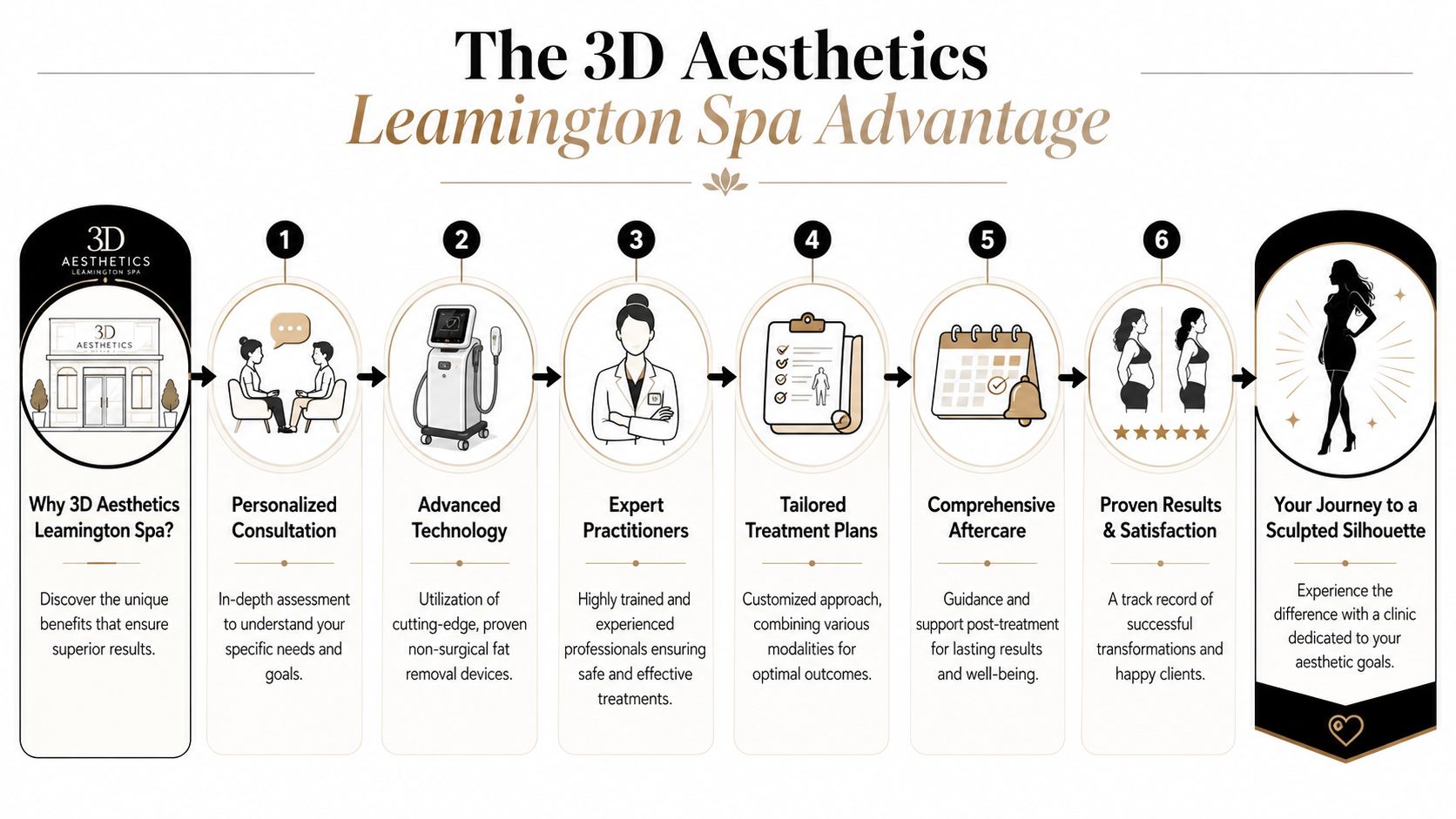
At 3D Aesthetics Leamington Spa, consultations include a full 3D body scan. That changes the conversation straight away. Instead of relying only on mirror impressions, the assessment can look at shape, proportions, and progress with more structure.
That's particularly helpful for abdominal concerns, where clients often describe “belly fat” but may be dealing with a mix of soft subcutaneous fullness, skin laxity, and posture-related shape changes. A scan helps separate those issues and makes follow-up clearer.
For clients considering muscle-focused body contouring alongside fat work, 3D Powersculpt treatments may also form part of a broader plan, depending on the concern and assessment outcome.
Why personalised plans tend to make more sense
One of the biggest mistakes in body contouring is treating every stomach the same way. Some abdomens suit cryolipolysis because the tissue is clearly pinchable. Others may need an approach that leans more towards cavitation, RF, or combination treatment because the concern is more about contour blending or mild laxity.
An individualized plan usually gives a more logical path than merely booking the trendiest machine. It also helps set a realistic endpoint. For example, one person may be aiming for a cleaner waistline in fitted clothing. Another may only want the lower tummy to sit flatter in leggings. Those are different goals, and they don't always need the same route.
The strongest clinics tend to focus on three things:
- Diagnosis before treatment: Work out what the tissue is.
- Progress tracking: Use photos, measurements, or scans to judge change properly.
- Method matching: Choose the technology for the anatomy, not the other way round.
That kind of planning usually creates a smoother experience because the treatment is based on your body, not on a generic sales script.
Frequently Asked Questions
How much does non-surgical stomach fat removal cost
The price varies by treatment type, the size of the abdominal area, and how many sessions are recommended. A small, clearly defined lower-stomach pocket is different from a broader abdominal plan. The only sensible way to get an accurate quote is through consultation and assessment.
Are the results permanent
Yes, in the sense that the treated fat cells are destroyed rather than shrunk. What matters afterwards is maintenance. If body fat increases later, the remaining fat cells in the area can still enlarge, so lifestyle still plays a role in how the result holds.
How is this different from liposuction
Liposuction is surgery. It removes fat directly and usually creates a more dramatic change, but it also involves a very different level of intervention and recovery. Non-surgical treatments are better thought of as gradual body contouring for the right candidate, not a surgical substitute for every case.
Is this a weight loss treatment
No. Evidence shows these treatments are primarily for localised cosmetic reshaping, not metabolic improvement. A clinical study on abdominal adipose tissue found that while radiofrequency treatment could reduce waist circumference, none of the non-invasive methods had a direct short- or long-term effect on lipid profile, insulin resistance markers, inflammation markers, or blood pressure, as reported in the PMC study on abdominal non-surgical fat reduction.
That's why candidacy matters so much. If your main concern is shape in one stubborn area, non-surgical treatment may be useful. If your main concern is overall weight, health risk, or deeper abdominal fullness, another route is usually more appropriate.
If you'd like clear advice on whether your stomach concern is suitable for treatment, book a consultation with 3D Aesthetics Leamington Spa. A proper assessment can tell you whether you're looking at pinchable subcutaneous fat, a skin-quality issue, or something that needs a different plan entirely.
← Back to Home