

You've probably had this experience already. You eat well, you exercise, your weight may even be stable, but the dimpling on the backs of the thighs, buttocks or lower abdomen still doesn't shift in the way you expected.
That's because cellulite isn't just “fat” and it isn't a sign that you're doing anything wrong. It's a structural skin and tissue issue, which is why it often needs a treatment that targets skin quality, connective tissue behaviour and the layer beneath the skin at the same time. Radiofrequency has become one of the main non-surgical options for that reason.
If you're trying to work out whether radiofrequency for cellulite is worth your time and money, the key is to understand what it can realistically do, what it feels like, and how progress should be measured properly rather than guessed from bathroom lighting or phone photos.
Table of Contents
- An Introduction to Radiofrequency for Cellulite
- How Radiofrequency Targets and Reduces Cellulite
- Your Radiofrequency Treatment Journey at Our Clinic
- Clinical Effectiveness and Realistic Results
- RF Compared to Other Non-Surgical Cellulite Treatments
- Safety Side Effects and Treatment Cost in the UK
- Frequently Asked Questions About RF Cellulite Treatment
An Introduction to Radiofrequency for Cellulite
Cellulite frustrates people because it often ignores the usual rules. You can improve fitness, build muscle and still notice dimpling when you stand, turn or sit under certain lighting. That's why so many people eventually look beyond creams and massage and start asking about treatment-led options.
Radiofrequency for cellulite is one of the most established non-surgical approaches used in aesthetic practice. A broad scientific review found that patient-reported satisfaction with radiofrequency for smoothing cellulite and reducing subcutaneous fat ranged from 71% to 97% in published studies, which gives it a stronger evidence base than many people realise (peer-reviewed review).
That matters because most clients aren't looking for perfection. They want skin to look smoother, firmer and less visibly uneven in normal life. They also want a treatment that doesn't involve surgery or a long recovery period.
Why people often misunderstand cellulite treatment
A lot of confusion comes from treating cellulite as one simple problem. It isn't. Skin texture, connective tissue tension, circulation, localised fat and skin firmness can all play a part.
So if you've also been looking into broader ways to support natural skin texture improvement, that makes sense. Home care can support skin quality, but cellulite usually needs a deeper tissue-based approach if visible dimpling is the main concern.
Practical rule: If a treatment only addresses the skin surface, it usually won't be enough for true cellulite change.
What makes RF a serious option
Radiofrequency sits in the middle ground many people want. It is non-surgical, widely used, and based on a clear biological mechanism rather than simple surface-level exfoliation or temporary plumping.
In clinic, the question isn't whether RF can heat tissue. It can. The more useful question is whether the treatment plan is personalised, whether the device is being used appropriately for the concern, and whether progress is tracked objectively.
That last point matters more than commonly expected. If you're relying only on memory or flattering before-and-after photos, it's easy to misjudge change.
How Radiofrequency Targets and Reduces Cellulite
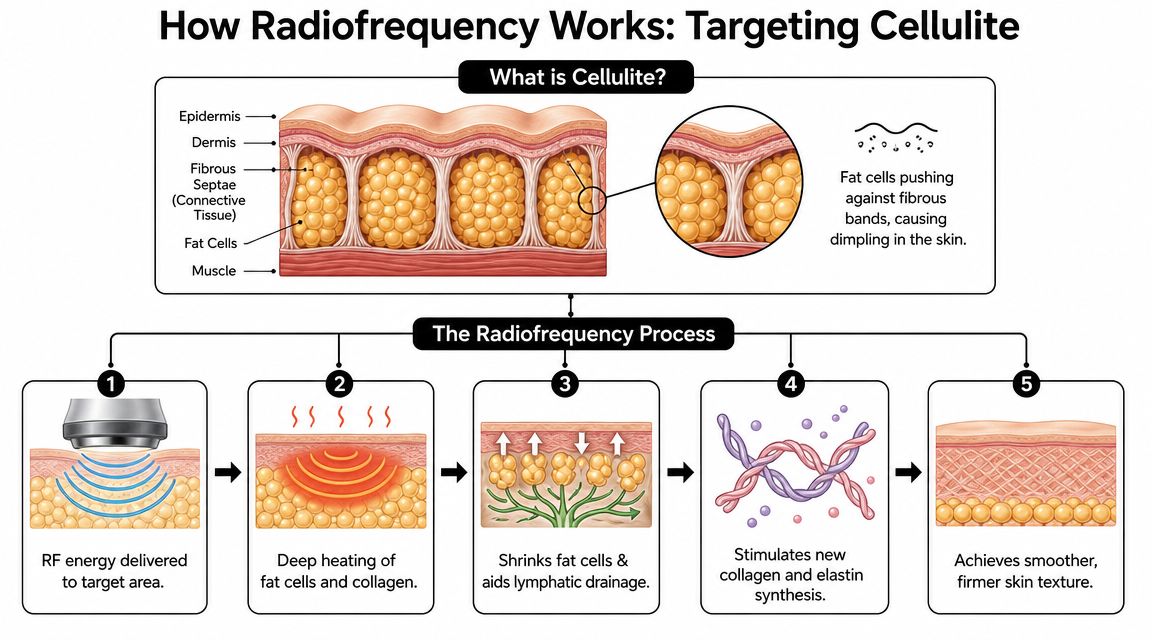
Cellulite makes more sense once you picture what's happening under the skin. The skin sits over fat and connective tissue. In cellulite-prone areas, fat cells push upward while fibrous bands tether downward, creating the uneven, dimpled look people notice on the surface.
What cellulite actually is
Think of a mattress with buttons pulling sections inward while the filling beneath presses upward. The result isn't a flat surface. It's a pattern of dips and bulges.
That's why cellulite doesn't behave like simple volume gain. Two people can be a similar size and have very different skin texture because the structure underneath differs.
How radiofrequency changes the tissue
Radiofrequency delivers high-frequency electromagnetic energy into the tissue, where it converts to heat in the dermal and hypodermal layers. That controlled heat stimulates new collagen and elastin synthesis, improves circulation, and stresses fat cells, which is why it's used for tightening and cellulite reduction (mechanism overview).
The technical range often discussed for RF is roughly 300 kHz to 3 GHz in the broader mechanism literature, but what matters to you as a client is simpler than that. The aim is not to shock the muscles or force them to contract. The aim is to warm the right tissue depth in a controlled way so the skin and supporting structures respond.
Here's what that heat is trying to do:
- Tighten existing collagen so skin can look a little firmer.
- Stimulate new collagen and elastin over time, which helps smoothness and resilience.
- Support circulation and lymphatic flow in the treated area.
- Stress fat cells in the target zone, which can contribute to a more refined contour.
If you're comparing body RF with facial treatments, the core principle is similar even though the settings and treatment goals differ. This piece on expert advice on facial RF gives a useful contrast for understanding how RF is adapted by area.
The best way to think about RF is targeted deep warmth, not surface heat.
Another point people often miss is treatment depth. Not all RF devices work in the same way, and not all are intended for the same tissue level. That's one reason a proper consultation matters more than buzzwords.
For body-focused treatment details, one example of the type of service used in practice is 3D Body RF treatment for the body, which is designed around tightening and cellulite-related concerns.
Your Radiofrequency Treatment Journey at Our Clinic
Most clients arrive with a very similar concern. They've seen cellulite for a long time, they've tried self-care, and they want to know whether a treatment plan can be personalized for their body rather than given as a generic package.
Starting with a measured baseline
The first step is the consultation. That's where the treatment area is assessed properly, your medical background is discussed, and the pattern of concern is identified. Some people have more obvious dimpling. Others have a mix of mild laxity, skin creasing and localised texture change.

A distinctive part of this process is the full 3D body scan. Instead of relying only on visual judgement, the scan creates a baseline view of shape and proportions so treatment can be planned more personally and progress can be checked over time with more objectivity.
That changes the conversation. Rather than “I think it looks a bit better”, you can review measured body data alongside clinical photographs and therapist assessment.
What the treatment session feels like
During treatment, clients usually describe RF as a gradual warming sensation over the area. It shouldn't feel like a sudden shock or a harsh snapping sensation. The handpiece is moved methodically across the chosen zone so the tissue is treated evenly.
A session is normally very straightforward from the client's point of view:
Area review
The therapist checks the treatment plan and confirms the day's focus.Skin preparation
The area is prepared so the applicator moves smoothly and the treatment remains comfortable.Controlled RF delivery
The therapist works across the tissue in a structured pattern, monitoring both comfort and tissue response.Post-treatment check
The skin is reviewed for temporary warmth or redness, and aftercare is discussed.
Clients often say it feels like a deep heated massage, especially on the thighs or buttocks.
Because cellulite treatment is rarely about one isolated factor, some people are also assessed for combination approaches. Where appropriate, cellulite removal treatments may involve more than one modality, depending on whether the main issue is dimpling, fluid retention, skin looseness or stubborn localised fat.
To give you a better feel for how body treatments are presented and explained in clinic settings, this short video helps visualise the treatment environment:
How progress is reviewed over time
Many clinics differ. If treatment is personalised properly, progress reviews shouldn't be an afterthought.
Useful reviews typically look at:
- Texture changes under similar lighting and positioning
- Body scan comparison to track contour and shape changes
- Client feedback on clothing fit, firmness and visible dimpling
- Response by body area, because thighs, buttocks and abdomen may improve differently
One point worth stating clearly is that cellulite rarely changes in a perfectly linear way. Some clients notice skin feeling firmer first. Others see the surface look smoother before they notice any contour difference. Structured follow-up helps stop people judging too early or by the wrong marker.
Clinical Effectiveness and Realistic Results
This is the primary concern. Does RF improve cellulite in a meaningful way, or does it just make the skin feel warm for an hour?
What published evidence shows
A 2023 peer-reviewed clinical study on combined monopolar radiofrequency plus targeted pressure energy in postpubertal women reported improvement in cellulite appearance in the majority of subjects and found measurable circumference reduction that persisted for up to 6 months after treatment (clinical study). The same paper also reported effectiveness across multiple body parts, which is useful because cellulite concerns rarely sit in only one anatomical area.

That doesn't mean every person gets the same outcome. It does mean there is published evidence showing that RF-based body contouring can produce visible and measurable change that lasts beyond the immediate post-treatment window.
The practical takeaway is this:
| What clients often hope for | What's more realistic |
|---|---|
| Completely flawless skin | Smoother texture and reduced visible dimpling |
| Instant final results after one visit | Progressive improvement over a treatment course |
| Identical response in every area | Different areas may respond at different speeds |
Good RF results usually look natural. Skin appears firmer and the dimple pattern looks less obvious, rather than suddenly erased.
Why different RF technologies don't produce identical outcomes
This is a major source of mixed expectations. People often hear “radiofrequency” and assume all RF treatments are interchangeable. They aren't.
Different systems vary by treatment depth, energy delivery and treatment design. That affects who they suit and what kind of result is realistic. For example, some RF devices focus more on skin tightening, while others are intended to affect deeper tissue.
There is also growing interest in microneedle RF for cellulite. Evidence is still emerging, but one study reported 30% to 40% improvement at six months after a single 30-minute session in 28 women (microneedle RF coverage). That's promising, but it's also device-specific and shouldn't be used to claim that every RF format will do the same thing.
A sensible way to judge likely results is to ask:
- What tissue depth is this technology aiming to reach
- Is the concern mostly dimpling, skin laxity, or localised fullness
- How will progress be measured
- Is the treatment plan based on your body, not a standard script
If those questions aren't answered clearly, it's difficult to judge value.
RF Compared to Other Non-Surgical Cellulite Treatments
Radiofrequency is only one option in the body contouring toolbox. The right treatment depends on what's creating the visible issue. Some people mainly need tightening. Others have a stronger fat-related component. Others have prominent dimpling with very little laxity.
How the main options differ
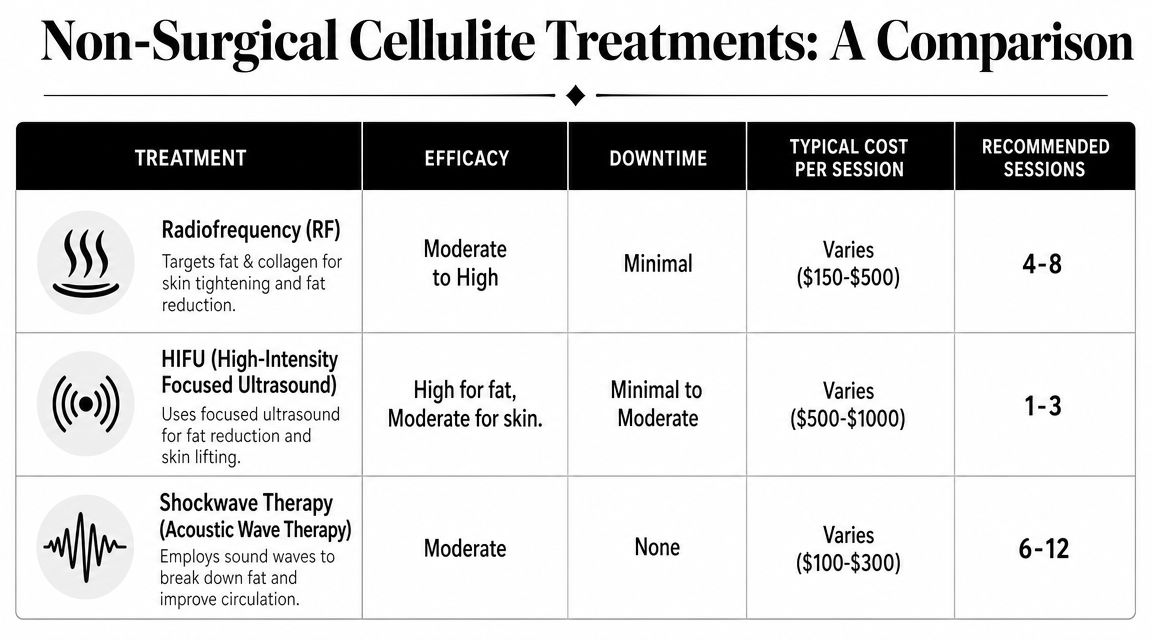
Here's a simple comparison of common non-surgical routes:
| Treatment | Main action | Best suited to | Sensation | Downtime |
|---|---|---|---|---|
| Radiofrequency | Heats tissue to support tightening and smoother texture | Cellulite with a skin-firmness component | Warmth | Usually minimal |
| Shockwave therapy | Mechanical stimulation of the tissue | Texture-focused plans, often as part of a combination approach | Pulsing or tapping | Usually minimal |
| Cryolipolysis | Targets localised fat by controlled cooling | Pinchable fat rather than surface dimpling alone | Intense cold then numbness | Usually minimal |
| HIFU for body | Focused energy at set depths | Selected lifting or contour concerns | Deep heat or brief intensity | Varies by area and settings |
One useful distinction is that cellulite isn't the same as poor muscle tone. That's why devices aimed at muscle contraction sit in a different category. If you want to understand that category better, this overview of BionicGym on muscle stimulation devices helps explain what muscle stimulation is designed to do.
Who usually suits RF best
RF often makes the most sense when cellulite is paired with mild to moderate skin looseness or a crepey surface quality. In those cases, working on collagen support and tissue firmness can be just as important as addressing the dimple pattern.
By contrast, someone with a very obvious pocket of localised fat but relatively smooth skin may be better assessed for a fat-focused treatment first. A person with mixed concerns may benefit from a staged plan.
For broader contour concerns, clinics may also assess fat reduction treatment options alongside cellulite-focused work, because the most suitable route depends on whether your priority is shape, firmness, texture, or all three.
A quick way to frame the difference:
- Choose RF-minded assessment if your main complaint is dimpling plus reduced firmness.
- Consider fat-focused assessment if the bigger issue is a clear bulge rather than uneven texture.
- Ask about combination treatment if you've got overlapping concerns and want a more customized plan.
One treatment can be excellent for one body type and underwhelming for another. Matching the mechanism to the problem is what matters.
Safety Side Effects and Treatment Cost in the UK
Modern RF has a strong safety profile when it's carried out by a trained professional using an appropriate device and suitable settings. The treatment is non-surgical, and individuals typically return straight to normal daily activity afterwards.
Common side effects and sensible precautions
The usual short-term effects are mild and temporary. You may notice warmth, slight redness, or a flushed look in the treated area shortly after the session. Some people also feel that the skin is a little more sensitive for a short period.
A careful consultation matters because not everyone is suitable for every treatment. Your therapist should ask about medical conditions, implants, pregnancy status, skin health, and anything else that could affect safe treatment planning.
A good safety conversation should include:
- Your medical history so contraindications can be screened properly
- Your skin response including sensitivity, bruising tendency or irritation
- Your expectations because unrealistic goals often lead to disappointment, not treatment failure
- Your aftercare such as hydration, skin care and heat exposure guidance if relevant
How cost is usually structured
Costs in the UK vary by clinic, treatment area and whether you're booking a single appointment or a course. The final price usually reflects three things: the size of the area, the complexity of the concern, and how many sessions are recommended for your plan.
Rather than chasing the lowest session price, it's better to ask what is included. A cheaper quote can be less useful if it doesn't include proper consultation time, progress reviews, or objective measurement. For cellulite, value usually comes from thoughtful planning and consistent delivery rather than a one-off bargain session.
Frequently Asked Questions About RF Cellulite Treatment
Can RF be combined with other body treatments
Yes, sometimes. Combination planning can make sense when cellulite sits alongside skin laxity, localised fat or fluid retention. The key is that the plan should be based on your tissue pattern, not on adding treatments for the sake of it.
Do I need to prepare before a session
Usually preparation is simple. Arrive with clean skin on the treatment area, avoid anything that heavily irritates the skin beforehand, and follow any clinic-specific guidance from your consultation.
Who may not be a suitable candidate
Suitability depends on medical history and the device being used. This is why a proper consultation is essential. Your therapist should screen you carefully before treatment starts.
What qualifications should my therapist have
Look for a therapist trained in the device they use, experienced in body contouring assessment, and confident explaining both benefits and limits. If they can't explain why they've chosen a particular RF approach for your cellulite pattern, keep asking questions.
Is microneedle RF automatically better than standard body RF
Not automatically. Evidence for standalone microneedle RF in cellulite is still developing, although one study reported 30% to 40% improvement at six months after a single session. That makes it interesting, but still highly dependent on the device and the concern being treated. The best choice is the one that matches your tissue depth and goal, not the newest-sounding label.
If you'd like a personalised opinion on whether radiofrequency for cellulite is the right fit for your body, 3D Aesthetics Leamington Spa offers consultation-led treatment planning with a full 3D body scan, so your starting point and progress can be assessed more objectively rather than guessed.
← Back to Home