
You catch your reflection in a shop window and the first thing you see is the redness. Maybe it's settled across your cheeks all day, maybe it flares after a glass of wine, central heating, exercise, or a stressful week. You've tried calming creams, “anti-redness” serums, and a careful skincare routine. Some help a little. Some sting. Some do nothing at all.
That's usually the point when people start looking into rosacea laser treatment. Not because they expect a miracle, but because they want a treatment that targets the visible blood vessels and persistent redness more directly than a cream sitting on the surface ever can. In clinic, that's often the shift that matters most. Moving from trial-and-error to a plan based on what the skin is doing.
Laser treatment isn't a cure for rosacea. It doesn't switch off the condition forever. What it can do is reduce the visible signs that make people feel self-conscious, and in some cases it can also calm some of the burning and stinging that make rosacea feel as uncomfortable as it looks.
Table of Contents
- Tired of Rosacea Controlling Your Life?
- What Is Rosacea and How Do Lasers Help?
- Your Laser and Light Therapy Options Explained
- Are You a Suitable Candidate for Laser Treatment?
- Your Treatment Journey From Start to Finish
- Risks, Costs, and Realistic Results
- Alternatives and Complementary Treatments
- Frequently Asked Questions and Your Next Step
Tired of Rosacea Controlling Your Life?
A lot of rosacea patients describe the same cycle. Their skin looks manageable for a while, then one trigger sets it off. Heat, wind, stress, alcohol, spicy food, over-exfoliation, even a warm office can be enough. By the end of the day, the face feels hot, looks flushed, and makeup either won't sit properly or only draws more attention to the texture and redness.
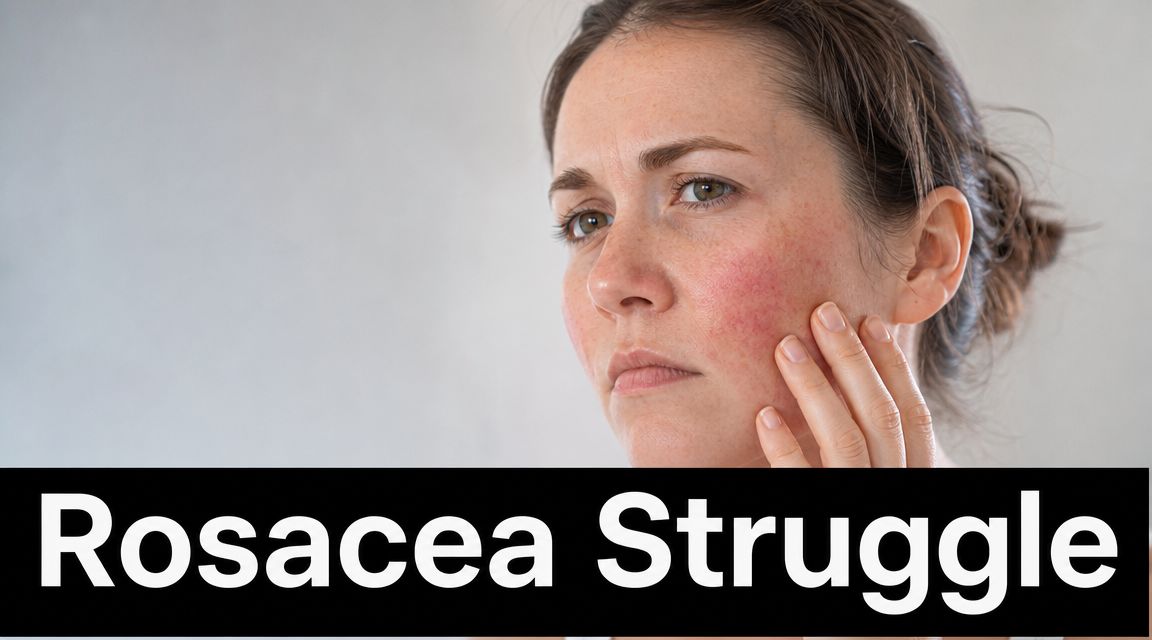
What makes rosacea especially frustrating is that it isn't just about appearance. Many people feel burning, tightness, tenderness, or sudden flushing that seems to happen without warning. It can make skincare feel risky and social situations feel tiring. When that's been going on for months or years, it's understandable to feel sceptical about any new treatment.
Laser and light therapy offer a different approach because they don't try to “cover” redness. They target the visible vessels and background vascular activity contributing to the look of rosacea. For the right person, that's often the first treatment that feels logical rather than cosmetic fluff.
Rosacea responds best when expectations are honest. The aim is improvement, control, and a calmer-looking skin surface, not perfection.
That distinction matters. If you're hoping one session will erase every flush forever, laser will disappoint you. If you want a more stable baseline, less obvious broken capillaries, and skin that feels easier to manage, rosacea laser treatment can be a very sensible step.
What Is Rosacea and How Do Lasers Help?
Rosacea is a long-term inflammatory skin condition that commonly shows up as facial redness, flushing, and visible thread veins or broken capillaries. Some people also develop bumps, sensitivity, or a hot, prickly feeling. The pattern varies from person to person, which is why one person's rosacea looks very different from another's.
What's happening under the skin
The easiest way to picture it is this. Imagine tiny facial blood vessels behaving like overstretched elastic. At first they expand and settle back down. Over time, some stop shrinking properly. They stay more visible, sit closer to the surface, and create that persistent red look across the cheeks, nose, or chin.
Those visible vessels are often called telangiectasia. They can look like fine red lines or a diffuse network of redness. Laser treatment is effective for these, because it's designed to target vascular structures rather than soothe the skin's surface for a few hours.
How light energy targets redness
The technical term is selective photothermolysis, but the simple version is much easier to understand. A specific wavelength of light is directed into the skin. That light is absorbed by haemoglobin, the red pigment inside blood vessels. The vessel heats up in a controlled way, the wall is damaged, and the body gradually clears it away.
The goal isn't to burn the skin. The goal is to deliver energy where the unwanted vessel is, while keeping surrounding tissue as undisturbed as possible. That's why wavelength choice, pulse settings, cooling, and skin assessment all matter.
A useful way to think about it is:
- The target is red pigment: The treatment looks for blood-rich vessels.
- The energy is controlled: Settings are adjusted to the vessel depth, size, and skin response.
- The body finishes the process: Once treated, the vessel is broken down naturally over time.
Practical rule: Lasers usually work best when the redness is being driven by visible vessels and fixed vascular change, not when the main problem is a temporary flare caused by a harsh product used the night before.
That's also why consultation matters so much. A face can look “red” for several different reasons. Rosacea laser treatment is strongest when the redness has a clear vascular component.
Your Laser and Light Therapy Options Explained
Not all redness treatments are the same. Some use broad-spectrum light. Some use a single laser wavelength. Some are better for widespread flushing, while others are better for distinct capillaries around the nose or cheeks.
To make that easier to understand, it helps to look at each technology by what it does.
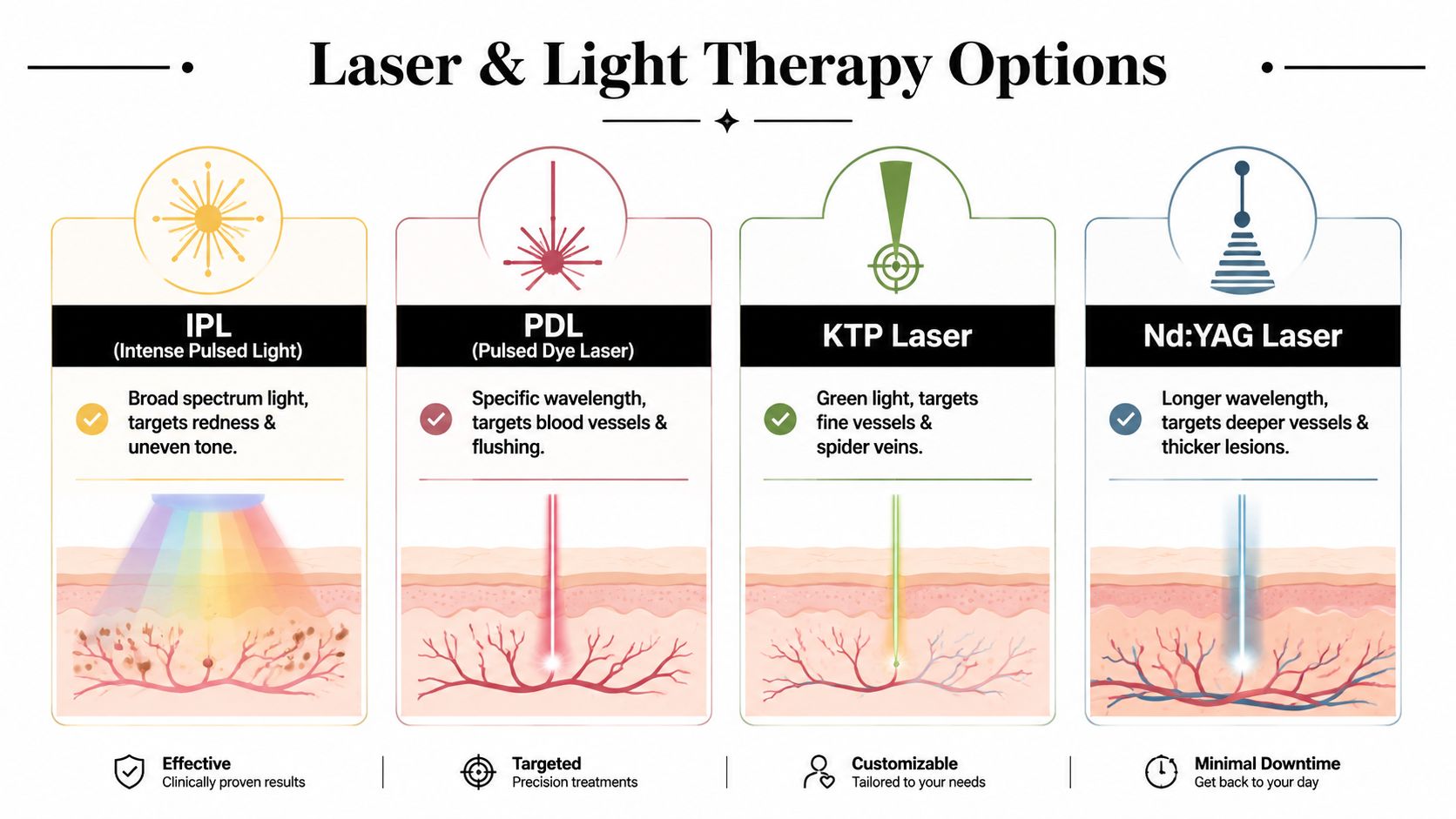
How the main technologies differ
IPL uses broad-spectrum light rather than a single laser beam. It's often chosen when redness is more diffuse and the concern isn't only individual capillaries. It can be a good fit for people who want an overall improvement in redness and tone, though results can depend heavily on skin selection and parameter choice.
PDL, or pulsed dye laser, is often the technology people hear about first for rosacea. It's known for targeting superficial vascular redness and visible vessels. In practice, it's a strong option when flushing and facial vessels are the main issue.
KTP laser works well on finer, more superficial red vessels. I tend to think of it as a precise option for smaller vascular markings rather than broad background redness.
Nd:YAG penetrates to greater depths. That makes it useful for deeper or larger vessels, though it may not be the first choice for every rosacea presentation. It often comes into the conversation when vessel depth or skin type changes the treatment plan.
A lot of people also want a lower-heat, supportive option between or alongside vascular treatments. If your skin is reactive and you're building a broader management plan, this 2026 guide to LED therapy for rosacea gives a helpful overview of where LED can fit. In clinic settings, some patients also ask about Dermalux LED therapy as a complementary route for calming reactive skin.
A short explainer can also help you visualise the differences in treatment style and targeting.
Comparing Rosacea Laser and Light Treatments
| Technology | How It Works | Best For | Sensation |
|---|---|---|---|
| IPL | Broad-spectrum light targets pigment and vascular redness across a wider area | General redness and uneven tone | Warm flashes, mild snapping |
| PDL | A vascular-focused wavelength targets haemoglobin in superficial blood vessels | Facial vessels, flushing, persistent vascular redness | Sharp elastic-band snap with heat |
| KTP Laser | Green light is absorbed well by superficial red vessels | Fine thread veins and small visible capillaries | Quick, focused sting |
| Nd:YAG Laser | Longer wavelength reaches deeper vascular structures | Deeper vessels and thicker vascular lesions | Deeper heat with brief snaps |
Where 3D Vasculase fits
Some clinics now use more modern vascular platforms to treat redness and visible vessels with a different balance of precision, comfort, and vessel depth. One example is 3D Vasculase, which is designed for vascular concerns such as broken capillaries and thread veins. At 3D Vasculase, the treatment is positioned as a vascular option for visible red veins and related lesions rather than a generic “redness facial”.
That matters because the right device should match the job. If someone has broad flushing with no obvious vessel network, one light-based route may make more sense. If they have stubborn capillaries around the nose and cheeks, a more vessel-specific platform may be the better choice.
Are You a Suitable Candidate for Laser Treatment?
The best candidates usually aren't just “people with red skin”. They're people whose redness has a vascular pattern, whose skin is stable enough to treat, and whose expectations are sensible.
Who tends to do well
Rosacea laser treatment tends to make the most sense if you have:
- Persistent facial redness: Especially when it lingers between flare-ups rather than disappearing completely.
- Visible broken capillaries: Fine thread veins on the cheeks or around the nose usually respond more predictably than vague, temporary flushing.
- Burning or stinging alongside redness: A JAMA Dermatology rosacea study found that after pulsed dye laser treatment, 24 of 32 patients no longer reacted to a lactic acid stinger test, and overall symptom scores fell from 6 ± 1.9 before treatment to 1 ± 1.6 after treatment. That's useful because it shows some vascular laser treatments can improve hypersensitivity as well as appearance.
Someone with those symptoms often benefits from a proper consultation because the problem is broader than “looking flushed”. Comfort matters too.
If your rosacea feels hot, stingy, and reactive as well as red, that's clinically relevant. It helps shape the treatment plan.
Who needs extra caution
Laser isn't appropriate for everyone on every day. Treatment may need to be delayed or adjusted if you're pregnant, using medications that increase photosensitivity, dealing with an active skin infection, or have severely irritated skin from recent exfoliation or overuse of actives.
Skin tone matters as well. Fitzpatrick skin type helps practitioners assess pigment risk and choose safer settings. Darker skin tones can absolutely be treated in many cases, but device selection, wavelength choice, and cautious testing become even more important. That's why a patch test isn't admin. It's part of safe practice.
A good consultation should also ask what bothers you most. Background redness, capillaries, flushing, bumps, stinging, or all of the above. Those details shape whether laser is the main answer, part of the answer, or not the best first step.
Your Treatment Journey From Start to Finish
Most anxiety about rosacea laser treatment comes from not knowing what the process feels like. Once people know the order of events, it usually feels much more manageable.
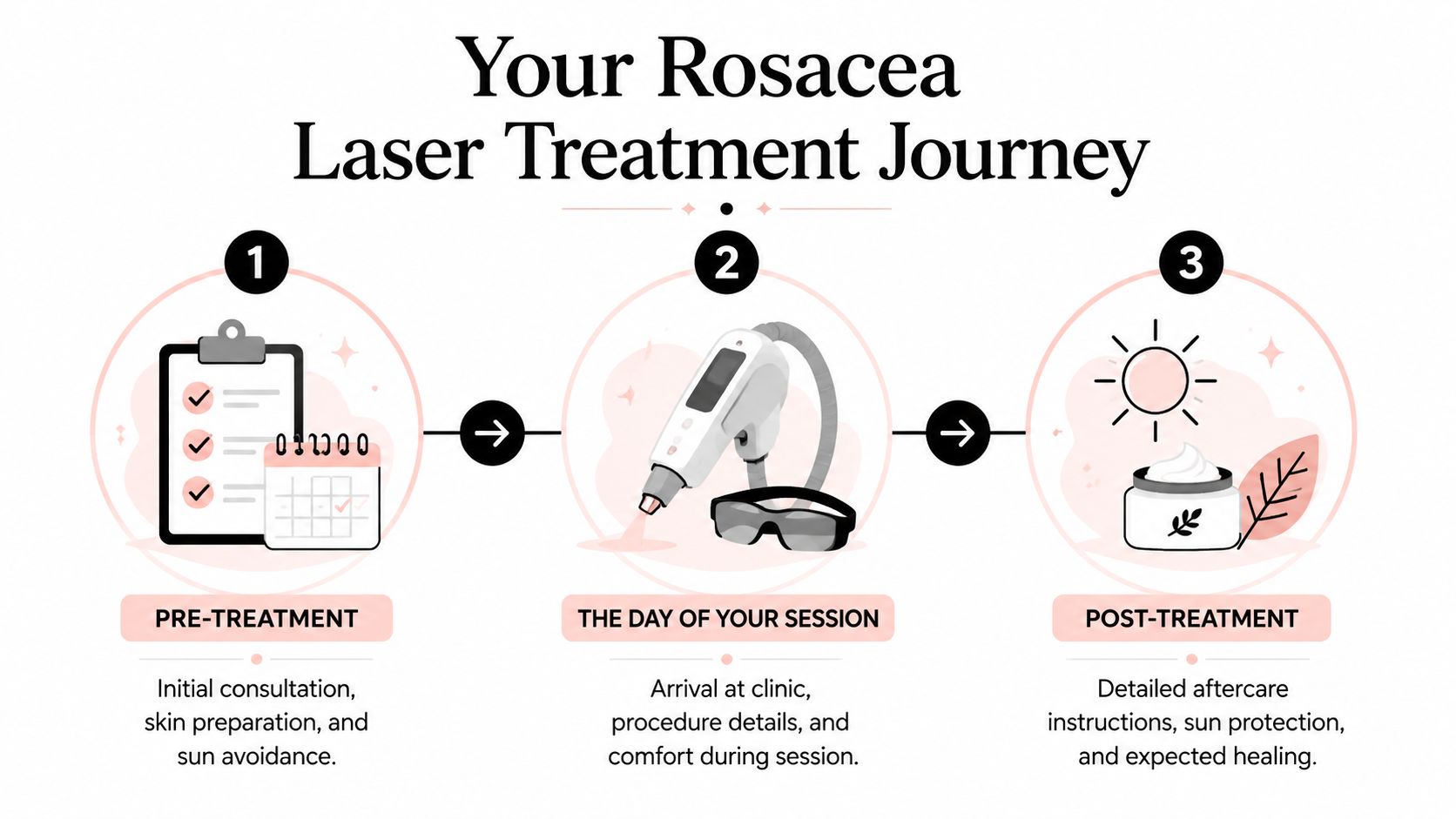
Before your appointment
Your preparation starts before you're on the treatment bed. The main aim is to make the skin as calm and predictable as possible.
Common pre-treatment advice includes:
- Avoid heavy sun exposure: Recently tanned or sun-irritated skin is harder to treat safely.
- Pause strong actives if advised: Retinoids, exfoliating acids, and other irritating products may need to be stopped for a short period beforehand.
- Come to consultation ready to discuss triggers: Heat, alcohol, exercise, skincare, and seasonal flares can all influence timing.
- Have a patch test when recommended: This helps check skin response and supports safe parameter selection.
For many people in the UK, timing matters more than they expect. If you know summer sun or winter wind reliably worsens your rosacea, plan treatment windows around that rather than booking reactively in the middle of a flare.
What happens on the day
On the day itself, the process is usually straightforward. Your skin is cleansed, photographs may be taken for progress tracking, and you'll wear protective eyewear. The practitioner then works methodically across the treatment area, adjusting technique depending on whether the concern is diffuse redness, discrete capillaries, or a mix of both.
The sensation varies by device. It is often described as a quick snap, flick, or pulse of heat. It can be uncomfortable in sensitive areas such as around the nose, but it's usually brief and very tolerable when settings are chosen properly.
After treatment, it's common to see temporary redness or mild swelling. Some vessels can look darker or more obvious before they fade, which often surprises first-time patients.
Skin that looks a bit pink and feels warm straight after treatment isn't necessarily a problem. It's often a normal early response.
If you like reading product-focused aftercare advice, this overview of Skinstitut Laser Aid benefits is a useful example of the kind of post-procedure support products people often look into after laser sessions.
Aftercare that protects your result
Aftercare is simple, but it matters.
For the first part of recovery, keep the routine boring. Use a gentle cleanser, a bland moisturiser, and reliable sun protection. Avoid heat-heavy workouts, hot showers, saunas, and aggressive skincare until the skin has settled.
A sensible aftercare checklist looks like this:
- Keep products minimal: Skip scrubs, acids, and retinoids until your practitioner says the skin is ready.
- Protect from UV exposure: Daily SPF is not optional after vascular treatment.
- Don't chase dryness with active products: If the skin feels tight, choose barrier support instead of exfoliation.
- Ask before restarting makeup: Many people can return to it fairly soon, but it should feel comfortable rather than forced.
Patients cope well when they know the skin may look temporarily more “treated” before it looks clearer.
Risks, Costs, and Realistic Results
Rosacea laser treatment works best when the goal is clear. It is usually strongest on visible vessels and fixed vascular change. It is less impressive when someone wants every flush, bump, and trigger response to disappear.
What kind of result is realistic
The clearest benchmark comes from the American Academy of Dermatology guidance on lasers and lights for rosacea. It reports that most patients see a 50% to 75% reduction in visible blood vessels after 1 to 3 treatments, with sessions typically spaced 3 to 4 weeks apart. The same guidance notes that reduction in general redness is often more modest, with many small studies showing only about 20% improvement in overall background redness.
That distinction is one of the most important things patients can understand. If your main concern is broken capillaries, treatment can be very worthwhile. If your main concern is diffuse flushing with no clear vessel pattern, results may feel more subtle.
Possible side effects and trade-offs
Most side effects are temporary and manageable, especially in experienced hands. Common short-term reactions include redness, warmth, swelling, and temporary sensitivity. These are usually expected treatment responses rather than signs something has gone wrong.
Less common but more serious risks can include blistering, pigment changes, or scarring. The chance of that rises when the wrong device is used, the skin is poorly assessed, aftercare is ignored, or treatment is carried out too aggressively.
How to think about cost
I won't invent a “typical UK price” because fees vary widely by clinic, technology, treatment area, practitioner experience, and whether you need a one-off vessel treatment or a course. The useful way to think about cost is per session and by treatment objective.
Ask these questions instead:
- What exactly is being treated: diffuse redness, nose capillaries, cheeks, or full face?
- Which technology is being used: not all vascular devices are priced the same.
- Is consultation and patch testing included: that changes value, not just the headline fee.
- What's the maintenance plan: rosacea is chronic, so future upkeep may matter.
The cheapest session isn't always the most economical if it isn't the right treatment.
Alternatives and Complementary Treatments
Laser can be very helpful, but it doesn't replace the basics of rosacea care. This is still a chronic skin condition, and long-term control usually comes from combining approaches rather than relying on one treatment category.
What laser does and doesn't replace
Prescription topicals and oral medication still matter for many patients. If bumps, pustules, or inflammatory flares are a major part of your rosacea, medical management is often part of the plan. Trigger control matters too. Sun exposure, overheating, alcohol, spicy food, stress, and irritating skincare can all keep the cycle going.
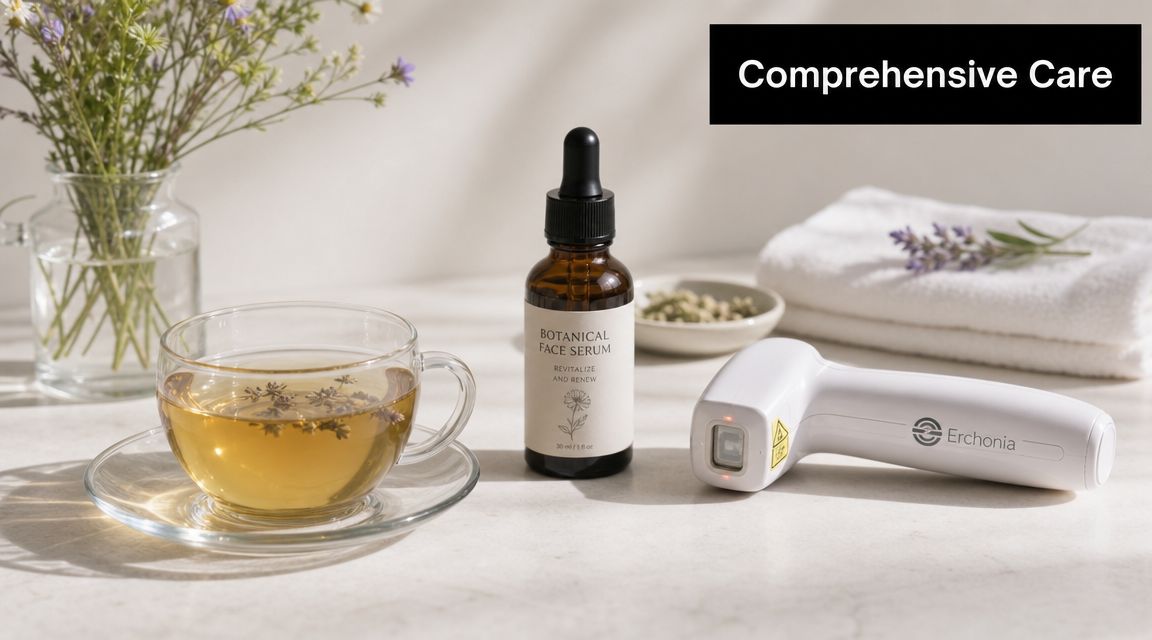
The best results usually come from combination care
Think of laser as the treatment that helps clear what is already visible, especially stubborn vessels and established redness. Then think of skincare, prescriptions, and lifestyle changes as the tools that help prevent the next wave from building as quickly.
That's why a strong home routine matters so much. If you're rebuilding a reactive skin barrier after treatment, this guide on why a skincare routine is so important is a useful reminder that consistency often beats complexity.
A balanced rosacea plan often includes:
- Trigger management: Work out what reliably worsens your skin, then reduce those exposures where realistic.
- Barrier-first skincare: Gentle cleansing and non-irritating moisturising usually beat aggressive “active” routines.
- Medical support when needed: Especially if inflammation and spots are part of the picture.
- Procedural treatment for visible vessels: Where redness has become structurally embedded in the skin.
That's the mature way to look at rosacea. Not as one treatment versus another, but as a layered condition that often needs layered care.
Frequently Asked Questions and Your Next Step
Does it hurt
Rosacea laser treatment is generally described as uncomfortable rather than painful. It's often compared to a quick elastic-band snap with some heat. Sensitive areas, especially around the nose, can feel sharper. The sensation is brief, and good technique makes a big difference.
Are results permanent
The vessels treated can be cleared, but rosacea itself is chronic. That means new vessels and redness can develop over time if your skin remains prone to flushing and vascular reactivity. Many patients think of laser as a reset and maintenance tool, not a once-in-a-lifetime cure.
When can I wear makeup again
That depends on how your skin looks and feels after treatment. If there's significant warmth, sensitivity, or swelling, leave it alone until the skin has settled. If recovery is mild, makeup can often be resumed fairly soon, but only if application feels comfortable and you're not rubbing the skin.
A general guide can only take you so far. The right device, settings, timing, and aftercare depend on your skin tone, vessel pattern, sensitivity, and what you're trying to improve. That's why an in-person assessment matters.
If you're considering 3D Aesthetics Leamington Spa, the sensible next step is to book a complimentary, no-obligation consultation. A proper assessment can tell you whether rosacea laser treatment is the right fit, what kind of improvement is realistic for your skin, and whether a broader plan would serve you better.