

You've tried the acids. You've switched cleansers. You've cut back on actives because your skin felt tight, reactive, or completely fed up. If that sounds familiar, you're not alone. Many people start looking into dermalux led therapy when they reach the point where they want results, but they don't want another harsh treatment, long recovery, or a plan that feels impossible to stick to.
A common pattern in clinic is this. Someone comes in with recurring breakouts, lingering redness, or skin that looks tired even when they're doing “all the right things”. They don't always need something aggressive. Often, they need a treatment that supports skin function, calms inflammation, and works well alongside a sensible home routine or other in-clinic procedures.
That's where Dermalux sits. It's gentle, structured, and clinically used for concerns such as acne, redness, and skin rejuvenation. It also feels very different from many treatments people associate with aesthetic clinics. There's no scraping, no heat-heavy recovery, and no trying to hide for days afterwards. For the right person, it can be one of the easiest treatments to commit to because the sessions are straightforward and the downtime is minimal.
Table of Contents
- Begin Your Journey to Radiant Skin
- What Is Dermalux LED Phototherapy
- The Science Behind the Light
- Clinical Benefits and Suitability
- Your Dermalux Session What to Expect
- Dermalux vs Other Facials We Offer
- Maximising Your Results and Aftercare
Begin Your Journey to Radiant Skin
A lot of clients first ask about dermalux led therapy when they feel stuck between two extremes. On one side, they've got active skin concerns that need proper attention. On the other, they're wary of doing too much and making things worse. That's especially true with adult acne, diffuse redness, post-treatment irritation, or skin that has started to look dull and less resilient.
One of the reasons LED phototherapy has become such a practical option in clinic is that it doesn't ask the skin to “fight through” discomfort. It supports repair. For some people, that means helping settle inflammation around breakouts. For others, it's about encouraging a fresher, healthier look when the skin has become tired, stressed, or slower to recover.
The kind of client it suits well
Dermalux often makes sense if any of these sound familiar:
- Breakouts keep flaring: especially when your skin also feels sore, inflamed, or easily irritated.
- Redness hangs around: not just a temporary flush, but a background level of visible sensitivity.
- You want rejuvenation without drama: something low downtime that fits into real life.
- You're already having other treatments: and want support for recovery rather than another standalone procedure.
Practical rule: If your skin barrier already feels compromised, a supportive treatment usually makes more sense than adding another aggressive exfoliating step.
That doesn't mean Dermalux is a miracle fix for every concern. It isn't. It works best when the treatment choice matches the problem. If someone wants major lifting, structural tightening, or deep resurfacing, LED won't replace more intensive options. But if the goal is calmer, stronger, healthier-looking skin with minimal interruption to your routine, it deserves serious consideration.
Why people stay consistent with it
Clients tend to stick with dermalux led therapy because the experience is simple and manageable. Sessions are comfortable, the treatment doesn't rely on visible skin trauma, and it fits neatly into a broader skin plan.
That matters. The most sensible treatment in the world won't help much if it's too disruptive to continue.
What Is Dermalux LED Phototherapy
Dermalux is a form of LED phototherapy. In simple terms, it uses carefully selected light wavelengths to support how skin cells function. A useful way to think about it is “photosynthesis for your skin”. Plants use light to create energy. Skin cells don't photosynthesise, of course, but they do respond to specific light wavelengths in a way that supports repair and regeneration.
The first thing to clear up is safety. Dermalux is a medically certified, non-UV phototherapy treatment, so it isn't a tanning bed and it won't expose your skin to UV. UK clinic guidance highlights that it does not emit UV rays, which is central to its safety profile because it avoids the risks associated with tanning, burning, or hyperpigmentation from UV exposure, and it uses Blue (415nm), Red (633nm), and Near-Infrared (830nm) as its core wavelengths with a typical structured course of around 12 sessions, often twice a week according to UK clinical guidance on Dermalux LED treatment.
The three lights in practical terms
Each light has a different job.
- Blue light is commonly used where blemishes and congestion are part of the picture.
- Red light is used when the aim is skin rejuvenation and visible skin quality support.
- Near-infrared light works at a deeper level associated with repair and recovery.
That's why dermalux led therapy can be relevant to very different concerns without being random or one-size-fits-all. The settings are chosen according to what the skin needs.
Why clinic-grade treatment matters
At-home LED devices have made people more familiar with this category, which is helpful. But professional treatment is about controlled delivery, accurate wavelengths, and a treatment plan that reflects your skin condition rather than a general setting.
If you're comparing options and want a broader look at innovative light therapy for skin rejuvenation, it's worth understanding the difference between consumer devices and medical or clinic-led systems. The gap isn't just convenience. It's precision, consistency, and how the treatment is integrated into a proper skin plan.
Dermalux works best when it's treated as a course-based therapy, not a random add-on once every so often.
That's one of the biggest misunderstandings around LED. People often expect a single appointment to do the work of a programme. In clinic, better results usually come from consistency.
The Science Behind the Light
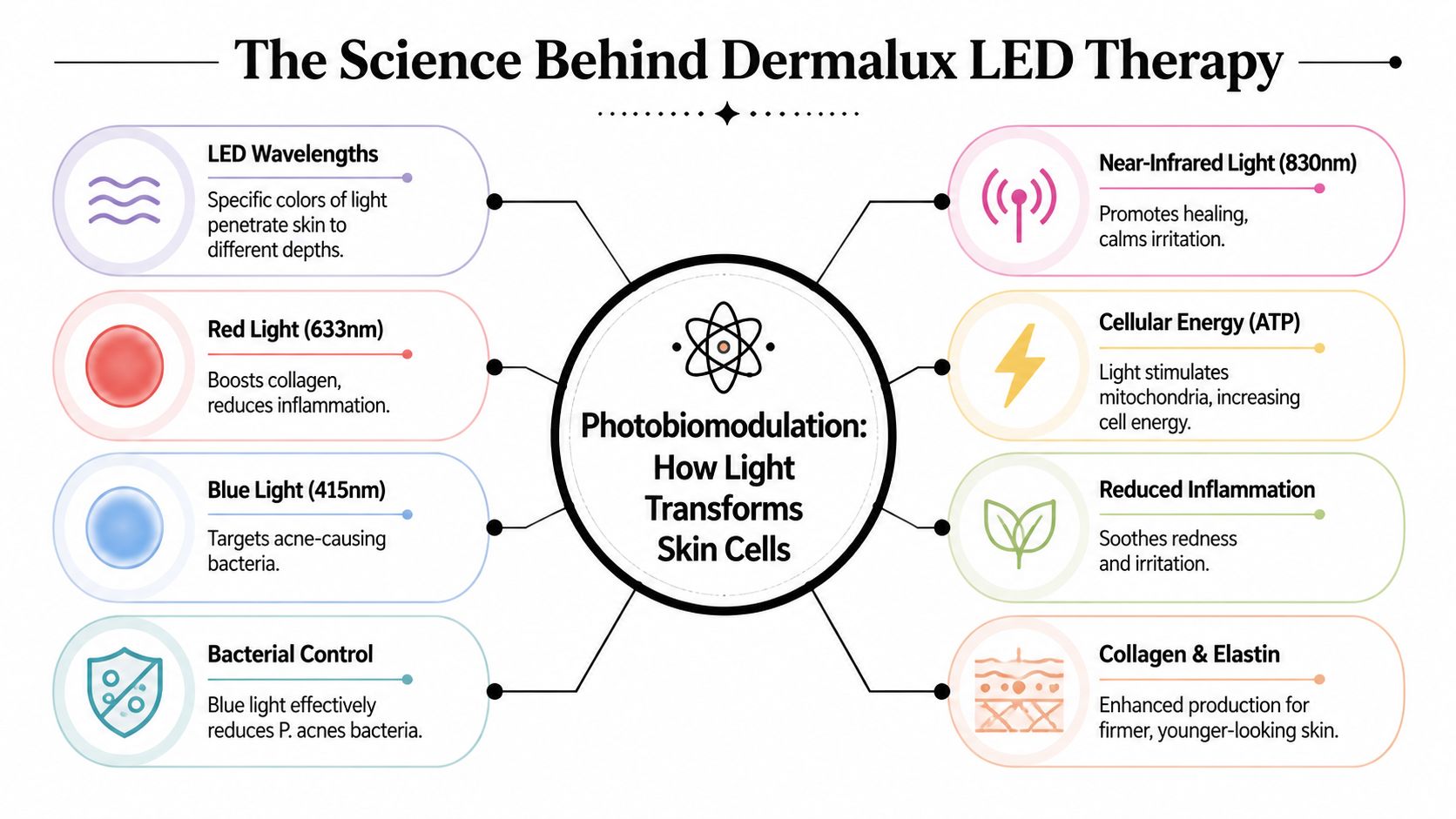
Photobiomodulation sounds technical, but the basic idea is straightforward. Specific wavelengths of light are delivered to the skin, and cells respond by using that light energy in ways that support their normal repair and renewal processes. With Dermalux, the clinical value comes from precision. The Dermalux Flex MD is described as a Class IIa medical device using 415nm blue, 633nm red, and 830nm near-infrared light for targeted clinical outcomes rather than a cosmetic-only effect, as outlined in the Dermalux Flex MD device overview.
Blue light and blemish control
Blue light at 415nm is commonly selected when acne or breakout activity is part of the concern. In practical clinic terms, it's used because it acts on blemish-causing bacteria. That's why it can be helpful for clients whose skin is not only oily or congested, but actively inflamed.
Not every acne treatment route needs to be exfoliating or drying. Some acne-prone clients already have an impaired barrier from overuse of strong products. Blue LED can offer a different route that supports the treatment plan without piling on irritation.
Red light and skin renewal
Red light at 633nm is linked with collagen and elastin stimulation. That makes it relevant when clients are concerned about dullness, early lines, or a general loss of skin vitality rather than a single isolated issue.
In the treatment room, red light is often the part people associate with “glow”, but that word can undersell what it's doing. The core value is support for healthier skin function over time. Skin that repairs better often looks better too.
If your main goal is healthier texture and a fresher overall look, red light usually makes more sense than chasing quick-fix facials every few weeks.
Near-infrared light and deeper repair
Near-infrared at 830nm is used for deep cell repair and wound-healing pathways. Dermalux becomes especially useful as a support treatment around other procedures or during phases when the skin is reactive and needs calming.
Since this wavelength penetrates further, it is often relevant to recovery-focused plans. That can include post-procedure support or skin that is struggling with irritation and prolonged inflammation.
Why the exact wavelength matters
Not all LED treatment is equal just because the device lights up. The wavelength has to be accurate enough to deliver a meaningful response in the target tissue. The Flex MD material also states a tight wavelength tolerance and notes treatment times can be adjusted across protocols, which is one reason clinic-grade treatment feels more purposeful than cosmetic lamp exposure.
In short, dermalux led therapy isn't about shining coloured light at the face and hoping for the best. It's a regulated light-based treatment built around specific biological targets.
Clinical Benefits and Suitability
The most useful way to judge Dermalux is by asking where it fits well, and where it doesn't. It's strongest as a supportive, low-downtime adjunct for concerns involving inflammation, skin recovery, and rejuvenation. UK clinic commentary also reflects the common questions clients ask most often, especially around acne, rosacea, and whether LED is enough on its own, with the practical answer being that it's usually best positioned as part of a broader plan rather than a cure-all, as noted in this UK clinic discussion of Dermalux for acne and rosacea support.

For acne and breakout-prone skin
For inflammatory acne, Dermalux can be a very sensible addition. The keyword there is addition. If someone has persistent or hormonally driven acne, LED may help calm inflammation and support clearer skin, but it usually works best alongside a proper skincare routine and, where appropriate, medical advice.
What usually doesn't work is treating LED as permission to keep using a chaotic home routine. If the skin is being over-cleansed, over-exfoliated, or constantly switched between products, the benefits are harder to maintain.
For redness and rosacea support
Rosacea-prone skin often needs a calm, measured approach. That's one reason LED has appeal. It can support skin that doesn't tolerate aggressive heat or repeated resurfacing well.
For this group, realistic expectations are essential. Dermalux may help with flare support and visible redness management, but it doesn't replace diagnosis, trigger management, or prescription care where that's needed.
For skin rejuvenation and recovery
When the goal is brighter, fresher, more resilient skin, red and near-infrared settings are often part of the plan. This is also where LED complements other facial treatments very well. Used sensibly, it can support recovery after procedures such as 3D microneedling by helping calm the skin and supporting the healing phase.
That complementary role is one of its biggest strengths. It doesn't have to compete with every other treatment. Sometimes its job is to make the overall plan work better.
Who needs extra caution
Dermalux is suitable for many people, but not everyone should go straight in without screening. A proper consultation matters if you have any history or medication that could affect light sensitivity.
Common situations that need extra care include:
- Light-sensitive epilepsy: treatment may not be appropriate.
- Photosensitising medication: some medicines can increase light sensitivity.
- Active skin conditions needing assessment: especially if the diagnosis isn't clear.
- Very recent treatment changes: new products or procedures can affect timing.
The safest LED treatment is the one matched to your skin history, not the one booked in a hurry.
Your Dermalux Session What to Expect
Clients are often pleasantly surprised by how uncomplicated a Dermalux appointment feels. There's no dramatic build-up. You arrive, your skin is assessed, and the session is planned around your concern rather than using the same setting for everyone.

At the appointment
The treatment itself is usually straightforward. Skin is cleansed first so there's no barrier between the light and the surface of the skin. You'll be made comfortable, given protective eyewear, and positioned under the device while the selected light programme runs.
Clients often ask whether it feels hot or claustrophobic. In most cases, it feels relaxing. The session is time under the LED light while the skin receives the chosen wavelength combination.
A single treatment is commonly described by UK clinics as taking 20 to 30 minutes, and a course is usually 6 to 12 sessions, with benefits that may last for several months after a completed course according to this UK guide to Dermalux treatment planning.
How many sessions do you usually need
This is the question people really want answered. The honest answer is that one treatment can be a nice boost, but Dermalux is generally a cumulative therapy. That means the skin tends to respond better to a planned course than to occasional, disconnected visits.
In practice, the usual pattern is:
- Initial course: often a run of sessions close enough together to build momentum.
- Concern-led planning: acne, redness, and rejuvenation don't always follow the same pattern.
- Maintenance: once the main course is complete, some clients continue at intervals that suit their skin.
For inflammatory conditions, spacing can matter as much as the treatment itself. A structured course is what gives the skin a fair chance to respond.
Before booking, some people like to see the treatment in action. This short video gives a useful sense of the setup and experience:
Consistency is usually what separates “that was nice” from “my skin is genuinely improving”.
Dermalux vs Other Facials We Offer
Dermalux does a specific job, and it helps to compare it against other options rather than assuming every facial sits in the same lane. If your main concern is hydration, resurfacing, collagen induction, or lifting, another treatment may be the better first choice. If your priority is calming inflammation, supporting recovery, or maintaining skin health with minimal interruption, Dermalux often fits well.
The easiest way to think about it is by treatment goal.
Comparing Facial Treatments at 3D Aesthetics
| Treatment | Primary Goal | Sensation | Downtime | Best For |
|---|---|---|---|---|
| Dermalux LED Therapy | Support skin repair, calm inflammation, improve overall skin quality | Gentle light exposure, generally relaxing | Minimal | Acne-prone, sensitive, red, or post-procedure skin |
| 3D-HydrO2 Facial | Deep cleansing, hydration, skin freshness | Wet facial with active infusion and exfoliation feel | Minimal | Dullness, dehydration, congestion, event prep |
| 3D Dermaforce Microneedling | Collagen induction and texture improvement | More active treatment sensation than LED | Some recovery expected | Acne scarring, texture, pores, rejuvenation |
| HIFU Non-Surgical Facelift | Structural tightening and lifting support | More intense, deeper treatment feel | Usually low, but not a pampering facial | Skin laxity, contour support, lifting goals |
If your skin is dry, congested, and in need of a glow, a 3D-HydrO2 facial treatment option may be more relevant than LED on its own. If you're targeting acne scarring or textural change, microneedling often takes the lead, while LED may play a supporting role around it.
Where Dermalux has the edge
Dermalux tends to stand out in three situations:
- Sensitive skin clients: when stronger treatments feel like too much.
- Recovery support: especially around treatment plans that create temporary inflammation.
- Maintenance plans: for clients who want regular skin support without obvious downtime.
That distinction matters because some clients choose a treatment based on what sounds advanced, not on what their skin needs right now. A well-timed supportive treatment can be more useful than a more aggressive option used at the wrong moment.
If you're researching broader treatment choices, this piece on microneedling outcomes for ethical beauty practices is useful for understanding how collagen-focused treatments differ from gentler support-led options like LED.
Maximising Your Results and Aftercare
The treatment itself is only part of the outcome. Skin responds best when the rest of the routine supports what the clinic session is trying to achieve. That doesn't mean a complicated ten-step regime. It usually means being consistent and not sabotaging progress with irritation.

Before your session
Keep preparation simple.
- Arrive with clean skin if you can: less residue means a smoother start to treatment.
- Mention medication changes: especially anything new since your last appointment.
- Flag active irritation: don't assume redness, dryness, or a reaction is irrelevant.
- Skip the urge to over-treat: strong exfoliants right before a calming appointment are rarely helpful.
Aftercare for lasting radiance
After LED, the main aim is to keep the skin settled and supported.
- Use a gentle routine: avoid throwing strong acids or retinoids at skin that's trying to recover.
- Stay consistent with hydration: dehydrated skin tends to look flatter and feel more reactive.
- Protect the skin barrier: use products that support comfort rather than chasing instant intensity.
- Be diligent with SPF: daily protection helps preserve progress and supports overall skin health.
If your skincare feels disorganised, it's worth getting the basics in place before judging any treatment too quickly. A structured routine often makes every clinic treatment work harder, and this guide on why a skincare routine matters is a useful starting point.
One final point matters more than most. Don't measure dermalux led therapy only by the mirror the next morning. Its true value is usually in steadier skin behaviour over time. Less reactivity. Better recovery. More consistent skin quality.
If you're considering 3D Aesthetics Leamington Spa, the next step is a consultation where your skin concerns, treatment history, and goals can be assessed properly before deciding whether Dermalux fits as a standalone course or part of a broader plan.
Powered by Outrank app
← Back to Home