
A lot of people start looking into colored tattoo removal at a very ordinary moment. You catch sight of an old bright tattoo in the mirror, or in a photo, and realise it no longer fits the person you are now. Sometimes it's the design. Sometimes it's the placement. Sometimes it's that the colours still shout when you'd rather they whispered.
That feeling is common, and it doesn't mean you made a bad decision at the time. It means life moved on. The good news is that modern laser treatment gives you options that didn't exist when removal relied on harsher methods that could leave obvious skin changes.
If you're weighing up tattoo regret, the most useful thing to know is this. Removing a colourful tattoo is possible, but it isn't one simple treatment with one simple machine. The result depends on the relationship between ink colour, laser wavelength, and your skin type. That's where many online guides oversimplify the process.
This guide is written in the same way I'd explain it in clinic. Plain English. No false promises. No pretending every colour behaves the same. If you understand the science well enough to ask better questions at consultation, you're much more likely to choose the right treatment plan for your skin.
Table of Contents
- That Colourful Tattoo You No Longer Love
- The Science of Erasing Ink Colours
- Picosecond vs Q-Switched Laser Technology
- A Rainbow of Challenges Which Colours Are Hardest to Remove
- Your Removal Journey Timelines Sessions and Pain
- Is Coloured Tattoo Removal Safe for You
- Choosing Your Clinic in Leamington Spa
- Frequently Asked Questions
- Can any coloured tattoo be fully removed
- Why does one part of the tattoo fade faster than another
- Is fading for a cover-up a sensible option
- Should I ask for a patch test
- Does the body location matter
- Can I compare clinics outside my area to learn what good information looks like
- What's the single best question to ask in consultation
That Colourful Tattoo You No Longer Love
A black tattoo can feel easier to mentally file away as “something I'll deal with later”. A coloured tattoo often doesn't give you that luxury. Bright reds, greens, blues, and yellows tend to stay visually busy, which means they keep drawing your eye long after you've emotionally moved on from them.
That's why coloured tattoo removal is such a specific conversation. Many clients arrive thinking the main question is, “Can this be removed?” A better question is, “How will each part of this tattoo respond?” A rose with black outlines and red petals won't behave like a pastel mandala, and neither will behave like a dense cover-up with mixed pigments.
There's also a lot of confusion created by oversimplified marketing. One advert says a certain laser removes everything. Another claims colours are no problem. Then someone you know says their black tattoo faded well, so yours should too. It's understandable that people walk into consultations unsure what to believe.
You don't need to know laser physics before booking a consultation. You do need enough understanding to spot when someone is giving you a one-size-fits-all answer.
A realistic coloured tattoo removal plan looks at several things together:
- The colour mix: Different pigments respond differently to light.
- The density of the ink: Packed, layered colour usually takes longer to break down.
- The tattoo size: More surface area often means a longer course of treatment.
- Your skin response: Healing, pigment risk, and treatment settings all matter.
The reassuring part is that modern laser removal is far more refined than older removal methods. Today, treatment is based on matching the right laser settings to the right pigment, with skin safety built into that decision. Once you understand that principle, the whole process starts to make much more sense.
The Science of Erasing Ink Colours
Laser tattoo removal sounds as if the machine “wipes away” ink. It doesn't. The laser breaks the ink into smaller fragments, and then your body gradually clears those fragments away over time.
What the laser is actually doing
The easiest analogy is a large rock and a hammer. If you want the rock gone, you can't carry away the whole thing in one go. First, you break it into smaller and smaller pieces. Laser energy does something similar to tattoo pigment sitting in the skin.
The laser sends very short pulses of light into the tattoo. If the pigment absorbs that light well, the ink particles fracture into smaller pieces. Your body then works on clearing that shattered pigment in the weeks after treatment.
That's why fading doesn't all happen in the treatment room. The session starts the process. Your skin and immune system continue the work afterwards.
Practical rule: If someone talks about tattoo removal as instant erasing, they're leaving out the most important part. The body has to process the broken-down ink between sessions.
Why wavelength matters so much
Coloured tattoos present additional complexities. Different inks absorb different parts of the light spectrum. So the laser has to deliver the right wavelength for the specific colour being treated.
Clinical guidance used in UK practice notes that to clear a full-colour tattoo effectively, practitioners often need at least three wavelengths: 1064 nm for black inks, 532 nm for red inks, and 755 nm for colours such as green and blue, with alternatives such as 694 nm and 785 nm sometimes used depending on pigment, as described in this multi-wavelength tattoo removal guidance. The same guidance notes that the wrong wavelength can leave pigment behind or increase skin risks.
Much like keys and locks, a black ink particle may respond well to one “key”, while a green pigment may need a different one. If you try to use one wavelength for a tattoo that contains several colours, some parts may fade while other areas barely shift.
Here's the simple version:
| Wavelength | Primary Target Colours | Notes |
|---|---|---|
| 1064 nm | Black inks | Commonly used for darker pigment |
| 532 nm | Red inks | Used for red tones |
| 755 nm | Green and blue colours | Helpful for colours that don't respond well to the wavelengths above |
| 694 nm | Some selected pigments | May be used depending on pigment type |
| 785 nm | Some selected pigments | May be used depending on pigment type |
This is the technical shift that made coloured tattoo removal a practical outpatient treatment rather than an unreliable abrasive process. It also explains why consultation should never stop at “What machine do you use?” The better question is, “Which wavelengths do you have available for the colours in my tattoo?”
Picosecond vs Q-Switched Laser Technology
The next question people usually ask is whether they need a picosecond laser, a Q-switched laser, or both terms explained in normal language. That confusion is fair because clinics often throw around the technology name without explaining what difference it makes.
The real difference is pulse duration
Both systems aim to break tattoo pigment apart. The main difference is how quickly they deliver energy.
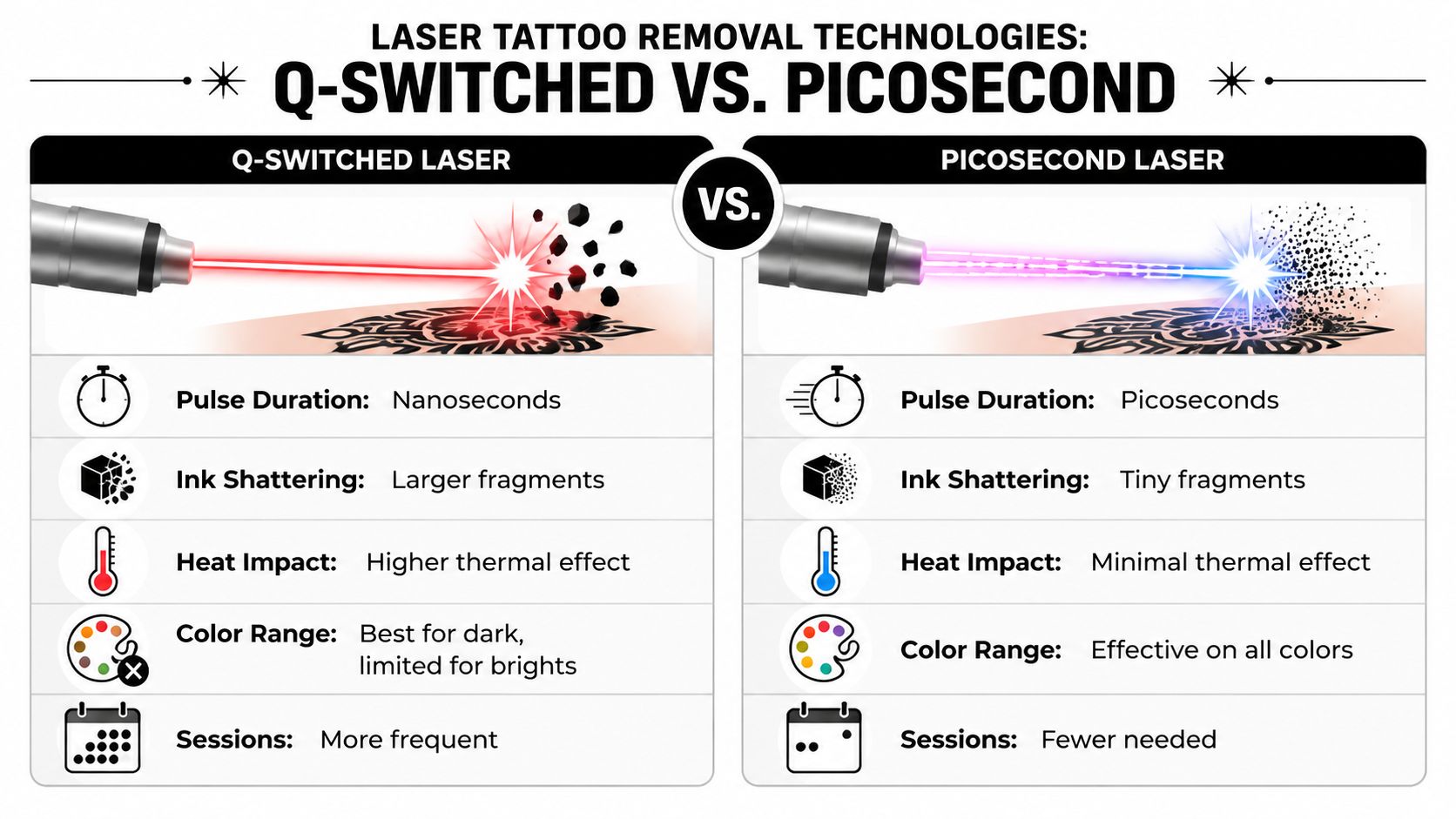
A Q-switched laser delivers energy in nanoseconds. A picosecond laser delivers energy in even shorter pulses. In simple terms, that shorter pulse can create a sharper mechanical impact on the pigment, rather than relying as heavily on heat.
That’s why you’ll often hear clinicians talk about a thermal effect versus a stronger shattering effect. Neither description means one device is magic and the other is obsolete. It means the technology changes how the treatment interacts with the ink.
What that means in practice
For a client, the practical issue isn’t which term sounds newer. It’s whether the device is suitable for your tattoo colours, your skin type, and the treatment goals. Some stubborn shades, especially those that don’t respond as easily, may benefit from the faster pulse profile of picosecond platforms. If you want a straightforward technical overview, this summary on the efficacy of Pico laser tattoo removal is a useful starting point.
Q-switched systems still matter because they’re a well-established treatment method and, when paired with the right wavelengths and an experienced practitioner, can treat many tattoos effectively. The deciding factor is not the label alone. It’s the combination of wavelength options, settings, skin assessment, and operator judgement.
A useful way to think about it is this:
- Q-switched technology: A long-standing, proven approach that can work well across many tattoos.
- Picosecond technology: Often chosen when clinicians want a more forceful pigment-shattering effect, particularly for difficult colours.
- Your consultation: Should focus on suitability, not sales language.
If a clinic only says “ours is the latest” or “ours is the gold standard” without discussing your actual pigment mix, that’s not a complete answer. A sensible clinician should explain why their platform matches your tattoo, not just what the machine is called.
A Rainbow of Challenges Which Colours Are Hardest to Remove
Not all parts of a colourful tattoo fade at the same pace. In fact, one of the most frustrating things for clients is seeing one section lighten nicely while another lingers. That uneven progress is normal in coloured tattoo removal.
The easier end of the spectrum
Black usually sits at the more responsive end because darker inks absorb laser energy more readily. Dark blue can also respond better than many brighter or lighter shades. When people hear that “tattoos can be removed”, they’re often hearing a truth that applies most neatly to these darker pigments.
Red can often be treated successfully too, but it still isn’t the same as black. It needs a different wavelength and a more specific match. That’s why a tattoo with black outlines and red fill may not fade evenly from the first session onward.
Then you start moving into shades that become less predictable. Mixed pigments can behave differently from what the eye sees on the surface. A colour that looks like one clear shade may contain a blend.
The stubborn end of the spectrum
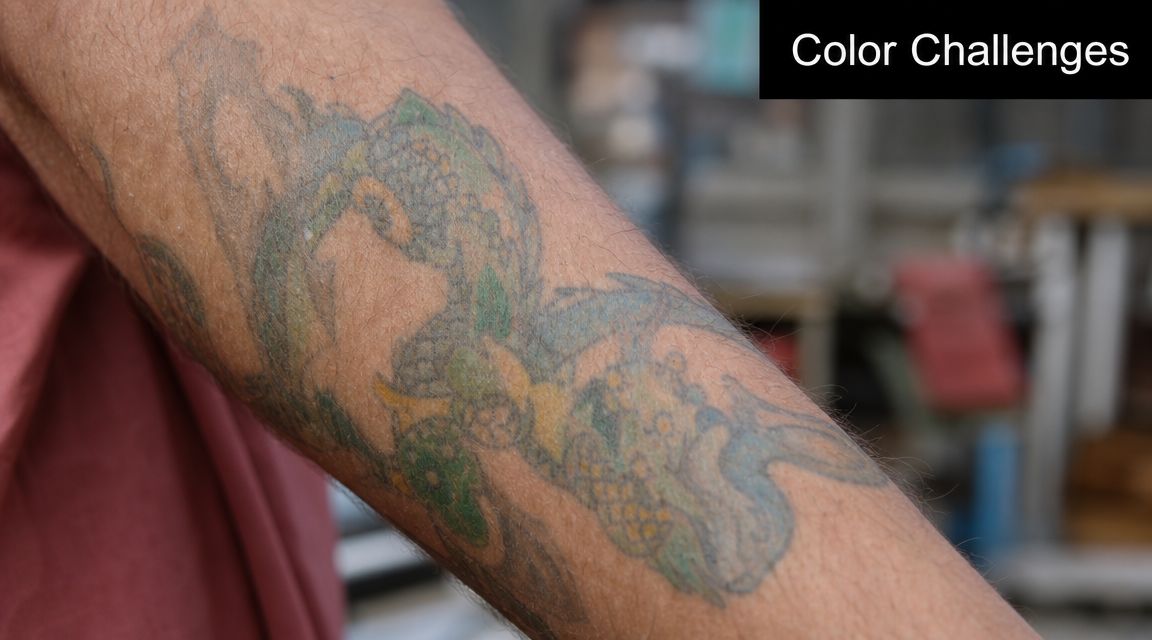
Guidance for colour tattoo fading notes that coloured tattoos commonly need more treatments than all-black tattoos, and that the most resistant inks are typically green, blue, purple, orange, yellow, and white. It also recommends planning around the hardest-to-remove colour in the design, not the easiest, as explained in this guide to colour tattoo removal response.
That one point matters a lot. If your tattoo contains black, red, and green, the whole treatment journey is often shaped by the green, not the black. The easy part doesn’t decide the timeline. The stubborn part does.
A simple way to think about the spectrum is:
- Usually more responsive: Black and some darker tones
- Often moderate: Reds and some warmer shades
- Often more resistant: Green, blue, purple, orange
- Commonly very difficult: Yellow and white
Why are the lighter shades awkward? Because some of them don’t absorb laser energy as efficiently, and some require very precise wavelength matching. White and pale mixed tones can be particularly unpredictable, so they deserve careful discussion before any treatment starts.
If your tattoo has several colours, ask your practitioner which single colour is likely to hold on the longest. That answer usually tells you more than any general promise about “full removal”.
Your Removal Journey Timelines Sessions and Pain
The treatment itself is only one part of the journey. The bigger commitment is time. Most clients don’t struggle with the idea of a session. They struggle with the reality that coloured tattoo removal is a course of treatment, not a one-off appointment.
How long the process usually takes
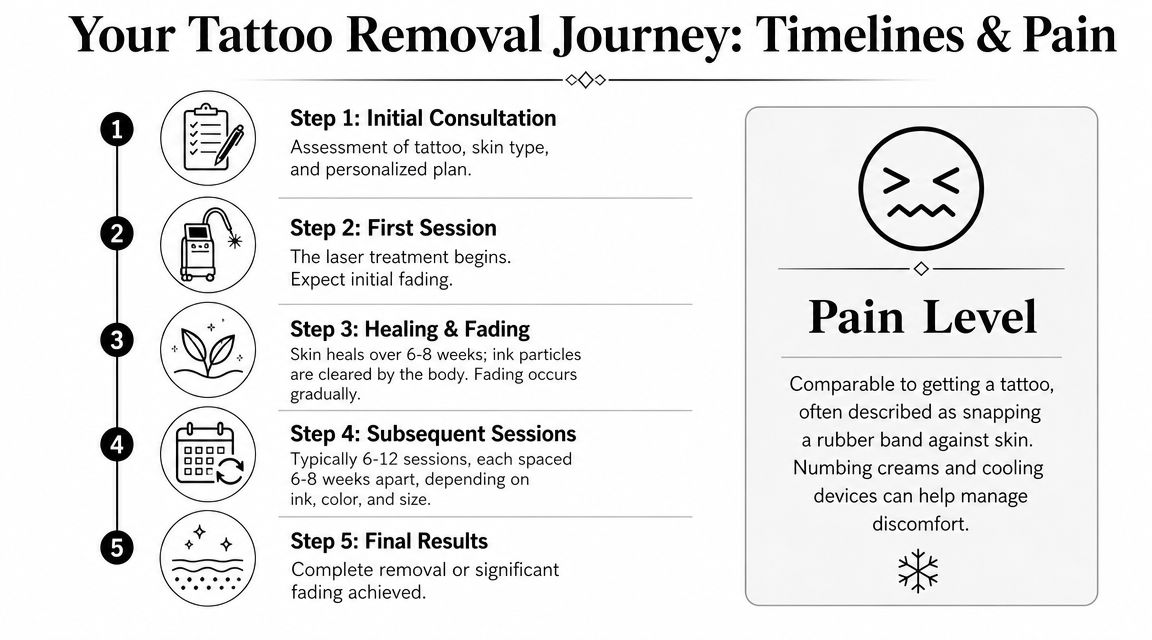
Common laser practice summarised in this tattoo removal timing guide notes that most patients need 6 to 8 sessions for a standard tattoo, while larger or multi-coloured tattoos may need 10 to 15 treatments spaced every 6 to 8 weeks. That means a typical plan can last 8 to 18 months or longer.
Those gaps between sessions aren’t there to slow you down or sell more appointments. Your skin needs time to settle, and your body needs time to clear what the laser has fragmented. Treating too close together doesn’t usually mean better fading. It often just means more irritation without giving the skin enough recovery time.
If you want a realistic visual sense of how gradual progress can be, it helps to look at tattoo removal before and after examples. They show what clients often forget in the early stages. Improvement is usually cumulative, not dramatic overnight.
What treatment feels like and what to expect after
The sensation is often described as similar to a rubber band snapping against the skin, or a hot flicking feeling repeated quickly over the area. Smaller tattoos are over fairly quickly. Larger or denser pieces naturally take longer.
After treatment, the skin can look and feel reactive. Common short-term effects may include:
- Redness: The treated area often looks flushed soon after the session.
- Swelling: Mild puffiness is common, especially in the first part of healing.
- Blistering or scabbing: This can happen as part of the normal recovery response.
- Tenderness: The area may feel warm or sensitive for a while.
Aftercare matters more than many clients expect. Keeping the area clean, avoiding irritation, and following the clinic’s instructions can make a real difference to healing. So can patience. The fading often becomes more noticeable in the weeks after the appointment, not immediately after the laser has been used.
Is Coloured Tattoo Removal Safe for You
Safety isn’t a side note in laser treatment. It’s the centre of good planning. A tattoo might be removable in principle, but that doesn’t automatically mean every treatment approach is right for every person.
Who needs extra caution
A proper consultation should include questions about your skin history, healing tendency, current medications, sun exposure, and any medical conditions that could affect recovery. If a clinic skips over that and goes straight to pricing or booking, that’s not a thorough assessment.
There are also times when the safest choice is to delay treatment, adjust the plan, or aim for fading rather than complete clearance. That can be disappointing to hear, but it’s a sign that the practitioner is treating this as a skin procedure, not just a cosmetic transaction.
Questions worth asking include:
- How will my skin type affect settings?
- Do you patch test when the pigment mix looks unpredictable?
- What side effects are you watching for in my case?
- Would fading for a cover-up be safer than chasing full clearance?
A cautious treatment plan isn’t a weak plan. In laser work, caution is often what protects the result.
Why skin tone changes the plan
For clients with darker skin tones, coloured tattoo removal carries a higher risk of pigmentary changes such as hypopigmentation or hyperpigmentation, and safe treatment requires careful wavelength selection, conservative settings, and a practitioner experienced in treating all skin phototypes, as outlined in this laser guidance for colour tattoos and darker skin tones.
Online advice often falls short when considering a key issue. People ask, “Can coloured tattoos be removed on darker skin?” The honest answer is yes, often they can, but the treatment plan must be more careful. The issue isn’t merely whether the ink can be targeted. It’s how to protect the surrounding skin while doing it.
That’s especially important with multicoloured tattoos, because the wavelengths that suit certain pigments may also increase the need for caution in melanin-rich skin. A skilled practitioner adjusts the settings to balance progress with safety. Sometimes that means slower, staged treatment. Sometimes it means accepting significant fading rather than pushing too aggressively for every last trace of colour.
Cost is part of this conversation too. The more complex the colour palette, the more cautious the treatment path, and the more sessions needed, the more important it is to budget for the full plan rather than a single visit.
Choosing Your Clinic in Leamington Spa
When you’re comparing clinics, the most useful mindset is not “Who says they remove colour?” It’s “Who can explain my tattoo clearly and safely?” A good consultation should leave you better informed, not just more persuaded.
What to ask before you book
The first thing to look for is whether the clinic talks about coloured tattoo removal as a colour-matching problem rather than a generic laser service. If they assess the design as a whole, discuss skin type, and explain likely sticking points, that’s a strong sign of a thoughtful approach.
Use a shortlist like this when you speak to them:
- Wavelength capability: Ask which wavelengths they use for the colours in your tattoo.
- Experience with skin phototypes: Ask how they adapt settings for different skin tones.
- Treatment planning: Ask whether they estimate based on the hardest colour in the design.
- Patch testing: Ask when they recommend it and why.
- Progress tracking: Ask how they document fading over time.
For local readers, laser tattoo removal in Leamington Spa is available through clinics that use dedicated tattoo-removal technology rather than trying to treat everything with one generic device. 3D Aesthetics Leamington Spa states that it uses the 3D-NanoSure dual-wavelength Q-switched laser for dark and multi-coloured tattoos, and its wider consultation model includes 3D imaging to track change over time.
Why consultation quality matters
A careful consultation often tells you more than the machine list. A clinician who studies the tattoo, asks about your goals, and explains likely limitations is usually more trustworthy than one who promises complete removal without hesitation.
This short video gives helpful context on what professional laser treatment looks like in practice:
You should leave that first appointment knowing three things clearly. Which colours are likely to respond first. Which areas may linger. And what safety steps matter most for your skin. If any of those answers stay vague, keep asking questions.
Frequently Asked Questions
Can any coloured tattoo be fully removed
Not always. Some coloured tattoos fade very well, while others keep a trace of resistant pigment. The final outcome depends on the colour mix, the ink depth, the laser wavelengths available, and how your skin responds over time.
Why does one part of the tattoo fade faster than another
Because the tattoo may contain pigments with very different laser responses. Black might lighten steadily while green or yellow hangs on. That doesn’t mean treatment has failed. It means the tattoo is behaving like a multicoloured tattoo usually does.
Is fading for a cover-up a sensible option
Yes, for many people it is. If complete removal isn’t the goal, partial fading can create a cleaner base for a new design. This can be especially useful when the most stubborn colours are unlikely to clear fully or safely.
Should I ask for a patch test
If the tattoo contains difficult colours, pale tones, or your skin has a higher pigment risk, it’s a sensible question. A cautious clinic should be comfortable discussing when a test area is useful and what they’d learn from it.
Does the body location matter
Yes, it can. Different areas of the body can respond differently, and some places seem slower to show visible change than others. That’s one reason a consultation should assess the whole picture rather than just the colour.
Can I compare clinics outside my area to learn what good information looks like
Absolutely. Sometimes it helps to read how other specialist providers explain the process so you can compare the quality of information, not just the price. For example, this page on tattoo removal Bournemouth is useful for seeing how another clinic frames treatment questions clients commonly ask.
What’s the single best question to ask in consultation
Ask this: “Which colour in my tattoo is likely to be the slowest to clear, and how does my skin type affect the plan?” If the answer is specific, balanced, and easy to understand, you’re probably in the right sort of consultation.
If you’re thinking about colored tattoo removal and want honest, personalised advice, 3D Aesthetics Leamington Spa offers consultations that can help you understand your options, likely timeline, and the safest route for your skin and tattoo colours.