
You notice them in ordinary moments. Getting dressed in better light. Catching your reflection in a changing room mirror. Looking down at a fine red web near the ankle or around the nose and wondering whether it's something to ignore, something to cover, or something you can treat.
That's usually when the questions start. Are these spider veins? Will they get worse? Is laser treatment for spider veins the right option, or am I better with injections? And if I do treat them, what does the process feel like in a UK clinic?
Those are sensible questions. Spider veins are common, and while they're often harmless, they can be frustrating because they sit right where you can see them most. Many people come in wanting a clearer answer, not a sales pitch. They want to know what works, what doesn't, how many appointments they may need, and whether laser is being recommended because it suits the vein or because it sounds modern.
This guide is written from that practical point of view. It's here to make the treatment journey easier to understand, from the first consultation through to the stage where the vessels begin to fade. If you're also comparing approaches internationally, this overview of Canadian laser spider vein options can be useful for seeing how clinics in another market explain similar decisions around vessel size, comfort, and session planning.
Table of Contents
- Introduction Your Guide to Tackling Spider Veins
- Understanding How Lasers Target Spider Veins
- Are You a Suitable Candidate for Laser Treatment
- Laser vs Other Vein Treatments A Practical Comparison
- The Patient Journey at 3D Aesthetics Leamington Spa
- Expected Results Risks and Cost Considerations
- Frequently Asked Questions About Laser Vein Treatment
Introduction Your Guide to Tackling Spider Veins
You catch sight of a few fine red lines around the nose or a small cluster on the legs, and suddenly they are hard to ignore. They are usually harmless, but they can make skin look uneven and leave you wondering whether laser is the right fix or just one of many treatments people mention online.
In clinic, the first point I make is simple. Laser treatment for spider veins can work very well, but it is not the right answer for every visible vessel. The best results tend to come from very superficial, fine veins, especially on the face and in carefully chosen small leg veins. Larger leg veins, deeper blue vessels, or wider networks often respond better to another approach.
That is why a proper consultation matters. Good planning starts with the vein in front of us, not with a one-size-fits-all treatment plan. We look at the colour, size, depth, and location of the vessel, then decide whether laser is likely to give a worthwhile result or whether another option would be more sensible.
A practical rule helps here. The finer and nearer the surface the vein is, the more likely laser is to be a good conversation.
For facial thread veins, many clients in our UK clinic setting are suitable for targeted vascular laser treatment such as 3D Vasculase for facial and superficial vascular lesions. For leg veins, expectations need to be more measured because laser can help some vessels, but it does not replace every other vein treatment.
If you have been comparing clinics or reading about Canadian laser spider vein options, the same principle applies. The machine matters, but matching the treatment to the type of vein matters more.
The aim of this guide is to make the whole process clearer from a UK clinic perspective, from the first assessment through to the final result, so you know what laser can do, where it has limits, and when another treatment may give you a better outcome.
Understanding How Lasers Target Spider Veins
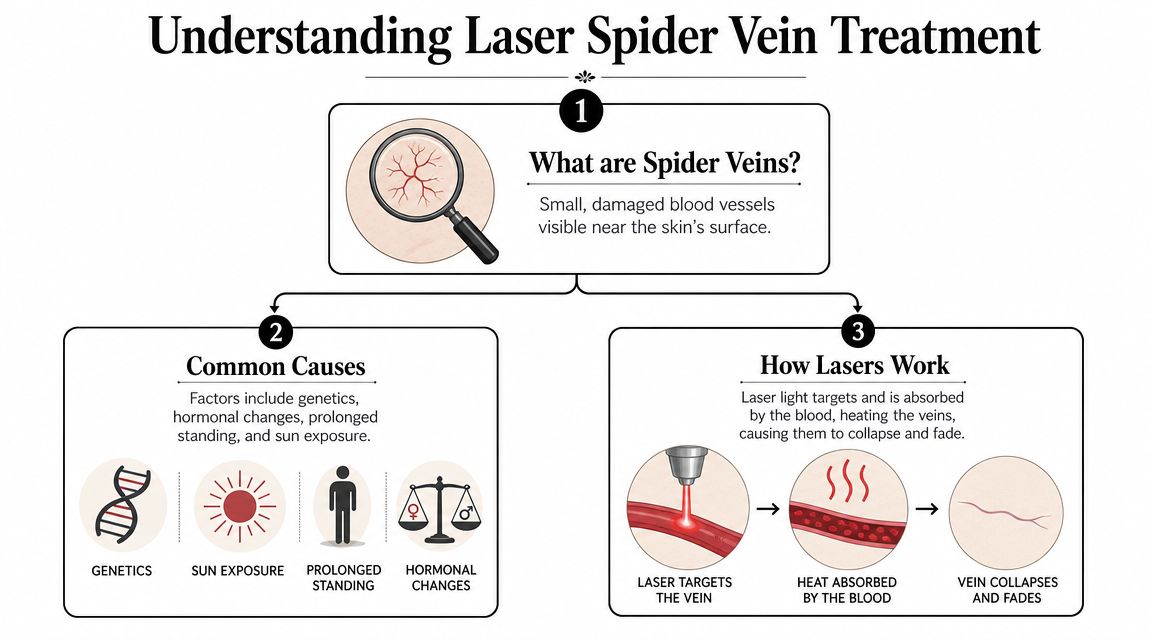
Spider veins are usually called telangiectasias in clinic language. They're small damaged or widened blood vessels close to the skin's surface. They often appear as fine red lines, little branches, or a web-like pattern.
Some people are more prone to them. Genetics can play a part. Hormonal changes can play a part. So can sun exposure on the face, or the day-to-day pressure of standing for long periods when the legs are involved. They're different from larger varicose veins, which are typically more raised, more obvious, and often part of a broader vein issue.
What spider veins actually are
The simplest way to think about them is this. A tiny vessel near the surface has become more visible than it should be. It's still part of the circulation, but cosmetically it stands out.
That's why treatment has to be selective. You don't want to damage the surrounding skin. You want to target the visible vessel itself.
How the laser does the work
Laser treatment works through photothermal injury. In plain English, the laser delivers energy that heats the blood and vessel wall enough to make that vessel collapse and close. Over time, the body breaks down the treated vessel and gradually reabsorbs it.
A useful analogy is sunlight on fabric. A dark top absorbs heat more readily than a white one. In a similar way, the laser is chosen so the blood in the vessel absorbs the energy more than the surrounding skin does. That selective uptake is what lets us treat a thread vein without treating the whole area around it.
A clinical review in NIHR/PMC literature notes that a 1064 nm Nd:YAG wavelength is technically advantageous for spider veins because its longer wavelength penetrates to a greater depth, allowing it to achieve thermo-sclerosis of deeper or slightly larger leg vessels that are less responsive to shorter-wavelength surface lasers, as explained in this NIHR/PMC review of vascular laser treatment.
That deeper reach is why Nd:YAG technology is often considered when tiny superficial facial vessels aren't the only concern. One clinic example of this category is 3D Vasculase treatment technology, which is used for vascular lesions where selective heat delivery to the vessel is the aim.
A laser still has limits. If a vessel is too large, too deep, or fed by underlying veins that haven't been addressed, the clearance can be incomplete. Laser tends to work better on thin red spider veins than on more obvious blue vessels, and treatment planning has to reflect that.
The laser isn't “erasing” a vein like an editor removes ink from paper. It's closing a tiny vessel so your body can clear it gradually.
That's also why results don't look instant. The biological clean-up takes time.
Are You a Suitable Candidate for Laser Treatment
Not every visible vein is a laser vein. The right candidate usually has the right vein type, the right skin context, and no obvious safety issue that would make treatment unwise.
Who tends to do well
Laser treatment for spider veins tends to make the most sense when the vessels are:
- Fine and superficial: Tiny red thread veins usually respond better than broader blue leg veins.
- Located on the face or in selected small leg vessels: In UK practice, laser is often discussed for facial veins first, or for small residual leg vessels where injections aren't ideal.
- Clearly visible and localised: A scattered few fine vessels are a different treatment conversation from a larger network with feeder veins.
- Unsuitable for injections or difficult to inject: Some patients aren't keen on needles, and some very small vessels are awkward to treat well with sclerotherapy.
Skin type also matters. Laser settings have to be chosen carefully to reduce the chance of post-inflammatory pigment change. That doesn't automatically rule treatment out, but it does mean the consultation has to be thorough and conservative.
When laser may not be the right fit
There are also times when I'd want a patient to pause and be assessed properly before any treatment plan is made.
Common reasons to delay or avoid treatment include:
- Pregnancy: Hormonal and circulatory changes can alter the appearance of veins, so timing matters.
- Photosensitising medication: If your skin is likely to react more strongly to light-based treatment, the safety margin changes.
- Active skin infection or irritation in the area: Broken, inflamed, or infected skin shouldn't be treated.
- A history of problematic scarring: If you've had keloid or unusual scar behaviour before, your risk profile needs closer review.
- Recent tanning or ongoing sun exposure: Tanned skin complicates safe laser settings and raises the risk of unwanted pigment change.
Published clinical summaries also make it clear that outcomes depend strongly on vessel size, depth, and skin type, which is why laser is generally positioned as a second-line option behind sclerotherapy for superficial telangiectasias and reticular veins in the leg in the UK evidence base, as noted earlier in the article.
A consultation isn't a formality. It's the point where we decide whether laser is appropriate, whether another treatment is smarter, or whether the safest decision is to wait.
If you want the short version, suitability is less about how much the veins bother you and more about whether the vessel pattern is one laser can realistically improve.
Laser vs Other Vein Treatments A Practical Comparison
Most patients aren't choosing between “doing nothing” and laser. They're choosing between laser, sclerotherapy, and sometimes IPL. The useful question isn't which sounds most advanced. It's which one matches the job.
Where each treatment fits
Historically, sclerotherapy is the older, well-established approach. A peer-reviewed review notes that one-treatment clearance ranges from 50% to 84% in about 70% to 80% of patients, and that as many as six treatments may be needed for full clearance, according to this peer-reviewed review of spider vein treatment options. That same review explains why many clinics still offer both sclerotherapy and laser. Laser is a newer refinement, not a universal replacement.
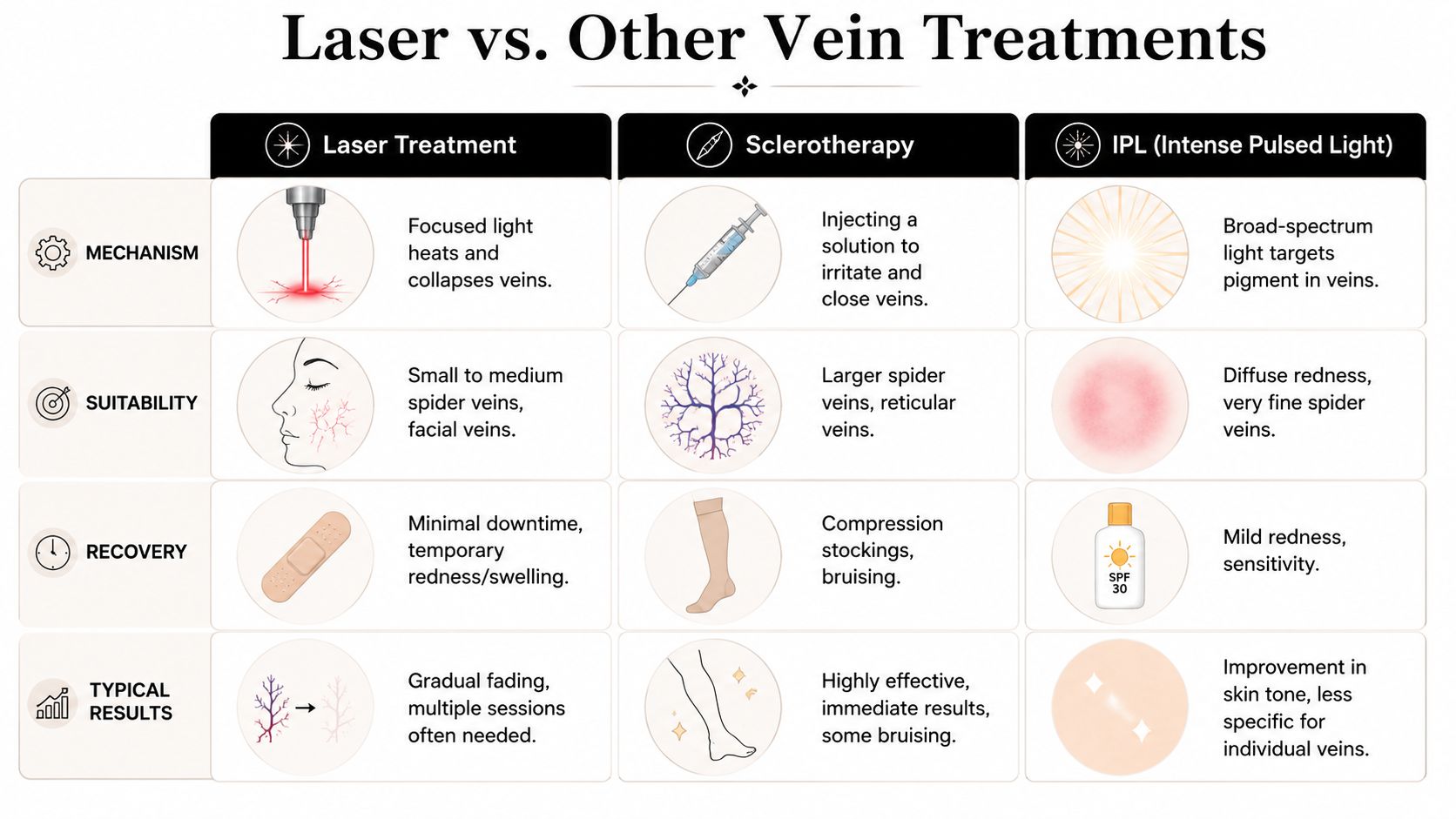
In practical terms, sclerotherapy remains the gold standard for visible leg vein eradication in many cases. Laser is often chosen for very fine vessels, facial veins, or when injections aren't the best fit. IPL can help with diffuse redness and general vascular flushing, but it's less specific when the goal is to remove a distinct, individual spider vein.
If redness and visible vessels sit alongside broader skin concerns, some people also compare vascular laser with treatments aimed at general photoageing and tone. That's where looking at options such as sun damage and skin treatment approaches can help separate “I want this one vein gone” from “I want the whole area to look more even”.
Treatment Comparison Laser vs Sclerotherapy vs IPL
| Feature | Laser (Nd:YAG) | Sclerotherapy | IPL (Intense Pulsed Light) |
|---|---|---|---|
| Best suited to | Fine superficial spider veins, especially facial veins and selected small leg vessels | Many visible leg spider veins and reticular veins | Diffuse redness and very fine surface vascular changes |
| How it works | Focused light heats the vessel so it collapses | A solution is injected into the vein to close it | Broad-spectrum light targets pigment and redness more generally |
| Precision | High for selected vessels | High for injectable veins | Lower for individual vessels |
| Typical treatment course | Often multiple sessions | May also need repeated sessions | Usually part of a skin-redness plan rather than single-vein targeting |
| Comfort profile | Heat and snapping sensation | Needle-based treatment | Light and heat sensation |
| What it doesn't do well | Larger, deeper, feeder-driven veins | Tiny vessels that are hard to inject | Larger or clearly defined individual leg veins |
A few key takeaways usually help patients decide:
- Choose laser when the target is tiny and visible: Fine red vessels often suit laser better than larger blue leg veins.
- Choose sclerotherapy when the leg veins are broader or more numerous: That's why it remains the standard reference treatment in many leg-vein cases.
- Choose IPL when the issue is diffuse redness rather than one specific vein: It can be useful, but it isn't a like-for-like substitute for vascular laser.
No treatment is “better” in the abstract. Better means better for the vessel in front of you.
The Patient Journey at 3D Aesthetics Leamington Spa
Uncertainty is often a source of stress. Once you know how the appointment unfolds, laser treatment for spider veins feels much easier to place in real life.
What happens at consultation
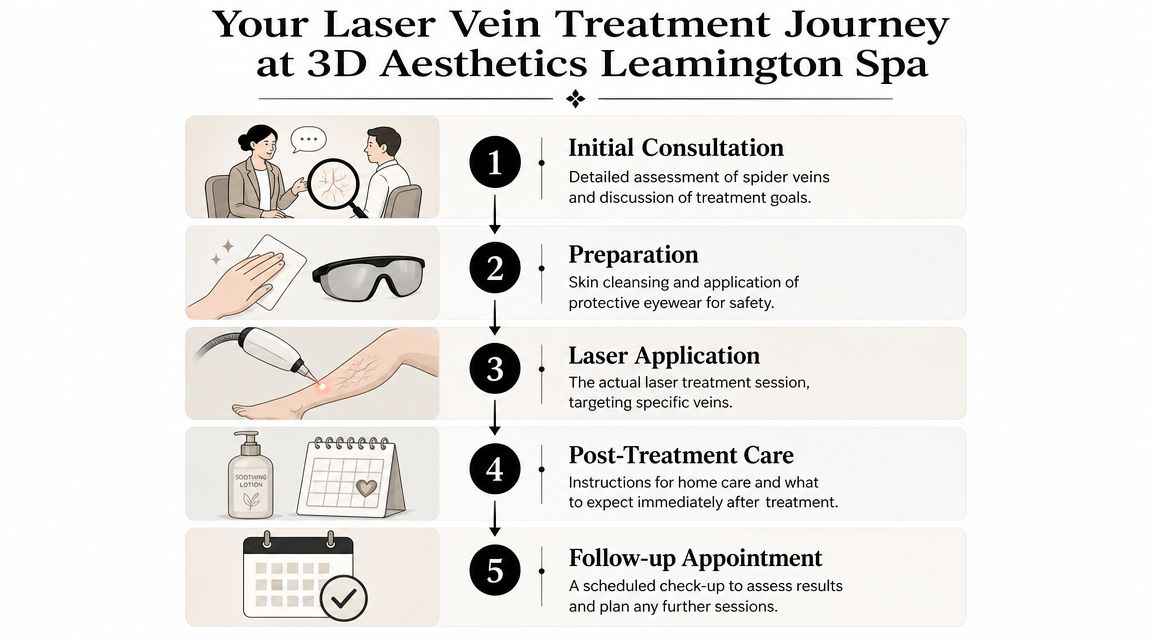
The first appointment is where the treatment earns or loses credibility. A proper consultation should look closely at the vessels, your skin, your medical background, and what result is realistic.
At this clinic, that process includes a complimentary consultation with a full 3D body scan to assess concerns, personalise planning, and track change over time. For vein patients, that's useful because what bothers you in the mirror doesn't always match what the skin and vessel pattern are likely to respond to.
You'll usually discuss:
- Where the veins are: Face and legs often behave differently.
- What colour and size they are: Tiny red threads are a different category from blue reticular-looking vessels.
- How long they've been present: Longstanding vessel patterns can need a more measured plan.
- Whether another treatment may be more suitable: Good consultations don't force everyone into laser.
What treatment day feels like
Once you're booked for treatment, the session itself is usually straightforward. The skin is cleansed, the area is assessed again, and you'll wear protective eyewear. The handpiece is then applied in short, controlled pulses to the target vessels.
Most patients describe the sensation as a quick snap of heat, similar to a small elastic band flick. Some areas are easier than others. Facial veins can feel sharp but brief. Leg vessels can vary depending on size and location.
This short video gives a useful visual sense of the treatment environment and pacing:
There's no need to expect dramatic theatre. Laser vein appointments are usually calm, methodical, and targeted. The focus is on delivering enough energy to affect the vessel without over-treating the surrounding skin.
Most anxiety drops once the first few pulses are done. Patients realise the treatment is sharp but manageable, and that the session is more controlled than they expected.
What happens after the session
Immediately after treatment, the area may look pink, warm, or slightly raised. Some vessels look darker at first. That can be part of the normal response rather than a sign that anything has gone wrong.
Published clinical summaries report that most patients need 1 to 5 treatments, with visible improvement beginning around 4 to 6 weeks as the treated vessels are gradually reabsorbed by the body, according to this clinical summary of spider vein laser treatment timing.
Aftercare usually focuses on protecting the result and calming the skin:
- Avoid direct sun on the treated area: Freshly treated skin is more vulnerable to pigment change.
- Use gentle skincare: Harsh exfoliants and active products can irritate the area.
- Follow your therapist's advice on heat and activity: For some patients, keeping things cool and simple for a short period helps comfort.
- Attend review appointments if advised: That's where progress is checked and any further session planning is made.
Laser works gradually. The journey is less “walk out vein-free” and more “see progressive clearing over the weeks that follow”.
Expected Results Risks and Cost Considerations
By the time patients reach this stage, the main question is usually simple. What result is realistic for my veins, my skin, and my budget?
How results tend to unfold
Laser can produce very good improvement in the right vessels, but the best results are usually seen in very small, superficial spider veins. Leg veins that are broader, deeper, or fed by an underlying vein often respond less predictably. In clinic, that is one of the key points I clarify early, because the treatment plan only makes sense if the target is suitable for laser in the first place.
A useful rule is this. The finer and more surface-level the vessel, the better laser tends to perform. The larger and more rooted the vessel, the more likely it is that improvement will be partial, slower, or better suited to another treatment such as sclerotherapy.
That matters for expectations. Some veins fade cleanly. Some break up and lighten. Some improve but do not fully disappear.

Risks and realistic budgeting
The common side effects are usually short-lived and localised. Redness, warmth, mild swelling, temporary darkening of the vessel, light crusting, and short-term pigment change can all happen after treatment. These effects are usually manageable, but they still matter, especially on visible areas or darker skin tones where post-inflammatory pigmentation is a bigger consideration.
More serious problems are uncommon, but they are the reason careful settings and proper assessment matter. Burns, blistering, prolonged pigmentation, and scarring are possible if the vessel is not well matched to the device or if the skin is treated too aggressively. A responsible UK clinic should discuss that plainly rather than presenting laser as risk-free.
There is another limit patients should know about. A treated vessel may clear, but your tendency to form visible veins does not disappear. Hormones, heat, genetics, sun exposure, and circulation patterns still play a part, so new veins can appear later even when the original treatment has worked well.
If the concern is facial redness rather than isolated leg veins, the assessment often shifts slightly. Diffuse flushing, broken capillaries, and background redness may sit closer to rosacea laser treatment options than to straightforward spider vein work, and the plan should reflect that.
Cost is best judged as part of a full treatment plan, not as a single-session headline price. Fees usually depend on the size of the area, how many separate vessels are being treated, how technically awkward the pattern is, and how many appointments are likely to be needed. A small patch beside the nose is priced very differently from several patches across both legs. If you want a broader example of how clinics structure laser pricing, even in another category, this guide on how much does laser removal cost shows the same principle. Size, complexity, and repeat sessions usually drive the quote.
The fairest quote comes after assessment, because the actual cost is the cost of getting a sensible result safely.
Frequently Asked Questions About Laser Vein Treatment
Is laser treatment for spider veins painful
It's usually uncomfortable rather than unbearable. Quick snaps of heat are often described. Some areas feel sharper than others, but sessions are generally well tolerated when settings are chosen properly.
Is there any downtime
There's usually minimal downtime. You may see redness, warmth, or mild swelling afterwards, and the area can look temporarily more noticeable before it settles.
Will the treated veins come back
A successfully treated vein can clear, but your body can still form new visible veins over time. That's why maintenance or future review may be relevant for some patients.
Can I have treatment on tanned skin
Usually, recent tanning makes treatment less straightforward and can raise the risk of pigment problems. If your skin is tanned, most responsible clinics will want to assess timing carefully rather than rushing ahead.
Is laser better than sclerotherapy
Not automatically. Laser is often very helpful for tiny superficial vessels and facial veins. Sclerotherapy is still widely regarded as the standard option for many visible leg veins.
How many sessions will I need
It depends on the vessel size, site, and how your skin responds. Some veins improve quickly, while others need a course of treatment and patience between sessions.
When will I see final results
Improvement is gradual. The treated vessels need time to break down and fade, so results unfold over weeks rather than overnight.
If you'd like clear advice on whether laser treatment for spider veins is the right fit for your skin and vein pattern, you can book a consultation with 3D Aesthetics Leamington Spa. A proper assessment can tell you whether laser is appropriate, whether another treatment would suit you better, and what kind of result is realistic before you commit.