
“Non-surgical” doesn't mean risk-free, and “regulated clinic” doesn't always answer the question you think it does. In the UK, people searching for non surgical fat removal uk are often comparing machines, prices and polished before-and-after photographs, while the more important questions concern patient selection, practitioner competence, insurance, consent and complication management.
These treatments can improve a localised pocket of pinchable fat. They won't treat obesity, remove visceral fat or replace a medically supervised weight-management plan. The UK market is also developing within a regulatory framework that remains uneven, particularly outside clearly defined medical settings. A sensible decision therefore starts with governance and anatomy, not with a brand name.
Table of Contents
- Why Non Surgical Fat Removal Is Not as Simple as It Sounds
- Understanding the Main Non Surgical Fat Removal Technologies
- Comparing Effectiveness, Downtime and Typical UK Costs
- UK Safety Regulation and What It Means for You
- How to Choose a Trustworthy UK Clinic
- What a Professional Consultation Looks Like at 3D Aesthetics
- Frequently Asked Questions About Non Surgical Fat Removal
Why Non Surgical Fat Removal Is Not as Simple as It Sounds
The popular advice is that fat freezing or ultrasound is a quick alternative to liposuction with no meaningful downside. That is too casual. Non-surgical body contouring can be useful, but it's designed for stubborn, localised subcutaneous fat, not general weight loss. The treatment area needs to contain a suitable fat pad that the device can safely reach, and the expected change should be modest enough to remain realistic.
A review covered by NICE examined 31 studies involving 2,937 patients and found that cryolipolysis, ultrasound, radiofrequency and low-level laser therapy could each produce reproducible circumferential reductions of 2 cm or more in areas including the abdomen, hips and thighs, with no serious or permanent adverse effects reported in those reviewed studies. That evidence supports the treatments as legitimate contouring options, but it doesn't turn every device, protocol or practitioner into an equivalent choice. NICE's evidence summary on non-invasive body contouring also makes the underlying limitation clear: these technologies work on subcutaneous fat, not visceral fat or the wider health risks associated with obesity.
Demand has grown faster than clarity
The commercial market is substantial. One UK industry forecast estimated the non-invasive fat reduction market at USD 51.8 million in 2023, with a projection of USD 150.1 million by 2030 and a projected compound annual growth rate of 16.4% from 2024 to 2030. The same forecast identified cryolipolysis as the largest and fastest-growing UK procedure segment, while historical data cited in that report recorded 376,962 non-invasive fat reduction procedures using CoolSculpting and Liposonix in the UK in 2018. These are market indicators, not guarantees of an individual result. The UK non-invasive fat reduction market forecast shows why consumers now encounter a wide range of clinics and treatment claims.
England has also moved towards formal licensing. The Health and Care Act 2022 gave the Secretary of State power to create a licensing regime for non-surgical cosmetic procedures, and the government consultation explicitly lists cryolipolysis and HIFU among procedures expected to fall within scope. The stated aim is to help consumers feel confident that treatments are safe and delivered to a high standard. The government consultation on licensing non-surgical cosmetic procedures is important reading for anyone assuming the whole UK already operates under one simple rulebook.
Practical rule: Choose the person and the safety process before you choose the machine.
A clinic should explain what the treatment can change, what it cannot change, who is providing it and what happens if the result is poor or a delayed complication develops. A useful starting point is to compare the treatment principles and consultation standards described in this guide to non-surgical body contouring, but treat any provider's own information as the beginning of your questions, not the end of them.
Understanding the Main Non Surgical Fat Removal Technologies
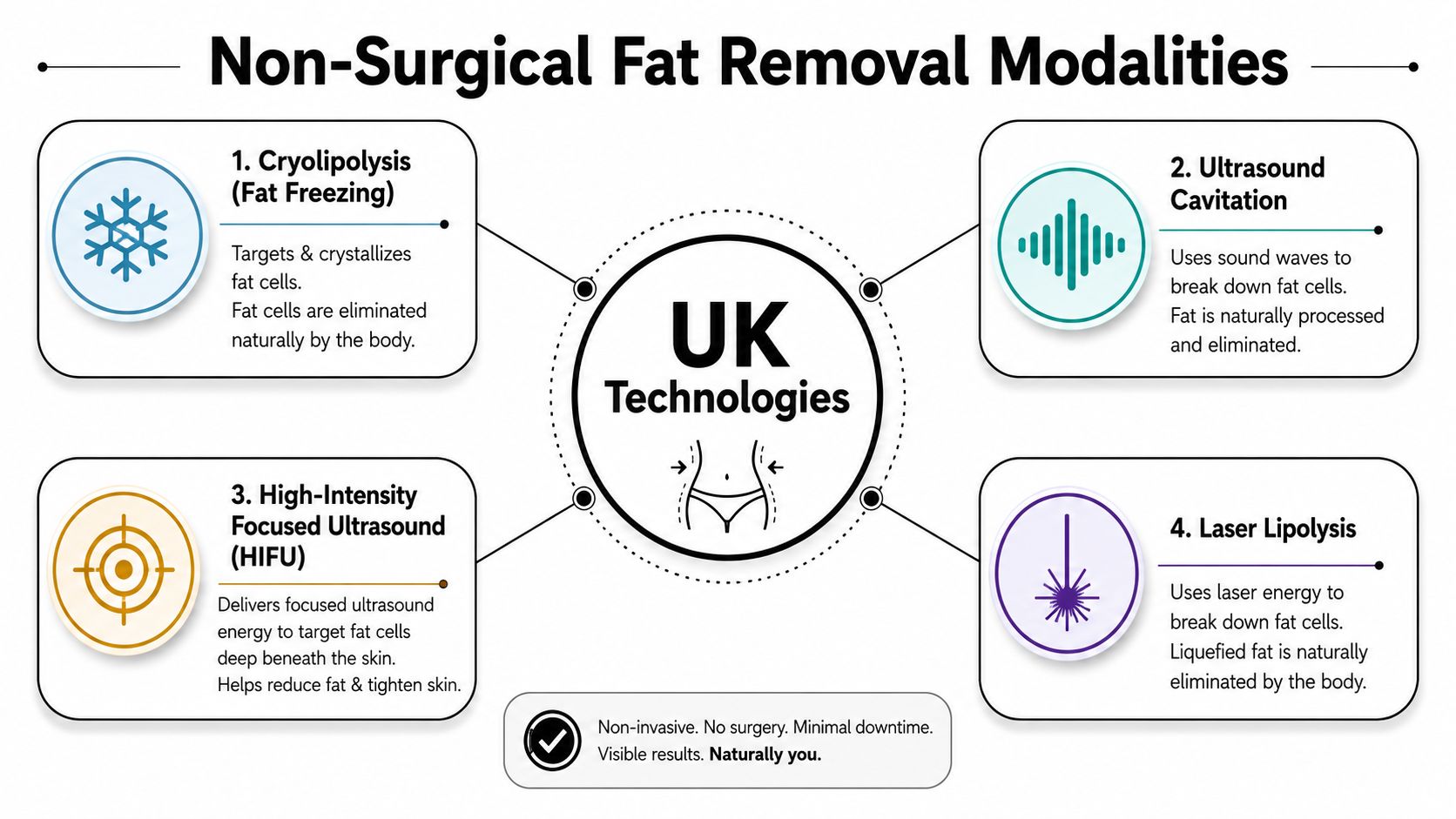
The device name is only part of the decision. The treatment method, applicator, energy settings, tissue depth and practitioner's safety checks determine whether a non-surgical procedure is suitable. Cryolipolysis uses controlled cold, ultrasound uses acoustic energy, HIFU concentrates ultrasound at a chosen depth, and radiofrequency, or RF, uses heat. These technologies are not interchangeable, even when clinics place them under the same “fat reduction” label.
Cryolipolysis or fat freezing
Cryolipolysis draws a fold of subcutaneous fat between cooling surfaces. Fat cells are more vulnerable to cold than many surrounding tissues, so controlled cooling injures the targeted cells and the body gradually clears the cellular material. The official description of cryolipolysis explains the basic mechanism and why the procedure has attracted regulatory attention in England.
It is generally better suited to a pinchable fold than to a firm, deep abdomen. Common areas discussed in consultation include the chin, abdomen, flanks, thighs, arms and back. Suitability still depends on tissue distribution, skin quality, medical history and whether the applicator can make safe, consistent contact.
A good assessment also checks whether the visible fullness is treatable fat. Loose skin, swelling, muscle shape or an underlying medical issue may require a different approach. Treatment produces a gradual local contour change, not general weight loss.
Clients considering this method can use the fat-freezing treatment information to prepare questions about target areas, planning and realistic expectations.
Ultrasound cavitation
Ultrasound cavitation directs acoustic energy beneath the skin. The intended effect is disruption of fat-cell membranes within a selected area, followed by the body's processing of the resulting cellular material. Clinics usually discuss it for localised contouring and circumference change, rather than visceral fat or a substantial reduction on the scales.
“Ultrasound” does not identify the device, protocol or treatment depth. Results and risks can vary with the equipment, settings, applicator contact and the operator's knowledge of anatomy. Ask which tissue is being targeted and how the practitioner will protect nearby structures.
HIFU
High-intensity focused ultrasound concentrates acoustic energy at a defined depth. The system aims to create a controlled effect at its focal point instead of spreading heat broadly through the skin. Body HIFU may suit selected localised areas, but accurate depth selection and careful positioning are needed around vulnerable structures.
Its inclusion alongside cryolipolysis in the English licensing consultation signals that policymakers view these procedures as requiring proper oversight. It does not show that every HIFU device, clinic or operator follows the same training, maintenance and incident-management standards. In the UK's developing regulatory framework, those governance details deserve as much attention as the brand name.
Radiofrequency and related options
RF heats tissue. Clinics may use it to improve the appearance of mild laxity and support skin tightening, sometimes alongside a modest fat-reduction aim. It is often more relevant when the concern includes skin texture or firmness, rather than a clearly defined fat pocket alone.
The evidence reviewed for RF, cryolipolysis, ultrasound and low-level laser therapy reported circumferential reductions of 2 cm or more across the reviewed body areas. That result describes a group of studies, not a guaranteed RF outcome for an individual client. The practical question is how much of the proposed change is expected from fat reduction and how much from altered skin appearance. Ask the practitioner to separate those outcomes, explain possible temporary effects, and state what happens if a delayed complication or disappointing result needs review.
Comparing Effectiveness, Downtime and Typical UK Costs
No treatment is a universal winner. Cryolipolysis usually suits a discrete, graspable fat pad. RF may be more appropriate when mild laxity or firmness is part of the concern. Ultrasound and HIFU need closer scrutiny because the device, energy settings and treatment depth can materially affect both the intended result and the risk profile.
Across the reviewed evidence for cryolipolysis, ultrasound, RF and LLLT, circumferential reductions of 2 cm or more were reported in some studies. That finding is not a guaranteed outcome for an individual client, and it does not establish a standard UK price or session plan. Clinics price according to the device, area, practitioner, appointment length, assessment and follow-up. Ask for a written quote that states exactly what is included.
Non Surgical Fat Removal Treatment Comparison
The shared evidence reference is the NICE evidence. Use it as context rather than treating the reported reduction as a promise.
| Treatment | Typical Reduction | Sessions Needed | Downtime | UK Price Range |
|---|---|---|---|---|
| Cryolipolysis | Intended for a localised, graspable fat pad. The response varies with the applicator, tissue and individual factors | Depends on the fat pad, applicator and response | Usually limited, although swelling, bruising, tenderness or altered sensation can occur | Varies by clinic, area and device. Request a written quote |
| Ultrasound cavitation | Uses ultrasound energy, with results dependent on the system, settings, treatment area and course design | Often planned as a course after assessment and adjusted according to response | Generally limited, but ask about the device protocol and expected after-effects | Varies by treatment plan and clinic |
| HIFU | Focuses energy at selected depths, so accurate positioning and appropriate settings matter more than the brand name alone | Individualised according to anatomy, device and treatment objective | Usually limited, although discomfort and delayed effects should be discussed | Varies by area, system and practitioner |
| RF | Often chosen where improved firmness or skin appearance is part of the objective, alongside any modest fat-reduction aim | Frequently arranged as a course when tightening is also being pursued | Usually limited, with temporary changes possible | Varies according to area and whether tightening is included |
Price is only one part of the calculation
A single-session advertisement may not show the full cost. The plan could include a consultation, multiple areas, repeat sessions, measurements, photographs, review appointments or treatment for a different tissue concern. Ask whether aftercare is included and who reviews swelling, altered sensation, burns, contour changes or an unsatisfactory result.
The main comparison is therefore between the proposed plan and the actual anatomy, not between headline prices. For someone considering abdominal treatment, information about targeted abdominal fat reduction can help frame the consultation. The final recommendation should follow an examination, with clear discussion of expected improvement, limitations, possible complications and the process for raising concerns.
UK Safety Regulation and What It Means for You
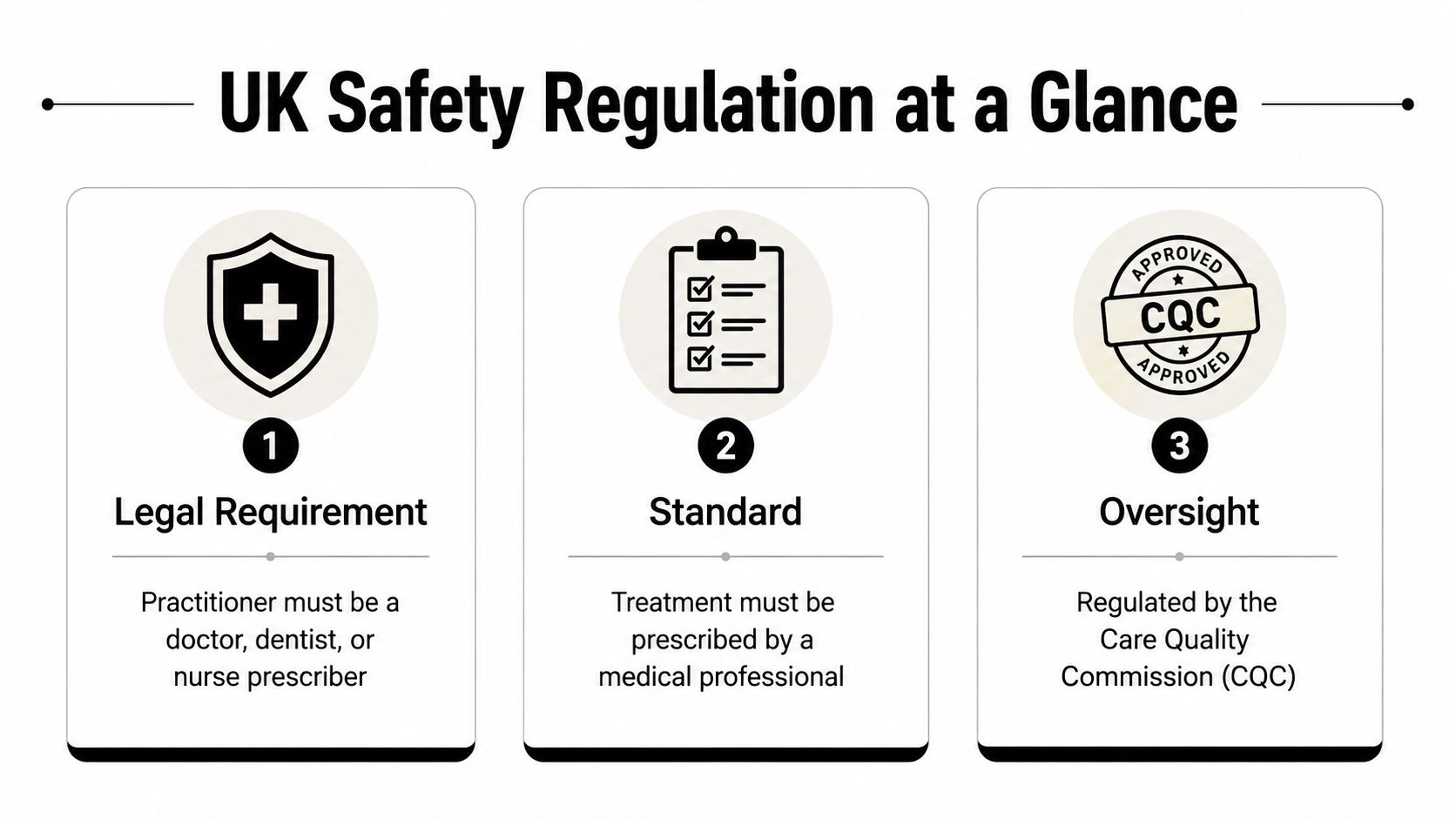
A treatment being available in a UK clinic does not mean every provider works under the same licensing system. In England, the government has set out a direction for licensing certain non-surgical cosmetic procedures, but the consultation response says it is not currently proposing to add further procedures to the scheme or remove existing ones. For a client, that means a clinic's own governance still matters. The consultation response on licensing non-surgical cosmetic procedures explains the current position.
The Health and Care Act 2022 created the power to establish licensing in England, and the consultation identifies cryolipolysis and HIFU among the procedures expected to fall within scope. A policy framework does not yet give every client one UK-wide register to check. Rules and registration arrangements can also differ between England, Scotland, Wales and Northern Ireland.
Complications deserve specific discussion
A responsible consultation covers more than expected redness, swelling and bruising. A 2025 systematic review summarised in UK clinical coverage estimated paradoxical adipose hyperplasia at about 0.22% across 28 studies and 13,078 patients, while noting low certainty and incomplete follow-up. The UK clinical summary of cryolipolysis risks presents that figure as an estimate, not a guarantee that complications will not occur.
Paradoxical adipose hyperplasia enlarges the treated area instead of reducing it. It can develop after the initial recovery period, so ask who will review a delayed change and how quickly. Other reported concerns include freeze burns, persistent pain, nerve symptoms, pigmentation changes and hernia risk where abdominal tissue is vulnerable.
The clinic should explain what happens if the result is poor or a complication needs medical input. Confirm whether follow-up is included, who assesses symptoms, when referral is arranged, and whether the practitioner will remain responsible for coordinating care.
Surgical fat removal has a different risk profile. NICE states that evidence for liposuction in chronic lipoedema is inadequate and lists risks including fluid imbalance, fat embolism, deep vein thrombosis and toxicity from local anaesthetic agents. It recommends the procedure only in research and specialist centres with experienced surgeons. NICE guidance on liposuction for chronic lipoedema concerns surgery rather than energy-based non-surgical treatment, but it shows why unexplained swelling or suspected lipoedema should not be treated as a straightforward cosmetic fat concern.
Watch the accompanying explanation before booking if you are weighing treatment options.
Ask directly: “If I develop a delayed complication, who assesses me, how quickly will I be seen, and what happens if I need referral?”
How to Choose a Trustworthy UK Clinic
A trustworthy clinic won't rush from an online enquiry to an applicator. It should first establish whether the concern is suitable for non-surgical contouring, whether the tissue is subcutaneous and pinchable, and whether a medical issue such as lipoedema, a hernia or unexplained swelling needs referral.
What to verify before paying
Use the consultation to test the clinic's standards, not just its sales technique.
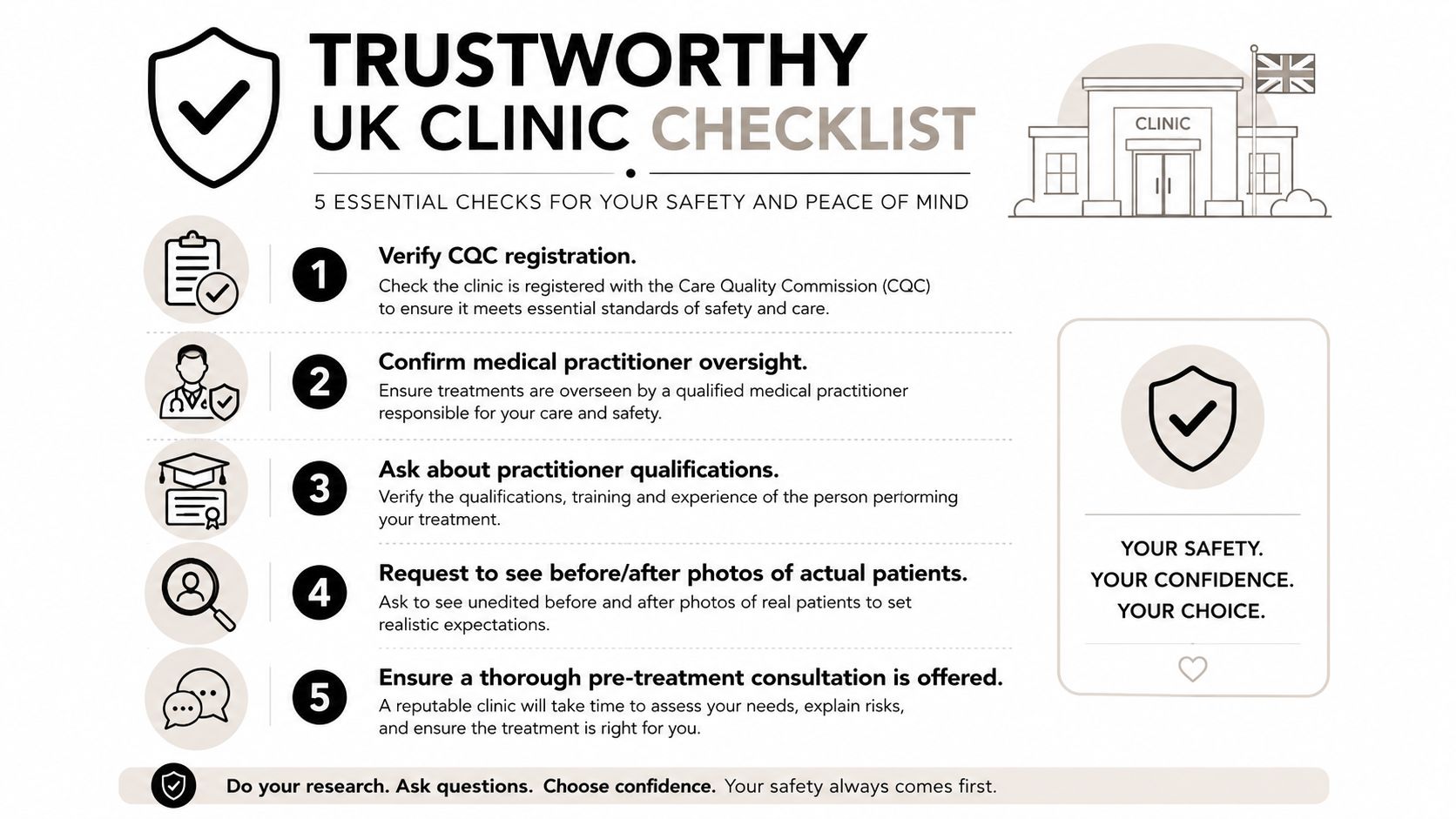
- Confirm the provider: Ask who performs the treatment, what training they hold for the specific device and whether a medically qualified professional provides oversight where appropriate.
- Check the setting: Ask about relevant registration, hygiene arrangements, emergency procedures and professional indemnity insurance. Don't assume a polished website proves any of these.
- Request an assessment: A proper consultation should cover medical history, medications, previous surgery, skin quality, fat distribution and your desired outcome.
- Ask about consent: You should receive a clear explanation of expected effects, limitations, common reactions and red-flag symptoms before treatment.
- Get aftercare in writing: The clinic should tell you who to contact, when a review takes place and how it escalates concerns that don't settle.
Marketing claims can hide the important detail
Before-and-after images can be useful, but they don't show the device settings, lighting, posture, treatment interval or whether the patient had additional procedures. Ask whether the photographs are from the same clinic and whether the results represent the treatment being proposed.
A low price may reflect a short appointment, an entry-level device or limited aftercare. It may also be perfectly legitimate, but you won't know until the clinic explains what the package includes. Clinics also need organised systems for enquiry handling and follow-up, which is why resources on healthcare marketing automation strategies can be useful for understanding how professional practices manage patient communication. Marketing automation, however, is not a substitute for clinical governance.
Red flags worth taking seriously
Be cautious if a provider promises weight loss, guarantees a fixed result, dismisses all complications as impossible or pressures you to buy a course before a full assessment. A practitioner who can explain why you are not suitable is demonstrating better judgement than one who offers every treatment to every person.
What a Professional Consultation Looks Like at 3D Aesthetics
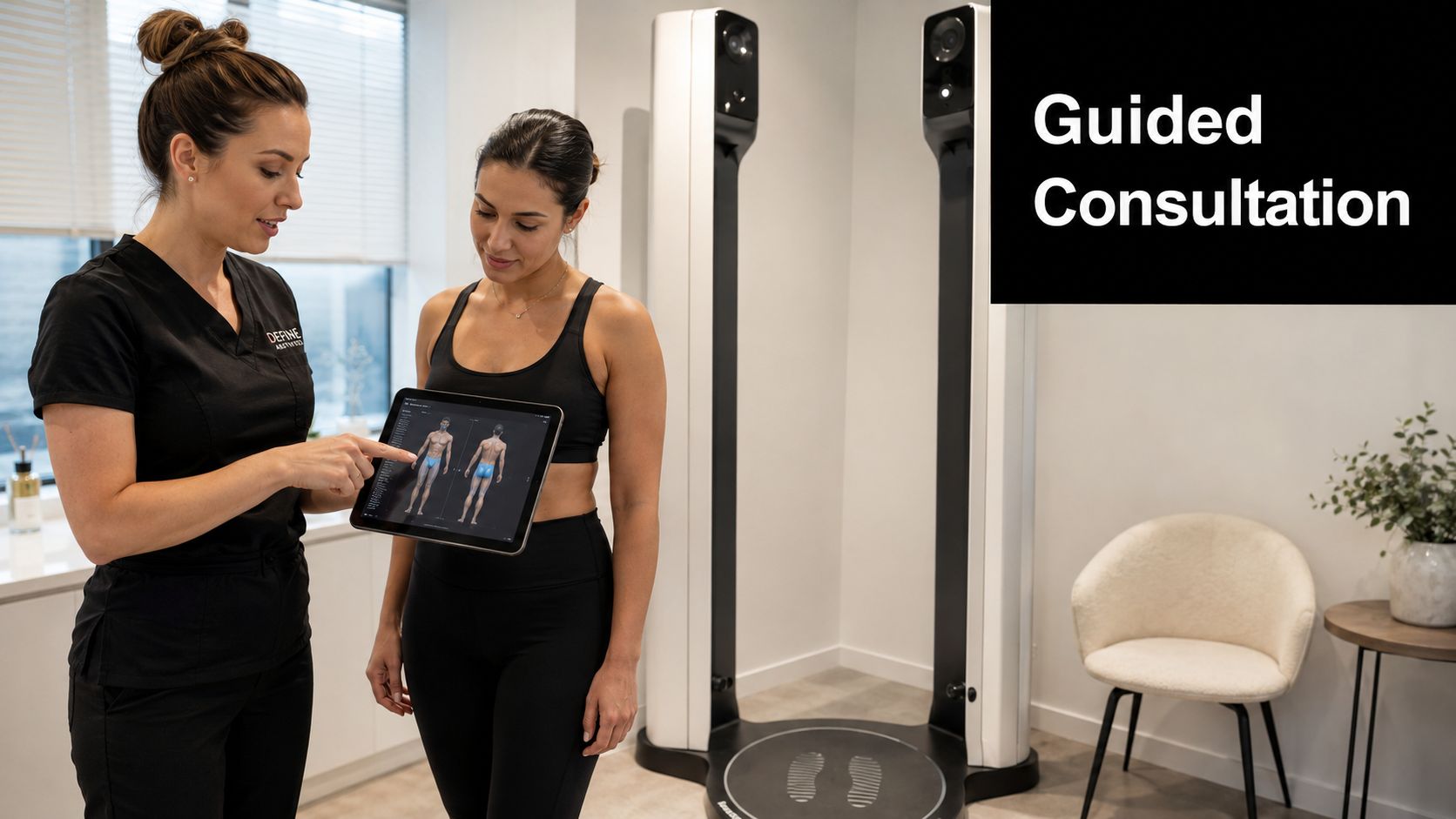
A useful consultation should turn a vague complaint, such as “my stomach won't shift”, into an anatomical and practical assessment. At 3D Aesthetics Leamington Spa, the stated consultation process includes a complimentary 3D body scan. That scan is intended to create measurements that help assess the concern, personalise a plan and track changes over time, rather than relying only on a mirror or a client's recollection.
A realistic client journey
Consider a client who is concerned about a localised abdominal fold after a period of weight stability. The practitioner should first discuss health history, previous treatments, skin laxity and the client's actual goal. The scan can help document the starting point and distinguish a measurable contour concern from an expectation that belongs to overall weight management.
The clinic's body-contouring portfolio includes fat freezing, ultrasound cavitation, 3D Powersculpt, shockwave therapy, body HIFU and radiofrequency. Those options have different purposes, so a responsible plan might recommend one modality, a staged combination or no treatment at all. The choice should follow tissue assessment and the client's priorities, not just the availability of a machine.
Measurement improves the conversation
Visual assessment still matters, but measurement gives both parties a clearer baseline. Follow-up scans can help assess whether a change is occurring and whether the treatment plan should continue, pause or be reconsidered. They can't guarantee a result, and they don't replace a medical history or examination, but they make the conversation less dependent on flattering lighting and subjective impressions.
The clinic describes itself as UK-registered and uses trained therapists for its non-surgical services. That information should still be confirmed directly during consultation, alongside questions about insurance, consent, aftercare and escalation. The same standard should apply whether you visit this clinic or another provider in your area.
Frequently Asked Questions About Non Surgical Fat Removal
Is non-surgical fat removal permanent?
Some modalities are intended to reduce or destroy selected fat cells, but the visible contour still depends on the remaining cells, future weight changes, skin quality and ageing. Treatment doesn't prevent fat from accumulating elsewhere, and it isn't a replacement for sustainable nutrition or movement.
How long does it take to see a result?
Results commonly develop gradually because the body needs time to process treated cellular material and the tissue needs time to settle. Your practitioner should provide a review plan rather than promising a precise date. Measurements and consistent photographs are more useful than checking the area repeatedly in different lighting.
Does treatment hurt?
Experience varies by modality, treatment area, applicator and personal sensitivity. Fat freezing can involve intense cold, pulling, pressure or altered sensation, while ultrasound, HIFU and RF produce different sensations. Ask what you'll feel during treatment and what reactions are considered normal afterwards.
What if I gain weight?
Weight gain can affect the overall contour even if selected fat cells have been treated. Non-surgical contouring targets a local area, so it can't control changes throughout the body. If your main goal is significant weight reduction, discuss appropriate medical or lifestyle support before considering aesthetic contouring.
Can treatments be combined?
They can be combined in some plans, but combination treatment shouldn't be used to compensate for poor patient selection. Combining technologies increases the importance of sequencing, treatment intervals, contraindication checks and clear responsibility for aftercare.
When is surgery more appropriate?
Surgery may be more appropriate when a person wants a substantial change, has extensive excess tissue or needs correction beyond the safe and realistic limits of non-surgical devices. It carries a different risk profile and requires specialist assessment. If the concern may involve lipoedema, a hernia, unexplained swelling or another diagnosis, seek medical evaluation rather than booking cosmetic treatment.
3D Aesthetics Leamington Spa offers consultations with 3D body scanning and non-surgical options including fat freezing, ultrasound cavitation, body HIFU and radiofrequency. To discuss whether your concern is suitable and receive a personalised assessment, visit 3D Aesthetics Leamington Spa.
← Back to Home