
You stand in front of the mirror, pull your waistband away from your stomach, and wonder why the scale hasn't changed enough to explain the new shape. Perhaps the area feels soft and pinchable, or perhaps it feels firm and distended. Those two experiences can look similar in clothing, but they involve different types of abdominal fat and need different strategies.
A sensible abdominal fat reduction plan starts by separating clinical central adiposity from cosmetic contouring. The waist measurement, the depth and texture of the fat, skin laxity, posture, muscle tone and weight stability all matter before anyone chooses a device. A 3D body scan can make that assessment more objective, turning “I want to lose my belly” into a clear treatment conversation.
Table of Contents
- Why Some Belly Fat Responds and Some Does Not
- Lifestyle Strategies That Move Central Fat
- Non-Surgical Treatment Options Explained
- Matching the Right Treatment to Your Concern
- What a Professional Consultation Actually Looks Like
- Aftercare and How Results Unfold Over Time
- Common Questions About Abdominal Fat Reduction
Why Some Belly Fat Responds and Some Does Not
A client may arrive asking for fat freezing because a lower-abdominal fold remains despite a generally stable weight. Another may describe a hard, rounded waist that can't be grasped between the fingers. Both may use the phrase “belly fat”, but a surface contouring treatment is only relevant to the first situation.
Think of the abdomen as two layers beneath the skin. Subcutaneous fat is the outer layer, the part you can pinch, lift and measure with a fold. Visceral fat lies deeper inside the abdominal cavity, around the organs. A useful coat-and-jumper analogy is simple: subcutaneous fat is the coat you can hold from the outside, while visceral fat is the jumper underneath, close to the body's internal structures.
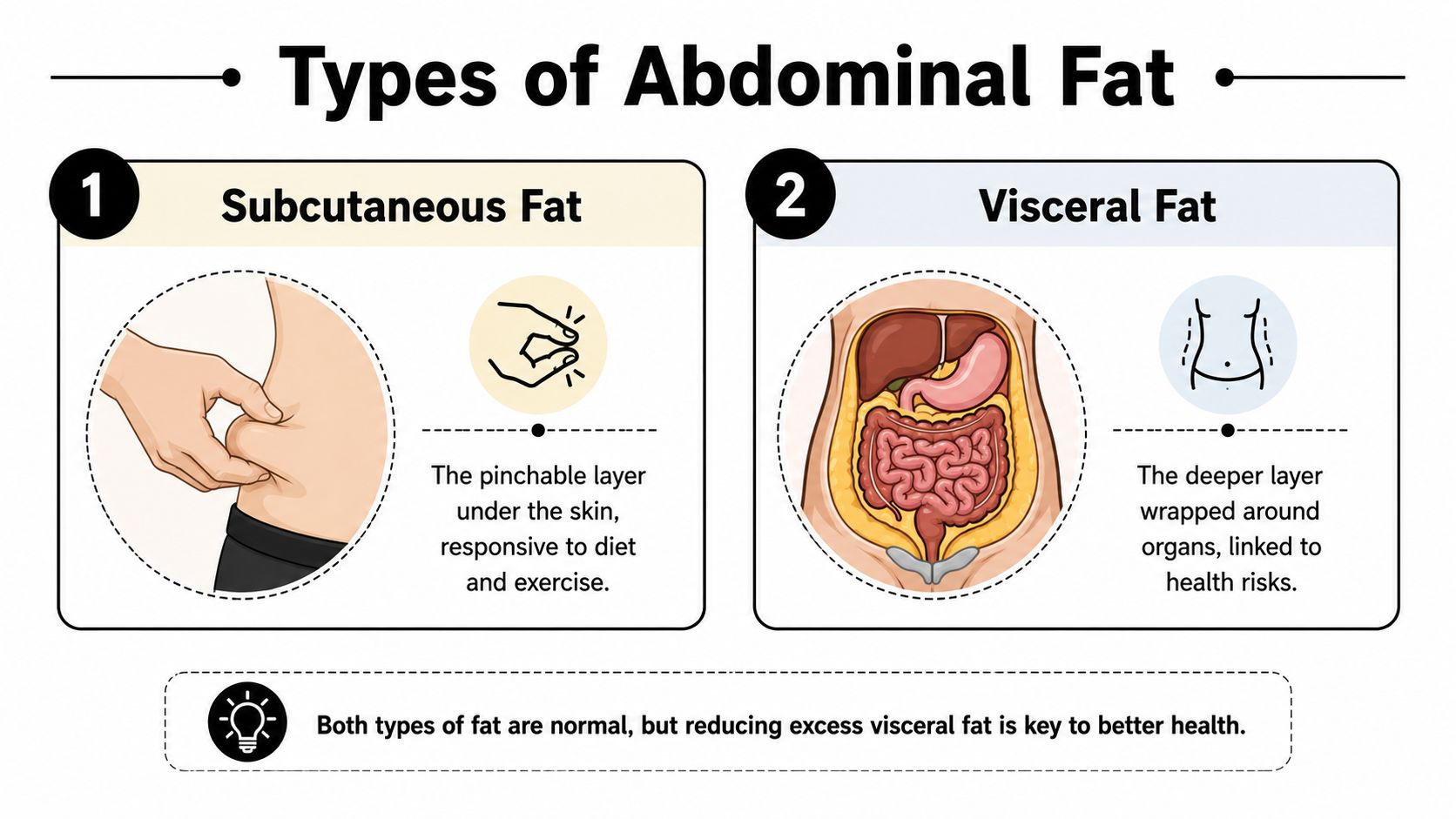
The outer layer and the inner layer
Cryolipolysis, ultrasound cavitation and other surface-based body-contouring treatments work on subcutaneous deposits. They can alter the appearance of a localised fold, but they can't reach fat wrapped around internal organs. Body HIFU, radio frequency and shockwave may improve skin quality, tissue firmness or the appearance of cellulite, but they're not substitutes for reducing visceral fat.
Lifestyle changes affect the broader abdominal picture. Food intake, resistance training, daily movement, sleep, alcohol consumption and stress all influence body composition and waist size. That doesn't mean every person with a larger waist has poor habits. Hormonal changes, medication, genetics and medical conditions can alter fat distribution, which is why a professional assessment matters.
Why the tape measure beats the bathroom scales
In England, waist circumference is the standard clinical proxy for abdominal obesity. The Health Survey for England 2022 adult overweight and obesity findings use sex-specific thresholds: for men, below 94 cm is desirable, 94 to 102 cm is high, and above 102 cm is very high; for women, below 80 cm is desirable, 80 to 88 cm is high, and above 88 cm is very high.
These thresholds aren't cosmetic targets, and a clinic shouldn't present them as guaranteed treatment outcomes. They show why abdominal fat reduction needs more than a scale reading. A person can lose weight without changing their waist much, or maintain a similar weight while changing body composition and reducing central fullness.
UK Biobank research has also helped move obesity assessment beyond weight alone. An analysis of up to 38,965 participants measured visceral adipose tissue, abdominal subcutaneous adipose tissue and gluteofemoral fat using MRI, as described in the UK Biobank imaging research record. In practice, a 3D scan isn't an MRI, but it can still document external shape, circumference, posture and visible distribution more usefully than a single weigh-in.
Lifestyle Strategies That Move Central Fat
Devices can refine a pinchable fold. They can't replace the habits that address central adiposity. That distinction matters in a country where 45% of adults said they were trying to lose weight in 2022, with women more likely than men to report trying, according to the Health Survey for England.
The most reliable approach isn't a punishing short-term diet. It's a repeatable routine that preserves muscle while gradually improving energy balance and waist measurements.
Start with resistance training
Resistance training deserves priority because it supports muscle retention and development while you work on fat reduction. Use bodyweight movements, resistance bands, dumbbells or machines, and train the major movement patterns rather than performing endless abdominal exercises.
Crunches can strengthen the abdominal muscles, but they won't selectively remove the fat above them. Squats, hinges, presses, rows and loaded carries create a more useful whole-body stimulus. For people training at home or working with limited space, these high-ROI small studio workouts can help turn a small room into a practical training environment.
Build meals around protein and fibre
Adequate protein supports muscle repair and helps meals feel satisfying. Include a clear protein source at meals, such as eggs, fish, poultry, yoghurt, tofu, beans or lentils, then add vegetables, fruit, pulses and wholegrains for fibre.
Fibre isn't a fat-freezing tool, but it can support appetite control and digestive regularity. Increase it gradually, especially if your current intake is low, and drink enough fluid to make the change comfortable.
Protect sleep and moderate alcohol
Short or disrupted sleep can make appetite management harder and can reduce the quality of training recovery. Treat sleep as part of the programme, not a reward you earn after exercise. A consistent bedtime, a darker bedroom and a buffer between work and sleep are more useful than searching for a miracle supplement.
Alcohol also deserves an honest review. It can add energy without creating much fullness, affect sleep and make food choices less deliberate. Reducing intake may support a waist-reduction plan, particularly when drinks are paired with late-night eating.
Practical priority: If you can only change two things this month, make resistance training consistent and make your everyday meals more filling.
Stress management completes the picture. Walking, breathing exercises, time outdoors, counselling or creating boundaries around work can help you follow the plan. The goal isn't to eliminate stress. It's to stop stress from dictating every meal, bedtime and training decision.
Non-Surgical Treatment Options Explained
Non-surgical abdominal contouring works best when the clinician identifies the tissue being treated. A device may reduce a localised fat layer, stimulate muscle contractions, tighten skin or improve the appearance of cellulite. Those are different outcomes, and a responsible consultation won't describe them as interchangeable.
The options below are presented as tools with distinct roles. Actual suitability depends on medical history, tissue thickness, skin condition, weight stability and the assessment carried out by a trained practitioner.
Cryolipolysis
Cryolipolysis, commonly called fat freezing, cools a selected fold of pinchable subcutaneous fat. The treated fat cells are exposed to controlled cooling, and the body gradually clears the affected cells over time. It isn't designed to treat visceral fat, and it doesn't function as a general weight-loss treatment.
A published clinical review of cryolipolysis summarises average fat reductions after a single treatment cycle ranging from 14.67% to 28.5% by caliper measurement and 10.3% to 25.5% by ultrasound, with follow-up commonly taking place over two to six months. The review also reports no significant effect on overall body weight. See the published clinical review of cryolipolysis for the underlying discussion.
The ideal candidate has a stable weight and a discrete fold that the applicator can safely capture. During treatment, you may feel intense cold, pulling, pressure, tingling or numbness. Temporary redness, tenderness or altered sensation can occur, and downtime is usually limited, but your clinician must screen for contraindications and explain risks properly. You can review how a clinic describes this treatment through its fat-freezing treatment information.
Ultrasound cavitation
Ultrasound cavitation uses acoustic energy at the skin surface to affect selected superficial tissue. Clinics generally position it as an inch-loss or contouring treatment for areas such as the abdomen and flanks, not as a method for reaching deep visceral fat.
Suitability is strongest when the concern is diffuse, soft, superficial fullness rather than a single substantial fold. The sensation may include warmth, vibration or a buzzing sound, and individuals return to normal activity quickly. A course is often more appropriate than a one-off appointment, because the intended result develops through repeated sessions and supportive habits.
3D Powersculpt
3D Powersculpt is intended to create strong muscle contractions in the treated area. Its role is therefore muscle stimulation and definition, not direct removal of visceral fat. It may suit someone whose abdominal appearance is affected by low muscle tone as well as a modest superficial fat layer.
Sessions can feel like intense repeated contractions, and the intensity should be increased according to tolerance and clinical guidance. Mild muscle fatigue can follow, much like after exercise. A practitioner should explain whether the proposed course is designed to improve firmness, definition or a combination of goals, rather than promising a specific centimetre reduction.
Body HIFU
Body HIFU uses focused ultrasound energy at selected tissue depths. Depending on the device and settings, the clinical objective may include body contouring and skin tightening. It can be relevant when loose or lax skin contributes more to the abdominal profile than the fat layer itself.
Treatment may produce brief heat, tingling or sharper sensations in isolated points. Downtime is generally limited, although tenderness or sensitivity can occur. Body HIFU is not a tool for visceral fat reduction, and it shouldn't be sold as one.
Shockwave and radio frequency
Shockwave treatments deliver mechanical acoustic pulses. In body programmes, they're often used as a complementary treatment for tissue texture, circulation-related concerns and the appearance of cellulite. They aren't a primary solution for a deep abdominal fat deposit.
Radio frequency heats tissue using electromagnetic energy. Its main value in abdominal contouring is often skin quality and firmness, particularly where the skin looks crepey after weight change. The handpiece normally feels warm, but settings must be controlled carefully to protect the skin. Neither shockwave nor RF should be described as a replacement for nutrition, exercise or medical management of central adiposity.
| Modality | Mechanism | Best candidate | Typical result | Downtime |
|---|---|---|---|---|
| Cryolipolysis | Controlled cooling of a pinchable superficial fat fold | Stable weight with localised abdominal fat | Gradual reduction in the treated fat layer and improved contour | Usually limited, with possible tenderness or altered sensation |
| Ultrasound cavitation | Surface-applied acoustic energy for superficial contouring | Diffuse, soft superficial fullness | Progressive inch-loss appearance across a planned course | Usually minimal |
| 3D Powersculpt | Intensive muscle contractions | Reduced muscle tone and a desire for more definition | Firmer-looking, more defined abdominal muscles | Possible temporary muscle fatigue |
| Body HIFU | Focused ultrasound at selected tissue depths | Skin laxity with or without contour concerns | Improved firmness and body contour, depending on indication | Usually limited |
| Shockwave | Mechanical acoustic pulses | Tissue texture or cellulite concerns as an adjunct | Smoother-looking tissue quality | Usually limited |
| Radio frequency | Controlled heating of superficial tissue | Crepey skin and mild laxity | Warmer, firmer-looking skin over a course | Usually minimal |
Matching the Right Treatment to Your Concern
Start with the physical feature you can identify, not the most familiar device name. A lower-abdominal fold that you can grasp is a different treatment problem from loose skin after weight loss, and both differ from a waist that feels firm and enlarged.
Use the pinch test carefully
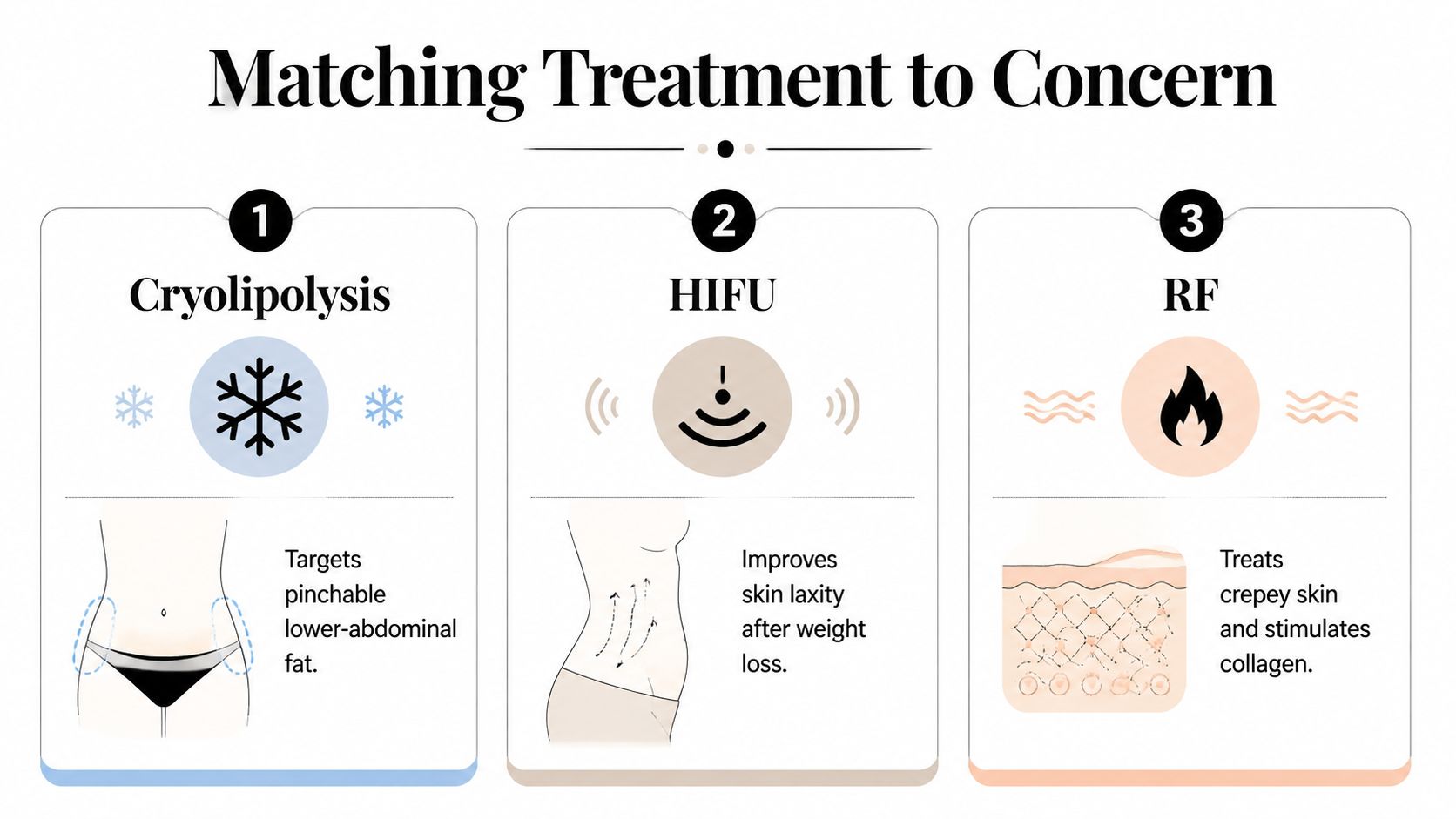
If the main concern is a pinchable lower-abdominal deposit, cryolipolysis may be worth discussing. The applicator needs enough superficial tissue to capture safely, and expectations should centre on contour change rather than a dramatic scale result.
If the fullness is spread across the abdomen and flanks, ultrasound cavitation may be considered as part of a planned course. It tends to make more sense for general superficial inch loss than for a sharply defined fold.
Look at the skin separately
Loose, thin or crepey skin can remain after fat has reduced. Body HIFU may be more relevant when laxity dominates the appearance, while RF can support a plan focused on surface firmness and texture. Neither should be chosen just because the abdomen is the treatment area.
Add muscle and texture support when appropriate
3D Powersculpt may fit a plan where muscle definition is limited. Shockwave can complement a programme when cellulite or uneven tissue texture is part of the concern, but it isn't the treatment I'd select as the primary answer to a sizeable fat fold.
Many clients benefit from a layered plan, but layering doesn't mean booking every device together. A sensible sequence might address superficial fat first, then skin firmness or muscle definition. The right choice depends on what the scan shows and how stable your weight and habits are.
For a broader overview of how clinics may combine contouring approaches, see this body-sculpting treatment information. The useful question is not “Which machine is strongest?” It's “Which tissue is limiting the result I want?”
What a Professional Consultation Actually Looks Like
A proper consultation should feel like an assessment, not a sales appointment. Before recommending abdominal fat reduction, the practitioner should ask about your medical history, medication, previous operations, pregnancies, weight changes, current symptoms and how stable your weight has been.
The practitioner should also examine the abdomen rather than relying on photographs or a verbal description. They need to distinguish a superficial fold from skin laxity, muscle separation, posture-related projection and fullness that may need medical discussion rather than cosmetic treatment.
Why a 3D scan changes the discussion
A 3D body scan can record circumference, visible fat distribution, asymmetry and posture. It gives the clinic a baseline for repeat comparisons, which is especially useful when day-to-day mirror checks are affected by bloating, lighting, clothing and normal fluctuations.
A scan isn't an MRI and it doesn't diagnose visceral fat. Its value is different. It documents the external contour more consistently, helping you and the practitioner agree on what the treatment is intended to change. You can see how this process is presented in the clinic's 3D body-scanning information.
Questions worth asking before treatment
A credible clinic should explain:
- The target tissue: Is the plan aimed at superficial fat, skin laxity, muscle tone or texture?
- The endpoint: What visible change is plausible, and what won't the treatment do?
- The course: How many appointments are proposed, and why?
- The financial commitment: What is the total cost, including reassessment or maintenance?
- The safety screening: Which conditions, medicines or previous procedures affect suitability?
- The measurement plan: When will the scan, photographs and circumference readings be repeated?
Walk away from any consultation that guarantees a precise inch loss without examining you. A practitioner who skips medical screening, refuses to discuss limitations or pushes several devices before identifying the problem isn't giving you informed choice.
Aftercare and How Results Unfold Over Time
The first 24 to 72 hours should be uncomplicated and practical. Follow the clinic's instructions, drink regularly, keep activity light if the area feels tender, avoid alcohol if advised, and don't massage or heat the treated area unless your practitioner specifically tells you to.
Mild tenderness, sensitivity, swelling or temporary redness can occur with some treatments. Severe pain, marked skin changes, spreading redness or symptoms that concern you should prompt a call to the clinic or appropriate medical advice.
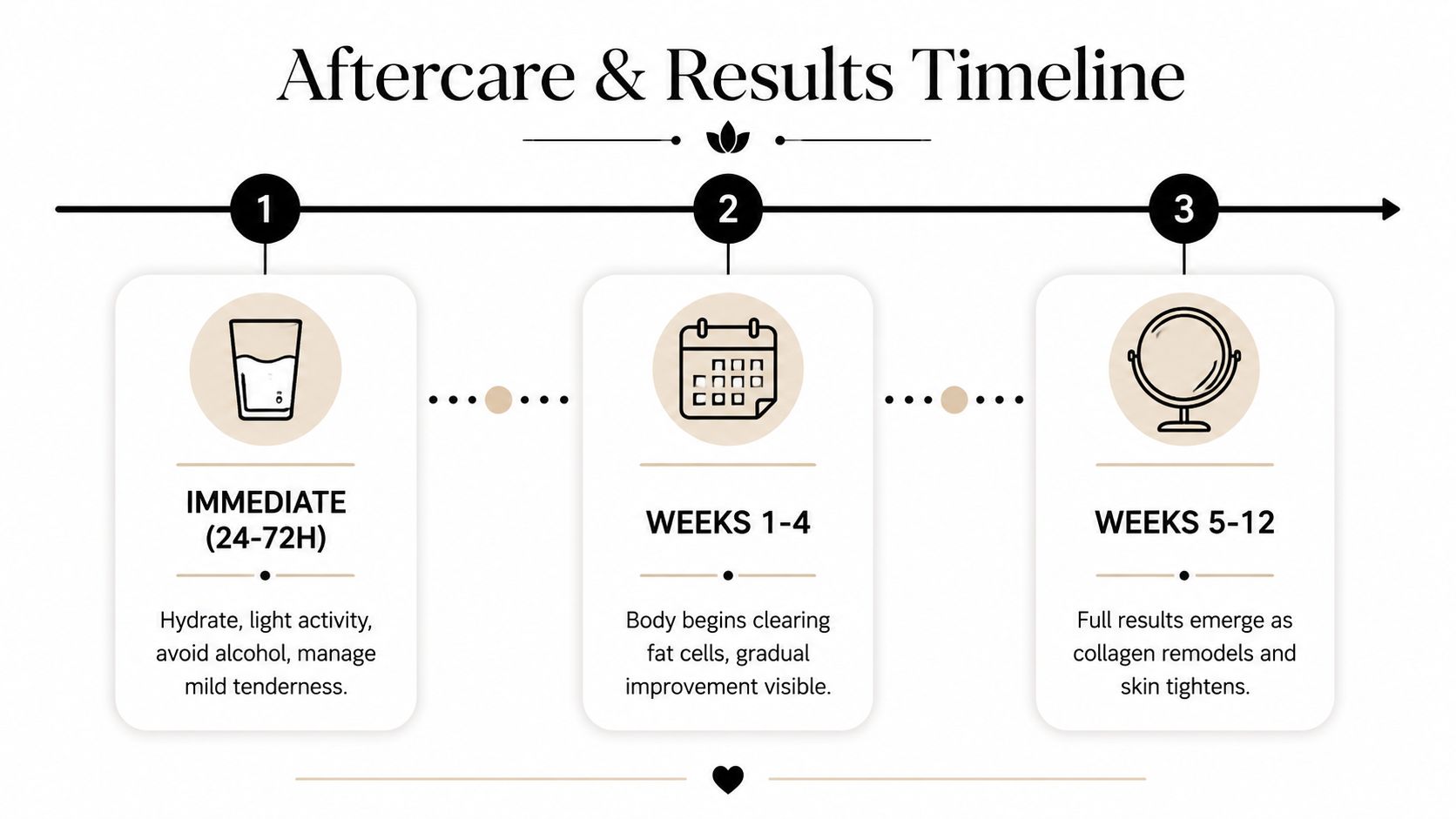
Don't judge a contouring result in the mirror every morning. Take measurements and photographs under consistent conditions, then compare at planned reviews such as week four and week eight, rather than reacting to normal daily variation. Treatments that rely on gradual clearance or collagen remodelling need time, and the final appearance won't necessarily arrive immediately after the appointment.
Measurement rule: Use the scan, tape measure and consistent photographs together. One number rarely captures a change in shape.
Fat cells affected by a treatment may be cleared, but the remaining cells can still enlarge if weight and habits regress. Maintenance therefore means keeping resistance training, balanced meals, regular movement and realistic alcohol habits in place, not repeatedly treating an unchanged pattern of overeating.
Common Questions About Abdominal Fat Reduction
Can the NHS provide cosmetic contouring?
NHS pathways don't generally provide non-surgical body contouring for appearance alone. NICE guidance NG246 separates central adiposity from overall obesity and uses a staged approach that begins with behaviour change, followed by medicines and specialist services for people who meet relevant risk and eligibility criteria.
Should I speak to my GP first?
Yes, if your waist has changed rapidly, the abdomen feels unusually hard or distended, you have unexplained symptoms, or you have conditions and medicines that may affect treatment safety. Cosmetic treatment shouldn't delay assessment of a possible medical problem.
Can several devices be used in one appointment?
Sometimes clinics combine modalities, but safe sequencing depends on the equipment, treatment areas, your skin and medical history. A practitioner should justify the combination rather than stacking treatments to increase the sale.
What if my results stall?
Return for reassessment with your original scan and measurements. The issue may be inaccurate expectations, unstable weight, skin laxity, untreated visceral fat, insufficient time for the result to develop or a treatment that didn't match the tissue involved.
At 3D Aesthetics Leamington Spa, you can discuss abdominal fat reduction through a complimentary consultation and full 3D body scan, with options including fat freezing, ultrasound cavitation, 3D Powersculpt, body HIFU, shockwave and radio frequency. Visit 3D Aesthetics Leamington Spa to arrange an assessment focused on your actual fat distribution, skin quality and measurable treatment goals.
← Back to Home