
You're probably here because the scales may be fairly steady, your routine is decent, and yet your stomach still doesn't look the way you expected. That small lower-belly pouch, the softness above the waistband, or the area that bunches when you sit can feel oddly resistant, even when the rest of you responds well to healthy habits.
That's exactly where fat freezing on the stomach tends to come into the conversation. It's a non-surgical treatment aimed at targeted body contouring, not general weight loss. The important part is knowing when it's likely to help, when it won't, and how to measure success properly. That last part matters more than is generally understood, especially if your changes are subtle rather than dramatic.
Table of Contents
- The Stubborn Stomach Fat That Won't Shift
- How Fat Freezing Works Its Magic on the Stomach
- Are You an Ideal Candidate for Stomach Fat Freezing
- Your Fat Freezing Treatment Journey Step by Step
- Results Timeline and What to Realistically Expect
- Fat Freezing vs Other Stomach Contouring Options
- Common Questions and Your Next Step in Leamington Spa
The Stubborn Stomach Fat That Won't Shift
A pattern I see often is this. Someone feels good in most clothes, eats reasonably well, exercises regularly, but still finds one section of the abdomen refuses to cooperate. It may be the lower tummy after weight loss, the soft fold that appears over jeans, or a small bulge that doesn't match the rest of the body.
That frustration is real. Stomach fat can be especially annoying because it's so visible in fitted clothing, and because effort doesn't always produce proportionate change in that one area.
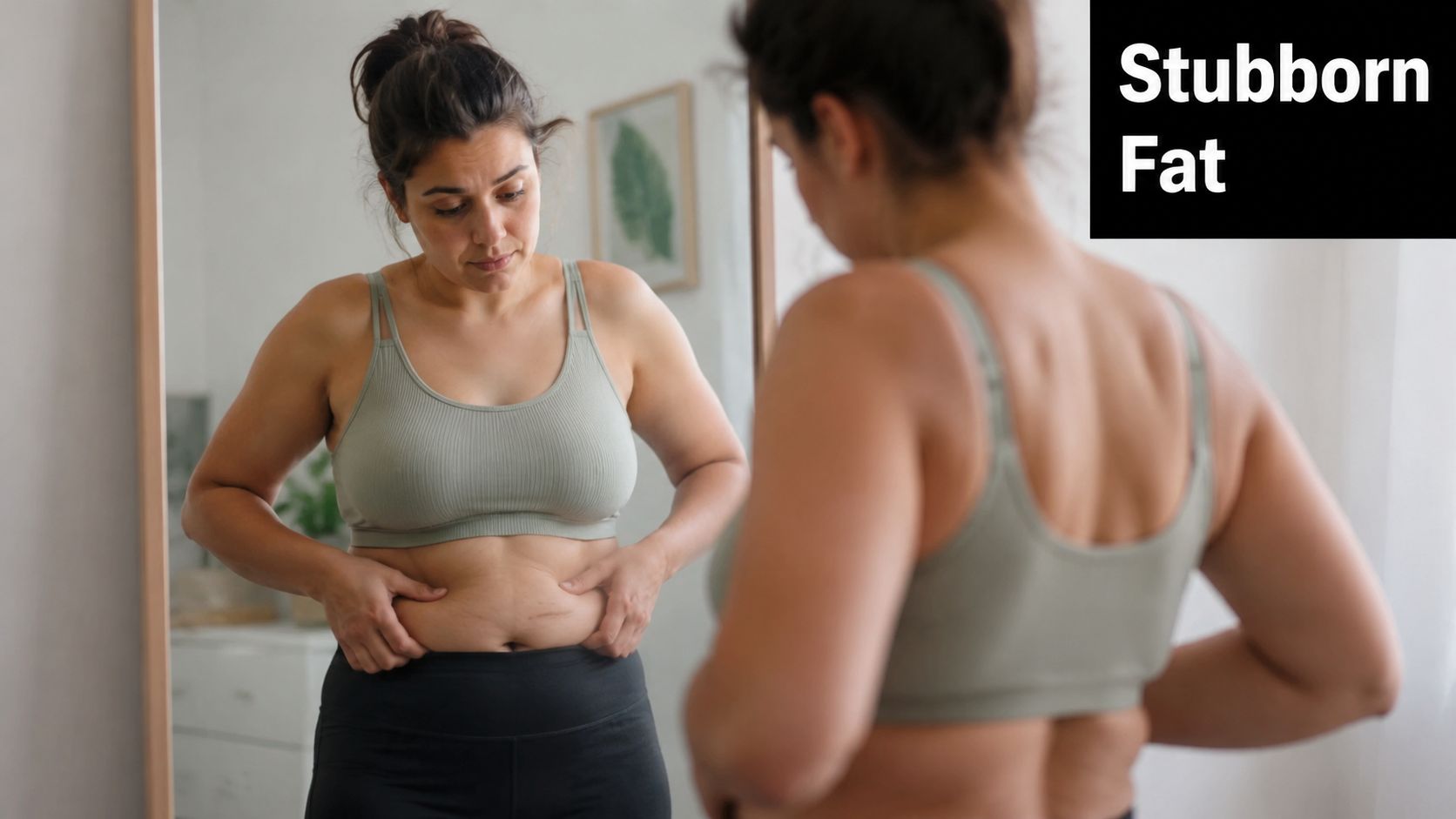
For many people, the issue isn't needing a major transformation. It's wanting the midsection to look smoother and more balanced. That's why fat freezing on stomach areas appeals to clients who are already making healthy choices. If age-related body changes are part of the picture, practical lifestyle support such as this guide to sustainable weight loss after 50 can help alongside any aesthetic treatment.
Why the stomach feels different
The abdomen often holds onto fat in a very localised way. You might lose fullness from your face, arms or legs first, while the tummy looks much the same. That can make the area feel “immune” to your efforts, even when your overall progress is good.
Practical rule: Fat freezing is for shaping a stubborn area, not for replacing diet, movement, or broader weight management.
A lot of online advice about fat freezing becomes confusing. Some articles talk about it as if it's a slimming shortcut. It isn't. It's better thought of as a finishing treatment for a specific pocket of fat that you can grab between your fingers.
Why guidance matters
Two stomachs can look similar in the mirror and need completely different advice. One person may have soft, pinchable fat sitting just under the skin. Another may have more internal abdominal fullness that won't respond to cryolipolysis in the same way.
That's why proper assessment matters from the start. The treatment can be very useful for the right stomach shape and the right fat type, but not every belly concern is a fat-freezing concern.
How Fat Freezing Works Its Magic on the Stomach
Fat freezing is the common name for cryolipolysis. The basic idea is simple. Fat cells are more vulnerable to cold than surrounding tissues, so a well-designed device can cool the target area enough to affect fat cells while leaving skin, muscle and other nearby structures unharmed.
Why the stomach is such a common treatment area
The stomach is one of the most popular zones because many people can clearly identify a small area they'd like to reduce. It's also a place where the applicator can often hold the tissue well, which helps treatment planning.
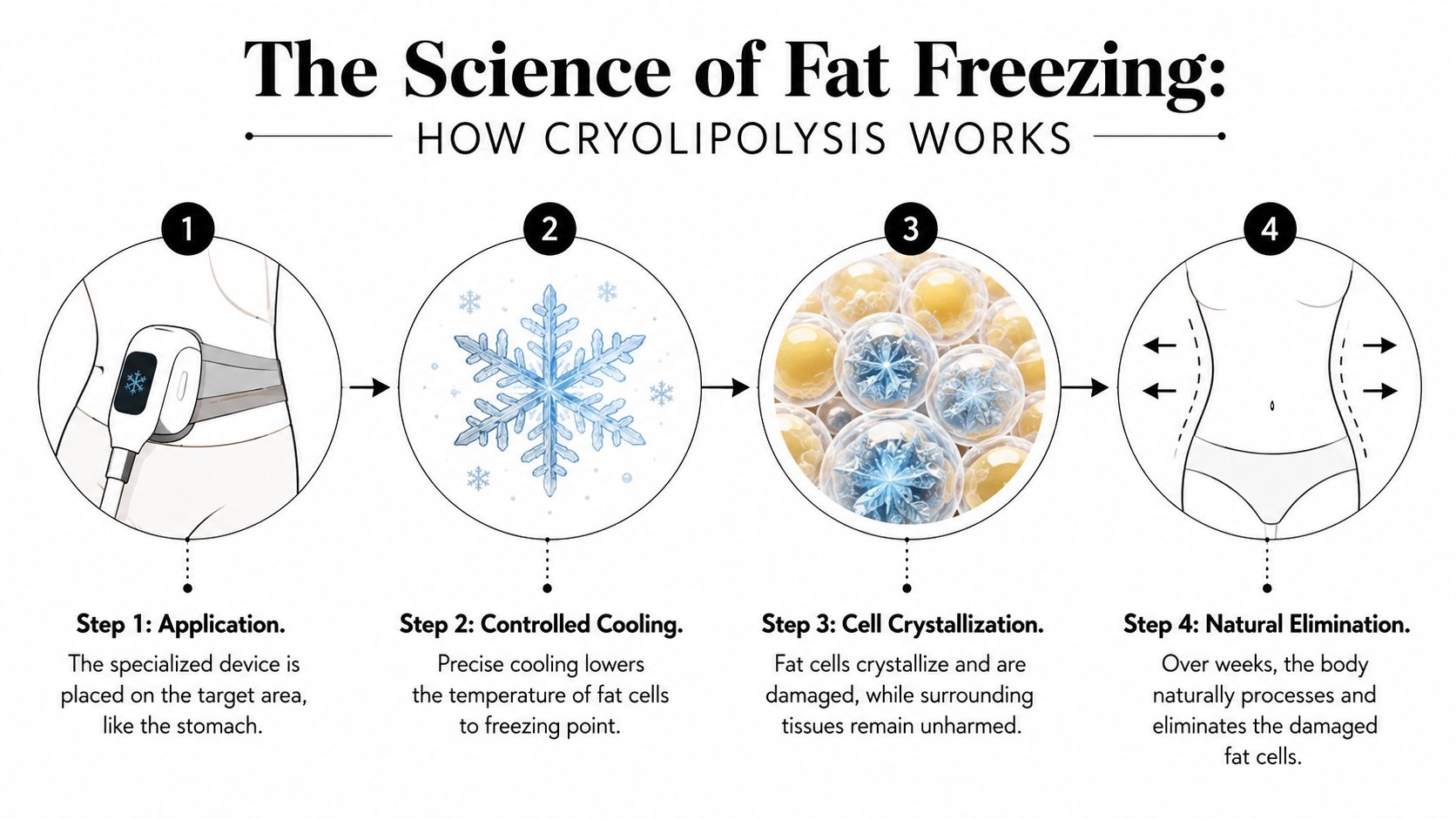
To make the process easier to picture, this visual gives a straightforward overview.
What the cold is actually doing
A useful analogy is a cold drink with ice in it. The ice affects the liquid first. The glass itself doesn't suddenly become an ice block. Cryolipolysis works on a similar principle of selective cooling.
On the abdomen, cryolipolysis uses targeted cooling of about −10°C to −11°C, which triggers apoptosis, or programmed cell death, in fat cells without damaging surrounding skin, nerves or muscle. The body then metabolises and excretes these dead cells over 3 to 6 months, according to this explanation of abdominal cryolipolysis.
A treatment usually starts with the area being marked and protected. The applicator then draws the tissue into place and applies controlled cooling. The first few minutes tend to feel the most intense because you notice the pull and the cold together. After that, the area usually becomes quite numb.
Here's a short video that helps show the general treatment concept in a more visual way.
One practical way to think about it is this. The appointment doesn't “remove” fat there and then. It starts a biological clean-up process. Your body does the rest gradually.
If you're comparing options, this overview of fat freezing treatment options shows how clinics typically position cryolipolysis within a broader non-surgical body contouring plan.
Are You an Ideal Candidate for Stomach Fat Freezing
Not everyone with a tummy concern is a good match for fat freezing on stomach areas. The best candidates are usually close to their goal weight and bothered by a localised, pinchable pocket of fat rather than a general need to lose weight.
That distinction matters because cryolipolysis is a shaping treatment. It's designed for spot reduction, not for changing the overall metabolic picture.
The difference between pinchable fat and deeper belly fullness
The clearest dividing line is subcutaneous fat versus visceral fat. Subcutaneous fat sits under the skin and can often be pinched. Visceral fat sits deeper inside the abdomen, around the organs, and doesn't behave like the soft outer layer.
BBC reporting highlights a critical point. Fat freezing only works on subcutaneous, pinchable fat, not visceral fat, and mismatched application is a key reason some people are disappointed or put at risk. The same reporting also notes a rare risk of paradoxical adipose hyperplasia, or PAH, where fat grows instead of shrinking, which is why professional assessment is vital, as discussed in this BBC report on the risks around fat freezing.
If the concern is a firm, rounded abdominal fullness rather than a soft outer layer, fat freezing may not be the right tool.
A few signs often point towards better candidacy:
- You can pinch the area easily. The bulge feels soft and sits close to the surface.
- Your weight is fairly stable. You're looking for contouring, not a major body change.
- Your goal is refinement. Smoother lines in clothes, less fullness, and better proportion tend to be realistic aims.
Less suitable situations can include significant weight fluctuation, expectations of dramatic size loss from one session, or stomach concerns that are mainly about loose skin rather than fat.
Why a 3D body scan matters before treatment
This is the step many generic guides skip. A consultation shouldn't rely only on a quick pinch test and a mirror discussion. Advanced assessment helps the therapist judge distribution, symmetry and whether the concern is likely to respond to cryolipolysis at all.
A 3D body scan is useful because it gives a structured baseline. Instead of relying on memory, guesswork or a single tape measure, you can assess body shape from multiple angles and compare scans over time. That's especially valuable on the abdomen, where small contour changes may matter visually even when the scales barely move.
From a safety perspective, careful assessment also helps rule out poor matches. Transparency is important here. PAH is rare, but because it's serious, it shouldn't be brushed off as a footnote. The best consultation is the one that sometimes says, “This treatment isn't the right fit for your stomach.”
Your Fat Freezing Treatment Journey Step by Step
Knowing what the appointment looks and feels like often brings a sense of relaxation. The treatment itself is usually straightforward, but it has a few sensations that are unusual if you've never had it before.
What happens on the day
Your therapist usually starts by reviewing the plan, confirming the treatment area and marking the stomach. That sounds clinical, but it's useful. Precise placement matters if you want a smooth result rather than a random reduction.
A protective gel pad is placed on the skin first. Then the applicator goes on top and draws the tissue into the cup using suction. Clients often describe the first moments as a mix of strong cold, tugging, and pressure.
After those first minutes, the area typically goes numb, which is why many people settle in quite comfortably. They'll read, check emails, listen to music or switch off for a while.
How it feels afterwards
When the applicator comes off, the treated section can look firm, cold and a little odd. Therapists sometimes compare it to a stick of butter straight from the fridge. That appearance is temporary, but it can be surprising if no one warned you.
The post-treatment massage is an important part of the appointment. It can feel intense for a short time because the area is cold and numb, then prickly as sensation begins to return.
According to this overview of the fat freezing procedure and recovery, over 17 million CoolSculpting treatments have been performed globally. The same source notes that common side effects such as redness, swelling, bruising or numbness are usually temporary and tend to settle within days to a few weeks.
A simple way to think of the after-effects is:
- Straight after treatment: The skin may look red and feel very cold or numb.
- Later that day: You might notice tenderness, tingling, or a bruised sensation.
- In the following days: Some people feel slightly puffy or oddly numb before things calm down.
If you want a more detailed look at what's normal after treatment, including the sensations people often worry about most, this guide to fat freezing side effects is useful.
Most of the anxiety around fat freezing comes from not knowing what the cold, suction and massage phase will feel like. Once clients expect it, they usually cope very well.
Results Timeline and What to Realistically Expect
Results with fat freezing on stomach areas are gradual. That's one of the biggest mindset shifts for anyone considering it. You're not leaving the clinic with a dramatically flatter stomach. You're starting a process that becomes visible over time.
When you may start to notice change
The timeline often makes more sense when you see it visually.
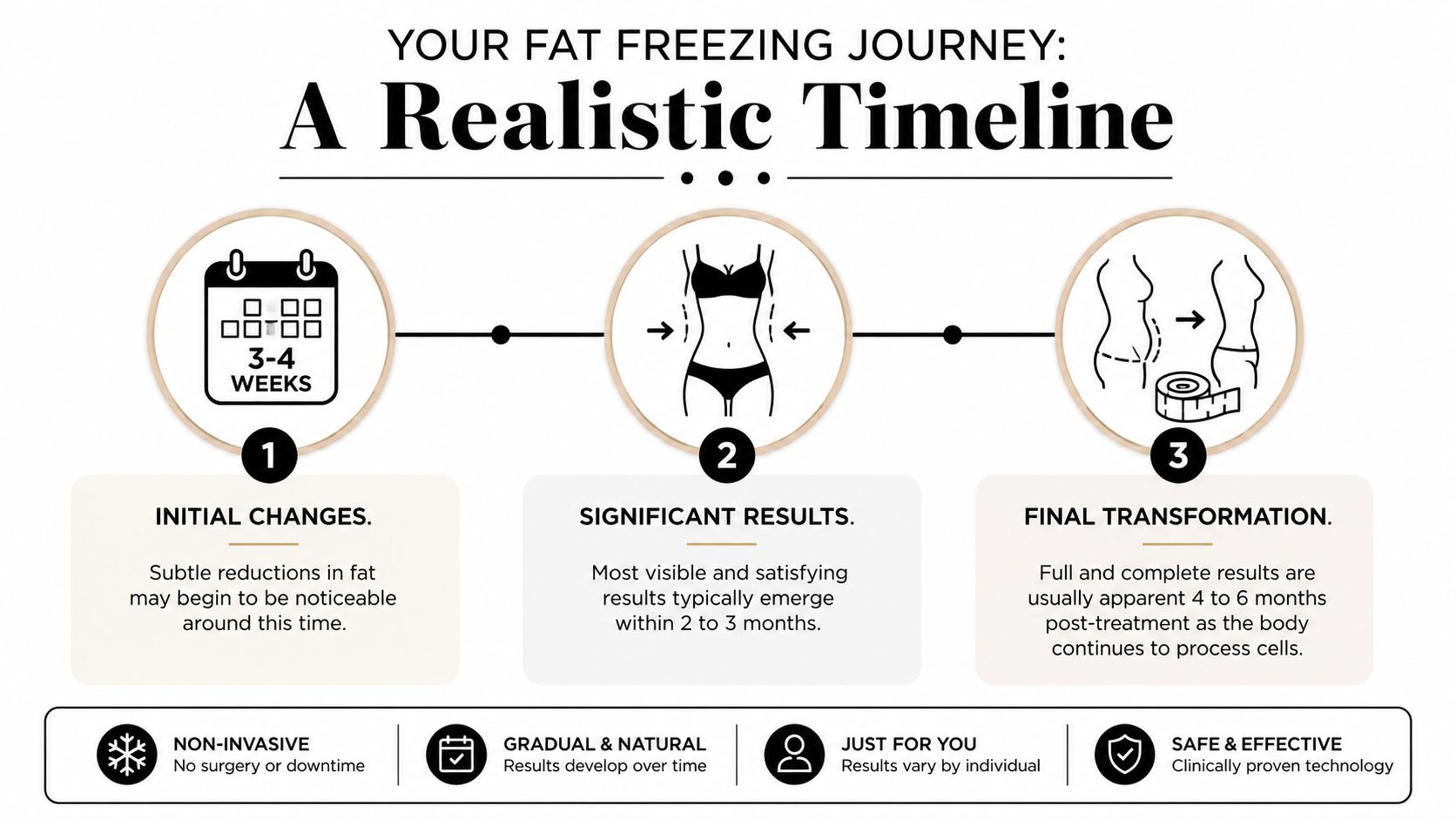
For the stomach, UK treatment information states that a single cycle typically reduces the treated fat layer by 20% to 25%, with the body naturally eliminating the crystallised fat cells over 8 to 12 weeks, as outlined in this overview of stomach fat freezing results. Broader clinical evidence cited there reports an average reduction of 15% to 28% at around 4 months, with visible changes often starting at about 3 weeks and more dramatic improvement commonly noticed after 2 months.
That helps explain why the “nothing's happening” phase can be misleading. In the early weeks, your body is still processing the treated cells. The contour shift often sneaks up on you. Clothes may sit a little better before your eye fully registers the difference.
Why percentages and waist measurements are not the same thing
Expectations require careful handling. Clinic websites often mention a percentage reduction in the fat layer, and that's medically useful. But clients usually think in terms of waistline, dress size, or how the front of a top falls.
Those aren't the same thing.
Harvard's explanation is helpful here. Marketing often cites 10% to 25% fat layer reduction, but that doesn't always create major inch loss. A 20% reduction in a 3 cm abdominal fat layer is only a 0.6 cm change, which shows why the visual result can be real but still modest, as noted in Harvard Health's discussion of freezing fat.
That's exactly why advanced diagnostics matter so much on the stomach.
What a 3D scan adds that a tape measure can miss
A tape measure tells you one circumference. Your stomach isn't one flat ring. It has upper fullness, lower fullness, asymmetry, posture effects and clothing-related pressure points.
A 3D body scan can help by showing:
| What you want to know | Why a 3D scan helps |
|---|---|
| Whether the lower tummy is changing | It can compare shape and projection over time |
| If one side is fuller than the other | It gives a more complete visual map |
| Whether progress is subtle but real | It captures contour change beyond scale weight |
| If your plan needs adjusting | It provides an objective baseline for review |
A small reduction can still be worth having if it improves proportion, smooths the waistline, or makes clothes sit better. The mistake is expecting every percentage change to look dramatic.
For many stomach treatments, one session may help, but some people need a staged plan to reach a result that feels meaningful to them.
Fat Freezing vs Other Stomach Contouring Options
Fat freezing isn't the only non-surgical route for the stomach, and it's not automatically the right one. The best option depends on whether the main issue is a soft fat pocket, loose skin, general inch loss, or a combination.
This visual comparison gives a quick overview of how the common non-surgical options differ.
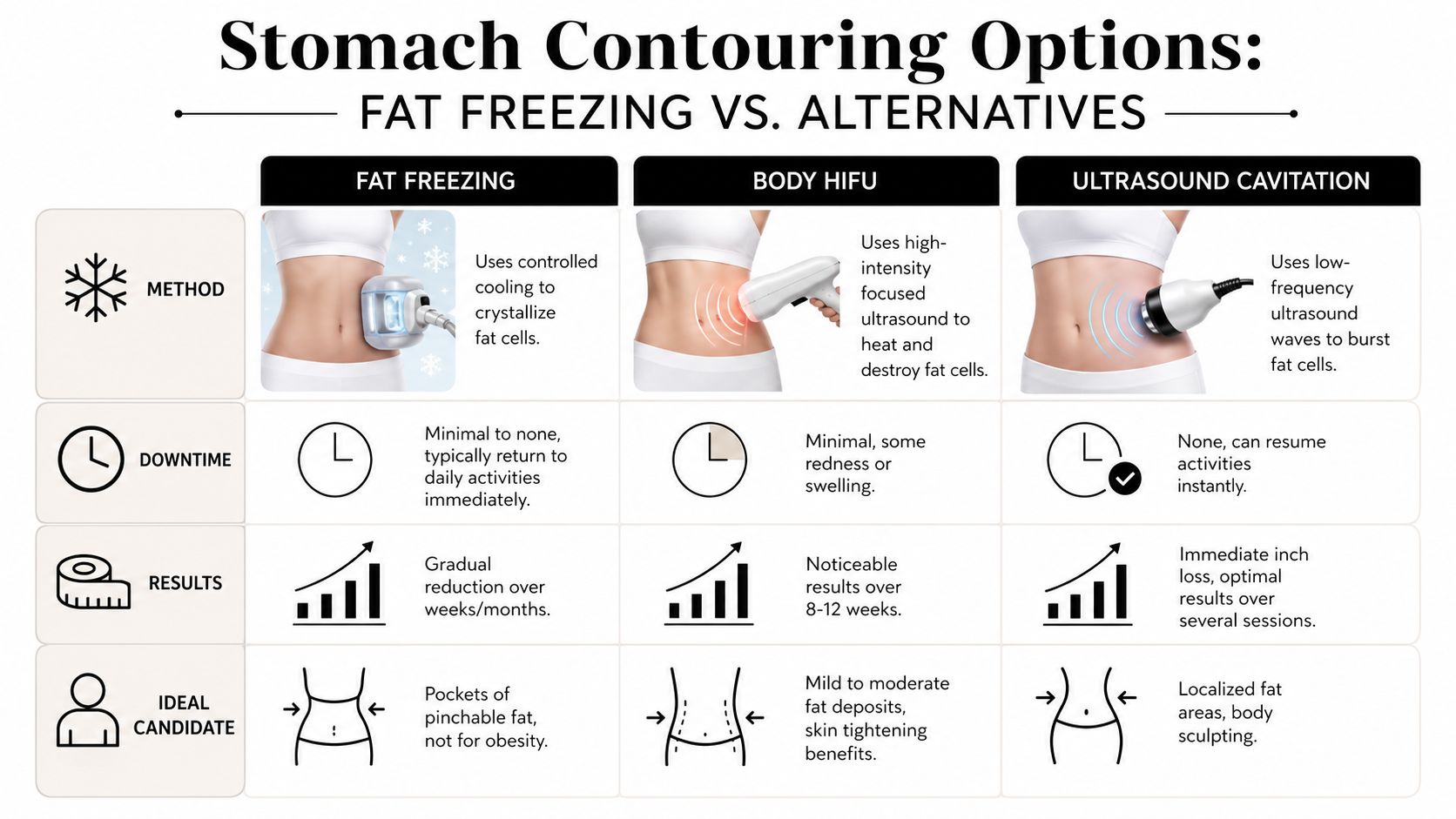
How the main options differ
Here's the practical comparison most clients need:
| Treatment | Usually best for | Main trade-off |
|---|---|---|
| Fat freezing | Pinchable, localised fat pockets | Results take time and may need repeat cycles |
| Body HIFU | Fat plus some tightening goals | Not everyone is suited to heat-based approaches |
| Ultrasound cavitation | Inch-loss focused body sculpting plans | Often planned as a course rather than a one-off |
| Liposuction | More dramatic surgical fat removal | Invasive, with recovery and medical risks |
One important point of comparison is treatment planning over time. In UK practice, abdominal fat freezing often involves 2 to 3 treatment cycles per area spaced 6 to 8 weeks apart, with cumulative reduction up to 28%, according to this review of how abdominal fat freezing protocols are typically structured.
That matters because some people assume one cryolipolysis appointment should create the same level of visible change as more intensive options. Usually, it won't. It's a slower contouring method.
When combination planning makes more sense
The stomach is rarely just one issue. A person may have a little subcutaneous fat, mild skin laxity and some desire for waistline refinement all at once. In those cases, a therapist may look beyond a single modality.
Some clinics offer several approaches in one place. For example, 3D Aesthetics Leamington Spa body contouring treatments include fat freezing, ultrasound cavitation and body HIFU, which means treatment choice can be matched to the concern rather than forcing every stomach into one method.
A simple decision guide looks like this:
- Choose fat freezing when the main issue is a distinct pinchable pocket.
- Consider HIFU when tightening is part of the goal as well as fat reduction.
- Consider cavitation when the priority is broader contouring and visible measurement change across a course.
- Consider surgery when the desired change is substantial or skin laxity is significant.
Common Questions and Your Next Step in Leamington Spa
Does it hurt
The sensation is typically uncomfortable at the start rather than painful throughout. The strong cold and suction are the main sensations. Once the area numbs, it usually becomes much easier to tolerate.
Are the results permanent
The treated fat cells that are successfully destroyed don't come back. But your body can still store fat in remaining or newly formed fat cells if your weight increases over time, so maintenance still matters.
How much does stomach fat freezing cost
Cost varies by clinic, device, treatment area size and how many cycles are recommended. A proper quote should come after assessment, not before, because the stomach can need very different plans from one person to the next.
What should you do next
If you're seriously considering fat freezing on stomach areas, the most useful next step isn't guessing from photos online. It's getting an assessment that confirms whether the fat is the right type, whether your goals are realistic, and how progress would be measured.
A thoughtful consultation should leave you with clarity, not pressure. You should know whether you're a good candidate, what kind of change is realistic, whether another treatment would suit you better, and how your result would be tracked objectively.
If you'd like personalised guidance, you can book a consultation with 3D Aesthetics Leamington Spa. Their consultations include a full 3D body scan, which can help assess candidacy for stomach contouring, build a customized treatment plan, and measure your changes over time with more precision than photos or tape measurements alone.