
You're probably here because the results look appealing, but the phrase fat freezing side effects has stopped you from booking. That's a sensible pause. The primary concern isn't about the idea of cooling fat. Rather, it's about what it feels like afterwards, what counts as normal, and whether rare complications are being brushed over.
Those are the right questions to ask before any aesthetic treatment.
In clinic, the most useful conversations aren't about glossy before-and-after photos. They're about recovery, trade-offs, and whether the treatment suits the area you want to improve. Fat freezing can be a very good option for localised pockets of fat, but it works best when you understand what the treatment can do, what it can't do, and what the short-term effects usually look like on real skin.
Table of Contents
- Considering Fat Freezing Your Guide to the Facts
- How Cryolipolysis Works and Why Side Effects Happen
- Common Side Effects A Post-Treatment Timeline
- Understanding Rare Complications Like PAH
- Minimising Your Risk The Role of a Specialist Clinic
- Your Aftercare Guide and When to Seek Medical Advice
- Fat Freezing vs Other Treatments A Safety Comparison
- Your Path to Safe Fat Reduction in Leamington Spa
Considering Fat Freezing Your Guide to the Facts
If you've been researching body contouring, you've probably seen two extremes online. One side says fat freezing is effortless. The other makes it sound risky in every case. Neither is especially helpful when you're trying to make a calm, informed decision.
A balanced understanding applies: Fat freezing is a non-surgical treatment with a mainly local and temporary side-effect profile in normal recovery, but it still needs proper screening, correct technique, and realistic expectations. That matters because many concerns people describe as “something going wrong” are expected short-term treatment effects, while a small number of symptoms do deserve review.
What usually helps most is a practical lens. Not just a list of possible reactions, but answers to the questions clients ask. Will I be red afterwards? Can I work the next day? Is numbness normal? What if the area feels odd after a few weeks? And what about the rare complication you may have seen mentioned online, paradoxical adipose hyperplasia, often shortened to PAH?
Most anxiety around fat freezing side effects comes from not knowing the timeline. Once you know what's common, what's less common, and what isn't typical, the treatment becomes much easier to judge sensibly.
That's the approach here. Clear language, honest trade-offs, and practical guidance based on published safety data and real clinical logic. If you're considering treatment, the aim isn't to persuade you to ignore risk. It's to help you recognise the difference between a normal recovery and a situation that needs attention.
How Cryolipolysis Works and Why Side Effects Happen
Cryolipolysis uses controlled cooling to target the fat layer under the skin. The treatment head draws the area into position and cools it in a very focused way. That cooling can trigger local vasoconstriction and tissue hypoxia, and peer-reviewed studies have found that while this can create short-term local reactions, systemic values for lipids and liver function remain normal, which supports the idea that the treatment effect is local rather than body-wide, as noted in this peer-reviewed review of cryolipolysis safety.

A simple way to think about it is this. The treatment is designed to stress a specific layer, not the whole body. The skin and surrounding tissue can react to that cold exposure, pressure, and suction even when the treatment is proceeding as planned. That's why common fat freezing side effects often include redness, swelling, tenderness, bruising, and temporary numbness.
Why normal side effects often look dramatic
The visible changes can seem more dramatic than they are. A treated area may look red, feel firm, or seem unusually cold or numb at first. That can be unsettling if no one has explained it properly.
These effects usually happen because the tissue has been compressed and cooled, then starts to rewarm and recover. The body's clean-up response in the area is part of why the treatment works, but it also explains why the area may feel tender, altered, or slightly swollen for a period afterwards.
- Redness and swelling often reflect the local tissue response.
- Bruising can happen because the applicator uses suction and pressure.
- Numbness or altered sensation can occur because superficial nerves in the area have been irritated by the cooling and compression.
- Tenderness can show up straight away or once the area starts settling.
You can read more about the treatment itself on our fat freezing treatment page.
What this means in practice
The key point is that most early side effects are not signs of systemic harm. They are usually local treatment effects. That doesn't mean every reaction should be dismissed. It means the starting assumption in a normal recovery is local, temporary tissue change.
Practical rule: If a side effect stays local to the treated area and gradually settles, that usually fits the expected pattern. If it becomes more painful, more severe, or looks increasingly abnormal, it needs review.
Common Side Effects A Post-Treatment Timeline
Published clinical reviews covering over 3,000 patients found the most common side effects were transient erythema, bruising, and oedema, and one review cited in the literature reported less than 1% for all complications, with most common reactions resolving within hours to a few days according to the clinical summary in this review discussing cryolipolysis complications and safety.
That's the broad evidence base. What most clients want, though, is a day-by-day sense of what that looks like.
What you may notice straight after treatment
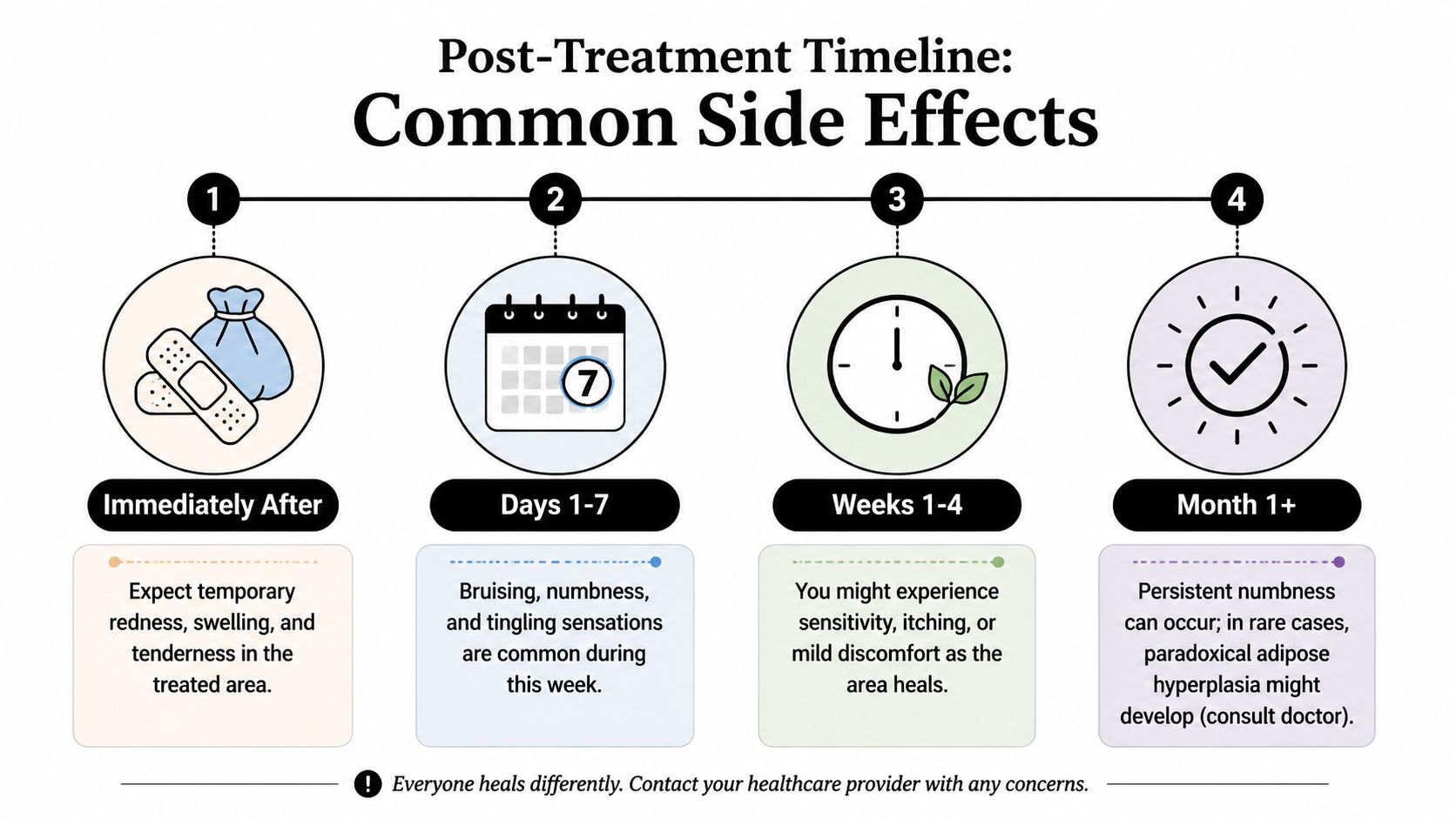
Directly after treatment, the area often looks and feels as though it has been firmly chilled and compressed. That may include visible redness, mild swelling, tenderness, firmness, and a strange numb sensation. Some people describe it as a patch that feels “not quite like my skin” for a while.
In the early window, the common pattern is:
- Redness: usually one of the first things you notice
- Swelling: often mild, but can make the area feel puffy or tight
- Tenderness: especially when pressing on the treated area
- Numbness or tingling: common as sensation shifts during recovery
A separate clinically focused source in the verified data notes that many common early reactions settle within hours to a few days, while tenderness can last a few days or longer in some people. That's why a treated area can look a little obvious at first, then become more comfortable fairly quickly.
Here's a short visual walkthrough that helps explain what typical recovery can involve:
What can continue over the next few weeks
Bruising may become more visible after the first day rather than immediately. Some clients also notice that numbness lasts longer than the redness did. That can feel odd, but it is a recognised part of recovery.
A practical timeline often looks like this:
| Time period | What's commonly normal |
|---|---|
| Same day | Redness, swelling, firmness, tenderness, numbness |
| First few days | Bruising may show more clearly, tenderness can continue, sensation may feel altered |
| Following weeks | Residual numbness, mild sensitivity, occasional tingling, gradual settling |
One review of 1,445 patients in the verified data identified decreased sensation as the most frequently reported issue lasting beyond 4 weeks. That doesn't mean numbness should be ignored forever. It means prolonged altered sensation is one of the more realistic things to discuss before treatment, rather than pretending every effect ends instantly.
A useful rule of thumb is that common side effects tend to fade, even if they don't all fade at the same speed. Redness often settles first. Bruising and tenderness may take longer. Numbness can be the slowest to fully resolve.
What doesn't work well is expecting the area to feel completely “normal” straight away. What does work is planning for a local recovery phase, wearing comfortable clothing if the area is tender, and checking progress over time rather than hour by hour.
Understanding Rare Complications Like PAH
While temporary redness or bruising are often tolerated, the complication that tends to cause concern is PAH, because it runs against the purpose of treatment. Instead of the area reducing, the treated area enlarges.
What PAH actually is
Paradoxical adipose hyperplasia is a rare but important complication of cryolipolysis. It matters because it is not a brief, expected treatment effect. It is a delayed change in contour where the treated area becomes larger or firmer rather than smaller.
Historically cited incidence estimates have varied. A Harvard Health review notes figures of roughly 1 in 3,000 to 1 in 20,000 treatments, while official product information states rare side effects may occur in 1 to 10 out of 10,000 treatments, or about 0.01% to 0.1%, as described in this Harvard Health overview of fat freezing safety and PAH.
Why the numbers need honest explanation
PAH is rare, but the reporting history matters. Early marketing often made it sound exceptionally uncommon in a way that left very little room for nuance. Later discussion has been more cautious.
That doesn't mean every person considering treatment should be alarmed. It does mean no responsible clinic should pretend the complication is too rare to mention. If you're comparing providers, openness on PAH is a good sign. Avoid anyone who seems irritated by the question or dismisses it as irrelevant.
Rare complications discussed in the wider literature also include problems such as prolonged pain, nerve-related symptoms, pigment change, and cold-related skin injury. Severe injury is uncommon, but the biological mechanism makes frostbite-type skin injury plausible if cooling is misapplied. That is one reason provider judgement and equipment standards matter so much.
- What helps: proper assessment, correct applicator choice, accurate placement, and clear follow-up
- What doesn't help: treating unsuitable areas, chasing aggressive treatment for unrealistic goals, or choosing solely on price
If a clinic talks openly about common effects and rare complications in the same conversation, that usually reflects a safer standard of consent.
Minimising Your Risk The Role of a Specialist Clinic
The most practical way to reduce risk isn't wishful thinking. It's choosing a clinic that assesses you properly before anyone places an applicator on your body.
Recent medical reviews discussed in the verified data suggest PAH risk may be higher in some series than early estimates suggested, with one physician-authored review arguing it may be around 1 in 138 treatments in some practitioner-led data, which is why candidate selection and consultation matter so much, as outlined in this discussion of newer PAH estimates and candidate selection.
What a proper consultation should cover
A decent consultation should do more than confirm you dislike a stubborn area. It should examine whether that area is likely to respond well to cooling at all.
The basics include:
- Area assessment: Is the concern localised fat, or is it skin laxity, posture, bloating, or a mix?
- Treatment suitability: Cryolipolysis is for localised fat reduction, not overall weight loss.
- Expectation setting: You need to know that contouring and slimming are not the same thing.
- Risk discussion: Common local reactions should be explained, and rare complications shouldn't be skipped.
At 3D Aesthetics Leamington Spa, consultations include a full 3D body scan to assess concerns, personalise planning, and track changes over time. That sort of structured assessment matters because it reduces guesswork. It also helps avoid overtreating an area that may be better managed with another body-contouring option.
Why expectations affect safety as well as satisfaction
Poor outcomes aren't always caused by a technical error. Sometimes the treatment was unsuitable. A person wanting overall weight loss, visceral fat reduction, or dramatic reshaping may judge a modest contour change as failure, then seek repeated treatment when a different approach would make more sense.
That's why honest screening protects both safety and satisfaction. The treatment should match the problem.
You can see the same principle in other areas of medicine. For example, people often search for side effects before they understand who a treatment is for. A useful comparison is Pause Medical's hormone therapy guide, which helps patients separate expected effects, individual suitability, and signs that need review. Fat freezing deserves the same quality of conversation.
Your Aftercare Guide and When to Seek Medical Advice
Most aftercare is straightforward. The challenge isn't usually complexity. It's knowing what matters and what can be safely watched.
Simple aftercare that supports a smooth recovery
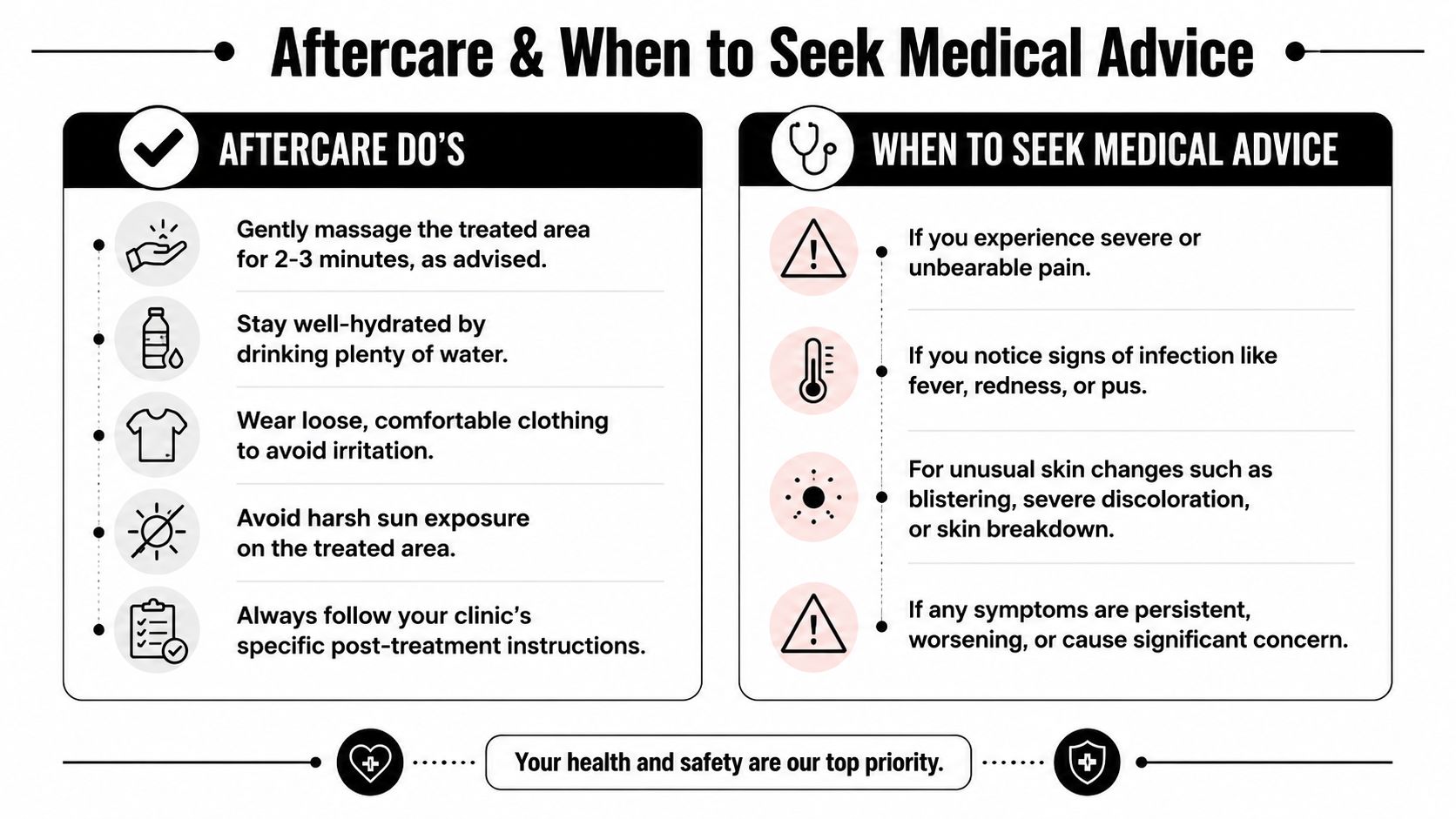
The treated area often benefits from common-sense care rather than over-management.
- Wear comfortable clothing: Tight waistbands or seams can make a tender area feel worse.
- Follow your clinic's instructions: If massage has been recommended for your treatment protocol, stick to the technique and timing you were shown.
- Keep an eye on the skin: Normal redness and bruising are one thing. Skin changes that look increasingly damaged are another.
- Give sensation time: A numb or altered feeling can linger longer than people expect.
What usually doesn't help is repeatedly pressing, poking, or checking the area every few hours. That tends to increase anxiety without improving healing.
Signs that should prompt a review
A key challenge for patients is distinguishing normal recovery from a complication. The verified data notes that while most decreased sensation resolves, prolonged pain, motor neuropathy, or the development of a new lump are not typical and warrant medical assessment, as explained in this patient-facing summary on cryolipolysis risks and warning signs.
Call your clinic or seek medical advice if you notice:
- Pain that is severe or getting worse: especially if it doesn't fit the normal pattern of gradual settling
- Blistering or unusual skin breakdown: this isn't part of routine recovery
- A new lump or enlarging area later on: particularly if the area seems firmer rather than flatter
- Movement-related nerve symptoms: altered function is different from simple numbness
- Anything that feels persistently abnormal: if the area is not following the expected trend, it needs review
Normal recovery tends to be inconvenient, local, and gradually improving. Complications tend to be unusual, persistent, worsening, or structurally different from what you were told to expect.
If you're ever unsure, ask. Reassurance is part of aftercare. So is escalation when something doesn't look right.
Fat Freezing vs Other Treatments A Safety Comparison
If you're weighing up options, it helps to compare side-effect profiles rather than looking at fat freezing in isolation.
Liposuction can remove fat more aggressively, but it's a surgical procedure. That means a different level of intervention, recovery, and medical risk. People considering it need to think about anaesthesia, wound healing, infection risk, scarring, compression garments, and time away from normal activity. For the right person, it can be appropriate. It's just not comparable to a lunchtime-style non-surgical appointment.
Fat freezing sits in a different category. Its safety trade-off is that the side effects are usually local and temporary, but contour change is more gradual and selection matters more. The aim is refinement of a stubborn area, not wholesale reshaping.
Other non-surgical options can suit different concerns. Treatments such as cavitation, radio frequency, HIFU, or muscle-focused body contouring may have a different feel during recovery and may be better for some combinations of fat, laxity, and skin quality. If you're comparing options, look at the full fat reduction treatment options available rather than assuming one technology suits every body area.
This decision-making process is similar to how people should approach supplements and wellness products. The useful question isn't “Is it safe in general?” but “Is it suitable for me, in this dose, for this goal?” That's why broader side-effect explainers such as this complete guide to green coffee safety can be a helpful reminder that context matters as much as the headline claim.
Your Path to Safe Fat Reduction in Leamington Spa
Taken as a whole, the evidence and the clinical picture point in the same direction. Fat freezing side effects are usually local, temporary, and manageable when the treatment is performed appropriately and the client has been assessed well. The common reactions are the ones you can see and feel in the treated area. Redness, swelling, bruising, tenderness, and altered sensation.
The rarer issues deserve honest discussion, especially PAH. Not because it is commonly experienced, but because informed consent should be real, not cosmetic. A treatment is easier to trust when the trade-offs are clearly explained.
If you're considering cryolipolysis, the safest next step isn't to self-diagnose from social media. It's to have the area assessed properly, ask direct questions, and make sure the treatment matches your goal. Sometimes fat freezing is the right fit. Sometimes another body-contouring option makes more sense.
If you'd like clear advice on whether fat freezing is suitable for your area and concerns, book a consultation with 3D Aesthetics Leamington Spa. You'll be able to talk through expected recovery, possible side effects, and whether another non-surgical option would be a better match before deciding on treatment.