

You catch yourself doing it in the mirror. Lifting your brows a little. Tilting your chin. Pulling the skin near the jawline back just enough to see the version of your face that still feels like you.
For many people, that's the moment they start looking into an ultrasound face lift. Not because they want to look different, but because they want to look less tired, less soft around the lower face, or less bothered by the early pull of gravity around the cheeks and neck.
The trouble is that most information online sounds either too salesy or too vague. You'll read that it “tightens and lifts”, that there's “no downtime”, and that results are “natural”. All of that can be true. But it doesn't answer the questions people have. Will it hurt? Will it work for my skin? What if my jowls are already quite heavy? Is this a genuine treatment or just a softer version of a facelift that won't do much?
This guide gives you the honest version.
Table of Contents
- Introduction What Is an Ultrasound Face Lift
- How HIFU Technology Rejuvenates Your Skin from Within
- Your Ultrasound Facelift Journey Step by Step
- Are You a Good Candidate for a HIFU Facelift
- Benefits Realistic Results and Potential Risks
- Ultrasound Facelift vs Other Anti-Ageing Treatments
- Choosing a Clinic in Leamington Spa What to Ask
Introduction What Is an Ultrasound Face Lift
An ultrasound face lift is a non-surgical treatment that uses focused ultrasound energy to target deeper support layers beneath the skin. The aim isn't to stretch the face or freeze movement. It's to trigger a repair response in the tissue so the skin gradually feels firmer and sits a little higher over time.
That matters if your main complaint is early laxity. A softening jawline. A slight drop through the brow. Skin at the neck that isn't hanging, but isn't as taut as it used to be either.
Expectations often fall into one of two categories. They either think it's a miracle replacement for surgery, or they think it's just a fancy facial. In reality, it sits somewhere in the middle. It's a genuine treatment with a real mechanism, but it has limits.
Practical rule: An ultrasound face lift is best thought of as a collagen-stimulating lift, not a skin-removing lift.
That distinction helps straight away. If you have mild to moderate looseness and want a fresher, firmer look without surgery, it can be a sensible option. If you have heavy jowling, significant excess skin, or you want the kind of change a surgical facelift creates, this probably won't be enough on its own.
The biggest advantage is that it works beneath the surface while leaving the outer layer of skin intact. That's why people often choose it when they want something more structural than a topical treatment, but don't want an operation, scars, or a recovery period that takes them out of daily life.
How HIFU Technology Rejuvenates Your Skin from Within
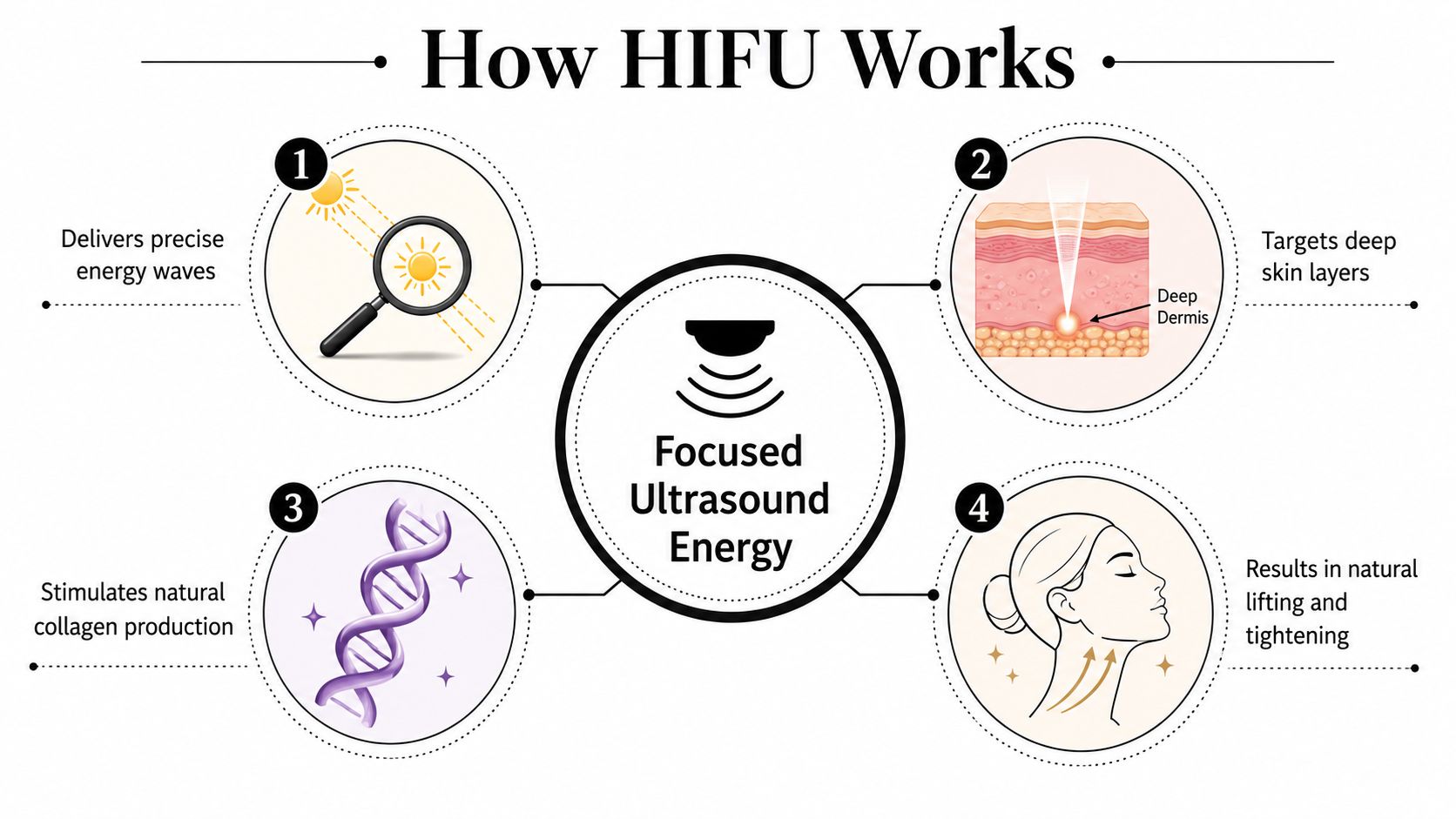
HIFU stands for high-intensity focused ultrasound. The easiest way to understand it is to think of a magnifying glass focusing sunlight onto one very precise point. The energy isn't spread loosely across the whole area. It's concentrated exactly where the device is designed to place it.
What the ultrasound energy is actually doing
During treatment, the device delivers tiny points of heat below the surface of the skin. In UK practice, the key technical point is that HIFU creates microthermal coagulation points at controlled depths, commonly around 1.5 mm, 3.0 mm, and up to about 4.5–5.0 mm depending on the device and handpiece, with the aim of reaching the dermis and SMAS-adjacent layers while leaving the epidermis intact, according to this clinical review of focused ultrasound in aesthetic practice.
Those precise thermal points act like a wake-up call to the tissue. Your body reads them as controlled injury, then begins rebuilding. Over time, collagen contracts and remodels. That's the part people often miss. The treatment doesn't “pull” the skin up on the day. Your body has to do the work afterwards.
If improving firmness is part of the goal, skin quality still matters alongside lifting. Treatments that target laxity and treatments that refine roughness or dullness often complement each other, which is why some people also look at options to improve skin texture as part of a wider plan.
Why the surface of the skin stays intact
A common point of confusion arises: If heat is going into the skin, why doesn't the top layer peel or burn?
The answer is depth control. HIFU is designed to place energy below the epidermis instead of scraping, blasting, or resurfacing the surface. That makes it very different from treatments aimed mainly at pigmentation, pores, or visible skin renewal.
A simple way to separate them is this:
| Treatment focus | Main target | What you usually notice |
|---|---|---|
| Ultrasound face lift | Deeper support layers | Gradual firmness and subtle lifting |
| Surface-based skin treatments | Outer skin layers | Texture, tone, brightness, resurfacing |
The delayed result is a sign of how it works, not proof that nothing happened.
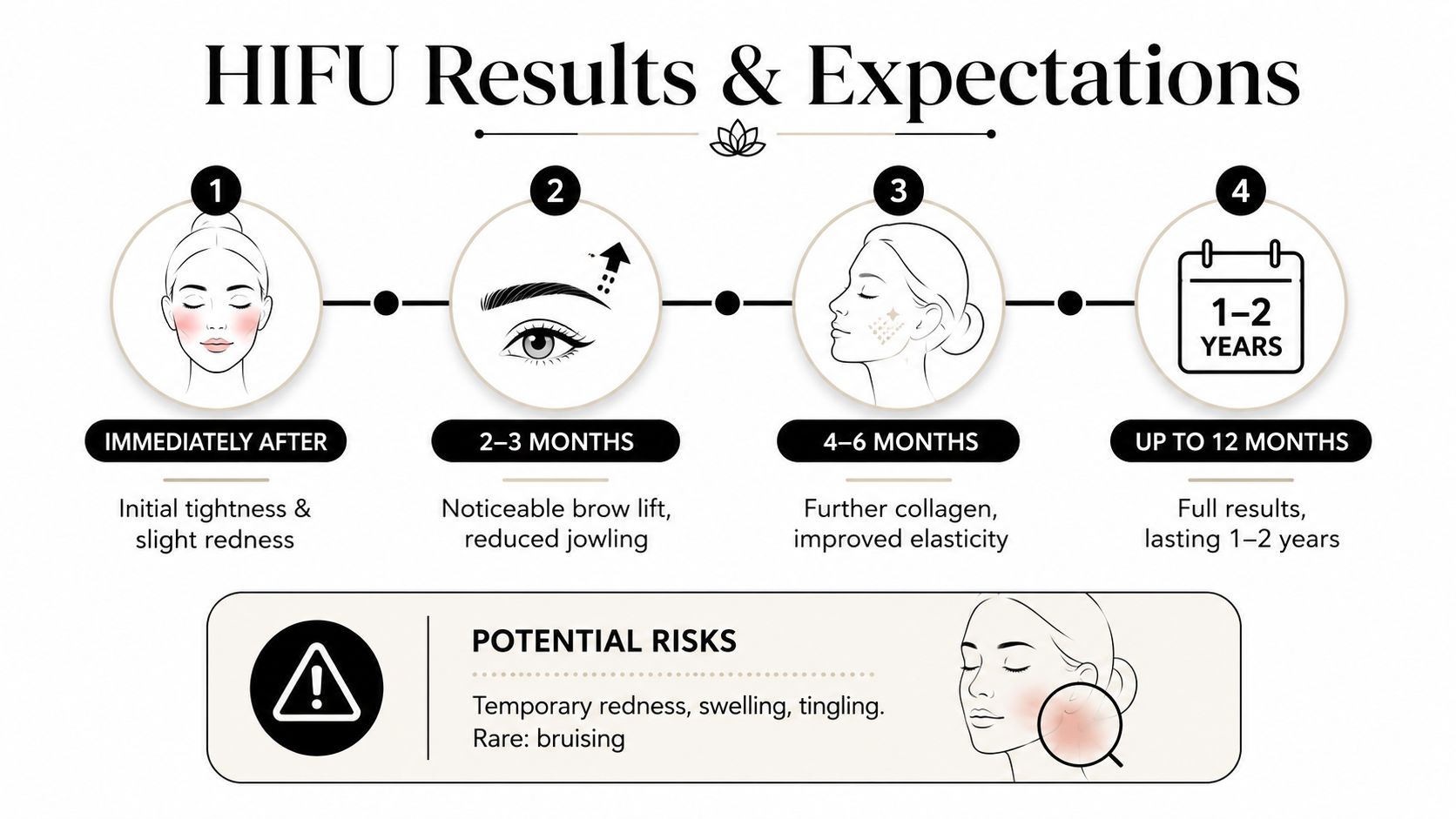
That delayed build is expected. The same review notes that results tend to appear gradually over 2–6 months because collagen remodelling takes time, not because the treatment is weak. For the right person, that gradual change is often part of the appeal. Friends may notice you look fresher, but they can't usually point to an obvious “done” look.
Your Ultrasound Facelift Journey Step by Step
A lot of treatment anxiety disappears once you know what the appointment feels like. The experience is much less mysterious than the marketing language makes it sound.
What happens before the treatment
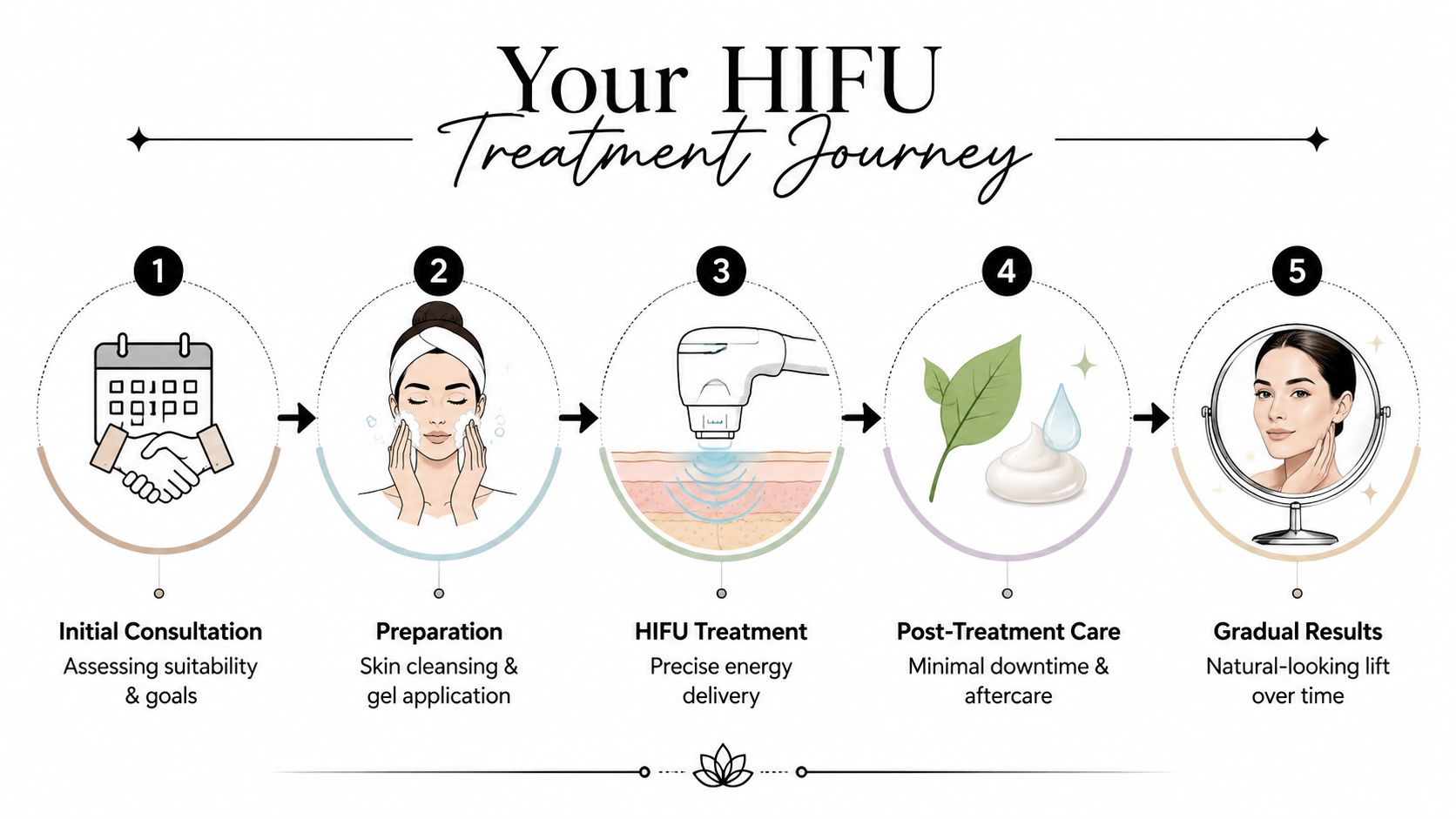
A proper consultation should focus on your skin laxity, facial structure, goals, and tolerance for gradual results. This is also the point where an honest practitioner should tell you if your concerns sound more surgical than non-surgical.
If you're researching local options, one example is the 3D HIFU face treatment page, which outlines a non-surgical facial lifting approach using focused ultrasound. What matters most at consultation isn't the brochure language. It's whether someone clearly explains what the treatment can and can't achieve for your face.
Before the session begins, the skin is usually cleansed and a gel is applied. That gel helps the handpiece move smoothly and helps transmit the ultrasound energy.
What the session feels like
This is the bit many clinic pages soften too much. “No downtime” doesn't mean “you won't feel anything”.
Patients commonly describe the pulses as a deep prickling, a quick electric flick, or a sharp warmth under the skin. Some areas feel very manageable. Others, especially bony parts of the face or jawline, can feel intense. It's usually tolerable, but comfort varies a lot from person to person.
A short demonstration can make the process easier to picture:
Some people are surprised that a non-surgical treatment can still be uncomfortable. That's normal. “Non-surgical” and “sensation-free” are not the same thing.
What to expect after you leave
Patients often go straight back to normal activities. That's the practical appeal. But you should still expect a possible short-term reaction.
A consumer treatment overview notes that while there is no downtime, people may experience discomfort, swelling, tenderness, or temporary numbness. The same source says results typically build over 2–3 months, may last around 1–2 years, and maintenance sessions are often discussed at around 18–24 months, which makes the treatment more of a staged commitment than a one-off event, as described in this patient-facing guide to common Ultherapy questions.
That maintenance point matters. If you're choosing an ultrasound face lift because it sounds easy, remember that “easy” and “single forever treatment” aren't the same thing.
Are You a Good Candidate for a HIFU Facelift
This is the question to ask first, not last. A treatment can be well designed and still be the wrong match for your face.
Who tends to get the most from it
The best candidates are people with mild to moderate skin laxity, often those starting to notice early changes rather than advanced sagging. According to the Ultherapy FAQs on candidacy, the treatment is generally most suitable for people with mild to moderate looseness and is often considered by patients in their 30s.
In practical terms, that often looks like this:
- Early jawline softening where the lower face has lost some crispness but doesn't have heavy hanging skin.
- Slight brow descent where the eyes look a bit hooded or tired without severe excess skin.
- Neck crepiness with mild looseness rather than a pronounced fold or substantial skin excess.
- Natural-result expectations where the goal is to look fresher, not transformed.
These patients usually understand that subtle improvement is still worthwhile. They don't need dramatic repositioning. They need support, firmness, and a cleaner outline.
Who usually needs a different plan
This is where honesty matters most. An ultrasound face lift is less effective for advanced skin laxity, heavy jowling, or significant excess skin, and the same Ultherapy guidance notes that surgery may be the more appropriate recommendation in those cases.
That doesn't mean the treatment is bad. It means the mechanism has limits.
If your tissue is already hanging heavily, collagen stimulation alone may not create enough visible lift to match your expectations. The same goes if you're hoping to erase deep folds, remove loose neck skin, or achieve the kind of repositioning a surgeon creates manually.
A different plan may suit you better if:
| Situation | More realistic view |
|---|---|
| Heavy jowls | Ultrasound may not produce enough lift on its own |
| Marked neck laxity | Surgical correction may be more appropriate |
| Excess skin | Collagen stimulation can't remove redundant skin |
| Very high expectations | A non-surgical result may feel disappointing |
The right treatment isn't the one with the nicest marketing. It's the one that matches the severity of the problem.
That's why a good consultation should feel slightly challenging, not just reassuring. If no one asks whether your goals are too advanced for HIFU, they're skipping the most important part of the decision.
Benefits Realistic Results and Potential Risks
The appeal of an ultrasound face lift is easy to understand. No incisions. No surgical recovery. A treatment that works beneath the skin and aims for a fresher version of your own face.
Still, the most useful question isn't “does it work?” It's “what sort of result does it realistically create?”
What kind of improvement people usually want
The benefits tend to sit in three areas:
- Lift and support for mild brow drop, early jowling, or softening along the jawline
- Tightening through areas that feel less firm than they used to
- Texture improvement that comes from renewed collagen activity over time
These changes are usually gradual rather than dramatic. That's why this treatment often suits people who want to age more neatly, not people looking for a visible reset.
What the evidence says about outcomes
One landmark study of micro-focused ultrasound with visualization reported that overall self-reported satisfaction remained at 95% at both 180 days and 1 year after a single treatment, with blinded assessment finding improvement in 6 of 14 evaluable subjects at one year. Patients also self-reported less sagging (79%), fewer lines and wrinkles (58%), and smoother skin texture (47%), according to this one-year clinical follow-up study in the Journal of Clinical and Aesthetic Dermatology.
That's useful because it shows two things at once. First, patients often felt pleased with the result even a year later. Second, the expert-assessed improvement was more modest than the language some marketing pages imply. That's not a contradiction. It's a reminder that patient satisfaction and dramatic visible change aren't always the same thing.
Risks and trade-offs to keep in mind
Most side effects are temporary and local. Redness, tenderness, swelling, and odd sensations such as tingling or numbness can happen after treatment. Some people brush this off easily. Others find the discomfort more memorable than expected.
The trade-off is straightforward:
- You avoid surgery, scars, and a formal recovery period
- You accept delayed results, possible discomfort, and the likelihood of maintenance over time
- You gain subtle-to-moderate improvement, not surgical-level correction
If you go in wanting refinement, this can feel worthwhile. If you go in wanting a facelift without surgery, disappointment is more likely.
Ultrasound Facelift vs Other Anti-Ageing Treatments
The smartest way to judge an ultrasound face lift is to compare it with what else is on the table. Not all tightening treatments do the same job, even when clinics market them with similar language.
Compared with a surgical facelift
A surgical facelift is still the stronger option for advanced sagging, heavy jowls, and excess skin. Surgery physically repositions tissue and removes redundant skin. HIFU doesn't. It stimulates collagen and relies on your tissue's ability to respond.
That means the choice usually comes down to the level of correction you need.
| Option | Invasiveness | Downtime | Type of result |
|---|---|---|---|
| Ultrasound face lift | Non-surgical | Minimal interruption to daily life | Gradual, subtle-to-moderate tightening |
| Surgical facelift | Surgical | Recovery required | More dramatic lifting and reshaping |
If your main goal is to delay surgery, HIFU can make sense. If your main goal is to replace surgery, it may not.
Compared with radiofrequency and thread lifts
Radiofrequency treatments usually focus on heating tissue to improve firmness and texture, but many patients think of them as a gentler tightening category rather than a deep lifting option. Thread lifts sit in a different space again. They involve inserting threads under the skin to reposition tissue mechanically.
HIFU often appeals to people who want neither needles placed under the skin nor a surface-based tightening treatment.
A helpful way to think about the three:
- Choose ultrasound if you want a non-invasive treatment aimed at deeper structural support.
- Choose radiofrequency if your concerns lean more towards firmness and skin quality than lift.
- Choose threads if you want a more immediate repositioning effect and accept that the approach is more invasive.
For readers comparing safety and visible effect, a systematic review found that uncommon adverse effects occurred in only 2% of patients, specifically 14 out of 573, and one included report described a surgeon's score of 80 after 6 months, indicating a moderate effect on skin texture with a minimal-to-moderate lifting effect in photographs, as summarised in this systematic review of microfocused ultrasound for facial rejuvenation.
That “minimal-to-moderate” wording is useful. It places HIFU in the right lane. It can be worthwhile, but it isn't the treatment for every face or every goal.
If your concern is fullness under the chin rather than skin laxity alone, a different route may fit better. Some people compare lifting with contouring and end up exploring treatments aimed more directly at localised fullness, such as fat reduction treatments, before deciding whether they also need skin tightening.
Choosing a Clinic in Leamington Spa What to Ask
Choosing the clinic matters almost as much as choosing the treatment. Ultrasound depends on assessment, depth selection, and realistic planning. A rushed consultation can lead to the wrong candidate getting the right treatment for someone else.
Questions that quickly reveal a clinic's standards
Ask direct questions and listen for direct answers.
- Who decides if I'm suitable. You want someone who assesses laxity accurately, not someone who assumes every concern can be treated with the same package.
- What device and treatment depths are being used. A clinic should be able to explain the basics in plain English.
- What will this treatment not fix. This question is often more revealing than asking about benefits.
- What side effects should I realistically expect. If they minimise sensation or recovery reactions too much, be cautious.
- How do you plan maintenance. A thoughtful provider should discuss long-term planning, not just the first appointment.
Some clinics also use digital tools to improve communication before and after treatment. If you're comparing providers more broadly, it can be useful to see how modern practices handle patient enquiries and triage, especially in busy settings. This overview of a dermatology practice AI receptionist is one example of how clinics are trying to make first contact, booking, and follow-up clearer for patients.
What a good consultation should feel like
A good consultation should feel specific. Your face. Your degree of laxity. Your tolerance for discomfort. Your timeline. Your budget for maintenance. Not a script.
It should also include alternatives. If a provider never mentions that another treatment, or even surgery, may suit you better, that's a red flag. Ethical advice includes the possibility that the answer isn't HIFU.
One local option people often consider is 3D Aesthetics Leamington Spa, which offers HIFU among a wider range of face and skin treatments. The useful part of a broader treatment menu is that it makes it easier to discuss whether lifting alone is enough, or whether another approach fits your concern more closely.
Ask the clinic to describe your likely result in ordinary language. “A bit firmer through the jawline” is more trustworthy than “dramatic non-surgical facelift”.
If you'd like specific advice on whether an ultrasound face lift suits your skin, book a consultation with 3D Aesthetics Leamington Spa. A clear assessment can save you time, money, and the frustration of choosing a treatment that doesn't match your goals.
← Back to Home