
You've probably done this already. You catch your reflection in bright bathroom light, or the front camera opens by mistake, and your eye goes straight to the marks acne left behind. Not the spots that fade in a week or two, but the dents, shadows, and uneven texture that makeup doesn't quite smooth and skincare doesn't seem to shift.
That's often the point where people start reading about laser resurfacing for acne scars. They want something stronger than creams, but they're also worried about pain, downtime, skin safety, and whether the results will look natural. Those are sensible concerns.
Laser treatment can help. It's also easy to misunderstand. Many people hear “resurfacing” and picture the top of the skin being stripped away, or they expect scars to disappear completely after one appointment. This process is more nuanced, and in many ways more reassuring. Good laser treatment is about controlled skin remodelling, careful scar selection, and patience while your skin rebuilds itself.
Table of Contents
- Tired of Hiding Your Scars The Promise of Laser Resurfacing
- How Lasers Remodel Your Skin From the Inside Out
- Choosing Your Laser Ablative vs Non-Ablative Technology
- Your Patient Journey From Consultation to Recovery
- What Results to Expect and When You Will See Them
- How Laser Compares to Microneedling and Other Treatments
- Is Laser Resurfacing Right for You? FAQs and Your Next Steps
Tired of Hiding Your Scars The Promise of Laser Resurfacing
A lot of clients arrive at this stage feeling worn down rather than vain. They've often made peace with the fact that acne happened. What still bothers them is that the scars keep telling the story long after the breakouts have calmed.
It can show up in small daily habits. Turning your face away in photos. Choosing softer lighting. Letting your hair fall over your cheeks. Avoiding close-up video calls if the camera is harsh. None of that sounds dramatic, but it adds up.
Laser resurfacing enters the conversation because it offers something skincare at home usually can't. It works below the surface as well as on the surface. That matters because acne scars aren't just a colour issue. They're a structure issue.
Scars don't usually need “covering”. They need the skin's framework to be encouraged to rebuild in a more even way.
That's why laser resurfacing can be so appealing. It's grounded in real skin biology, not wishful thinking. A recent review notes that the 10,600 nm CO2 and 2,940 nm Er:YAG lasers are considered first-line treatments for atrophic acne scars, with reported efficacy in the literature of up to 90% in selected contexts, which helps explain why these devices remain central in aesthetic practice (evidence review on first-line acne scar lasers).
Still, the promise isn't “perfect skin”. The better promise is this: smoother texture, softer scar edges, and skin that looks more even in normal life. For many people, that's the difference between constantly noticing their scars and not thinking about them as much anymore.
How Lasers Remodel Your Skin From the Inside Out
If the science feels intimidating, it helps to think of scarred skin like a wooden table with dents and rough patches. You wouldn't pour cream on the table and expect the dents to level themselves out. You'd carefully refinish the surface and encourage a smoother structure underneath.
That's the basic idea of laser resurfacing.
What the laser is actually doing
A resurfacing laser delivers controlled energy into the skin. In practical terms, it creates very small zones of targeted injury. That sounds alarming at first, but the key word is controlled. The aim isn't random damage. The aim is to prompt a repair response in a very precise way.
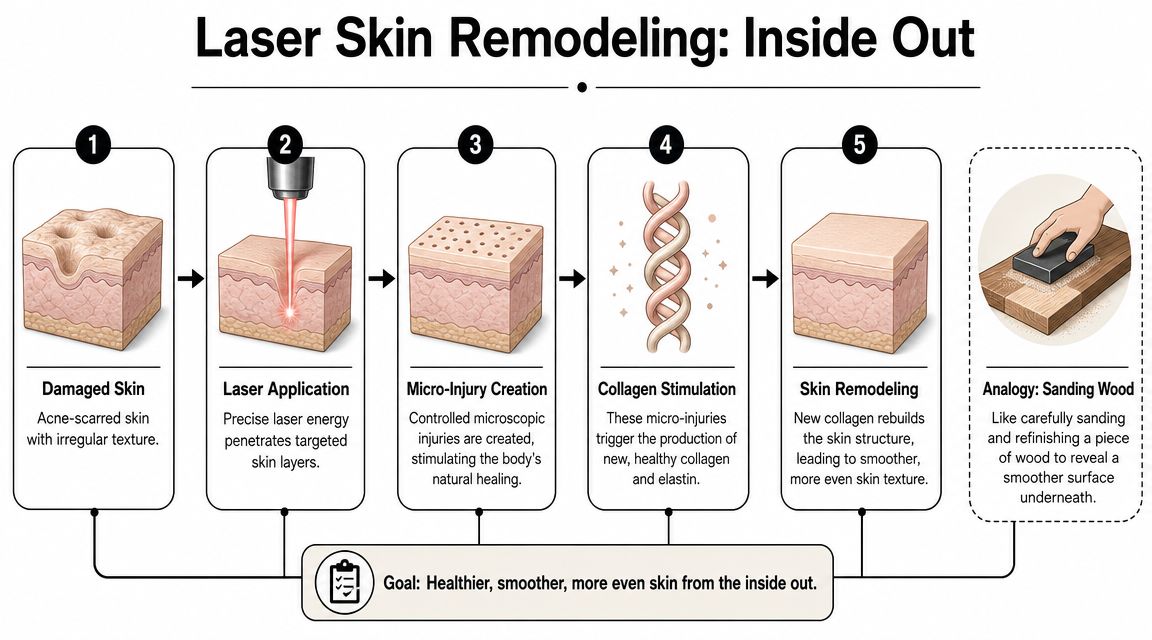
Some lasers remove a very thin portion of the skin's surface while also heating deeper layers. Others leave the top layer more intact and focus more on heating the underlying tissue. In both cases, the treatment is trying to interrupt an old scar pattern and encourage a healthier one.
Think of it as asking the skin to do a more organised version of what it already knows how to do. Heal. Replace. Remodel.
Why collagen matters so much
Collagen is the support structure that gives skin firmness and shape. When acne causes atrophic scars, that support structure has been disrupted. The scar sits lower because the skin beneath it doesn't have the same even framework as the surrounding area.
Laser resurfacing helps by stimulating new collagen formation, often called neocollagenesis. That new collagen doesn't arrive all at once on the day of treatment. It develops gradually as your skin repairs itself.
Practical rule: laser results are rarely about instant polishing alone. The deeper benefit comes from the slow rebuild that follows.
This is why people can feel confused after treatment. They expect the biggest change to happen as soon as the peeling settles. In reality, the skin often keeps improving after the visible recovery phase because remodelling is still happening under the surface.
That's also why experienced practitioners talk about remodelling rather than erasing. The skin is being guided into a smoother, stronger pattern from the inside out.
Choosing Your Laser Ablative vs Non-Ablative Technology
You do not need to learn a new vocabulary to understand your options. What matters is knowing how each laser behaves in real life, on real skin, with real recovery.
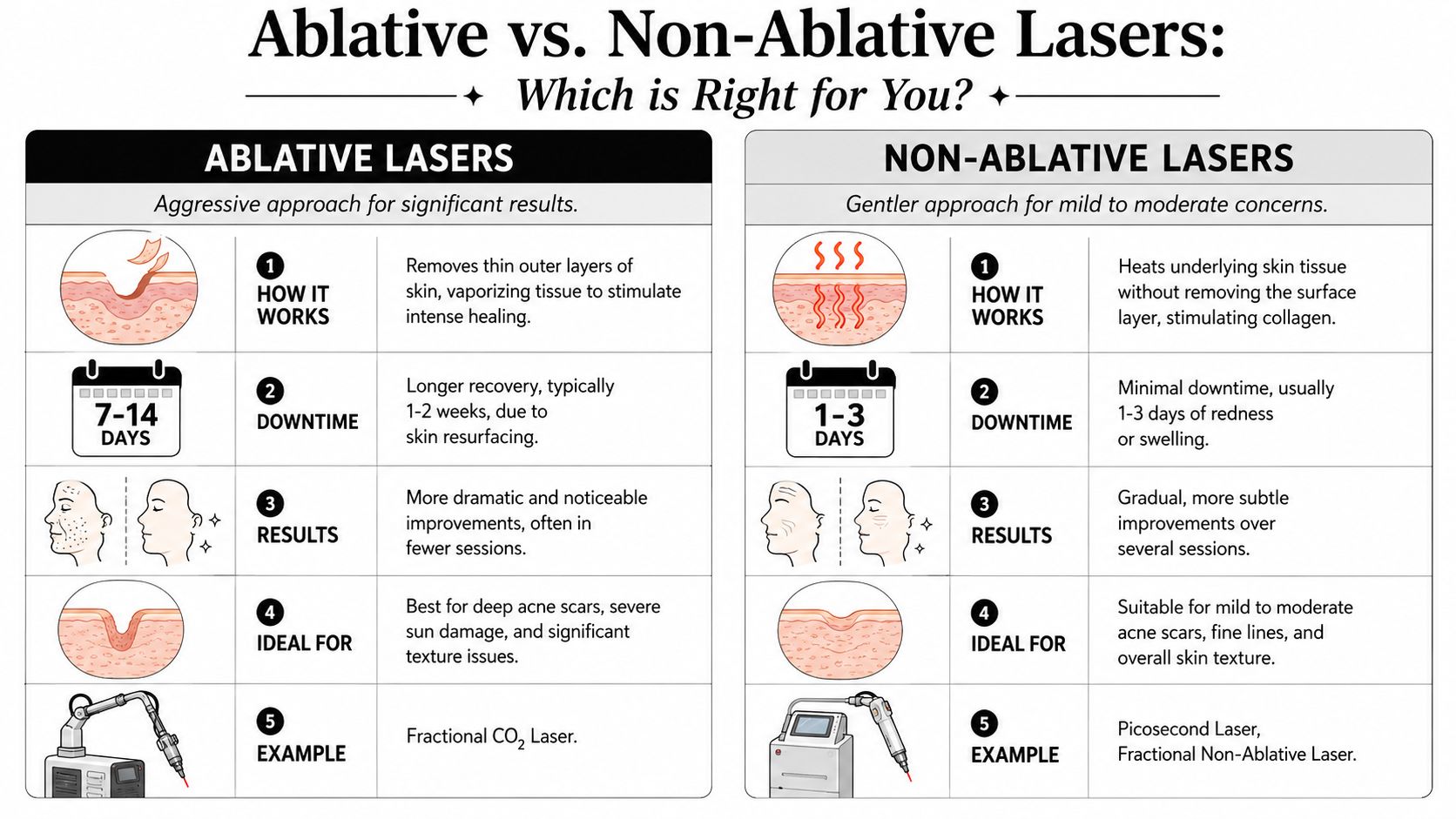
Ablative and non-ablative lasers are often presented as if one is clearly better. A more useful way to look at them is this: they sit at different points on the same spectrum. One pushes harder and usually asks for more downtime. The other is gentler and usually asks for more patience.
Ablative lasers in plain English
An ablative laser treats the skin more aggressively. It removes very fine columns or layers from the surface and heats deeper tissue at the same time. Fractional CO2 is the example many people hear about first because it is often used for acne scar texture.
Ablative treatment works like renovating damaged paving by lifting and resetting sections, not just polishing the top. That stronger approach can make sense for more established boxcar or rolling scars, especially when uneven texture is the main concern. It also tends to bring a more visible healing phase, which matters if you work face-to-face, commute daily, or cannot easily take time out.
For clients researching local treatment options, fractional CO2 laser scar treatment is one example of how this technology is used for texture-focused scar remodelling rather than simple surface brightening.
Non-ablative lasers in plain English
A non-ablative laser aims its energy below the surface without removing the top layer in the same way. The goal is still collagen remodelling, but the treatment is usually less intense per session.
That often means less obvious downtime and a lower disruption to work, school runs, or social plans. The trade-off is that improvement can come more gradually and may need a series of sessions. For someone who wants a softer approach, that can still be the right decision.
Where fractional fits in
Fractional does not mean weak or strong by itself. It describes the pattern of treatment.
A fractional laser treats the skin in tiny columns with untreated skin left between them. Those untouched areas help recovery along. You can have fractional ablative treatment, such as fractional CO2, or fractional non-ablative treatment. This is one reason the names feel confusing at first. The words are describing different features of the same device.
A practical way to compare them
| Question | Ablative approach | Non-ablative approach |
|---|---|---|
| Main goal | Stronger resurfacing and remodelling | Gradual collagen stimulation |
| Best fit | More noticeable textural scarring in suitable candidates | Mild to moderate textural change or lower downtime preference |
| Recovery feel | Redness, swelling, and visible healing are usually more obvious | Healing is often easier to fit around daily life |
| Treatment pace | Fewer sessions may be needed, depending on the plan | A longer course is more common |
| Lifestyle match | Better for people who can plan for recovery | Better for people who need a lighter schedule impact |
The laser is only part of the decision
Scar type matters just as much as laser category. Ice-pick scars often need different methods, such as TCA CROSS or punch techniques, because they are narrow and deep. Rolling scars may improve more when subcision is part of the plan. Boxcar scars can respond well to resurfacing, but depth and edge shape still matter.
Skin tone matters too, especially in UK practice where clinics see a wide range of complexions. Darker skin tones can still be treated, but the settings, device choice, and pre- and post-care need more caution because the risk of pigment change can be higher. A careful practitioner does not choose the strongest setting just because the scar looks stubborn.
This is why the best consultation often sounds less dramatic than the marketing. Instead of promising one miracle device, a good practitioner explains what your scars are made of, how much downtime is realistic for your life, and whether laser should be your main treatment or one part of a wider plan.
One final expectation check helps. Laser resurfacing usually aims to soften scars and improve texture, not remove every mark completely. That difference may sound small, but it is what helps people choose wisely and feel satisfied with the long-term result.
Your Patient Journey From Consultation to Recovery
The part many people fear isn't always the laser itself. It's the unknown. They want to know what happens, what it feels like, and what they'll look like while healing.
A clear treatment journey makes the whole thing less daunting.
What happens before treatment
The consultation is more important than commonly believed. In this session, a practitioner looks at scar type, depth, skin tone, active acne, healing history, and day-to-day lifestyle. Someone preparing for a wedding, public-facing work, or frequent travel may need a different plan from someone who can manage a more obvious recovery period.
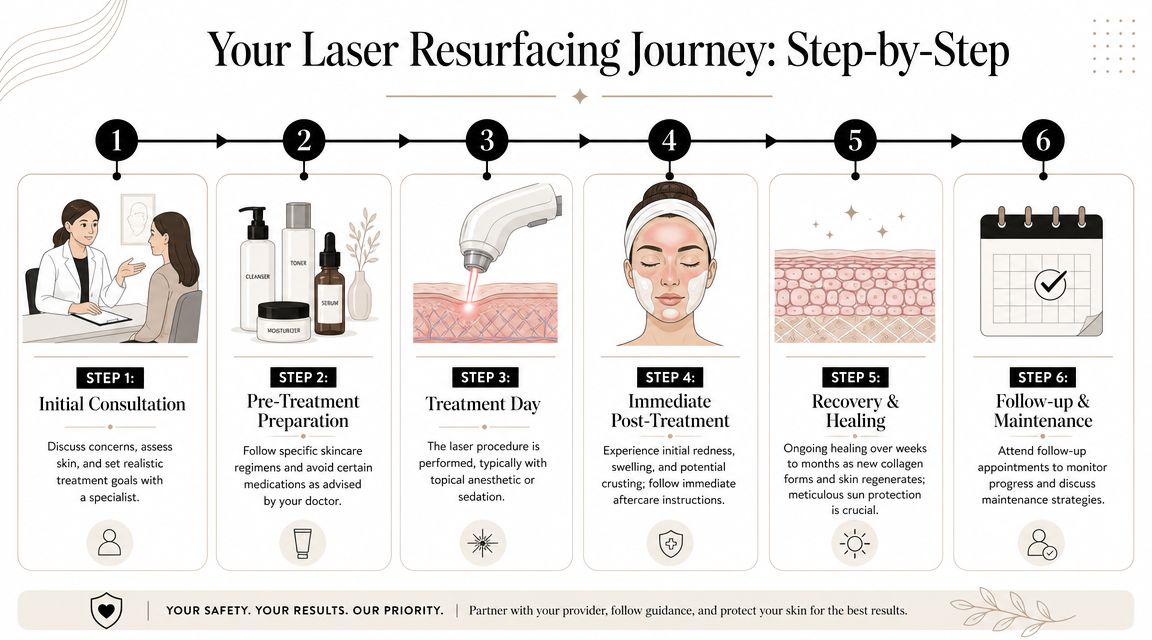
You may also be advised to simplify your skincare before treatment. Irritating products, active breakouts, or recent sun exposure can all affect how safely and predictably your skin responds.
What treatment day feels like
On the day, the skin is cleansed and prepared. Comfort measures are used according to the treatment plan. During the procedure, people often describe a sensation of heat, prickling, or repeated warm snaps.
This short video gives a helpful visual sense of the process:
Straight after treatment, the skin usually looks red and feels hot, rather like a strong sunburn. Depending on the settings used, swelling, tightness, and a rough bronzed look can follow.
How healing usually unfolds
Recovery is where realistic preparation matters most. The American Society for Dermatologic Surgery notes that ablative laser resurfacing can take 10 to 21 days to heal and may involve pain, swelling, bleeding, crusting, discoloration, scarring, and infection risk. The same guidance highlights that transient post-inflammatory hyperpigmentation can be a concern, particularly when skin tone and treatment intensity require extra caution (ASDS overview of acne-scar laser healing and risks).
A simple healing pattern often looks like this:
- Early phase: the skin feels hot, tight, and looks red.
- Middle phase: swelling settles, the surface may darken or feel rough, and shedding begins.
- Later phase: fresher skin appears, but pinkness can linger while deeper repair continues.
Healing isn't just a cosmetic inconvenience. It's part of the treatment doing its work.
People with skin of colour often need a more cautious conversation here. Not because laser is automatically off the table, but because pigment response matters. Lower settings, different treatment choices, or a slower plan can sometimes be the safer route.
Good aftercare usually comes down to being boring and consistent. Gentle cleansing, protecting the skin barrier, avoiding picking, and taking sun protection seriously. The smoother the healing period, the better the final remodelling tends to look.
What Results to Expect and When You Will See Them
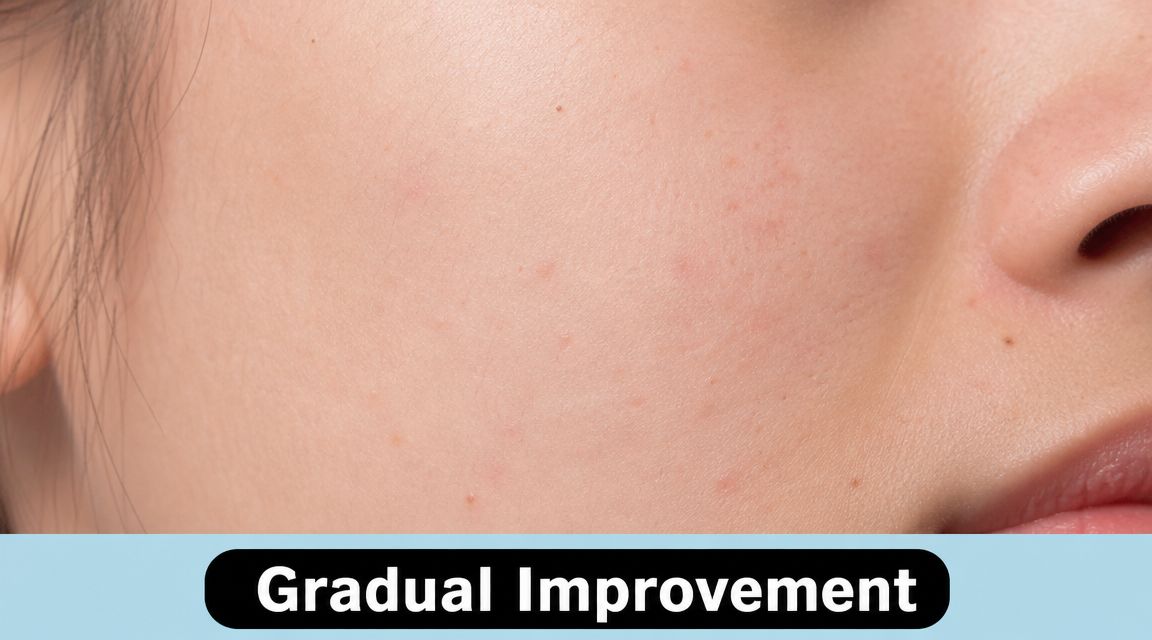
The first thing to know is that results are progressive. The skin may look fresher once the initial healing settles, but that isn't the full outcome. The more meaningful change comes later as collagen remodelling matures.
Early changes versus real remodelling
Fractional CO2 is a good example of why timing matters. Published clinical experience reports a mean improvement of 1.96 grades at 1 month and 2.41 grades at 3 months after a single session in patients with mild-to-moderate acne scars, which shows that improvement continues after the skin has outwardly healed (clinical report on fractional CO2 acne scar improvement over time).
That delayed improvement happens because the main benefit isn't just surface renewal. It's the collagen rebuilding underneath. So if you judge your result too early, you may underestimate what the treatment is still doing.
The mirror changes first. The structure changes after.
What improvement usually looks like
How results are perceived is key. Patients aren't looking at a ruler and measuring each scar. They're noticing whether the skin catches light more evenly, whether makeup sits better, and whether their scars look less sharp in daylight.
A realistic result often includes:
- Softer edges: scar borders don't stand out as abruptly.
- Shallower texture: indentations may look less deep.
- Better blending: the treated area can look more even with the surrounding skin.
- Improved overall finish: the skin often looks smoother as a whole, not perfect in every tiny spot.
If texture is one of your main concerns, this guide on ways to improve uneven skin texture can help you think about laser as one option within a broader skin-remodelling plan.
One more expectation check is useful. Laser resurfacing for acne scars is usually about improvement, not total scar removal. When clients understand that from the start, they're far more likely to feel pleased with the change they do see.
How Laser Compares to Microneedling and Other Treatments
A lot of clients reach this stage feeling stuck between options. Laser sounds stronger. Microneedling sounds gentler. Friends mention peels, subcision, or filler. The right choice depends less on which treatment is "best" and more on what your scars are doing in the skin.
A simple way to view it is this. Laser resurfacing treats the skin surface and the collagen framework underneath across a broader area. Microneedling creates controlled channels in the skin to trigger repair in a more gradual way. Subcision releases scars that are being tugged down from below. TCA CROSS targets very narrow, deep scars one by one. Fillers lift selected depressions rather than remodelling the full area.
That distinction matters because acne scars are not all built the same way.
Where laser often fits best
Laser resurfacing is often chosen when texture is the main complaint, especially if the skin looks uneven across a larger area rather than in just a few isolated marks. It can be a good match for shallow boxcar scarring, widespread roughness, and skin that catches light unevenly in daylight.
For some people, laser is the main treatment. For others, it is one step in a plan. A face with rolling scars, a few ice-pick scars, and post-acne redness may need more than one method, because each problem sits at a different depth.
Where another treatment may come first
Microneedling often suits people who want a steadier, lower-intensity approach to collagen stimulation, or those who are not ready for the downtime that laser can bring. If you want to compare that route in more detail, professional microneedling treatment for facial skin concerns explains how it is commonly used for texture and scar support.
Other options can be better matched to specific scar shapes:
- Subcision: usually more useful for rolling scars that look tethered or pulled inward.
- TCA CROSS or punch techniques: often better for deep, narrow ice-pick scars.
- Fillers: sometimes helpful when a small number of scars need lifting rather than full resurfacing.
- Topical care: helpful for tone, barrier support, and maintenance, though products do not replace in-clinic treatment for indented scars. This guide to effective solutions for acne scars gives a useful overview of where skincare can fit.
Downtime also changes the decision. In UK practice, many people are balancing treatment with work, school runs, social events, and how comfortable they feel being seen while the skin is red or flaky. Laser usually asks for more planning than microneedling. Darker skin tones also need extra care in treatment selection, because the risk profile is different and settings need to be chosen thoughtfully.
A good consultation should feel like a sorting process, not a sales script. Your practitioner should look at scar type, depth, skin tone, active acne, previous treatments, and the amount of recovery time you can realistically manage. That is how a sensible plan is built, and why the right answer is sometimes laser, sometimes another treatment, and sometimes a combination.
Is Laser Resurfacing Right for You? FAQs and Your Next Steps
Some people read everything about lasers and still have the same few practical questions. That's normal.
Quick answers to common questions
Does it hurt?
Individuals typically describe discomfort rather than severe pain. The exact feeling depends on the device, settings, and how treatment comfort is managed.
Will my scars disappear completely?
Usually, no. The aim is improvement in texture and blending, not complete erasure.
Is one session enough?
Sometimes one session gives worthwhile change, but many people need a course of treatment. Your scar type and the intensity of each session matter.
Can darker skin tones have laser treatment?
Sometimes yes, but this needs careful planning. Pigment risk has to be taken seriously, and not every laser or setting suits every skin tone.
Can I have it if I still have active acne?
Often, active acne needs managing first. Calm skin is usually a better starting point for resurfacing.
Who tends to be happiest with the outcome?
People who want visible softening, smoother texture, and a more even look. People expecting every scar to vanish usually need a more detailed discussion before booking.
If you're considering treatment, the next step should be a proper face-to-face assessment, not another hour of scrolling before-and-afters. A consultation lets someone assess your scar type, explain whether laser is suitable, and explain if another treatment would make more sense first.
If you'd like personalised advice, you can book a complimentary consultation with 3D Aesthetics Leamington Spa. An individual assessment can help you understand whether laser resurfacing for acne scars fits your skin, your schedule, and your expectations.
← Back to Home