
For most adults, shockwave therapy is considered a safe, non-invasive treatment, and the reactions reported most often are mild and short-lived. The more important question is whether it's safe for you, because pregnancy, recent steroid injections, pacemakers, infection, clotting disorders and certain tissue problems can make treatment unsuitable.
You may be asking after weeks of stubborn Achilles pain, plantar heel pain or tennis elbow. Perhaps exercise, rest and standard physiotherapy haven't brought enough relief, and a clinic has suggested shockwave therapy as a non-surgical option. It's reasonable to ask about safety before you book.
The reassuring headline is accurate, but incomplete. UK NHS patient information describes shockwave therapy as generally safe, while also using screening checks to identify people who shouldn't receive it or who need individual clinical advice. This guide separates those two questions clearly: is shockwave therapy generally low risk, and is it appropriate for your medical history, treatment site and current symptoms?
Table of Contents
- Is Shockwave Therapy Safe and What You Really Want to Know
- What Shockwave Therapy Actually Is and How It Works
- What UK Evidence Says About Safety and Effectiveness
- Common Side Effects and How Long They Last
- Who Should Avoid Shockwave Therapy
- Short-Term Comfort Versus Long-Term Repeated Treatment
- What to Expect Before During and After Treatment
Is Shockwave Therapy Safe and What You Really Want to Know
A runner with persistent Achilles pain may hear that shockwave therapy is “very safe” and assume there's nothing else to check. A desk worker with stubborn tennis elbow may focus on whether the treatment hurts, but overlook a recent injection or medication that affects bleeding. In both situations, the sensible next step is a proper assessment, not blanket reassurance.
The plain-English verdict is simple: for suitable adults, shockwave therapy is usually considered safe and non-invasive, with temporary local reactions rather than serious whole-body effects. UK NHS leaflets describe possible redness, bruising, swelling, altered sensation and pain after treatment, while also listing clear exclusions. The Royal Orthopaedic Hospital describes the treatment as “very safe”, and other NHS Trusts describe it as safe while explaining its limitations and screening requirements (Royal Orthopaedic Hospital patient information).
Why the word safe needs context
“Safe” doesn't mean suitable for every person, every body area or every stage of an injury. It means clinicians generally regard the treatment as low risk when they select the patient carefully, avoid vulnerable structures and use an appropriate protocol.
That distinction matters because a treatment can have a favourable safety profile in clinical studies while still being inappropriate for someone who is pregnant, has an active infection near the treatment site or recently received a corticosteroid injection.
You'll find practical answers here to the questions that matter before treatment:
- How it works: What the sound or pressure pulses do inside tissue.
- What the evidence says: How NHS Trusts and NICE describe safety and adverse reactions.
- What you may feel: Which effects are expected and which deserve medical advice.
- Who needs caution: The conditions, medicines and treatment-site issues to disclose.
- What repeated treatment means: Why short-term comfort doesn't answer every long-term question.
- How to reduce risk: What should happen before, during and after a session.
Practical rule: A responsible clinic should screen you before treatment, not rely on the word “non-invasive” as a substitute for medical history.
What Shockwave Therapy Actually Is and How It Works
Shockwave therapy, also called extracorporeal shockwave therapy, delivers acoustic pressure pulses through the skin. A useful everyday analogy is a controlled sonic boom. A jet produces a sudden pressure change as it moves through the air, while a treatment device creates a carefully directed pressure pulse and transfers it into the tissues through a gel interface.
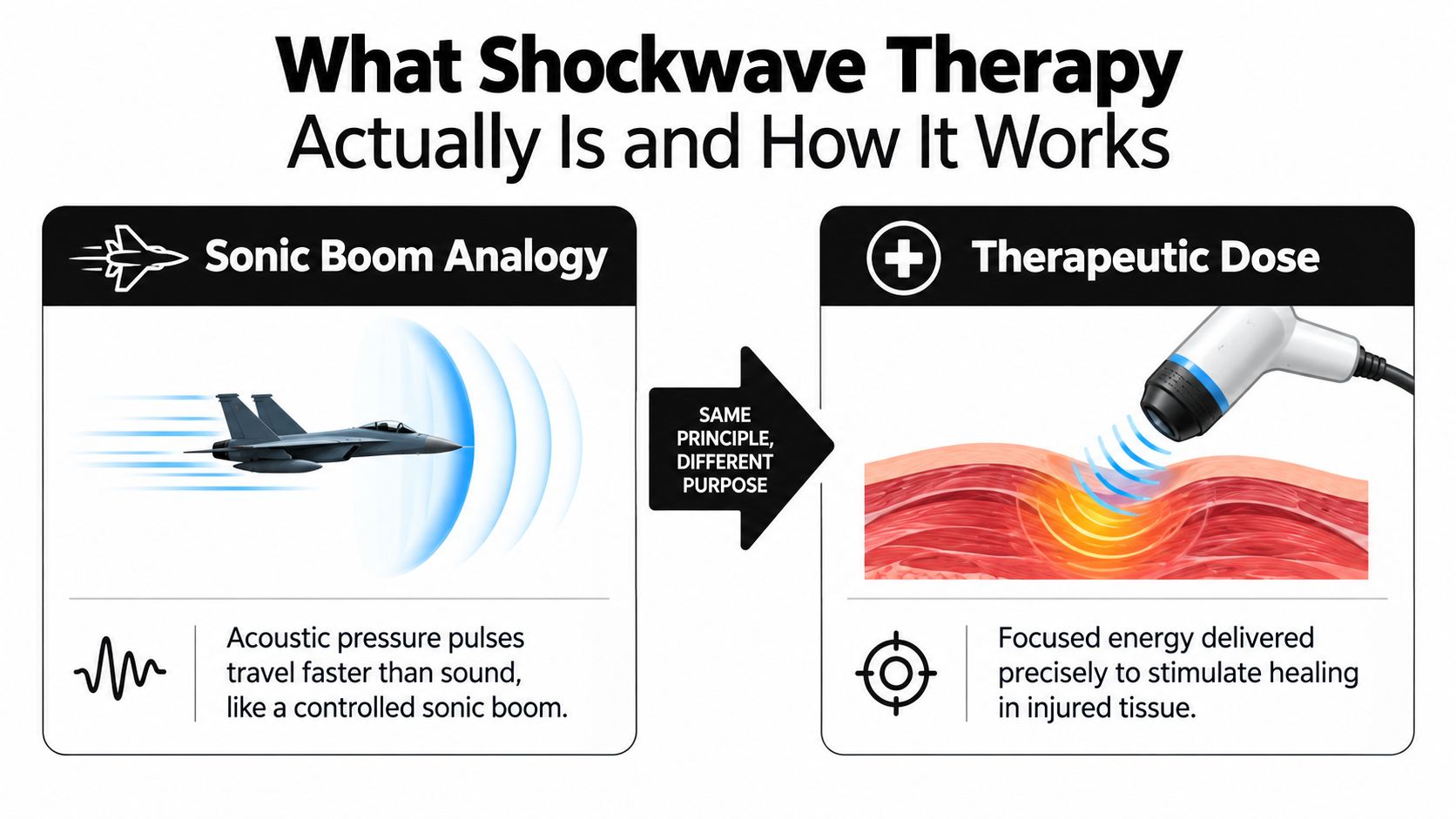
The clinician usually marks the painful area, applies gel and places a handheld applicator against the skin. The device produces a series of audible pulses. Depending on the system and the target, the energy may be aimed at a deeper, more specific point or spread across a broader superficial area.
Focused and radial treatment
Focused shockwave therapy, often abbreviated as fESWT, concentrates energy at a selected depth. That can be useful when a clinician needs to target a more precise region.
Radial shockwave therapy, or rESWT, distributes pressure more broadly from the applicator. Patients may feel this as rapid tapping or pulsing over a wider area. The labels can sound technical, but the practical difference is the shape and depth of energy delivery, not a simple safe-versus-unsafe divide.
Clinicians use these approaches for musculoskeletal problems including plantar fasciitis, Achilles tendinopathy, tennis elbow, calcific shoulder tendinopathy and greater trochanteric pain syndrome. Suitability still depends on the diagnosis, the tissue involved and the patient's medical history.
The treatment may feel sharp, intense or uncomfortable at first. A trained practitioner should adjust the intensity around your response, rather than treating discomfort as something you must endure. If you're comparing shockwave with other non-surgical approaches, this overview of acupuncture and mind-body techniques provides useful context about different ways people approach persistent pain.
Shockwave therapy is also marketed for cosmetic concerns, where the treatment aim and evidence questions differ from musculoskeletal rehabilitation. For that reason, readers exploring body treatments should also distinguish medical tendon treatment from shockwave therapy for cellulite.
What UK Evidence Says About Safety and Effectiveness
Suppose you are deciding whether shockwave therapy is generally safe, but your real concern is whether it is safe for your body, diagnosis and medical history. UK evidence supports reassurance, with limits. NICE reviews of extracorporeal shockwave therapy in studied musculoskeletal uses describe a favourable safety profile and identify no major safety concerns for refractory tendinopathies. The reported reactions were generally local and temporary, rather than severe effects throughout the body (NICE evidence review for ESWT).
One randomised controlled trial included 272 patients. Transient skin reddening occurred in 31% of ESWT recipients and 8% of people receiving sham treatment. This provides a clear example of a short-lived local reaction recorded in the UK evidence. Redness may be relatively common in a study without representing medically dangerous harm.
Safety and effectiveness answer different questions
Safety asks whether treatment causes unacceptable harm. Effectiveness asks whether it improves the problem being treated. A procedure can have an acceptable safety profile while offering uncertain or modest symptom improvement. If shockwave therapy does not reduce your pain, that is a disappointing result, but it is not the same as a serious adverse event.
The evidence also varies between studies. Devices, energy levels, treatment schedules and patient selection can differ, so results from one trial may not apply exactly to another diagnosis or treatment plan. Some studies monitor adverse events in detail, while others provide less safety information. A clinician should explain both the known risks and the gaps in evidence for your particular condition.
| Indication | NICE or evidence reference | Studies reviewed | Reported adverse events | Safety verdict |
|---|---|---|---|---|
| Refractory tendinopathies | NICE ESWT evidence overview | Evidence includes randomised trials and other reviewed studies | Local, temporary reactions such as redness and soreness | No major safety concerns identified in the reviewed uses |
| Calcific tendinopathy | NICE evidence review | Systematic-review evidence | Adverse events were reported, but serious events were not reported in the cited review | Minor reactions can occur, serious harm remained uncommon |
| Musculoskeletal ESWT more broadly | UK NHS and NICE patient and evidence documents | Multiple indications and protocols | Redness, bruising, swelling, altered sensation and pain | Generally favourable, subject to screening and appropriate application |
NHS Trust information adds the patient-specific detail. Bradford Hospitals describes side effects as typically short lasting, while St George's says increased pain or sensitivity normally improves with time. Whittington Hospital also notes a small risk of tendon rupture and soft-tissue damage. Screening, correct application and a treatment plan suited to your diagnosis therefore matter, even when the overall evidence is reassuring.
Common Side Effects and How Long They Last
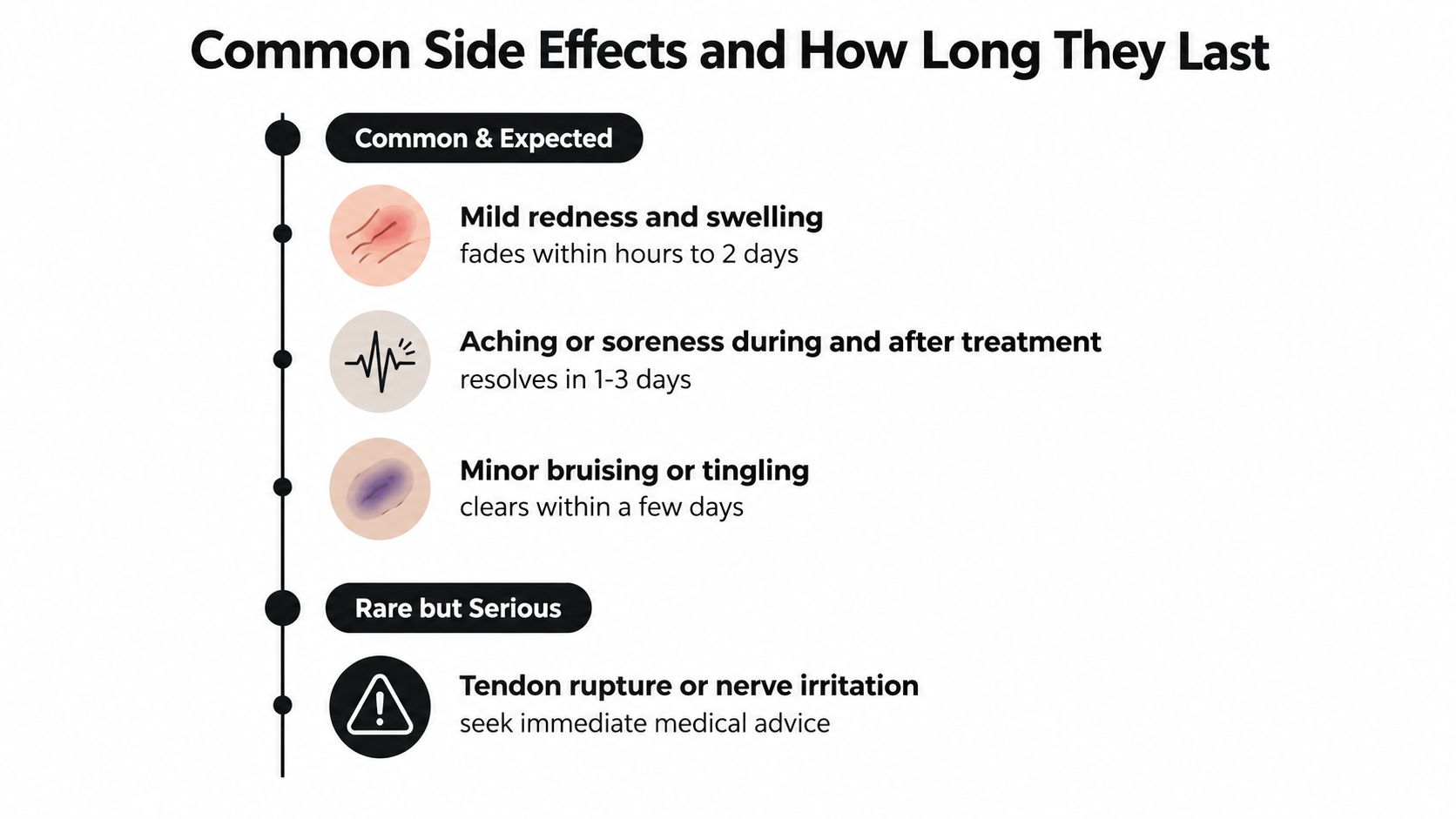
The usual reaction is local. The treated area may look red, feel tender or become slightly swollen after the pulses have stimulated the tissue. NHS leaflets describe bruising, altered sensation and pain as possible effects, and these symptoms generally settle rather than progress.
NICE evidence reviews similarly identify transient skin reddening as a common recorded event. In practice, “adverse event” can sound alarming because it includes minor reactions that a patient might describe as temporary soreness or visible redness, not only complications requiring medical care.
Expected responses
- Redness and warmth: The skin may look flushed immediately after treatment and then return towards normal over a short period.
- Aching or tenderness: The area can feel more sensitive after the session, particularly if the applicator has been used over an already irritable tendon.
- Bruising: Small areas of bruising may appear, especially where tissue is sensitive or the treatment produces a stronger local response.
- Swelling: Mild local swelling can occur and should gradually reduce.
- Tingling or altered sensation: Temporary tingling, numbness or sensitivity may be reported around the treatment area.
The NHS sources describe these effects as mild or short lived in most cases, with some patient leaflets stating that symptoms usually settle within a week (Whittington Hospital and NHS patient information).
When a reaction needs attention
Tendon or ligament rupture is described in UK information as very small or very rare, with particular concern around recent steroid injection. Persistent nerve symptoms, worsening swelling, marked skin change or signs of infection also need clinical review rather than simple observation.
Follow the aftercare instructions supplied by your practitioner. If pain keeps increasing, the area becomes increasingly hot or discoloured, or you develop new weakness or persistent numbness, contact the treating clinic or an appropriate healthcare professional.
The treatment sensation and recovery experience are shown clearly in this patient-facing video:
For a more detailed overview of possible reactions, see this guide to shockwave therapy side effects, but use it as general education rather than a diagnosis of your own symptoms.
Who Should Avoid Shockwave Therapy
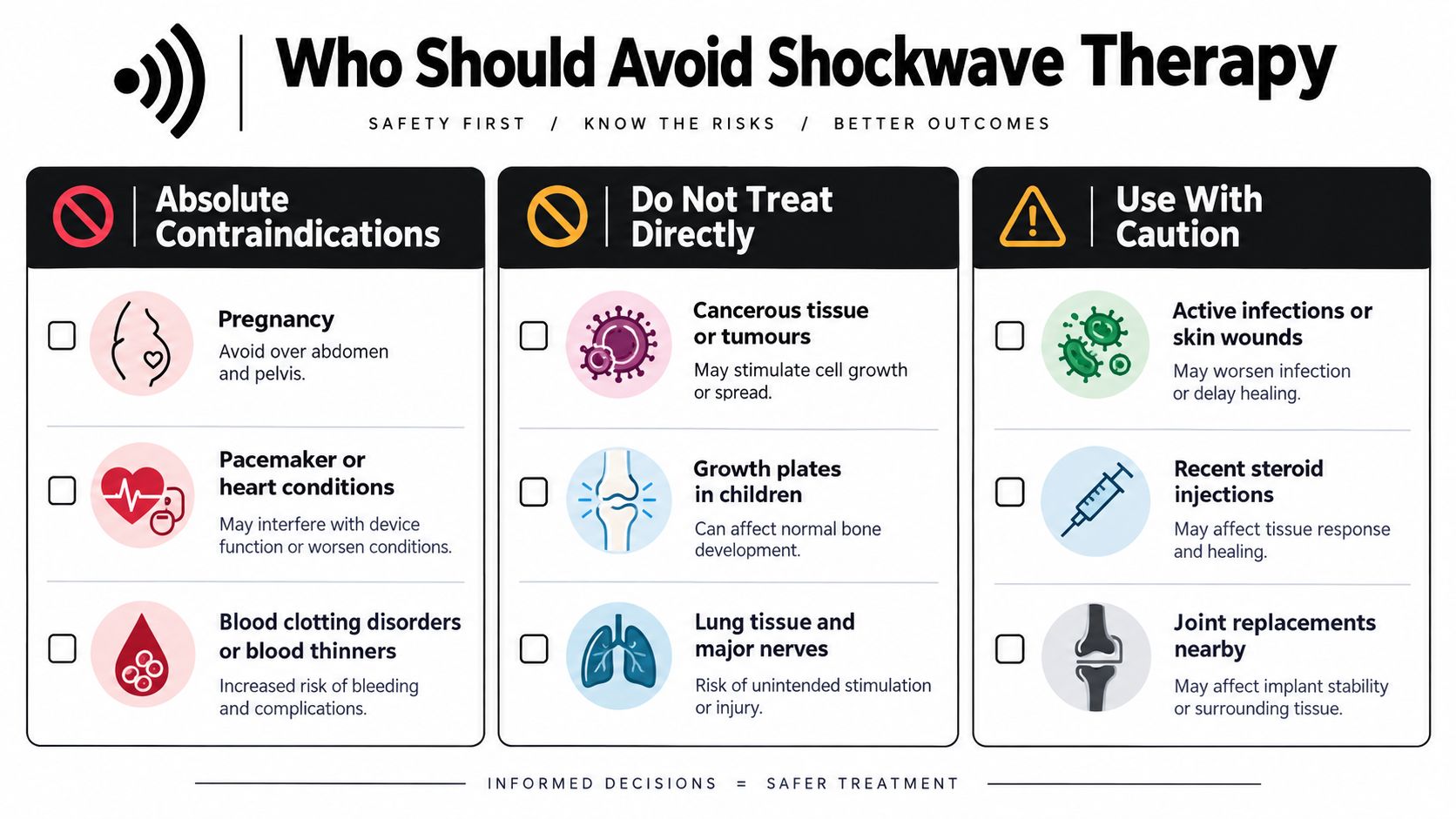
The most important safety decision happens before the device touches your skin. NHS patient leaflets consistently state that shockwave therapy is safe for many people but not appropriate for everyone, and they list exclusions such as pregnancy, recent steroid injection, pacemakers, infection, clotting disorders and certain tendon or fascia ruptures.
Tell the clinician about your full medical history, not just the problem you want treated. A practitioner needs to know about medicines, injections, implanted devices, pregnancy, bleeding problems, cancer history and any changes in sensation around the treatment site.
Situations that usually exclude treatment
The following issues should be discussed before booking and may mean the treatment must not be used in the proposed area:
- Pregnancy: Avoid treatment unless a qualified clinician specifically confirms suitability.
- Pacemakers or implanted cardiac devices: The treating team needs to assess whether the device and treatment location create an unacceptable risk.
- Active infection or open skin: Shockwave shouldn't be applied over infected, damaged or open tissue.
- Malignancy at the treatment site: Cancerous tissue requires specialist medical advice and shouldn't be treated casually.
- Recent corticosteroid injection: Recent injection can increase concern about tendon or soft-tissue damage.
- Known rupture: Certain tendon or fascia ruptures may make shockwave inappropriate.
The exact exclusion can depend on the body area and device, so don't self-clear yourself based on a generic online list. The clinician should explain whether the concern is an absolute reason to avoid treatment or a reason to change the location, timing or protocol.
Situations requiring extra judgement
Blood clotting disorders and anticoagulant medication may increase bruising or bleeding concerns. Metal pins, joint replacements, nerve damage, diabetes with neuropathy and treatment near major nerves or vessels also deserve careful assessment. Children with open growth plates require particular caution and should only be considered by an appropriate specialist.
Before treatment, disclose every medication, recent injection, implanted device and relevant diagnosis. Screening is the main safeguard that turns a general safety statement into a personal decision.
Short-Term Comfort Versus Long-Term Repeated Treatment
A single session can appear straightforward. You receive local pressure pulses, notice temporary soreness or redness, and recover. A full course raises a different question: what happens when the tissue is stimulated repeatedly and minor reactions are counted across several appointments?
NICE evidence reviews provide useful nuance. In one calcific tendinopathy systematic review, 26% of shockwave patients experienced an adverse event compared with 7% of placebo patients, while no serious adverse events were reported (NICE calcific tendinopathy evidence review). The correct interpretation isn't that repeated treatment is dangerous. It's that minor reactions become easier to record when every session and every symptom counts.
| Factor | Single session | Full course |
|---|---|---|
| Main safety question | How does your tissue respond to one application? | Do soreness, bruising or irritation settle between appointments? |
| Monitoring need | Check intensity, location and immediate symptoms | Review progress and reactions before continuing |
| Typical concern | Temporary tenderness or redness | Accumulation of local discomfort if the tissue isn't recovering |
| Decision point | Was the session tolerated? | Is the course still justified for your response and diagnosis? |
A clinician may adjust energy and treatment coverage according to your response. If the area remains unusually painful, swollen or numb, continuing automatically isn't sensible. A review may lead to a lower setting, a longer interval, a different target or a decision to stop.
Long-term evidence also deserves honest wording. NICE reviews note limitations in the available safety and outcome reporting, and longer follow-up is less extensive than short-term monitoring. Acceptable short-term safety therefore doesn't guarantee that every repeated course is appropriate for every person.
Ask what outcome the course is intended to achieve, how your response will be measured and what would make the practitioner change the plan. That turns repeated treatment into a monitored clinical decision rather than a fixed sequence you must complete regardless of symptoms.
What to Expect Before During and After Treatment
A safe appointment begins with questions, not equipment. The practitioner should confirm the diagnosis or working diagnosis, examine the treatment area and ask about pregnancy, medicines, bleeding disorders, recent steroid injections, pacemakers, infection, wounds and previous surgery.
You can also ask who will deliver the treatment and what training they've completed. In the UK, checking whether the practitioner is appropriately registered for their professional role, such as through the Health and Care Professions Council where relevant, adds useful reassurance. Ask which device type will be used, why it suits your condition and how the energy will be adjusted.
Before the session
Bring a complete medication list and mention anything that may seem unrelated to your tendon or pain. Recent injections, anticoagulants, implanted devices and altered sensation can change the safety assessment.
A good consultation should also explain alternatives. Shockwave therapy may be considered alongside rehabilitation, load management and strengthening, rather than treated as a replacement for understanding why the pain persists.
During treatment
The practitioner normally identifies the target area, applies gel and places the applicator against the skin. You'll hear clicking or tapping as the pulses are delivered. The sensation may range from firm pressure to sharp discomfort, and intensity should be adjusted through communication.
The clinician may treat several points around the painful structure rather than one exact spot. That choice depends on the examination and the device. Tell the practitioner if the sensation becomes intolerable, spreads along a nerve or feels distinctly different from the expected pressure.
After the session
Your clinic should give personalised instructions, because aftercare can vary by diagnosis and treatment settings. General advice may include avoiding activities that sharply aggravate the area for a short period and monitoring soreness rather than repeatedly testing the tissue.
Keep a simple symptom diary. Record pain, swelling, bruising, numbness, activity and recovery before the next appointment. This gives the clinician useful information when deciding whether to continue, modify or stop the course.
Before booking, you may find patient experiences and treatment questions in these shockwave therapy reviews, but remember that another person's response doesn't establish your suitability.
Call the clinic promptly: Seek advice about increasing pain, new weakness, persistent numbness, marked skin discolouration, worsening swelling, unusual heat or possible infection.
Choose a clinic that explains screening clearly, records your treatment settings and welcomes questions. If the appointment skips your medical history, promises guaranteed results or dismisses significant pain as irrelevant, pause before proceeding.
3D Aesthetics Leamington Spa offers consultation-led shockwave therapy for cellulite and uneven skin texture, with a 3D body scan to help plan and monitor treatment. Visit 3D Aesthetics Leamington Spa to discuss your goals, medical history and whether this non-surgical option is appropriate for you.
← Back to Home