
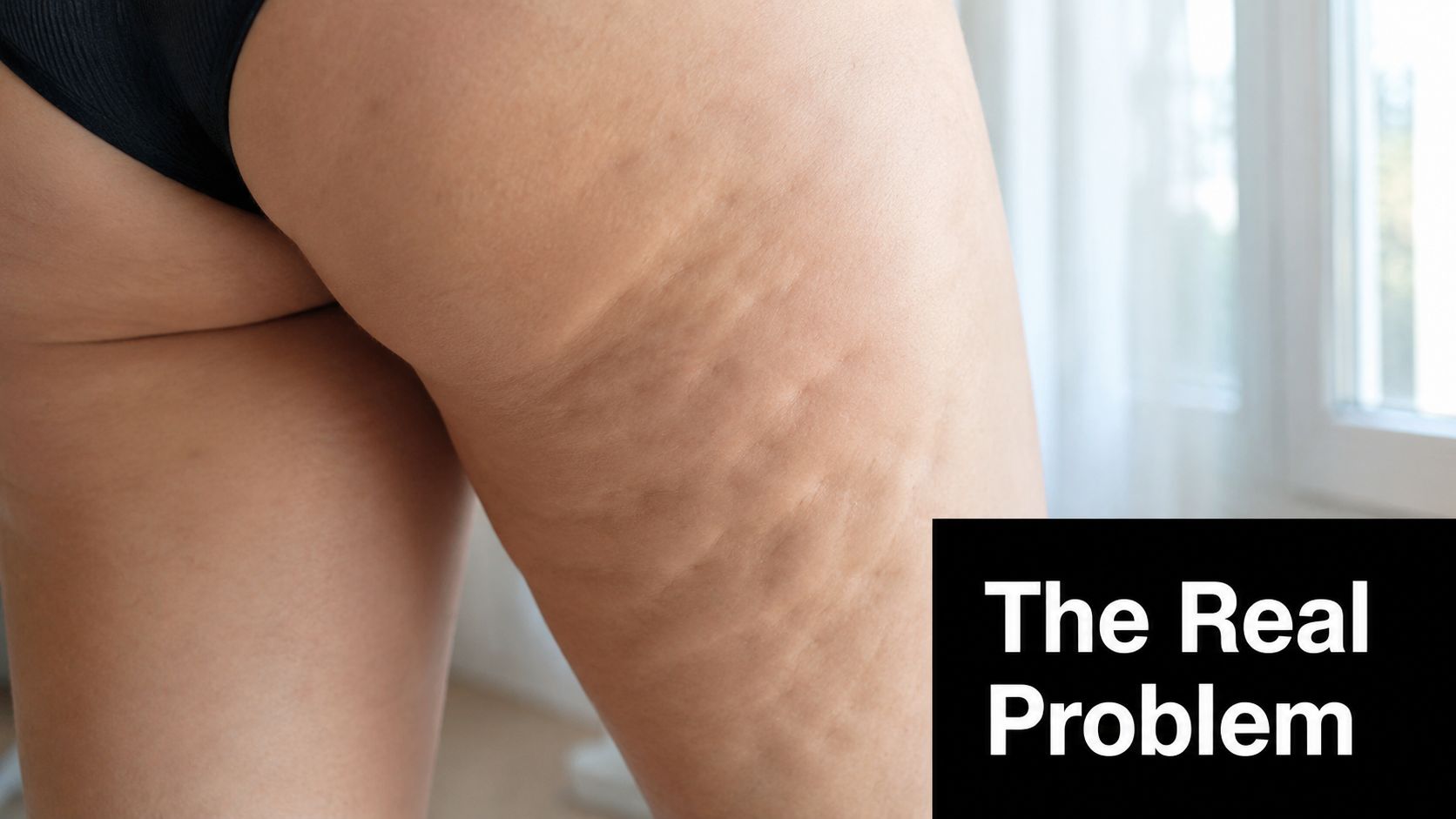
You've probably noticed it in a changing-room mirror, under bright bathroom lighting, or when you sit down and the skin on your thighs suddenly looks different. Exercise may have improved your strength, creams may have softened the surface, but the dimpling remains. Cellulite is common, structurally complex, and not a reliable measure of fitness or body weight.
Shockwave therapy for cellulite has become a popular non-surgical option in UK aesthetic clinics because it targets the quality and behaviour of tissue beneath the skin rather than masking uneven texture. It can be useful, but it isn't a magic eraser. The most sensible way to assess it is to look at what the treatment does, what clinical studies have measured, and how a realistic course differs from an over-promised one.
Table of Contents
- Understanding Shockwave Therapy for Cellulite
- How Acoustic Waves Work on Subcutaneous Tissue
- What the Clinical Evidence Shows
- Comparing Shockwave Therapy with Other Modalities
- Treatment Course and Aftercare Essentials
- Myths and Misconceptions About Cellulite Treatment
- Next Steps and Professional Guidance
Understanding Shockwave Therapy for Cellulite
A client may arrive wanting one thing, smoother-looking thighs, while the practitioner sees several possible contributors: tethered fibrous bands, reduced skin elasticity, uneven contour, or tissue that feels less supple. Cellulite isn't just a surface problem, which helps explain why topical products and general weight loss often don't remove it completely.
Shockwave therapy, also called extracorporeal shock wave therapy, or ESWT, uses an applicator placed against the skin to deliver acoustic energy into the treated area. The sensation is usually rhythmic tapping or pulsing. The practitioner moves the handpiece across areas such as the thighs, hips, and buttocks, adjusting the approach according to comfort, tissue characteristics, and the treatment objective.
The treatment sits within the wider field of non-surgical body contouring. It isn't the same as fat freezing, ultrasound cavitation, radiofrequency, or HIFU. Those technologies address different combinations of fat volume, skin laxity, heating, or tissue remodelling. Shockwave therapy is generally considered when dimpling and tissue texture are the primary concerns, rather than when a client is mainly seeking substantial fat reduction.
What it can and cannot change
The practical aim is usually a visible reduction in the prominence of cellulite, improved skin feel, and a more even appearance. A good consultation should also discuss what the treatment won't do. It won't guarantee perfectly smooth skin, replace exercise, or prevent future changes caused by ageing, hormonal shifts, weight fluctuation, or normal variation in connective tissue.
For a broader explanation of how non-surgical contouring treatments differ, you can read what body contouring involves. The key question isn't whether shockwave therapy sounds appealing. It's whether the pattern and severity of your cellulite match a treatment designed to improve tissue quality over a course of sessions.
How Acoustic Waves Work on Subcutaneous Tissue
Think of cellulite-affected tissue as a quilt. The skin is the outer fabric, while fibrous connective bands act like stitches pulling parts of that fabric down. Fat and soft tissue beneath the skin can push upwards around those anchored points, producing the familiar uneven surface. Shockwave therapy doesn't polish the top layer. It delivers mechanical energy into the tissue to encourage a more adaptable, better-remodelled environment.
The treatment process
A typical treatment follows a straightforward sequence:
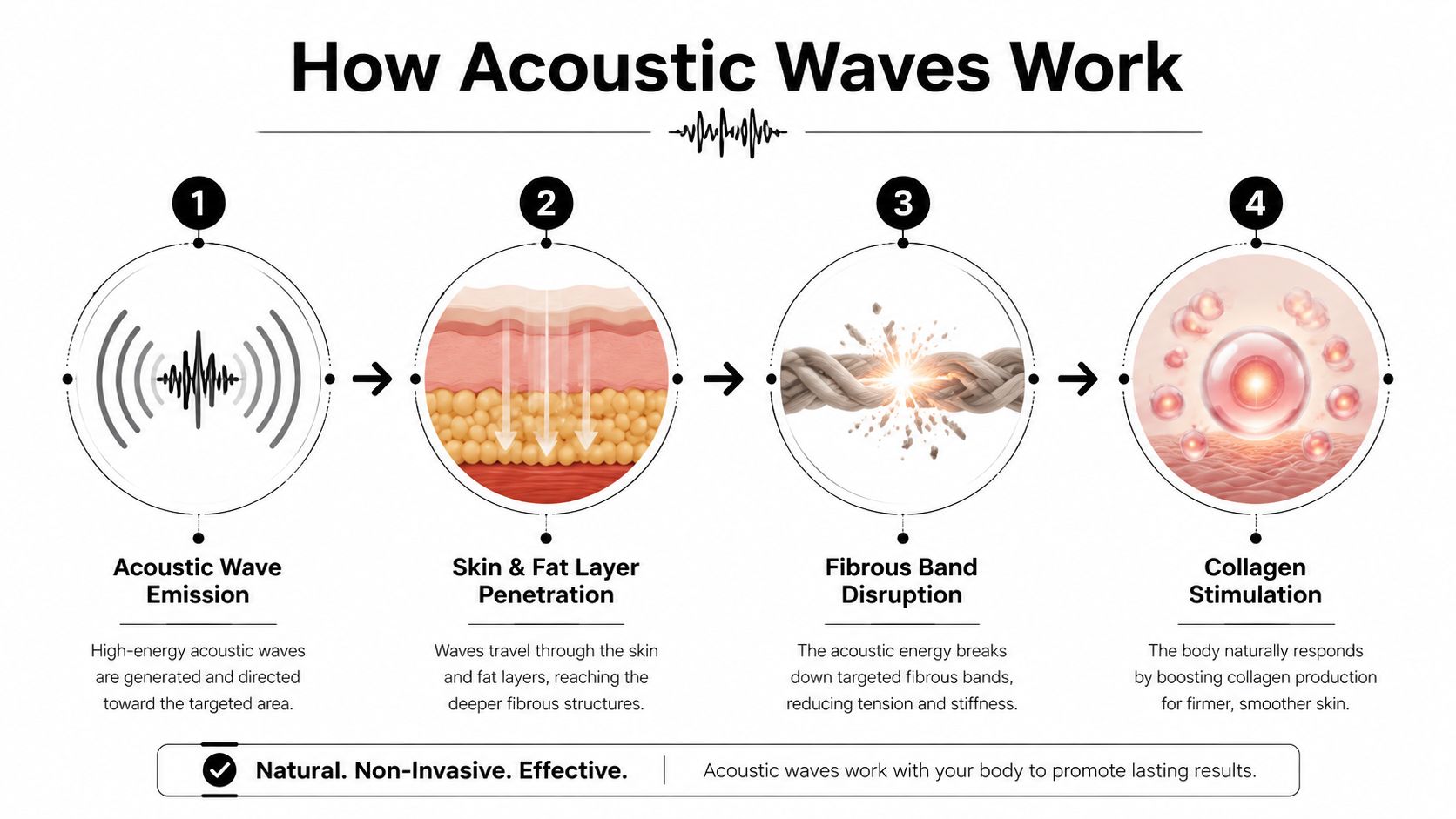
The area is assessed and prepared. The practitioner identifies the regions of concern and applies an appropriate coupling medium so the applicator can move across the skin efficiently.
Acoustic energy enters the tissue. Radial waves spread through a broader area, while focused waves concentrate energy more precisely at a selected depth. The choice depends on the device, protocol, treatment zone, and the practitioner's assessment.
Mechanical stimulation affects the tissue. The pulses create controlled mechanical stress. This may help influence fibrous tissue, circulation, fluid movement, and the behaviour of connective tissue around cellulite dimpling.
Remodelling takes place over time. The body's response doesn't finish when the handpiece leaves the skin. Collagen activity and changes in tissue quality develop gradually, which is why a course usually makes more sense than a single appointment.
Focused and radial waves
Focused ESWT directs energy towards a more defined target and may be selected where a practitioner wants a concentrated effect. Radial ESWT disperses energy outwards from the applicator and is commonly used across broader superficial areas. These terms describe how energy is distributed, not a guarantee that one approach will outperform the other for every client.
A 2015 meta-analysis pooled 11 clinical trials involving 297 female participants and found that both focused and radial ESWT could improve cellulite appearance and subcutaneous tissue measures, while also describing the evidence base as modest (2015 ESWT meta-analysis). That distinction matters. The mechanism is plausible and the findings are encouraging, but the treatment still requires an individual protocol rather than a generic promise.
You can also watch a visual demonstration of the type of acoustic-wave application used in aesthetic settings below.
The tapping can feel sharp over sensitive areas, but the practitioner should adjust intensity rather than expecting you to tolerate unnecessary discomfort. Temporary redness, tenderness, or sensitivity can occur, and your medical history must be reviewed before treatment.
What the Clinical Evidence Shows
The evidence supports cautious optimism, not a guaranteed result. Studies differ in wave type, device, treatment area, session count, assessment method, and follow-up period. A responsible consultation should therefore present improvement as a possible range, rather than promise one fixed outcome for every client.
Findings from repeated-session studies
A prospective study of electromagnetic shock wave therapy used 10 treatment sessions. It reported statistically significant improvements in cellulite severity, skin elasticity, and skin deformation, with no adverse reactions recorded during or after treatment. Improvement remained significant at 3-month follow-up, indicating that the measured response was not limited to the immediate post-treatment appearance (prospective electromagnetic shock wave study).
For UK clients, the protocol also reflects a practical point: shockwave is generally delivered as a course, not as a single appointment intended to create an instant, permanent change. The study was registered as NCT03275259, providing a traceable clinical-study reference.
A UK-relevant acoustic wave trial used 12 sessions over 6 weeks on the gluteus and posterior thighs. Severe cellulite fell from 60% of subjects to 38%, while the mean Cellulite Severity Scale improved from 11.1 to 9.5, p<0.001. Hip circumference measurements reduced from 99.7/103.2 cm to 96.2/100.3 cm, p<0.001, and MRI-measured subcutaneous fat thickness decreased from 28.3±6.5 mm to 26.7±6.1 mm, p<0.001 (UK-relevant acoustic wave trial details).
How to interpret those results
The findings extend beyond a photographic impression. Researchers assessed severity, elasticity, contour, and tissue thickness. They still do not mean every client will see the same change, or that shockwave permanently removes cellulite.
Evidence-based expectation: A treatment course may improve cellulite's visible appearance and measurable tissue qualities, but the size and durability of the response depend on the individual, the protocol, and the follow-up period.
The wider research remains cautious. One review of 46 ESWT studies across plastic-surgery applications concluded that the evidence was insufficient to support any specific intervention with high confidence (review of ESWT evidence). Another review described possible collagen remodelling and generally good safety, while emphasising study heterogeneity and the need for further research to clarify suitable indications (evidence-based review of cellulite treatments).
For treatment planning, shockwave is a reasonable option to assess when cellulite texture is the main concern. It should be chosen with realistic expectations, followed according to the agreed protocol, and reviewed over time rather than judged solely on an immediate before-and-after image.
Comparing Shockwave Therapy with Other Modalities
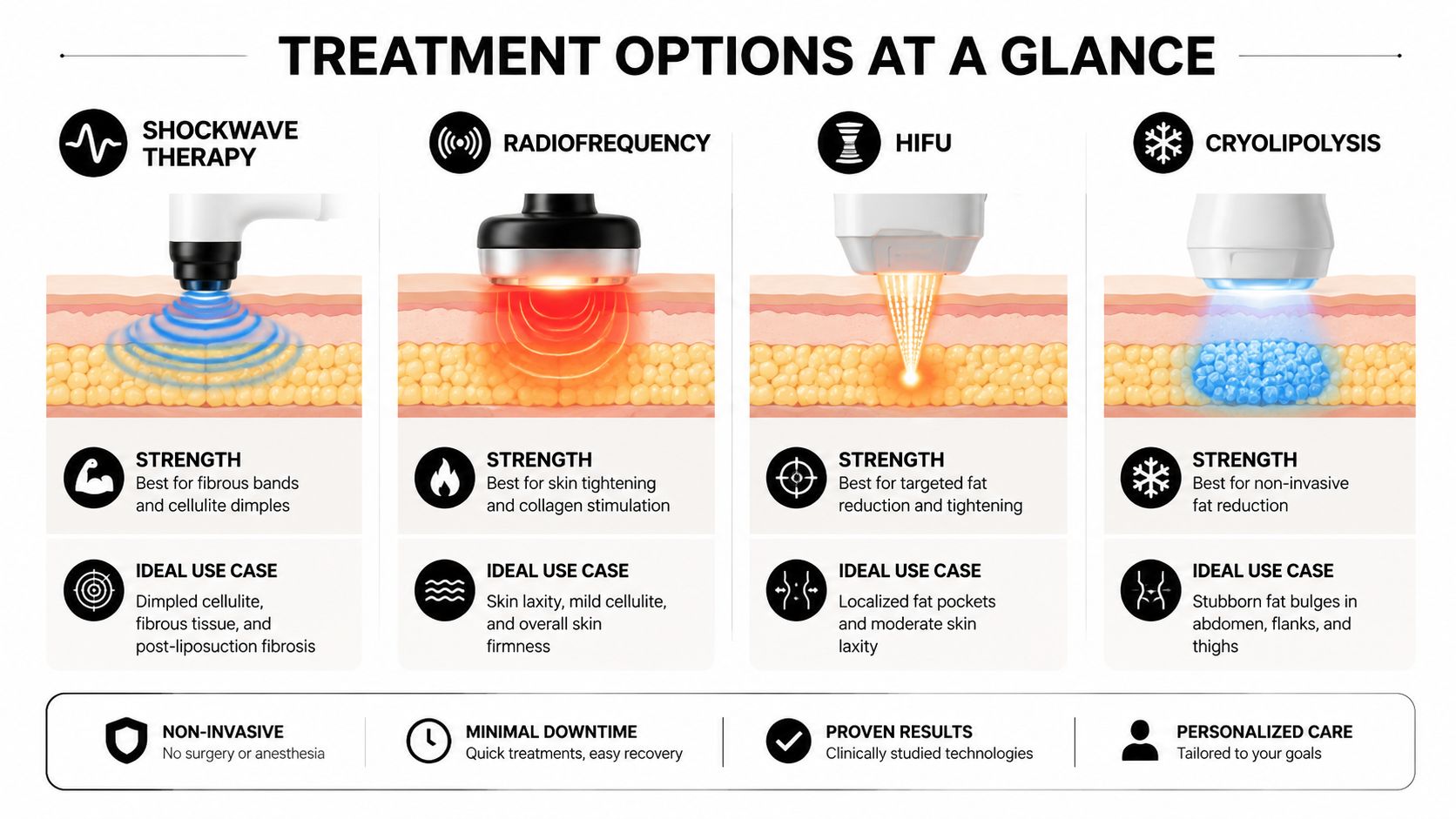
Different technologies solve different problems. If dimpling is your main concern and your skin has reasonable firmness, shockwave may be more relevant than a treatment designed primarily to reduce fat. If the dominant issue is loose skin or a localised fat pocket, another modality may deserve priority.
| Modality | Main focus | Where it may fit |
|---|---|---|
| Shockwave therapy | Mechanical stimulation and tissue remodelling | Cellulite texture, fibrous tissue, and skin quality |
| Radiofrequency | Controlled heat and collagen-focused tightening | Mild laxity, firmness, and surface smoothness |
| HIFU | Focused ultrasound energy at selected tissue depths | Targeted tightening and contour refinement |
| Cryolipolysis | Cooling of a localised fat area | Fat reduction where excess volume is the primary concern |
Choosing according to the problem
Shockwave is not a substitute for cryolipolysis when the main issue is a distinct pocket of unwanted fat. Equally, fat reduction alone may leave the surface dimpling largely unchanged if fibrous tethering and skin texture are the main causes of concern. A practitioner should separate cellulite, fat, and laxity during assessment instead of placing all three under the single label of body contouring.
Radiofrequency can be useful when the skin feels loose or crepey, while HIFU may be considered when focused tightening is the priority. You can compare treatment categories through Glowmi treatment groups, then ask a practitioner which concern each technology is intended to address.
For a more specific explanation of heat-based treatment, see radiofrequency for cellulite. Combining modalities can make sense, but only when each treatment has a distinct role. More devices don't automatically produce a better result, and stacking treatments without adequate assessment can increase cost, discomfort, and recovery demands.
Treatment Course and Aftercare Essentials
A realistic programme begins with an assessment, not a promise. The practitioner should photograph or otherwise document the starting appearance, identify the treatment zones, discuss relevant medical factors, and explain how the clinic will judge progress. Session frequency and total course length vary, although the published studies show why clients should expect multiple appointments rather than an instant correction.
What the appointment feels like
The applicator delivers repeated pulses across the skin. Sensation can range from manageable tapping to sharper discomfort over more sensitive or fibrous areas. Tell the practitioner if the intensity feels excessive. Good treatment should be active and purposeful, not painful for its own sake.
Most clients choose shockwave because it involves little interruption to normal life compared with invasive procedures. Redness or tenderness may occur temporarily, so schedule demanding activities according to your clinic's advice and your own response.
Supporting the result
Aftercare should remain simple and sensible:
- Keep moving gently. Light activity can help you avoid stiffness and return to your usual routine, unless your practitioner gives different advice.
- Follow hydration guidance. Drink normally and follow any personalised instructions rather than treating excessive water intake as a shortcut.
- Avoid aggressive treatment of the area. Don't add vigorous massage, heat-based procedures, or another body-contouring session without checking the timing.
- Track the change calmly. Take comparison photographs under similar lighting and posture. Daily inspection makes gradual remodelling difficult to judge.
Visible improvement may develop progressively as tissue responds after the course. Maintenance can be discussed if the result matters to you over the longer term, but a clinic should explain why it recommends follow-up sessions rather than presenting maintenance as an unavoidable subscription.
Myths and Misconceptions About Cellulite Treatment
The most misleading cellulite marketing usually turns a possible improvement into a guarantee. Shockwave therapy deserves a more careful explanation.

Myth one, one session is enough. Clinical protocols have used repeated treatments, including the 10-session electromagnetic study and the 12-session acoustic wave study cited earlier. A single appointment may make the area feel temporarily different, but it shouldn't be sold as the full evidence-aligned course.
Myth two, shockwave permanently removes cellulite. The treatment may improve skin appearance and tissue measures, but cellulite can become more visible again as skin elasticity, body composition, hormones, and connective tissue change. A durable plan requires realistic maintenance expectations.
Myth three, results look identical on every body. They won't. Dimpling depth, skin thickness, laxity, fat distribution, age, and previous treatment history all affect what improvement looks like. Before-and-after photographs can help, but only when lighting, posture, camera angle, and follow-up timing are transparent.
Myth four, cellulite is excess fat. Fat can influence contour, but cellulite also involves the relationship between skin and underlying connective tissue. That's why reducing volume doesn't automatically produce a smooth surface.
A useful test: Ask what the clinic measured, when it measured it, and what happens if the improvement is less than expected.
Next Steps and Professional Guidance
Start with a consultation that treats your concern as a clinical assessment rather than a sales opportunity. The practitioner should examine the area while you're standing and, where appropriate, moving or changing position. They should distinguish cellulite from fat, loose skin, swelling, or a texture concern that may need another approach.
Ask direct questions before booking:
- What is the main target? Dimpling, skin laxity, fat volume, or a combination?
- Which wave type and device will be used? Ask whether the protocol is radial, focused, or electromagnetic, and why it suits your tissue.
- How many sessions are recommended? Request the clinical reasoning, not just a package price.
- How will progress be documented? Look for consistent photographs, measurements, or a clear severity assessment.
- What are the alternatives? A credible practitioner should explain when radiofrequency, HIFU, cryolipolysis, exercise support, or no treatment may be more appropriate.
- What safety screening is required? Your medical history, medications, pregnancy status, skin condition, and treatment-area concerns should be discussed.
The evidence supports cautious optimism. Shockwave can be a useful non-surgical tool for improving cellulite appearance and tissue quality, but it works best when the plan matches the anatomy and the client understands its limits. A clinic that explains uncertainty is more trustworthy than one that guarantees perfection.
If you're based in the area, you can book a free consultation with 3D Aesthetics Leamington Spa to discuss whether shockwave or a combined approach fits your goals.
3D Aesthetics Leamington Spa offers standalone shockwave treatment and a cellulite-reduction approach combining cavitation, radiofrequency, and shockwave therapy, with consultation-led planning for individual concerns. Visit 3D Aesthetics Leamington Spa to discuss your cellulite, skin firmness, or body-contouring goals and arrange professional guidance.
← Back to Home