
You're sitting in a consultation room, considering fat freezing for a stubborn area that hasn't changed despite your efforts. The treatment sounds simple, but one question keeps returning: fat freezing, is it safe? You may also be wondering who's qualified to perform it, whether the machine matters, and what happens if your body reacts badly.
Cryolipolysis is generally regarded as a low-risk, non-invasive body-contouring treatment, but low risk doesn't mean no risk. The strongest safety evidence shows that serious complications are uncommon, while UK clinical governance and case reports make another point clear: patient selection, accurate applicator placement, equipment control and follow-up all matter. This guide separates expected short-term reactions from rare complications, so you can judge whether the treatment fits your health, expectations and tolerance for risk.
Table of Contents
- Why People Ask Whether Fat Freezing Is Safe
- How Cryolipolysis Actually Works
- Common Side Effects and How Long They Last
- Rare but Serious Complications You Should Know
- Who Should Avoid Fat Freezing and Why Screening Matters
- Fat Freezing Compared With Other Non-Surgical Options
- What Happens During and After a Treatment Session
- A Practical Verdict on Fat Freezing Safety
Why People Ask Whether Fat Freezing Is Safe
You book a consultation for a stubborn pocket of fat, expecting a simple cosmetic appointment. Then a more difficult question appears: fat freezing, is it safe? The answer depends on more than the cooling technology. The practitioner's training, the device used, your medical history and the clinic's follow-up process all shape the risk.
Fat freezing, or cryolipolysis, is widely offered in aesthetic clinics and other non-surgical treatment settings. That accessibility can make it seem comparable to an ordinary beauty service. It is still a medical procedure involving controlled cooling of living tissue, so patients reasonably ask whether the device is properly maintained, whether the operator can recognise unsuitable anatomy and what happens if recovery does not follow the usual pattern.
Some concerns are immediate, such as redness, tenderness or temporary numbness. Others involve symptoms that last longer, including persistent pain, altered sensation or an unexpected change in the treated contour. A responsible explanation should make room for both possibilities. Reassurance is appropriate for the generally low overall risk, but it should not erase rare, serious outcomes.
UK clinical governance places weight on identifying and reporting suspected device-related problems. The MHRA guidance and UK cosmetic-procedure policy reflect the importance of responding to adverse incidents rather than assuming that a non-surgical label means risk-free treatment. A clinic focused only on the typical recovery can overlook warning signs that need review.
What the safety question really involves
Assessing suitability is like checking four links in the same chain. A weak link can affect the whole result:
- The treatment mechanism: Controlled cooling is intended to affect subcutaneous fat, yet poor technique can expose nearby tissue to injury.
- Your suitability: A small, pinchable fat pocket presents a different concern from a hernia, reduced sensation or an unsuitable treatment area.
- The operator and device: Training, applicator choice, temperature monitoring and equipment calibration influence treatment control.
- The follow-up plan: You should know which reactions are expected, when they should improve and which symptoms require medical assessment.
A clinic that promises risk-free treatment, skips your medical history or discourages questions is giving you useful information about its safety standards before treatment begins.
The evidence supports proportionate confidence, not absolute certainty. Serious complications appear uncommon, while real-world reports show that incorrect delivery can cause substantial harm. The practical question is whether this treatment, performed on you, by this practitioner, with this screening and follow-up process, is a reasonable choice.
How Cryolipolysis Actually Works
You arrive hoping to reduce a small, pinchable pocket of fat. The applicator then cools that tissue through the skin, aiming to affect fat cells while limiting exposure of the skin and surrounding structures. Understanding that sequence helps separate the treatment's intended mechanism from the factors that determine whether it is delivered safely.
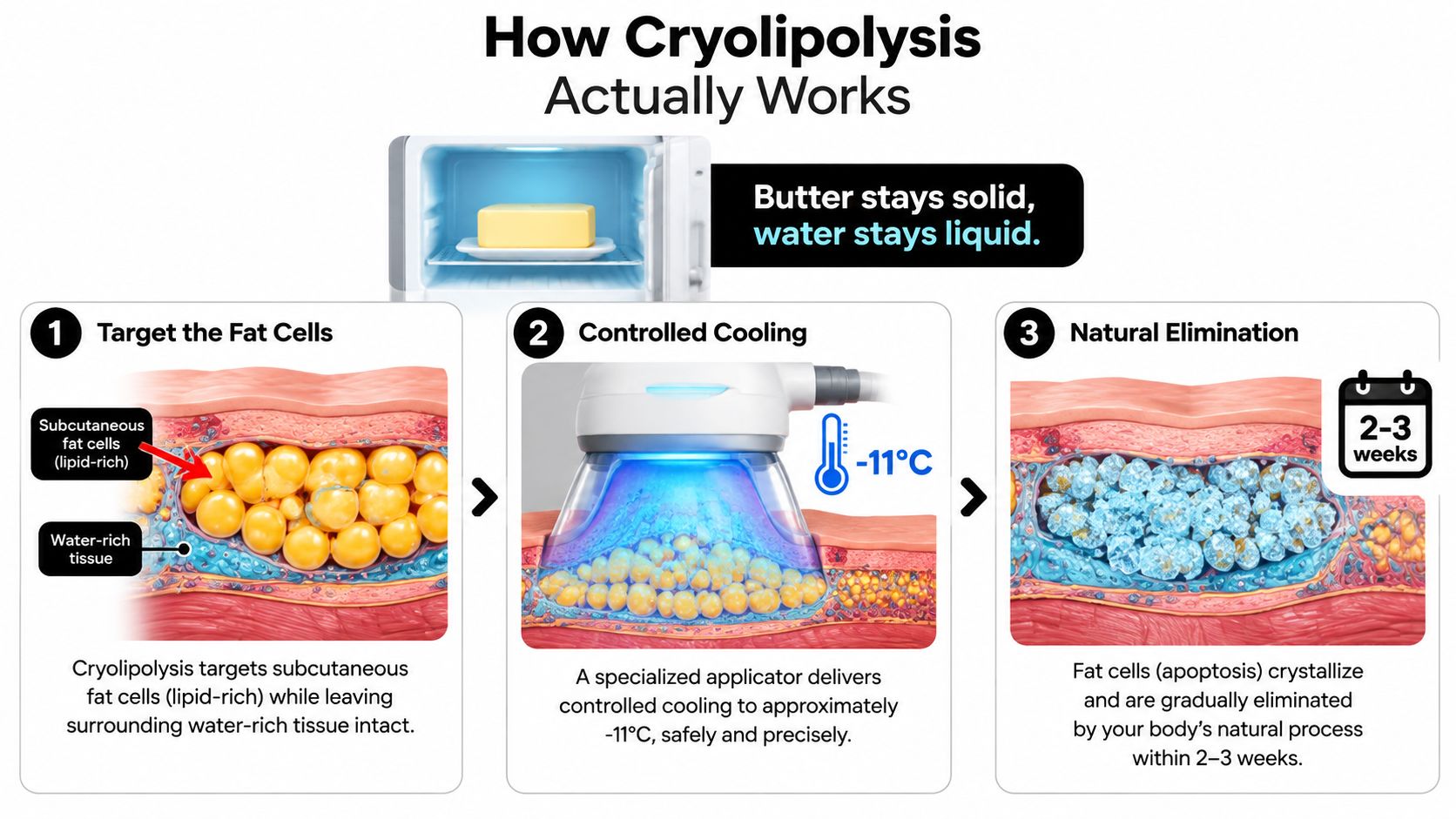
Cryolipolysis relies on a difference in how tissues respond to cold. Butter firms in a refrigerator more readily than water, because its structure reacts differently to cooling. Fat tissue is more vulnerable to controlled cooling than many nearby water-rich tissues, allowing an applicator to target subcutaneous fat beneath the skin.
During treatment, the applicator draws or holds the selected tissue against a cooling surface. A protective membrane or gel pad helps shield the skin, while the device controls the treatment temperature. The UK government's discussion of non-surgical cosmetic procedures describes cooling as causing fat cells to rupture, after which the body clears the affected material. The safety problem is precision: the intended fat layer needs the planned exposure without damaging cold reaching the skin or nearby structures.
Why equipment and placement matter
A suitable setup includes temperature sensors in the applicator and a protective pad between the cooling surface and skin. The operator must select an applicator that fits the treatment area, then place it over the intended fat pocket rather than a hernia, weak abdominal wall or other vulnerable structure. Screening and accurate placement are forms of clinical governance, not minor preparation.
The affected fat cells undergo a controlled form of cell death and are processed gradually by the body. Visible change is therefore delayed. Little immediate difference does not, by itself, show that treatment failed or was unsafe. Early redness, swelling or numbness may temporarily hide the contour change.
Controlled cooling is only one part of safety. The operator must identify the right tissue, protect the skin and respond appropriately if the treatment follows an unexpected course.
Temperature control also appears in other clinical settings, although the goals differ. The clinician TTM protocol explains how monitoring supports controlled cooling in clinical care. It is not a cryolipolysis guide, but it illustrates why temperature-based treatment depends on measurement, equipment checks and trained judgment rather than guesswork.
Common Side Effects and How Long They Last
After a cryolipolysis session, the treated area may look and feel different before it looks slimmer. A patient might notice redness, firmness, swelling, tenderness, numbness or unusual sensitivity. Tingling can occur as sensation returns. These reactions usually remain local and improve without treatment, but their duration depends on the person and the body area treated.
A published clinical review lists erythema, bruising, swelling, numbness or paraesthesia, sensitivity and pain among the common adverse effects. A systematic review reported complications in 0.82% of patients and identified reduced sensation lasting more than four weeks as the most common longer-duration issue. Mild symptoms can therefore be part of ordinary recovery, while clinically significant complications remain uncommon. UK clinical governance guidance also highlights the need for clear aftercare and access to follow-up when symptoms do not settle as expected.
Common Cryolipolysis Side Effects and Typical Duration
| Side Effect | Typical Incidence | Typical Duration | Action Needed |
|---|---|---|---|
| Redness or erythema | Common local reaction | Often short-lived, although it can persist for a while | Monitor and follow the clinic's aftercare advice |
| Swelling or oedema | Common local reaction | Usually settles over days to weeks | Contact the practitioner if it worsens rather than improves |
| Bruising | Common local reaction | Generally resolves gradually | Protect the area and seek advice if extensive or worsening |
| Tingling or altered sensation | Common local reaction | May continue for several weeks | Arrange review if prolonged, severe or spreading |
| Tenderness or pain | Common local reaction | Usually temporary | Ask about suitable pain relief; seek advice for severe pain |
| Blistering or marked colour change | Unusual warning sign | Requires assessment | Contact the practitioner promptly |
A mild cold ache, numbness or sensitivity does not automatically mean that treatment has gone wrong. The pattern matters. Symptoms that gradually ease fit the usual recovery process, whereas severe pain, blistering, skin breakdown, unusual darkening or a reaction that keeps intensifying needs prompt clinical attention.
Aftercare should work like a safety net. Before treatment, ask who will review you, which symptoms warrant a call and how quickly the clinic responds. Keep the provider's contact details available. If altered sensation remains troubling beyond the timeframe described by the practitioner, arrange an assessment rather than relying on online reassurance.
A responsible provider should record the treatment area, explain expected changes and make reporting concerns straightforward. Good governance is visible in these practical details, not only in the cooling equipment itself.
Rare but Serious Complications You Should Know
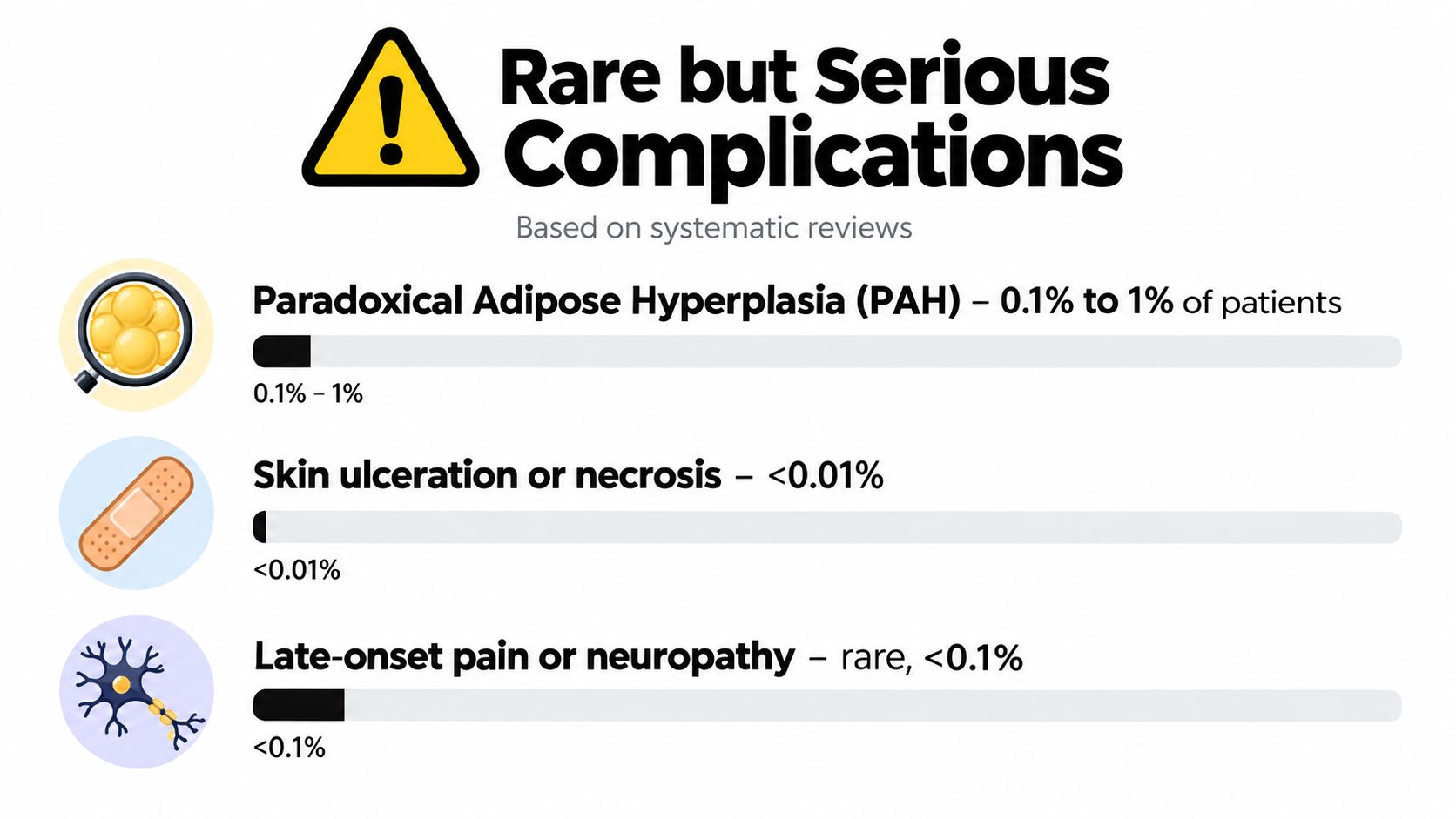
A firm enlargement that appears after fat freezing deserves attention, even if the treatment initially seemed uneventful. This complication is paradoxical adipose hyperplasia, usually shortened to PAH. The treated fat becomes larger rather than smaller. It may be painless and develop after a delay, so it can be mistaken for ordinary swelling or dismissed as part of the normal recovery period.
The largest real-world analysis reviewed 16,504 treatment cycles. Adverse events occurred in 1.98% of cycles, and 3.12% of patients experienced at least one adverse event. PAH was estimated at 0.018% to 0.048% per cycle, approximately one in 5,501 to one in 2,063 cycles. These findings, reported in the published review in Aesthetic Surgery Journal, place PAH in context. It is rare, but a low rate does not make the outcome irrelevant to someone affected by it.
Cold injury and nerve symptoms
Incorrect applicator placement, unsuitable treatment settings or poor monitoring can injure the skin and deeper tissue. A UK case report described frostbite with substantial flank necrosis after treatment in a beauty salon. Delayed medical review made the injury worse. The published case report shows why “non-surgical” describes the method, not a guarantee that tissue damage cannot occur.
Clinical reports also describe persistent pain, dysaesthesia, hyperpigmentation, motor neuropathy and firm areas under the skin. The appropriate response depends on the finding. PAH may require surgical correction, while nerve symptoms need assessment of their severity and likely recovery.
UK clinical governance matters here. A separate UK-facing discussion reported that 7% of members of the British Association of Aesthetic Plastic Surgeons had dealt with serious complications, with 21 patients requiring surgery over a three-year period. It stated that all 21 had some permanent deformity or scarring after attempted correction. This does not represent the individual risk for every patient, but it supports careful provider selection, screening and follow-up. The UK aesthetic medicine discussion also describes how uncommon complications can occur even when the overall rate remains low.
Seek prompt clinical advice if a hard enlargement continues to grow, pain becomes severe or delayed, or the skin develops blistering, breakdown or an unexpected colour change.
Who Should Avoid Fat Freezing and Why Screening Matters
A proper consultation is a clinical assessment, not a quick sales conversation. The practitioner should ask about your medical history, inspect the skin and assess whether there's enough pinchable subcutaneous fat for the applicator to treat safely. They should also look for abdominal-wall weakness, a hernia, scar tissue or other local features that could make positioning unsafe.
Conditions involving abnormal cold sensitivity are particularly important. A practitioner should consider whether treatment is appropriate if you have cryoglobulinaemia, cold agglutinin disease, paroxysmal cold haemoglobinuria or severe Raynaud's phenomenon. Active skin problems, an open wound, significant inflammation or a hernia in the treatment area also require avoidance or specialist assessment.
What a meaningful consultation includes
Expect the provider to:
- Review your health history: Mention circulation problems, cold reactions, sensory changes, surgery, pregnancy and relevant medicines.
- Examine the treatment area: A physical pinch assessment helps establish whether the tissue is suitable for the applicator.
- Check the skin and abdominal wall: Hernias, weakness, scars and poor skin quality can alter the risk.
- Set an honest goal: Cryolipolysis is for localised contouring, not general weight loss or treatment of obesity-related health risks.
- Explain alternatives: A good clinician should be willing to recommend another option or no treatment.
Larger body types and men aren't automatically excluded. Recent evidence suggests overall safety is good across a broader range of patients, but suitability still depends on the actual tissue, the treatment area and the person's expectations. The 2025 review of safety outcomes describes numbness, redness, pain, tingling, oedema, hyperpigmentation and temporary discomfort among the main reported effects, while also highlighting the importance of nuanced selection.
Be cautious if a provider says everyone is suitable, refuses to examine you, promises major weight loss or minimises a hernia or sensory problem. A practitioner who declines treatment after screening may be demonstrating good governance, not losing a sale.
Fat Freezing Compared With Other Non-Surgical Options
Cryolipolysis isn't the only non-surgical body-contouring treatment available in the UK. The alternatives use different forms of energy and may suit different concerns. Comparing them by mechanism and tissue target is more useful than choosing based on a “no downtime” label.
Cryolipolysis vs Cavitation vs RF vs HIFU
| Modality | Mechanism | Sessions Needed | Downtime | Notable Risks |
|---|---|---|---|---|
| Cryolipolysis | Controlled cooling of pinchable subcutaneous fat | Depends on area and assessment | Usually minimal | Numbness, swelling, bruising, pain and rare PAH or cold injury |
| Ultrasound cavitation | Ultrasound energy used for body-contouring aims | Usually planned according to response and area | Generally minimal | Temporary discomfort or local sensitivity; outcomes depend on device and technique |
| Radiofrequency | Heating intended to support contouring and skin tightening | Often requires a course | Generally minimal | Heat-related discomfort or skin injury if poorly controlled |
| HIFU | Focused ultrasound energy delivered into targeted tissue | Depends on device and treatment plan | Usually limited | Pain, tenderness and potential heat-related injury if incorrectly delivered |
Cryolipolysis is most relevant when you can pinch a defined pocket of fat, such as an abdominal or flank area. It has a well-developed clinical evidence base, but its results appear gradually and it carries the distinctive PAH risk described earlier. It may also be less convenient when several larger areas need treatment.
Radiofrequency may make more sense when mild laxity is a larger concern than the fat volume itself. Cavitation is often chosen for softer, more diffuse contouring goals, while HIFU can be considered when focused energy is appropriate. None of these treatments should be presented as a substitute for weight management or medical care.
For a broader UK-oriented overview of non-surgical fat-reduction approaches, you can review non-surgical fat removal options in the UK. Ask the provider what evidence supports the specific device they use, how they screen for contraindications and what happens if the result is unsatisfactory.
A practical decision rule is simple. Pinchable, localised fat points towards cryolipolysis. Mild laxity points towards RF. Diffuse contouring goals may lead to cavitation. HIFU requires particularly clear discussion of energy delivery, expected discomfort and operator competence.
What Happens During and After a Treatment Session
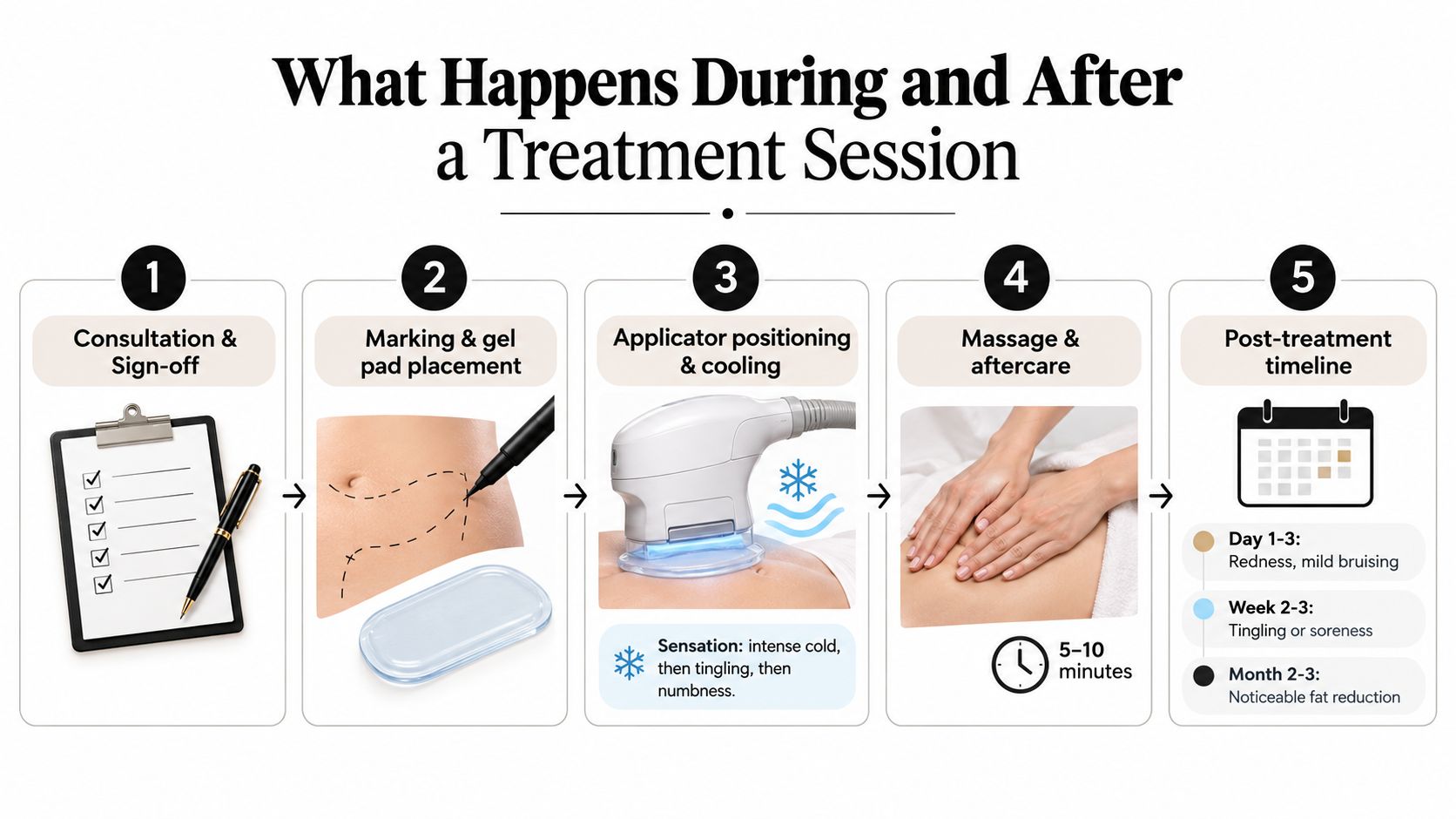
A safe appointment starts before the applicator touches your skin. After the consultation has been signed off, the practitioner should mark the target area, check the skin and position a protective gel pad. They'll then select and place the applicator so it treats the intended layer rather than pressing over a vulnerable structure.
The first sensation is usually intense cold, sometimes accompanied by pulling or pressure. Tingling and temporary numbness commonly follow as the area cools. Treatment time varies by device and area, but the clinical plan notes a typical duration of 35 to 60 minutes per applicator. Once the applicator is removed, the practitioner may massage the treated tissue, which can feel uncomfortable for a short period.
The recovery timeline
Immediately afterwards, the area may look red, swollen, pale or firmer than usual. Tenderness, itching and altered sensation can persist while the local response settles. Visible contour change is delayed because the body processes the affected cells gradually, so early appearance isn't a reliable measure of the final result.
A clinic should give you written aftercare and a direct contact route. In general, gentle everyday movement is usually compatible with recovery, while you should follow the provider's specific advice about heat exposure, bathing and pain relief. Don't take medication because it appears on an online checklist. Ask a pharmacist or clinician if you're unsure what's suitable for you.
You can read more about planning treatment frequency in this guide to how many fat-freezing sessions may be needed. The decision to repeat treatment should follow an assessment of the first result and your recovery, not pressure to book immediately.
Contact the clinic promptly if you develop an expanding hard lump, severe pain that doesn't settle, blistering, skin breakdown or a marked colour change. Don't wait for a routine review when the reaction is worsening.
A Practical Verdict on Fat Freezing Safety
For a suitable patient, cryolipolysis can be a reasonable evidence-backed option for localised, pinchable fat. The balance is most favourable when your weight is reasonably stable, your expectations are modest, you have no relevant cold-sensitivity condition or local contraindication, and a trained practitioner uses an appropriate, properly maintained device.
The published evidence supports reassurance with boundaries. In the large review cited earlier, adverse events affected 1.98% of treatment cycles, and PAH was estimated at 0.018% to 0.048% per cycle. Those figures describe a low overall risk, not a guarantee. UK case reporting demonstrates why operator competence, screening and timely review remain central to safety.
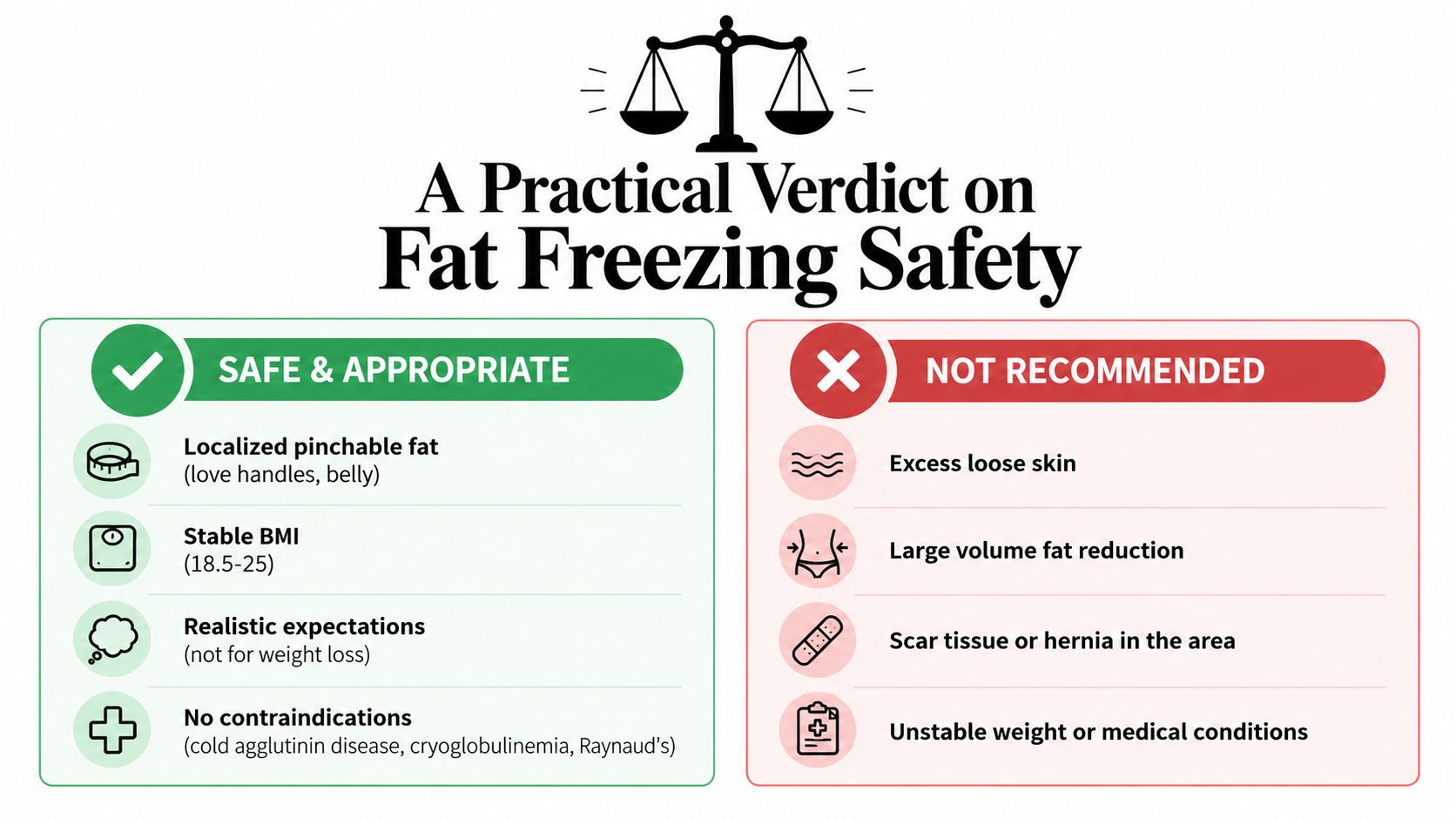
Use this checklist before booking
- Ask who will treat you: Check the practitioner's training, experience with the specific device and process for dealing with complications.
- Ask about screening: Confirm that the consultation includes your medical history, skin, sensation, abdominal wall and treatment goals.
- Ask what the treatment can achieve: The purpose is contouring a localised fat pocket, not substantial weight loss.
- Ask about follow-up: Find out who you contact, how quickly concerns are reviewed and what symptoms require urgent advice.
- Walk away from guarantees: Risk-free promises, pressure to pay before assessment and refusal to discuss PAH are red flags.
People often ask whether fat freezing is safe for men, larger bodies or abdominal fat. The answer depends less on gender or body shape than on the tissue being treated, the condition of the treatment area and the person's health and expectations. A careful provider should individualise the decision rather than placing every client into a single low-risk category.
For information on interpreting outcomes and setting realistic expectations, see fat-freezing results. The safest conclusion is balanced: fat freezing is usually low risk when properly delivered, but it isn't risk-free. Informed consent, honest screening and a clear follow-up pathway give you more protection than marketing language ever can.
At 3D Aesthetics Leamington Spa, clients receive a complimentary consultation with a 3D body scan to assess concerns, shape a personalised plan and monitor results over time. If you're considering fat freezing and want to discuss suitability, risks and alternative body-contouring options with a trained team, visit 3D Aesthetics Leamington Spa to arrange a consultation.
← Back to Home