
A single fat freezing cycle typically reduces roughly 20% to 40% of fat cells in the treated area, with visible change developing over 2 to 4 months and final results usually assessed at about 12 weeks. It reshapes a local pocket of fat, rather than causing general weight loss.
That distinction challenges the most popular advice people hear about fat freezing. Cryolipolysis isn't a shortcut to a lower number on the scales, and it won't replace weight management. It's designed for the tummy, flanks, thighs, double chin, or another defined pocket that remains noticeable after your weight has become fairly stable.
The change is usually gradual. Your clothes may sit differently before the mirror shows a clear difference, and a measured contour change can be more meaningful than a dramatic-looking photograph taken in different lighting.
This guide explains what fat freezing results tend to look like in real terms, how 3D scanning makes progress easier to judge, why one person sees a subtle improvement while another wants a refinement session, and what to do if the result is uneven or disappointing. It also covers safety, recovery, and how fat freezing compares with other non-surgical treatments available in Leamington Spa.
If you're planning content or patient education for an aesthetics business, take the leap with custom marketing can help you communicate treatment expectations clearly rather than relying on oversized promises.
Table of Contents
- Introduction
- What Fat Freezing Results Actually Look Like
- How Your Results Are Measured With 3D Body Scanning
- What Influences Your Fat Freezing Outcome
- Real Before-and-After Journeys
- Risks, Side Effects and Recovery
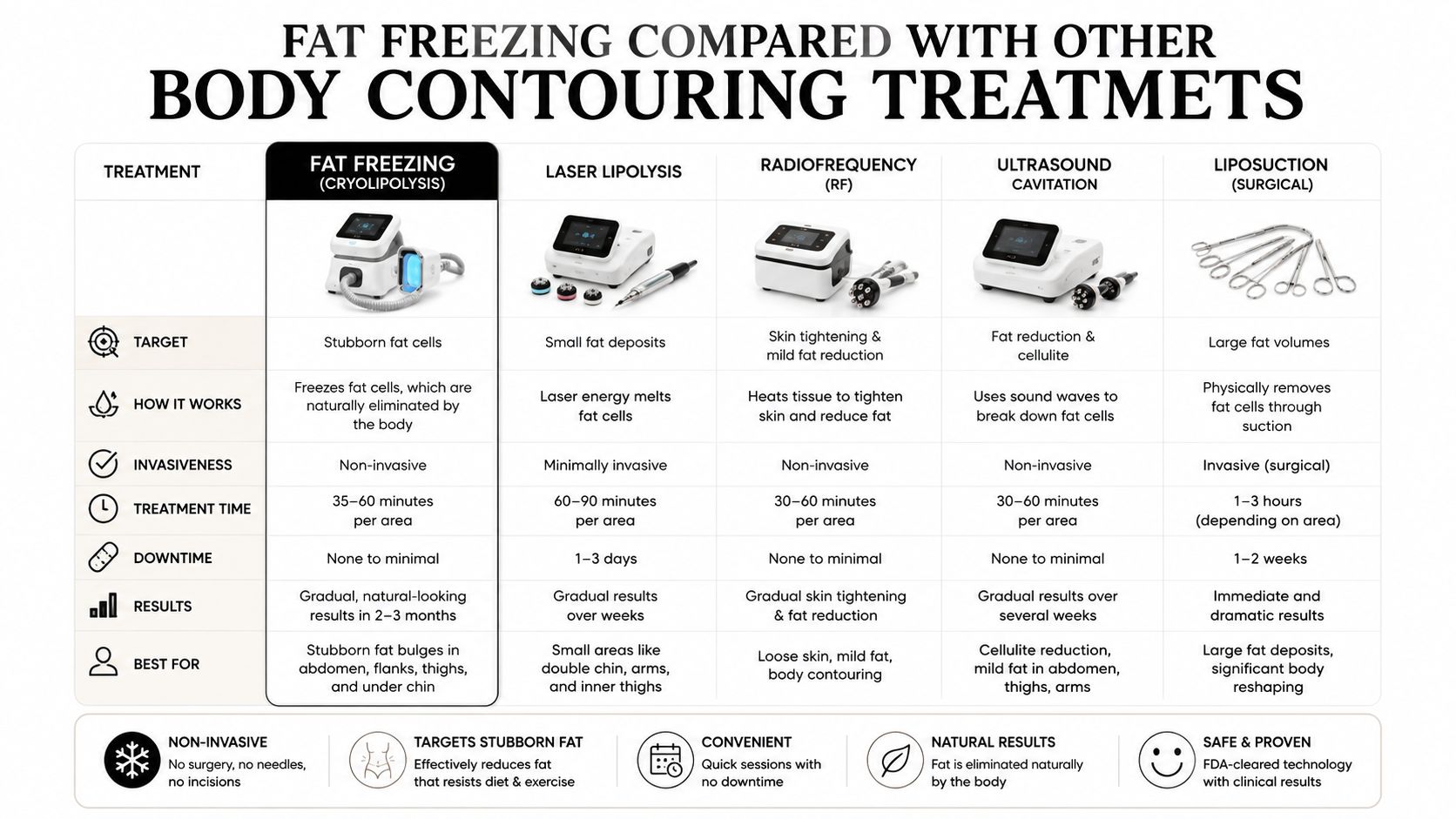
- Fat Freezing Compared With Other Body Contouring Treatments
- Fat Freezing FAQs From Leamington Spa Clients
Introduction
Fat freezing works by applying controlled cooling to a localised area of fat. The treated cells are damaged and then gradually cleared by the body, while the treatment aims to leave surrounding tissue unharmed. The practical result is a change in the shape of that area, not a whole-body slimming effect.
A single cycle is often discussed as reducing roughly 20% to 40% of fat cells in the target area, based on UK patient guidance from ACE in the evidence summary provided for this article. That figure describes the treated pocket, not the person's total body fat, and it shouldn't be read as a promise of a particular visual transformation.
Your starting shape matters. Someone with a near-normal BMI and one noticeable lower-abdominal pocket may see a more obvious contour improvement than someone seeking broad weight reduction. The treatment area, skin elasticity, applicator positioning, and whether one or more areas need attention all influence how the final result looks.
A more useful way to judge change
The bathroom scales are a poor primary test after cryolipolysis because the treatment targets a small area. Your overall weight may stay similar even while the treated fold becomes flatter or your waistline looks smoother in clothing.
A sensible consultation should therefore ask different questions:
- Where is the pocket? Is it suitable for localised fat reduction rather than weight loss?
- What would count as success? A smaller fold, a cleaner waistline, or a less prominent profile?
- How will progress be measured? Photographs, tape measurements, and 3D scanning can provide a better baseline than memory.
- What happens if the result is subtle? A review should consider the scan and your goals before anyone discusses further treatment.
Good expectations don't make the treatment less appealing. They make the decision safer and help you recognise a believable improvement when it develops.
What Fat Freezing Results Actually Look Like
Cryolipolysis produces a localised body-contouring effect. The evidence doesn't support describing it as a general weight-loss method. A 2025 systematic review and meta-analysis pooling 3,158 participants across 30 clinical trials found measurable effects in the treated area, with a pooled average BMI decrease of about 1.8 points and waist-circumference reduction of 3.56 cm. More than 80% of participants reported favourable outcomes, but the central message remains contouring rather than broad slimming, as reported in this UK summary of the meta-analysis.
UK-facing clinical reviews report visible fat reduction after one cycle at roughly 14.67% to 28.5% by caliper measurement and 10.3% to 25.5% by ultrasound. A UK professional education source in the same review also cites removal of up to 40% of fat cells after one treatment, while a published review records improvement in 86% of 518 subjects. These figures use different measurement methods and shouldn't be treated as interchangeable promises, as explained in the PMFA Journal review of published cryolipolysis data.
The useful translation: expect a gradual reduction in the fullness of one treated pocket, not a dramatic fall in body weight.
The timeline in plain English
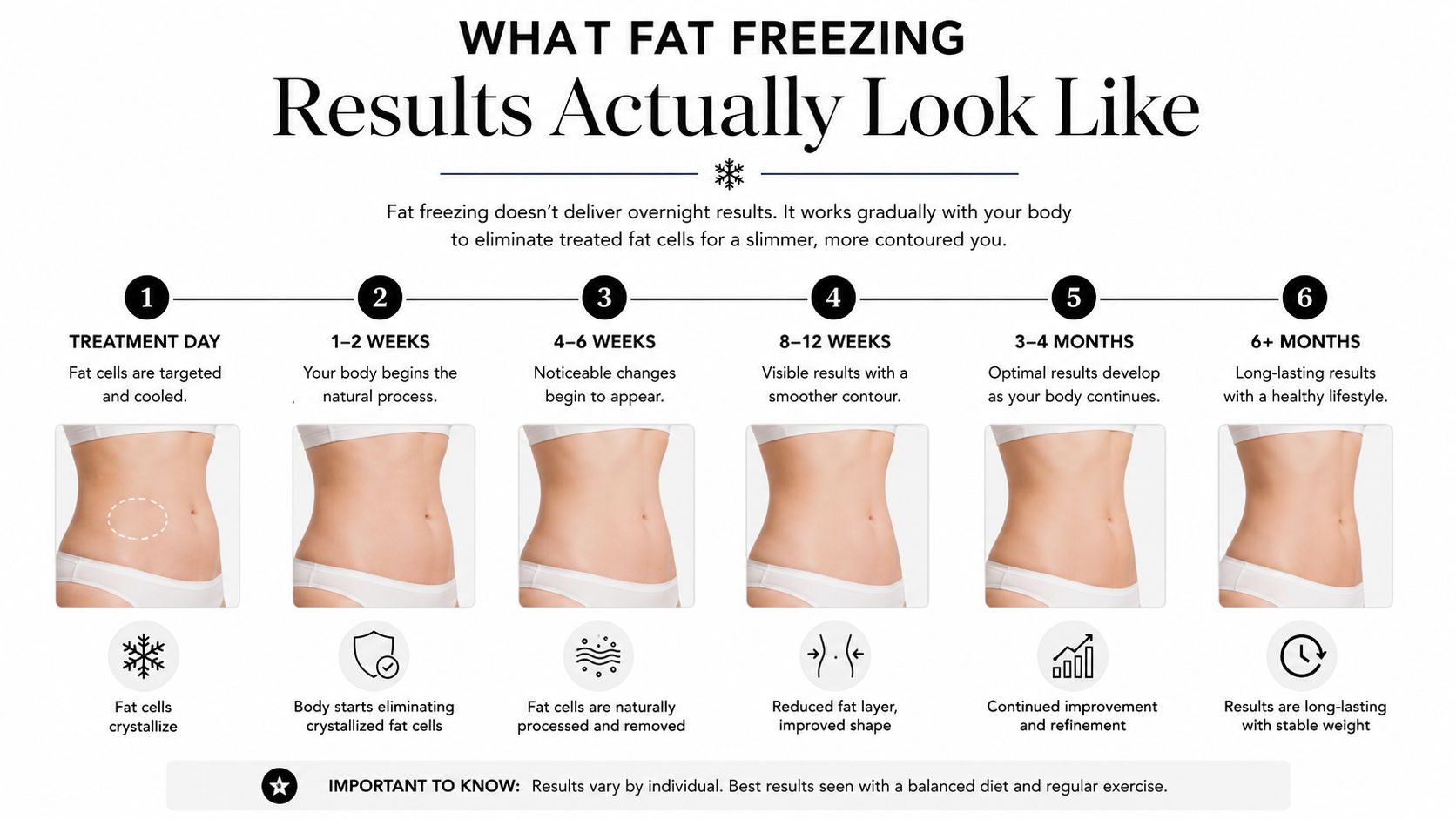
During the early period, the area can look unchanged or temporarily swollen. Visible change commonly develops from about 4 to 8 weeks, with final outcomes from one cycle usually assessed at around 12 weeks, according to the research update on cryolipolysis and submental fat.
Think of your body as a slow waste-clearance service. The cooling starts the process, but your body needs time to process and clear the affected fat cells. The mirror may show a flatter tummy, smoother love handles, or a softer double-chin profile, while the scales barely move.
For the chin area, the cited meta-analysis found a mean thickness reduction of 2.78 mm and a volume reduction of 19.57 cm³. Those measurements show why a small change in a compact area can be visible in profile, even though it won't represent meaningful overall weight loss.
How Your Results Are Measured With 3D Body Scanning
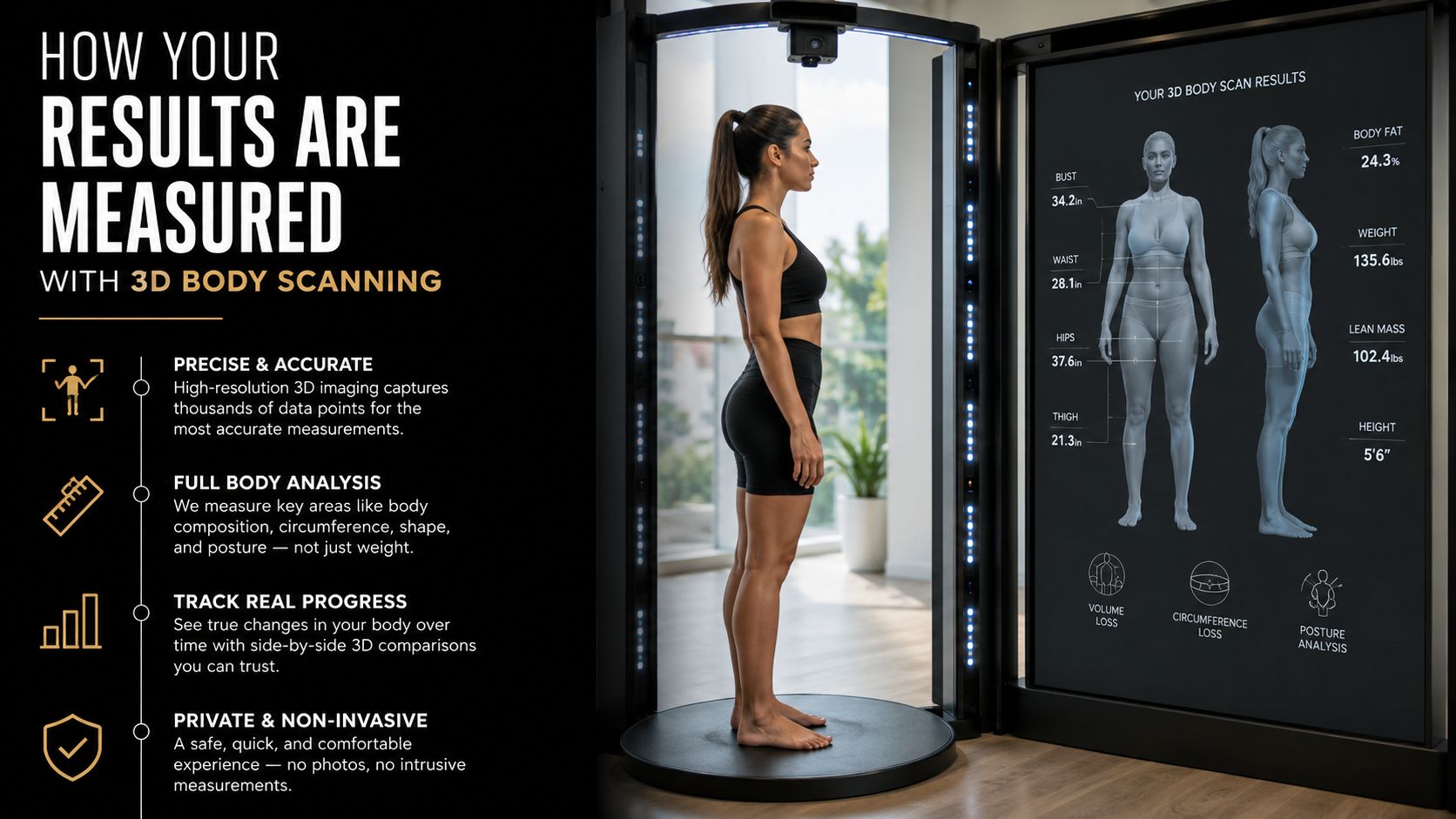
A photograph can flatter you. A mirror can change the apparent shape of your body depending on posture, clothing, lighting, and how closely you stand. A 3D body scan gives the consultation a more objective starting point by recording the contours of the area before treatment.
At 3D Aesthetics Leamington Spa, every client receives a complimentary, in-depth consultation that includes a full 3D body scan. That baseline helps the therapist assess the concern, discuss whether fat freezing is appropriate, and define what improvement might look like for that particular body shape.
What happens at review
The scan isn't there to turn your consultation into a numbers exercise. It gives you and the therapist a shared reference point.
- Before treatment, the scan records the shape and measurements of the relevant area.
- At review, a repeat scan can show whether the treated pocket is changing as expected.
- During planning, the comparison can help distinguish a subtle but genuine improvement from a result that needs further assessment.
- If you want more treatment, the scan gives both sides something concrete to discuss instead of relying on sales pressure or memory.
You can read more about body measurement tracking with 3D scanning if you want to understand how objective comparisons support treatment planning.
A useful educational overview can also help you see why visual changes develop progressively. Watch the video after considering the role of baseline measurements, rather than treating a single image as proof of what your own result will look like.
What Influences Your Fat Freezing Outcome
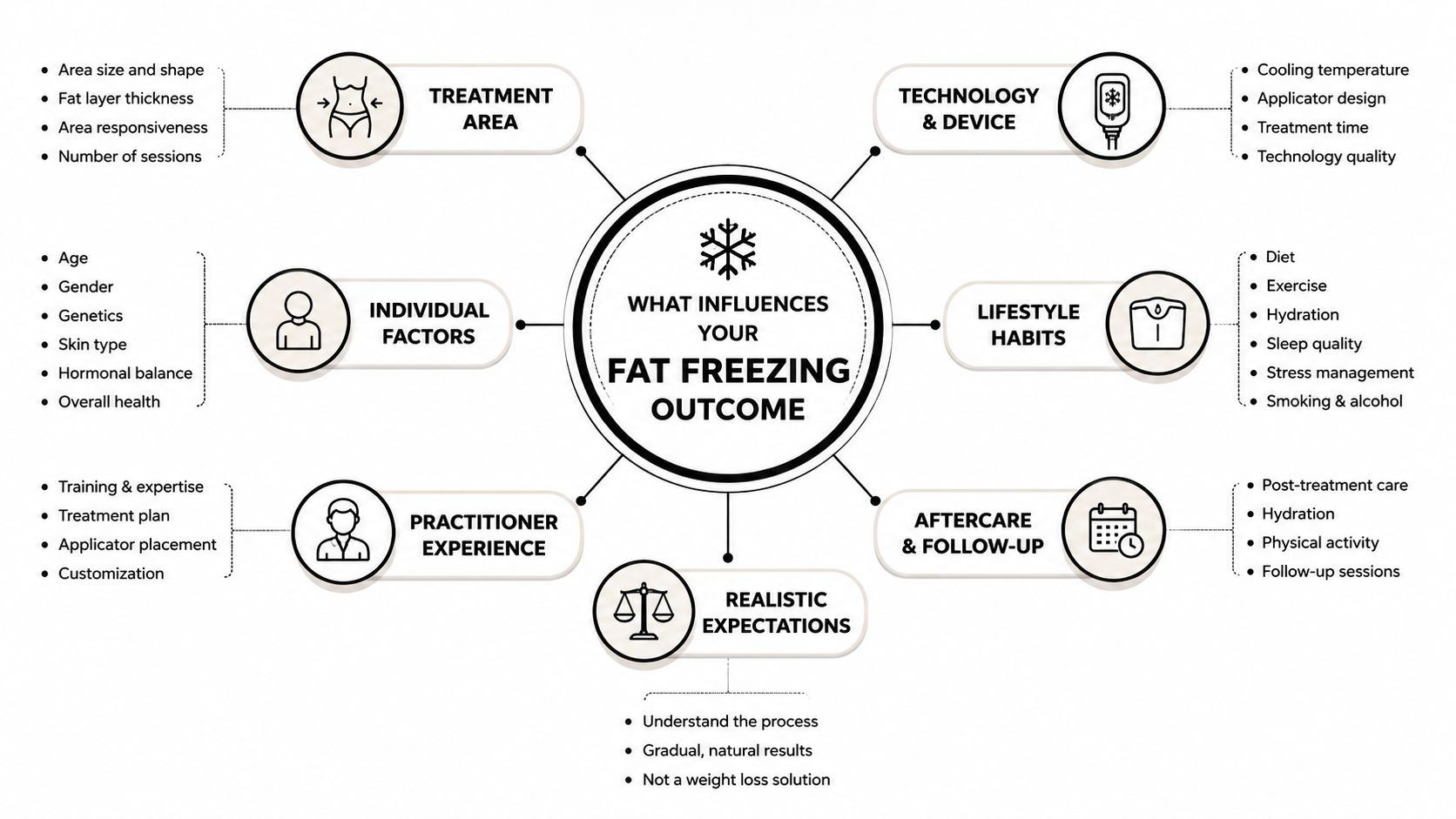
Two people can receive treatment on a similar area and still see different-looking outcomes. The reason isn't necessarily that one treatment worked and the other failed. Their body composition, fat distribution, skin quality, and expectations may be different.
A client with a near-normal BMI may notice a local contour change clearly because the treated pocket contrasts with an otherwise leaner frame. A client carrying weight across several areas may need a broader plan before one treated fold creates the visual balance they want. Fat freezing still targets the selected pocket in both cases.
The area changes the visual story
The abdomen and love handles often present as folds or bulges that are easy to compare in clothing. The submental area is smaller, so a modest reduction in thickness can alter the profile without affecting the rest of the body. The evidence summary reports a mean submental thickness reduction of 2.78 mm, which illustrates how measurement and appearance relate in a compact treatment area, as detailed in the cited submental research update.
Skin elasticity matters too. Reducing a fat pocket doesn't automatically tighten loose skin. If laxity or cellulite is the main concern, another technology may be more suitable, or a combined plan may produce a more coherent result.
Lifestyle affects maintenance. The treated cells are targeted for elimination, but weight can still change the surrounding shape, so keeping your weight reasonably stable helps preserve the contour you achieved.
How many sessions might you need?
Many clients find one cycle gives them the improvement they wanted. Others choose a second session to refine the same area, balance both sides, or address another pocket. That decision should be made at review after the result has had time to develop, using the scan and your satisfaction rather than an automatic upgrade.
A multicountry study reported 89.6% satisfaction or very high satisfaction at 12 weeks, alongside a mean subcutaneous fat-volume reduction of 264.8 mL. The result is best understood as measurable body shaping, not a showroom-style transformation, as shown in the study published in the Aesthetic Surgery Journal.
For more practical guidance on planning treatment, see how many fat-freezing sessions may be appropriate.
Real Before-and-After Journeys
The following journeys are representative examples, not promises or individual clinic case studies. They show how a sensible before-and-after process works: identify the pocket, record a baseline, allow time for the change, then review the result without forcing the outcome.
A post-pregnancy tummy pocket
A woman in her forties may have a stable weight but still notice fullness below the navel after pregnancy. Her consultation would focus on whether the concern is a localised fat pocket, how much skin laxity is present, and what a realistic improvement would look like in fitted clothing.
Her baseline scan records the contour before treatment. By around week eight, she might notice a flatter waistband and less fullness when sitting, while the final review at about week twelve confirms whether the change is measurable and whether it matches her expectations.
The improvement may be meaningful without producing a flat stomach. That distinction matters, particularly where skin laxity or muscle separation contributes to the appearance.
Love handles and abdominal fullness
A man may want to reduce stubborn flank fullness and abdominal fat that remains despite regular activity. One cycle might soften the outline, but a review could show that a refinement session is needed to create a more even transition between the waist and lower back.
The therapist should compare the follow-up scan with the original position and discuss symmetry. A second session isn't automatically evidence that the first failed. It may reflect the difference between reducing a pocket and refining the overall shape.
A double chin
For a client concerned about submental fat, the change is judged from the side as well as from the front. The evidence summary reports a mean reduction of 19.57 cm³ in submental fat volume, with visible results developing over 4 to 8 weeks and final assessment commonly taking place at around 12 weeks, according to the cited clinical research update.
The client may see a cleaner angle beneath the chin rather than a radically different face. A baseline photograph and scan make that gradual profile change easier to recognise than trying to remember how the area looked on treatment day.
Risks, Side Effects and Recovery
Marketing often makes fat freezing sound almost frictionless. The procedure is non-surgical, but non-surgical doesn't mean risk-free. Responsible consent includes common temporary effects and the rare complications that need prompt clinical review.
Common reactions can include redness, numbness, bruising, swelling, tingling, tenderness, or altered sensation in the treated area. These effects are generally mild and temporary, and many people return to normal activity the same day, although your therapist should give you individual aftercare advice.
The uncommon problem people need to know
Paradoxical adipose hyperplasia, or PAH, is a rare complication in which the treated area becomes enlarged or firmer rather than smaller. It isn't the normal course of treatment, but a patient should know it exists before consenting.
UK risk discussions have also raised more serious concerns. An Aesthetic Medicine report summarising BAAPS audit data stated that 7% of BAAPS members reported serious complications related to fat-freezing treatments, and that 21 patients required surgery between 2018 and 2020. The report stated that all of those patients were left with permanent deformity or scarring after attempted correction, as described in the Aesthetic Medicine report on the BAAPS audit.
The same discussion highlighted PAH as a real complication, while a later review covering medical device reports from 28 countries recorded 380 PAH reports, representing about 75% of adverse-event reports in that review. Those figures concern reported events and should be discussed in context, rather than treated as a prediction of an individual patient's risk.
What to do if the result seems wrong
Do not wait if the area becomes noticeably larger, hard, unusually painful, or increasingly uneven. Contact the clinic and request an assessment so the therapist can document the change and advise whether medical review is needed.
A careful provider should record your baseline, explain expected recovery, answer questions without dismissing them, and tell you who to contact after treatment. Clear follow-up is part of safe care, not an optional extra.
Fat Freezing Compared With Other Body Contouring Treatments
Fat freezing suits a person with a discrete stubborn fat pocket who can wait for gradual contour change. It isn't automatically the right choice for loose skin, cellulite, muscle tone, or general weight reduction.
| Treatment | Best for | Downtime | Result profile |
|---|---|---|---|
| Fat freezing | Localised pockets of stubborn fat | Usually minimal | Gradual reduction in the treated contour |
| Ultrasound cavitation | Inch-loss goals and selected areas | Usually minimal | Non-surgical shaping that may be planned across treatments |
| 3D Powersculpt | Muscle stimulation and toning goals | Usually minimal | Focuses on muscle engagement and body definition |
| Shockwave | Smoothing and texture concerns | Usually minimal | Supports the appearance of smoother skin and treated contours |
| Body HIFU | Deeper tightening concerns | Usually minimal | Aims to support tightening rather than simply reducing fat |
| Radio frequency | Skin tightening and cellulite concerns | Usually minimal | Targets skin quality, firmness, and surface texture |
The table is a starting point, not a diagnosis. A person with a small abdominal pocket and good skin elasticity may shortlist fat freezing, while someone mainly concerned with laxity may need to discuss body HIFU or radio frequency instead.
3D Aesthetics Leamington Spa offers fat freezing alongside ultrasound cavitation, 3D Powersculpt, shockwave, body HIFU, and radio frequency. A complimentary 3D-scan consultation can help match the treatment to the actual concern, and some plans combine technologies rather than treating every body-shape issue as a fat problem. You can explore the clinic's non-surgical fat removal options in the UK before booking.
Fat Freezing FAQs From Leamington Spa Clients
Does fat freezing hurt?
Most clients feel intense cold, pressure, pulling, or tugging while the applicator is positioned. The area can feel numb afterwards, with temporary tenderness or tingling as sensation returns.
Are the results permanent?
Treated fat cells are targeted for elimination, but your body shape can still change if your weight changes. Maintaining a stable weight gives you the best chance of preserving the contour.
Can men use it for gynecomastia or abdominal fat?
Men can discuss fat freezing for suitable localised abdominal or chest fullness. A consultation must first establish whether the fullness is subcutaneous fat, glandular tissue, loose skin, or another concern, because fat freezing isn't a universal treatment for every form of gynecomastia.
How flexible is booking in Leamington Spa?
The clinic discusses appointment options during consultation, including the timing of treatment and follow-up. Ask about opening times and review arrangements when you book so the schedule fits your routine.
A complimentary consultation and 3D body scan gives you a personalised answer before you commit. You can ask what change is realistic, how it will be measured, and which treatment best matches your concern.
3D Aesthetics Leamington Spa offers complimentary consultations with full 3D body scanning, fat freezing, and other non-surgical contouring options for people seeking measurable local change. Visit 3D Aesthetics Leamington Spa to arrange a consultation and discuss your starting point, expected timeline, and safest treatment plan.
← Back to Home