
You're standing in a clinic mirror, comparing a fat-freezing quote with a liposuction consultation. One promises little interruption to your routine. The other offers a more substantial contour change, but asks you to accept surgery, recovery, and a larger financial commitment. Both options can sound better than they are when the clinic is selling only its preferred treatment.
The right choice isn't decided by the word “non-surgical”. Start with four practical questions: How much fat needs removing? How quickly do you want to see change? How much downtime can you tolerate? What level of cost and surgical risk can you accept? This guide compares fat freezing vs liposuction on those terms, so you can avoid paying for a treatment that under-delivers for your body goals.
Table of Contents
- Why This Decision Matters More Than the Marketing
- How Fat Freezing and Liposuction Work
- Side-by-Side Results You Can Realistically Expect
- Recovery Time and Downtime Compared
- Risks and Safety Considerations for Both
- Cost, Treatment Time, and Number of Sessions
- Which Option Suits Your Body Goals
- When to Choose Each Method and Book a Consultation
Why This Decision Matters More Than the Marketing
A consultation often begins with a simple question, “Which treatment is better?” That's the wrong starting point. Fat freezing and liposuction solve different contouring problems, and each becomes a poor choice when the requested result doesn't match its capabilities.
Fat freezing suits small, localised pockets that you can pinch, particularly when you want gradual change and little disruption. Liposuction suits larger-volume contouring when a single procedure and a more pronounced reduction matter more than avoiding surgery. Neither treatment replaces weight loss, and neither guarantees tighter skin.
The UK market reflects that difference. BAAPS reported 2,623 liposuction operations in 2024, an 8% year-on-year increase, placing liposuction among the top five cosmetic procedures that year. The same reporting recorded a 17% fall in 2023, followed by a rebound, which shows that demand can shift rather than moving in one predictable direction. You can review this context in the BBC's report on UK cosmetic procedure figures.
Practical rule: Choose the method whose limitations you can live with, not the method whose advert sounds most convenient.
Use this order when assessing your options:
- Define the physical target. Is it a small soft bulge, or do you want a broader change across the abdomen, flanks, thighs, or several areas?
- Set a result threshold. A modest reduction may satisfy you. If you want a dramatic reshaping, a gradual treatment may frustrate you.
- Check your calendar. “No surgery” doesn't mean no symptoms, while surgery requires genuine planning around work, exercise, childcare, and travel.
- Compare the complete commitment. Include repeat sessions, consultations, garments, follow-up, and the possibility that a treatment may not meet your target.
Independent discussion of the shift from surgical contouring to non-surgical alternatives can be found in this overview of how liposuction gained a non-surgical alternative. Treat any clinic's recommendation as a starting point, then ask what happens if the proposed method produces less change than you expect.
How Fat Freezing and Liposuction Work
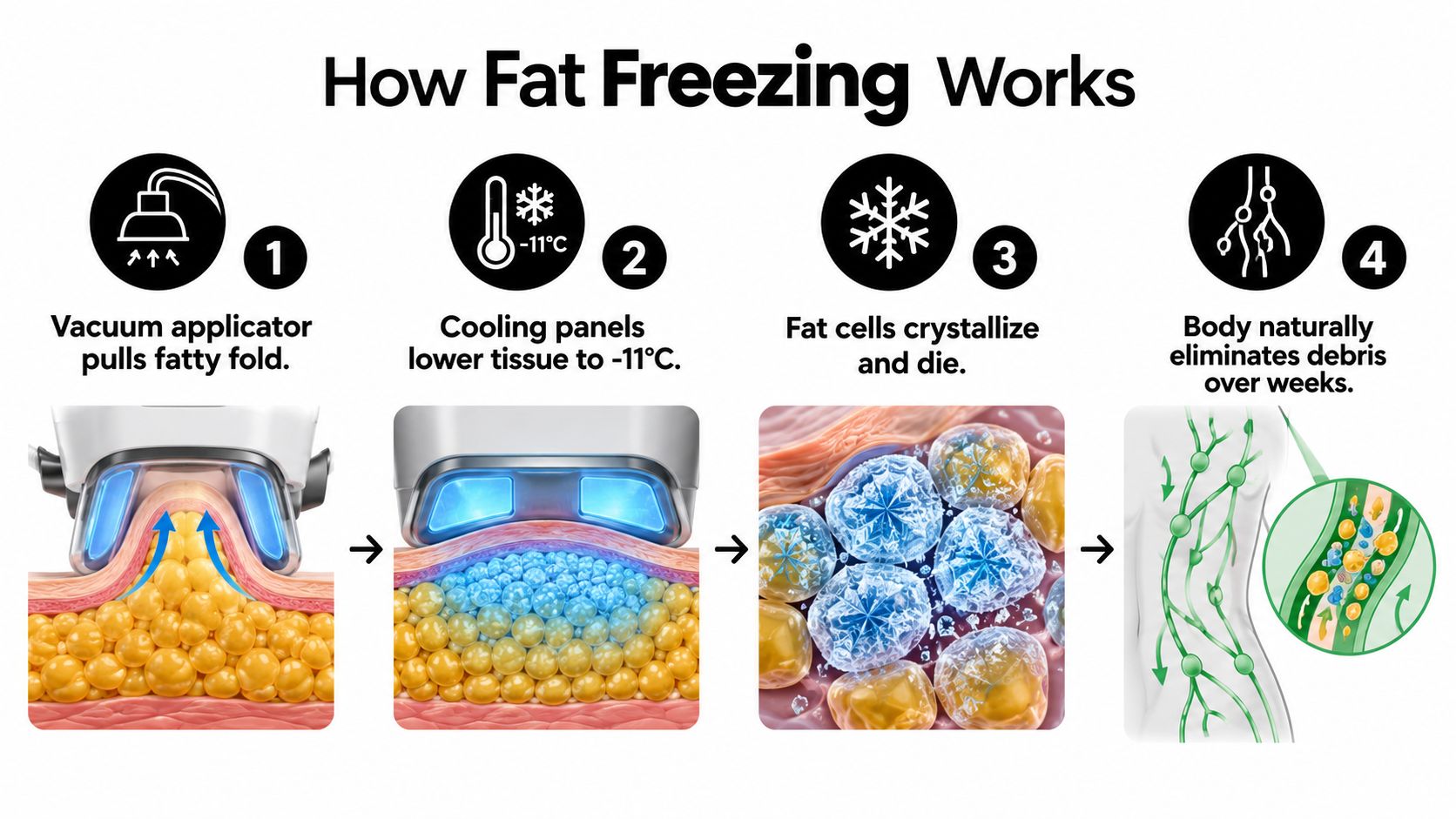
Fat freezing, or cryolipolysis, uses controlled cooling rather than an incision. A vacuum applicator draws a fold of fatty tissue between cooling panels. The device holds the area at a low temperature, commonly described in treatment guidance as around minus 11°C for 35 to 60 minutes. Cooling targets fat cells while aiming to spare the skin and underlying muscle.
The exposed fat cells crystallise and die through apoptosis, a natural cell-death process. Your body then clears the cellular debris through its normal systems over the following weeks. The contour therefore develops gradually, making fat freezing a poor fit if you want an immediate change or need a substantial reduction from one appointment.
Mechanical removal versus gradual clearance
Liposuction takes a surgical route. A qualified surgeon makes small incisions, inserts a cannula, and physically removes fat from the treatment area. Depending on the plan and anaesthetic, the operation may use local or general anaesthesia. Several connected areas can be sculpted during one procedure, although your health, anatomy, and treatment plan determine whether that is suitable and safe.
The practical difference is clear:
- Fat freezing changes the biological process. It damages selected fat cells, which your body clears progressively.
- Liposuction removes tissue mechanically. Fat leaves during the operation, so contour change starts immediately, although swelling can hide the early result.
- Fat freezing avoids incision-based wound care. It does not involve surgical access points or the post-operative compression associated with liposuction.
- Liposuction offers greater control over volume and shape. A surgeon can remove larger deposits and refine transitions between treated areas.
The NHS liposuction guidance describes liposuction as surgery with a meaningful recovery period. Fat freezing is less disruptive, but that lower commitment limits the contour change it can provide. Choose it for a localised, pinchable bulge when you accept gradual improvement. Choose liposuction when your goal requires more substantial reshaping and you can plan for surgery and recovery.
Side-by-Side Results You Can Realistically Expect
Fat freezing is a contouring treatment, not a rapid reduction in body size. UK-facing guidance commonly describes a 10% to 25% reduction in the treated area after a session, while independent clinical evidence reports measurable changes in local circumference and fat thickness without a significant change in body weight. A review of cryolipolysis studies also reported average improvements around a 1.8 BMI-point decrease and a 3.56 cm reduction in waist circumference across the studies reviewed. These figures describe study averages, not a promise for an individual patient, and they shouldn't be confused with weight loss. See the UK cryolipolysis evidence review for the evidence summary.
Liposuction remains the stronger option when the problem involves a larger volume or several connected areas. The surgeon removes fat during one operation, but swelling means the visible result develops over time. You may notice an early contour difference before the final shape settles.
Results compared
| Factor | Fat Freezing | Liposuction |
|---|---|---|
| Typical reduction | Around 10% to 25% per treated area after a session | Larger-volume removal, assessed individually by a surgeon |
| Number of sessions | May require repeat treatment for further shaping | Often planned as one surgical procedure |
| Visible result | Gradual, as the body clears treated cells | Initial change can appear quickly, with swelling masking the final contour |
| Best-suited areas | Small, localised fat pockets | Larger deposits, broader contouring, or multiple areas |
| Skin tightening | Doesn't tighten loose skin | Doesn't automatically tighten loose skin and can make laxity more apparent |
Neither option is designed to treat visceral fat inside the abdomen. Neither is a substitute for managing overall weight. A stable weight gives you a more predictable contour and reduces the chance that later weight changes will alter the result.
Fat freezing under-delivers when you're asking it to flatten a large apron of abdominal tissue or create a dramatic waist transformation. Liposuction under-delivers when you have only a very small pocket and the disruption of surgery outweighs the improvement you're seeking.
Your result should be judged against your stated goal, not against a before-and-after image selected by the clinic.
Skin quality also matters. Fat reduction can reveal laxity that was previously supported by the underlying volume. If loose skin is your primary concern, fat removal alone may not provide the finish you want, and a separate skin-tightening discussion may be necessary.
Recovery Time and Downtime Compared
Recovery is where the difference becomes most tangible. Fat freezing has no incision, anaesthetic recovery, or surgical wound, so many people return to normal activities quickly. The treated area can still feel tender, numb, swollen, bruised, or tingly, and those sensations may be more inconvenient than the appointment itself suggests.
Liposuction requires a planned recovery period. The NHS states that swelling can take up to six months to fully settle, compression garments are worn for several weeks, gentle exercise commonly resumes around three to four weeks, and strenuous activity is avoided for 10 to 12 weeks. Those timelines matter more than the length of the operation because they affect work, parenting, exercise, and travel.
Recovery timeline compared
| Recovery stage | Fat Freezing | Liposuction |
|---|---|---|
| Immediately afterwards | No incision-based wound care; normal activity is often possible | Surgical monitoring and post-operative care are required |
| First days | Tenderness, numbness, swelling, bruising, or tingling may occur | Pain, bruising, swelling, limited movement, and wound care may be present |
| Work | Many people return the same day or shortly afterwards | Time away from work depends on the extent of surgery and the type of work |
| Exercise | Activity is usually less restricted | Gentle exercise is commonly delayed for several weeks, with strenuous activity restricted for longer |
| Compression | No post-operative compression garment is normally required | Compression garments are commonly worn for several weeks |
| Final settling | Gradual changes appear as treated cells are cleared | Swelling can continue settling for months |
Fat freezing's lighter recovery doesn't make it automatically better. If you need a significant contour change, several appointments and a long wait for the outcome may be a poor use of your time. Conversely, liposuction may be impractical if your job involves lifting, your care responsibilities can't be delegated, or you can't protect a proper recovery window.
The most useful question is not, “How long does the treatment take?” Ask, “How long will this treatment affect the way I live?” A short appointment can still involve repeated planning. A single operation can still require months before the final result is clear.
Risks and Safety Considerations for Both
Neither treatment deserves a risk-free label. Fat freezing avoids surgery, but it can cause redness, bruising, swelling, tenderness, tingling, and altered sensation. These effects are usually temporary, although your practitioner should explain what to expect and what would require follow-up.
The rare complication that deserves specific discussion is paradoxical adipose hyperplasia, in which the treated area becomes larger rather than smaller. UK reporting has highlighted this complication, and corrective liposuction may be required in affected cases. Read the BBC report on the rare fat-freezing complication before consenting, rather than relying only on a general statement that the treatment is safe.
Liposuction carries the risks of an operation. These include infection, blood clots, seroma, contour irregularities, delayed healing, scarring, and complications related to anaesthesia. Risk can increase when treatment covers larger areas or combines several procedures. Your medical history, medication, smoking status, skin quality, and the surgeon's plan all influence the decision.
Risks compared
| Risk category | Fat Freezing | Liposuction |
|---|---|---|
| Skin and sensation | Redness, bruising, numbness, tenderness, or tingling | Bruising, swelling, numbness, pain, and scar-related changes |
| Rare complications | Paradoxical adipose hyperplasia can enlarge the treated area | Infection, blood clots, seroma, contour irregularity, and anaesthetic complications |
| Skin laxity | Doesn't tighten loose skin | May make existing laxity more noticeable |
| Weight change | Doesn't treat overall weight | Doesn't treat overall weight |
| Professional oversight | Requires a trained practitioner and appropriate equipment | Requires a qualified surgeon, suitable facility, and surgical aftercare |
Safety isn't a contest between “non-surgical” and “surgical”. It's a question of which risks fit your health, anatomy, expectations, and tolerance for recovery.
For liposuction, check that the provider is appropriately regulated and that the surgeon is registered with the GMC. Confirm the facility's CQC status where applicable, ask who will perform each part of the procedure, and request a clear plan for complications and follow-up. For cryolipolysis, ask about practitioner training, device standards, contraindications, applicator selection, and the clinic's process for handling unexpected reactions.
A useful independent discussion of the question whether fat freezing is safe should supplement, not replace, an individual consultation. Don't proceed if the provider dismisses your medical history, refuses to discuss rare complications, or promises a result that doesn't match the treatment's modest contouring purpose.
Cost, Treatment Time, and Number of Sessions
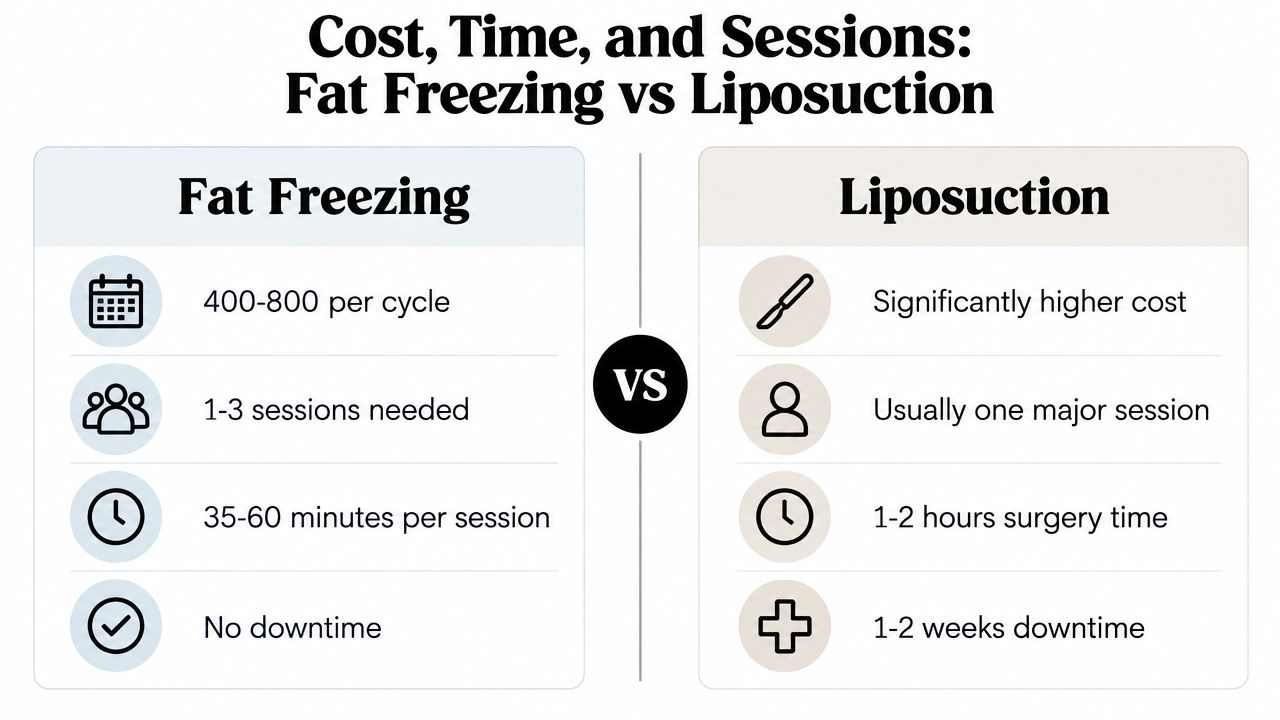
Price comparisons become misleading when one treatment is quoted per cycle and the other is quoted as a complete operation. Fat freezing usually spreads the financial commitment across appointments. Liposuction concentrates more of the cost into surgery, anaesthesia, facility use, garments, and follow-up.
UK market information commonly positions fat freezing as a lower-entry-price treatment, with prices starting from about £49 per applicator, while the NHS gives a private liposuction range of approximately £3,000 to £8,500, depending on the area treated. The UK comparison of fat freezing and liposuction pricing explains this market split. Treat these as broad reference points, not a personalised quotation.
What you're really paying for
Fat freezing may fit a lunch break, with each applicator commonly used for around 35 to 60 minutes. The final cost depends on the number of applicators, areas, and repeat sessions. A low headline price can become poor value if you need several cycles to pursue a result that surgery could have delivered more directly.
Liposuction usually involves one major procedure, but the quoted price should be itemised. Ask whether it includes:
- The surgical fee, including the surgeon's planning and operating time.
- Anaesthesia and facility charges, which may be separate.
- Compression garments, prescriptions, and post-operative reviews.
- Treatment of additional areas, since multiple areas can increase complexity and cost.
- Revision or complication arrangements, particularly if the result needs assessment later.
The better value depends on your scarce resource. If money is tighter than time, spreading treatment across non-surgical sessions may be workable. If time away from work is costly but you want a more substantial one-off change, surgery may offer better value despite the larger initial payment.
You can compare the role of non-surgical options in the UK through this guide to non-surgical fat removal in the UK. Make your budget decision only after you know the complete treatment plan, not from the first price shown in an advert.
Which Option Suits Your Body Goals
Your body goal should determine the method. A soft, localised pocket that remains after your weight has stabilised is a reasonable fat-freezing target. A broad area with substantial volume, uneven transitions, or a desire for more pronounced shaping usually calls for a surgical assessment.
Fat freezing tends to suit people who can pinch a discrete fold of subcutaneous fat and accept a gradual, measured change. Common consultation targets include stubborn flanks, small abdominal pockets, upper arms, inner thighs, and submental fat. It's a poor match for visceral fat, a large abdominal apron, pronounced loose skin, or anyone expecting a dramatic reshaping.
Liposuction is more appropriate when the target involves larger-volume contouring, multiple connected areas, or stronger definition. It can remove fat from the areas treated during the operation, but it won't repair lax skin by itself. If skin quality is weak, removing volume can make the looseness more visible rather than producing the smooth finish you imagined.
Goal-to-method matching
| Body goal or candidacy profile | Best-fit option | Why it fits |
|---|---|---|
| Small, soft, pinchable bulge | Fat freezing | Gradual local reduction without surgery |
| Minimal interruption to work or caregiving | Fat freezing | Avoids surgical recovery and compression requirements |
| Larger fat deposit or several areas | Liposuction | Allows broader contour planning in a surgical procedure |
| Stronger body-sculpting change | Liposuction | Offers greater control over the amount and distribution of removed fat |
| Loose skin as the main concern | Neither automatically | Fat removal alone doesn't tighten skin and may expose laxity |
| Unwilling to accept scars or surgical risk | Fat freezing | Removes the surgical component, though results are more limited |
| Little fat but a concern about skin texture | A skin-focused assessment | Neither method directly solves every skin-quality problem |
If you're unsure whether the issue is fat, muscle, skin, or overall body composition, objective assessment can help. For people in the North West, DEXA body composition testing in Manchester may provide useful information about body composition before you commit to a contouring plan. It won't choose the treatment for you, but it can make the conversation more precise.
My advice is consultation-first, not treatment-first. A responsible provider should tell you when fat freezing is unlikely to meet your goal and when liposuction deserves a referral. If a clinic presents every concern as suitable for the product it sells, seek a second opinion.
When to Choose Each Method and Book a Consultation
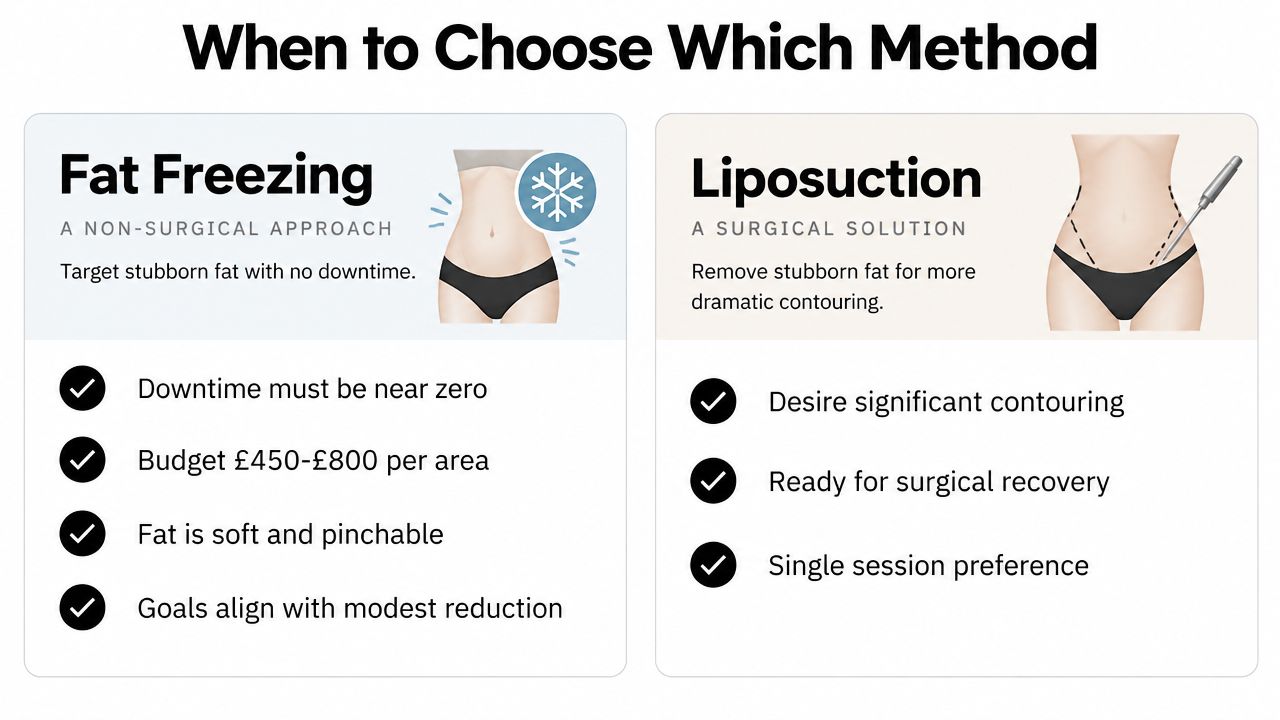
Choose fat freezing when downtime must be near zero, the target is soft and localised, and you're comfortable with a modest result developing over time. It makes sense when your budget is around £450 to £800 per area, based on the treatment plan, and when you're prepared for one to three cycles if your practitioner considers further treatment appropriate. The method is wrong for a large volume, loose skin, or a dramatic transformation.
Choose liposuction when you want more substantial contouring, several areas assessed together, or a single major treatment rather than a sequence of appointments. You must also be able to accept surgical risk, possible scarring, compression, and a meaningful recovery period. NHS guidance places private cosmetic liposuction at about £3,000 to £8,500, depending on the area treated, so ask for a complete written quotation rather than comparing only the surgeon's fee.
Run this self-check before booking
- Pinch test: If there's no clear, soft fold, ask whether the concern is fat.
- Calendar test: Identify the recovery window you can protect, not the one you hope to manage.
- Budget test: Decide whether repeated sessions or one larger commitment is financially realistic.
- Scar and risk test: Be honest about whether you're willing to accept surgery for a stronger contour change.
- Expectation test: Describe the result in practical terms, such as a smaller flank bulge, rather than using a vague promise like “more toned”.
Book a consultation that includes a medical history review, an examination of the tissue, clear photographs or measurements where appropriate, and a discussion of alternatives. If your request exceeds what non-surgical contouring can achieve, expect an honest referral to a suitably regulated surgical provider rather than pressure to buy more sessions.
At 3D Aesthetics Leamington Spa, you can discuss fat freezing and related body-contouring options during a complimentary consultation that includes a 3D body scan for treatment planning and progress measurement. Visit 3D Aesthetics Leamington Spa to arrange an assessment and receive advice based on your target area, available downtime, and realistic result.
← Back to Home