

You've cleaned up your eating, you're moving more, and your weight may even be fairly steady. But there's still that one area you keep checking in the mirror. Lower abdomen. Flanks. Outer thighs. The sort of stubborn pocket that doesn't seem to respond in the same way the rest of your body does.
That's usually the point where people start looking at body contouring and run into a wall of vague promises. “Melt fat.” “Lose inches.” “See dramatic change.” The problem isn't just whether a treatment can help. A more pertinent question is simpler and much more useful. How will you measure whether it's working?
That's where HIFU body sculpting becomes easier to understand. It isn't a weight-loss treatment. It's a targeted contouring treatment designed for localised areas of subcutaneous fat. If you're also thinking about facial fullness and how different areas of the body respond differently, this guide on 12 methods to reduce face fat gives useful context on why “spot reduction” conversations need nuance.
Table of Contents
- Your Guide to Targeted Fat Reduction
- How HIFU Body Sculpting Melts Fat Cells
- Are You an Ideal Candidate for HIFU
- The HIFU Treatment Journey Explained
- Benefits Risks and Expected Results
- HIFU vs Other Body Contouring Treatments
- See Your Results with a 3D Body Scan
Your Guide to Targeted Fat Reduction
A lot of first appointments start the same way. Someone sits down and says, “I'm not trying to lose loads of weight. I just want this one area to shift.” That distinction matters.
HIFU body sculpting is built for shape refinement, not broad weight management. If your concern is a soft roll across the lower stomach, fullness at the flanks, or a patch of thigh fat that feels out of proportion with the rest of you, this is the sort of concern HIFU is usually discussed for. It's less about changing your body wholesale and more about improving a specific outline.
That's also why expectations need to be realistic from the beginning. If someone wants the scales to move dramatically, HIFU will probably disappoint them. If someone wants a more defined waistline in clothing or less fullness in one targeted area, that's a more sensible conversation.
Practical rule: Ask yourself whether your goal is “weight loss” or “shape change”. HIFU fits the second category.
People often get confused because clinics use the phrase “inch loss”, which sounds immediate and universal. In reality, contour change is usually gradual and area-specific. You're not treating your whole body. You're treating a selected pocket of fat beneath the skin.
A useful way to think about it is this:
- Weight loss changes the whole system. Your diet, activity, hormones, sleep, and routine all play a part.
- Body contouring changes a local area. The aim is to improve shape where fat is resistant.
- Measurement decides whether it was worth doing. If you can't track the area properly, it's easy to rely on guesswork.
That last point is the one frequently overlooked. Lighting changes. Clothing changes. Your own perception changes day to day. If you're investing in a contouring treatment, you want a method of assessment that goes beyond “I think it looks a bit better”.
How HIFU Body Sculpting Melts Fat Cells
A common first question is simple: if nothing is cut out or sucked away, what is HIFU doing?
HIFU uses focused ultrasound energy to heat a small, chosen layer of fat beneath the skin. A useful comparison is a magnifying glass concentrating sunlight into one point. The energy is directed to a specific depth, so the treatment is aiming below the surface rather than broadly heating the skin.
The basic mechanism in plain English
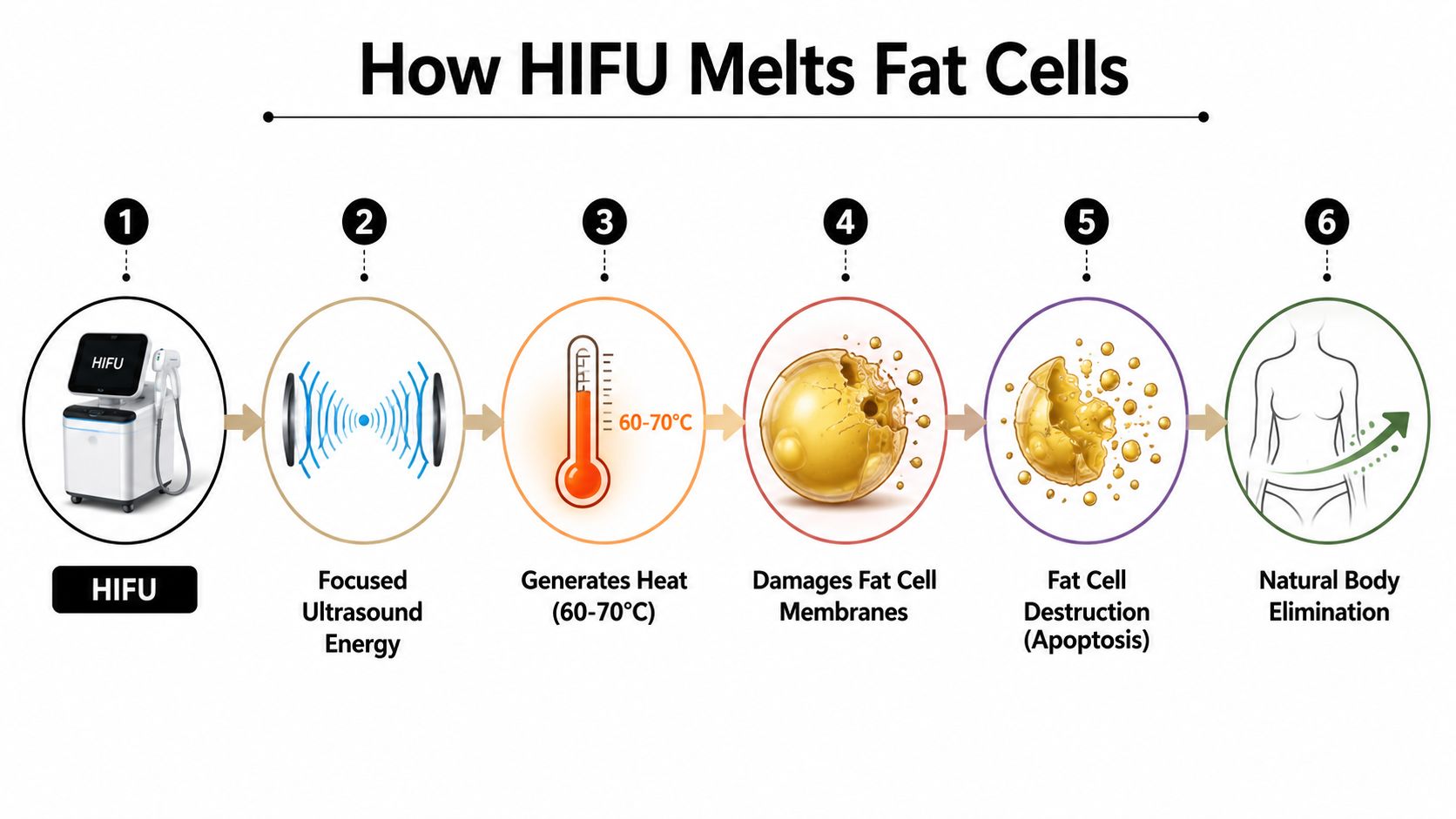
At the treatment depth, the temperature in the targeted fat can rise enough to damage those fat cells while the skin above is largely spared, as described in this body-contouring HIFU evidence source.
That sounds technical, so here is what it means in practice.
- The practitioner maps out a specific pocket of fat.
- The handpiece delivers focused energy into that layer.
- Some of the treated fat cells are damaged by heat.
- Your body gradually clears that disrupted tissue over the following weeks.
This gradual clearance matters. HIFU does not produce an instant after photo on the treatment bed, because nothing is physically removed on the day. The change develops over time, which is one reason measurement matters so much. If you only rely on memory or mirror checks, subtle contour changes are easy to miss.
For readers comparing treatment details, the page on 3D body HIFU treatment options shows how clinics place this technology within a wider body-contouring plan.
Why the skin surface is protected
People often hear the word "heat" and assume it means a surface burn. That is not how HIFU is designed to work. The energy is concentrated at a selected depth, so the main effect is intended to happen in the fat layer, not across the whole skin surface.
The target sits underneath the skin. That is the part many clients miss at first.
Published reviews of HIFU for non-invasive body contouring have reported measurable circumference reduction in treated areas and mainly short-term side effects such as redness, swelling, and mild discomfort. In day-to-day clinic language, clients usually describe the sensation as warmth, tingling, or brief tenderness rather than sharp pain.
The more useful question, though, is not just "can it reduce an area?" It is "how will you prove what changed?" Circumference tape measures can help, but they miss shape changes that happen unevenly across the waist, flanks, or lower abdomen. That is why objective tracking, especially 3D body scanning, gives a clearer picture of whether the treatment has made a visible difference.
Are You an Ideal Candidate for HIFU
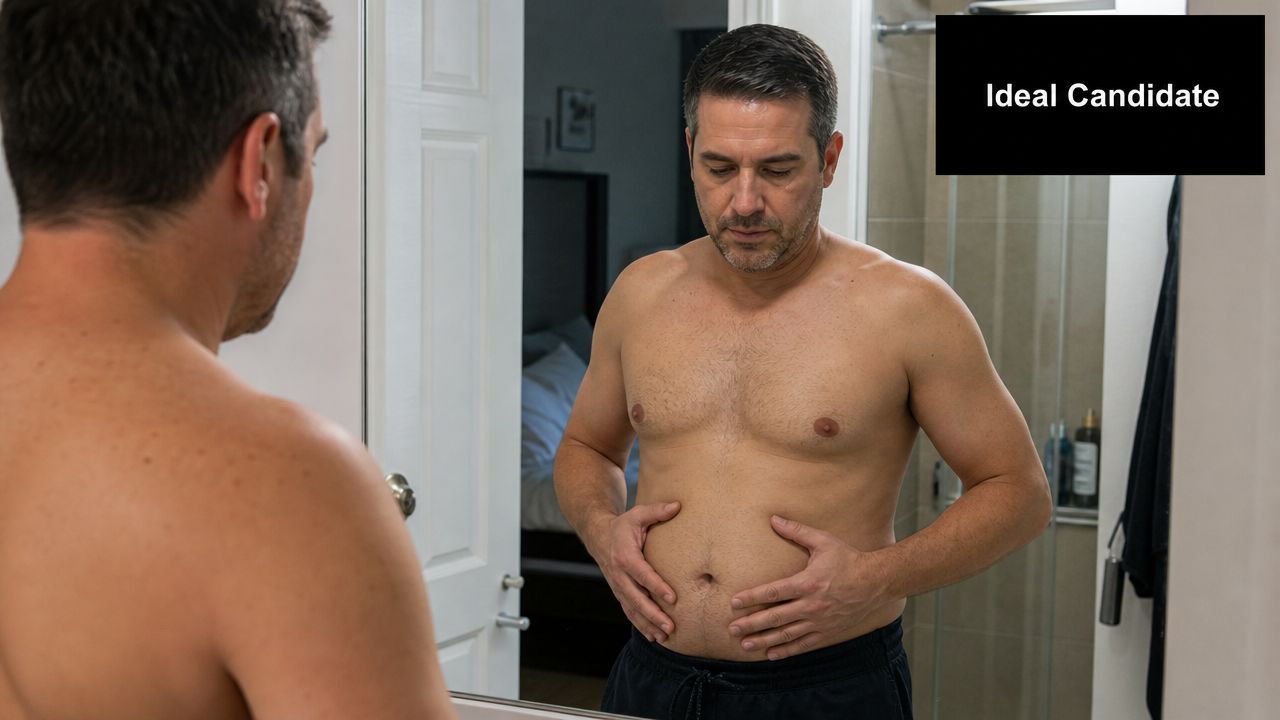
Not everyone who wants a flatter area is a good candidate for HIFU. The treatment works best when the problem is localised, pinchable fat, not when the goal is major weight reduction.
Good fit for
You're usually a better fit if several of these sound like you:
- You're close to your own comfortable target weight. You don't need a treatment to shrink your whole body. You want help with one area.
- You can pinch a layer of fat in the area. Common examples are the abdomen, flanks, thighs, hips, or buttocks.
- Your expectations are shape-based. You want contour improvement, not a dramatic drop on the scales.
- You're patient. You're comfortable with gradual change rather than an overnight result.
- You want something non-surgical. No incisions, no anaesthetic, no significant downtime.
People often do well when they say things like, “My clothes fit well everywhere except here,” or “This area hasn't changed even though the rest of me has.”
Not suitable for
HIFU is less suitable if your goals or body type fall outside that pattern.
- You want significant weight loss. This isn't a replacement for a broader medical or lifestyle approach.
- You have very little subcutaneous fat in the area. If there isn't enough tissue to treat, HIFU won't be the right match.
- You expect instant transformation. The treatment process doesn't work like that.
- You have a medical issue that needs formal clearance first. A proper consultation should always check contraindications, medications, and treatment history.
A good consultation should be comfortable, but it should also be honest. If a practitioner can't explain why you are or aren't a good fit, that's a concern.
A sensible candidate for HIFU usually wants refinement, not reinvention.
The HIFU Treatment Journey Explained
The process feels much less intimidating when you know what happens in order. Most of the uncertainty comes from not knowing whether it's painful, how long it takes, or what you'll look like afterwards.
Start with the overall flow below.
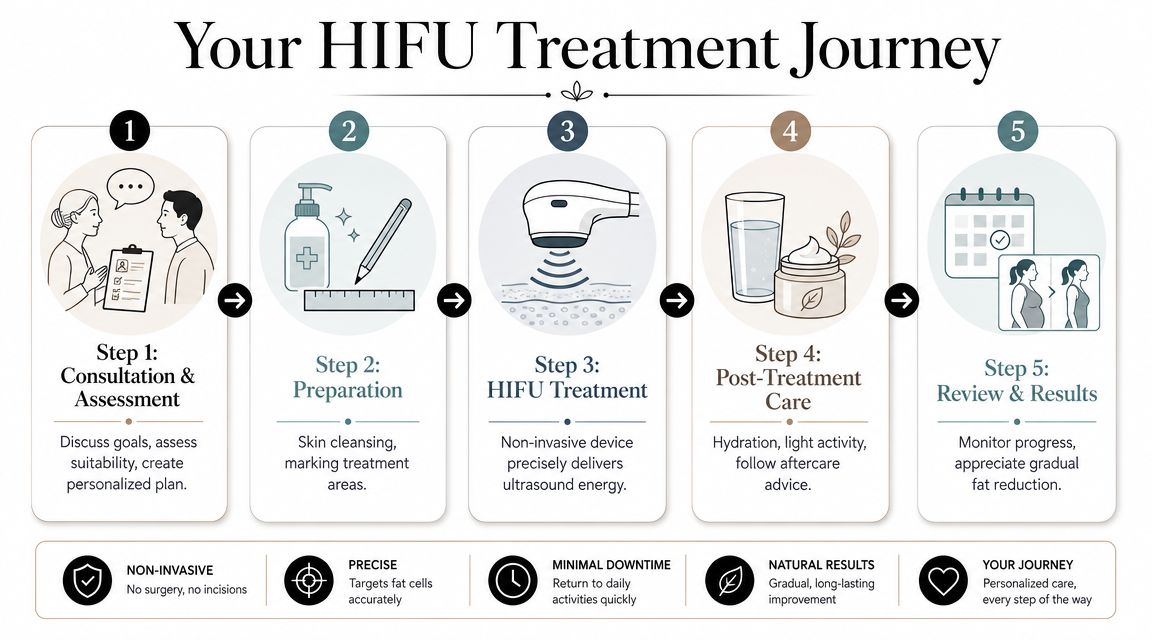
Consultation and planning
A proper consultation should never begin with the machine. It should begin with your concern. Which area bothers you? How long has it been there? Has your weight been stable? What outcome would make you happy?
The practitioner should assess the treatment zone, check whether there's enough suitable fat, review your medical history, and discuss whether HIFU makes sense or whether another treatment would suit better. This is also where measurement should be set up properly, because without a baseline, later “results” become hard to judge.
What happens on treatment day
The area is usually cleansed and marked. The handpiece is then placed against the skin to deliver focused ultrasound pulses into the chosen depth.
Most clients describe a warm, tingling, or pulsing sensation. Some areas feel sharper than others, especially where tissue is denser or more sensitive, but it's typically manageable. Because it's non-invasive, you won't have incisions, dressings, or stitches afterwards.
A short visual overview can help if you like seeing the treatment flow before booking:
Aftercare and follow-up
After treatment, the area may feel warm, slightly swollen, or mildly tender. That can feel odd if you were expecting a dramatic visible change immediately, but the visible result usually comes later.
Typical aftercare advice is simple:
- Keep hydrated. Your body is doing the clean-up work over time.
- Stay gently active. Light routine movement is usually sensible unless your practitioner advises otherwise.
- Follow review timings. The point of follow-up is to compare like with like.
- Don't judge it too early. Early swelling and normal body fluctuations can make assessment unreliable.
The emotional side matters too. People often check the mirror too often in the first few days and then convince themselves nothing has happened. That's why structured review points are more useful than daily self-inspection.
Benefits Risks and Expected Results
The attraction of HIFU is easy to understand. It gives people a non-surgical option for targeted contouring with little interruption to normal life. For the right person, that's a practical middle ground between doing nothing and considering a surgical procedure.
What people usually like about it
The main benefits are straightforward.
- No surgery: There are no incisions and no general recovery period in the surgical sense.
- Targeted treatment: It's aimed at localised pockets rather than whole-body change.
- Gradual contouring: The result tends to develop progressively, which many people find looks more natural.
- Minimal downtime: A quick return to usual routines is common.
That said, “natural-looking” doesn't mean “invisible”. It means the body shape changes progressively rather than all at once.
Possible side effects and limitations
The biggest mistake people make is assuming non-surgical means no risk and no limits. Every aesthetic treatment has boundaries.
Short-term effects can include redness, swelling, tenderness, or mild discomfort in the treated area. These are generally temporary. The bigger limitation is expectation. If someone wants dramatic volume reduction across multiple body areas, HIFU may feel underwhelming because it's designed for modest, localised contouring.
There's also another practical issue. After fat reduction, some people start focusing more on skin quality than volume. If that's on your mind, this guide to managing loose skin post weight loss is a helpful companion read because contouring and skin firmness are related, but they aren't the same problem.
What results look like in real life
The strongest way to talk about results is to avoid hype and stick to what the evidence supports. In a 2025 review of HIFU in aesthetic contouring, body studies reported an average 2.5 to 4.5 cm reduction in circumference, especially in the abdomen and thighs, and one abdominal-fat study observed the effect in 68.7% of patients at 8 weeks, which supports the idea that results are usually gradual rather than immediate, as reported in the Aesthetic Surgery Journal review.
So what does that mean for a real person? Usually this:
- Your clothes may fit differently before the scales change.
- You may notice the change first in one posture or one outfit.
- The area may look smoother or less projected rather than dramatically smaller.
- You need repeatable measurements if you want a fair assessment.
If a treatment promises contour change, the sensible question isn't “Will I lose weight?” It's “How will we measure the area before and after?”
That single shift in mindset tends to save people from disappointment. HIFU is presented misleadingly when it's framed as broad slimming. It makes more sense when it's framed as precise body shaping.
HIFU vs Other Body Contouring Treatments
HIFU is only one tool. If you're choosing between treatments, the right option depends less on trends and more on what exactly you want to change. Is the issue localised fat, loose skin, or both?
How the options differ
Here's a practical comparison of three common non-surgical routes, including the broader fat reduction treatment options people often compare during consultation.
| Feature | HIFU Body Sculpting | Fat Freezing (Cryolipolysis) | Ultrasound Cavitation |
|---|---|---|---|
| Main mechanism | Focused ultrasound heat delivered at depth | Controlled cooling applied to fat | Ultrasound-based disruption aimed at localised contouring |
| Best suited to | Stubborn localised fat where precise contouring is the main goal | Localised fat pockets for people who prefer a cooling-based approach | Inch-loss plans where a broader non-surgical contouring approach is being considered |
| Skin surface feel during treatment | Warm, tingling, pulsing | Cold, pulling, numb pressure | Buzzing or vibrating sensation |
| Ideal conversation in clinic | “I want to refine one area” | “I want to target a bulge with a different method” | “I'm comparing non-surgical inch-loss treatments” |
| Results pattern | Gradual | Gradual | Gradual |
| Downtime profile | Minimal for most people | Minimal for most people | Minimal for most people |
A few simple distinctions usually help:
- Choose HIFU when precision matters. It suits people focused on a defined treatment zone.
- Consider fat freezing if you prefer cooling to heat. Some clients feel more comfortable with that treatment style.
- Look at cavitation when building a broader body-contouring plan. It's often part of a wider inch-loss conversation rather than a like-for-like copy of HIFU.
No treatment is automatically “better”. A good practitioner matches the method to the tissue, the area, and the result you're trying to create.
The best treatment is the one that fits the problem you actually have, not the one with the strongest marketing language.
See Your Results with a 3D Body Scan
You finish a course of HIFU, look in the mirror a few weeks later, and wonder whether the change is real or whether you are just catching a better angle in the bathroom light. That is a common point of uncertainty in body sculpting. The treatment may be doing its job, but without a clear baseline, it is hard to judge progress with confidence.
Why measurement matters more than marketing
A recent review of body-contouring studies reported circumference reduction, but it also highlighted a problem with inconsistent measurement methods and noted the value of structured 3D scanning in consultation, as discussed in this systematic review summary on PubMed.
That matters in clinic.
Tape measures depend on placement, tension, posture, and even how relaxed your abdomen is on the day. Photos can mislead for the same reason. A slight turn of the hips, different lighting, or higher-waisted leggings can make an area look smaller or fuller. Memory is unreliable too. Clients often remember how they felt in clothes, not the exact shape they started with.
What a 3D scan adds
A 3D body scan gives you a baseline in the same way a map gives you a starting point before a journey. Without that starting point, every follow-up becomes guesswork. With it, you can compare shape and measurements over time in a more consistent way.
That is especially useful with HIFU because change is gradual. You do not wake up one morning looking dramatically different. The contour tends to refine slowly, which means small improvements are easy to miss if you rely only on mirrors or clothing fit.
If you have looked into what defines your fitness, you will know that body change makes more sense when it is measured, not assumed. The same principle applies here. A treatment plan is easier to assess when you can track the area before treatment, review it at follow-up, and compare like with like.
One sensible option is a consultation built around 3D body scanning, where the discussion starts with recorded baseline data rather than broad promises about inch loss. That approach helps cautious clients because it turns, “I think something has changed,” into, “Here is what changed, where, and by how much.”
If I were advising a new client, this is the standard I would want. Careful measurement. Clear follow-up. Realistic interpretation of progress.
If you want a clearer answer on whether HIFU body sculpting suits your shape goals, book a consultation with 3D Aesthetics Leamington Spa. A proper assessment can check whether the area is suitable for treatment, set realistic expectations, and use 3D measurement to track change over time rather than relying on guesswork.
← Back to Home