
Most tattoos need roughly 4 to 12 sessions for meaningful fading, while professional or multicoloured work is more likely to need 10 to 16 or more. The exact number depends on the ink, colour, depth, location, skin response and whether you want a cover-up fade, maximum fading or the clearest result achievable.
Why is the answer so often given as one neat number when tattoos vary so much? At our clinic in Leamington Spa, we treat session count as a planning estimate, not a promise. A lightly inked amateur design and a dense professional cover-up may sit on the same arm, yet respond very differently.
We're 3D Aesthetics Leamington Spa, formerly 3D Lipo Leamington Spa. Our approach is to assess the tattoo properly, explain the likely range and be honest when treatment isn't appropriate.
Table of Contents
- How Many Sessions for Tattoo Removal Does It Really Take
- What Happens During a Laser Tattoo Removal Session
- The Six Factors That Change Your Session Count
- Amateur Versus Professional Tattoos
- What to Expect Between Sessions
- Common Myths About Tattoo Removal Sessions
- When to Book a Personal Consultation
How Many Sessions for Tattoo Removal Does It Really Take
“How many sessions will my tattoo need?” The honest answer is a planning range, not a fixed course. Laser tattoo removal commonly takes 4 to 12 sessions, while professional or multicoloured tattoos are more likely to need 10 to 16 or more, according to North Bristol NHS Trust. Cheshire and Merseyside NHS guidance also makes clear that results vary with the tattoo and the individual response. These ranges help with planning, but they do not promise a particular result.
Start by choosing your endpoint. Partial fading may require fewer sessions if you want a cover-up or only need a name, date or symbol softened. Maximum fading means continuing while the tattoo keeps responding and your skin remains suitable for treatment. Full clearance is the most demanding aim, and some residual pigment may remain in dense, layered or multicoloured work.
At 3D Aesthetics Leamington Spa, we assess the ink, colour, depth, location and skin response before giving an estimate. We also explain when treatment may not be appropriate, rather than promising clearance that the tattoo cannot realistically achieve.
Why the calendar matters
Treatments need recovery time between appointments. NHS guidance commonly places sessions 8 to 12 weeks apart, so the full process can take many months or longer. A four-session plan with 8-week gaps spans roughly 24 weeks. A 12-session plan with 8 to 12-week gaps can take about 88 to 132 weeks. These are calendar examples, not guarantees.
Practical rule: Shortening the gap does not clear ink faster. The skin must heal, and the body needs time to process fragmented pigment.
Your endpoint determines the target. The tattoo's ink, colour and depth shape the estimate, while your skin's response determines how closely treatment follows that plan. The second planning decision is whether you can commit to the 8 to 12-week intervals required between sessions.
What Happens During a Laser Tattoo Removal Session
Laser tattoo removal starts with a consultation review, consent and photographs so we can compare fading over time. We then treat the tattoo with a Q-switched Nd:YAG laser, where Nd:YAG means a laser wavelength designed to target pigment while limiting absorption by surrounding skin.
We first check the treatment area and confirm that the skin is suitable on the day. Protective eyewear is essential for you and for the practitioner. We use cooling to make the appointment more comfortable, and the sensation is often described as a series of quick, warm elastic-band snaps.
How the laser breaks up ink
The laser delivers very short pulses of light into the tattoo. Ink particles absorb the energy and break into smaller fragments. The body then clears those fragments over the following weeks, which is why the appointment itself is only one part of the process.
Different colours absorb light differently. Darker pigments generally respond more readily, while lighter or more resistant colours may need altered settings, additional sessions or a more cautious plan. We don't assume that a black outline and a pale green fill will behave in the same way.
For a small tattoo, the laser part of an appointment may be brief, but total time depends on size, density and preparation. We photograph the area, discuss what you may notice afterwards and arrange the next appointment only when the recommended interval has passed. NHS guidance supports treatment gaps of at least 8 weeks, with some centres using approximately 12 weeks.
You can read more about the treatment process on our laser tattoo removal information page. The page URL covers a laser service at our clinic, and your consultation remains the point where we decide whether tattoo treatment is appropriate.
The Six Factors That Change Your Session Count
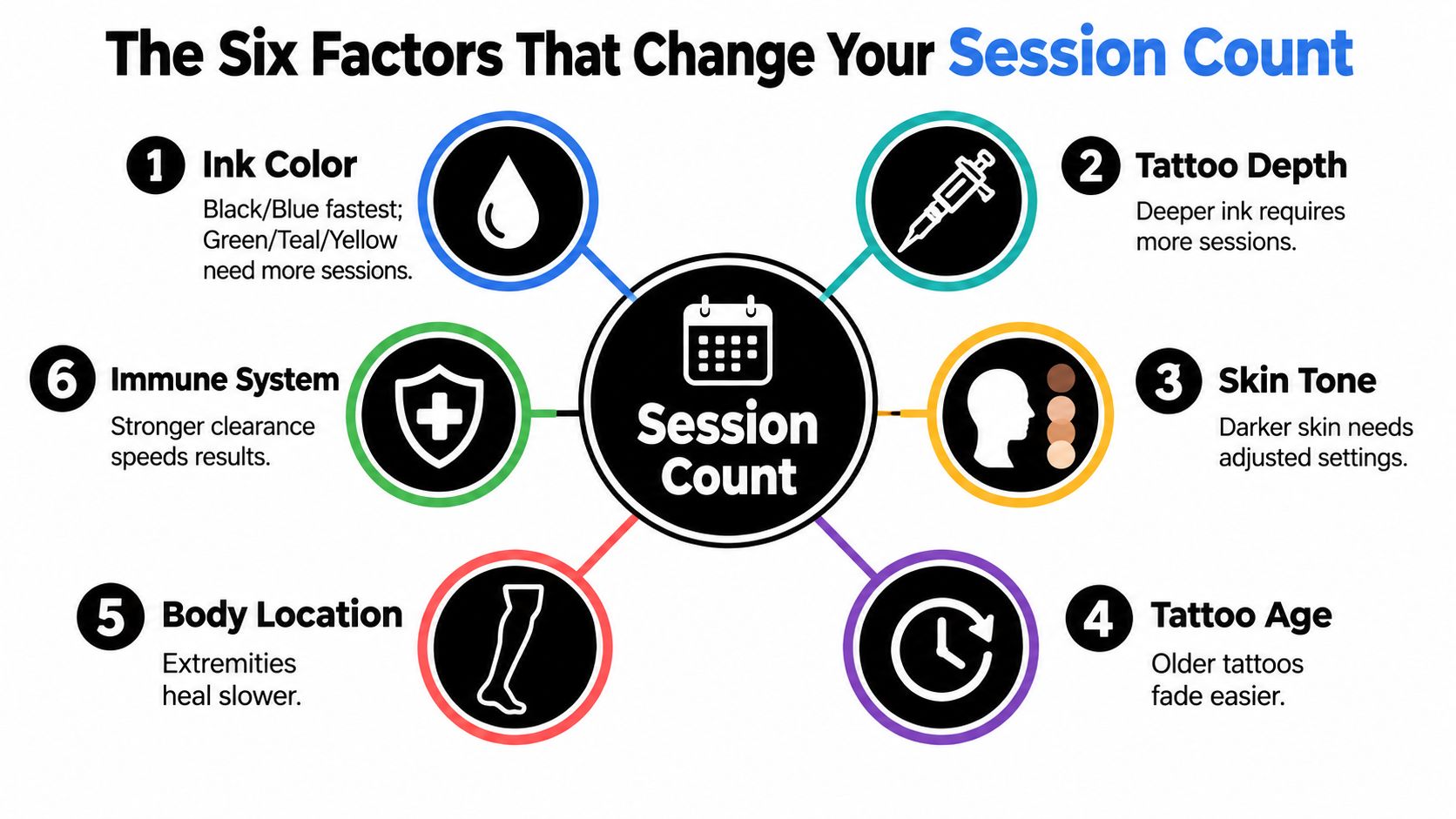
Laser tattoo removal session estimates change mainly because six tattoo and skin characteristics alter how efficiently pigment can be treated and cleared. UK NHS guidance specifically considers skin type, location, ink colour, ink intensity, scarring or skin damage and tattoo layering when estimating treatment requirements.
Ink colour
Black and red usually respond better than some other colours, as noted by NHS Birmingham and Solihull. Dark ink tends to absorb the relevant laser energy more readily. Green, teal, yellow and some pale shades can be more difficult, so a multicoloured tattoo often needs a longer plan than a simple black design. Results vary from person to person.
Tattoo depth and density
Ink deposited deep or packed densely gives the laser more pigment to address. Professional shading, solid colour and areas with previous tissue damage can therefore take longer than fine, lightly applied marks. Existing scarring may also affect how evenly the skin responds.
Tattoo age
Older tattoos often show more natural fading before treatment because the body has already broken down some pigment. That doesn't mean an older tattoo disappears quickly. Its remaining ink may still be deep, dense or resistant.
Skin type
We assess skin using the Fitzpatrick scale, which groups skin according to its response to light. Darker skin may require more conservative settings to protect surrounding pigment, while recent tanning can make treatment unsuitable until the skin settles. The setting must be selected for the individual, not just for the tattoo.
Body location
Blood flow, healing and clearance vary across the body. Tattoos on the face or chest may respond differently from tattoos on the hands, feet or ankles. Extremities can be slower to heal and clear, which may lengthen the overall plan.
Layering and cover-ups
A cover-up contains more than one history of pigment. The newer design may sit over an older tattoo, so the laser may need to work through layered colours and different ink densities. That is one reason a cover-up shouldn't be estimated like a single-layer amateur tattoo.
We also inspect any raised or altered tissue before treatment. If you're concerned about the appearance of the skin as well as the ink, our information on laser tattoo removal and scar considerations explains why a consultation matters.
Amateur Versus Professional Tattoos
How much fading do you want, and how much clearance is realistic? Amateur tattoos often respond in fewer sessions because the ink may be lighter, less evenly deposited or limited to one dark colour. NHS estimates include approximately 4 to 6 sessions for Indian-ink tattoos and around 10 to 12 sessions for professional tattoos, according to North Bristol NHS Trust. Other NHS guidance, such as the Cheshire and Merseyside NHS tattoo laser removal policy, places many complete-removal courses around 12 to 16 sessions, with some requiring up to 20.
Those figures are planning benchmarks, not promises. Partial fading may take fewer sessions than maximum fading, while full clearance can require a longer course or may not be achievable in every case. Ink type, colour, depth and your skin's response all affect the result.
| Factor | Amateur Tattoo | Professional Tattoo |
|---|---|---|
| Pigment | Often lighter or unevenly deposited | Usually denser and consistently packed |
| Colour | Frequently single-colour | May contain several colours |
| Depth | Can vary considerably | Often deeper and more consistent |
| Planning benchmark | Roughly 4 to 8 sessions in simpler cases | Often 10 to 16 or more for complex work |
| Main complication | Uneven fading | Saturation, layering and resistant colours |
The categories overlap. A faded professional black tattoo may respond more readily than a fresh amateur tattoo with unexpected pigment. Cover-ups contain layered ink, while a partial-removal request may need a different endpoint from full clearance.
What to check before guessing
Ask three practical questions:
- Where did the ink come from? A stick-and-poke or homemade mark can behave differently from machine-applied pigment.
- How many colours are visible? Black-only work is generally easier to plan than green, yellow or multicoloured ink.
- How old and faded is it? Existing fading may help, but it does not reveal the pigment's depth or composition.
For clients in Leamington Spa, Warwick and Kenilworth, we use these details to provide a range rather than attach false precision to one number. Results vary between individuals.
What to Expect Between Sessions
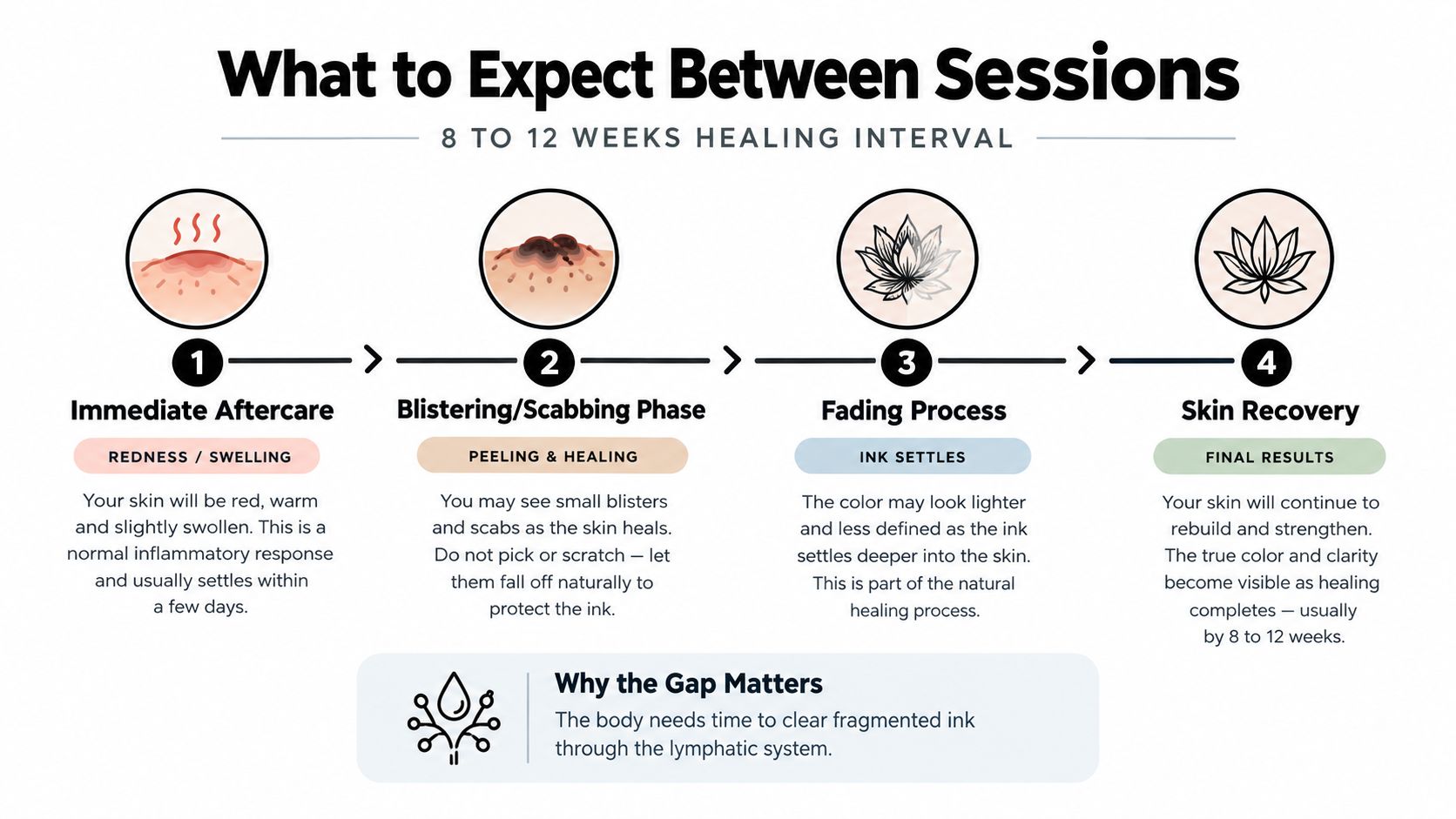
How long should you wait before another laser tattoo removal session? Allow an 8 to 12 week interval. The skin needs to recover, while your body gradually clears the fragmented ink. Treating sooner does not speed up that process.
The early healing period
Straight after treatment, the area may look lighter or frosted. Redness, swelling, tenderness, blistering and scabbing can follow. Keep the skin clean and dry, follow the aftercare provided, and do not pick at scabs or blisters.
During the first week, avoid swimming pools, saunas and hot baths. Keep the treated area away from direct sun and use only products recommended for freshly treated skin. Contact the clinic if redness, swelling or discomfort continues instead of settling.
The tattoo usually fades gradually over the weeks that follow. Fading can look uneven because colours and pigment at different depths respond at different rates. We assess the skin before every appointment, and treatment continues only when the area has recovered sufficiently.
For a clear visual guide, this healing timeline for removal shows how the area can change while it settles.
Our laser tattoo removal aftercare guidance covers the practical steps for home care. Good aftercare supports healing and helps prevent avoidable delays, although it cannot make a complex tattoo clear like a simple one.
Common Myths About Tattoo Removal Sessions
Laser tattoo removal almost never fits the idea of one appointment because ink sits at different depths and breaks down in stages. Even a small, faded black tattoo usually needs more than one session, while professional and multicoloured tattoos commonly need a longer course. Results vary from person to person.
Myth one, every colour responds the same
Black and red generally respond better than some other colours, according to NHS Birmingham and Solihull guidance. Greens, yellows, pale blues and other resistant shades may need different settings or additional treatment. A practitioner should assess each colour rather than quote a single number for the whole design.
Myth two, older means easy
An older tattoo may have faded naturally, but age doesn't tell us how much pigment remains or how deep it was placed. Older ink can still be dense, layered or uneven. Natural fading is helpful information, not a reason to promise a short course.
Myth three, more power is always better
Higher energy isn't automatically safer or more effective. We need to balance pigment targeting with the condition and colour of the surrounding skin. Recent tanning, altered tissue or a history of unusual scarring can change the plan.
Myth four, creams do the same job
Over-the-counter creams can't replicate the targeted action of a laser breaking pigment into fragments. Be cautious with products that promise complete clearance or a single-session result. The Committee of Advertising Practice guidance on cosmetic interventions warns against absolute claims and guarantees about tattoo-removal outcomes.
Some people also confuse tattoo removal with other skin treatments. Our page about how many microneedling sessions may be needed concerns a different treatment and shouldn't be used to estimate laser tattoo-removal sessions.
When to Book a Personal Consultation
A consultation is worth booking whenever you want more than a guess at how many sessions for tattoo removal your specific design may need. We assess the tattoo and your skin in person before deciding whether treatment is appropriate.
We don't treat everyone. We may decline or postpone treatment for clients who are pregnant or breastfeeding, have an active skin condition in the treatment area, have a recent suntan or active fake tan, have a history of keloid scarring, or take certain photosensitising medicines. We also need to consider any recent tattooing, skin damage or unusual healing history. If treatment isn't suitable on the day, we'll explain why rather than proceed for the sake of booking a session.
What to bring
Bring a clear photograph if you're enquiring remotely, although seeing the actual tattoo in person gives us more useful information. Tell us about your medical history and current medicines, and be open about previous laser treatment, fading attempts or cover-up work.
Think about your desired endpoint before you arrive:
- Partial fading: enough change for a cover-up or modification.
- Maximum fading: continuing while the tattoo keeps responding.
- Full clearance: aiming for the greatest reduction possible, while accepting that residual pigment may remain.
We can discuss a patch test when appropriate. A patch test and review may be particularly useful where colour, skin tone or previous treatment makes the response harder to predict.
What we assess
We look at the tattoo under good lighting, noting colour, density, estimated depth, age, location and any visible layering. We assess your Fitzpatrick skin type, current tanning, the condition of the treatment area and any scarring or texture changes.
At 3D Aesthetics Leamington Spa, our consultation is designed to leave you with practical information, not a sales script. We aim to provide a written session range, a realistic timeline based on the required gaps and a per-session price so you can plan clearly. Our clinic is at 11 Guys Place East, Leamington Spa, Warwickshire CV32 4RG, and you can arrange a free tattoo-removal consultation. Call 01926 315764 if you want to discuss whether an appointment is appropriate before booking.
We offer laser tattoo removal consultations in Leamington Spa for clients from Warwickshire, Warwick and Kenilworth, with session planning based on your tattoo rather than a fixed promise. Visit 3D Aesthetics Leamington Spa to learn about our laser services and arrange a personal assessment.
← Back to Home