
Most advice on laser hair removal permanent gets the key point slightly wrong. It talks as if one course of treatment switches hair off forever, in every follicle, for every person. That isn't how hair biology works, and it isn't how responsible UK clinics describe the treatment.
The honest answer is better than the marketing version. Laser can give long-lasting, meaningful reduction in hair growth, but in UK medical practice it's described as permanent hair reduction, not a guaranteed permanent cure for every hair. That distinction matters because it shapes what you should expect from your sessions, your maintenance, and your long-term result.
If you've been comparing claims online and wondering why one clinic says “permanent” while another sounds more cautious, the difference usually comes down to wording, not whether laser works. A useful starting point is to separate advertising language from the clinical reality behind permanent hair removal treatments. Once you understand that, the whole process becomes much easier to judge.
Table of Contents
- The Truth About 'Permanent' Laser Hair Removal
- Understanding Permanent Hair Reduction
- How Laser Technology Actually Works on Hair
- Your Treatment Timeline from Start to Finish
- Is Laser Hair Removal a Good Fit for You?
- Laser Hair Removal vs Other Hair Removal Methods
- Your Consultation at 3D Aesthetics Leamington Spa
- Frequently Asked Questions
The Truth About 'Permanent' Laser Hair Removal
Here is the part many clinics gloss over. The word permanent on its own creates the wrong picture.
In UK practice, laser hair removal is described more accurately as permanent hair reduction. That wording is not legal caution or careful marketing. It is a medical way of setting honest expectations based on how hair behaves over time. A treated area can stay far less hairy for years, yet still produce some finer or scattered regrowth later.
Clients often expect one of two extremes. Either every hair disappears forever, or anything less means the treatment failed. Neither view is helpful. Good laser results usually sit in the middle. You get a major, long-lasting drop in growth, less frequent shaving, and often fewer ingrown hairs, but you may still need occasional maintenance.
The reason matters. Your body is not a static system. Hair follicles can be influenced by hormones, age, genetics, and even changes in medication. So a follicle that was quiet after a full course can become active again later. That does not cancel the benefit of treatment. It explains why the UK term focuses on reduction rather than a promise of complete lifelong removal.
A useful way to frame it is this. Laser can switch off a large share of the follicles that are suitable to treat, but it cannot sign a lifelong contract with every follicle in the area.
That is why careful clinics speak plainly. At 3D Aesthetics Leamington Spa, the goal is to help clients get realistic, lasting improvement with a treatment plan matched to their skin, hair, and lifestyle, not to sell a one-visit fantasy. If you want a clearer picture of that longer-term outcome, our guide to permanent hair removal treatment expectations gives more context.
The honest truth is reassuring. You do not need perfect, total eradication for laser to be worth doing. For many clients, a large reduction in coarse visible hair is what changes daily life. Getting dressed feels easier. Holiday prep takes less effort. Shaving becomes occasional rather than constant.
If a clinic promises absolute permanence in every case, treat that as a warning sign. Clear language usually reflects better clinical judgement.
Understanding Permanent Hair Reduction
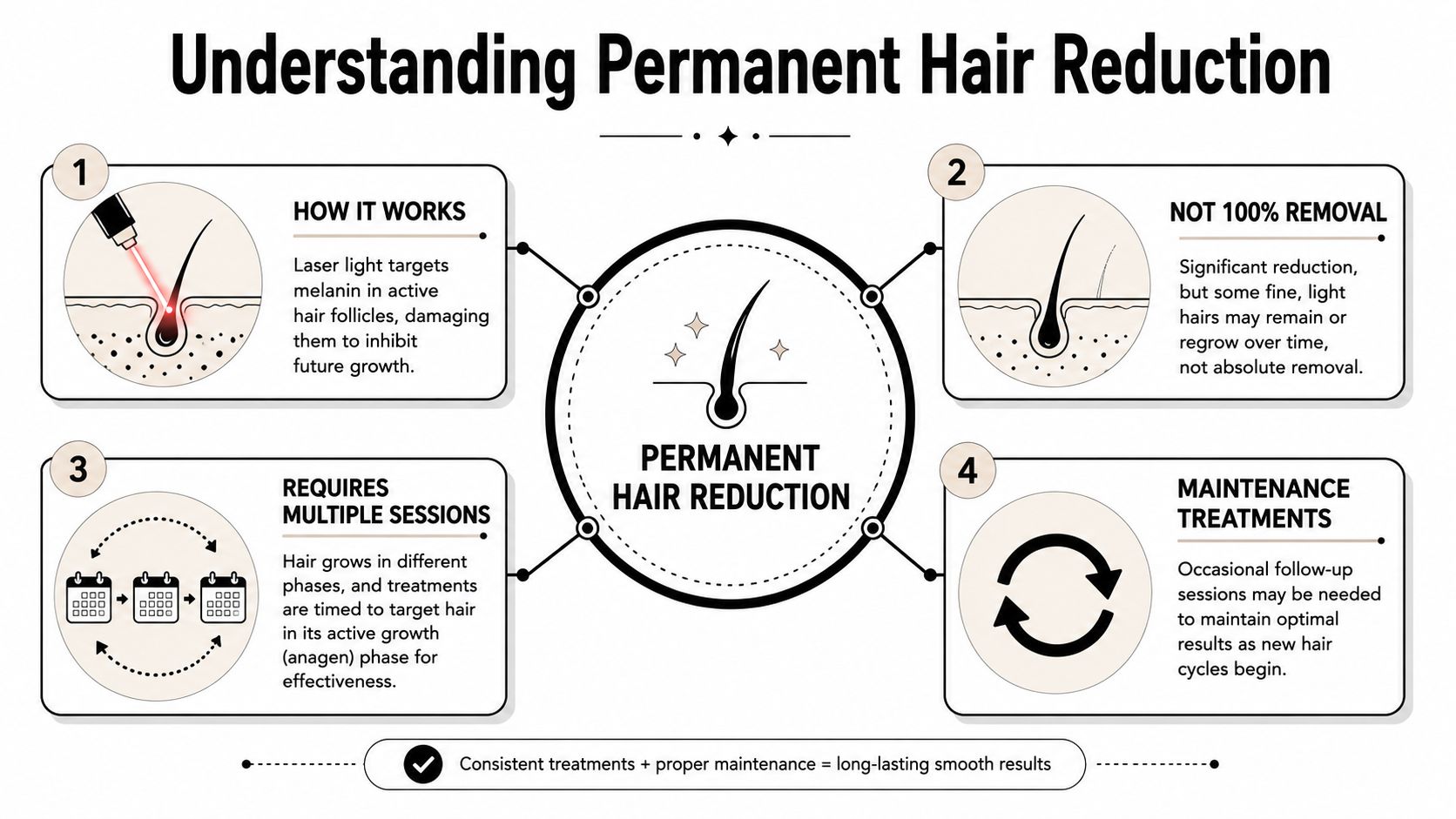
“Permanent” sounds absolute. In clinical practice, the more accurate term is permanent hair reduction, because the goal is a long-term decrease in growing hairs, not a guarantee that no hair can ever appear in that area again.
That distinction is not wordplay. It is how good clinics set honest expectations from the start.
A simple comparison helps. Treating unwanted hair is a bit like reducing traffic on a road network rather than closing every road forever. If enough key routes are shut down, the flow changes dramatically and day-to-day life becomes much easier. A few cars may still get through on smaller roads later on, but the overall pattern is still very different from where you started.
What the term means in real life
For clients, permanent reduction usually means a clear, lasting shift in how the area behaves after a full course of treatment. Hair often grows back in lower volume. What does return may be finer, lighter, or more scattered. The practical result is often the part that matters most. Less shaving. Less ingrown irritation. Less planning around hair removal.
The UK wording matters because it reflects biology, not marketing. Hair does not grow in one single wave, and follicles do not all respond identically over a lifetime. A medically careful clinic explains that long-lasting reduction is a realistic aim, while complete lifelong removal of every follicle is not something any ethical practitioner should promise.
Why “reduction” is still a strong result
Some clients hear the word “reduction” and worry it sounds partial or disappointing. In practice, it often describes exactly the outcome people want. If underarm hair becomes sparse enough that shaving is only occasional, or if bikini line growth becomes patchy instead of constant, that is a meaningful change in daily life.
This is also where personalised planning matters. One person may want fewer visible hairs on the face. Another may want to reduce heavy body hair that makes shaving tedious and uncomfortable. The success measure is not perfection in theory. It is how much the treatment improves comfort, convenience, and confidence in real life.
At 3D Aesthetics Leamington Spa, that conversation should happen before treatment starts. The consultation is where skin tone, hair type, treatment area, and medical history are reviewed so the likely level of reduction is discussed in plain terms. That helps bridge the gap between what clients hope “permanent” means and what the treatment can realistically deliver over time.
Why clinics use this definition
Permanent hair reduction is the honest medical phrase because hair follicles are part of a living system. Some follicles respond well and stop producing noticeable hair for the long term. Others may be missed in earlier sessions because they were not in the right stage to respond well. Later in life, hormonal changes can also influence new activity in a treated area.
So a good result is not judged by spotting one stray hair months or years later. It is judged by the overall lasting decrease and by how manageable the area becomes after a proper course.
That is why follow-up planning matters. For many clients, the main treatment course does the heavy lifting, and occasional maintenance protects the result if their hair pattern changes with time.
How Laser Technology Actually Works on Hair
Laser only makes sense once you understand what it is targeting. It isn't “burning hair off” at the surface. It is using light energy to affect the follicle below the skin.
The laser targets pigment and heat
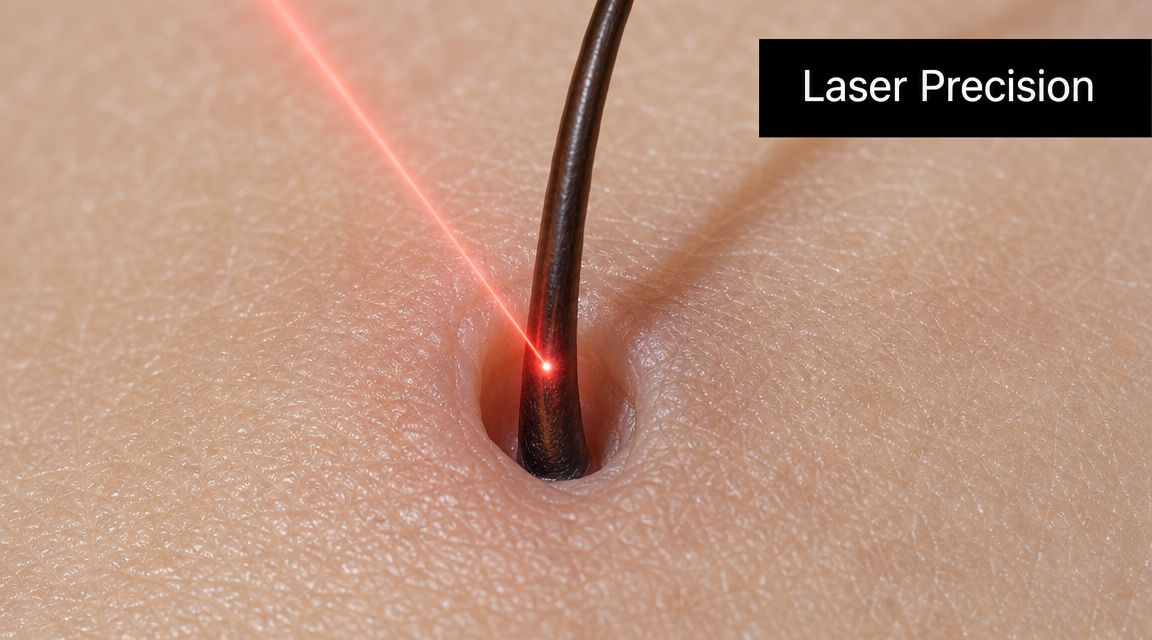
The medical principle is called selective photothermolysis. In plain language, the laser wavelength is absorbed by melanin in the hair shaft, that light converts to heat, and the heat damages the follicle so future growth is inhibited. Because only follicles in the active anagen phase are effectively treated, a course of 4 to 6 sessions spaced around 4 to 6 weeks apart is standard clinical practice according to StatPearls guidance on laser hair removal.
That's the part many clients find reassuring. The laser is not random. It's trying to target a specific structure with a specific physical response.
A therapist then adjusts treatment settings based on what they see in front of them:
- Hair colour matters because darker pigment gives the laser a clearer target.
- Skin phototype matters because the device and settings must protect the surrounding skin.
- Treatment area matters because different body zones can behave differently over time.
For a practical overview of treatment options, many clients start by reading about laser hair removal services before booking a consultation.
Why timing matters as much as the machine
Hair doesn't grow all at once. Some follicles are active, some are transitioning, and some are resting. The laser works best when the hair is actively growing and still properly connected to the follicle.
That's why spacing matters. If you treat too early or too late, you miss part of the target population. Good timing lets each appointment catch a different set of active hairs.
Clinical takeaway: multiple sessions aren't a sales tactic. They're built around the hair cycle.
This short explainer gives a useful visual sense of the process:
When clients understand this, they usually become much less frustrated by the idea of a course. One appointment can start the process. It can't finish a biological cycle that is still unfolding under the skin.
Your Treatment Timeline from Start to Finish
Laser hair removal is not experienced as a dramatic overnight change, but rather as a gradual reduction that becomes more obvious as the course progresses.
Medical guidance commonly explains that most patients need 6 to 8 treatments spaced weeks apart to capture hairs in the anagen phase, and that maintenance may still be needed every 6 to 12 months because some fine regrowth can occur, as outlined by Cleveland Clinic's patient guidance on laser hair removal.
What usually happens after each appointment
The first session often surprises people because the area may not look instantly hair-free. That's normal. What usually changes first is the pattern of regrowth.
A typical journey feels more like this:
Early appointments
You may notice some hairs shedding in the days or weeks after treatment. The area starts to look patchier rather than uniformly dense.Middle of the course
Regrowth often appears slower, finer, and less even. Many clients realise they're shaving less often at this stage.Later appointments
The remaining hairs are often the more stubborn ones. Progress can still happen, but it may feel subtler because there's less left to compare.
Don't judge the full outcome after one session. Laser usually reveals its value through cumulative change.
What long-term maintenance looks like
Maintenance doesn't mean you're back at square one. It usually means a lighter review of the area after your main course has done the heavy lifting.
You might need a top-up if:
- Fine hairs reappear after a period of stability.
- Hormonal shifts happen and new follicles become active.
- You want the area tidier for convenience rather than because density has returned to baseline.
That's why I encourage clients to think in two phases. First, the structured course. Second, occasional maintenance if your skin and hair pattern call for it later.
Is Laser Hair Removal a Good Fit for You?
The right question isn't only “does laser work?” It's “how likely is it to work well, safely, and predictably for my skin and hair?”
That answer depends on contrast, skin condition at the time of treatment, and your wider medical picture.
Skin tone hair colour and safety
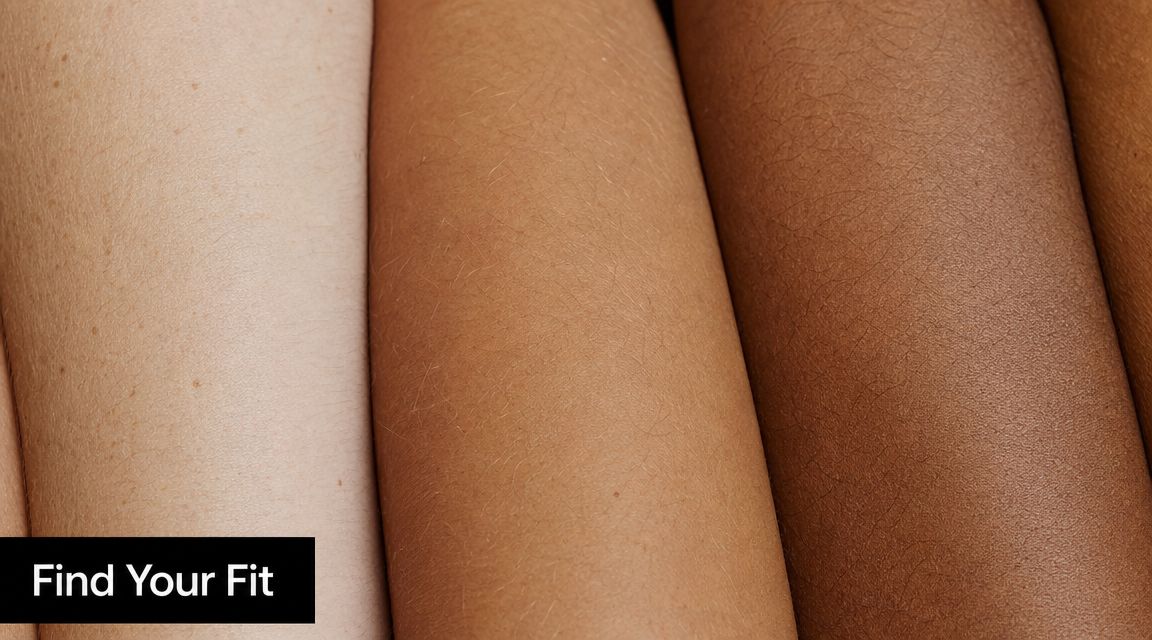
Laser works by targeting pigment in the hair, so the classic easy-to-treat combination has usually been darker hair against lighter skin. That said, modern practice is broader than old-fashioned advice suggested.
Clinical guidance notes that outcomes vary with skin and hair colour, and people with tanned skin are often advised to avoid treatment because of higher burn risk. It also matters that 18.8% of people in England and Wales were from an ethnic minority group in the 2021 Census, making it important to discuss differences across Fitzpatrick skin types with UK clients, as noted in Mayo Clinic guidance relevant to treatment suitability.
For darker skin tones, practitioners often choose longer wavelengths such as diode or Nd:YAG systems because they can improve safety by reducing unwanted epidermal injury. That's one reason consultation quality matters so much. The machine alone doesn't decide the outcome. Device choice and settings do.
When hormones and tanning change the plan
Generic online advice often falls short, as a person can be an excellent candidate on paper and still need a different treatment schedule, more caution, or more conservative expectations.
A proper assessment should cover:
- Recent sun exposure because tanned skin can raise the risk of unwanted reactions.
- Hair colour and thickness because finer or lighter hair may respond differently.
- Hormonal history because conditions that drive ongoing hair growth can affect how stable the result feels over time.
- Medications and skin sensitivity because safety always comes before speed.
If your skin tone is deeper, your hair is lighter, or your hormones affect regrowth, that doesn't automatically rule laser out. It means the plan needs to be tailored.
That's the difference between a screening conversation and a real consultation. One just checks a box. The other decides whether laser is appropriate, how it should be delivered, and what “good results” should look like for you.
Laser Hair Removal vs Other Hair Removal Methods
Laser makes the most sense when you compare it with the alternatives people commonly use. Most clients aren't choosing between “hair” and “no hair”. They're choosing between different kinds of maintenance.
Some methods are quick but repetitive. Some are more precise but slower. Laser sits in the middle as a method aimed at long-term reduction over a course of treatments rather than constant short-term removal.
Hair Removal Method Comparison
| Method | Result | Best For | Average Sessions | Pain Level |
|---|---|---|---|---|
| Laser hair removal | Long-term hair reduction after a course, with possible maintenance later | People wanting less frequent upkeep across larger areas | Course of sessions, then occasional top-ups for some clients | Often described as brief heat or snapping discomfort |
| Electrolysis | Targets individual follicles one by one and is often chosen when absolute precision matters | Small areas, isolated hairs, or hair colours less suitable for laser | Usually ongoing because each follicle is treated individually | Can feel sharp and repetitive |
| Waxing or sugaring | Removes hair from the root but regrowth returns | People who want temporary smoothness without shaving | Repeated appointments as hair regrows | Often uncomfortable, especially on sensitive areas |
| Shaving | Cuts hair at skin level with no effect on the follicle | Fast home maintenance | Frequent upkeep | Usually mild, but can irritate skin |
Laser often appeals to people who are tired of the cycle of constant regrowth, appointments, and irritation. Electrolysis may be better for very small zones or certain hair types. Waxing suits people who want temporary smoothness and don't mind repeat maintenance. Shaving is convenient, but it rarely changes the underlying problem.
If you're weighing the two most commonly compared clinical options, this guide on laser hair removal vs electrolysis can help clarify which route fits your goals.
A practical rule I give clients is simple. Choose based on your end goal, not on habit. If you want fewer hairs over time in a larger area, laser is often the more efficient route. If you want to remove scattered hairs with precision, another method may fit better.
Your Consultation at 3D Aesthetics Leamington Spa
A good laser consultation is not a formality. It is the point where marketing language gets translated into a realistic treatment plan for your skin, your hair, and your goals.
At 3D Aesthetics Leamington Spa, the consultation is described as a complimentary in-depth appointment with a full 3D body scan to assess concerns, create a personalised plan, and track change over time. For laser hair reduction, the clinic states that it uses the 3D-Trilogyice system for permanent hair reduction after a course of treatments. That wording matters. It matches the medical reality discussed earlier. In the UK, the honest standard is permanent reduction, not a blanket promise that every hair is gone forever.

What a proper consultation should cover
A proper consultation works like a map before a journey. If the map is vague, the result is disappointment. If it is specific, you know what route you are taking and what result counts as success.
That usually means your therapist assesses the area to be treated, asks about skin history and medication, checks for recent sun exposure or fake tan, and looks at the colour, thickness, and density of the hair. Those details shape both safety and response. Dark, coarse hair usually gives the laser a clearer target than fine, pale hair, so expectations need to be set before treatment starts, not halfway through a course.
You should also get clear answers to questions such as:
- Am I suitable for treatment right now
- What level of reduction is realistic for my hair colour, density, and skin tone
- How many sessions are likely before we assess the response
- What signs will show that the treatment is working
- Will occasional maintenance sessions probably be needed later
If those questions are brushed aside, the word “permanent” can sound bigger than the biology behind it.
How technology and assessment shape realistic results
Technology helps when it improves decision-making and consistency. The machine matters, but the consultation matters just as much. A strong device in the wrong settings, or used on the wrong candidate, does not create better outcomes.
That is why clinics combine the equipment with clinical judgement. A detailed assessment helps the therapist choose suitable settings, plan safe treatment intervals, and explain what your hair is likely to do over time. Progress tracking also gives you something more useful than guesswork. You are not left asking, “Is it working?” based only on a few hairs in the mirror. You can judge change by thinning, patchiness, slower regrowth, and how manageable the area becomes between sessions.
The most reassuring consultation is often the most honest one. It does not promise perfection. It explains what permanent reduction means in practice, how your treatment course will be adjusted if needed, and what kind of long-term result is realistic for you before the first pulse is delivered.
Frequently Asked Questions
Does laser hair removal hurt
The sensation is described as a quick flick of heat or an elastic-band snap. Some areas feel more sensitive than others. Cooling systems, pacing, and the right settings make a noticeable difference to comfort.
What does aftercare involve
Aftercare is usually straightforward. Keep the area cool, avoid extra heat if your therapist advises it, protect the skin from sun exposure, and follow any shaving or skincare instructions you've been given. The aim is to let the skin settle without irritation.
Can laser be used over tattoos or moles
Tattooed skin usually needs special caution because the pigment can react to light energy. Moles and other pigmented marks may also need to be avoided or covered. Your therapist should inspect the area first rather than treating around guesswork.
Why do some hairs seem to come out after treatment
That's often shedding, not fresh growth. Treated hairs can work their way out of the follicle after a session, which can make it look as though hair is still growing for a short time.
Should I wax between sessions
Usually, no. Waxing removes the hair from the root, and the follicle needs a target present for treatment. Therapists commonly prefer shaving between appointments if any hair management is needed.
If you're thinking about laser and want an honest opinion on whether it suits your skin, hair, and goals, book a consultation with 3D Aesthetics Leamington Spa. A proper assessment can tell you far more than a generic “is laser hair removal permanent?” article ever will.
← Back to Home