
A typical course runs 4 to 12 laser tattoo removal sessions, with each appointment spaced at least 8 weeks apart. Simple black Indian ink often sits at the lower end, while professional tattoos can reach the higher end, and complete courses may require 12 to 16 or more sessions over a year or longer.
You may be looking at an old tattoo in the mirror, wondering whether removal means a few appointments or a long-term commitment. The honest answer is that there isn't one fixed number. The ink, application technique, colour, location, skin and your body's clearance response all influence the plan.
For a Leamington Spa patient considering treatment with 3D Nanosure, the most useful way to think about the process is not “how many laser sessions can I fit into a month?” It's “how long does my body need between treatments to clear the fragmented pigment?” UK NHS guidance places that interval at at least 8 weeks, which is why tattoo removal is measured in months rather than quick treatment blocks. North Bristol NHS Trust's tattoo guidance gives a practical baseline, with Indian ink often needing about 4 to 6 sessions and professional tattoos about 10 to 12 sessions.
A complimentary consultation and full 3D body scan can help turn a broad range into a more personal estimate. The assessment considers the tattoo's pigment load, colour mix, age, depth and position, alongside your skin and treatment history.
Table of Contents
- Introduction How Many Laser Tattoo Removal Sessions Will You Need
- How Laser Tattoo Removal Works and Why It Takes Multiple Sessions
- Key Factors That Determine Your Number of Sessions
- How 3D Nanosure Technology Affects Session Count
- Typical Timeline and What to Expect During Each Session
- Aftercare Contraindications and Keeping Your Course on Track
- Realistic Results Before and After and Your Next Steps in Leamington Spa
Introduction How Many Laser Tattoo Removal Sessions Will You Need
You may be standing in front of the mirror with two questions: will this faded tattoo clear after a few visits, and how long will a dense professional design take? Size alone cannot answer either question. A small tattoo can contain concentrated pigment, while a larger, older design may have already lightened.
A lightly applied black tattoo and a heavily saturated multicolour cover-up can occupy a similar area yet respond very differently. Laser treatment breaks pigment into smaller fragments, then your body gradually clears them. The appointment count depends on what remains after each treatment, so a responsible plan changes with your progress rather than following a fixed calendar.
The practical expectation: session count is a range, not a promise. A consultation should give you an estimate and explain what could move it higher or lower.
UK NHS guidance provides a broad reference range of 4 to 12 sessions, depending on the ink and tattoo type. North Bristol NHS Trust gives examples of approximately 4 to 6 sessions for Indian ink and approximately 10 to 12 sessions for professional tattoos, with appointments separated by at least 8 weeks. That NHS reference also explains that a single-colour black tattoo can still need repeated treatments for maximum fading.
Complete clearance can take longer than an initial estimate suggests. UK commissioning guidance describes full removal as variable, often requiring 12 to 16 sessions, with some cases needing as many as 20. The NHS policy document supports the need for patience, because each appointment must be followed by the body's pigment-clearance period.
For a Leamington Spa patient considering 3D Nanosure, the useful question is not how many appointments can fit into a short block. It is how your tattoo looks after the body has had time to clear the fragmented pigment. A consultation and 3D body scan can then assess pigment load, colour mix, age, depth, position, skin and treatment history before suggesting a more personal estimate.
How Laser Tattoo Removal Works and Why It Takes Multiple Sessions
A tattoo can look unchanged when you leave the clinic, yet its fading process has already started. Laser tattoo removal is a partnership between the device and your body. The laser breaks the pigment apart quickly. Your immune and lymphatic systems then clear the smaller fragments over time.
Tattoo ink sits beneath the skin in concentrated deposits. During treatment, a Q-switched or nanosecond laser delivers energy into the pigment and fractures larger deposits into much smaller particles. The laser does not vacuum ink out. It makes the particles small enough for your body to process gradually.
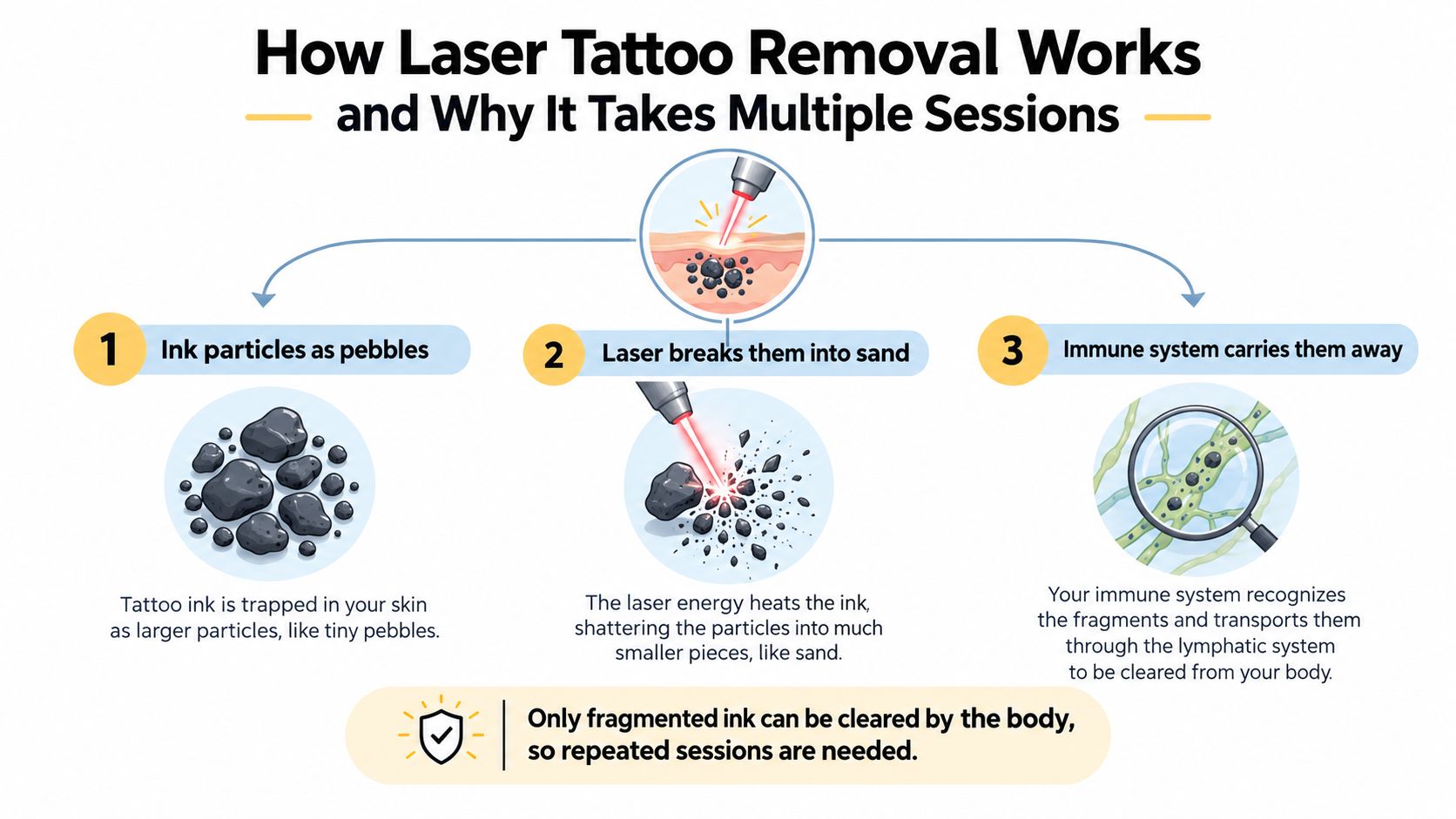
The three stages of fading
The laser targets pigment. The practitioner selects a suitable wavelength according to the ink's colour and characteristics. Dark pigment generally absorbs laser energy differently from lighter or more resistant colours.
The pigment fragments. One treatment affects only part of the total pigment load. Deeper, denser or less responsive particles can remain visible after the appointment, so the tattoo may fade unevenly.
Your body clears the fragments. Immune cells gradually carry the smaller particles away through normal biological processes. Fading can continue for weeks after treatment, as the body works through what the laser has fragmented.
This clearance stage explains why appointments are spaced apart. Guidance from North Bristol NHS Trust recommends allowing at least 8 weeks between treatments, so the body has time to process the fragments and the skin can recover. Its patient guidance describes different treatment requirements for Indian ink and professional tattoos, reinforcing that session counts vary with the tattoo.
The waiting period is part of the treatment, not lost time. Treating too soon may target pigment that has not yet cleared and skin that is still settling. In a Leamington Spa clinic journey with 3D Nanosure, progress is better judged after this clearance cycle than immediately after the laser pulse. Each review can then show what pigment remains and help guide the next appointment.
Laser technology is also used for other skin concerns, but each has its own clinical process. For example, laser wart removal addresses a different target from tattoo pigment, so the assessment and treatment approach are not interchangeable.
Key Factors That Determine Your Number of Sessions
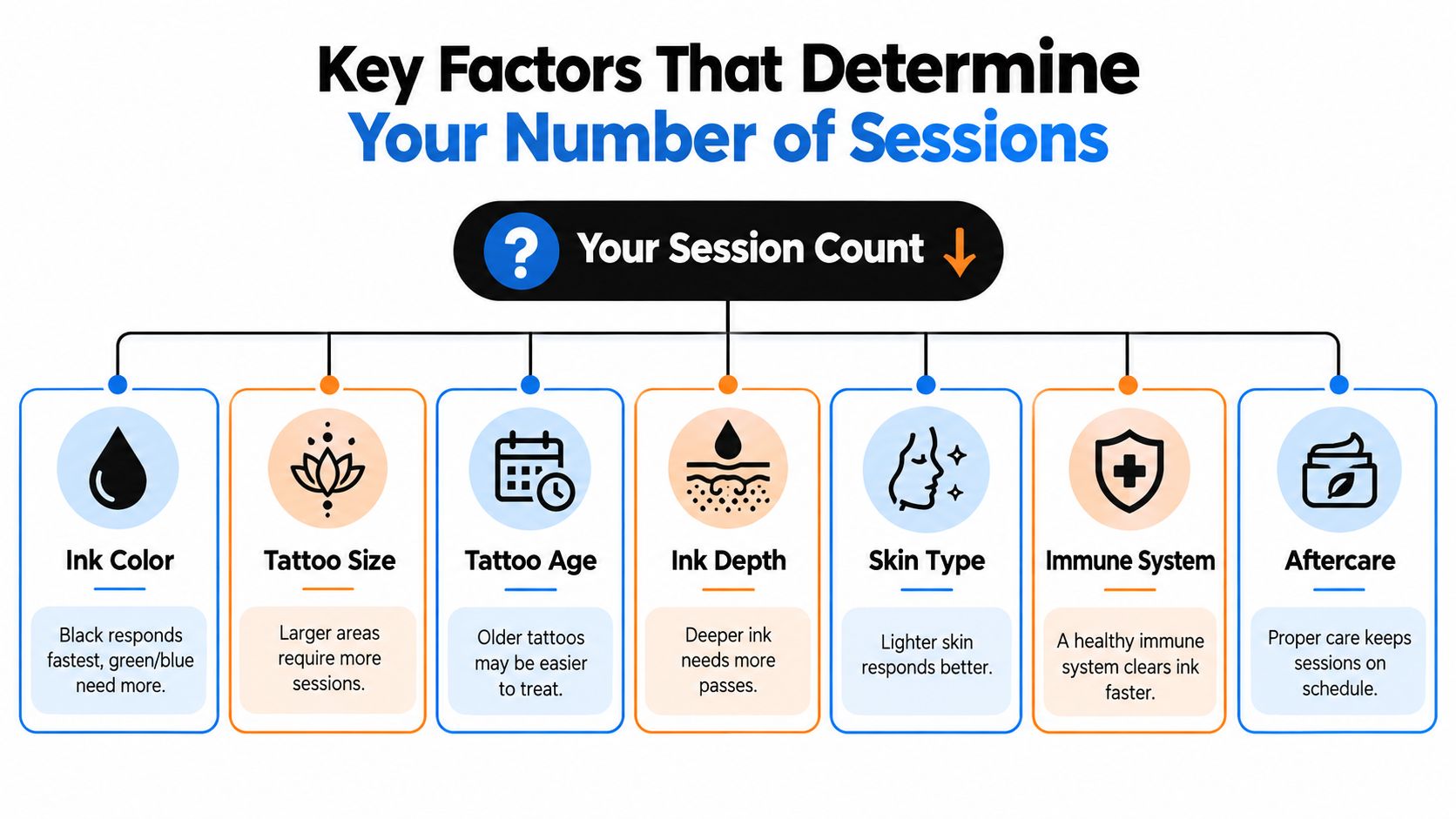
Two tattoos can look similar in a photograph and still need different treatment plans. The main reason is pigment load, which includes how much ink is present, how it sits and how many colours must be addressed.
Pigment load matters more than size alone. A large tattoo with light shading may respond differently from a smaller design packed with dense, layered ink.
Colour changes the treatment response
Black ink is usually easier to target because it absorbs a broad range of light. Multicolour tattoos require the practitioner to assess each pigment separately. Greens, blues and other less responsive shades may keep parts of a design visible after darker areas have faded.
A tattoo can therefore appear uneven during removal. The black outline may lighten while coloured sections remain stronger. That doesn't necessarily mean the treatment has failed. It reflects the different way each pigment interacts with the selected wavelength.
Density and depth add pigment to clear
A fine-line tattoo with open skin between the marks contains less pigment than a solid, heavily shaded design. Professional tattoos are often placed more consistently and deeper than amateur tattoos, which can make the course longer. Cover-up work may be especially complex because a newer design sits over earlier pigment.
Location affects the body's clearance work
The body clears fragmented pigment through its normal circulation and lymphatic processes. Tattoos on the torso or upper body may respond differently from tattoos on hands, feet, ankles or lower legs, where clearance can be slower.
Location also affects practical treatment planning. A tattoo on an exposed area may receive more sunlight, while a design near a joint may experience movement and friction during healing. Your practitioner should account for the skin's condition, not just measure the tattoo with a ruler.
Skin type influences safe settings
Laser energy must be selected with your natural skin tone and current pigmentation in mind. Tanned or sun-exposed skin may require additional caution because the surrounding melanin can also interact with laser energy. A consultation should include a skin assessment before anyone promises a session total.
Age and previous fading provide useful clues
Older tattoos may already have lost some pigment naturally. A design that has visibly softened over time may have less remaining ink than a fresh, saturated tattoo, although age alone can't guarantee a shorter course.
Application style matters
Amateur tattoos often contain less consistent pigment placement, while professional work may use denser and deeper ink. The distinction isn't absolute, so a visual assessment remains more useful than assuming that every small tattoo will be quick to remove.
Your response and routine still matter
Your body completes much of the clearance between appointments. Overall health, skin recovery and compliance with aftercare can affect whether your next session proceeds on schedule. Sun exposure, irritation or poor healing may require the practitioner to delay treatment for safety.
A UK clinic benchmark compiled across 346 clinics reports that a full removal course commonly runs 8 to 12 sessions, with published per-session prices ranging from £80 to £1,000 depending on factors including size, colour, age and skin tone. The Proactive Laser benchmark supports the point that session count and cost depend on more than dimensions alone.
How 3D Nanosure Technology Affects Session Count
Device choice can influence how efficiently a practitioner addresses different pigments, but it can't remove the biological waiting period. 3D Nanosure uses Q-switched laser technology designed to deliver short pulses that target tattoo pigment. At 3D Aesthetics Leamington Spa, the practitioner can assess the tattoo and select an approach appropriate to its colour and condition.
The important comparison isn't “new laser versus old laser”. It's whether the device offers suitable wavelength options, whether the settings are chosen safely for your skin, and whether the treatment is adjusted as the tattoo fades. A responsive black area may progress differently from a green or blue section, even within the same design.
Colour responsiveness and session planning
| Ink colour | Typical response | Effect on session count |
|---|---|---|
| Black | Often the most responsive pigment | May sit towards the lower part of an individual estimate |
| Dark blue | Can respond, depending on pigment composition | May require continued treatment after black areas fade |
| Green | Can be more resistant than black | May extend the course |
| Red or orange | Requires a suitable wavelength and assessment | Session count depends on pigment behaviour |
| Yellow or pale shades | Often more difficult to target | May remain visible for longer |
| White | Needs careful professional assessment | Can respond unpredictably and may affect planning |
This table is a guide to discussion, not a guaranteed number of appointments. A practitioner still needs to inspect the ink density, depth, skin tone and any previous laser treatment.
Nanosecond delivery can break pigment into smaller fragments than a slower, less targeted approach in some circumstances, but the final result still depends on how much ink remains and how your body clears it. No responsible clinic should promise that a particular device will make every tattoo disappear within a fixed number of visits.
The consultation is where technology becomes relevant to your tattoo rather than a marketing label. A 3D body scan can help document the treatment area and compare fading over time, while photographs and in-person review help determine whether another session is appropriate.
Typical Timeline and What to Expect During Each Session
A Leamington Spa tattoo-removal journey starts with planning, not the first laser pulse. During a complimentary consultation, the practitioner reviews the tattoo's colour, density, age and position, along with your skin condition and treatment history. At 3D Aesthetics Leamington Spa, a full 3D body scan can support personalised planning and show how the tattoo changes between appointments.
Before treatment
Your target result shapes the course. You may want complete removal, or enough fading to make space for a new design. The practitioner should ask about recent sun exposure, skin conditions, medication and previous treatment before deciding whether treatment is appropriate.
A patch test or suitability assessment may come first. It gives the practitioner a controlled way to choose settings for your skin and observe the pigment's early response.
The first laser appointment
The laser sensation is often compared with quick snaps or elastic-band flicks. Appointment length depends on the tattoo's size and location. The practitioner works methodically across the area, allowing each section to receive appropriate treatment rather than rushing through it.
Right afterwards, the skin may appear flushed or swollen. You will receive instructions about cleaning the area, expected healing changes and signs that should prompt you to contact the clinic.
If you are considering topical numbing, ask the practitioner before applying anything. This numbing cream with lidocaine guide explains why product choice and safe use require care. Your treating practitioner should decide whether it suits your appointment.
The clearance interval
Laser treatment breaks pigment into smaller fragments during the appointment. The body then clears those fragments gradually, much like removing grit from a filter a little at a time. UK NHS guidance requires appointments to be spaced at least 8 weeks apart, giving the body time to absorb and clear the pigment. North Bristol NHS Trust's treatment information describes approximately 4 to 6 sessions for Indian ink and approximately 10 to 12 sessions for professional tattoos.
The eight-week cycle also determines the calendar:
- A 6-session course takes roughly a year when appointments are separated by 8 weeks.
- A 12-session course can extend to nearly two years at the same minimum interval.
- A course requiring 12 to 16 sessions may take longer if the clinic recommends extra recovery time.
These examples show appointment spacing, not a promised result. Plan around holidays, weddings, sport and periods when the tattoo may be exposed to sunlight. Allowing the skin and body enough recovery time is generally more useful than bringing appointments closer together.
Aftercare Contraindications and Keeping Your Course on Track
A Leamington Spa patient may leave a 3D Nanosure appointment feeling well, then notice redness, tenderness or small scabs later. That response can be part of the skin's healing process. Good aftercare protects the treated area while the body continues clearing fragmented pigment, helping you reach the next session safely.
The first days after treatment
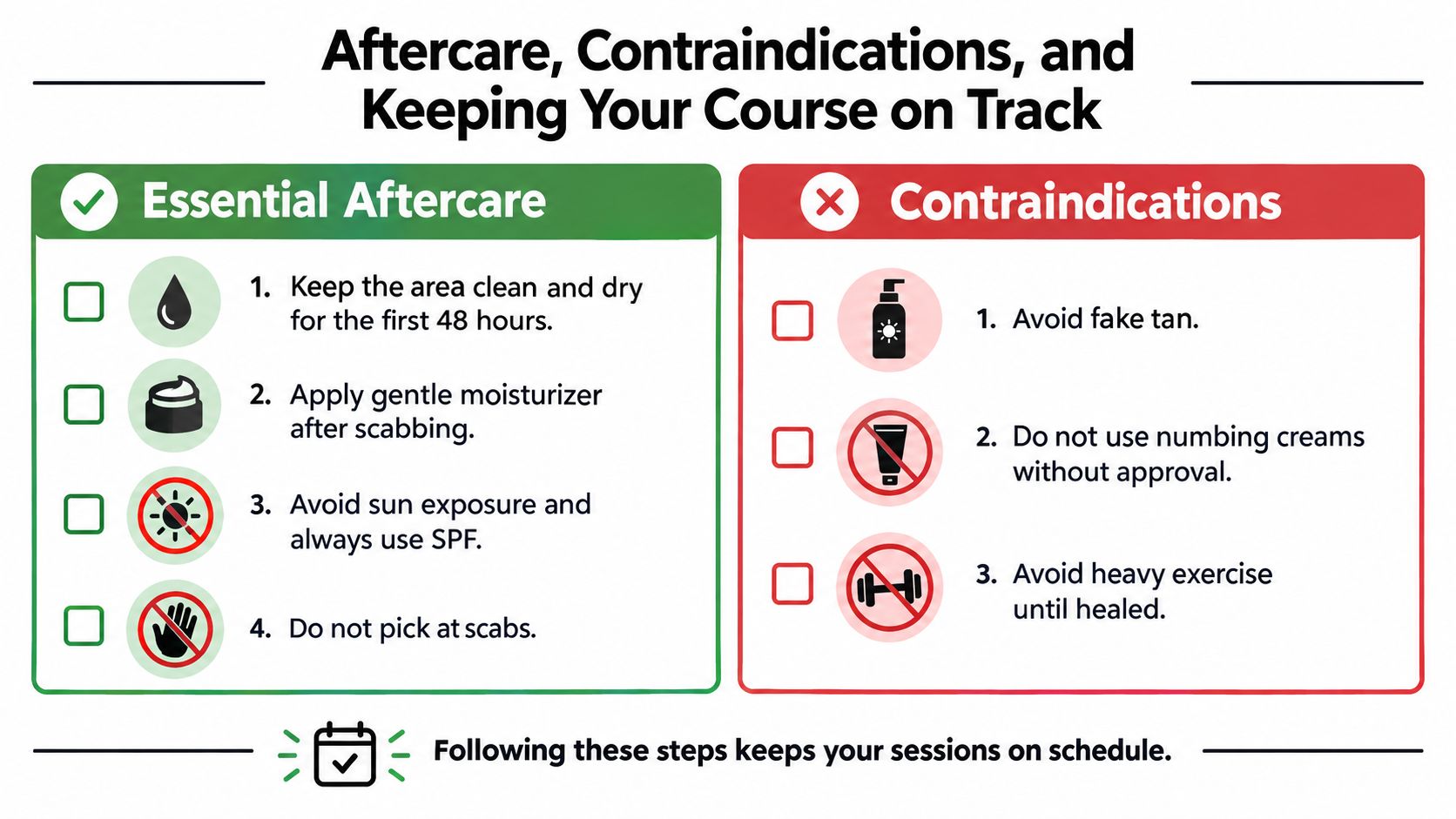
Keep the area clean and follow your practitioner's dressing and cleansing instructions. Do not pick, scratch or remove scabs, even if they feel tempting to touch. The skin needs time to repair without extra trauma.
Wear loose clothing wherever fabric could rub the area. Pause activities that make the treated skin hot, sweaty or repeatedly irritated until your practitioner confirms that healing is adequate. If the response seems unusually severe or slow, contact the clinic before changing your routine.
Sun and tanning precautions
Protect the tattoo from direct sunlight throughout the course. Sun exposure can change the surrounding skin's pigmentation and may affect whether the practitioner can treat safely at the planned settings.
Avoid fake tan before an appointment, and tell the clinic about recent tanning or sunburn. Treatment may need to wait until the skin returns to a safer condition. This is one reason to plan sessions around holidays and outdoor activities rather than squeezing appointments closer together.
Health and medication checks
Tell your practitioner about medication, photosensitivity, active skin conditions, infection, recent procedures and any history of unusual scarring. Pregnancy, active infection and significant irritation need professional discussion before treatment. A cream or supplement can still matter even when applied away from the tattoo, so do not assume it is harmless.
Use this appointment checklist:
- Before booking: disclose relevant medication, skin conditions and recent sun exposure.
- Before each visit: arrive with the area clean and free from unapproved products.
- After treatment: follow the clinic's cleansing, moisturising and dressing instructions.
- Between sessions: protect the area from sunlight and wait for full healing before resuming activities that cause irritation.
- Before rescheduling: send photographs or speak with the practitioner if healing appears unusually slow.
The eight-week interval discussed earlier gives the body time to clear pigment fragments before the next appointment. It also means a removal course usually spans many months, so keeping aftercare consistent helps avoid preventable delays.
Keep the clinic's laser tattoo removal aftercare guidance available after your appointment. Following one clear plan is safer than combining advice from unrelated sources.
Realistic Results Before and After and Your Next Steps in Leamington Spa
A tattoo usually fades in stages. Early changes may be difficult to notice, while later sessions can reveal clearer differences as the remaining pigment becomes less concentrated. Deep, layered or resistant ink may leave a faint shadow or small areas of colour, even after a substantial course.
The body needs time to clear pigment fragments between treatments. The commonly used spacing of about eight weeks allows that clearance cycle to progress, so a before-and-after comparison is more useful when you compare each review with the starting photograph, rather than judging the skin immediately after treatment.
A UK evidence summary describes meaningful clearance during an early part of some treatment courses, while complete or near-complete removal may need considerably more sessions. Results depend on the individual tattoo, so a generic session chart cannot predict your endpoint.
At 3D Aesthetics Leamington Spa, consultation findings, 3D scanning and progress reviews can help assess whether the skin is ready for another treatment and whether the plan remains appropriate.
Your next step is a complimentary in-depth consultation. Bring details of previous tattooing or laser treatment, then ask what level of fading is realistic for your ink and skin. 3D Aesthetics Leamington Spa offers Q-switched 3D Nanosure treatment, a complimentary consultation and 3D body scan to help estimate your course. Ask about the expected eight-week spacing and your personalised plan.
← Back to Home