
You've been training consistently, eating more carefully, and watching the scales move in the right direction. Yet the mirror still shows fullness around the nipples or lower chest. Shirts fit everywhere else, but you avoid swimming, changing rooms, and fitted clothing because your chest doesn't look the way you expected.
That experience is common, and it doesn't automatically mean you've lacked discipline. Non surgical gynecomastia treatment can help some men, but only when the treatment matches the tissue causing the enlargement. Fat can often be reduced with lifestyle changes or body-contouring technology. Firm glandular tissue is a different problem and usually needs medical assessment rather than another round of chest exercises.
Table of Contents
- The Hidden Reality of Male Breast Enlargement
- Understanding the Causes and Tissue Types
- Effective Non-Surgical Technologies Available
- Non-Surgical Treatments Compared to Surgery
- Assessing Your Candidacy and Expected Results
- Your Consultation Journey at 3D Aesthetics
- Frequently Asked Questions
The Hidden Reality of Male Breast Enlargement
A man in his thirties steps from the shower and studies his chest. His waist is leaner, his bench press has improved, and oversized jumpers no longer hide his shape. Yet fullness remains beneath each nipple. When he presses it, the area feels firmer than the surrounding tissue.
His first thought may be more cardio or a stricter diet. That approach may reduce overall fat without changing a firm glandular area. Chest enlargement can involve fat, glandular tissue, or a mixture of both, so the same treatment cannot produce the same result for everyone.
The emotional effect can be just as real as the physical change. Some men avoid holidays, changing rooms, or swimming without a top. Others alter their posture or clothing to conceal their chest. These reactions reflect discomfort with a body that seems not to match the effort invested in it, not vanity.
A common clinical concern
Gynecomastia is common enough for a British Journal of General Practice review to report prevalence between 35% and 65% in males aged 50 to 69 years in its review of the condition. It can occur across different body shapes, fitness levels, and medical histories.
Referral does not automatically mean surgery. In a South Manchester NHS breast-unit study of 271 men, 243, or 89.7%, were reassured and discharged, 9, or 3.3%, received tamoxifen, and 10, or 3.7%, underwent surgery. Those figures describe one NHS service, not every patient in the UK. They do show why assessment matters: possible causes are reviewed first, and conservative management may be appropriate.
A reassuring starting point: the first decision is not which device to choose. It is whether the fullness is mainly fat, gland, or both.
Discussions of surgical options for gynecomastia in Atlanta may help when comparing treatment routes. Non-surgical technologies can be useful for suitable candidates, particularly when excess fat is the main concern, but they generally do not remove dense glandular tissue. Persistent, painful, sudden, or one-sided changes should be discussed with a GP or appropriately qualified clinician before cosmetic treatment.
Understanding the Causes and Tissue Types
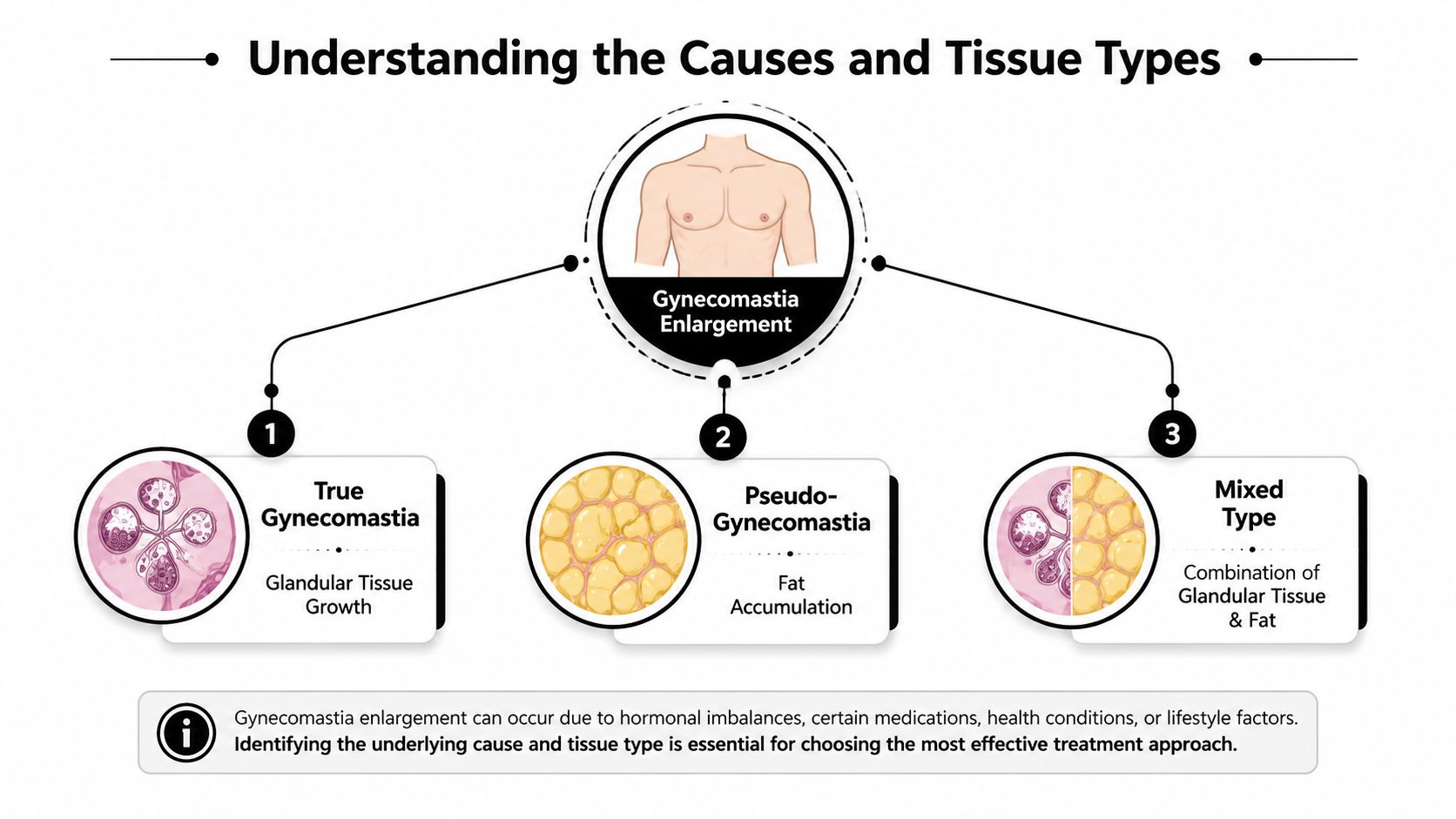
The most useful distinction is between pseudo-gynecomastia, true gynecomastia, and a mixed presentation. That distinction determines what a non-surgical treatment can realistically change.
Fat, gland and combination tissue
Pseudo-gynecomastia means the visible enlargement comes predominantly from adipose tissue. The chest tends to feel soft, and the fullness may change as overall body weight changes. Diet, activity, and targeted fat-reduction technology may improve the contour, although no method can guarantee that every area loses fat evenly.
True gynecomastia involves the growth of glandular tissue, often felt as a firmer disc or area beneath the nipple. Exercise can strengthen the pectoral muscles around it, but it doesn't selectively dissolve the gland. Fat-freezing and similar devices target fat cells, not dense glandular tissue.
Mixed gynecomastia contains both elements. Expectations often go wrong in these cases. A treatment may reduce the soft layer around the chest while leaving a firm central projection. The result can be an improvement in overall shape without complete flattening.
Why weight loss may not finish the job
Weight loss reduces body fat rather than choosing one specific tissue type. As the surrounding fat becomes thinner, persistent glandular tissue can appear more obvious, even though the person has made substantial progress.
Hormonal or medication-related factors can also matter. A clinician may review medicines, supplements, anabolic steroid use, alcohol intake, medical conditions, symptoms, and, where appropriate, blood tests. Reversible causes should be addressed before someone commits to a cosmetic plan.
The practical rule: don't judge suitability from photographs alone. A hands-on examination, medical history, and appropriate clinical assessment are more useful than guessing from the mirror.
For a broader explanation of the surgical side and how clinicians distinguish tissue concerns, understanding gynecomastia surgery can provide useful background. If your concern appears to be predominantly soft chest fat, you can also review how to reduce chest fat alongside professional advice.
Effective Non-Surgical Technologies Available
Non-surgical devices have a defined role, but their role is narrower than many adverts suggest. They can address fat volume, local contour, and skin quality. They can't excise a firm glandular mass.
That limitation doesn't make them useless. It makes tissue assessment essential. A man with mostly chest fat may see a meaningful contour change from a suitable treatment. A man with a dense gland beneath the nipple may see only partial improvement if the device is used alone.
Cryolipolysis for the fatty component
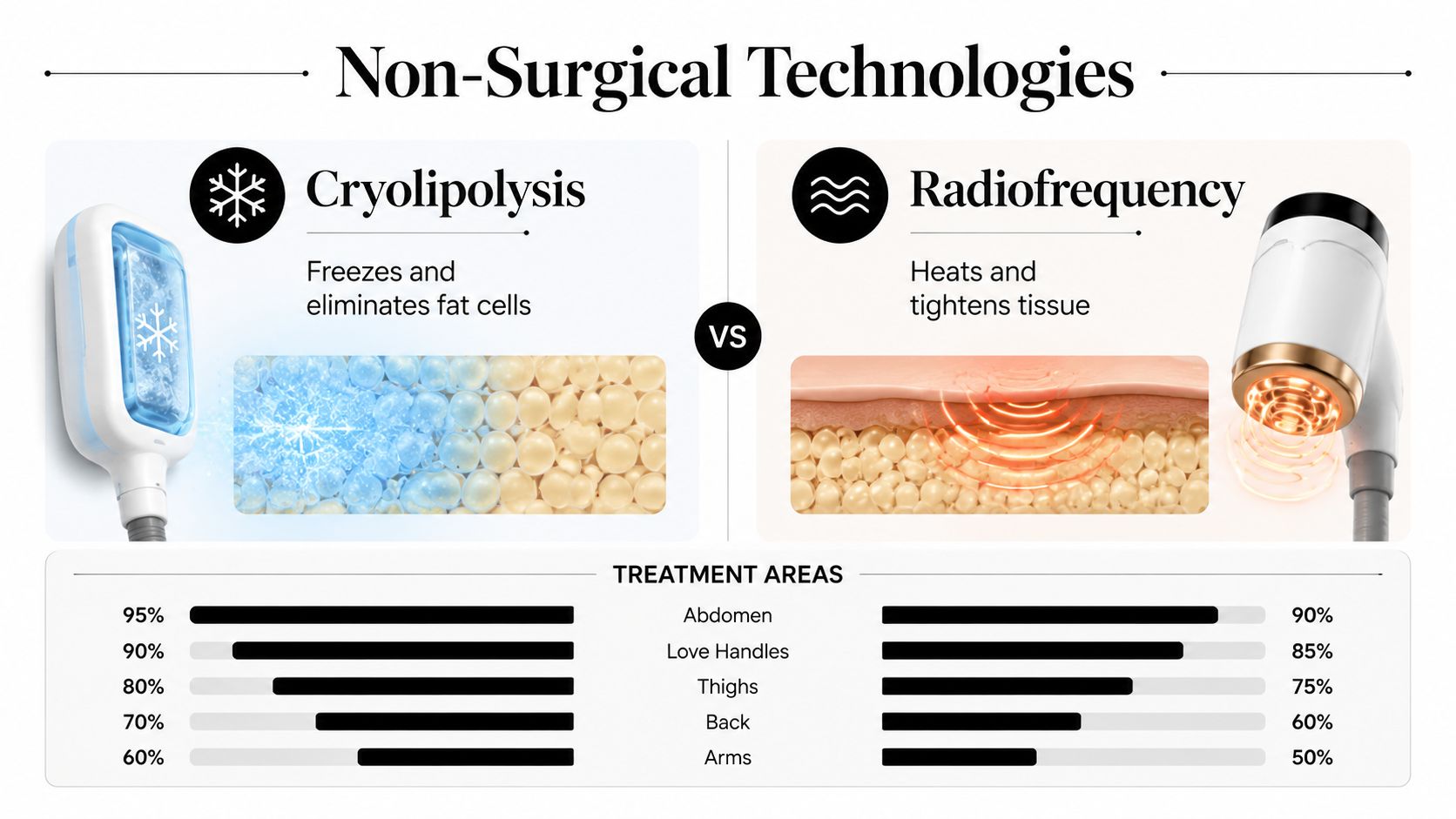
Cryolipolysis, often called fat freezing, cools a selected fat layer under controlled conditions. The body then processes the affected fat cells gradually. It's suited to pinchable, localised fat rather than a hard area directly beneath the areola.
A practitioner must assess the chest carefully because male breast fullness is not always a simple fat pocket. Treatment placement, applicator suitability, skin condition, and the amount of tissue available all affect whether the area can be treated appropriately.
Ultrasound cavitation and focused ultrasound
Ultrasound cavitation uses acoustic energy in body-contouring protocols intended for localised fat reduction. It may be considered where the concern is soft fat, but it shouldn't be presented as a way to remove glandular tissue.
High-intensity focused ultrasound, or HIFU, can be used in body treatments with the aim of affecting localised tissue and supporting skin tightening. It isn't a substitute for gland excision. Its relevance depends on whether laxity or surface contour contributes to the appearance after the fatty component has been addressed.
Radiofrequency for tightening
Radiofrequency, or RF, heats tissue in a controlled treatment setting. Its main value in this context is skin tightening and surface refinement, rather than removal of the gland beneath the nipple. RF may complement fat reduction when skin elasticity is part of the concern, but it won't convert true gynecomastia into a flat chest by itself.
These technologies are therefore best understood as tools for selected anatomy:
| Main tissue concern | Technology may be relevant for | Main limitation |
|---|---|---|
| Soft, localised fat | Cryolipolysis or ultrasound-based contouring | Doesn't remove glandular tissue |
| Skin laxity or surface texture | RF or body HIFU | Doesn't replace tissue excision |
| Firm gland beneath the nipple | Medical assessment and specialist options | Device-based fat reduction is unlikely to remove it |
| Fat plus gland | A tailored plan, sometimes involving more than one pathway | Partial improvement is possible if the gland remains |
The NHS study cited earlier supports the broader clinical pattern that many referred men are managed conservatively, but it doesn't prove that any specific cosmetic device works for every patient. For information about UK-focused non-surgical fat removal, look for clear explanations of candidacy, limitations, and follow-up rather than promises of a universal fix.
Non-Surgical Treatments Compared to Surgery
The central difference is physical. Non-surgical contouring reduces or remodels selected soft tissue. Surgery can remove glandular tissue directly. That distinction should guide the decision, not fear of one option or exaggerated claims about the other.
A non-surgical plan usually appeals to men who want no incision, no surgical scar, and a gradual change. It can be appropriate when the chest fullness is predominantly fat and the skin has enough elasticity to settle over the new contour. The treatment is performed externally, and recovery is generally easier than an operation, although the exact sensations and aftercare depend on the technology used.
Surgery offers a more direct route when a firm gland is the main source of projection. A surgeon may combine excision of glandular tissue with liposuction for surrounding fat, depending on the anatomy. More extensive skin excess can require a different operative approach. The trade-off is an incision, surgical recovery, potential scarring, and the usual need for a proper medical assessment.
A practical comparison
| Consideration | Non-surgical contouring | Surgical reduction |
|---|---|---|
| Tissue addressed | Primarily fat and, with some technologies, skin quality | Glandular tissue, fat, and sometimes excess skin |
| Skin access | No incision | Incisions are required |
| Change | Gradual and usually more modest | More direct and potentially more comprehensive |
| Recovery | Often limited, but treatment-specific effects can occur | Requires planned postoperative recovery |
| Scarring | No surgical scar | Scars may remain and mature over time |
| Best fit | Predominantly fatty fullness with realistic expectations | Established glandular enlargement or significant excess tissue |
A key UK policy point is that male breast reduction surgery is rarely funded by the NHS. NHS guidance says surgery may be considered when gynaecomastia has lasted a long time, hasn't responded to other treatments, or causes considerable pain or distress, and male breast reduction isn't usually available on the NHS according to NHS guidance.
That doesn't mean surgery is automatically required. It means a person with persistent glandular tissue shouldn't spend repeatedly on fat treatments expecting them to perform an operation without an incision. Equally, someone with mainly chest fat doesn't need to assume surgery is the only possible route.
Assessing Your Candidacy and Expected Results
Suitability depends on what you have, what you want changed, and how stable the situation is. A good candidate for non-surgical chest contouring generally has a localised fatty component, a reasonably stable weight, and skin that can adapt after the treated fat volume decreases.
A consultation should also explore whether the enlargement is recent, painful, changing, one-sided, or associated with another symptom. Those features don't automatically indicate a serious problem, but they make medical assessment more important than booking a cosmetic session immediately.
Use a four-part decision check
Tissue: Is the fullness soft and pinchable, or is there a firm area beneath the nipple? Mixed tissue is common, so the answer may not be entirely one or the other.
Skin: Does the skin appear reasonably elastic, or is there significant looseness? Fat reduction alone cannot remove a substantial fold of excess skin.
Stability: Has your weight and chest appearance been fairly stable? Ongoing weight change can alter the result and make it harder to judge the appropriate treatment area.
Expectation: Are you seeking a reduction in soft fullness, or complete removal of a firm projection? The second expectation may point towards specialist surgical assessment.
Results from fat reduction aren't immediate. The body needs time to process treated fat, and the visible change develops gradually rather than appearing when you leave the clinic. A responsible practitioner won't promise a precise outcome or claim that one session works for every chest.

The Association of Breast Surgery states that tamoxifen or anastrozole may be considered in selected persistent pubertal or unexplained cases, and that treatment is most effective before tissue becomes fibrotic in its UK pathway guidance. This is a medical treatment question, not a cosmetic-device shortcut. Those medicines are used selectively and require appropriate clinical supervision.
Your Consultation Journey at 3D Aesthetics
A sensible consultation starts with listening. You should be able to explain when the change began, whether it hurts, what you've already tried, and what outcome would make you feel more comfortable. The practitioner should examine the area and explain whether the proposed service is designed for fat, skin laxity, or another concern.
At a clinic such as 3D Aesthetics Leamington Spa, the consultation can include a complimentary assessment and a 3D body scan. The scan helps document body contours and track changes over time. It supports the conversation, but it shouldn't be described as a replacement for medical diagnosis or a definitive test that identifies every type of glandular tissue.
What the appointment should establish
- The problem to treat: whether the visible fullness appears mainly fatty, mixed, or unsuitable for a non-surgical approach.
- The treatment area: how the chest shape, tissue thickness, symmetry, and skin quality affect device selection.
- The plan: which technology may be appropriate, what it can realistically achieve, and what it cannot change.
- The safety process: relevant health history, contraindications, expected sensations, aftercare, and when to seek help.
- The review method: how photographs, measurements, or repeat scans will help assess progress rather than relying on daily mirror checks.

Ask whether the practitioner believes the tissue is suitable for fat reduction and what happens if the glandular component remains. You can also ask about body measurement tracking so the review process measures contour change objectively.
A UK clinic should be clear about its qualifications, treatment protocols, consent process, privacy, and aftercare. If a provider promises that a fat device will dissolve true glandular gynecomastia, treat that as a warning sign rather than reassurance.
Frequently Asked Questions
Will non-surgical treatment remove a firm gland? Usually not. Fat-reduction technologies address fat, while established glandular tissue needs medical or surgical assessment.
Is treatment painful? Sensations vary by technology and individual tolerance. Your provider should explain cooling, heat, pressure, or tenderness before treatment.
Can I return to work? Many non-surgical procedures involve little disruption, but temporary redness, swelling, numbness, or sensitivity can occur.
How many sessions will I need? It depends on tissue type, treatment area, device, and your desired change. A consultation is more reliable than a fixed promise.
Should I speak to my GP? Yes, especially for sudden, painful, one-sided, or persistent enlargement, or if you take medicines that could contribute.
If you're in or near Leamington Spa, visit 3D Aesthetics Leamington Spa for a complimentary consultation and 3D body scan to assess whether your chest fullness is suitable for non-surgical fat reduction. The team can discuss options such as cryolipolysis, ultrasound cavitation, body HIFU, and RF while keeping the distinction between fat and glandular tissue clear.
← Back to Home