
A pink-red mark on a baby's cheek can prompt the same uneasy questions for many families: Will it fade? Is it harmless? Should treatment start now, or can we wait? Adults may arrive at the same decision years later, after noticing that a once-flat patch has become darker, thicker or harder to conceal. The uncertainty is understandable, particularly when NHS access, private treatment and realistic results can seem difficult to manage.
Port wine stain treatment is usually a gradual process rather than a single appointment or guaranteed removal. The right plan depends on the stain's colour, depth, location, texture, age and the person's skin. Early assessment can clarify whether pulsed dye laser is suitable, what improvement may be realistic, and whether a thicker or resistant lesion needs specialist discussion beyond laser alone.
Table of Contents
- Introduction to Port Wine Stains and Why Treatment Matters
- What Causes Port Wine Stains and How Diagnosis Works
- Evidence Based Port Wine Stain Treatment Options Compared
- What to Expect From Consultation Through Treatment and Aftercare
- Sessions Timelines Age Considerations and Likely Outcomes
- Costs NHS Access and How to Choose a Clinic Safely
- Your Next Steps and Maintaining Results Over Time
Introduction to Port Wine Stains and Why Treatment Matters
A child's pink or red facial mark may lead parents to wonder whether it will fade, whether it is harmful and whether treatment should begin soon. An adult may face the same decision years later, especially if a once-flat patch has become darker, thicker or more difficult to conceal. A port wine stain is a capillary malformation, formed by small blood vessels near the skin's surface. It can deepen from pink to red or purple and may develop a more textured surface over time.
This change does not mean anyone has caused it, and the mark is not automatically dangerous. Treatment is often considered because of appearance, unwanted attention or the emotional effect of a visible mark. Early advice can also help families understand the likely course before further thickening makes management more complicated.

Why early information helps
Port wine stains are a recognised paediatric dermatology concern. Great Ormond Street Hospital explains port wine stains and their treatment, including why specialist advice may be useful early in life.
Pulsed dye laser, commonly called PDL, targets blood vessels and can reduce the stain's colour. Treatment earlier in life may be easier before the area becomes thicker, although adults can still achieve meaningful lightening after assessment. NHS access may involve waiting and referral, so discussing realistic timing early can help families compare available routes without assuming that delay makes treatment pointless.
A realistic starting point: treatment usually aims to make the mark lighter and less noticeable. Complete removal is uncommon, and improvement often requires several sessions over a long period.
A clinician or appropriately trained laser professional should examine the mark rather than judge suitability from a photograph alone. Assessment can distinguish a flat capillary malformation from thickening, nodularity or another feature needing specialist referral. If a lesion has become raised or bulky, laser alone may not provide enough change, and a specialist team may discuss additional procedures or other staged options.
What Causes Port Wine Stains and How Diagnosis Works
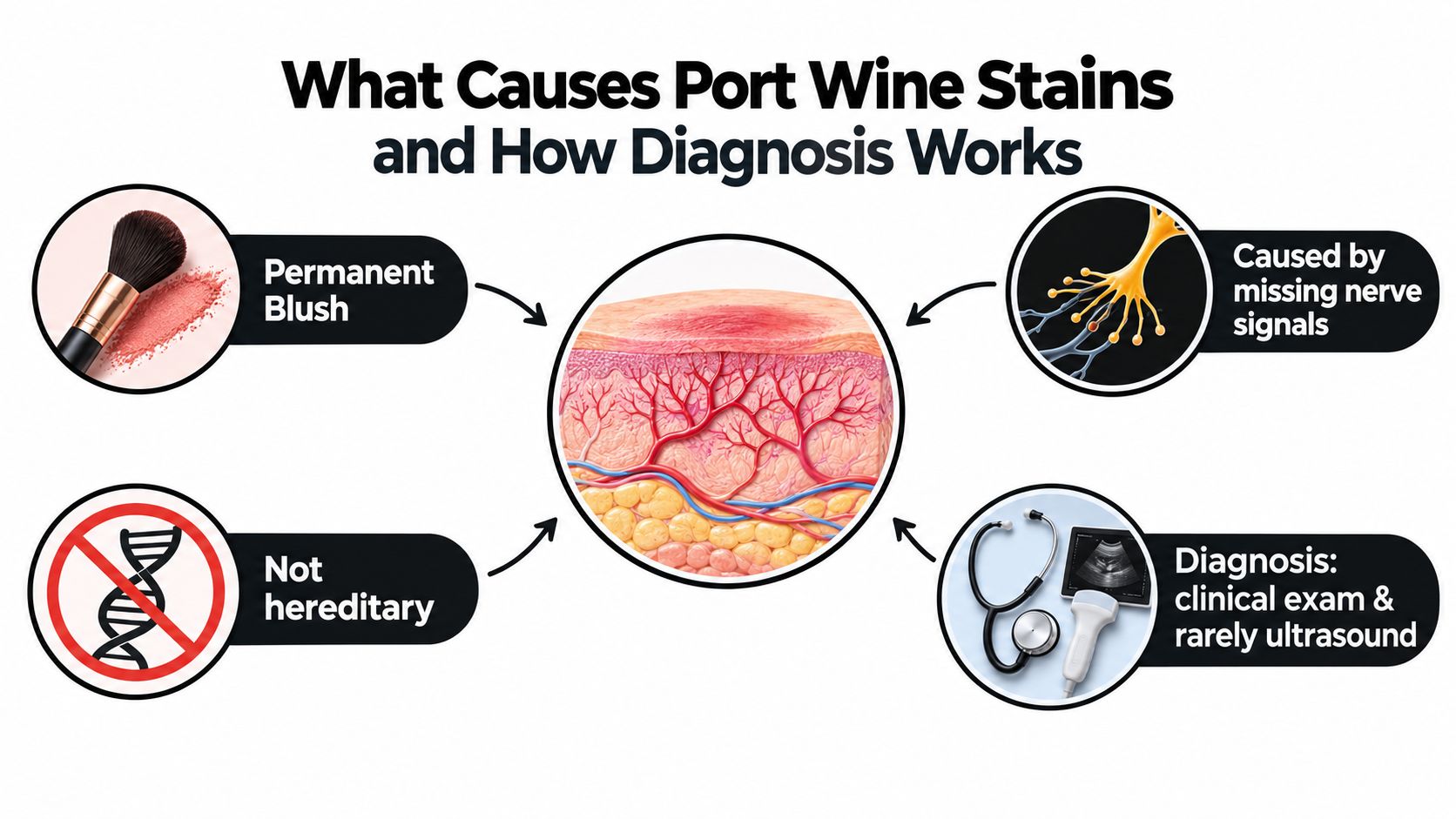
Normal capillaries form a fine network of tiny vessels beneath the skin. A port wine stain is a capillary malformation. Some of these vessels develop differently and remain more visible near the surface, creating a colour that can look like a permanent blush. It is not surface pigment, so a pigmentation laser is not the logical match.
Vascular laser works by directing light towards blood inside the affected vessels. The treated material is then cleared gradually by the body, and the mark may become lighter. Early assessment matters because a flatter lesion is generally easier to treat than one that has become thicker or nodular. Adults can still gain meaningful improvement, although expectations should be based on the lesion's current depth, colour and texture. NHS referral routes may involve waiting, so families often need to weigh access and timing rather than assume that delayed treatment has no value.
How clinicians assess the mark
Diagnosis is usually clinical. A trained clinician examines several features:
- Colour: Pink, red, purple and deeper shades can reflect differences in the visible vessels.
- Surface: A flat patch needs different counselling from skin that has become raised, thickened or nodular.
- Location: Facial and limb lesions may respond differently, while areas near the eyes require careful planning.
- Extent: Measurements and photographs create a baseline for judging gradual change.
- Associated signs: Certain facial patterns or symptoms may lead to specialist referral and, when appropriate, further assessment.
Further investigation is considered when the appearance, distribution or symptoms raise questions about deeper structures or an associated condition. Colour alone does not decide the pathway.
A clinician should also distinguish an uncomplicated vascular mark from other vascular lesions and how they are assessed. Bring childhood photographs, notes about changes in colour or texture, a medicine list and details of previous laser or light treatment to the appointment.
If a lesion has become bulky or irregular, laser alone may not create enough change. A specialist team might discuss additional procedures or staged treatment, depending on the findings. The purpose of diagnosis is therefore practical: match the treatment plan to the vessels' depth, the skin's surface and the person's goals.
Evidence Based Port Wine Stain Treatment Options Compared
The main comparison begins with pulsed dye laser. PDL is the treatment of choice in UK specialist dermatology practice because its light is designed to target blood vessels selectively. It's the benchmark against which other light-based approaches are usually considered.
The British Association of Dermatologists notes that PDL is available in specialist centres and may require up to 10 sessions at roughly 8-week intervals. Facial lesions generally respond better than limb lesions, while earlier treatment tends to produce better outcomes before thickening develops. The British Association of Dermatologists' vascular birthmark guidance provides this specialist context.
| Treatment option | How it works | Best for | Limitations |
|---|---|---|---|
| Pulsed dye laser | Delivers vascular-selective light absorbed by blood within superficial vessels | Many flat port wine stains, particularly when assessed early | Multiple sessions are common, limb lesions may respond less well, and complete removal is uncommon |
| Other vascular lasers | Uses a different wavelength or treatment profile to reach selected vessels | Carefully chosen lesions that are resistant or deeper | Suitability depends on depth, colour, skin type and clinician experience; evidence is less established than for PDL |
| Intense pulsed light | Delivers a broad range of light rather than one narrowly targeted laser wavelength | Selected superficial vascular colour concerns | It isn't the standard benchmark for port wine stains, and response can be less predictable in thicker or difficult lesions |
| Photodynamic therapy | Combines a light-sensitive process with targeted light exposure | An emerging or specialist option in selected cases | It needs careful specialist selection and doesn't replace first-line assessment with PDL |
| Intralesional bleomycin | Injects medicine into thickened vascular tissue | Thick or refractory lesions, especially when tissue change limits laser response | This is an escalation option requiring a specialist vascular birthmark service, not a routine cosmetic treatment |
A UK evidence review found that PDL provides clinically relevant clearance, while stronger randomised evidence is still needed for other light and light-source modalities. The Cochrane-indexed review on laser treatment for port wine stains supports a cautious approach to alternatives. In practice, a different device may have a role, but “newer” doesn't automatically mean more suitable.
If visible thread veins or facial telangiectasia are part of the wider concern, a provider may discuss related vascular treatments separately. Information about treatments for spider veins on the face can help distinguish those small superficial vessels from a congenital port wine stain.
What to Expect From Consultation Through Treatment and Aftercare
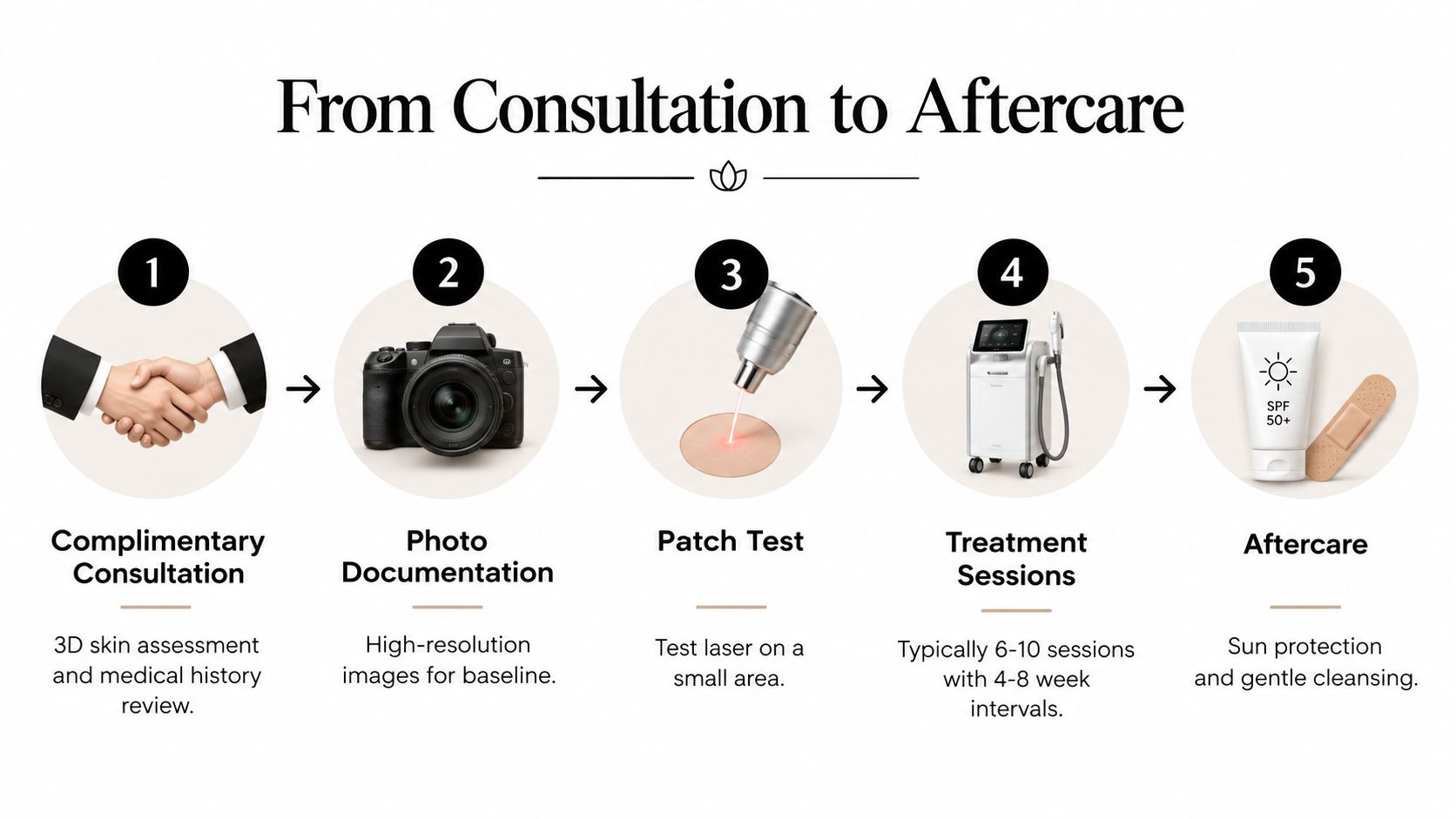
A good appointment should feel more like planning than pressure. The clinician examines the stain, records its size and appearance, asks about health and previous treatments, and explains whether the proposed device matches the lesion. Some clinics may use structured photography or a 3D assessment where relevant, but the treatment decision still depends on clinical examination.
Photographs matter because fading is usually gradual. A baseline image taken in consistent lighting makes small changes easier to judge and can prevent memory from exaggerating or minimising progress.
Before the first session
A patch test may be recommended, particularly when the clinician needs to assess how your skin responds or when pigment-change risk requires extra caution. You should disclose recent tanning, active skin irritation, medicines, a history of unusual scarring and any previous energy-based treatment.
The professional should also explain eye protection, expected sensation, cooling and the plan for review. Ask who will perform the treatment, which device will be used, how the settings are chosen for your skin type and what happens if the response is weaker than expected.
During and after treatment
PDL commonly feels like a brief snapping, stinging or flicking sensation. Cooling and, where appropriate, topical anaesthetic can make the experience easier. Protective eyewear is essential, especially for marks near the eyes.
Immediately afterwards, the skin may look red, swollen or bruised. Those effects are part of the expected short-term response for many patients, but your provider should explain which changes are normal and which require contact with the clinic. Keep the area clean, avoid picking or rubbing, follow the clinic's wound-care instructions and protect healing skin from sunlight.
UK NHS leaflets report that laser can improve around 80% of port wine stains, but several sessions are usually needed and complete removal is uncommon. Great Ormond Street Hospital describes the best results as typically coming from 4 to 6 treatments spread over 2 to 3 years, while other NHS guidance describes intervals of 6 to 8 weeks between sessions. This NHS leaflet on vascular skin lesions explains why the pathway can be lengthy.
For general principles around protecting treated skin, compare your provider's instructions with this practical guide to laser treatment aftercare. The instructions for a vascular birthmark may differ, so your clinic's advice takes priority.
Sessions Timelines Age Considerations and Likely Outcomes
Port wine stain treatment works more like turning down a dimmer switch than deleting a mark with an eraser. Each session may reduce some of the vascular colour, then the skin needs time to settle before the clinician decides whether another treatment is appropriate.
Age matters because younger skin and an earlier-stage lesion may be easier to treat before vessels become thicker and the surface develops texture. The British specialist guidance cited earlier also reports better responses for facial lesions than limb lesions. That doesn't make adult or limb treatment pointless. It changes the conversation about likely lightening, treatment duration and whether laser alone will be enough.
What the UK figures mean in practice
UK hospital guidance reports that about 70% of children improve by roughly 70% after 4 to 6 laser sessions, while another NHS service says around 80% of stains can be improved. The Birmingham and Solihull NHS policy information stresses that results vary with lesion characteristics, and that adult changes such as cobblestoning need different counselling.
Those figures describe improvement, not a promise of complete clearance for every person. A flat facial stain may respond more favourably than a thickened lesion on a limb. Colour, depth, texture, location, age and skin type all influence how a clinician selects settings and estimates the likely pathway.
Children and adults need different expectations
For a child, early referral gives the family time to discuss timing, comfort, safeguarding and the practical demands of repeated visits. It may also allow treatment before thickening becomes more established.
Adults often ask whether it's “too late”. It isn't automatically too late, but an older lesion may be darker, deeper or more textured, which can reduce the response to superficial laser treatment. An adult plan may focus on meaningful reduction in contrast, rather than promising that the mark will vanish. If colour returns or residual vessels remain visible, future review or maintenance may be discussed.
The most useful forecast comes from an examination, not a generic session calculator. Ask for a staged plan with a review point, expected milestones and a clear explanation of what the clinician will do if progress plateaus.
Costs NHS Access and How to Choose a Clinic Safely
Many families assume that a visible birthmark automatically qualifies for NHS treatment. In reality, UK NHS guidance says port wine stain laser treatment is often not routinely funded. Some integrated care board policies may require an Individual Funding Request, with decisions influenced by local criteria and the available evidence around long-term outcomes, quality of life and cost-effectiveness.
That makes the referral route worth clarifying early. Ask your GP or specialist team whether an NHS vascular birthmark service is available locally, whether referral criteria apply and what happens if funding is declined. A refusal of routine funding isn't the same as a clinical statement that treatment cannot help.
Private pricing usually depends on the area treated, lesion complexity, equipment, practitioner expertise and the number of sessions. A responsible clinic should explain what the quoted fee includes, whether review appointments are included and how it handles a weak response or an unexpected skin reaction.
A safe clinic checklist
- Relevant experience: Choose a provider who regularly assesses vascular lesions, not only hair removal or general cosmetic pigmentation.
- Device clarity: Ask whether the proposed device is PDL or another technology, and why it suits the lesion's colour, depth and texture.
- Skin-type planning: Confirm how the practitioner reduces pigment-change risk and whether a patch test is appropriate.
- Evidence of assessment: Look for consistent clinical photographs and written treatment plans, rather than guaranteed results.
- Aftercare access: Find out who you contact if swelling, blistering, unusual pain or prolonged colour change concerns you.
- Escalation knowledge: A clinic should recognise when laser isn't enough and refer appropriately.
Thickened lesions deserve particular care. South Tees NHS states that thick port wine stains or associated thickened tissue may be considered for intralesional bleomycin. Its vascular birthmark service reports treating more than 620 patients, with a 93% response rate, including 83% with significant improvement. South Tees NHS explains intralesional bleomycin for vascular birthmarks. Those figures come from that service and shouldn't be treated as a guarantee for an individual patient.
Your Next Steps and Maintaining Results Over Time
Begin with a specialist assessment and a realistic baseline. The clinician can check whether the mark remains a flat capillary malformation, whether thickening has developed and whether pulsed dye laser, or PDL, is a sensible first option. Treatment usually works through gradual change, with sessions spaced apart and photographs used to judge progress. One appointment rarely provides a complete answer.
Sun protection helps keep treated and untreated areas from appearing more different after tanning. Healing skin can also be more sensitive to irritation, so follow the products and timing recommended by your clinician. Attend reviews and report changes in texture, colour or symptoms promptly rather than waiting for the next session.
A thickened or resistant stain may need a different plan. Ask whether laser alone is still appropriate and whether referral to a specialist vascular birthmark service should be considered. South Tees NHS notes that thick port wine stains or related thickened tissue may be considered for intralesional bleomycin, with treatment decisions made through specialist assessment. South Tees NHS explains intralesional bleomycin for vascular birthmarks.
3D Aesthetics Leamington Spa offers consultation-led vascular lesion assessment through its 3D Vasculase service, including discussion of whether laser treatment may suit a port wine stain. To explore treatment planning and aftercare, visit 3D Aesthetics Leamington Spa. The strongest plan explains likely improvement, possible persistence and the next option if progress slows.
← Back to Home