

You may be dealing with stubborn cellulite that hasn't changed despite exercise, a plateau in body contouring, or tendon pain that keeps returning whenever you increase activity. Shockwave therapy appears in all three conversations, but the phrase can hide important differences. The treatment has a specific role, and its benefits depend on the condition, the device, the protocol, and what you combine it with.
For tendon and soft-tissue problems, extracorporeal shockwave therapy has a recognised place in UK musculoskeletal care. For cellulite and body contouring, the evidence is more modest and supports an adjunctive role rather than a replacement for fat-reduction treatments. Understanding that distinction is the best way to judge whether shockwave therapy benefits match your goal.
Table of Contents
- Where Shockwave Therapy Actually Fits
- How Acoustic Pressure Becomes a Biological Signal
- What the Evidence Says for Cellulite and Body Contouring
- A Realistic Treatment Course From Session One to Results
- When You Will Notice the Benefit and How Long It Lasts
- Shockwave Compared to Cryolipolysis Cavitation and Radio Frequency
- Who Is a Good Candidate and How Clinics Measure Progress
- Choosing Shockwave With Confidence
Where Shockwave Therapy Actually Fits
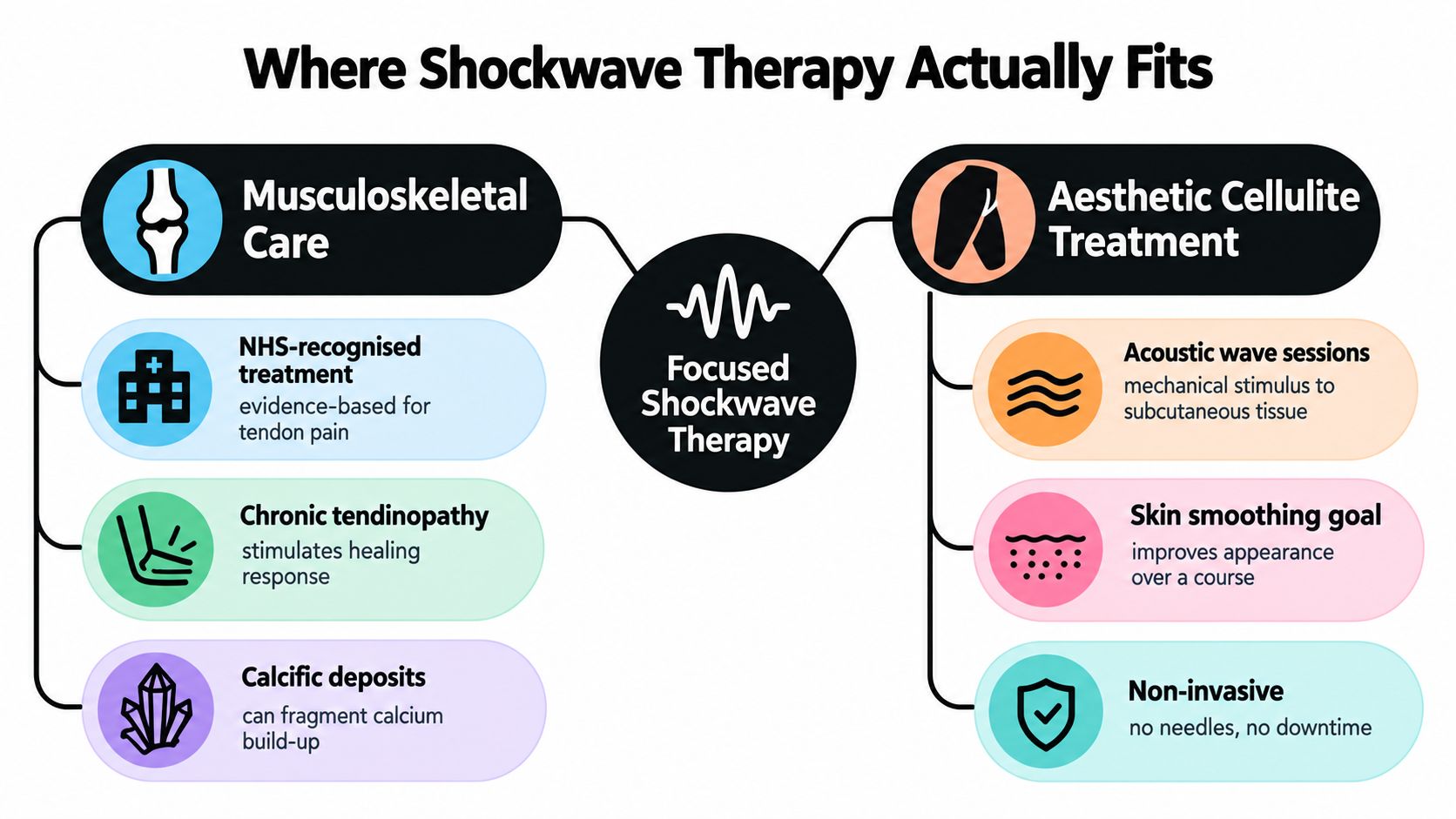
Shockwave therapy is one technology used in two noticeably different settings. In musculoskeletal care, clinicians use focused shockwave to target persistent tendon problems, plantar fasciitis, calcific shoulder tendinitis, and stubborn elbow pain. UK NHS guidance commonly presents it as a treatment for pain and function, usually alongside rehabilitation rather than as a general wellness procedure. An NHS leaflet from Oxford University Hospitals describes reported effectiveness in studies while also stressing that treatment doesn't work for everyone and is most useful with rehabilitation, as explained in its patient information on extracorporeal shockwave therapy.
In aesthetic clinics, radial acoustic waves are applied across larger areas such as the thighs, buttocks, or abdomen. The goal is usually smoother-looking skin, improved tissue quality, and reduced cellulite dimpling, not the direct removal of a substantial volume of fat. That makes it closer to a tissue-remodelling and finishing treatment than a standalone slimming procedure. For context, body contouring itself covers several different approaches, as outlined in this guide to what body contouring means.
The clinical question comes first
Ask what you want the treatment to change:
- Persistent tendon pain: shockwave may support pain reduction and functional rehabilitation.
- Calcific deposits: focused energy may help fragment calcified tissue in selected conditions.
- Cellulite texture: radial treatment may improve the appearance of dimpling over a planned course.
- Larger fat-volume reduction: shockwave isn't the primary tool because it doesn't directly destroy fat cells.
The phrase shockwave therapy benefits therefore needs a condition attached to it. A benefit demonstrated for intermittent claudication or Achilles tendinopathy shouldn't automatically be transferred to cellulite, and an aesthetic result shouldn't be presented as proof of a medical effect.
Practical rule: Choose the treatment according to the tissue problem, not the marketing name on the clinic menu.
How Acoustic Pressure Becomes a Biological Signal
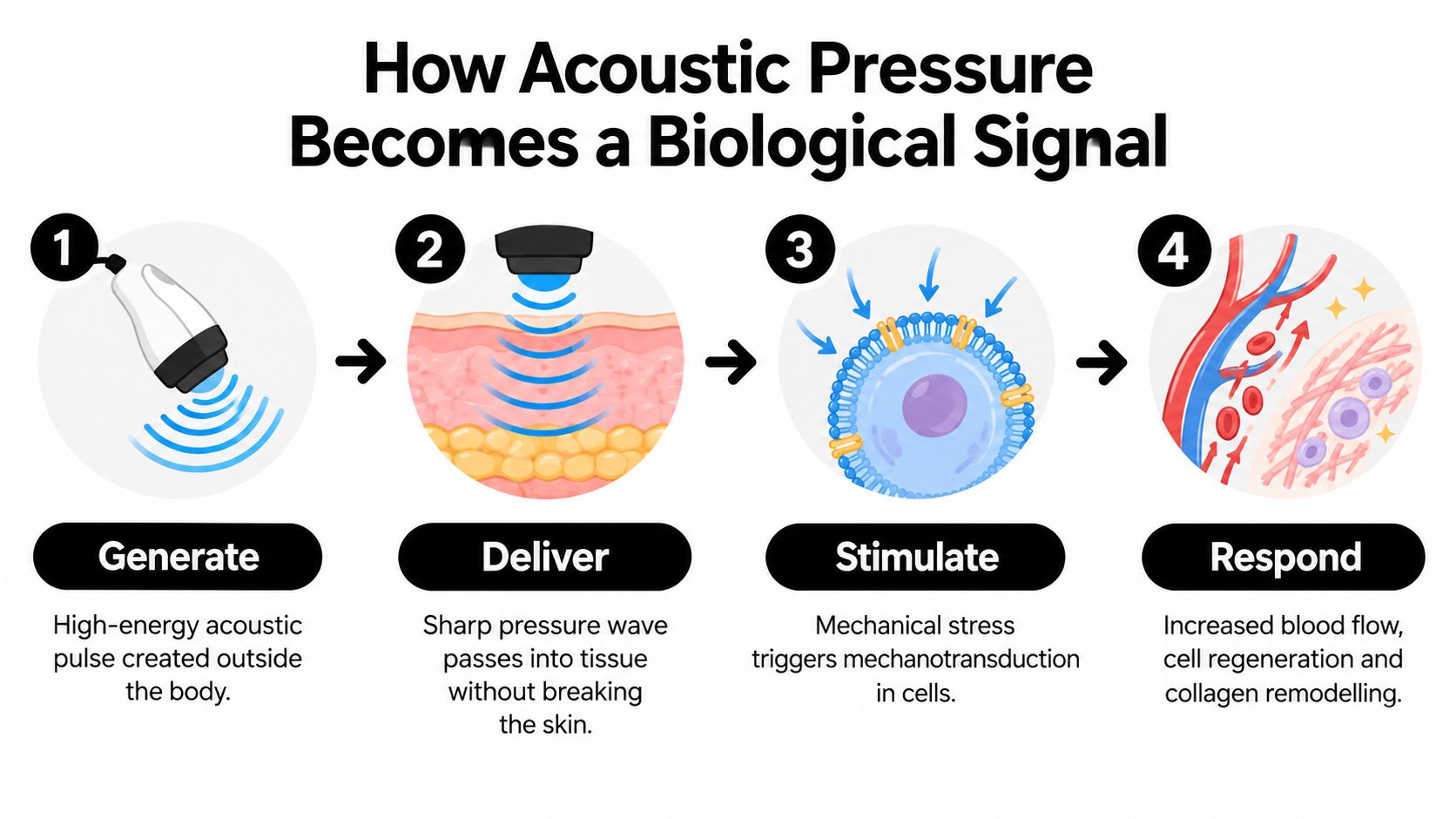
A shockwave device creates a brief, high-energy acoustic pulse outside the body. The applicator transfers that pressure through coupling gel and the skin, so the treatment can deliver a mechanical stimulus without an incision. A useful analogy is a single, controlled flick to a trampoline. The surface moves, and the impulse travels through the material rather than heating or cutting it.
Inside tissue, cells detect that mechanical change through a process called mechanotransduction. Mechanical stress is converted into chemical signalling, which can influence circulation, connective-tissue activity, and the local healing response. In an aesthetic setting, clinicians use this stimulus to work on the tissue structures associated with cellulite texture. In musculoskeletal care, the target is more specific, such as a tendon insertion or calcific deposit.
Focused and radial are not interchangeable
Clinic descriptions often use “shockwave” as though every machine delivers the same treatment. It doesn't.
Focused shockwave concentrates energy at a chosen depth. That precision suits musculoskeletal applications where the clinician needs to target a particular tendon, insertion, or calcific area. The NHS-linked intermittent claudication pilot used an intensive three-week course and found statistically significant gains in maximum walking distance, initial claudication distance, and post-exertional ABPI in the active group, with benefits for walking remaining at 12 months, according to the published Coventry University record.
Radial shockwave, also described as radial pressure wave therapy or acoustic wave therapy, spreads energy more broadly from the handpiece. That makes it practical for mapping larger superficial areas, including cellulite-prone skin over the thighs and buttocks. It shouldn't be assumed to have the same depth, energy distribution, or evidence base as focused treatment.
The biological response also isn't a guarantee of a visible result. Tissue signalling can support repair or remodelling, but the final outcome depends on the diagnosis, baseline tissue quality, loading programme, treatment settings, and individual response.
What the Evidence Says for Cellulite and Body Contouring
A person seeking shockwave therapy for cellulite may notice smoother-looking skin, while someone expecting substantial fat loss may be disappointed. The aesthetic evidence supports a narrower claim. A 2023 review in the Aesthetic Surgery Journal included 13 aesthetic-context studies, all reporting beneficial physiological effects related to cellulite, body contouring, or skin tightening. It also identified limits, including small trials and varied treatment protocols, as described in the Aesthetic Surgery Journal review.
Shockwave may affect connective tissue and the skin features associated with dimpling. That does not establish it as a standalone treatment for removing a large amount of adipose tissue. A discrete fat bulge may require another modality for the primary fat-reduction effect, with shockwave considered an adjunct for surface texture or tissue quality.
One UK-relevant trial treated the gluteus and posterior thighs with 12 sessions over six weeks. Severe cellulite decreased from 60% of participants to 38%, while the Cellulite Severity Scale changed from 11.1 to 9.5. Both findings were reported as statistically significant at p<0.001. The report also recorded hip circumference changes from 99.7/103.2 cm to 96.2/100.3 cm, plus MRI-measured subcutaneous fat thickness changes from 28.3±6.5 mm to 26.7±6.1 mm, again reported at p<0.001, in this UK-facing cellulite trial summary.
Shockwave aesthetic evidence at a glance
| Study metric | Reported finding | How to interpret it |
|---|---|---|
| Included aesthetic studies | 13 studies | Review covering cellulite, contouring, or tightening research |
| Cellulite treatment course | 12 sessions | Six weeks in the UK-relevant trial |
| Cellulite Severity Scale | 11.1 to 9.5 | Change reported at p<0.001 |
| Hip circumference | 99.7/103.2 cm to 96.2/100.3 cm | Change reported at p<0.001 |
| Subcutaneous fat thickness | 28.3±6.5 mm to 26.7±6.1 mm | MRI measurement, reported at p<0.001 |
These figures show why progress should be measured rather than judged from memory, posture, or changing bathroom light. They do not predict the same result for every person, and they do not make shockwave a weight-loss treatment. A sensible plan presents it as an adjunct for cellulite texture and tissue quality, supported by standardised photographs, circumference measurements, and, where appropriate, scan-based assessment.
A Realistic Treatment Course From Session One to Results
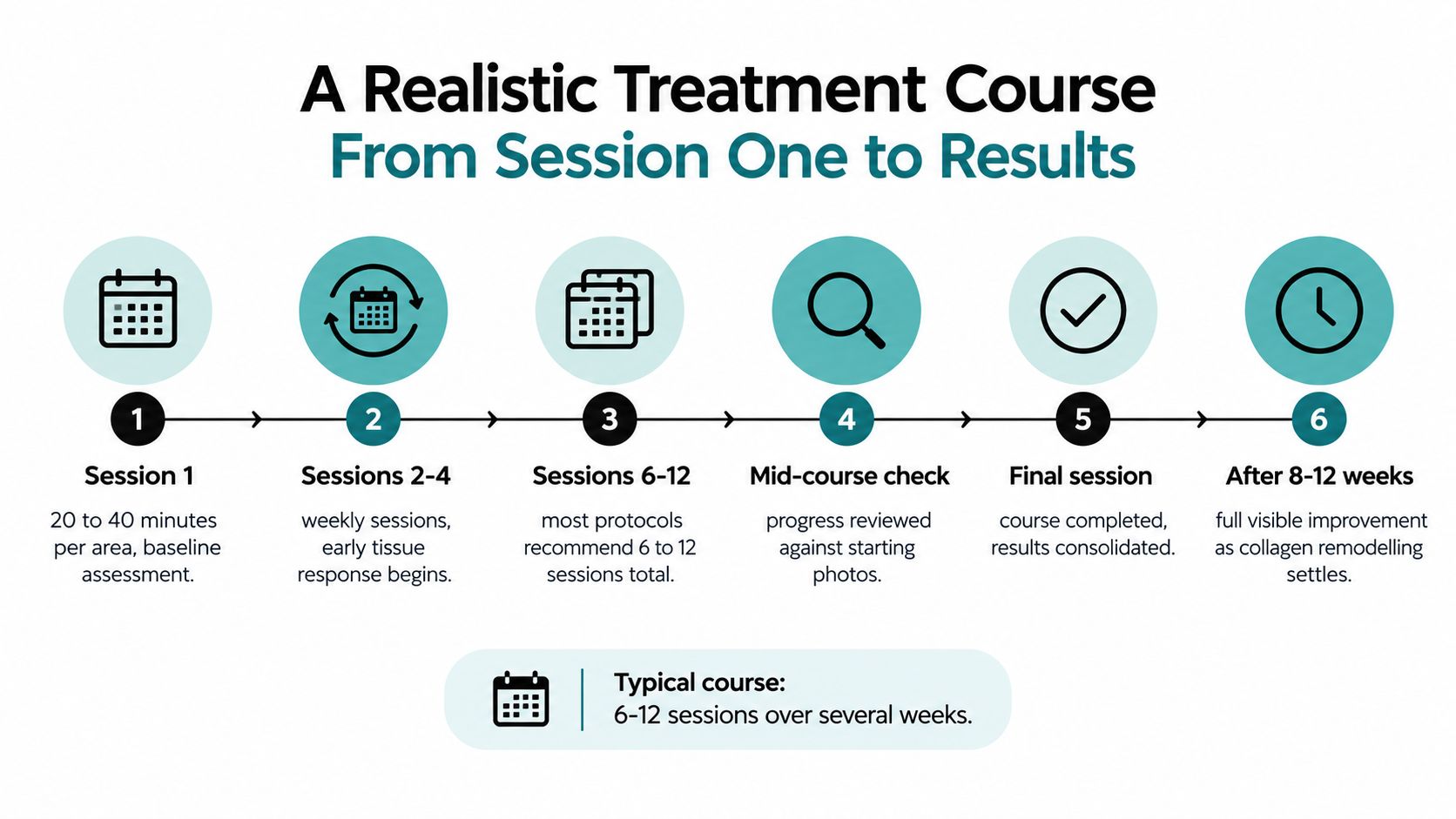
An aesthetic shockwave appointment usually starts with an assessment of the treatment area rather than immediate use of the handpiece. The clinician marks the zone, applies coupling gel, and moves the applicator across the skin in a controlled pattern. Treatment is normally felt as rapid tapping or flicking, with discomfort varying according to the area, pressure, and intensity.
What happens during a course
A practical course may look like this:
- Baseline visit: The clinic records the concern, takes standardised photographs, and agrees what outcome will be assessed.
- Treatment sessions: The clinician works across the target area and adjusts intensity according to tolerance and the treatment plan.
- Review points: Progress is compared with the baseline rather than judged from memory or changing bathroom light.
- End-of-course decision: The clinic decides whether the result is sufficient, whether another modality is more appropriate, or whether maintenance is reasonable.
For cellulite, the UK-relevant trial described above used 12 sessions over six weeks, while the broader review identified different protocols across the included studies. That variation matters. A clinic promising a fixed result after a single visit isn't reflecting the way the aesthetic evidence has generally been organised.
There is usually no incision or injection, and many people return to everyday activity after treatment. Mild redness, sensitivity, or tingling can occur, but a clinician should explain what is expected and what would require contact with the clinic. The important practical point is that visible improvement may lag behind the appointment schedule because connective tissue and skin appearance change gradually.
A treatment video can help you understand the handpiece movement and the patient experience, but it shouldn't replace a consultation or medical screening.
When You Will Notice the Benefit and How Long It Lasts
Shockwave isn't an instant correction. The clearest UK data on timing comes from musculoskeletal care, where improvement can build after treatment rather than appearing immediately. Guy's and St Thomas' reports that only 13% of people with refractory greater trochanteric pain syndrome felt better at one month, compared with 68% at four months and 74% at 15 months, in its patient guidance on refractory greater trochanteric pain syndrome.
That pattern is a useful warning for anyone expecting a dramatic same-day result. Early pain modulation can happen, but the longer-term benefit may depend on tissue adaptation, progressive exercise, and the original diagnosis. The 2025 UK randomised controlled trial on radial shockwave for chronic noninsertional Achilles tendinopathy found average pain improved by 34% at six months, while also finding no consistent benefit in global function, activity, or mood. It reported that recommended-dose treatment wasn't superior to minimal-dose treatment, as described in the published trial.
Aesthetic results need the same patience
Cellulite protocols are usually assessed across a course and sometimes after the final appointment, not immediately after the first session. Fluid shifts, tissue remodelling, and changes in skin tension can make the appearance fluctuate, so a clinic should use consistent photography and measurements.
No treatment can guarantee permanent results if the underlying factors affecting skin texture and body shape continue to change. A responsible consultation should therefore discuss what maintenance might involve and what the treatment cannot change, rather than describing shockwave as a one-off fix.
Shockwave Compared to Cryolipolysis Cavitation and Radio Frequency
The most useful comparison is mechanism, not popularity. Cryolipolysis is designed to target fat through controlled cooling. Ultrasound cavitation uses acoustic energy for a different tissue effect, while radio frequency uses heat to influence the dermis and collagen. Shockwave primarily provides a mechanical stimulus and is more naturally associated with cellulite texture and tissue remodelling than with direct fat-cell destruction.
| Modality | Mechanism | Best for | Typical sessions | Downtime | Realistic outcome |
|---|---|---|---|---|---|
| Shockwave | Mechanical acoustic pressure | Cellulite texture and tissue quality | Course-based, depending on protocol | Usually minimal | Smoother-looking skin and supportive remodelling, not a standalone large-volume fat solution |
| Cryolipolysis | Controlled cooling of targeted fat | Discrete fat bulges | Treatment plan depends on area and response | Usually minimal | Reduction of a localised fat pocket |
| Ultrasound cavitation | Low-frequency ultrasound effect | Larger-area contouring plans | Course-based | Usually minimal | Possible contour change, with response depending on assessment and protocol |
| Radio frequency | Controlled heating of skin and dermis | Skin laxity and texture | Course-based | Usually minimal | Gradual tightening and collagen-related texture improvement |
The table shows why combining treatments can make sense, but only when each one has a defined job. A clinician might use a fat-reduction modality for volume, radio frequency for laxity, and shockwave for the surface appearance of cellulite. That isn't automatically better than one treatment. It means the plan should match the tissue problem instead of asking one device to do everything.
For readers comparing options in Britain, this overview of non-surgical fat removal in the UK can help separate fat reduction from skin tightening and cellulite-focused care.
Ask this before booking: Is the proposed treatment intended to reduce fat, tighten skin, improve cellulite texture, or support recovery? If the answer includes all four without explaining the mechanisms, ask for a clearer plan.
Who Is a Good Candidate and How Clinics Measure Progress
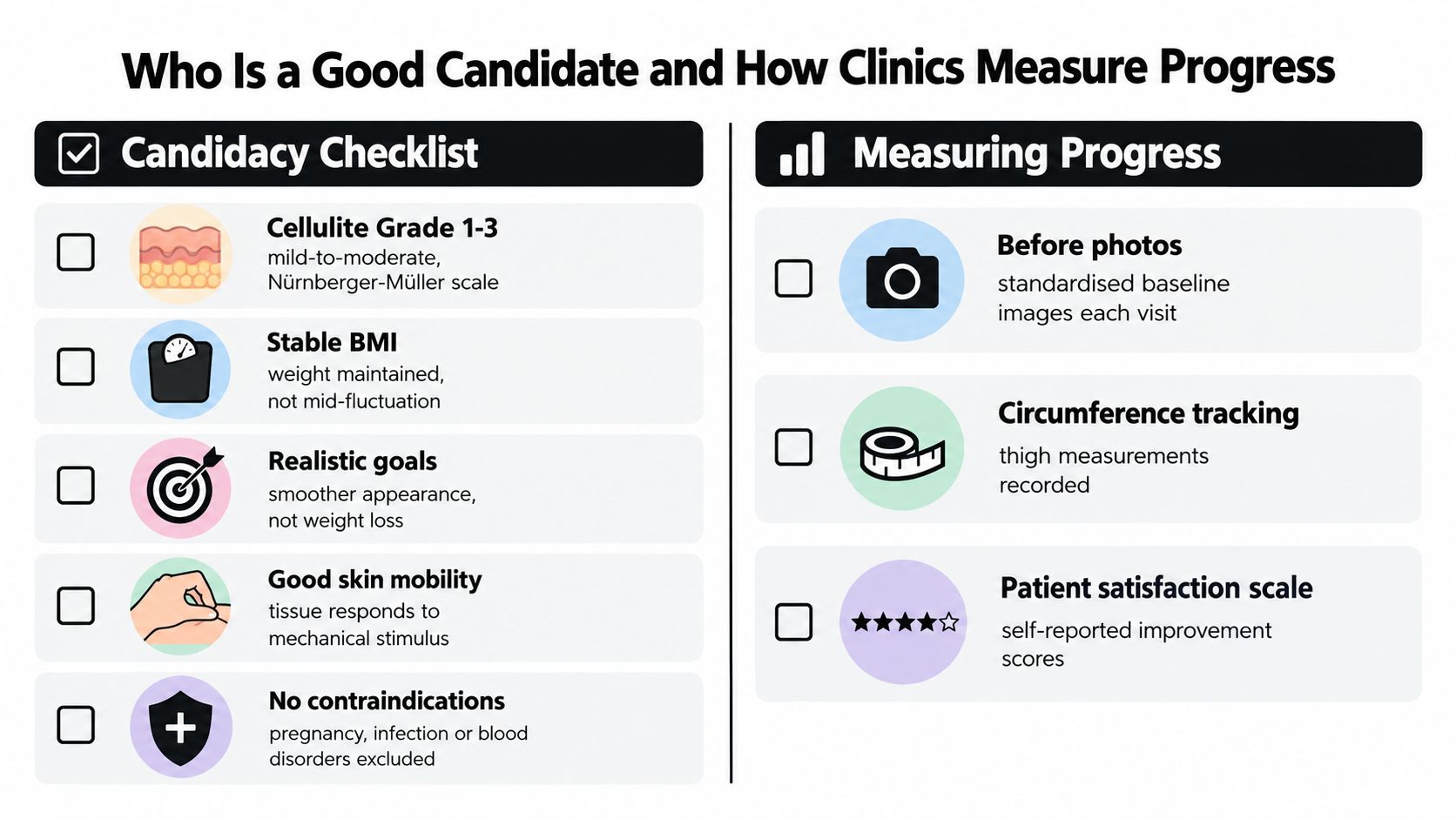
Good candidacy starts with the goal, not a particular body shape. Someone with mild-to-moderate cellulite and realistic expectations may be suitable for an aesthetic consultation, especially when the desired change is a smoother appearance rather than weight loss. A person with persistent tendon pain needs a clinical assessment first, because the diagnosis determines whether shockwave is relevant.
A safe consultation should cover medical history, medicines, skin condition, pregnancy, blood-clotting risks, implanted devices, and the exact area being treated. Active infection, acute thrombosis, active malignancy near the treatment area, pregnancy, and some implanted cardiac devices are reasons to seek specialist advice or avoid treatment. The clinician should also explain alternatives and whether rehabilitation or another aesthetic modality better fits the objective.
Measurement protects against wishful thinking
Mirrors, lighting, posture, hydration, and camera angles can all change how cellulite appears. A clinic that wants to measure genuine progress should agree on a consistent method before treatment begins.
Useful measures include:
- Standardised photographs: The same lighting, distance, body position, and angles at each review.
- Fixed circumference points: Thigh, abdomen, or flank measurements taken at marked anatomical landmarks.
- Cellulite scoring: A recognised severity scale applied consistently by the same trained assessor where possible.
- Scan-based assessment: A 3D body scan or other validated imaging approach when the clinic offers it and explains its limitations.
A result is more credible when the same tool, operator, time of day, and measurement points are used across visits. The 2023 aesthetic review specifically noted the value of objective measures such as standardised photography and serial circumference or skin-quality assessments, alongside its warning that protocols remain heterogeneous.
Choosing Shockwave With Confidence
Use shockwave as a condition-specific tool:
- For cellulite texture, it may be a primary aesthetic treatment when the goal is modest smoothing and the plan includes realistic measurement.
- For tendon pain, it may support a rehabilitation programme after an appropriate clinical assessment.
- For larger-volume contouring, it is better considered an adjunct to a treatment that addresses fat reduction directly.
- For severe skin laxity or a diagnosis unrelated to the treatment target, another option may be more appropriate.
An evidence-led clinic should explain the device type, treatment settings, target tissue, expected number of sessions, possible adverse effects, and alternatives. It should also provide a written plan and show how progress will be tracked. Be cautious if the consultation centres on urgency, guaranteed fat loss, or a same-day package before anyone has assessed your health and objective.
A sensible next step is to book a consultation that includes medical screening, baseline photographs or measurements, and a written explanation of why shockwave fits your goal. Don't commit to a package until you understand whether the treatment is being offered as a primary option, a finishing step, or an adjunct to another modality.
At 3D Aesthetics Leamington Spa, consultations can include a 3D body scan to assess concerns, personalise a plan, and track results over time. The clinic offers shockwave for cellulite-focused care alongside options such as ultrasound cavitation and radio frequency, so book a consultation to discuss the right role for your goal before choosing a course.
← Back to Home