
You catch it in a shop window, on a video call, or in a photograph taken from the side. The skin beneath your jaw looks softer than you remember, and the first instinct is often to search for the best skin tightening under chin treatment.
At 3D Aesthetics Leamington Spa, this is one of the common concerns we assess. The important point is that a fuller or less defined area under the chin usually isn't one problem. Submental fat, meaning fat stored beneath the chin, and skin laxity, meaning reduced firmness and recoil in the skin, can appear together but need different approaches.
Table of Contents
- Why the Area Under Your Chin Changes and What Can Help
- What Causes Loose Skin Under the Chin
- HIFU Facelifts and Microfocused Ultrasound for the Jawline
- Radiofrequency Skin Tightening and 3D Face & Eye RF
- Threads, Injectables and Surgery as Alternatives We Will Talk Through
- How We Assess You at Our Leamington Spa Clinic
- Choosing the Right Path and What Happens Next
Why the Area Under Your Chin Changes and What Can Help
Our first job isn't to recommend a device. It's to work out whether the main issue is fat, loose skin, or a combination of both. A person with a small pocket of fat and good skin recoil may need a different plan from someone whose weight has changed and left excess, thinner skin beneath the jaw.
We offer non-surgical options including HIFU, radiofrequency treatments such as 3D Face & Eye RF, 3D Dermaforce RF microneedling, and double chin treatments that address volume and firmness separately. Lifestyle changes can also matter when weight fluctuation contributes to the appearance, although lifestyle alone can't remove established loose skin.
Our practical rule: a device is only useful when its depth and purpose match the tissue we're treating.
A consultation helps us identify the starting point. Our facial skin tightening treatment options can support collagen remodelling where laxity is mild or moderate, while fat-focused treatment may be more appropriate when fullness dominates. Results vary from person to person, and no non-surgical plan promises a surgical-equivalent change.
The options people often ask about
Some clients arrive asking about threads, injectables, or surgery. We don't offer injectables at our clinic, and we don't present a non-surgical treatment as a replacement for surgery. Threads and surgical procedures belong in a separate discussion, particularly where there's substantial excess skin.
Nutrition and overall health can support skin quality, but they shouldn't be confused with a treatment for laxity. For balanced background reading, our clients may find this guide to skin nutrition useful.
We also use our complimentary AI Skin Scanner and 3D assessment to make the plan more specific. The aim is simple: to treat the anatomy you have rather than the concern as it appears in a photograph.
What Causes Loose Skin Under the Chin
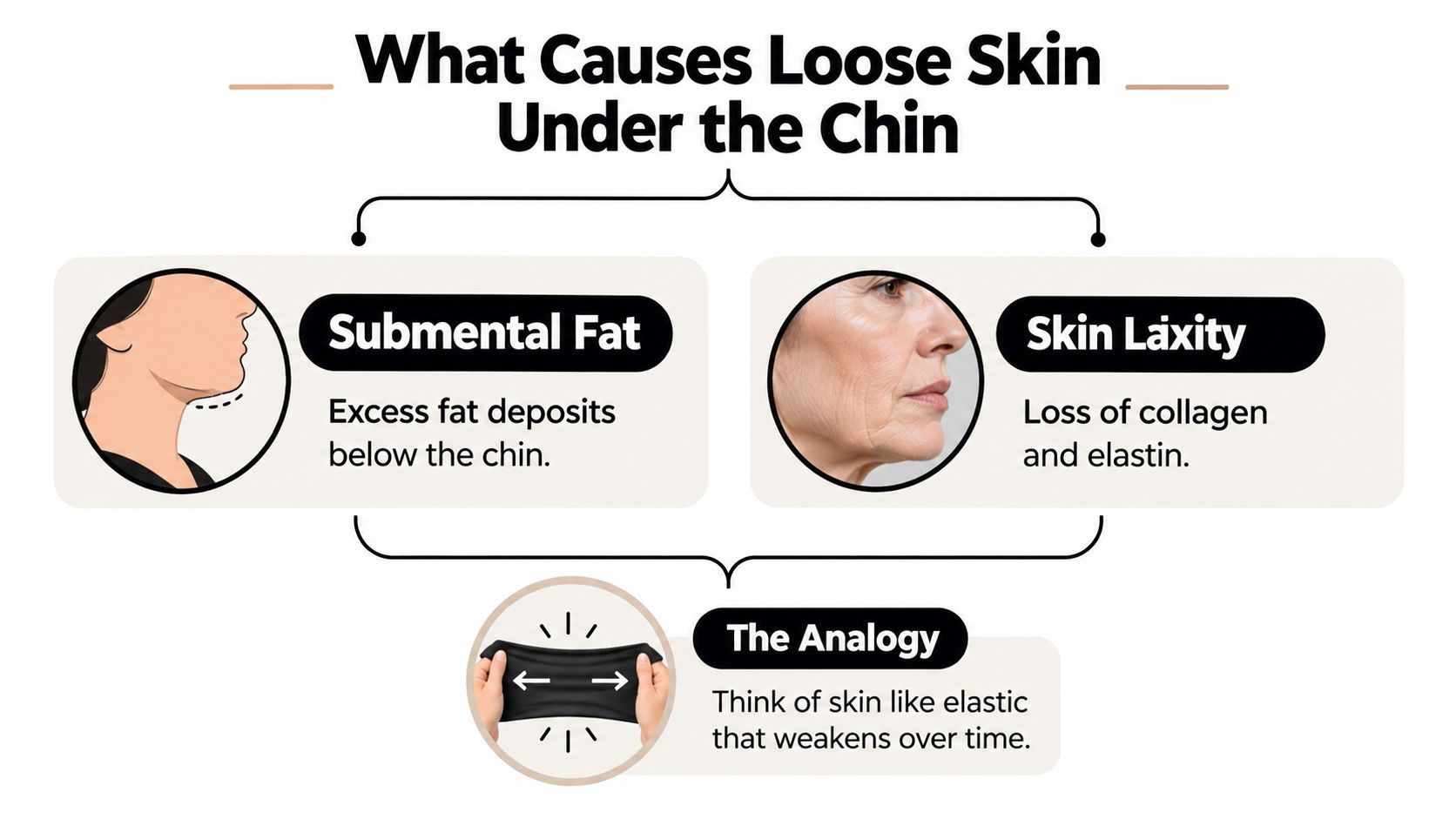
A softer profile can come from two different tissues. Submental fat adds volume beneath the jaw, while loose skin drapes, creases, or fails to recoil after being stretched. Both may appear together, but they require different approaches.
Skin recoil depends partly on collagen, the structural protein that helps resist stretching, and elastin, which helps skin spring back. With age, these fibres become less effective. Sun exposure can also increase visible texture and laxity, particularly because the neck and jaw may receive more ultraviolet exposure than people realise.
The relationship is straightforward: tightening skin does not remove the tissue beneath it, and reducing fat does not restore lost elasticity. A treatment aimed at only one layer can therefore produce an incomplete result.
Fat and laxity are different findings
Weight fluctuation can affect both fullness and recoil. After substantial weight reduction, the face and neck may lose volume while the remaining skin looks looser. Our case discussion about excess skin after dramatic weight loss helps explain why a fat-focused plan may be unsuitable when the skin has lost significant support.
Genetics also influence the angle between the chin and neck. Some people have a softer jawline at a stable weight, while forward-head posture can make the area look less defined. The platysma, a broad sheet of neck muscle, may appear less supported in that position.
Why does skin become loose under the jaw
Loose skin under the jaw reflects reduced collagen and elastin support, with age, sun exposure, genetics, weight change, and individual neck anatomy affecting how clearly it shows. Submental fat can make the area look fuller, so volume and laxity often overlap rather than presenting as separate problems.
Skin-tightening treatments can encourage contraction and collagen remodelling, but they do not remove a large amount of excess skin. Fat-focused treatments address volume, not the skin's ability to recoil. At consultation, we assess the skin pinch, visible laxity, fat depth, jaw and neck anatomy, and BMI before recommending a route. The same concern, often described as a softer profile, can therefore represent very different tissue problems in our Leamington Spa clinic.
Nutrition may support general skin quality, but it cannot reverse established anatomical laxity. For broader reading, this resource on collagen and skin sagging discusses the subject without replacing an assessment of the tissues beneath the chin.
HIFU Facelifts and Microfocused Ultrasound for the Jawline
HIFU, or high-intensity focused ultrasound, delivers focused thermal energy at defined tissue depths beneath the skin, encouraging collagen-fibre contraction and a later wound-healing response that forms new collagen. The treatment is designed for lifting and firming, not for removing substantial submental fat.
The evidence needs careful interpretation. A 2023 systematic review summarised by NHS Scotland reported a 26–45 mm² reduction in the submental area on lateral photographs. Investigator ratings found improvement in 92% of 337 patients at 90 days, while patient-reported improvement increased more modestly from 42% at 90 days to 53% at 360 days. These findings come from the NHS Scotland evidence summary, and they show why clinical photographs and what a person notices day to day aren't always the same.
Who HIFU may suit
HIFU is generally considered when laxity is mild to moderate and the person has enough skin recoil for collagen remodelling to make a visible difference. In our clinic profile, a BMI below 30 is more favourable, although BMI is only one part of the assessment. We still need to decide whether fat, rather than laxity, is the main reason the jawline looks softer.
Treatment is typically moderately painful. Short-lived redness, swelling, and tenderness can occur. The NHS Scotland summary also reports uncommon adverse effects in approximately 2% of cases, including altered sensation, bruising, stinging, burns, striations, and contact dermatitis.
Our HIFU face-lift treatment is not suitable for everyone. We may advise against treatment where laxity is severe, where the client is pregnant, where there is an active infection near the area, or where certain metal implants sit close to the treatment zone. We also turn people away when they expect ultrasound to remove hanging skin or produce the result of a surgical lift.
The wider published literature gives another useful boundary. A 2025 systematic review indexed by PubMed reported HIFU improvements in skin laxity of approximately 18% to 30%, particularly in lower-face and neck applications. Those are study-level observations, not an individual forecast, and results vary from person to person.
Radiofrequency Skin Tightening and 3D Face & Eye RF
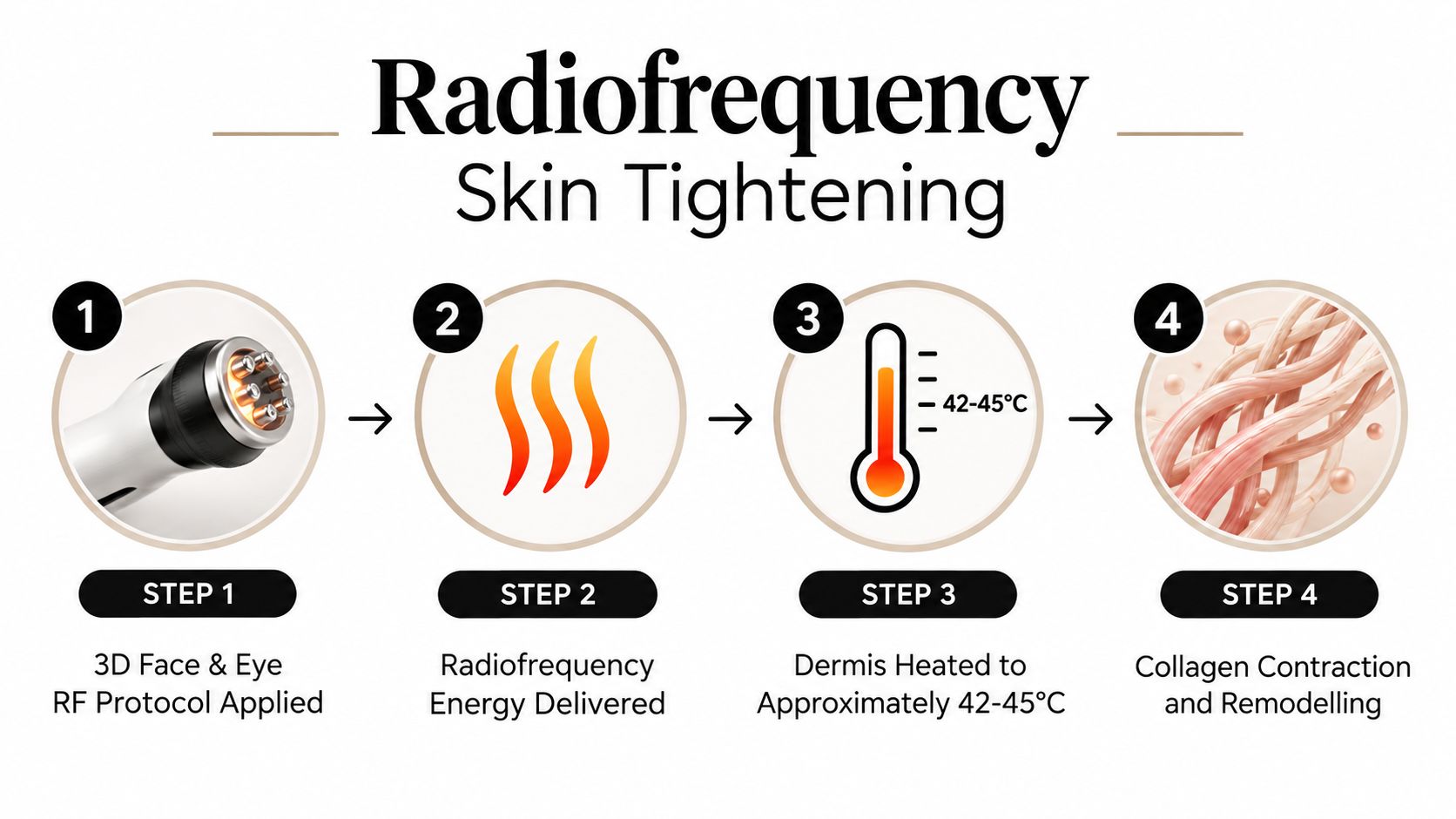
Radiofrequency skin tightening, including our 3D Face & Eye RF protocol, uses controlled heat in the dermis, the lower layer of skin, to contract existing collagen and encourage new collagen formation. A London local-authority treatment guide describes radiofrequency heating the dermis to approximately 40–45°C while avoiding burning the surface, as detailed in this radiofrequency treatment guide.
The temperature isn't the treatment goal on its own. Contact, movement, energy level, tissue thickness, and the shape of the area all affect how the skin responds. Excessive heating can contribute to fat atrophy or excessive tightening, which may create a visible depression, particularly when settings exceed manufacturer guidance. That is why we use conservative parameters beneath the chin rather than assuming more heat will produce a better result.
What RF feels like in practice
3D Face & Eye RF uses a smaller applicator suited to focused facial areas, including beneath the chin and around the eyes. Most treatment plans involve 4–6 sessions, usually spaced a week or two apart. The sensation is generally mild warmth rather than the more pronounced response associated with HIFU, and most clients have little to no downtime.
Our radiofrequency skin tightening treatment is usually discussed when the early signs of laxity are the main concern or when someone wants a gradual option with minimal disruption. Results vary from person to person, and the number of sessions depends on skin quality, anatomy, and the endpoint we agree is realistic.
3D Dermaforce RF microneedling is different. It combines controlled microneedles with radiofrequency in the same pass, so it can be considered where surface texture and tightening need attention together. Because needles enter the skin, its downtime and aftercare aren't the same as routine RF.
Clinical judgement matters: the smallest treatment area still needs a full assessment, because thin tissue beneath the jaw has less margin for aggressive settings.
Radiofrequency doesn't remove excess skin, and it isn't a fat-reduction treatment. When submental volume dominates, we discuss a different pathway, potentially combining suitable fat reduction with a tightening plan only when the anatomy supports it.
Threads, Injectables and Surgery as Alternatives We Will Talk Through
Threads use dissolvable sutures beneath the skin to create lift and stimulate collagen. They appeal to clients who want a more immediate change than energy-based treatment, although bruising can be greater than with HIFU or RF. Results are often discussed as lasting around 12–18 months, but the outcome depends on technique, tissue quality, and individual response.
We do not offer threads as a routine treatment at our Leamington Spa clinic. If the concern appears better suited to a thread procedure, we explain the trade-offs and refer to a suitably qualified practitioner where appropriate. We also do not provide injectables, Botox, or dermal fillers, so we will not present them as services available here. Anyone considering prescription treatment should consult an appropriately qualified prescriber.
When surgery is the more honest discussion
A face and neck lift can remove excess skin and address deeper structural laxity that non-surgical energy treatments cannot correct. Surgical correction may therefore be the more realistic discussion for someone with marked laxity, substantial excess tissue, or submental fullness that will not respond to tightening alone.
That does not mean surgery is suitable for everyone. Recovery, scarring, medical risk, cost, and the extent of the procedure all need careful discussion with a properly qualified surgical team. Our role is to recognise when a non-surgical plan is unlikely to meet the person's goal and say so clearly.
The table separates the main pathways. Session numbers describe typical planning rather than a promise, and results vary from person to person.
| Option | Best suited to | Typical sessions | Typical downtime | Realistic outcome |
|---|---|---|---|---|
| HIFU | Mild to moderate laxity with limited fat | Discussed after assessment | Temporary tenderness, redness, or swelling | Modest lift and improved contour |
| 3D Face & Eye RF | Earlier laxity and smaller areas | 4–6 | Usually little to none | Gradual firmness improvement |
| 3D Dermaforce RF microneedling | Laxity with texture concerns | Personalised course | More aftercare than routine RF | Tightening with skin-texture improvement |
| Threads | Selected clients seeking a lifting approach | Usually a single procedure | Bruising and swelling may occur | Lift that requires appropriate referral |
| Surgery | Severe laxity or substantial excess tissue | Surgical consultation | Surgical recovery | More extensive correction |
The right choice depends first on whether fat, loose skin, or both create the fullness beneath the jaw. A treatment aimed at skin quality will not remove a significant fat pocket, while fat reduction alone will not tighten heavily lax skin. For broader facial treatment context, clients can read about our approach to treating wrinkles, while remembering that the under-chin area needs its own anatomical assessment.
How We Assess You at Our Leamington Spa Clinic
We begin with a complimentary 3D body scan, followed by a medical and anatomical consultation, so we can separate fat-dominant fullness from laxity-dominant looseness before suggesting treatment. Our clinic is at 11 Guys Place East, Leamington Spa, Warwickshire CV32 4RG, and we see clients from Leamington Spa, Warwick, Kenilworth, and surrounding Warwickshire.
What the scan adds
The scan gives us a structured baseline for the under-chin area alongside wider body measurements. It helps us track changes over time and discuss whether the visible concern is changing because of volume, skin quality, or both. The scan doesn't replace a clinician's judgement, and we don't use a measurement to force someone into treatment.
We then review:
- Skin recoil: We gently assess the skin pinch and how quickly the tissue returns.
- Laxity severity: We look at draping, creasing, and the amount of support beneath the jaw.
- Fat depth: We assess whether submental fat is substantial enough to influence the treatment choice.
- Neck anatomy: We consider the jawline, chin projection, tissue thickness, and visible muscle pattern.
- BMI and history: We discuss weight stability, medical history, previous procedures, and relevant contraindications.
The NHS guidance on HIFU and facial aesthetics describes HIFU as directing energy into deeper layers to encourage contraction and lifting, while radiofrequency uses controlled heating to promote renewal and tightening. Those mechanisms aren't interchangeable with fat reduction, so our examination determines which question we're trying to answer.

Safety before treatment
Before an energy-based procedure, we check the device immediately before use, confirm the settings, and make sure the treatment area is appropriate. Local-authority licensing conditions require a consultation covering medical history and contraindications, and prohibit treatment on or within 10 centimetres of infected skin, a rash, cut, broken skin, or another wound, as set out in these electric treatment licence conditions.
We provide written aftercare, including what to do if an adverse reaction occurs. We also arrange a review so we can compare photographs and measurements rather than relying only on memory. If the anatomy doesn't support a useful outcome, we say so and turn the person away.
You can book your free consultation to discuss the scan and assessment before deciding whether to proceed. Our wider Health Hub also offers blood, microbiome, and genetic testing, but those services are separate from the anatomical assessment used to plan skin tightening.
Choosing the Right Path and What Happens Next
The right treatment depends on whether laxity, fat, texture, or a mixture of these is driving the softer profile. HIFU generally suits mild to moderate laxity with limited submental fat. 3D Face & Eye RF fits earlier changes, smaller treatment areas, and clients who prioritise minimal downtime.
3D Dermaforce RF microneedling becomes more relevant when skin texture is part of the concern as well as firmness. It isn't the same as routine RF because microneedles enter the skin, so we discuss the additional aftercare and recovery before recommending it.
A fat-reduction pathway may be more appropriate where volume dominates. Our double chin removal options can include fat freezing and RF skin tightening when the tissue assessment supports that combination, but we don't assume every double chin needs fat reduction. A thin, lax area can look worse if treated as though it contains substantial fat.
When we advise waiting or seeking another opinion
We may advise you to wait if you're pregnant or breastfeeding, have an active skin infection near the chin, or have a relevant neurological issue. We also pause when weight is changing significantly, because the tissue may not yet represent a stable baseline.
We won't proceed if you expect a surgical-equivalent result from a non-surgical route. Severe laxity, substantial submental fat, or extensive excess skin may justify a surgical opinion instead. Results vary from person to person, and no outcome is guaranteed.
Our next step is straightforward. At our Leamington Spa clinic, the complimentary consultation includes the 3D scan, a discussion of your medical history, and an honest view of what may or may not help. We can then explain HIFU, radiofrequency, RF microneedling, or a fat-focused plan in relation to your actual anatomy.
At 3D Aesthetics Leamington Spa, we assess skin laxity and submental fullness with a complimentary 3D scan before discussing HIFU, 3D Face & Eye RF, RF microneedling, or double chin treatments. Visit 3D Aesthetics Leamington Spa or call 01926 315764 to arrange your consultation at 11 Guys Place East, Leamington Spa, Warwickshire CV32 4RG.
← Back to Home