
You're sitting in a clinic consultation, ready to ask whether ultrasound cavitation could help with a stubborn area of fat. The practitioner explains that the treatment is non-surgical, but skips over your medication, pregnancy status, medical history, or any implanted devices. When you ask which settings the machine uses, you're told only that it's “safe”.
That answer isn't enough. The familiarity of ultrasound imaging can make aesthetic cavitation sound automatically low risk, yet the devices, treatment goals, energy levels, focal depths, and monitoring practices may differ. A responsible decision requires two things at once: understanding the physics behind cavitation and recognising where the evidence for cosmetic fat reduction remains limited.
Table of Contents
- Understanding Ultrasound Cavitation Risks Before Treatment
- How Ultrasound Cavitation Works
- Common and Uncommon Side Effects
- Contraindications and Pre-Treatment Safety
- Clinical Evidence and Safety Limits
- Comparing Body Contouring Options
- Choosing a Reputable Cavitation Clinic
- A Safer Decision and Next Steps
Understanding Ultrasound Cavitation Risks Before Treatment
Ultrasound cavitation risks begin before the handpiece touches your skin. They begin when a clinic decides whether you're suitable, chooses treatment parameters, and explains what the device can and can't do. If those steps are vague, your consent isn't as informed as it should be.
A proper consultation should cover pregnancy, active or suspected malignancy, blood-clotting problems, significant heart or metabolic disease, medication, recent surgery, hernias, liver or kidney problems, and implanted devices or metal near the planned treatment area. The practitioner should also identify the exact device, explain the intended treatment zone, and tell you what symptoms should prompt contact after the appointment.
Why diagnostic ultrasound can create false reassurance
Diagnostic ultrasound uses sound waves to produce images. Aesthetic cavitation uses acoustic energy with the intention of mechanically affecting subcutaneous fat. Both rely on pressure waves, but the fact that diagnostic ultrasound is widely used doesn't make every cosmetic ultrasound exposure equivalent to an imaging examination.
UK safety guidance from the Royal College of Radiologists' ultrasound safety document describes a theoretical cavitation risk when the Mechanical Index rises above 0.7 in the presence of gas microbubbles. The same guidance uses an upper Mechanical Index limit of 1.9 for regulated diagnostic equipment in the UK and EU context. These figures belong to diagnostic safety governance, not a universal guarantee for cosmetic fat-reduction devices.
Practical rule: If a clinic won't discuss the device and its settings, postpone treatment until you can obtain clear answers.
The evidence gap matters because consumer information often explains the bubble mechanism without identifying the acoustic exposure used in aesthetic practice. UK-facing discussion also highlights that clinics and clients may lack clear, comparable information about complication monitoring and reporting pathways for cosmetic cavitation, as outlined in this UK guide to ultrasound cavitation safety and realistic expectations.
This doesn't mean every treatment is dangerous. It means “ultrasound” is a category, not a safety certificate. Your decision should rest on the specific device, your health history, the treatment area, and the practitioner's ability to explain and monitor the exposure.
How Ultrasound Cavitation Works
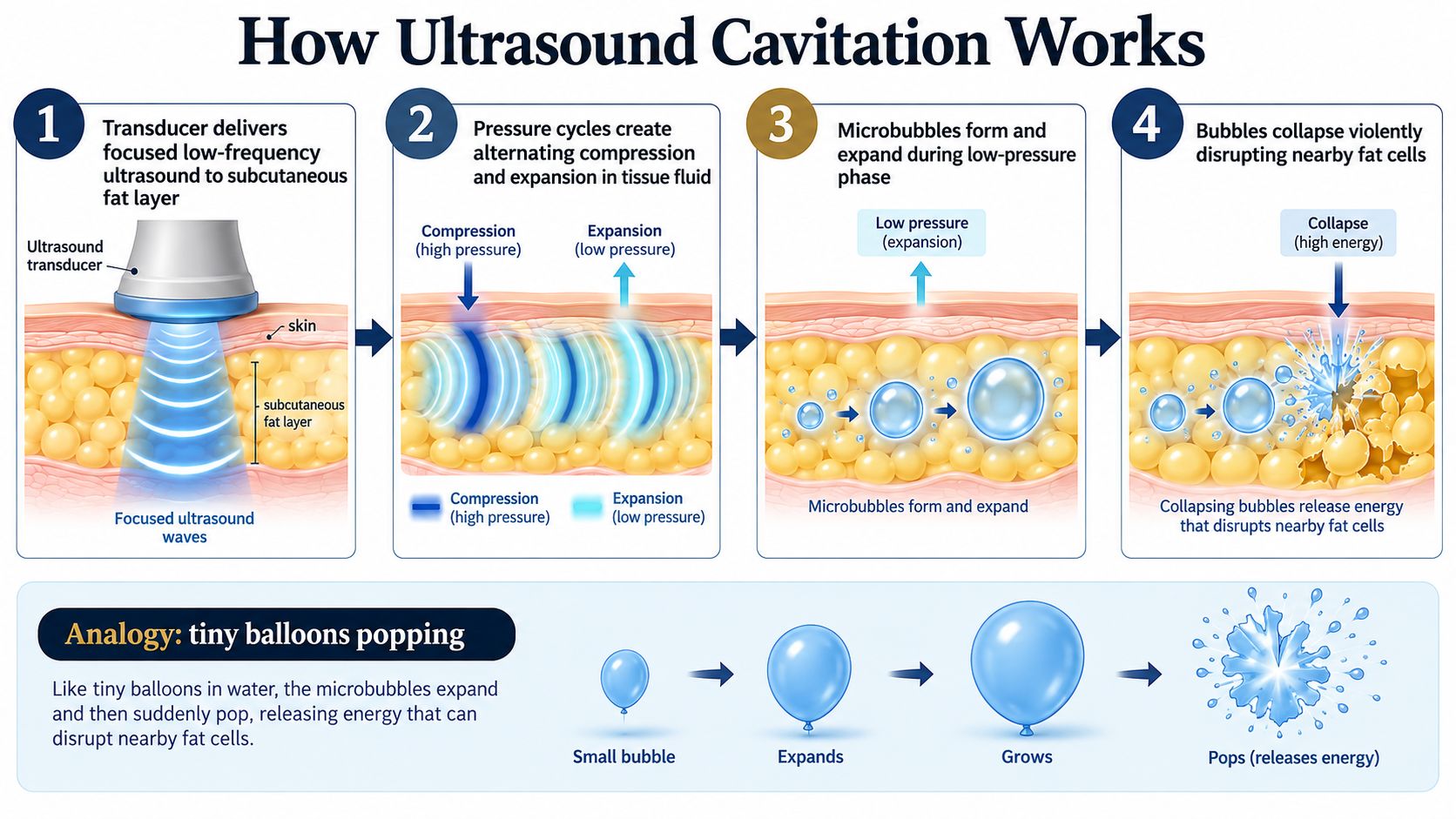
A cavitation handpiece, or transducer, sends low-frequency ultrasound into the subcutaneous fat layer. The sound wave alternates between compression, where pressure rises, and rarefaction, where pressure falls. Those repeated pressure cycles can encourage tiny gas pockets or microbubbles in tissue fluid to expand and collapse.
A useful analogy is a water-filled balloon being squeezed repeatedly. Each squeeze changes the pressure inside. If tiny bubbles appear, repeated pressure changes can make them grow, then collapse sharply. In tissue, that collapse creates mechanical stress near the bubble rather than warming the skin.
From pressure waves to a treatment effect
The intended sequence is usually described in four stages:
- Delivery: the transducer couples sound energy through the skin towards localised subcutaneous fat.
- Pressure cycling: tissue fluid experiences alternating high and low pressure.
- Bubble activity: microbubbles expand during the lower-pressure phase.
- Collapse: bubble collapse produces mechanical forces that may disrupt nearby fat-cell membranes.
When cell membranes are disrupted, stored triglycerides can be released from the affected cells. The body then processes and clears the resulting material through normal physiological pathways. This is why cosmetic cavitation is presented as a body-contouring treatment rather than an immediate weight-loss procedure. It targets a local area, and any visible change is expected to develop gradually rather than through a single dramatic event.
The explanation of whether ultrasonic cavitation works should therefore be read alongside realistic expectations about treatment selection and follow-up, not as a promise of a particular result.
Diagnostic and aesthetic systems may differ in frequency, intensity, focal depth, pulse pattern, and how long the operator holds the probe over one area. A diagnostic scan generally aims to obtain information, while aesthetic cavitation deliberately seeks a tissue effect. That difference is central to understanding why diagnostic safety limits shouldn't be treated as a complete cosmetic safety guarantee.
The UK guidance cited earlier connects cavitation risk with pressure swings, Mechanical Index, gas bodies, and contrast microbubbles. The practical physics is straightforward: lower frequencies and higher peak negative pressures make bubble activity more relevant, especially where gas-filled structures may sit near the beam.
A short visual explanation can help patients understand the distinction between an ultrasound image and an acoustic treatment:
Common and Uncommon Side Effects
Most post-treatment effects, when they occur, are temporary and local. You might notice redness, warmth, mild tenderness, or a feeling of fullness in the treated area. Some people also report temporary swelling or increased urination, although these sensations shouldn't be used as proof that fat has been removed.
The skin may look slightly flushed because of contact, pressure, or local circulation. Mild tenderness can feel similar to the sensitivity that follows exercise. These effects should settle rather than intensify. Your practitioner should give you written aftercare advice and a direct route for reporting symptoms.
What patients may notice first
A practical way to assess a reaction is to consider its direction over time. A mild, short-lived sensation that steadily improves is different from pain that becomes stronger, spreads, or interferes with normal activity.
Less common problems can include bruising, headaches, short-lived nausea, blistering, or a surface burn. Burns may occur when a probe overheats, when coupling between the handpiece and skin is poor, or when the operator keeps energy concentrated over one spot. These possibilities reinforce the need for continuous movement or controlled positioning according to the device protocol.
| What you notice | Sensible response |
|---|---|
| Mild warmth or redness that fades | Follow the clinic's aftercare guidance and monitor it |
| Tenderness or mild swelling | Contact the practitioner if it doesn't improve or becomes more uncomfortable |
| Bruising, blistering, or a burn-like area | Report it promptly and ask whether medical review is needed |
| Persistent pain, numbness, or marked swelling | Stop further sessions and seek professional assessment |
| Skin discolouration, welts, or an unexpected contour change | Request prompt review rather than waiting for the next appointment |
Red flags deserve a direct response
Persistent pain, skin welts, prolonged numbness, significant swelling, unusual discolouration, or changes in skin texture shouldn't be dismissed as evidence that the treatment is “working”. A rare but important concern is an unexpected increase in fat or contour enlargement after treatment, sometimes described as paradoxical fat growth. The available UK-facing safety guidance also stresses that cavitation can produce cellular responses through mechanical, chemical, or thermal pathways, so symptoms beyond simple redness deserve attention. You can review those practical cautions in this guide to ultrasound cavitation contraindications and aftercare.
Seek urgent medical advice for severe or worsening pain, rapidly increasing swelling, signs of infection, extensive blistering, or systemic symptoms that concern you.
Don't book another session to “balance out” an unexpected reaction. Ask the clinic to document the area, identify the device and settings used, and explain whether an independent medical assessment is appropriate.
Contraindications and Pre-Treatment Safety
Screening is the most controllable part of ultrasound cavitation safety. A practitioner can't remove every uncertainty about the technology, but they can refuse treatment when your medical history makes the exposure inappropriate or requires professional clearance.
Circumstances that should stop treatment
Pregnancy, active malignancy concerns, thrombotic or clotting disorders, and some significant cardiometabolic conditions require particular caution. Implanted electronic devices or other implants near the treatment area also need specific assessment. Don't assume a standard consent form has covered the issue because you've had ultrasound imaging before.
A clinic should not pressure you to proceed if you're unsure about a diagnosis, medication, or implant. The safest response to incomplete information is to defer and obtain advice from the clinician who manages that condition.
Situations that need medical review
Hernias, liver or kidney impairment, uncontrolled metabolic disease, recent surgery, infections, and unexplained pain in the treatment area should be discussed before booking. The reason isn't that every person with one of these conditions will automatically be unsuitable. The reason is that the practitioner needs enough information to judge whether energy delivery, local tissue response, and post-treatment clearance could create avoidable risk.
A thorough intake should ask about:
- Medical history: Include cardiovascular problems, blood disorders, cancer history, diabetes, kidney or liver disease, and neurological symptoms.
- Medication: Bring a current list, including anticoagulants, medicines that affect healing, and prescribed or non-prescribed supplements.
- Tissue and treatment area: Disclose hernias, scars, tattoos, dermal fillers, metal implants, skin conditions, and recent sun exposure.
- Timing: Recent operations, infection, significant inflammation, and menstrual symptoms may justify postponement.
- Expectations: Discuss whether your concern is localised subcutaneous fat, loose skin, cellulite, or overall weight, because cavitation isn't a substitute for weight management.
- Documentation: Ask for baseline photographs or measurements and a written consent record that identifies the treatment area and device parameters.
Your right to defer or stop
Drink according to your normal health needs, but don't treat aggressive hydration instructions as a safety guarantee. Ask what aftercare is recommended and which symptoms need medical review. You can decline treatment before it starts, and you can ask the operator to stop during a session if the sensation feels wrong or the explanation changes.
A complete screening conversation is a safety requirement, not an administrative formality.
Clinical Evidence and Safety Limits
The most important evidence question is not whether ultrasound can affect tissue. It can. The harder question is whether cosmetic cavitation devices deliver predictable, well-monitored exposure across different machines, operators, body areas, and client health histories.
Diagnostic ultrasound has a long history of safety governance because clinicians use defined systems for imaging, output controls, and exposure monitoring. The Royal College of Radiologists guidance identifies the Mechanical Index as relevant to cavitation and places an upper limit of 1.9 on regulated diagnostic equipment in the UK and EU context. That benchmark is useful for understanding acoustic risk, but it doesn't establish that an aesthetic device using a different protocol, focal depth, or dwell time has the same safety profile.
What the evidence can and can't answer
Reports of temporary redness, warmth, and tenderness are compatible with a local treatment response. Claims about long-term safety require stronger follow-up. Important unanswered questions include cumulative exposure, how tissue responds after repeated treatment, the effect of treating near visceral fat or gas-filled structures, and interactions with metabolic disease.
Marketing language can also blur three separate ideas: a device may be authorised or registered for a particular use, it may have a CE-related conformity history, or it may be discussed alongside FDA-cleared technologies. None of those labels automatically proves that a specific treatment plan is suitable for you. Ask the clinic to identify the exact device, its intended indication, and the evidence supporting the protocol it uses.
| Parameter | Diagnostic Ultrasound | Aesthetic Cavitation |
|---|---|---|
| Primary purpose | Imaging and clinical assessment | Localised body contouring |
| Intended tissue effect | Produce interpretable images | Create a mechanical effect in subcutaneous fat |
| Safety framework | Defined output controls and diagnostic governance | Can vary by device, protocol, operator, and clinic |
| Key physics question | Whether exposure remains appropriate for imaging | Whether acoustic energy is controlled for the intended tissue response |
| Evidence limitation | Safety guidance applies to regulated diagnostic equipment | Diagnostic guidance cannot serve as a complete cosmetic safety guarantee |
The discussion of ultrasound cavitation results should therefore be considered in context. Circumference change, photographs, and subjective satisfaction don't answer every safety question. A careful clinic should track outcomes, record adverse reactions, and explain what it would do if a client reports persistent symptoms.
The practical conclusion is measured rather than alarmist: diagnostic ultrasound knowledge gives us valuable physics and safety principles, but aesthetic cavitation needs its own transparent exposure information and monitoring standards.
Comparing Body Contouring Options
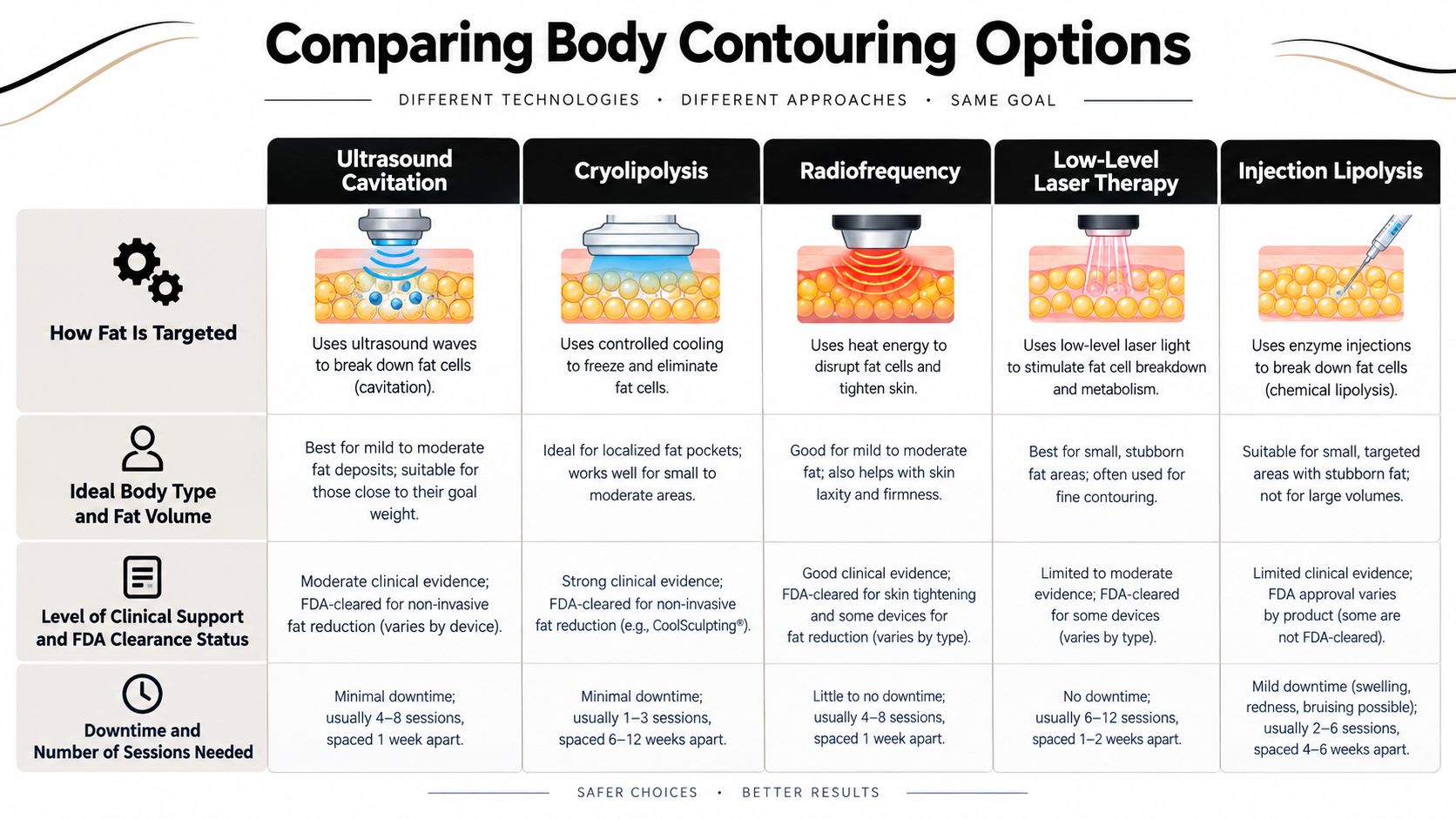
No body-contouring method is risk-free, and no single modality suits every type of fat, skin concern, or medical history. The relevant comparison is not “which treatment is safest?” in isolation. It's “which mechanism, treatment burden, and risk profile fit this specific person?”
How the approaches differ
Ultrasound cavitation uses mechanical acoustic energy and is generally positioned for localised subcutaneous fat when a client accepts gradual, modest contour changes and potentially needs a course of sessions. Its key safety questions concern acoustic exposure, gas interfaces, coupling, treatment depth, and operator control.
Cryolipolysis uses controlled cooling to affect fat cells. It may suit a different distribution of pinchable fat, but clients should ask about cold-related effects and the possibility of paradoxical adipose hyperplasia, an unexpected enlargement of fatty tissue after treatment.
Radiofrequency uses heat and may be selected where skin tightening or texture is part of the objective. Heat creates its own risk profile, including discomfort and burns if the temperature or contact is poorly controlled.
Low-level laser therapy uses low-intensity light-based energy and is often marketed as a gentler contouring option. The practical questions remain similar: what result is realistic, what evidence supports the specific device, and how does the clinic assess suitability?
Injection-based lipolysis introduces a chemical agent into tissue rather than relying on external energy. That means injection technique, product choice, sterility, swelling, bruising, and product-specific contraindications become central.
Match the treatment to the problem
The UK overview of non-surgical fat removal can help frame the available categories, but a provider still needs to assess your actual fat distribution and health history. Ask whether the concern is loose skin, localised fat, cellulite, or a combination. Then ask why the proposed modality is appropriate and what would make the practitioner recommend a different option.
A useful consultation should compare downtime, comfort, number of sessions, evidence quality, and complication management, rather than presenting one technology as universally superior. Be cautious if a clinic recommends the same treatment for every body area without examining the tissue or discussing alternatives.
Choosing a Reputable Cavitation Clinic
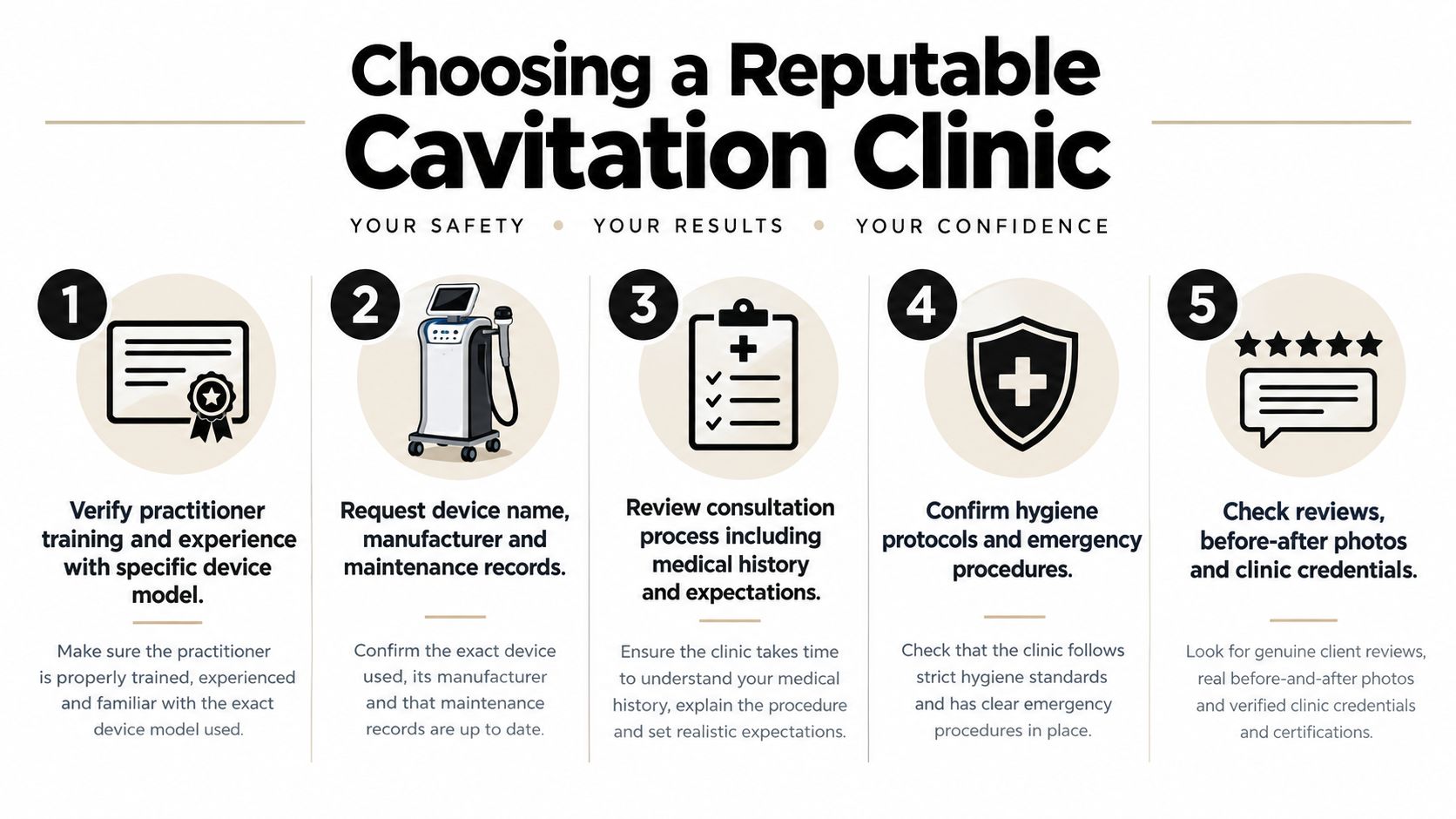
A reputable clinic should make safety questions easier, not make you feel difficult for asking them. During the consultation, the practitioner should identify their training, explain their experience with the specific device, and assess your medical history before recommending treatment.
Questions to take with you
Ask for the device name and manufacturer. Ask what indication the device is intended for, how the clinic selects frequency and intensity, which probe is used, and how the operator prevents excessive exposure to one area. If the clinic can't provide a clear answer, you're entitled to pause.
You should also ask:
- Who performs the treatment: Confirm training, supervision, and experience with the exact machine, not just general beauty-treatment experience.
- How screening works: Check that the consultation covers pregnancy, cancer concerns, clotting disorders, implants, medication, recent surgery, and relevant organ or metabolic conditions.
- How safety is monitored: Ask what the practitioner records during treatment and who handles complications or adverse reactions.
- What aftercare includes: Request written advice, contact details, and clear thresholds for seeking medical review.
- How results are assessed: Ask whether the clinic records baseline photographs, measurements, or body scans instead of relying only on verbal impressions.
Aggressive package selling is a warning sign, especially when it appears before a medical history review. So are identical treatment recommendations for different body areas, refusal to name the technology, and promises that imply guaranteed fat loss. Independent reviews and before-and-after images can provide context, but they don't replace a proper consultation.
Compare at least two providers. Trust the clinic that welcomes detailed questions, explains uncertainty clearly, and gives you time to decide. A safe practitioner won't treat your hesitation as an obstacle to overcome.
A Safer Decision and Next Steps
Use four checkpoints before you consent:
- Suitability: Confirm that pregnancy, malignancy concerns, clotting problems, implants, recent surgery, organ disease, and other relevant conditions have been addressed.
- Mechanism: Make sure you understand that cavitation is intended for localised body contouring, not general weight loss, and that outcomes can vary with fat distribution, metabolism, and lifestyle.
- Provider quality: Verify the practitioner, device, treatment parameters, documentation, aftercare, and complication pathway.
- Freedom to defer: If answers are incomplete or your symptoms and medical information are uncertain, reschedule. You can stop during treatment.
Record your baseline photographs or measurements and attend the recommended review. Report persistent pain, bruising, numbness, swelling, welts, discolouration, skin changes, or an unexpected contour increase promptly. Don't interpret a worrying reaction as a reason to continue.
An informed consultation is the next step, not an automatic booking. You should leave knowing what will happen, why it has been recommended, what remains uncertain, and who will help if something doesn't feel right.
3D Aesthetics Leamington Spa offers ultrasound cavitation for localised body contouring alongside cryolipolysis, radiofrequency, body HIFU, and other non-surgical treatments, with consultations that include a 3D body scan to assess suitability and track progress. Visit 3D Aesthetics Leamington Spa to discuss your health history, treatment options, device questions, and a safety-led plan before making a decision.
← Back to Home