

Most clients need between 3 and 6 microneedling sessions, spaced around 4 to 6 weeks apart, while deeper scarring may need 6 to 8 sessions. The right number depends on what you're treating, how severe it is, and how far the device can work safely.
You may be asking because one clinic has recommended a course of three treatments, while another has suggested six or more. That difference doesn't automatically mean one provider is exaggerating. Microneedling isn't a single-purpose treatment with one standard prescription. A light course for general skin freshness is very different from a deeper programme for established acne scars or stretch marks.
I've guided many clients through this decision, and the most useful question isn't just, “How many microneedling sessions do I need?” It's, “What does each session need to achieve, and has my skin had enough time to respond?” The answer becomes clearer when you look at three factors: your skin concern, the severity of the change, and the device and depth used.
Table of Contents
- Why Every Clinic Page Seems to Give a Different Answer
- What Microneedling Actually Does Beneath the Surface
- How Many Sessions by Skin Concern and Severity
- How the Device Changes the Number You Need
- Why the Gap Between Sessions Matters
- Building Your Personal Session Estimate
- Keeping Results Long Term With Maintenance Sessions
- Setting Realistic Expectations for Your Course
Why Every Clinic Page Seems to Give a Different Answer
Search for microneedling and you'll quickly find conflicting recommendations. One page may describe a course of three, while another recommends four to five treatments, and a scar-focused provider may discuss six to eight. In the UK, clinic pricing commonly presents microneedling as a course rather than a one-off appointment. One London clinic lists courses of 3 and 6 treatments, while another UK provider recommends 4 to 5 monthly sessions for best results (Dr Leah's microneedling pricing guidance).
Those figures can all make sense because the treatment target changes. A client seeking a brighter-looking complexion may need less intensive remodelling than someone with deep rolling acne scars. A practitioner also adjusts needle depth, treatment pressure and coverage according to the area being treated and the skin's tolerance.
The three variables behind the number
Your goal comes first. General rejuvenation, fine lines, uneven texture, acne scarring and stretch marks don't respond to the same course design. The more structural the concern, the more repeated collagen-stimulation cycles may be needed.
Severity changes the estimate within each category. Mild texture irregularity may respond towards the lower end of a course, whereas tethered or deeper scars usually require a longer plan and a realistic discussion about partial improvement rather than complete removal.
The device and treatment depth also matter. A professional pen can work more precisely on selected scar areas, while a lighter treatment may be chosen when the aim is glow, tone or gradual maintenance.
Practical rule: A session number is a treatment plan, not a promise. A responsible practitioner should explain why that number applies to your skin.
Before booking, compare the recommendation with the clinic's consultation process and treatment details. A facial treatment overview such as face treatment options at 3D Aesthetics Leamington Spa can help you understand where microneedling sits among other non-surgical facial options.
What Microneedling Actually Does Beneath the Surface
Microneedling works by creating controlled micro-injuries rather than removing the entire surface of the skin. Fine needles make tiny channels, and the body interprets those channels as a repair signal. That response encourages the activity involved in rebuilding collagen and elastin, the proteins that support firmness and structure.
The process is easier to understand as a sequence:
- Micro-channels are created. The device passes over the skin and produces precise punctures at the selected depth.
- The skin sends repair signals. Cells release signalling molecules that organise the early healing response.
- Fibroblasts become active. These skin cells help produce fresh collagen and elastin as the tissue repairs itself.
- The tissue remodels. Newly formed fibres gradually organise, so texture and firmness can improve over the following weeks.
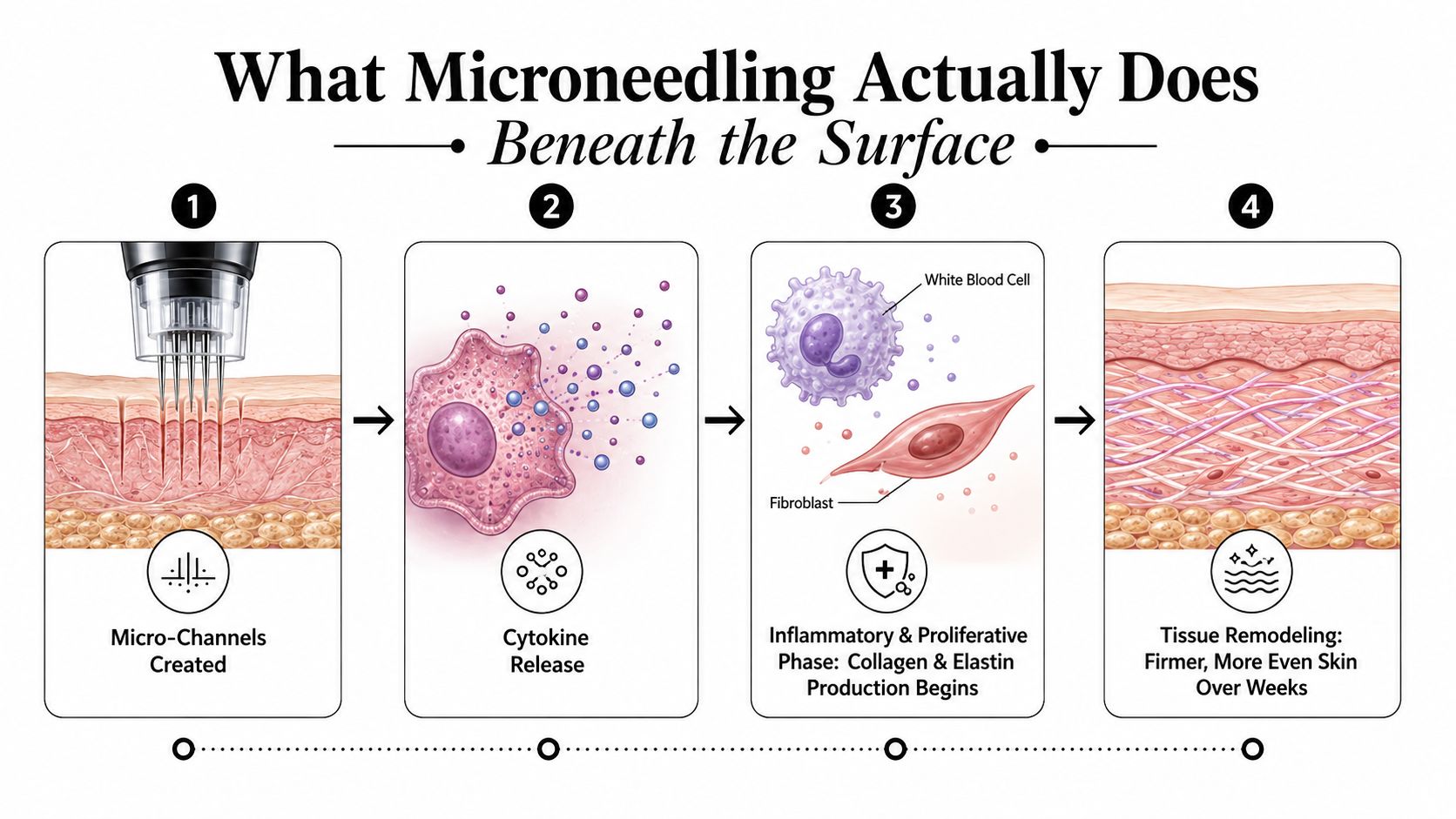
The important point is that the needle pass starts the process, but it doesn't complete it. Your skin needs time to close the surface, settle inflammation and build new supporting fibres. One appointment may leave the complexion looking fresher, but structural concerns usually need several carefully timed repair cycles.
That's why repeating treatment too quickly isn't a shortcut. The aim is to stimulate the skin again after it has had an opportunity to respond, not to keep injuring tissue before the previous response has matured.
For acne scars, the treatment can also help soften the contrast between the scarred area and the surrounding skin. It won't erase every scar, and the result depends on scar type, depth, skin response and whether other treatments are appropriate.
How Many Sessions by Skin Concern and Severity
The right session count follows the concern being treated, its depth, and how the skin responds. General rejuvenation usually needs fewer appointments than scar work, while stretch marks and altered surgical tissue often need a longer course. UK clinician guidance commonly places general rejuvenation at about 3 sessions, acne scarring at 4 to 6, and deeper scars at 6 to 8 (Hampstead Aesthetics' scar-focused microneedling guidance).
| Skin concern | Typical sessions | Suggested spacing | Severity notes |
|---|---|---|---|
| General rejuvenation and tone | 3 to 4 | About 4 to 6 weeks | Lower end may suit mild dullness and texture concerns |
| Fine lines and mild texture | 4 to 5 | About 4 to 6 weeks | More sessions may be needed where lines or roughness are established |
| Deeper wrinkles or sun-related texture | 5 to 6 | About 4 to 6 weeks | Treatment depth and skin tolerance influence the final plan |
| Acne scarring | 4 to 6 | At least 6 weeks where treatment is deeper | Deeper rolling or tethered scars may need 6 to 8 sessions |
| Surgical scars and stretch marks | 6 to 8 or more | Usually several weeks apart | Older, wider or more deeply altered marks can need a longer course |
General rejuvenation is usually the simpler starting point because the aim is refinement rather than major scar remodelling. Three sessions may suit clients seeking smoother-looking texture, mild unevenness, or a fresher appearance. The final plan still depends on skin condition and recovery.
Fine lines and mild texture often sit around four to five sessions. Fine lines can reflect changes below the surface, so repeated stimulation may be more useful than treating once and expecting a lasting change. Around delicate areas, the practitioner may keep the treatment moderate and review progress before increasing intensity.
Deeper wrinkles and sun-related texture commonly move towards five or six treatments. The plan must reflect how extensive the textural change is, which areas are being treated, and how well the skin settles between appointments. A slower response does not automatically mean the treatment has failed.
Acne scars need a closer assessment because rolling, boxcar, and ice-pick scars have different shapes and depths. One number cannot describe every scar pattern. UK NHS guidance states that microneedling normally requires 4 to 6 sessions, with treatments spaced at least 6 weeks apart (Chelsea and Westminster NHS patient leaflet). Deeper or tethered scars may sit at the upper end of that range and may need scar-specific approaches.
Stretch marks and surgical scars can be slower to change because they involve altered tissue across a wider area. They are often treated as a longer course, with progress reviewed over time rather than judged after one visit. Once the planned course is complete, occasional maintenance sessions may help support the improvement, depending on the concern and the practitioner's assessment.
How the Device Changes the Number You Need
A device can change the number of sessions because it changes how evenly and precisely the practitioner reaches the skin. A pen-style device uses a cartridge that moves vertically. The practitioner can adjust its depth and treat uneven areas selectively, which is helpful when scars sit beside relatively normal skin.
A roller uses a wheel with needles set into it. As the wheel crosses the skin, the needles enter at an angle, so treatment may be less uniform over contours. Depth is also less adaptable when one area contains different scar types or levels of tissue change.
Pen and roller differences
| Device type | Typical needle depth | Rejuvenation sessions | Acne scar sessions | Stretch mark sessions |
|---|---|---|---|---|
| Professional derma pen | Adjustable according to area and concern | About 3 to 6 | About 4 to 8 | About 6 to 8 or more |
| Clinic derma roller | More limited and less adaptable | About 3 to 6 | About 6 to 8 | About 6 to 8 or more |
| Home roller | Typically lighter than professional scar treatment | Not a substitute for a clinical course | Not suitable for planning deep scar treatment | Not suitable for planning deep scar treatment |
| RF microneedling | Adjustable needles with added radiofrequency heat | A tailored course may still be needed | Depends on scar pattern and device | Depends on body area and tissue change |
These are broad planning ranges, not fixed prescriptions. UK guidance and clinic information place many courses around 3 to 6 sessions, while more altered or tethered scars can require 6 to 8 (Dr Leah's UK pricing information). The number still depends on the concern, scar type, treatment area, and how the skin responds.
A pen may therefore reduce unnecessary treatment of nearby healthy skin, but it does not guarantee fewer appointments. A roller may suit simpler, more even areas, while a home roller should not be used to plan clinical scar treatment.
RF microneedling adds radiofrequency heat beneath the surface. It is not simply a stronger version of standard microneedling. A practitioner may consider it when laxity or crepey texture forms part of the concern, but the device still needs to match the skin and treatment goal.
For stretch marks, compare microneedling with other scar-focused options, including CO2 laser treatment for stretch marks. A consultation can clarify whether the device, depth, and course length fit the type of tissue change present.
Why the Gap Between Sessions Matters
Your skin may look settled within days of microneedling, yet deeper repair continues for longer. A calm surface does not show that collagen remodelling has finished. The treatment plan needs enough time for these changes to develop.
What happens between appointments
Early healing involves the micro-channels closing and the initial inflammatory response settling. Later, fibroblasts produce and organise new collagen. That process is gradual, so a practitioner reviews progress over time rather than judging the result from the first few days.
Clinical guidance commonly allows several weeks between treatments. The Chelsea and Westminster NHS microneedling patient information recommends 4 to 6 sessions, with appointments at least 6 weeks apart. This interval gives the skin time to heal and helps the practitioner decide whether the current depth and intensity remain suitable.
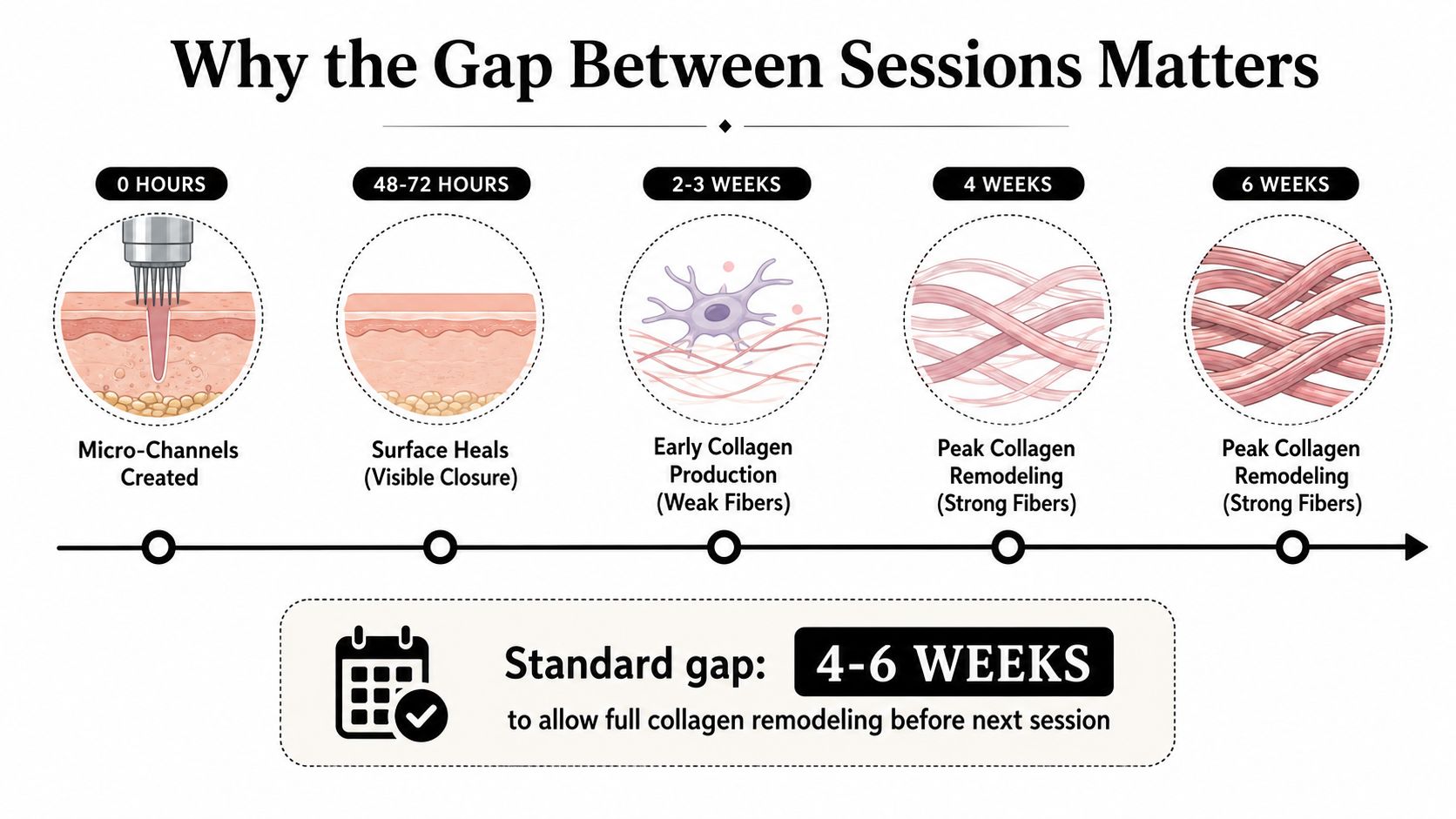
A longer gap does not erase progress. It extends the course, which may suit skin that remains reactive, an upcoming event, or a practitioner who wants to assess the full response before treating again.
The fastest calendar is not automatically the best plan. Treatment intensity must fit healing, sun exposure, aftercare, and your skin's response. The appropriate session count is the number your skin can recover from properly. Once the course is complete, maintenance sessions may help support the result, with timing based on how your skin changes and responds.
Building Your Personal Session Estimate
You can create a useful starting estimate before your consultation, but treat it as a conversation point rather than a final prescription. Begin with the outcome you care about most, because “better skin” is too broad to guide treatment depth.
- For general rejuvenation, start by considering the lower end of a professional course.
- For moderate texture, fine lines or early acne marks, expect the middle of the usual range.
- For deep rolling scars, established surgical scars or stretch marks, prepare for a longer course and the possibility of additional treatment planning.
Next, assess severity carefully. Mild unevenness and enlarged-looking pores aren't the same as deep depressions, tethered scars or wide stretch marks. Scar type matters as much as scar age, so a close examination is more useful than judging yourself from a photograph.
Factors that can change the plan
Your practitioner will also ask about factors that influence treatment safety and recovery. These can include recent sun exposure, active skin inflammation, skincare ingredients such as retinoids, smoking and your history of prolonged redness or pigmentation after procedures.
Darker skin deserves careful discussion rather than automatic exclusion. A 2022 meta-analysis of 12 randomised controlled trials reported improvement in acne scars with microneedling monotherapy and reported no cases of post-inflammatory hyperpigmentation in those trials (summary of the meta-analysis and skin-tone considerations). That finding doesn't guarantee the same response for every person, but it supports an individualised conversation about settings, aftercare and pigmentation risk.
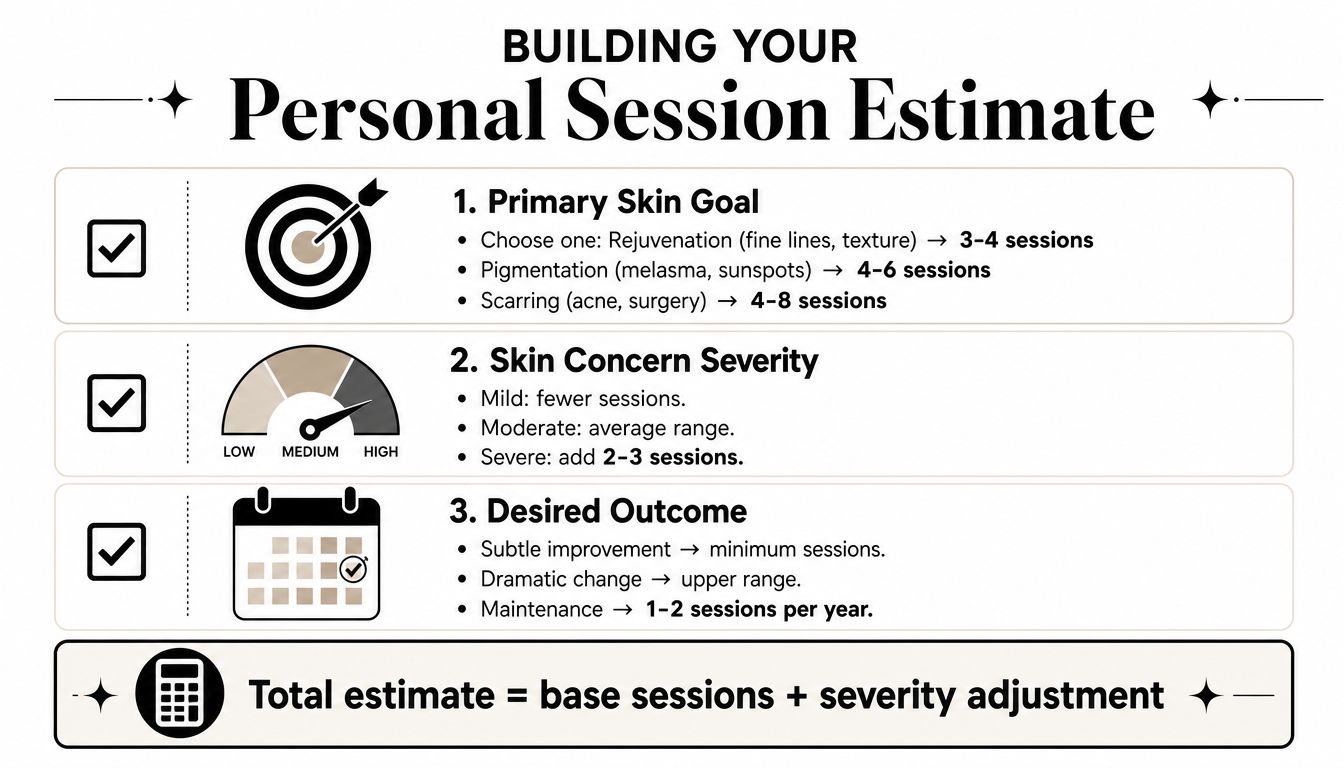
A practical estimate combines three elements: a base course for the concern, an adjustment for severity, and the device depth that can be used safely. Your consultation should confirm whether your initial estimate is realistic, not pressure you into a fixed package before anyone has examined your skin.
Keeping Results Long Term With Maintenance Sessions
Finishing an initial course doesn't mean your skin stops changing. Collagen production naturally shifts with age, while sun exposure, hormonal changes and everyday inflammation can gradually affect texture and firmness. Maintenance keeps the treatment approach active instead of waiting until the original concern becomes prominent again.
A simple way to think about maintenance is to review your skin periodically and schedule a lighter top-up when your practitioner believes it's appropriate. Some clinics discuss a seasonal rhythm, but there isn't one universal maintenance interval that applies to every client. The timing depends on your original concern, the result you achieved and how your skin behaves between treatments.
Maintenance should feel different from correction
An initial scar-focused course may use a more targeted approach. A maintenance appointment may use a lighter setting and focus on overall texture, rather than repeatedly treating every area at the same intensity. That distinction helps make ongoing care more manageable.
Maintenance isn't about starting from zero again. It's about supporting the improvement you've already built.
Sun protection and a consistent home routine matter between appointments. If your practitioner recommends a serum or recovery product, ask exactly how it should be used and whether it suits your skin. For readers researching product support, this resource on safe microneedling with stem cell serum offers context on using serums safely around microneedling.
Other supportive options may also be discussed. For example, Dermalux LED therapy at 3D Aesthetics Leamington Spa may form part of a broader skin plan when a practitioner believes complementary treatment is suitable.
The central point is consistency. A maintenance plan should fit your lifestyle, budget and tolerance for downtime. You shouldn't feel obliged to book treatments indefinitely, but you should understand that no collagen-stimulating procedure permanently freezes the skin at one point in time.
Setting Realistic Expectations for Your Course
A single session may leave skin looking fresher, yet established scars, deep texture concerns and significant laxity usually require a course. Microneedling begins a repair response beneath the surface, while visible changes emerge as the skin remodels. Session numbers therefore reflect the concern being treated, its severity and the device depth selected by your practitioner.
During the first week, redness, tightness, dryness or sensitivity can make skin appear temporarily worse. Close-up checking can add to the confusion, especially when a pre-treatment photograph was taken in different lighting. Healing skin needs time before it gives a fair picture of progress.
A more useful progress timeline
Between the second and third week, some people notice a smoother feel or more even surface. Treat that as an early sign, rather than the finished result. Collagen organisation continues after the initial recovery stage.
Around six weeks, changes in firmness or texture may become clearer, although improvement varies between people and scar types. Treatment spacing matters because the skin needs time to recover and remodel. Patient guidance recommends at least 6 weeks between treatments, so judge a course over its planned timeline rather than by day-three skin.
Use the same method at each review:
- Photograph consistently. Keep lighting, distance and facial expression similar.
- Track texture as well as appearance. Notice whether the area feels smoother, not only whether it looks different.
- Review after healing. Wait until redness and dryness have settled before making a final judgement.
- Discuss plateaus early. Your practitioner can review depth, spacing, scar type or treatment choice when progress slows.
Gradual improvement reflects the intended mechanism, not a treatment failure. A carefully planned course combines controlled stimulation, adequate recovery and honest review, instead of chasing an immediate dramatic result.
3D Aesthetics Leamington Spa offers 3D Dermaforce microneedling with a complimentary consultation to assess your concerns and personalise a proposed course. Visit 3D Aesthetics Leamington Spa to discuss how many microneedling sessions may suit your skin, goals and recovery needs.
← Back to Home