

You notice it in the bathroom mirror, usually under bright morning light: a fine red line across the cheek, a small branching mark beside the nose, or a pinpoint vessel that seems more obvious than it did last week. You press the skin, wait for it to fade, and wonder whether it's temporary flushing or something that now needs treatment.
Facial thread veins are common, but they aren't all the same. Some are isolated superficial vessels, while others sit within a wider pattern of rosacea, persistent redness, irritation, or sun-damaged skin. The most effective treatments for spider veins on face therefore begin with diagnosis, not a device. A careful clinician needs to identify what is visible, why it appeared, and whether the surrounding skin is stable enough for light-based treatment.
Table of Contents
- Why Facial Spider Veins Appear and What They Really Are
- The Hidden Link Between Rosacea and Facial Thread Veins
- Comparing Laser, IPL, and Diathermy for Facial Veins
- What to Expect Before, During, and After Treatment
- Suitability, Risks, and Realistic Cost Expectations
- How 3D Aesthetics Leamington Spa Plans Your Treatment
- Common Questions and Misconceptions About Facial Vein Removal
Why Facial Spider Veins Appear and What They Really Are
Facial telangiectasia refers to small, permanently widened vessels that remain visible near the skin's surface. They can look like fine red lines, branching threads, or a small central vessel with radiating arms. Unlike temporary flushing, they usually don't disappear completely when the skin cools or when pressure is applied.
The vessels involved are typically superficial venules and arterioles in the upper dermis. Their walls have lost some of their normal elastic recoil, so they stay dilated rather than returning fully to their previous calibre. UK NHS guidance describes facial telangiectasia as visible blood vessels that may be improved with vascular laser or intense pulsed light, with light energy heating the vessels until they shrink and become less noticeable while limiting injury to nearby tissue. You can read the NHS explanation of vascular laser and IPL treatment for that mechanism.

Not every red mark is a thread vein
A clinician separates facial telangiectasia from several lookalikes:
- Thread veins: Fine, persistent red or purplish vessels that may appear singly or in branching groups.
- Broken capillaries: A familiar public term that often describes superficial telangiectasia, although it doesn't identify the exact vessel or cause.
- Petechiae: Tiny spots caused by blood leaking into the skin, rather than a stable dilated vessel.
- Cherry angiomas: Small benign vascular growths that are usually rounder and more solid in appearance.
- Inflammatory redness: Diffuse colour without a discrete vessel, often associated with irritation or rosacea.
The cause may be cumulative rather than singular. Ultraviolet exposure can weaken the collagen support around superficial vessels. Genetic tendency affects how readily vessels become visible, while hormonal changes, including pregnancy or hormone replacement therapy, may alter vascular reactivity. Alcohol can produce facial vasodilation in susceptible people, and repeated mechanical trauma from harsh exfoliation, aggressive cleansing, or inappropriate steroid use may make delicate facial skin more reactive.
Why the face needs a different plan from the legs
Facial vessels are generally superficial and delicate, while leg veins commonly deal with greater gravitational and hydrostatic pressure. That difference affects the choice of treatment. A modality suitable for a deeper or larger leg vessel isn't automatically appropriate for a fine vessel beside the nose or on the cheek.
NHS pathways also show why facial treatment shouldn't be viewed as a guaranteed one-off cosmetic appointment. NHSScotland guidance on thread veins and telangiectasia describes limited, criteria-based access, while NHS patient guidance notes that several treatments may be needed for facial thread veins. The practical message is simple: match the cause, vessel depth, and skin behaviour to the modality rather than defaulting to whichever laser is advertised.
The Hidden Link Between Rosacea and Facial Thread Veins
A client who notices “a few spider veins” may have a wider rosacea pattern. Persistent cheek redness, repeated flushing, visible vessels, spots, burning, or eye discomfort suggest that the vessels may be part of an inflammatory skin condition, rather than isolated cosmetic telangiectasia.
Rosacea can drive a vascular-inflammatory cycle. Facial nerves respond abnormally to triggers, blood vessels dilate repeatedly, and inflammation affects the tissue supporting those vessels. Over time, background redness may become constant and fine vessels more noticeable. Facial thread veins do not always indicate rosacea, but treating the visible lines alone may leave the underlying trigger active.
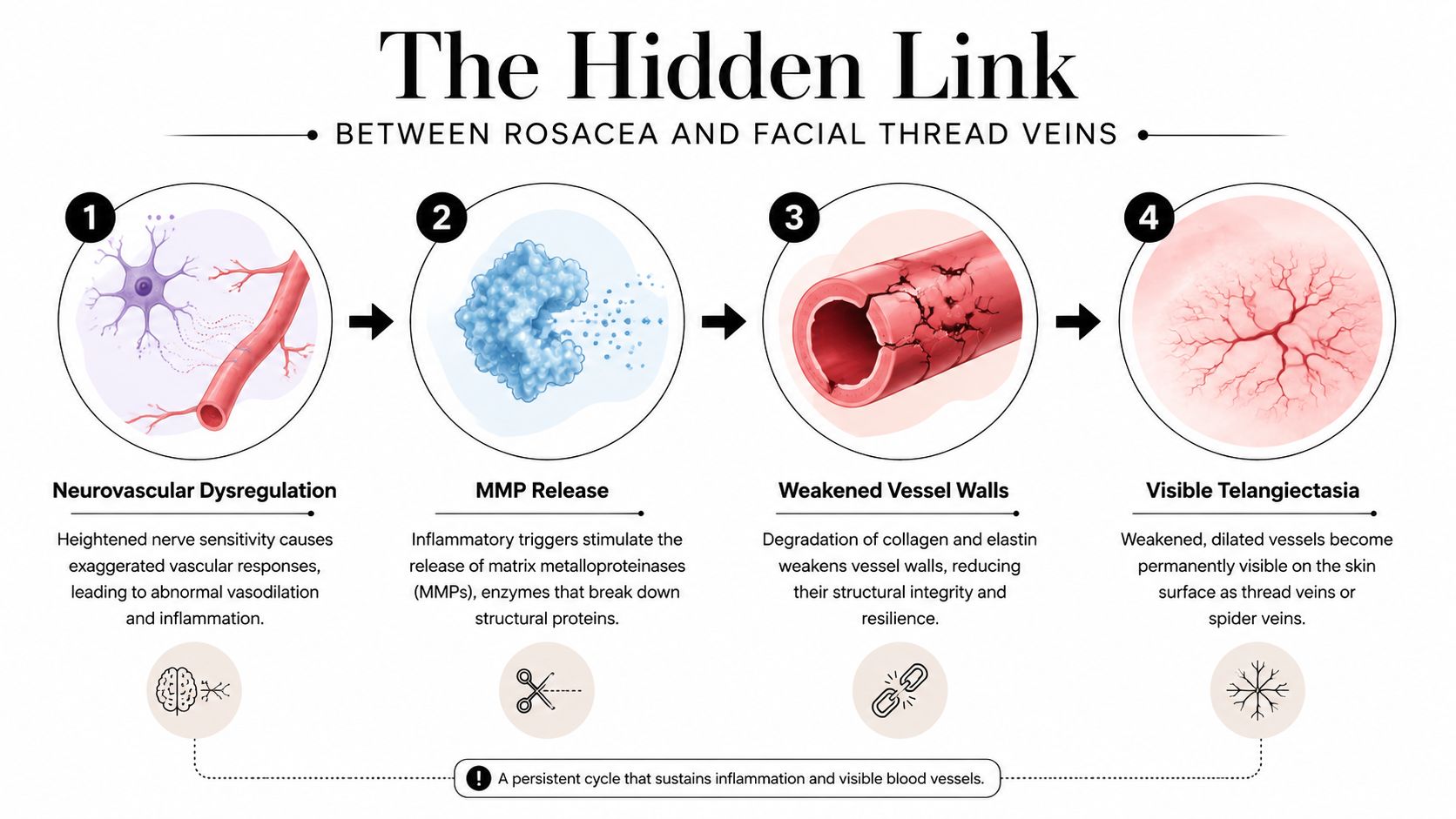
Signs that rosacea may be involved
Assess the surrounding skin, not only the vessel. Rosacea becomes more likely when you notice:
- Trigger-related flushing: Heat, spicy foods, alcohol, emotional stress, or temperature changes cause marked facial colour.
- Persistent central redness: The cheeks, nose, chin, or forehead remain pink between flushing episodes.
- Papules or pustules: Red bumps appear alongside the visible vessels.
- Sensitive or burning skin: Cleansers, cosmetics, or active ingredients sting more than expected.
- Ocular symptoms: Grittiness, irritation, watery eyes, or inflamed eyelid edges require medical attention.
UK rosacea pathways place anti-inflammatory management before vascular procedures in suitable cases. Depending on the presentation and medical assessment, treatment may include topical metronidazole, azelaic acid, ivermectin, or oral tetracyclines. The NHS Dorset rosacea pathway lists vascular procedures for telangiectasia, but not as a replacement for controlling active inflammatory disease.
Review our guide to rosacea management before considering vascular treatment.
The sensible treatment sequence
Active rosacea should be assessed and settled before light-based treatment. A GP or dermatology professional may prescribe topical therapy, while oral medication may be considered for more troublesome inflammatory episodes. Once the skin is stable, reassess the remaining vessels and choose a treatment that suits their size, distribution, and the client's skin type.
Clinical rule: Frequent flushing, stinging, breakouts, or eye symptoms justify a rosacea assessment before booking a vascular procedure.
This order can prevent unsuitable sessions and reduce prolonged irritation or unwanted pigmentation, particularly in darker skin types. The consultation should also confirm that a red mark is vascular before treatment begins. If the diagnosis changes, the treatment timeline changes with it.
Comparing Laser, IPL, and Diathermy for Facial Veins
No single device is right for every facial vessel. Selective photothermolysis uses light absorbed preferentially by blood pigment, while short-wave diathermy uses electrical energy to heat and coagulate an individual vessel directly. The correct choice depends on colour, calibre, depth, distribution, background redness, and skin type.
UK NHS-linked guidance confirms that laser, IPL, and short-wave diathermy can all be useful, with treatment selection influenced by vein size and clinical presentation. Royal United Hospitals Bath guidance on rosacea treatment also reinforces the importance of assessment, patch testing where appropriate, and planning for more than one visit.
How the main options differ
532 nm KTP laser is commonly considered for fine, superficial red threads. It can be precise when the vessels are clearly defined, but the clinician must manage epidermal heating carefully. It may be less forgiving in heavily pigmented or recently tanned skin.
595 nm pulsed dye laser, or PDL, is useful for superficial red vessels and broader vascular redness. It targets haemoglobin effectively, but purpura can occur, creating a bruised or purple appearance during recovery. UK NHS information on pulsed dye laser treatment for spider naevi describes the treatment as highly effective with a very low scarring risk, while also warning that results may not be permanent and repeat treatment can be needed.
1064 nm Nd:YAG laser penetrates more and may be considered for deeper or blue-purple vessels. The longer wavelength generally bypasses some superficial pigment, but the energy still needs careful adjustment, particularly on higher Fitzpatrick skin types.
IPL delivers a broader band of light rather than one laser wavelength. It can be useful when diffuse redness, superficial vessels, and pigment concerns coexist, but it is less targeted than a dedicated vascular laser. Its safety depends heavily on skin colour, tanning status, filters, fluence, cooling, and operator judgement.
Short-wave diathermy is a useful option for a small number of isolated, stubborn capillaries. The probe treats the vessel directly, making it practical for precise work. It isn't the obvious choice for widespread background erythema.
Facial vein treatment modalities compared
| Modality | Wavelength / Energy | Best For | Skin Type Safety | Sessions Needed | Downtime | Avg UK Cost per Session |
|---|---|---|---|---|---|---|
| KTP laser | 532 nm light | Fine superficial red threads | Requires careful settings and assessment on darker skin | Course varies by vessel response | Redness or local swelling may occur | Clinic-specific |
| Pulsed dye laser | 595 nm light | Superficial vessels and diffuse erythema | Patch testing and cooling are important | A course may be required | Bruising or purpura can occur | Clinic-specific |
| Nd:YAG laser | 1064 nm light | Deeper or blue-purple vessels | Often considered for deeper targets, with conservative settings | Course varies by depth and calibre | Redness, swelling, or temporary darkening | Clinic-specific |
| IPL | Broad-spectrum pulsed light | Mixed redness and superficial pigment | Greater caution is needed with darker or tanned skin | Two to four treatments may be needed for skin according to NHS guidance | Redness, swelling, or temporary pigment change | Clinic-specific |
| Short-wave diathermy | Direct electrical thermolysis | Isolated fine capillaries | Localised treatment can be useful when selected appropriately | Course depends on the number of vessels | Small crusts or local irritation may occur | Clinic-specific |
The table deliberately avoids invented prices. Private fees vary by clinic, treatment area, device, practitioner, and consultation findings. Combination protocols can be sensible when a client has widespread redness plus a few sharply defined vessels, but combining treatments isn't automatically better. The clinician should sequence them around skin tolerance and rosacea control.
For a practical explanation of treatment aimed at visible facial capillaries, see this guide to broken capillaries treatment.
What to Expect Before, During, and After Treatment
A safe appointment starts before the handpiece touches your skin. During consultation, the practitioner should examine the vessels under good lighting, review your medical history, ask about rosacea symptoms and medication, and assess your Fitzpatrick skin type. Recent tanning, active irritation, photosensitising medication, and a history of pigment problems all affect the plan.
Patch testing may be recommended before laser or IPL. It gives the practitioner an opportunity to assess how your skin responds to the chosen settings rather than assuming that a standard protocol is appropriate. Your clinician may also advise pausing irritating skincare, limiting sun exposure, and reviewing supplements or medicines that increase bruising risk. Don't stop prescribed medication without speaking to the prescriber.
During the appointment
Treatment time depends on the size and number of areas. A small group of nasal vessels may be brief, while cheeks with widespread redness take longer. Protective eyewear is essential, and a cooling system or cooling application helps protect the epidermis and improve comfort.
Individuals describe vascular laser pulses as a quick snap, heat, or elastic-band sensation. Diathermy feels more localised because the practitioner treats individual vessels with a fine probe. The expected response varies by device, but the clinician should explain whether temporary darkening, pinpoint crusting, swelling, or bruising is likely.
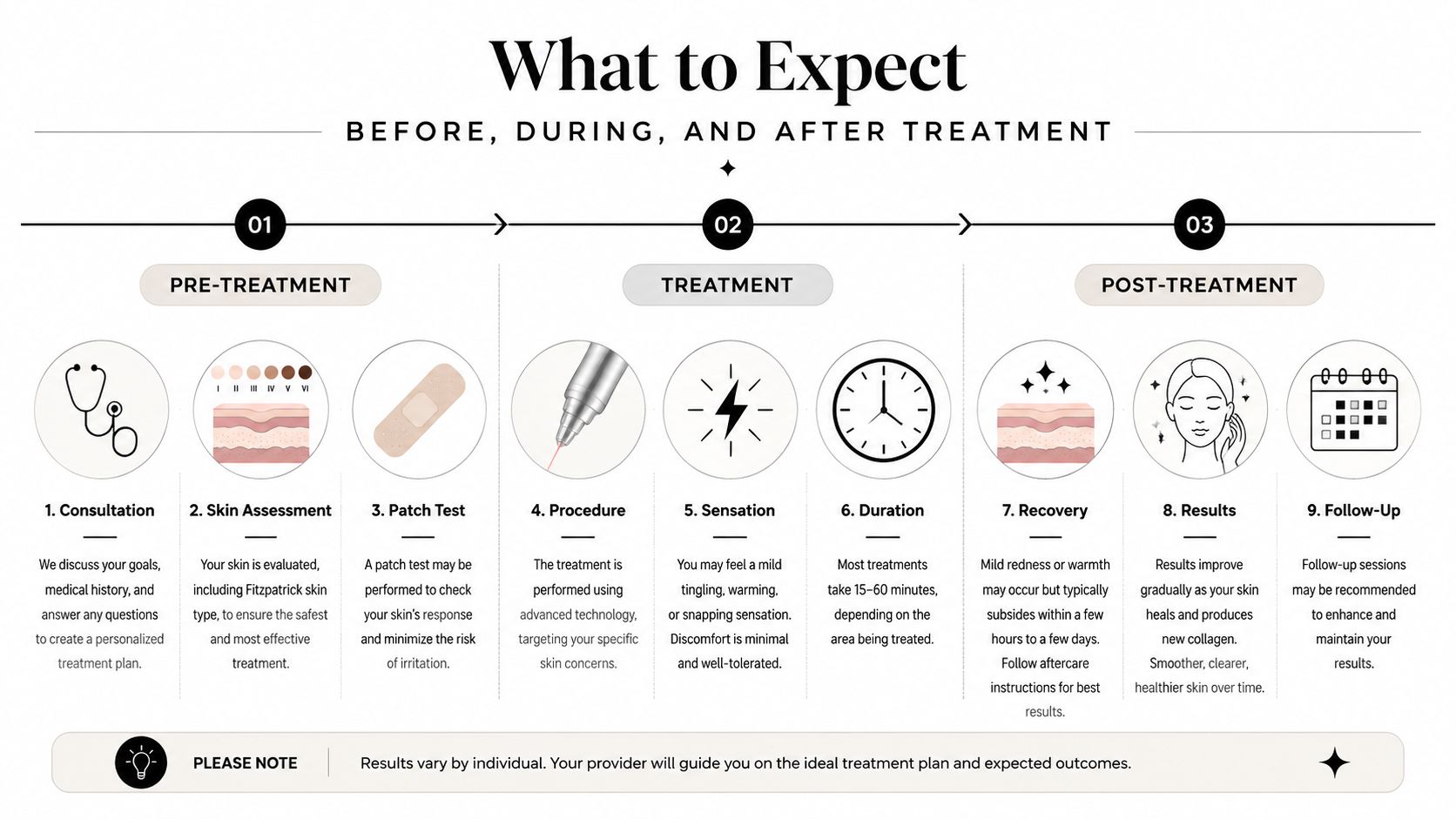
Recovery and aftercare
Expect some immediate redness and possibly mild swelling. The treated vessels then fade gradually as the body clears the coagulated blood and damaged vessel structure. NHS guidance notes that bruising after treatment can last about a week and recommends sun avoidance and high-factor SPF to reduce inflammation and pigment complications. NHS evidence on laser and IPL for rosacea-related telangiectasia describes the evidence as low to moderate certainty, so your clinician should present improvement realistically rather than promise complete clearance.
For the first couple of days:
- Keep cleansing gentle: Use lukewarm water and a non-abrasive cleanser.
- Avoid excess heat: Delay saunas, very hot showers, and strenuous exercise if your clinic advises this.
- Protect from sunlight: Apply broad-spectrum high-factor SPF and use physical shade where possible.
- Don't pick treated areas: Crusting or darkening needs to resolve naturally.
- Contact the clinic promptly: Report blistering, escalating pain, spreading swelling, or signs of infection.
Use the Dermalux LED therapy information to understand how supportive light-based skin care may fit into a broader recovery plan, but don't treat it as a replacement for vascular treatment.
Suitability, Risks, and Realistic Cost Expectations
Suitability isn't decided by the presence of a visible vein alone. A practitioner should consider whether the skin is calm, whether rosacea is controlled, how dark or recently tanned the skin is, and whether the mark has been correctly identified. Active infection, open skin, pregnancy, photosensitising medication, and a history of poor healing may mean treatment needs to be delayed or medically reviewed.
Darker Fitzpatrick skin types can be treated in some circumstances, but IPL and certain vascular lasers carry a greater risk of unwanted pigment change because melanin may absorb part of the energy. Conservative settings, effective cooling, patch testing, and appropriate wavelength selection matter. An experienced practitioner should be willing to decline treatment when the risk is not acceptable.
Risks worth discussing openly
Potential complications include burns, blistering, prolonged redness, temporary pigment alteration, paradoxical darkening, and scarring. These outcomes aren't inevitable, but they become more concerning when the device is poorly matched to the vessel or the skin has been recently exposed to ultraviolet light.
A consultation should also cover the possibility of incomplete clearance. Some vessels respond quickly, while others need further treatment or remain partly visible. New telangiectasia can also appear later if sun exposure, hormonal influences, or rosacea continues.
Cost and session planning
UK NHS guidance makes clear that facial skin treatment is often not routinely funded and may require dermatology referral. NHSScotland also describes criteria-based access for thread veins and related vascular lesions, so private care is a common route for people seeking cosmetic treatment.
The following framework uses no assumed prices because fees differ between clinics:
| Treatment Type | Cost Per Session | Sessions Needed | Interval Between Sessions |
|---|---|---|---|
| Vascular laser | Set by clinic after assessment | Often more than one may be required | Planned around healing and response |
| IPL | Set by clinic after assessment | NHS guidance notes two to four treatments a year may be needed for skin | Determined by skin recovery |
| Short-wave diathermy | Set by clinic after assessment | Depends on the number of isolated vessels | Scheduled after local healing |
Ask whether the quote covers consultation, patch testing, aftercare, review appointments, and treatment of the full area or only individual vessels. A low headline price may not represent the complete course.
How 3D Aesthetics Leamington Spa Plans Your Treatment
A personalised plan should start with the skin, not with a promise attached to a machine. At consultation, the practitioner should review medical history, current skincare, rosacea symptoms, previous procedures, tanning, medication, and the result you want. They should then explain what can realistically improve and what may continue to develop over time.
For facial thread veins, the relevant assessment includes vessel calibre, colour, depth, distribution, and Fitzpatrick skin type. A few isolated red vessels may call for a focused vascular treatment, while diffuse erythema may need a different approach. If rosacea is active, medical management or referral may need to come before vascular work.
3D Aesthetics Leamington Spa offers thread vein and vascular lesion treatment using its 3D Vasculase service. The clinic describes the system as a 980 nm laser for unwanted thread veins and broken capillaries, including facial vessels. That makes it one option to discuss during an assessment, not a reason to skip diagnosis or assume every facial mark requires the same setting.
What a responsible plan should include
- A proper skin assessment: The practitioner identifies vascular features and checks for inflammatory redness, irritation, or another skin condition.
- Treatment selection by presentation: Device choice reflects vessel size, depth, colour, and skin response rather than a fixed package.
- Patch testing where indicated: The clinic checks tolerance before proceeding with a larger area.
- A realistic course: The plan explains that visible improvement may require review and repeat treatment.
- Structured aftercare: You receive clear guidance on cleansing, heat, sun protection, and warning signs.
- Long-term skin management: Trigger control and daily photoprotection help reduce the factors that can encourage new redness.
A clinic's willingness to assess, explain limitations, and postpone treatment when the skin is unstable is a positive safety signal. The right service is not the one offering a laser. It's the one that connects the device, the diagnosis, the skin type, and the follow-up plan.
Common Questions and Misconceptions About Facial Vein Removal
Can vitamin K or retinol remove established thread veins?
Topical vitamin K or retinol may support a suitable skincare routine, but they do not close an established dilated vessel. Creams can improve texture or help manage irritation. Visible telangiectasia usually needs a vascular procedure when clearance is the aim.
Will one laser session remove everything?
No single session guarantees complete clearance. Treatment response varies with vessel size, depth, distribution, skin type, and whether rosacea is still active. A clinician should review the result before recommending further treatment, rather than selling a fixed course. The Bristol Laser Centre guidance outlines why repeat treatment may be needed.
Can the NHS fund facial thread-vein treatment?
Cosmetic facial telangiectasia is not routinely funded, although pathways differ and an assessment may be appropriate when the vessels relate to a diagnosed condition. Funding status should be checked locally rather than assumed.
Will treatment make my skin thinner?
Vascular laser, IPL, and diathermy target vessels, not the skin's surface, when selected and used appropriately. Temporary sensitivity, irritation, or pigment change remains possible. Extra caution is needed with darker skin, active inflammation, or recent sun exposure. Treatment should wait if the skin is unstable.
Do treated veins return worse?
The treated vessel may fade without becoming worse. New vessels can appear as rosacea, ultraviolet exposure, hormonal changes, or repeated flushing continue to affect the skin. Managing those triggers can help limit further visible vascular change, but it cannot guarantee permanent prevention.
3D Aesthetics Leamington Spa provides consultations and 3D Vasculase treatment for facial thread veins and broken capillaries. The plan can be adjusted to your skin and vascular presentation, including whether rosacea management should come before light-based treatment. Visit 3D Aesthetics Leamington Spa to arrange a consultation.
← Back to Home