

You've probably seen the pattern: one photo shows uneven texture, acne scars or fine lines, and the next shows smooth, luminous skin. The lighting is flattering, the skin looks calm, and the caption suggests that microneedling created the change almost overnight. If you're comparing those images with your own face in the bathroom mirror, it's reasonable to wonder whether your results could look similar.
A believable microneedling facial before and after journey is less dramatic in the first few days and more gradual over the following months. The initial redness is recovery, not the final result. Genuine improvement comes from the skin's repair process, usually across a planned course of treatment, careful aftercare and realistic assessment of the scar or skin concern being treated.
Table of Contents
- What a Microneedling Facial Actually Does
- A Realistic Microneedling Facial Before and After Timeline
- Preparing for a Session and Caring for Your Skin Afterwards
- How Microneedling Compares with HIFU, RF and CO2 Resurfacing
- Reading Before and After Photos Without Getting Misled
- Choosing the Right Provider for Your Skin Goals
- Bringing It All Together Before You Book
What a Microneedling Facial Actually Does
Microneedling is a controlled, minimally invasive treatment. A clinical device fitted with fine needles creates precise micro-channels in the skin. Those tiny openings are designed to stimulate a wound-healing response, rather than remove the entire surface layer.
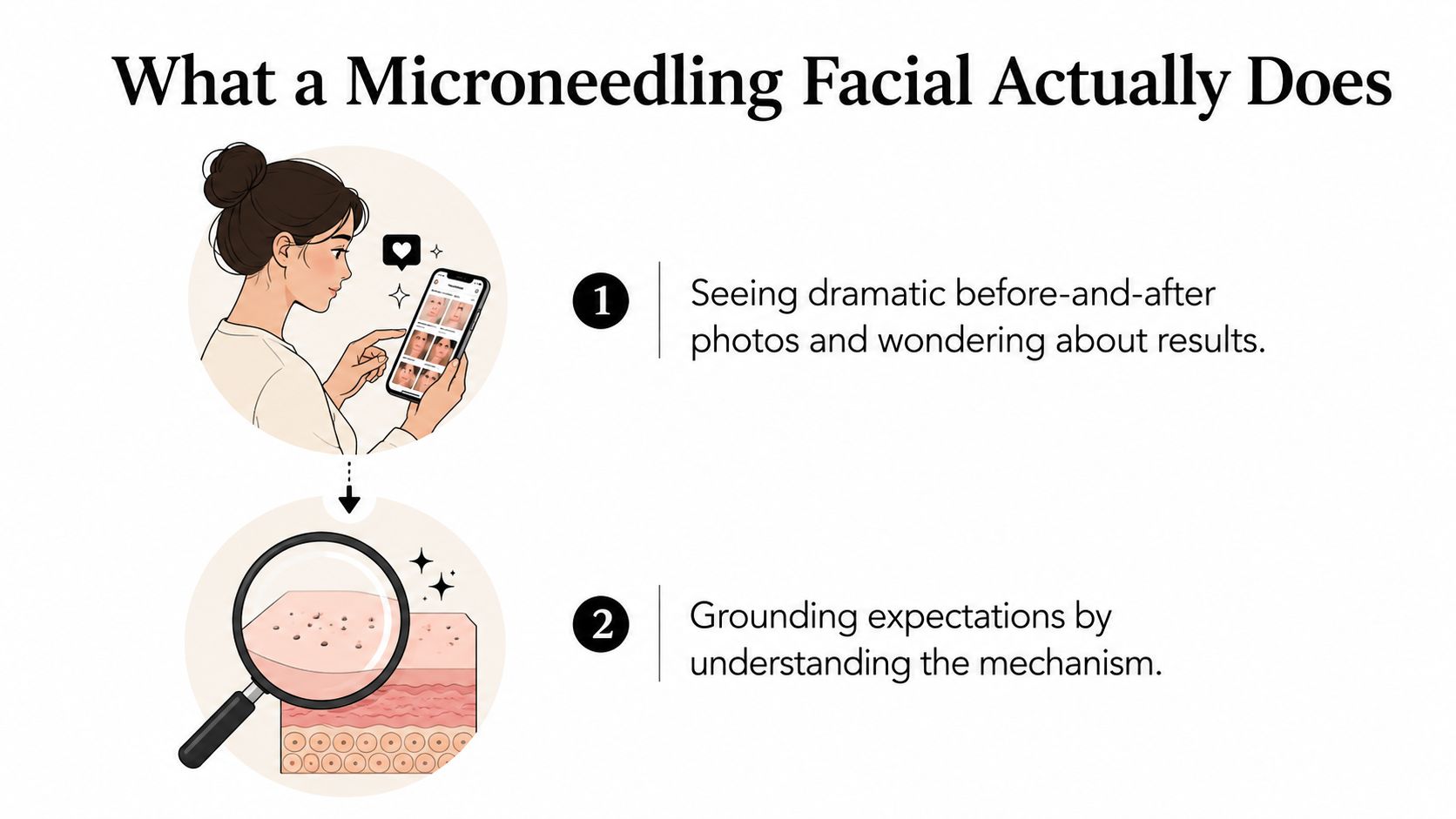
The repair process in plain English
Your skin responds in stages:
- Inflammatory phase: The controlled injury signals that repair is needed. Redness, warmth, tightness and mild swelling can appear while the skin begins responding.
- Proliferative phase: The body starts building new tissue and supporting the wound-healing process. This is when the treated area may feel dry or slightly rough.
- Remodelling phase: Newly formed tissue gradually reorganises. Collagen and elastin contribute to improved structure, texture and elasticity over time.
The immediate post-treatment glow can confuse this process. Temporary swelling and increased circulation may make the skin appear brighter for a short period, but that appearance isn't the same as deeper collagen remodelling. A UK NHS patient leaflet explains that microneedling produces organised dermal tissue, including collagen and elastin, through controlled puncturing and wound healing. It also states that four to six sessions are normally required, with sessions spaced at least six weeks apart, and that improvement may take three months or more. Chelsea and Westminster Hospital's microneedling guidance provides useful context for anyone judging photographs too soon.
Clinical treatment isn't the same as home rolling
A home dermaroller and a professional device don't offer the same controlled approach. A trained practitioner can select the device, needle depth and treatment pattern according to the area, skin sensitivity and concern. Clinical systems such as Dermapen 4 or SkinPen are motorised pens designed to create more consistent vertical channels than casual rolling.
Some clinics apply a topical serum during or after treatment because the temporary channels can affect how products contact the skin. The ingredients vary, and products marketed as growth factors or exosomes shouldn't be treated as automatically necessary or risk-free. Ask exactly what will be applied, why it has been selected and whether the product is intended for use with the device.
Microneedling can help improve atrophic acne-scar texture, uneven surface quality, fine lines and some forms of scar elasticity, but it isn't a universal scar eraser. The Worcestershire Acute Hospitals guide describes it as a reconstructive treatment that may improve scar texture and elasticity, and may help recolour pale scars by activating melanin production. This guide to comparing microneedling outcomes can help you assess photographs with that gradual, tissue-remodelling mechanism in mind.
A Realistic Microneedling Facial Before and After Timeline
You leave a clinic after microneedling with red, tight skin and wonder whether the treatment has made anything better. A session-by-session timeline gives a more honest picture than a single polished photograph. The early period is dominated by recovery, while later changes reflect collagen remodelling.
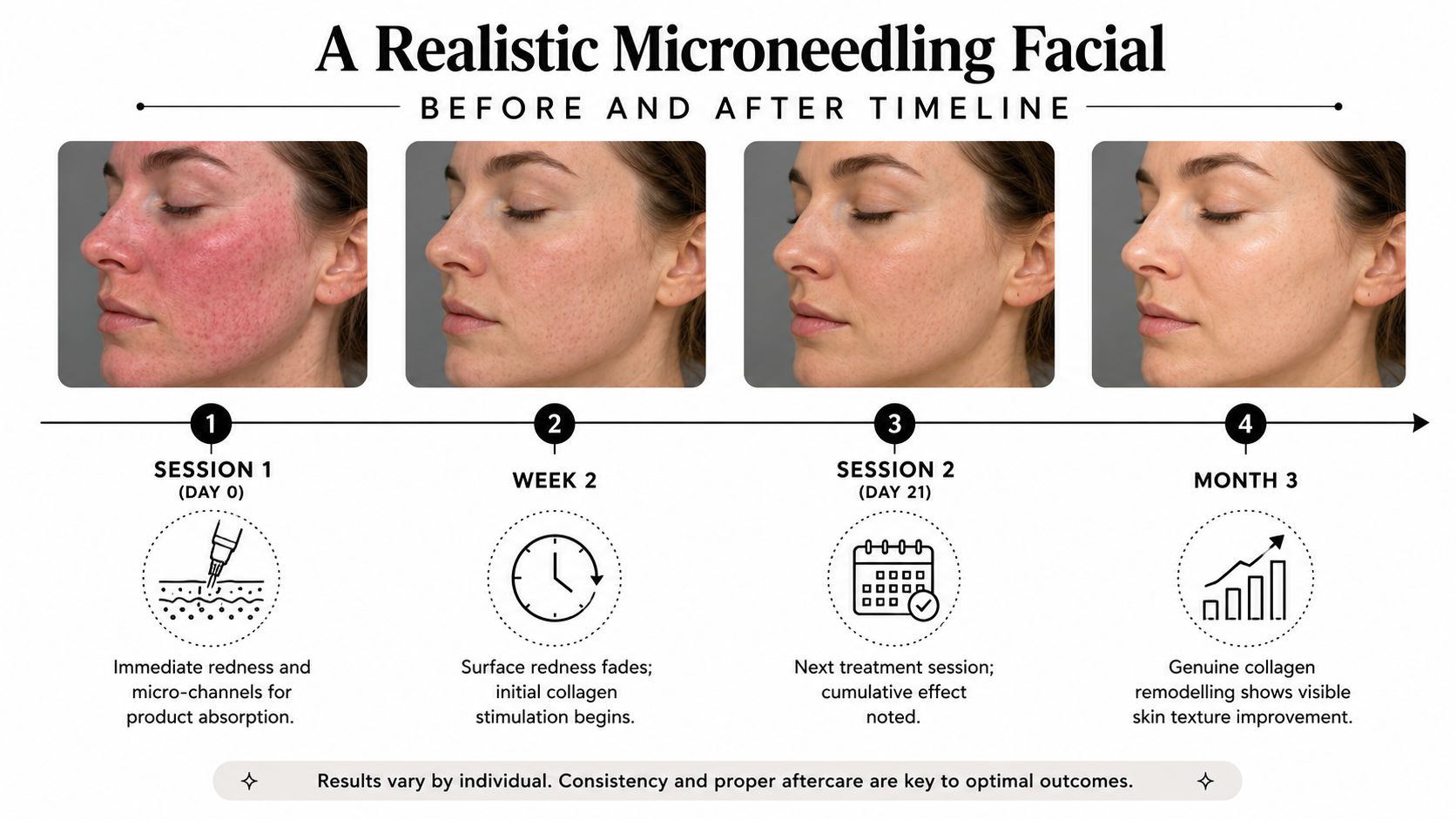
The first week after treatment
During the first one to three days, redness, tightness, peeling and occasional pinpoint bleeding can be more noticeable than any improvement. Chelsea and Westminster NHS aftercare guidance says patients may need to avoid make-up, swimming, saunas, hot water and strenuous exercise for up to 72 hours, and avoid sun exposure for seven days. These restrictions reduce irritation while the skin barrier is vulnerable. The NHS microneedling aftercare leaflet explains this early recovery period.
By days three to seven, the surface is often calmer, although treatment intensity and individual sensitivity affect how quickly it settles. A smoother appearance at this point marks the end of the most visible recovery stage, not the completion of collagen change.
Weeks and sessions, not one-off transformations
Between the second and fourth weeks, some people notice a subtle improvement in smoothness, tone or make-up application. The difference may be easier to feel under the fingertips than to see in a quick mirror check. A UK evidence review used by NICE references clinical studies in which microneedling-based approaches produced measurable improvements in facial acne scars after courses of three sessions, with further improvement observed at six months. One cited trial reported a mean difference of 3.4 in scar scores at six months, with a P value of .03. The UK-relevant clinical evidence review illustrates why a final photograph should not be taken immediately after treatment.
Three common treatment journeys show how results can differ:
- Rolling acne scars: The first session may leave skin red and tight, with little immediate change in the depressions. After several sessions and later remodelling, the edges of shallow rolling scars may appear softer. Deeper or tethered scars may need another or combined approach.
- Early fine lines and dullness: Temporary brightness may appear first, followed by more refined texture as the course progresses. The result should resemble fresher skin, rather than a frozen or radically altered face.
- Post-inflammatory hyperpigmentation on a darker skin tone: Controlled treatment and pigment-aware aftercare matter. Irritation can complicate discolouration, so the practitioner should adjust the plan to skin sensitivity and monitor the response.
A large prospective study cited in the verified guidance found scars improved by at least 50% after an average of 2.5 sessions, with over 80% of patients seeing 50 to 75% improvement and 65% seeing over 75% improvement. The NHS-linked evidence discussion places these figures in a course-based context, while individual results still vary.
The most useful “after” photographs are taken well after the final session, once immediate redness has settled and remodelling has had time to develop. Maintenance may be discussed later as an occasional review, not an automatic commitment. For planning, read this guide to how many microneedling sessions may suit different concerns.
If your skin is reactive, keep the routine simple while it settles. Natural products are not automatically gentle, so check ingredients before trying alternatives such as African black soap for sensitive skin.
Preparing for a Session and Caring for Your Skin Afterwards
Good preparation makes the appointment easier to assess and can reduce avoidable irritation. Your clinic should give you personalised instructions, especially if you use prescription medication or have a history of pigmentation changes.
Before the appointment
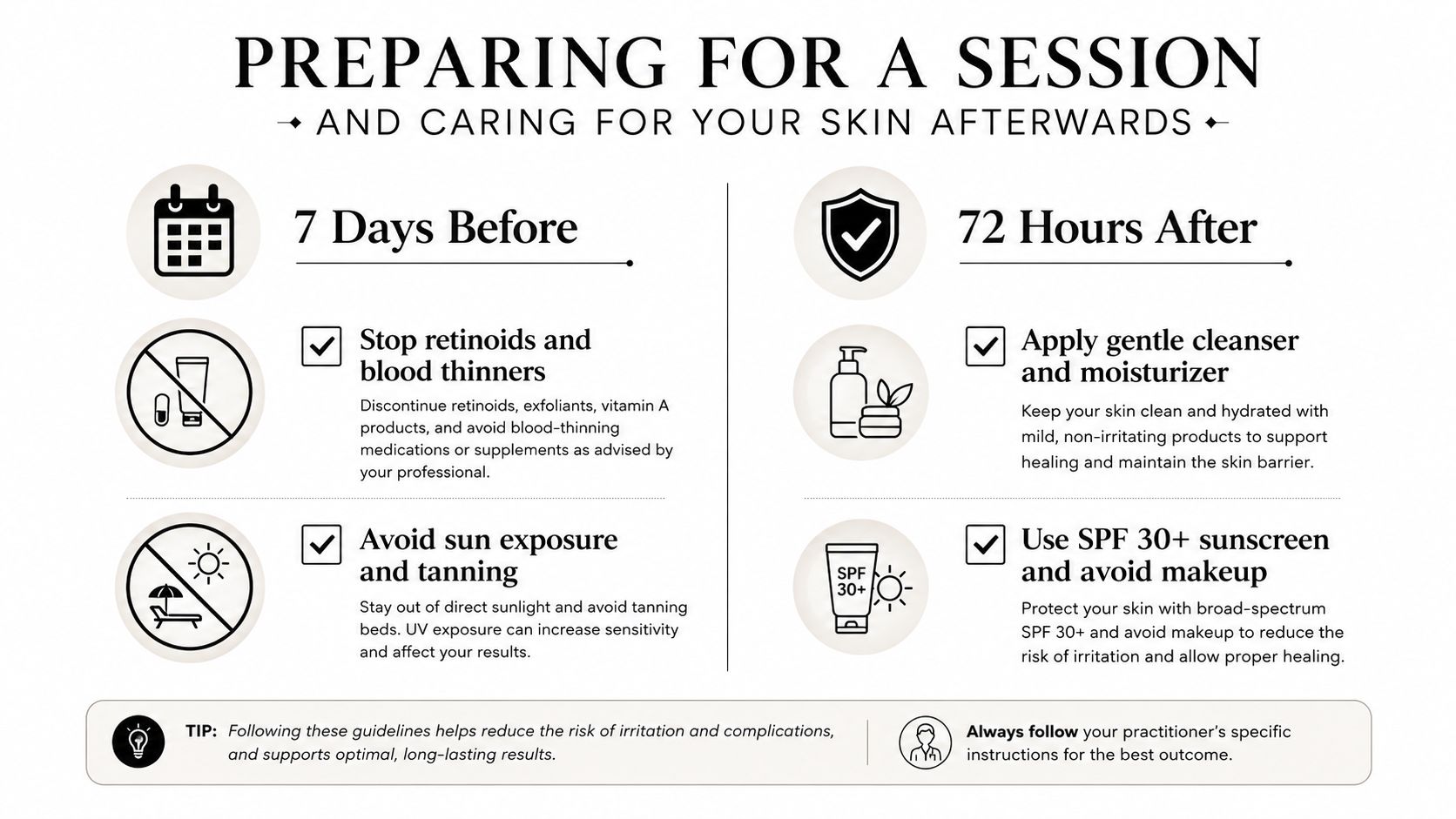
During the days before treatment, ask the practitioner which products to pause. Many clinics advise stopping retinoids, exfoliating acids and vitamin C for three to five days, but the correct interval depends on the formulation, strength and your skin. Avoid deliberate sun exposure and self-tan, and arrive with clean skin without make-up.
Tell the clinic about recent isotretinoin use, cold sores, active breakouts, eczema, psoriasis, unusual scarring or medication that affects healing. Don't conceal an active flare because the safest decision may be to postpone treatment. A proper consultation should also cover your tolerance for redness, peeling and temporary restrictions.
The first 72 hours afterwards
Use a gentle cleanser and avoid scrubs, brushes and fragranced products. A practitioner may recommend a simple petrolatum-based barrier cream during the first 48 hours, particularly if your skin feels tight or dry. Apply a broad-spectrum SPF, commonly SPF 50, once your provider says it is suitable, and limit sun exposure while the skin recovers.
NHS guidance advises avoiding make-up, swimming, saunas, hot water and strenuous exercise for up to 72 hours, while avoiding sun exposure for seven days. Deeper treatments, including radiofrequency microneedling, can cause redness and swelling that lasts longer than a standard superficial session. The Chelsea and Westminster aftercare information is a useful reference, but your clinic's instructions take priority when they differ for a specific device.
Practical rule: Calm skin is the priority during recovery. Don't chase faster results by adding stronger products.
Keep this short checklist available:
- Do cleanse gently: Use lukewarm water and clean hands rather than friction.
- Do protect the barrier: Follow the recommended moisturiser or barrier cream routine.
- Do use sun protection: Reapply as directed and avoid unnecessary exposure.
- Don't pick flaking skin: Let peeling resolve naturally.
- Don't add active ingredients early: Wait until your practitioner confirms that retinoids and exfoliants can resume.
- Don't exercise through significant irritation: Heat and sweat can make discomfort worse.
Contact the clinic if swelling persists or worsens, yellow discharge develops, pain becomes marked or you suspect infection. You can also review the clinic-specific advice in this microneedling aftercare guide. Aftercare protects the skin during the period when the procedure has created its healing stimulus, so it deserves the same attention as the appointment itself.
How Microneedling Compares with HIFU, RF and CO2 Resurfacing
No treatment is universally better. The useful question is whether the way a procedure acts on tissue matches your main concern and the amount of recovery you can accept.
Microneedling creates controlled channels to encourage dermal repair. RF microneedling adds radiofrequency heat at the needle tip, combining puncture with thermal energy. HIFU focuses ultrasound energy deeper in the tissue, so it's generally considered when laxity and lifting are more important than surface texture. Fractional CO2 laser creates columns of controlled ablation in the epidermis and underlying skin, offering stronger resurfacing with more recovery.
| Treatment | Depth of action | Typical downtime | Best for | Sessions for visible change |
|---|---|---|---|---|
| Microneedling | Controlled needle channels through the skin, with depth selected by the practitioner | Redness, tightness and peeling are commonly the main early concerns | Atrophic acne-scar texture, fine lines and general skin refinement | A course is commonly planned, with UK NHS guidance stating that four to six sessions are normally required and spaced at least six weeks apart according to Chelsea and Westminster Hospital |
| RF microneedling | Needles deliver radiofrequency heat into selected tissue depths | May involve longer redness or swelling than standard microneedling | Texture, fine lines and tightening where heat is appropriate | Multiple treatments are often discussed, with timing based on device settings and response |
| HIFU | Focused ultrasound energy acts deeper for tissue tightening and lifting | Often selected when limited surface disruption is preferred, although individual reactions vary | Laxity and facial lifting concerns | A consultation is needed to establish whether one treatment or a planned course suits the concern |
| Fractional CO2 | Ablates controlled columns of epidermal and dermal tissue | More visible recovery than standard microneedling, including redness and peeling | Stronger resurfacing, textural irregularity and selected scars | The plan depends on scar depth, skin type and the intensity considered safe |
| Lighter chemical or laser treatments | Act mainly at the surface or upper skin layers | Often less intense, though irritation and pigment changes remain possible | Tone, mild uneven texture and selected pigmentation concerns | A course may be recommended according to the product or laser system |
The table gives direction, not a prescription. A person with rolling scars and limited downtime may find microneedling a sensible starting point, while someone mainly concerned with laxity may need to ask about facial skin tightening options. CO2 may be more appropriate for selected deeper textural problems, but skin tone, healing history and aftercare capacity matter.
A clinic should also explain when combination treatment might improve the plan, and when adding procedures would create unnecessary irritation. Device depth, energy settings and practitioner technique can change both recovery and outcome, so comparing treatment names alone isn't enough.
Reading Before and After Photos Without Getting Misled
A side-by-side image can suggest a result, but it can't prove that microneedling caused every visible difference. Skin photographs are highly sensitive to the conditions around the camera.
Ring lighting can soften shadows in scar depressions. Ring-flash hotspots can make the skin look brighter. A relaxed expression may deepen or flatten certain lines compared with a posed expression, while a change in hair position can alter how the face is framed. Make-up, tinted moisturiser and skin tint also affect redness, pigmentation and apparent texture.
Retouching is harder to detect. A smoothed image may remove the very texture the treatment is supposed to address. Even without editing, camera focus and exposure can produce a misleading comparison.
What a useful gallery should show
Look for a series rather than one dramatic pair. Ideally, the photographs use the same person, camera, background, facial expression and angle. The skin should be shown under comparable lighting, with clear information about make-up and the time elapsed since the last session.
Ask the clinic:
- Are the lighting and camera settings consistent? A brighter “after” image isn't a fair comparison if the original was taken under harsh overhead light.
- How long after treatment was the photograph taken? Immediate redness can make an image look worse, while temporary swelling can make skin look smoother.
- Are both images from the same patient? A credible gallery should identify whether the comparison is a genuine matched pair.
- How many sessions were completed? A final image after a full course shouldn't be presented as the expected result after one appointment.
Pay particular attention to acne-scar depth. Rolling, boxcar and ice-pick scars don't respond in identical ways, and a broad claim about “acne scars” hides important differences. Pore appearance can also change with hydration, lighting and make-up, while pigmentation may fluctuate with sun exposure and inflammation.
A trustworthy before-and-after photograph documents conditions as carefully as the treatment.
Be cautious with phrases such as “one session transformation” or “instant scar removal”. The verified UK evidence describes measurable changes after treatment courses and follow-up periods, not a universal overnight outcome. A credible provider will explain what the photograph demonstrates, what it doesn't demonstrate and how closely your skin resembles the example.
Choosing the Right Provider for Your Skin Goals
Start with the consultation, not the package. A suitable UK provider should ask about your skin type, medication, previous acne or scarring, cold sores, pigment response and how much downtime you can manage. If the conversation moves straight to payment without examining the skin, you haven't received enough information to make an informed decision.
Questions worth asking
Ask which device will be used and whether the treatment is standard microneedling or RF microneedling. A motorised pen, such as Dermapen 4 or SkinPen, should be used with a single-use cartridge, and the practitioner should explain how depth will vary across the face. Scarred areas may need a different approach from thin skin near the eyes.
You can also ask:
- What training and insurance does the practitioner hold? The clinic should be willing to explain who performs the procedure and how they maintain safety standards.
- Do you patch test or plan cautiously for darker or reactive skin? This is particularly relevant if you have a history of post-inflammatory pigmentation.
- How will you track progress? Ask whether the clinic offers consistent photographs or a follow-up review at four to six weeks, rather than relying on memory.
- Will you adjust depth by area? A careful practitioner shouldn't treat every part of the face identically.
- When would another option be more suitable? HIFU may be discussed for laxity, RF for selected tightening goals and CO2 for stronger resurfacing, depending on the assessment.
The Worcestershire Acute Hospitals guidance reinforces an important point: microneedling supports reconstruction and remodelling, but it doesn't erase a scar. That distinction should appear in the consultation, especially if you're expecting a deep depression to disappear.
3D Aesthetics Leamington Spa offers 3D Dermaforce RF microneedling alongside facial options such as HIFU, fractional CO2 resurfacing, Dermalux LED light therapy and RF treatments. Its complimentary consultation includes a 3D body scan to assess concerns, personalise treatment planning and measure results over time, which may be relevant if you want a provider to compare options rather than sell one procedure automatically.
Red flags
Be wary of pressure to buy a large course before the practitioner has assessed your skin. Other warning signs include vague device information, no explanation of cartridge hygiene, no discussion of contraindications, unrealistic promises and a gallery that uses inconsistent lighting or unidentified models.
A measured provider may recommend waiting, treating active breakouts first or choosing another option. That isn't a failure of the consultation. It's evidence that the recommendation is based on your skin rather than a pre-set sales script.
Bringing It All Together Before You Book
The central distinction is simple: redness is short-term recovery, while collagen change develops gradually. A calmer face after several days doesn't mean the final result has arrived, and a dramatic glow immediately after treatment shouldn't be mistaken for permanent remodelling.
Use three questions to decide what to do next:
- What is the main concern? If it's atrophic texture or mild acne scarring, ask whether standard microneedling is appropriate. If laxity is the priority, ask about HIFU or RF. If the surface irregularity is pronounced, ask whether fractional CO2 should be considered.
- Can you accept recovery? The early period may involve redness, tightness, peeling and restrictions on heat, exercise, swimming and make-up. If even brief downtime isn't practical, discuss lighter alternatives.
- Do you accept a course rather than a single dramatic appointment? UK NHS guidance describes four to six sessions as normally required, while clinical evidence cited for acne scarring includes improvement after three sessions and later follow-up. Your provider should explain why their plan differs, if it does.
Wait if you have active inflammation, an unresolved infection, recent relevant medication or skin that isn't suitable for treatment yet. Ask for a written plan covering preparation, device, expected recovery, follow-up photographs and what happens if the response is weaker than hoped.
Legitimate clinics welcome measured questions. They won't guarantee that your face will match a social-media photograph, and they may recommend waiting or choosing another procedure. That caution is exactly what you should want from someone working on your skin.
If you're in or near Leamington Spa, visit 3D Aesthetics Leamington Spa to discuss whether 3D Dermaforce RF microneedling, standard microneedling or another facial treatment fits your texture, scarring or laxity goals. Book a complimentary consultation to review your skin, recovery expectations and a measured treatment plan before committing to sessions.
← Back to Home