

You notice the lines after pregnancy, a growth spurt, or a period of rapid weight change. At first they're pink or purple, then they gradually fade into silver-white marks that seem to resist every cream, oil, and home remedy you try. The frustration usually comes from expecting a surface product to repair damage that sits much deeper in the skin.
Radio frequency for stretch marks can improve the texture, depth, and colour contrast of striae, but it won't erase them completely. The most useful way to understand the treatment is to separate early red or purple marks from older white striae, examine what the clinical evidence measured, and then consider the practical realities of sessions, downtime, suitability, and UK pricing.
Table of Contents
- Why Stretch Marks Are Harder to Treat Than Most People Think
- How Radio Frequency Actually Reworks Striae
- Red and Purple Striae Versus Old White Marks
- What the Clinical Evidence Really Shows
- Sessions, Downtime, and What a Visit Feels Like
- Comparing RF With Lasers, Microneedling, and Topical Options
- Who Is a Good Candidate and Who Should Avoid RF
- Making the Decision and Booking in Leamington Spa
Why Stretch Marks Are Harder to Treat Than Most People Think
A client may arrive after months of applying moisturiser to her abdomen, hoping the silvery lines left after pregnancy will disappear. She may already have read pregnancy skincare advice, including this practical guide to Healtsy pregnancy skincare advice, and still be wondering why prevention and hydration haven't changed the marks that are already there.
The answer is structural. Stretch marks, or striae, form when the skin stretches faster than its support network can adapt. Collagen and elastin fibres in the dermis become damaged, then heal in a disorganised pattern. That makes striae closer to a type of scar than to ordinary dryness or uneven surface pigmentation.
The three barriers to improvement
First, the damage sits in the dermis, below the level reached by most cosmetic creams. A moisturiser can make surrounding skin look smoother and reduce dryness, but it can't rebuild a disrupted collagen framework from the surface.
Second, mature white marks have a different biology from fresh red or purple striae. Early marks still show vascular colour through thinner skin, while older marks have settled into a paler, more stable scar pattern. A product that improves hydration won't recreate the blood supply or restore the original arrangement of fibres.
Third, adult skin does remodel itself, but slowly and incompletely. Its repair system is more like a renovation team working with limited materials than a factory replacing every damaged component. That's why successful treatment usually means softening contrast and improving texture, not returning the skin to its pre-stretch appearance.
Practical rule: If a product promises complete removal, treat that as a marketing claim rather than a realistic clinical endpoint.
For a fuller overview of available approaches, see this guide to stretch mark treatment options. RF is interesting because it can deliver controlled energy into the dermal layer without surgery, giving the skin a reason to begin a more organised remodelling response.
How Radio Frequency Actually Reworks Striae
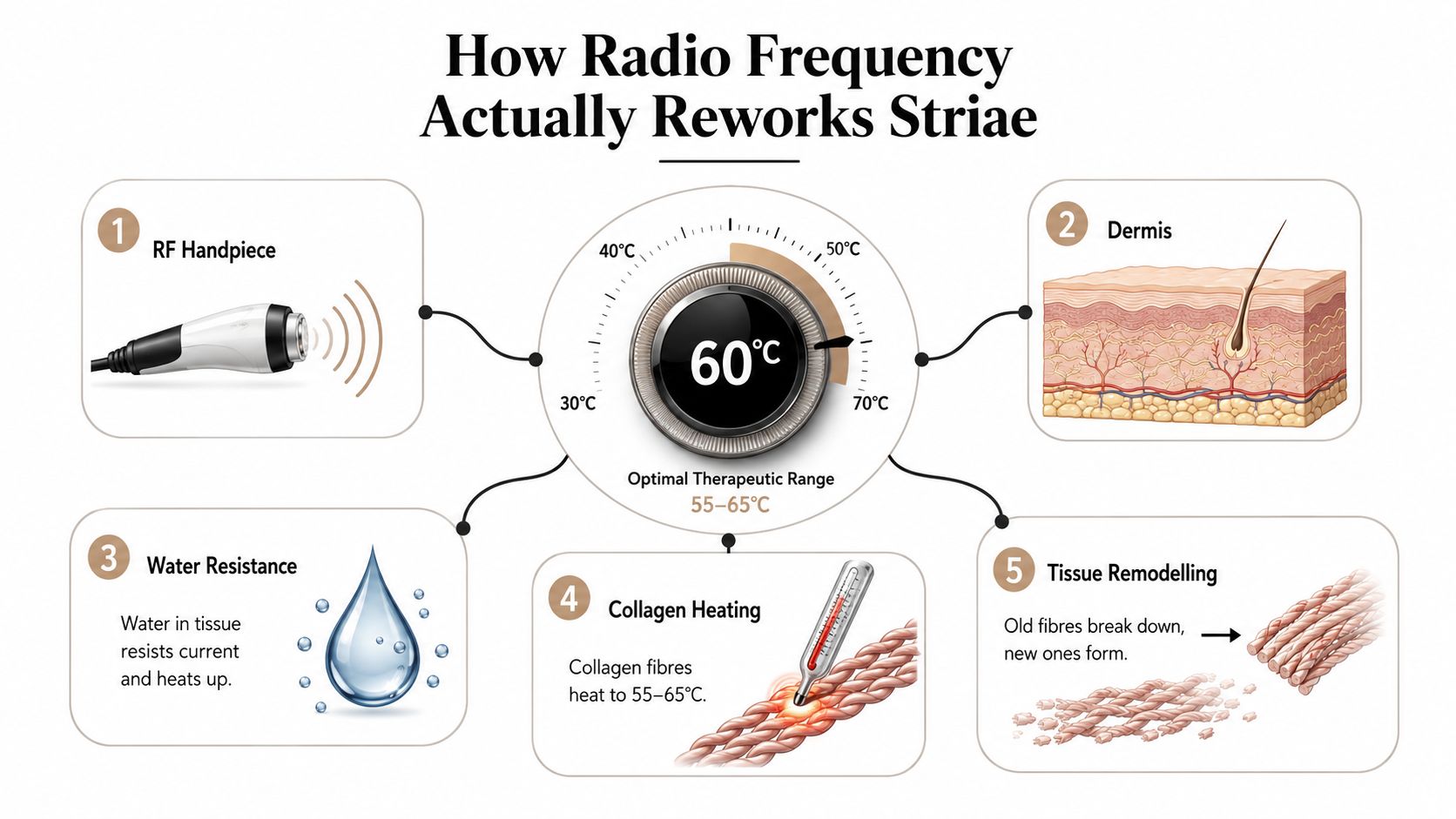
Think of RF treatment as a carefully controlled thermostat rather than a laser beam burning the surface. The handpiece sends an electrical current through the tissue. Water in the tissue resists that current, and that resistance produces heat in the deeper skin.
The intended heating range is roughly 55 to 65 degrees Celsius, although the precise setting depends on the device, treatment area, skin thickness, and the practitioner's technique. At the right temperature, collagen fibres contract initially, while the controlled thermal stimulus activates a wound-healing response that encourages further collagen and elastin formation over the following weeks.
Why the delivery method matters
Different RF devices distribute energy differently.
- Monopolar RF sends energy through a larger pathway and can reach deeper tissue, which may suit broader body areas such as the abdomen or thighs.
- Bipolar and multipolar RF keep the energy pathway more localised. They usually feel gentler and distribute heat more superficially.
- Fractional RF creates small, controlled treatment zones while leaving nearby tissue untouched. The untreated areas help support recovery.
- Microneedling RF combines tiny needle punctures with direct heating inside the dermis. The needles create controlled micro-injuries, while RF adds thermal stimulation at depth. This combination is among the more closely studied RF approaches for striae.
The skin's surface can remain comparatively cool while the deeper layer warms. That distinction matters for people with darker skin tones, because the treatment doesn't rely primarily on targeting melanin in the way some light-based treatments do. It may therefore offer a useful option where pigment changes are a particular concern, although correct settings and experienced assessment still matter.
For readers considering the broader skin-tightening uses of the technology, this explanation of radio frequency skin tightening covers the same basic principle in a wider treatment context.
Red and Purple Striae Versus Old White Marks
A red or purple stretch mark usually indicates an earlier, still-changing stage. Visible blood vessels show through thinner, disrupted skin, while the surrounding tissue continues settling. An older white or silver mark has lost much of that colour and behaves more like a stable, pale scar.
RF can be used for both stages, but the visible result may differ. Early striae may show softer colour and some flattening before texture changes become obvious. Mature marks are more likely to show a smoother edge, reduced shadowing, and gradual improvement in surface texture. The aim is to make the skin look more even, not to recreate untouched skin.
| Striae type | Typical colour | Tissue state | Expected RF response | Sessions to visible change |
|---|---|---|---|---|
| Early striae | Red, pink, or purple | Active, vascular, still remodelling | Colour may soften alongside texture and flattening | Usually develops progressively during a course |
| Older striae | White or silver | More settled, scar-like tissue | Texture and depth may improve, but original colour won't necessarily return | Often requires patience and may benefit from combination treatment |
The clinical figures give useful context. In a prospective study, 15 subjects completed four sessions. At the 16-week follow-up, average striae volume had reduced by 19.1%. Redness fell by 14.3%, pigmentation by 11.2%, and striae colour by 8.82% in the published clinical study.
Those averages describe the study group, not a guaranteed personal outcome. A newer red mark may respond differently from a long-established white one, and the depth, width, body area, skin tone, and device settings all affect what becomes visible. Improvement usually means partial remodelling. Complete eradication is not a realistic promise.
A careful assessment should track colour and texture separately. Consistent photographs under the same lighting can reveal gradual changes that are easy to miss day to day, while touch and side-by-side comparison help show whether the surface has become flatter or less sharply indented.
What the Clinical Evidence Really Shows
A client may see smoother-looking skin after RF, while an instrument records a smaller change in the mark's dimensions. Both observations can be valid. Neither means the striae have disappeared.
The evidence is encouraging, although it remains limited. Research includes small prospective studies, pilot work, and comparisons involving combination treatment. These studies can show whether a method is tolerable and whether measurable changes occur. They cannot establish that every patient will achieve the same result.
One two-centre pilot study followed 16 women aged 30 to 72, with a mean age just over 46, after multipolar RF combined with pulsed magnetic fields. 14 of the 16 participants, or 87.5%, reported visible improvement, and all 16 participants, or 100%, described the treatment as comfortable. No side effects or undesirable safety events were recorded. Objective measurements also found significant reductions in striae length and width one month after treatment, with mean reductions of 1.031 and 0.160, respectively, both at p<0.001 in the pilot study report.
What those measurements mean in practice
A patient-reported improvement may mean that a mark catches less light, feels flatter, or blends more easily with nearby skin. An objective reading may identify a change that is difficult to notice in a mirror. Clinical decisions are stronger when both forms of assessment are considered, rather than relying on either one alone.
The fractional RF study offers a practical reference point. After four sessions and a 16-week assessment, the average changes were modest to moderate, not dramatic. The same publication reported a mean pain score of 3.8 out of 10, tolerability of 3.1 out of 4, and no serious adverse events, as noted earlier. These figures describe the study group, not a promised personal result.
| Study | RF type | Patients | Sessions | Improvement |
|---|---|---|---|---|
| Prospective fractional RF study | Fractional RF | 15 completed | 4 | Average striae volume reduction of 19.1% at 16 weeks |
| Two-centre pilot study | Multipolar RF with pulsed magnetic fields | 16 women | Not stated in the verified data | 87.5% reported visible improvement, with objective reductions in length and width |
A 2020 comparative-effectiveness network meta-analysis identified bipolar RF combined with topical tretinoin as a recommended approach for striae distensae, within the comparative evidence discussed earlier. This places RF among possible treatment strategies, rather than presenting it as a miracle standalone device. The sensible expectation is partial remodelling, with the degree of change influenced by the mark's age, depth, body area, skin characteristics, and treatment settings.
Sessions, Downtime, and What a Visit Feels Like
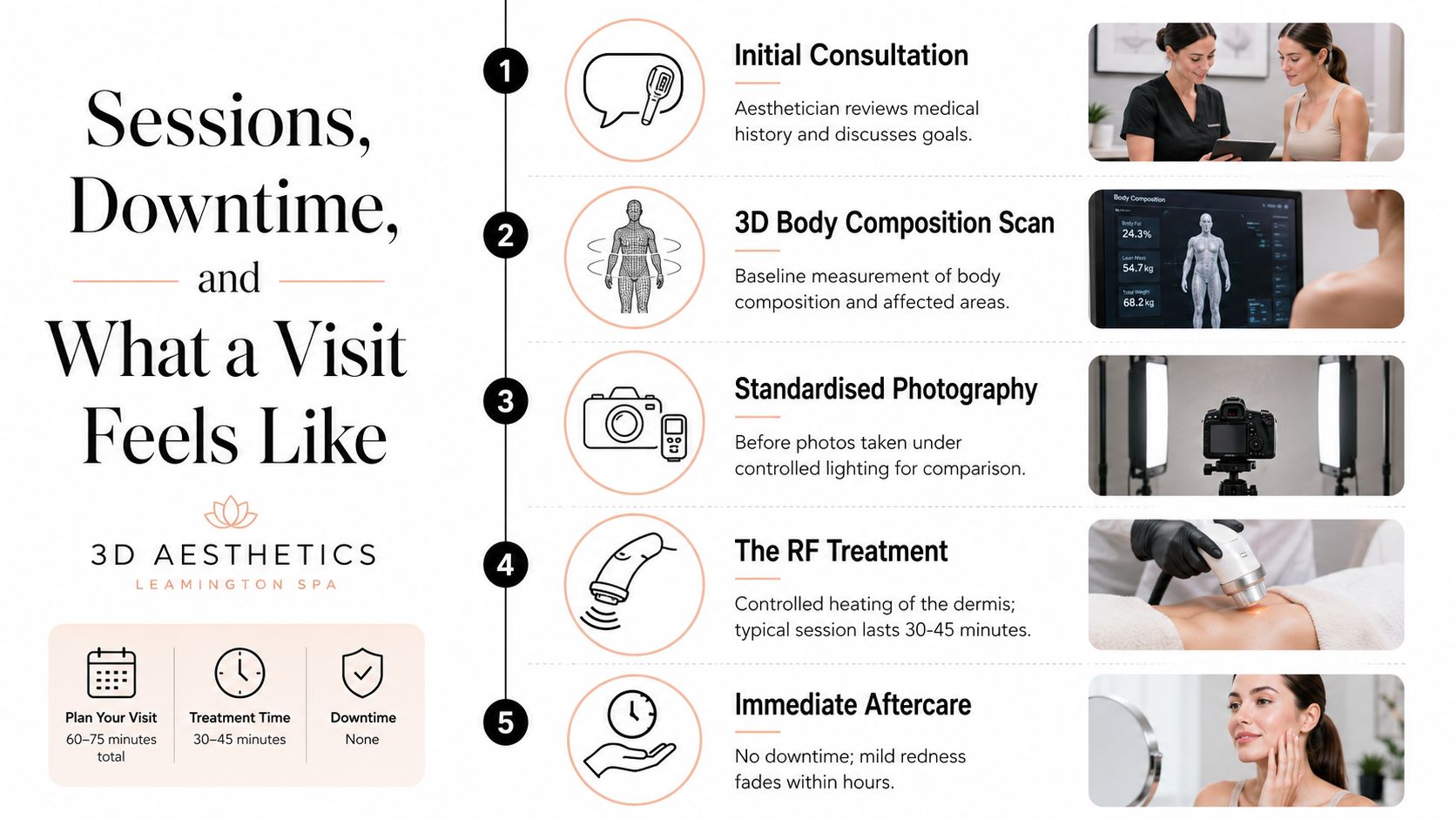
The visit begins before the handpiece reaches your skin. At a Leamington Spa appointment, the practitioner reviews your medical history, examines the striae, asks what you want to improve, and checks whether those aims fit what RF can realistically achieve. This conversation matters because treating a shallow red mark and an older, deeper white mark is not the same task.
A baseline may include a 3D body composition scan, standardised photographs, and markings that define the treatment area. These records provide a stable comparison. Stretch marks can appear more or less visible under bathroom, daylight, and clinic lighting, so consistent photographs are more reliable than memory.
What the appointment feels like
The practitioner cleans the skin, applies conductive gel where appropriate, and chooses settings based on the treatment area and RF method. Surface body RF usually feels warm and rhythmic, rather like a hot stone massage. RF microneedling feels sharper and more prickly. Topical numbing may be used according to the device and the clinic's protocol, and the skin can resemble mild sunburn afterwards.
A course is usually planned rather than improvised at each visit. RF microneedling is commonly arranged as three to four sessions, with four to six weeks between treatments. Exact scheduling depends on the device, the marks, and how your skin responds. Pricing should be confirmed after the practitioner assesses the treatment zone, since the area and method affect the quote.
Recovery and aftercare
Downtime depends on how RF is delivered:
- Surface body RF: Usually causes little or no visible downtime, although the area may feel warm or mildly flushed.
- Fractional RF: Can leave temporary redness and sensitivity while the micro-injury zones settle.
- Microneedling RF: May cause redness, swelling, and pinpoint marks for a short period. The clinical material reported good tolerability and no serious adverse events, but recovery still differs between individuals.
Use gentle skincare, keep the area hydrated, and follow the clinic's instructions. Practitioners often advise pausing retinoids and exfoliation, avoiding very hot showers while the skin settles, and applying suitable mineral SPF if the area is exposed. A treatment is more like starting a repair process than repainting the surface, so the final response will not be visible immediately. Dermal remodelling develops gradually.
Comparing RF With Lasers, Microneedling, and Topical Options
No single treatment wins for every type of striae. The right choice depends on whether the marks are red or white, how deep and wide they are, your skin tone, how much downtime you can manage, and whether you're prepared for a course rather than a single appointment.
| Treatment | Best for | Sessions | Downtime | Cost in the UK |
|---|---|---|---|---|
| Bipolar body RF | Mild texture change and patients prioritising comfort | Usually a course | Low or minimal | Clinic-dependent |
| RF microneedling | Texture, depth, and mature marks | Often a planned course | Short recovery period | About £350 to £1,200 per session, depending on area and location UK treatment-cost reference |
| Fractional laser | Selected deeper or more established scars | Planned around skin response | More noticeable recovery | Clinic-dependent |
| Microneedling alone | Surface texture and patients seeking a simpler intervention | Usually multiple sessions | Short-term redness | Clinic-dependent |
| Topical creams and oils | Hydration and comfort | Ongoing use | None | Product-dependent |
Ablative fractional lasers, such as CO2 or erbium systems, can be more aggressive. They may suit selected mature, deeper striae, but a practitioner must consider heat exposure, recovery, and the possibility of pigment alteration, particularly in darker skin tones. RF and RF microneedling generally offer a more conservative route across a wider range of skin tones, although “safer” never means risk-free.
Topicals have a narrower role. They can soften dryness and make the surface feel more comfortable, but they don't replace a treatment that reaches the damaged dermal structure. Combination treatment may make sense, particularly where colour, texture, and laxity need different types of attention.
For patients comparing standard microneedling with RF-assisted treatment, this guide to microneedling for stretch marks explains the distinction in more detail.
Who Is a Good Candidate and Who Should Avoid RF
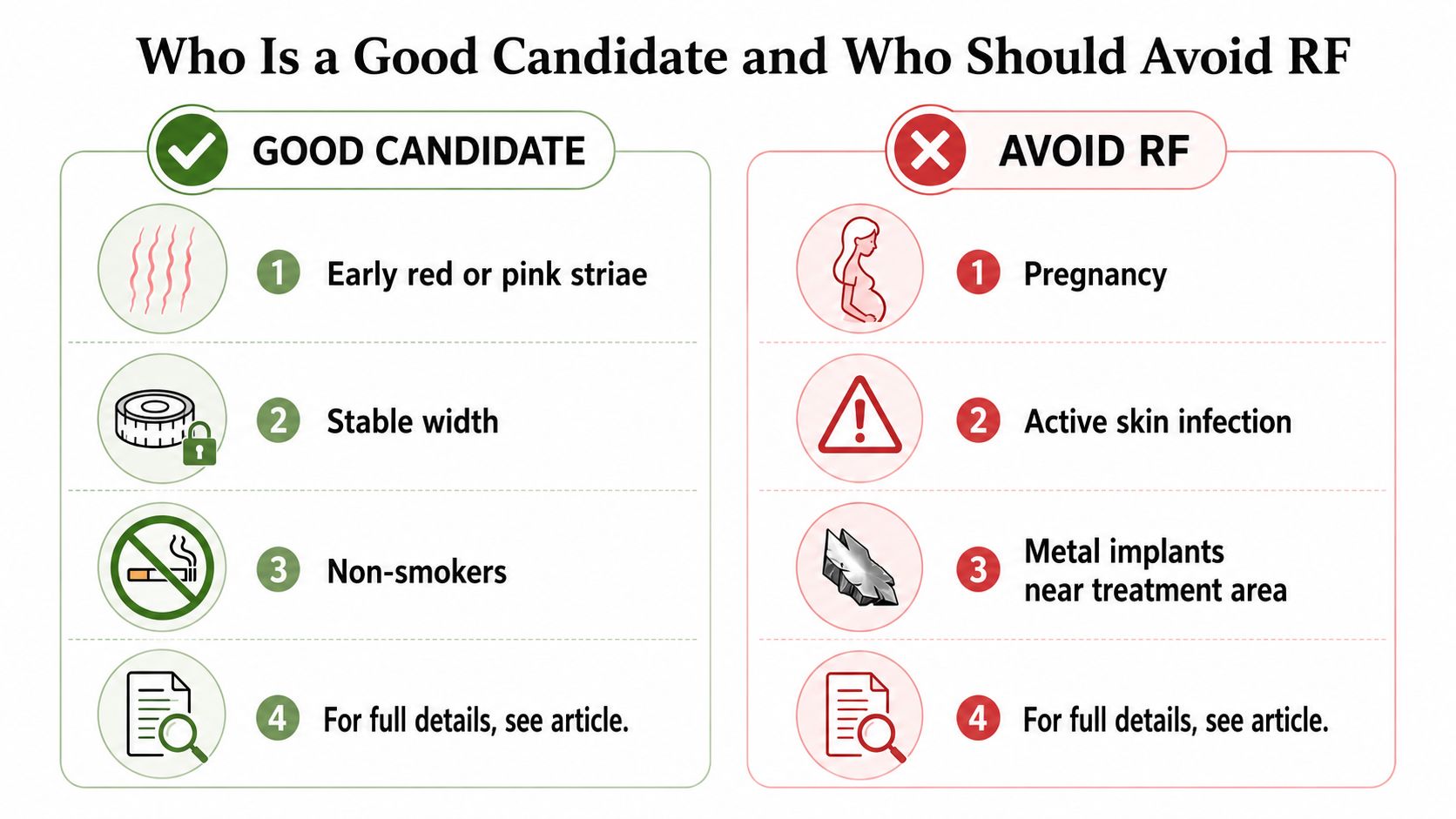
The most suitable candidate has stable stretch marks, realistic expectations, and enough time to complete a treatment course. Early red or pink striae may be a sensible reason to seek assessment because the tissue is still changing, while mature white marks can also improve in texture but usually need more careful expectation-setting.
Smoking, poor skin healing, and ongoing stretching can affect the treatment decision. If you're pregnant, actively losing weight, or your skin is still under substantial tension, treating the marks may be premature.
Avoid treatment or request medical clearance if you have
- Pregnancy or breastfeeding: Treatment should be postponed until a qualified practitioner confirms that it's appropriate.
- Active infection, eczema, or broken skin: The area needs to heal before energy or needles are applied.
- A pacemaker or implanted electronic device: RF may be unsuitable.
- Metal implants near the treatment zone: Tell the practitioner before assessment.
- Uncontrolled diabetes or a blood-clotting disorder: Healing and safety need medical review.
- Recent isotretinoin use: Your skin may require additional recovery time.
- A history of keloid scarring: Needle-based treatment may not be the right first choice.
Darker skin tones can often be considered for RF because the energy is directed into tissue water and the dermis rather than primarily absorbed by melanin. Even so, a practitioner should assess your history of pigmentation, healing, and scarring before selecting settings.
RF may not be the best first option for very deep atrophic marks. Fractional laser or a combination plan could be more appropriate, but that decision belongs in a consultation, not in an online checklist.
Making the Decision and Booking in Leamington Spa
Use three questions to narrow the decision.
Are the marks red or pink and still relatively new? An RF consultation is a reasonable starting point because early striae may show changes in colour as well as texture.
Are they mature, white, wide, or significantly indented? Expect a longer conversation about improvement rather than removal. You may need combination work, and it's sensible to ask how the clinic will measure progress.
Is your budget limited? Ask about a small test area or staged plan before committing to a full course. Standardised photographs can help you decide whether the early response justifies continuing.
At 3D Aesthetics Leamington Spa, the consultation process includes a complimentary assessment and a 3D body scan used to map concerns, build a personalised plan, and monitor changes. The clinic offers RF-based options, including 3D Dermaforce, which combines microneedling with bipolar radiofrequency for skin concerns such as stretch marks. Ask about the proposed session count, spacing, recovery, total price, and whether maintenance might be useful after future weight change.
A good consultation should feel like a two-way discussion. Bring photographs if the marks change with lighting, explain whether they appeared after pregnancy or weight change, and ask the practitioner to show you how improvement will be assessed. You're looking for softened colour and texture, not a promise of perfect skin.
3D Aesthetics Leamington Spa offers complimentary consultations, 3D body scanning, and specialized RF and microneedling options for stretch marks and related skin concerns. Visit 3D Aesthetics Leamington Spa to discuss your marks in person, understand the likely downtime and pricing, and decide whether RF is suitable for your skin.
← Back to Home