

You notice them after a shower, in the gym mirror, or while getting dressed for work. At first they look angry and obvious, then you start doing what almost everyone does. Searching online, buying a cream, wondering whether they'll fade on their own, and trying to work out what helps.
That confusion is understandable. Stretch marks sit in an awkward space between “normal skin change” and “something I'd still like to treat”. They're common, but that doesn't mean you have to feel indifferent about them. If you want to improve their appearance, the key is choosing the right treatment for the type of mark you have, rather than wasting time on products or procedures that don't match the stage of the skin.
In clinic, the most useful starting point isn't the brand of cream or the latest device. It's identifying whether your stretch marks are new and active, or older and mature. Once that's clear, the treatment path becomes much simpler and much more realistic.
Table of Contents
- Decoding Your Stretch Marks From Home to Clinic
- Practical At-Home Care and Topical Treatments
- Bridging the Gap From Home Care to Professional Help
- Your Guide to Advanced Clinical Stretch Mark Treatments
- Preparing for Your Treatment and What to Expect
- A Realistic Path to Smoother Confident Skin
Decoding Your Stretch Marks From Home to Clinic
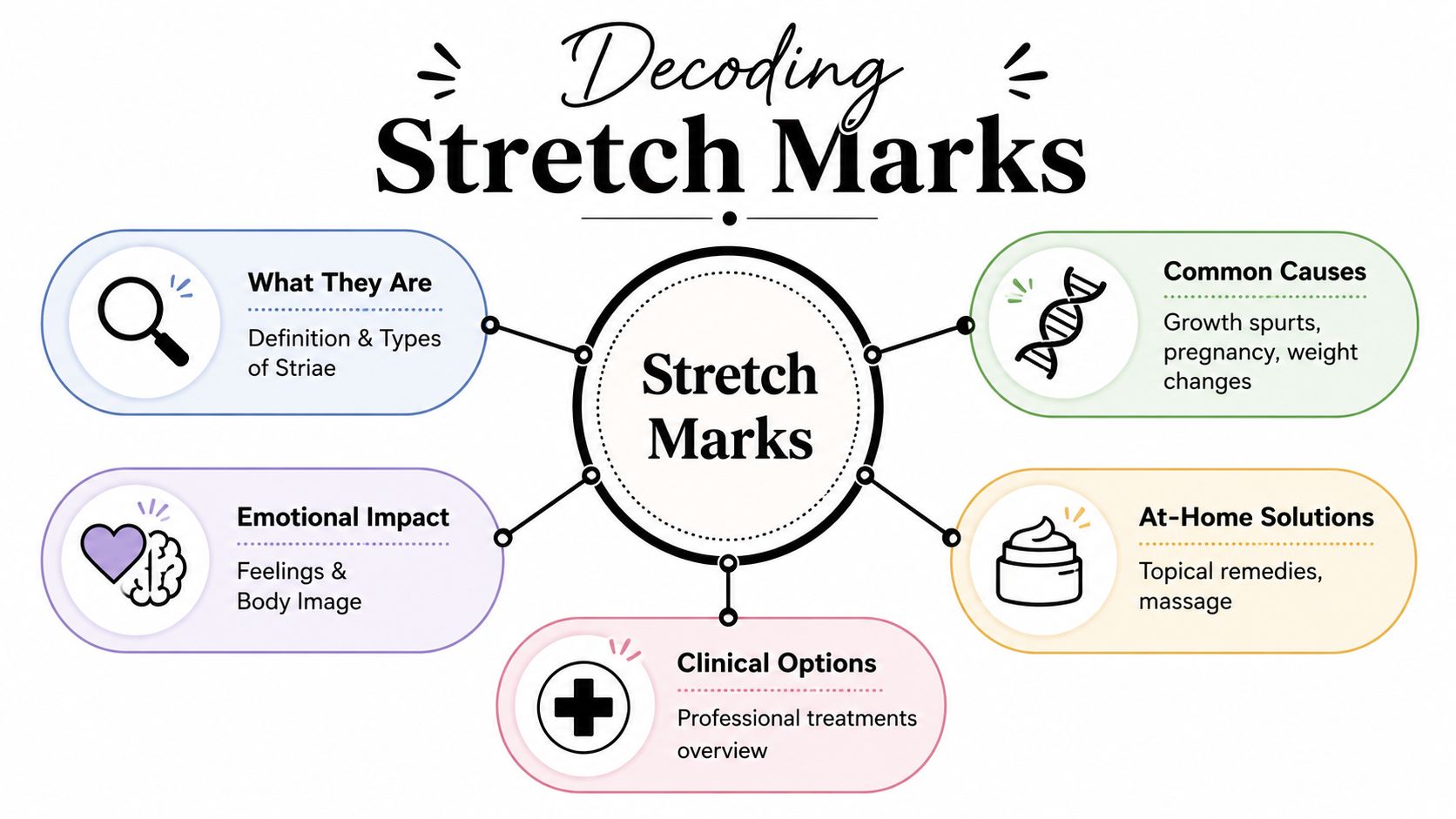
Stretch marks are easier to treat well when you stop looking at them as one single problem. They're a form of scar-like change in the skin, but they don't all behave the same way. The biggest difference is whether they're still relatively new or whether they've settled into a mature, pale pattern.
Why the colour matters
Newer stretch marks are usually red, pink, or purple. These are called striae rubra. They often appear more inflamed, more noticeable, and more frustrating, but clinically they're the marks that tend to respond better. The skin is still in a more active stage, so treatments aimed at calming colour and stimulating collagen have a better chance of making a visible difference.
Older stretch marks are usually white, silver, or pale. These are striae alba. They're more stable and often less obvious at a glance, but they're also more resistant. That doesn't mean they can't be treated. It means they usually need a stronger approach than creams alone.
Practical rule: If your marks are still red or purple, act early. Early treatment usually gives you more room to improve colour and texture before the marks become fully established.
What stretch marks actually are
They develop when the skin stretches faster than its supporting structure can comfortably adapt. That can happen during growth spurts, pregnancy, weight change, or muscle gain. What patients often feel is embarrassment or frustration. What clinicians see is a pattern in the skin that needs to be assessed by stage, colour, depth, and location.
A simple home check can help you sort them into the right category:
- Look at the colour: Red and purple usually means newer. White and silver usually means older.
- Check the texture: Fresh marks can feel slightly raised or irritated. Mature marks often feel softer, thinner, or faintly indented.
- Consider timing: If they appeared recently, topicals may still play a useful role. If they've been there a long time, home care alone usually won't do enough.
- Notice your skin tone: Some device choices carry more risk of pigment change, so treatment has to be selected carefully.
The question isn't how to treat stretch marks. The better question is how to treat your stretch marks based on where they are in their life cycle. Once you know that, the guesswork starts to fall away.
Practical At-Home Care and Topical Treatments
For many people, home treatment is the first step because it's accessible, private, and easy to start. That's sensible, as long as you're realistic about what home care can and can't do. Good at-home care can support the skin and, in the right situation, improve the appearance of newer marks. It won't erase established stretch marks.
What home care can realistically do
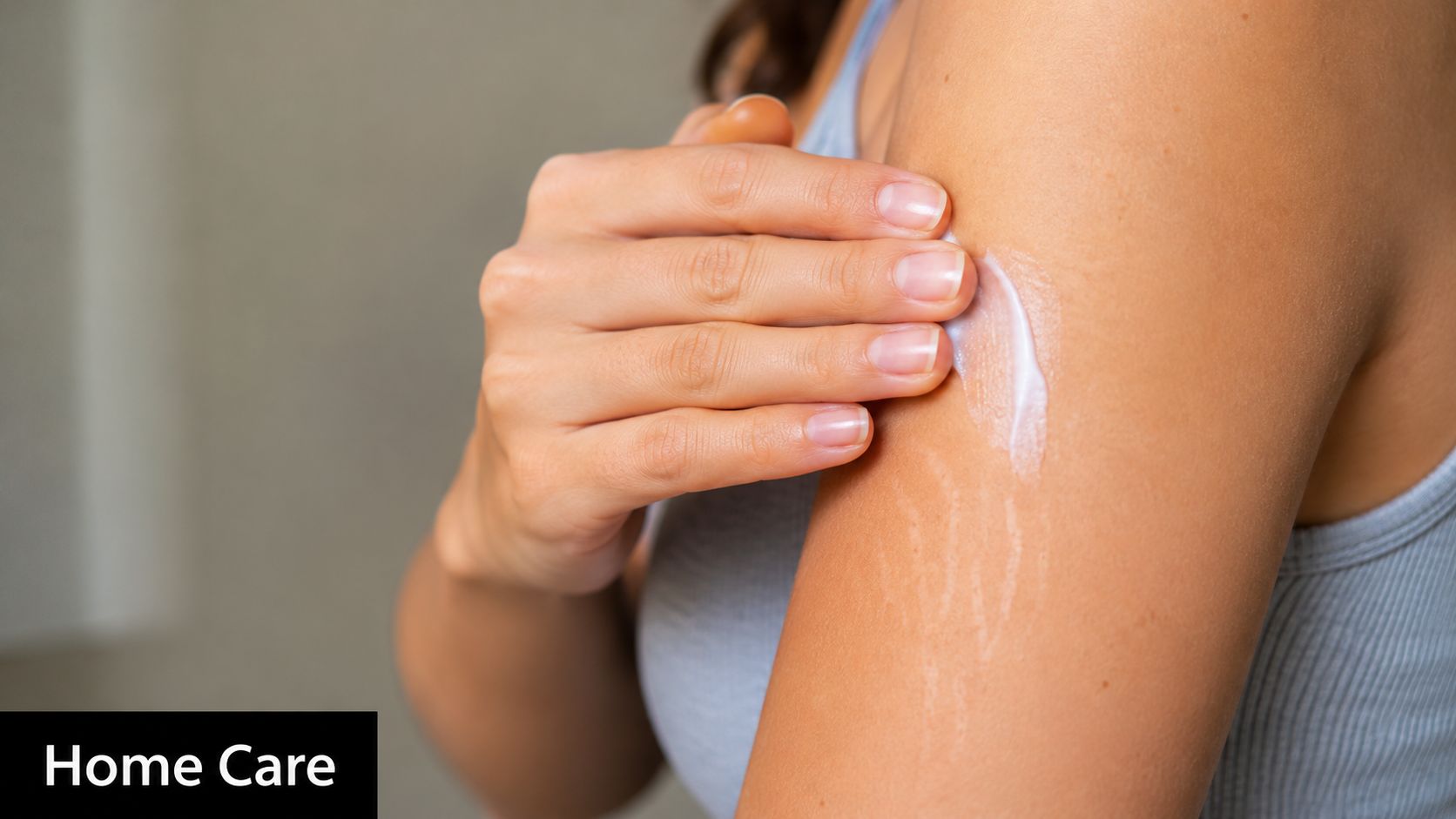
Start with the basics. Keep the skin comfortable, hydrated, and regularly massaged when applying a product. Hydration won't rebuild damaged skin structure on its own, but well-moisturised skin often feels less tight and can look smoother on the surface. That matters, especially if your stretch marks are recent and the surrounding skin is dry.
At-home care is most useful when it does one of two things. It either supports the skin barrier, or it introduces an ingredient with a plausible treatment role. Everything else is usually noise.
A practical home routine often includes:
- A consistent moisturiser: Use one you'll apply daily. Consistency matters more than a long ingredient list.
- Gentle massage during application: This won't remove stretch marks, but it can help you apply products evenly and keep the area supple.
- Sun protection on exposed areas: Stretch marks can look more obvious when surrounding skin tans and the marks don't.
- Texture-focused skincare: If your concern includes roughness as well as stretch marks, advice on improving skin texture can help you build a more sensible routine around the area.
Stretch marks respond poorly to panic buying. A small number of well-chosen products used consistently is more useful than rotating through every cream social media recommends.
When topicals make the most sense
The strongest at-home option for early, red or purple striae rubra is usually a topical retinoid such as tretinoin. The Mayo Clinic guidance on stretch mark treatment notes that tretinoin may help marks that are less than a few months old by rebuilding collagen. It also makes an important point that patients need to hear early. The evidence supports appearance improvement, not complete removal.
That distinction matters in clinic every day. People often assume that if a topical is “medical grade”, the mark should disappear. That isn't how stretch marks behave. Retinoids can be useful, especially in early-stage marks, but the result is usually gradual softening of colour and texture rather than full clearance.
A few practical trade-offs to keep in mind:
| Topical option | Most useful for | Main upside | Limitation |
|---|---|---|---|
| Tretinoin or another retinoid | Newer red or purple marks | Supports collagen remodelling | Can irritate skin |
| Hyaluronic acid based products | Early supportive care | Helps with hydration and skin feel | Less useful for older marks |
| Basic moisturisers | Any stage as support | Comfort and barrier support | Cosmetic support only |
If your marks are already pale and mature, home care still has value, but mainly as support. In that situation, creams often help the skin feel better without changing the mark enough to satisfy the person treating it.
Bridging the Gap From Home Care to Professional Help
The hardest part of treating stretch marks isn't usually choosing between two clinic devices. It's recognising when home care has reached its limit. Many people stay with oils, scrubs, and body creams for too long because they hope one more product will finally be the answer.
Why home care often plateaus
That plateau is common for a reason. Mature stretch marks sit deeper than surface dryness or mild textural roughness. Once the skin has moved into a stable white or silver phase, over-the-counter care rarely changes the structure enough to create the improvement many seek.
Even with excellent compliance, topical care tends to work best as an early-stage intervention or as support around professional treatment. It's not a failure to need more than a cream. It's the nature of the condition.
Why UK patients often turn to private clinics
The UK position is fairly clear. The NHS guidance on stretch marks states that stretch marks usually fade over time but don't disappear completely, and that treatments such as retinoid creams, light or laser treatments, and microdermabrasion are not available on the NHS. In practical terms, that means people who want active treatment usually need to pursue it privately.
That guidance is useful because it sets the right expectation from the outset. The aim isn't perfection. It's cosmetic improvement. It also highlights why early intervention matters. New marks may respond to topical support, while established marks often need procedures that stimulate collagen more directly.
If you've reached the point where your routine feels tidy but your results still look negligible, a professional consultation becomes the logical next step. A good clinic won't just offer a machine. It should tell you whether your marks are likely to respond, what trade-offs exist for your skin tone, and whether the expected improvement justifies the cost and downtime.
Your Guide to Advanced Clinical Stretch Mark Treatments
You book a consultation after months of creams, body oils, and patience. The marks may have faded a little, but the texture is still there under certain light, and that is usually the point where clinic treatment starts to make sense. Advanced treatment is not about polishing the surface. It is about encouraging the skin to rebuild in a more organised way.
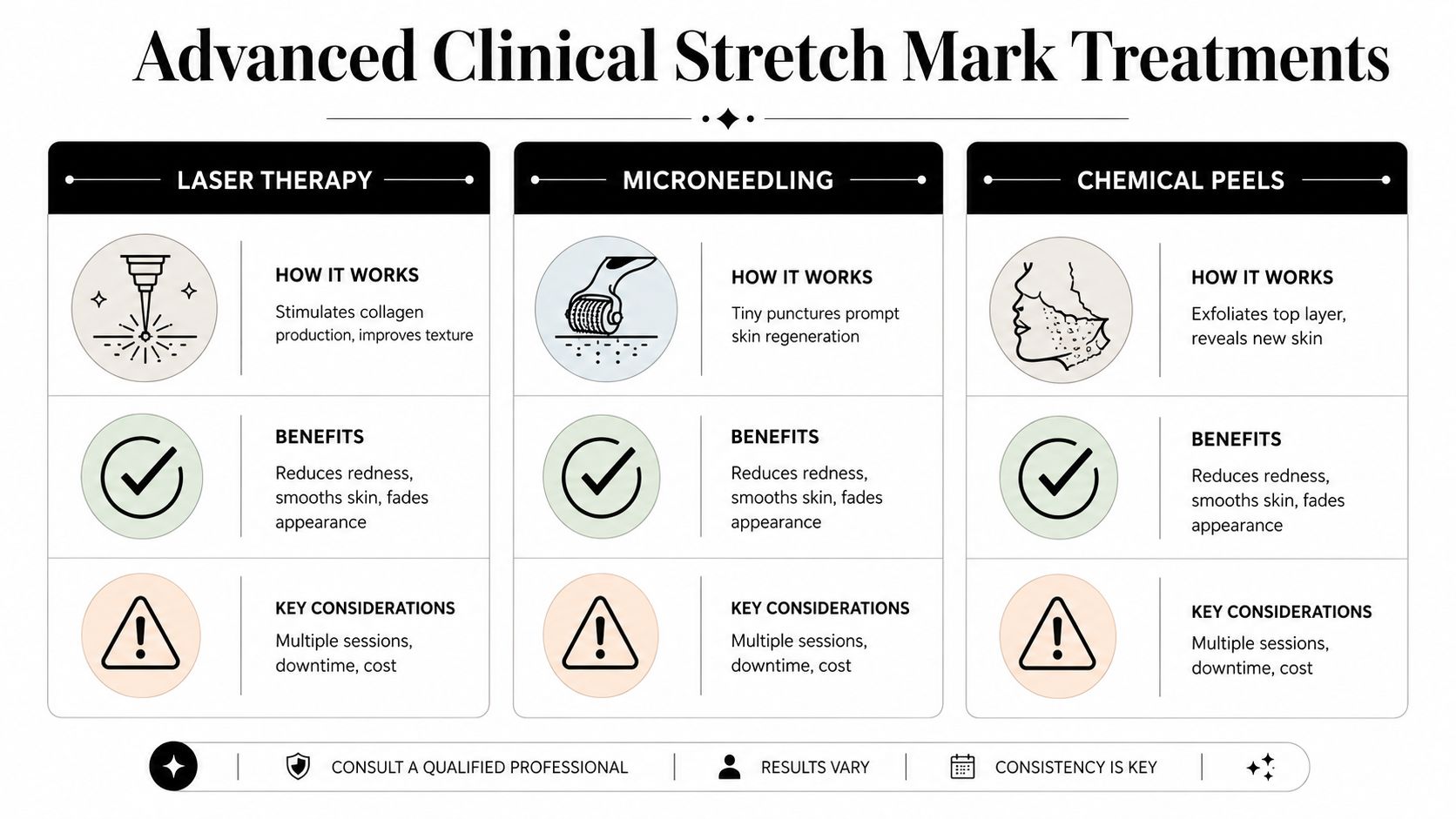
The right option depends on what kind of stretch mark you have in front of you, not the treatment that sounds strongest on paper. In clinic, the useful questions are straightforward. Are the marks red or white? Flat or indented? How reactive is your skin? How much downtime can you accept, and how much visible improvement would make the cost feel worthwhile?
Microneedling and fractional microneedling radiofrequency
For many patients, microneedling is the first professional treatment worth discussing. It creates controlled injury in the skin so collagen repair can gradually improve the texture and softness of the marks. The aim is blending, not erasure.
The Cleveland Clinic overview of stretch marks notes that microneedling often requires several sessions to produce visible change. It also highlights a practical point that matters in real consultations. Microneedling tends to carry less risk of pigment change than laser treatment, which is one reason clinicians often consider it early for darker skin tones.
Fractional microneedling radiofrequency adds heat to the needling process. That gives a second stimulus for collagen remodelling deeper in the skin. In practice, it can be useful for stretch marks with more textural change or for patients who have already had standard microneedling with limited improvement.
A 2025 review published in the PMC systematic review on stretch-mark treatment algorithms supports a more specific approach based on lesion stage and skin type. It also found that combination treatment was especially effective for striae rubra, while microneedling and fractional microneedling radiofrequency performed well across skin types. That reflects what many good UK clinics already do. They match the method to the mark rather than putting every patient through the same package.
Here is the practical clinic view.
- Microneedling suits patients who want a versatile starting point with lower downtime and gradual textural improvement.
- RF microneedling suits patients who need stronger collagen stimulation and are comfortable with a slightly more intensive treatment plan.
- Darker skin types often need cautious energy settings and careful aftercare because avoiding post-inflammatory pigmentation matters as much as improving the stretch mark itself.
Clinic insight: The best treatment is not the most aggressive one. It is the one your skin can heal from well, with a level of downtime and risk you are prepared to accept.
A clinic option in this category is 3D Dermaforce microneedling, which uses controlled needling to stimulate collagen and can be considered as part of a broader stretch mark plan where microneedling is appropriate.
Some clinics also use recovery support such as Dermalux LED therapy for post-treatment skin recovery alongside skin-repair procedures.
A quick visual explanation can help if you're comparing options before a consultation.
Fractional CO2 laser and other energy devices
Fractional CO2 laser is a more intensive resurfacing treatment. It creates tiny columns of controlled thermal injury, which pushes the skin into a stronger remodelling response. For established white stretch marks, especially those with visible textural depression, that can be useful.
The trade-off is clear. CO2 laser usually brings more downtime, more aftercare, and more caution around pigmentation risk than basic microneedling. That does not rule it out. It means patient selection matters, patch testing may be sensible in some cases, and expectations need to be realistic from the start.
If you want an additional non-promotional explainer before deciding whether laser belongs in your treatment plan, this guide on understanding CO2 laser for stretch marks gives a useful overview of how the technology is typically positioned.
Other energy devices may also come up in consultation, especially for red stretch marks, mixed presentations, or skin that is more prone to pigment disruption. A good clinic should be able to explain why one device is being recommended over another, what result it is targeting, and what risk is being managed by that choice.
Why combination plans often make more sense
One treatment rarely addresses every part of a stretch mark. Colour, texture, and depth do not always improve at the same pace. That is why combination plans often produce better cosmetic improvement than repeating a single method without a clear reason.
In practical terms, a plan might use one treatment to stimulate collagen, another to improve surface texture, and supportive care to calm inflammation and help recovery between sessions. This is often the gap patients struggle with when comparing home care to clinic options. The answer is not merely "stronger treatment." It is the right sequence.
| Treatment | Best For | Typical Sessions | Downtime |
|---|---|---|---|
| Microneedling | Texture improvement across many skin types | Often a course of treatment rather than a single session | Usually shorter than more aggressive laser resurfacing |
| Fractional microneedling radiofrequency | Patients needing stronger collagen stimulation with a specific approach | Varies by plan | Moderate, depending on settings |
| Fractional CO2 laser | More established texture change when stronger resurfacing is appropriate | Varies by plan | Higher than basic needling in many cases |
| Nonablative laser or light-based options | Selected cases where tolerance and pigmentation risk shape the plan | Varies by plan | Often lighter than ablative resurfacing |
For anyone trying to choose sensibly, the clearest rule is this. Newer red marks and older white marks are not the same treatment problem. Red marks may respond to earlier intervention and staged combination care. Mature white marks usually need procedures that focus more directly on collagen remodelling.
Preparing for Your Treatment and What to Expect
People usually feel more comfortable once they know what a proper consultation should look like. Good stretch mark treatment starts with assessment, not treatment on the same day just because there's a machine available.

What a proper consultation should include
A thorough consultation should examine the age of the marks, colour, body area, skin tone, sensitivity history, and your treatment goal. “I want them gone” is a common starting point. A clinician then has to translate that into a realistic plan, which usually means aiming for visible softening rather than complete removal.
Medical history matters here. Retinoid use, pregnancy status, scar tendencies, pigmentation history, and recent sun exposure can all influence whether a treatment is suitable or whether the plan needs adjusting. If a clinic skips those questions, that's a concern.
In a more detailed setting, assessment tools can help track change over time, especially when the marks are subtle and progress is gradual. If you're considering resurfacing, it also helps to understand how clinics approach related scar care, such as CO2 laser scar removal, because the same principles of skin remodelling and downtime management often apply.
Improvement is usually progressive. The result you notice after the first treatment is rarely the final result, because collagen remodelling takes time.
Questions worth asking before you commit
When choosing a provider, ask direct questions. You're not being difficult. You're making sure the treatment matches the skin in front of them.
- What type of stretch marks do I have? Ask whether they're treating striae rubra, striae alba, or a mixed pattern.
- Why are you recommending this device over another? The answer should relate to your skin type, mark stage, and downtime tolerance.
- What kind of improvement is realistic? Look for honest language about improvement, not guaranteed removal.
- What are the main risks for my skin tone? Pigment change should always be part of the conversation where relevant.
- What will aftercare involve? Good outcomes depend on what happens after treatment as well as during it.
A strong consultation leaves you informed, not pressured. You should know what the plan is, why it suits you, what the recovery will feel like, and what result would count as success.
A Realistic Path to Smoother Confident Skin
Stretch marks don't need to be ignored, and they don't need to be treated with false promises either. The most useful approach is usually progressive. Identify the stage of the mark first, use home care where it is helpful, and move to clinic treatment when the skin needs more than surface support.
This is how to treat stretch marks well. Match the treatment to the mark. Early red or purple marks may respond to topical support and early intervention. Older white or silver marks usually need collagen-focused clinical work such as microneedling, radiofrequency-based needling, laser, or a carefully chosen combination.
The outcome worth aiming for is visible improvement you can be satisfied with. Smoother texture. Softer edges. Less contrast. More confidence in clothing, at the gym, on holiday, or in your own skin. Those are meaningful results.
If you're unsure where your stretch marks sit on that spectrum, a professional consultation can save you months of trial and error. Good advice should leave you feeling clearer, not sold to.
If you'd like personalized advice, 3D Aesthetics Leamington Spa offers a no-obligation consultation to assess your stretch marks, discuss suitable non-surgical options, and build a treatment plan around your skin type, mark stage, and comfort with downtime.
← Back to Home