
You're probably here because you've looked at your stomach, thighs, hips or breasts in certain light and thought the same thing many clients tell me in clinic: “I don't mind having skin that's lived a life. I just want these marks to look less obvious.”
That's a sensible goal. Stretch marks are hard to treat with creams alone because they aren't just a surface issue. They sit deeper in the skin, which is why results depend far more on the right technology, the right depth, and the right treatment plan than on hype.
For many people, microneedling for stretch marks is one of the most practical non-surgical options available. But not all microneedling is the same. Standard microneedling can do useful work on mild or newer marks. Older, white, stubborn striae often need a more advanced approach, and that's where RF microneedling changes the conversation. Just as important, a bespoke plan that starts with a proper skin and body assessment, ideally including a 3D scan, gives you a realistic baseline and a way to track whether treatment is working.
Table of Contents
- Understanding Stretch Marks and Why They Form
- How Microneedling Rebuilds Skin From Within
- Choosing the Right Type of Microneedling Treatment
- What Results Can You Realistically Expect
- Are You an Ideal Candidate for Microneedling
- Your Treatment Journey at 3D Aesthetics
- Frequently Asked Questions
Understanding Stretch Marks and Why They Form
A client will often tell me the same story. The marks seemed to appear in a short window, after pregnancy, a growth spurt, a period of weight change, or a new training phase. Months later, the colour has faded, but the texture is still there and creams have made little difference.
That pattern makes sense once you know what a stretch mark is. Stretch marks are a structural change in the dermis, where collagen and elastin fibres have been stretched beyond what the skin can reorganise neatly. In practice, I treat them more like a type of dermal scarring than a surface dryness problem. That is why products that sit on the top layer can help comfort the skin but rarely do much for the actual indentation or crinkled texture.
They are also extremely common, especially during times of rapid body change. In clinic, the important point is not how common they are. It is how different they can look and behave from one person to the next.
Why colour and age matter
Colour gives us clues about the stage of the stretch mark. Red, pink, or purple marks usually have more vascular activity and are generally newer. White or silvery marks have usually been present longer and tend to be more fibrotic, with less visible blood supply and a flatter, shinier appearance.
That difference affects treatment planning.
- Newer stretch marks often respond faster because the tissue is still changing.
- Older white stretch marks usually need a more intensive plan, and this is where standard microneedling and RF microneedling start to separate.
- Stubborn, mature striae often need more than a generic needle depth or a one-size-fits-all course of sessions.
For older marks, the question is not just whether microneedling can help. The question is which form of microneedling is appropriate for that specific skin quality, body area, and scar depth. Standard microneedling can improve texture. Advanced RF microneedling adds controlled heat into the dermis, which can be useful when the tissue is dense, pale, and resistant. I would not decide between those options by eye alone for a difficult case.
That is why a bespoke plan matters. For stubborn stretch marks, a 3D skin scan is often the best starting point because it helps map depth, texture variation, and treatment progress with more precision than photos alone. If you are comparing options before booking, this overview of stretch mark treatment information gives useful context on where microneedling sits among other non-surgical approaches.
Stretch marks can improve well. They rarely disappear completely. Clients do best when we set that expectation from the start and choose the treatment intensity based on the age and behaviour of the marks, not on hope alone.
How Microneedling Rebuilds Skin From Within
Microneedling works because it gives the skin a controlled reason to repair itself. The easiest way to explain it is this: it's a bit like aerating a lawn. You create tiny channels, and that prompts healthier regrowth. In skin, those controlled micro-injuries trigger repair activity in the dermis rather than just polishing the surface.
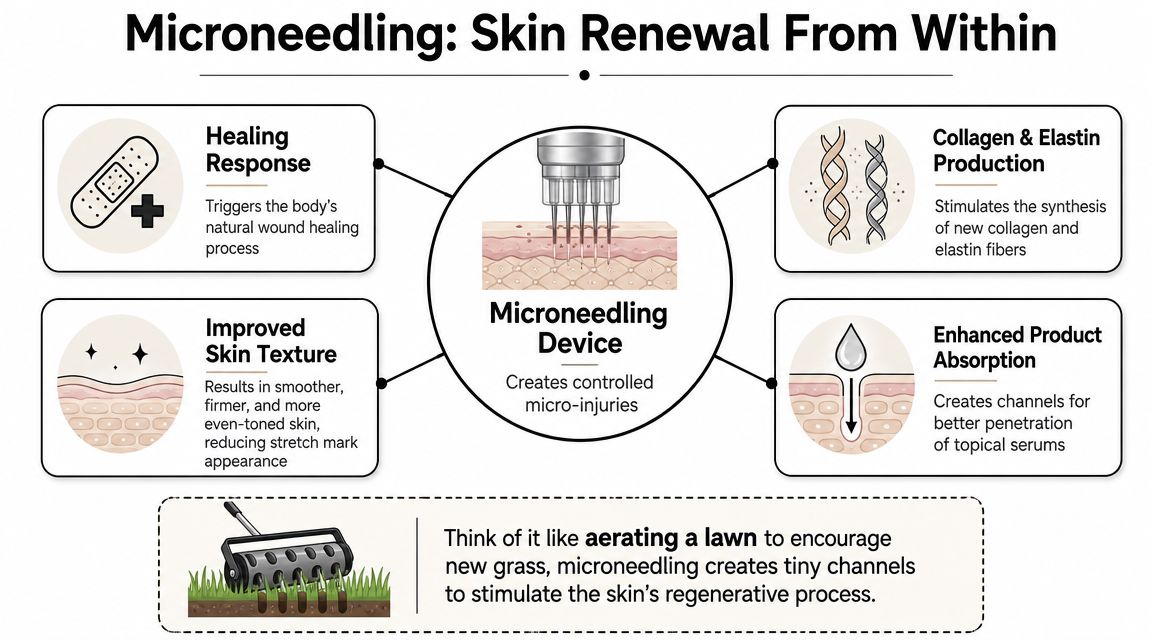
For body areas with stretch marks, clinicians often work at roughly 1.5 mm to 2.5 mm needle depth so the treatment reaches the dermis, where the torn collagen and elastin fibres sit (body microneedling depth guidance). That's a key reason at-home devices don't play in the same league.
The three stages of repair
Once treatment creates those micro-channels, the skin goes through a healing sequence.
Inflammation
The body recognises controlled injury and starts the repair signal. This stage is why the area can look pink or feel warm afterwards.Proliferation
Fibroblasts get to work. These are the cells involved in producing fresh structural support in the skin.Remodelling
This is the long game. Collagen and elastin reorganise over time, which is why texture and blending improve gradually rather than overnight.
Why this matters for stretch marks
Stretch marks look visible on the surface, but their weakness is deeper. Microneedling targets that deeper weakness by encouraging the skin to lay down better support from within.
- Texture can soften: The depressed, crepey quality often becomes less obvious.
- Edges can blend better: Marks may look less sharply defined against surrounding skin.
- Skin can feel firmer: Especially when treatment reaches the right level consistently.
Nutrition and recovery still matter. If you want a simple, non-technical read on the building blocks involved in collagen support, this Peak Performance collagen guide is a helpful background resource.
Practical rule: If a treatment for stretch marks doesn't reach the dermis, don't expect it to remodel a dermal scar.
Choosing the Right Type of Microneedling Treatment
Many people waste time and money by misunderstanding microneedling. They hear “microneedling” and assume every version does the same job. It doesn't.
There's a big difference between a home roller, a professional microneedling pen, and RF microneedling. For stubborn, older stretch marks, that difference matters even more because mature striae usually need more than a basic surface-level stimulus.
At-home rollers versus clinic devices
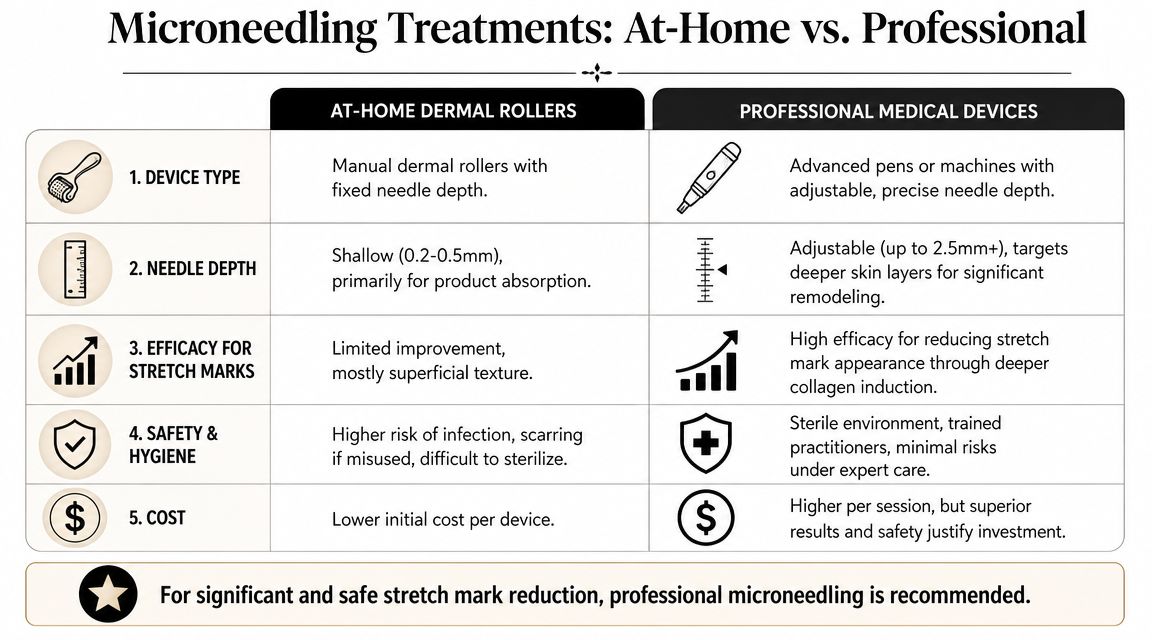
At-home rollers appeal because they seem cheaper and easier. In practice, they're usually the wrong tool for stretch marks. They don't offer the same control, the same hygiene standard, or the same ability to tailor depth properly across different body areas.
Professional devices are different. A clinic-grade pen allows controlled, even needling and treatment settings that can be adjusted according to the age of the marks, the thickness of the skin, and the tolerance of the area.
Here's the trade-off in plain terms:
- At-home rollers: Lower barrier to entry, but limited usefulness for true remodelling.
- Standard professional microneedling: A solid option for many newer or moderate stretch marks.
- RF microneedling: Better suited to older, more resistant white striae because it adds another layer of stimulation.
Where RF microneedling makes the difference
Standard microneedling relies on mechanical injury alone. RF microneedling adds radiofrequency energy into the deeper tissue through the needles. That means you're not only creating a controlled injury, you're also delivering heat at depth to drive a stronger remodelling response.
For mature, pale stretch marks, that extra thermal input can be the difference between “some improvement” and “a treatment course that justifies the effort”. It's not right for every case, and it does require a skilled practitioner who understands settings, skin behaviour and recovery. But when marks are older and fibrotic, it's often the more logical tool.
One clinic option in this category is 3D Dermaforce microneedling, which combines microneedling with RF technology for concerns including stretch marks.
If your stretch marks are old, white and stubborn, standard microneedling may still help. It just may not be the most efficient route on its own.
Stretch Mark Treatment Comparison
| Treatment | Mechanism | Best For | Typical Downtime |
|---|---|---|---|
| At-home dermal roller | Superficial needling at limited depth | Very mild texture concerns, product penetration | Minimal, but results are limited |
| Professional microneedling pen | Controlled mechanical micro-injury | Newer marks, moderate textural irregularity | Short recovery with temporary redness |
| RF microneedling | Mechanical needling plus heat at depth | Older, stubborn, white stretch marks and texture change | More noticeable recovery than basic needling |
| Topical creams | Surface hydration and skin conditioning | Supporting skin quality, not deep scar remodelling | None |
| Laser treatments | Energy-based resurfacing or vascular targeting depending on system | Selected cases depending on skin type and mark type | Varies by laser and intensity |
Topicals still have a place. They can support barrier function and skin condition. They just don't rebuild a dermal scar on their own. Lasers can also help in selected cases, but they aren't automatically better. The right choice depends on skin type, mark age, downtime tolerance and whether texture, colour or tightening is the main goal.
What Results Can You Realistically Expect
You come in hoping the stretch marks will look less obvious in clothes, in bright bathroom lighting, and on photos. That is a fair goal. The common question is not whether microneedling can help, but whether it can help enough.
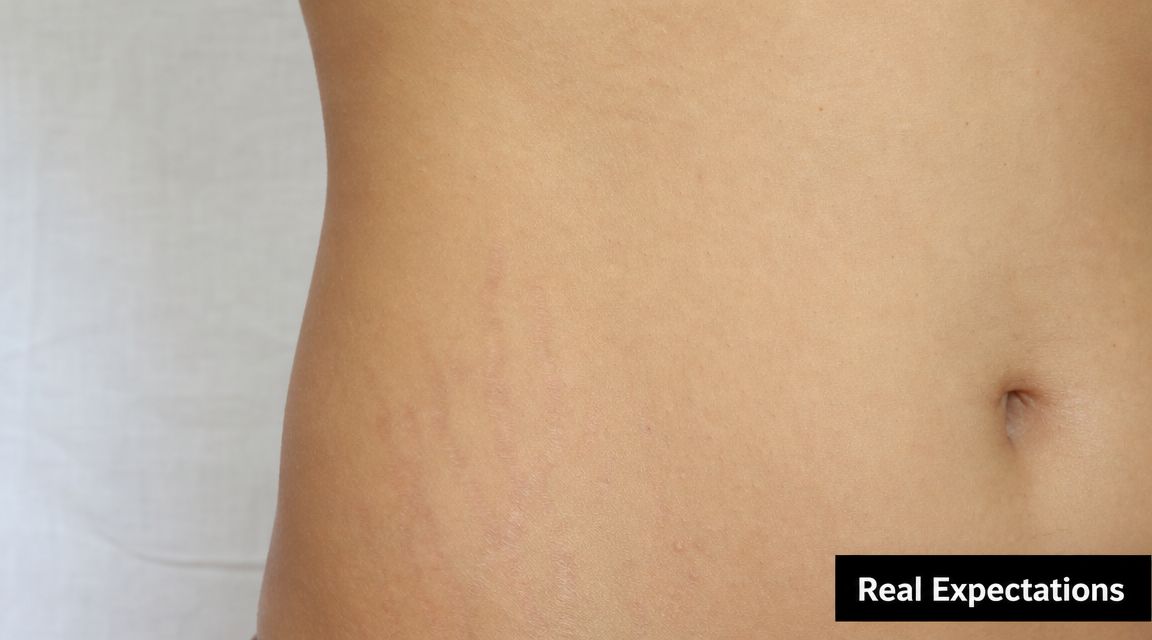
For the right client, the answer is yes. The result is improvement, not removal. In practice, the biggest wins are usually softer texture, less visible depth, and better blending with the surrounding skin.
Results also depend heavily on what type of mark you have. Newer red or purple marks often respond faster because there is still more active change in the skin. Older white marks are a different category. They tend to be more fibrotic and more resistant, which is why standard microneedling and RF microneedling should not be treated as interchangeable.
A review on striae alba found meaningful improvement after microneedling-based treatment, including one included study where every participant improved by at least 50%, with some improving by more than 75% (review of microneedling outcomes for striae alba). Good paper results still need careful translation into real clinic advice. Study protocols, devices, and patient selection vary, so I set expectations around visible progress over a course of treatment rather than a dramatic one-session change.
That is where assessment matters. For stubborn, older stretch marks, I would usually consider whether RF microneedling is the better tool because it adds controlled heat at depth as well as mechanical needling. That can make a real difference where the skin is flat, pale, and scar-like. Standard microneedling still has value, especially for milder textural change or for clients who want less downtime, but it is often slower on mature striae.
A bespoke plan should start with proper imaging. At 3D Aesthetics, a 3D skin scan helps map texture, depth variation, and the wider condition of the skin before we decide how aggressive the treatment needs to be. Without that starting point, it is much harder to match the treatment to the problem or track progress properly.
Several factors shape the result:
- Age of the stretch marks: Fresh marks usually improve faster than long-standing white marks.
- Depth and width: Broader, more indented striae often need more sessions or a higher-intensity approach.
- Skin laxity: Loose skin can make marks look more obvious, which sometimes shifts the plan toward RF microneedling.
- Body area: Abdomen, thighs, hips, and breasts do not all heal or respond in the same way.
- Downtime tolerance: A stronger treatment can be more efficient, but recovery is usually more noticeable.
For a wider view of what skin remodelling can realistically change, this guide on how to improve skin texture explains the limits as well as the benefits.
What clients usually notice first is touch, not appearance. The skin tends to feel smoother before it looks dramatically different. After that, the marks often start to appear less sharp at the edges, less creased, and less contrasty against the surrounding skin.
This short video gives a useful visual overview of what clients often want to understand before starting treatment:
The best outcomes usually show up in comparison photos taken under the same lighting, from the same angle, across a full treatment course.
Are You an Ideal Candidate for Microneedling
You come in with white, older stretch marks on the abdomen, and the first question is usually, “Will microneedling work for me?” My answer depends on the marks, the skin around them, and whether standard needling is enough to create change.
Suitable candidates are not defined by one box to tick. They are identified through assessment. At 3D Aesthetics, that starts with a 3D skin scan so we can look at texture change, depth, laxity, and the overall condition of the tissue before deciding on a plan. For newer, shallower stretch marks, standard microneedling may be reasonable. For stubborn, long-standing marks that are pale, indented, or sitting in looser skin, RF microneedling is often the better option because it treats deeper tissue and adds heat-based remodelling as well as mechanical stimulation.
Research reviews have shown that microneedling can improve the appearance of stretch marks with a good safety profile when patients are selected properly and treated as part of a course, not as a one-off procedure (clinical review of microneedling for striae and other scars). In practice, selection matters as much as technique.
Who tends to be a good fit
The strongest candidates usually have clear expectations and skin that can recover predictably after treatment.
- You want improvement, not perfection: Stretch marks can look softer, flatter, and less obvious. They are not usually removed completely.
- Your skin is healthy in the treatment area: No active rash, infection, open cuts, or flare-up of eczema or dermatitis.
- You can commit to a treatment course: Older marks rarely respond well to a single session.
- You heal well: This includes following aftercare, avoiding friction, and protecting the area from sun exposure.
- You are open to the right modality: Some people come in asking for standard microneedling, but their skin would respond better to RF microneedling. The better candidate is the one willing to treat the skin they have, not the treatment they had in mind before assessment.
That last point matters more than many clients expect.
Older striae alba often need a stronger plan. If the tissue is thin, creased, and lax, standard needling can still help, but results are usually slower and less dramatic than with a well-judged RF approach. That is why a bespoke plan based on scan findings is necessary if the goal is meaningful change rather than mild improvement.
When I would delay treatment or advise against it
I do not needle compromised skin.
Treatment is usually delayed if you have active acne or infection in the area, broken skin, a recent sunburn, or irritation that makes the barrier unstable. If that is relevant to you, start by addressing the skin quality first. Our guide to treatment options for sun-damaged skin before skin remodelling explains why timing affects both safety and outcome.
I would also screen carefully if you have a history of keloid scarring, poorly controlled autoimmune or inflammatory skin conditions, or any medical factor that affects healing. Pregnancy and breastfeeding often mean postponing treatment as well. The issue is not whether microneedling is useful in general. The issue is whether your skin is in the right state for it now.
A good consultation should end with a clear recommendation. Standard microneedling, RF microneedling, a staged combination, or a decision to wait. That level of specificity is how realistic plans are built.
Your Treatment Journey at 3D Aesthetics
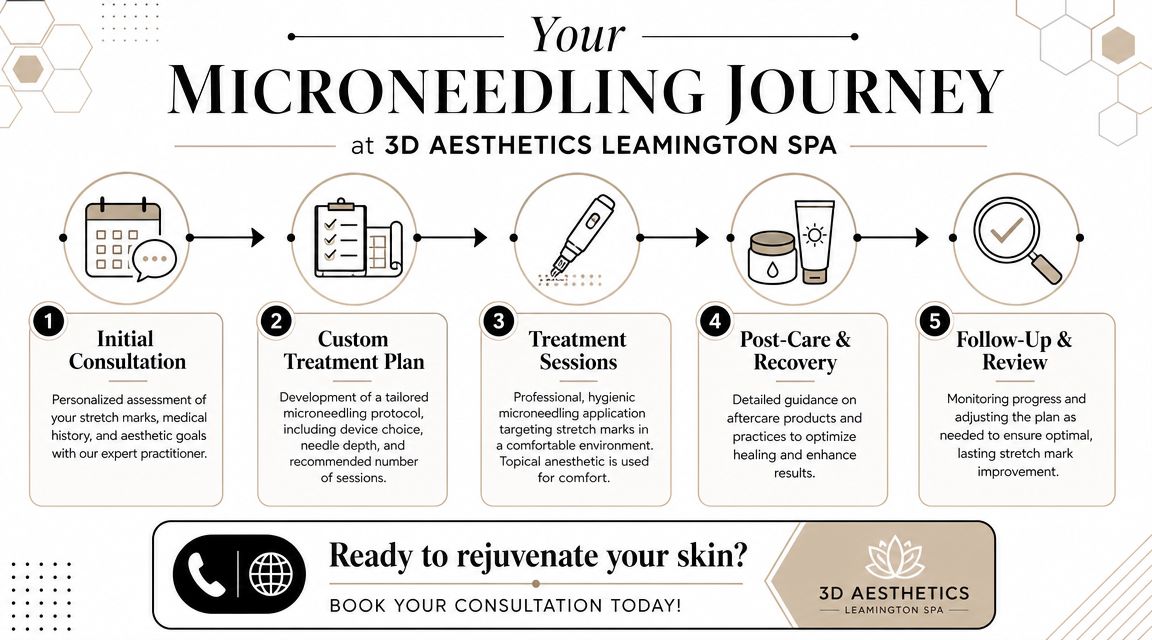
A common first appointment goes like this. A client shows me stretch marks on the abdomen or thighs, says they have tried creams for years, and asks whether microneedling will finally make a visible difference. The answer depends less on the label of the treatment and more on what the skin is doing.
Recent, shallow marks are usually easier to plan for. Older white stretch marks are different. They often sit in thinner, looser tissue, and that is where the gap between standard microneedling and RF microneedling starts to matter.
Why the consultation matters more than people expect
A good consultation should give you a treatment plan, not a generic recommendation.
I assess the age of the marks, their width and depth, the firmness of the surrounding skin, and whether the area has enough tissue quality to respond well to standard needling alone. Some clients are suitable for conventional microneedling. Others are better served by RF microneedling because the added heat can help where mature striae are more fibrotic and resistant.
The practical questions are straightforward:
- Are the marks still pink or purple, or have they turned white?
- Is the main concern texture, creasing, or loose skin around the marks?
- Will standard microneedling give a reasonable improvement, or only a modest one?
- Would RF microneedling make better use of your time and healing cycles?
- Is a staged plan the safer and more effective option?
As noted earlier, microneedling works as a treatment course, not a one-off fix. Skin remodelling also continues after the last session, so the plan needs review points built into it. That is how settings are adjusted properly instead of repeated out of habit.
Why a 3D scan is required for stubborn striae
For older stretch marks, clear baseline imaging matters. Phone photos are inconsistent. Lighting changes. So does posture, skin tension, and camera angle. Small improvements in depth and texture can be easy to miss if the starting point was recorded poorly.
At 3D Aesthetics, the consultation includes a full 3D body scan. That allows the treatment plan to be matched to the exact area, the pattern of the striae, and the condition of the surrounding tissue. It also gives us a reliable way to compare progress over time, especially in clients with broad or multi-area stretch marks where visual judgment alone is often misleading.
Bespoke treatment is not about making a plan sound more advanced. It is about choosing the right device, setting the right depth, and spacing sessions according to how your skin heals. For stubborn striae, that level of detail often decides whether you see mild softening or a more meaningful change.
Frequently Asked Questions
Does microneedling for stretch marks hurt
Most clients cope well with it. Stretch mark treatments on the body can feel sharper than facial microneedling because the target tissue often sits deeper, especially with older, thicker striae.
We apply numbing cream first, then adjust depth and intensity to the area being treated. Abdomen, hips, thighs, and breasts do not all tolerate treatment in the same way. That matters even more if we are comparing standard microneedling with RF microneedling, because RF adds heat within the skin as well as needle penetration. For stubborn, mature stretch marks, that extra power can be useful, but comfort planning needs to be part of the treatment plan from the start.
What is the aftercare really like
Expect redness, warmth, dryness, and a tight feeling for a short period after treatment. Some areas can look mildly sunflushed for a day or two. RF microneedling may leave you a little more swollen than standard needling, particularly on larger body areas.
Aftercare is straightforward. Keep the area clean, avoid rubbing and intense exercise for the initial healing window, skip heat such as hot baths and saunas, and protect the skin from UV exposure. Good aftercare supports calm healing, which gives the skin the best chance to remodel evenly.
Can microneedling be combined with other treatments
Yes. For older white stretch marks, combination treatment is often the better plan.
Mature striae can be fibrotic, flat in some places, crepey in others, and uneven across the same treatment area. In those cases, standard microneedling may improve texture but still leave you wanting more change. RF microneedling can be more effective for resistant marks because it treats depth and dermal heating together. Some clients also benefit from staged treatment rather than repeating the same session type each time.
The right combination depends on what the 3D scan and skin assessment show. Depth, skin thickness, laxity, and healing response all affect the plan.
How many sessions will I need
There is no honest fixed number before assessment. Newer red stretch marks may respond faster than old white ones, and broad areas usually need a longer course than a small, localised patch.
In practice, standard microneedling often suits milder textural change or newer marks. Older, stubborn stretch marks usually need a more targeted plan, and that is where RF microneedling can make better use of your treatment time. Results build over a course of sessions, then continue to develop as collagen remodelling carries on in the following weeks and months. I tell clients to expect review points, not a preset package copied from someone else.
If you want a realistic plan for stretch marks rather than vague promises, book a consultation with 3D Aesthetics Leamington Spa. A proper assessment, including a 3D body scan and a personalised discussion of standard microneedling versus RF microneedling, will show what is worth doing, what may give only modest change, and what level of improvement your skin is likely to achieve.
← Back to Home