
You've stared at the mirror long enough to know this isn't just a few old marks. The texture catches the light, makeup sits unevenly, and every search for acne scar treatment near me seems to split into two frustrating paths: NHS rules that aren't always easy to follow, and private clinics that promise too much. The specifics matter more than most marketing suggests, because scar type, skin tone, and whether acne is fully settled all change what should be done.
Table of Contents
- Understanding the Reality of Acne Scarring
- Advanced Treatment Modalities Available Locally
- Matching Treatments to Your Specific Scar Type
- What to Expect From Your Treatment Journey
- How to Choose the Right Local Clinic
- Preparing for and Recovering From Your Procedure
- Frequently Asked Questions About Acne Scar Revision
Understanding the Reality of Acne Scarring
A patient often comes in after trying serums, spot-fading creams, and “scar repair” products that never touch the texture. That's because true acne scarring isn't the same thing as redness or leftover pigment. Post-inflammatory erythema and post-inflammatory hyperpigmentation can fade, while real scars change the skin's shape and need procedural treatment.
What the skin is actually dealing with
Acne scarring usually starts after deeper inflammation, especially when nodules or cysts burst, or when spots have been picked and squeezed. NHS guidance also makes the point that scarring can persist long after the breakout has gone, and that established scars are difficult to treat fully. That's why a proper consultation starts with seeing whether the issue is active acne, residual marks, or permanent textural change.
Practical rule: if the skin is still breaking out, the first job is to stabilise the acne. Treating scars while new lesions are forming just keeps the cycle going.
NICE treats severe acne-related scarring as a specialist dermatology issue, not a casual cosmetic add-on. In its guidance, if scarring is severe and still present a year after acne has cleared, referral to a consultant dermatologist-led team is recommended, and that team may consider CO2 laser or glycolic acid peel treatment. NICE also notes that access varies across the country, so local availability is not uniform.
That gap is exactly why many people end up searching for acne scar treatment near me in the private sector. A good clinic doesn't just sell a procedure, it explains why a particular scar needs resurfacing, needling, release, or a combination. If you want a useful background on overall skin support alongside procedure planning, holistic radiant skin tips can be a helpful companion read, but it won't replace medical assessment or scar-specific treatment.
Why local access matters
UK NHS sources say acne scarring is not usually available on the NHS except in rare cases involving serious psychological distress. That leaves many patients needing private care for laser resurfacing, microneedling, or chemical peels, while NHS pathways stay focused on the most severe, referral-based cases. So the key question isn't just whether treatment exists, it's whether there's a clinic nearby that can match the scar pattern to the right method.
Advanced Treatment Modalities Available Locally
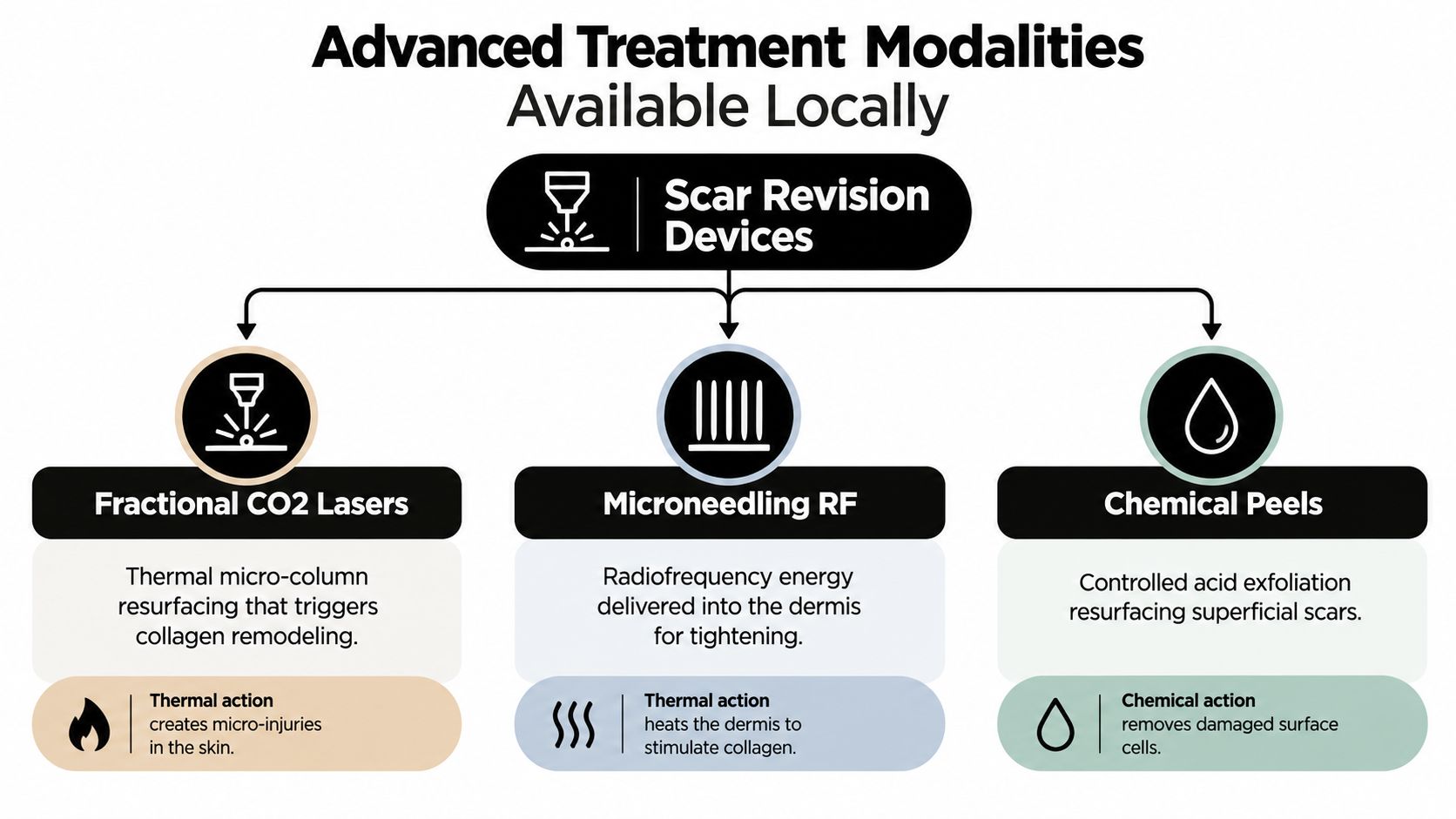
A proper acne scar consultation should feel more like skin engineering than a beauty menu. The device chosen matters because scar tissue sits at different depths, and each treatment works on a different layer. Fractional laser, microneedling RF, peels, and subcision are not interchangeable, even when clinics bundle them under one umbrella.
Fractional CO2 laser and dermal remodelling
Fractional CO2 laser is one of the most established options for textural scars. It creates controlled micro-columns of thermal injury in the skin, leaving surrounding tissue intact so healing can happen more efficiently than with a fully ablative pass. That thermal effect is what triggers collagen remodelling, which is why it's often chosen for boxcar scars, rough texture, and mixed atrophic scarring.
UK NHS sources note that fractionated CO2 laser is commonly used for acne scarring and may produce about 30–50% improvement from a single treatment, with one to three sessions sometimes needed and six months between sessions, though results vary substantially between individuals. That range is useful because it stops unrealistic expectations before they start. If a clinic talks as if one session will erase every scar, it's overselling.
Microneedling RF and layered heating
Microneedling, especially radiofrequency microneedling, works differently. Tiny needles bypass the outer epidermis and deliver energy into the dermis, where the collagen framework lives. That makes it useful when the issue isn't just surface roughness but deeper textural irregularity, particularly in rolling scars and mixed scars.
For local clinics, devices such as 3D Dermaforce are relevant because they combine controlled injury with thermal stimulation, which can be a better fit for some patients than laser alone. I'd also expect a reputable provider to discuss how the skin's thickness, downtime tolerance, and risk profile affect the choice between RF and laser. If you want to see how one local clinic presents this pathway, laser resurfacing for acne scars is a practical example of how the treatment is framed.
Chemical peels and subcision
Chemical peels are often misunderstood because people think of spa peels that only brighten the surface. Medical peels are chosen to remove controlled layers of damaged skin and can have a role in selected scar patterns, especially when texture is mild or the goal is to support a larger treatment plan. NICE specifically mentions glycolic acid peel as an option in consultant-led care for severe, persistent scarring.
Subcision is a different tool again. It's used when fibrous bands tether the scar down, which is why it's relevant for rolling scars that look like the skin is pulled unevenly. In practice, the best result often comes from combining release, energy-based remodelling, and maintenance skincare rather than expecting one machine to do everything.
Clinical insight: if a scar looks tethered when the skin is stretched sideways, a resurfacing device alone may improve the texture but won't fully release the pull.
For patients comparing providers, that combination mindset is more important than any single brand name. A clinic should be able to explain why it's using one modality, or several, and what tissue layer each one is aiming at.
Matching Treatments to Your Specific Scar Type
A lot of disappointment starts when people book a generic “laser facial” for scars that need targeted work. The mirror usually shows more than one pattern, but each scar type has a preferred approach. That's why morphology matters.
Acne Scar Morphology and Targeted Treatments
| Scar Type | Visual Characteristics | Primary Treatment Modality |
|---|---|---|
| Ice pick | Deep, narrow pits that look sharp and puncture-like | TCA cross or punch excision, then resurfacing if needed |
| Rolling | Wavy, uneven surface with soft depressions | Subcision plus microneedling RF |
| Boxcar | Broader depressions with defined edges | Fractional CO2 laser resurfacing |
| Mixed texture | More than one scar pattern in the same area | Combination plan, often laser plus needling or release |
If you're trying to match what you see in the mirror, the simplest clue is depth and edge shape. Ice pick scars are narrow and deep, rolling scars look tethered and uneven, and boxcar scars are wider with sharper borders. Many patients have all three, which is why single-device marketing rarely holds up in real treatment planning.
Why the combination approach wins
For a patient with rolling scars, subcision may need to come first because a laser can tighten the top layer without fully releasing the deeper pull. For deeper boxcar scars, resurfacing can improve contour, but the skin still needs enough healing time to make that change visible. Ice pick scars are often too narrow for broad resurfacing to solve on their own.
If you want an idea of how a clinic positions a broader pathway, best acne scar removal treatment shows how treatment options are often grouped for consultation purposes. The key is to treat that as a starting point, not a final diagnosis. Your scar map should decide the plan, not the brochure.
For day-to-day support, moisturizer for scar-prone skin is worth reading if you're thinking about barrier care around procedures, because skin that's dry or irritated often tolerates treatment less well. But moisturiser alone won't lift a tethered scar or resurface a depressed one.
What to Expect From Your Treatment Journey
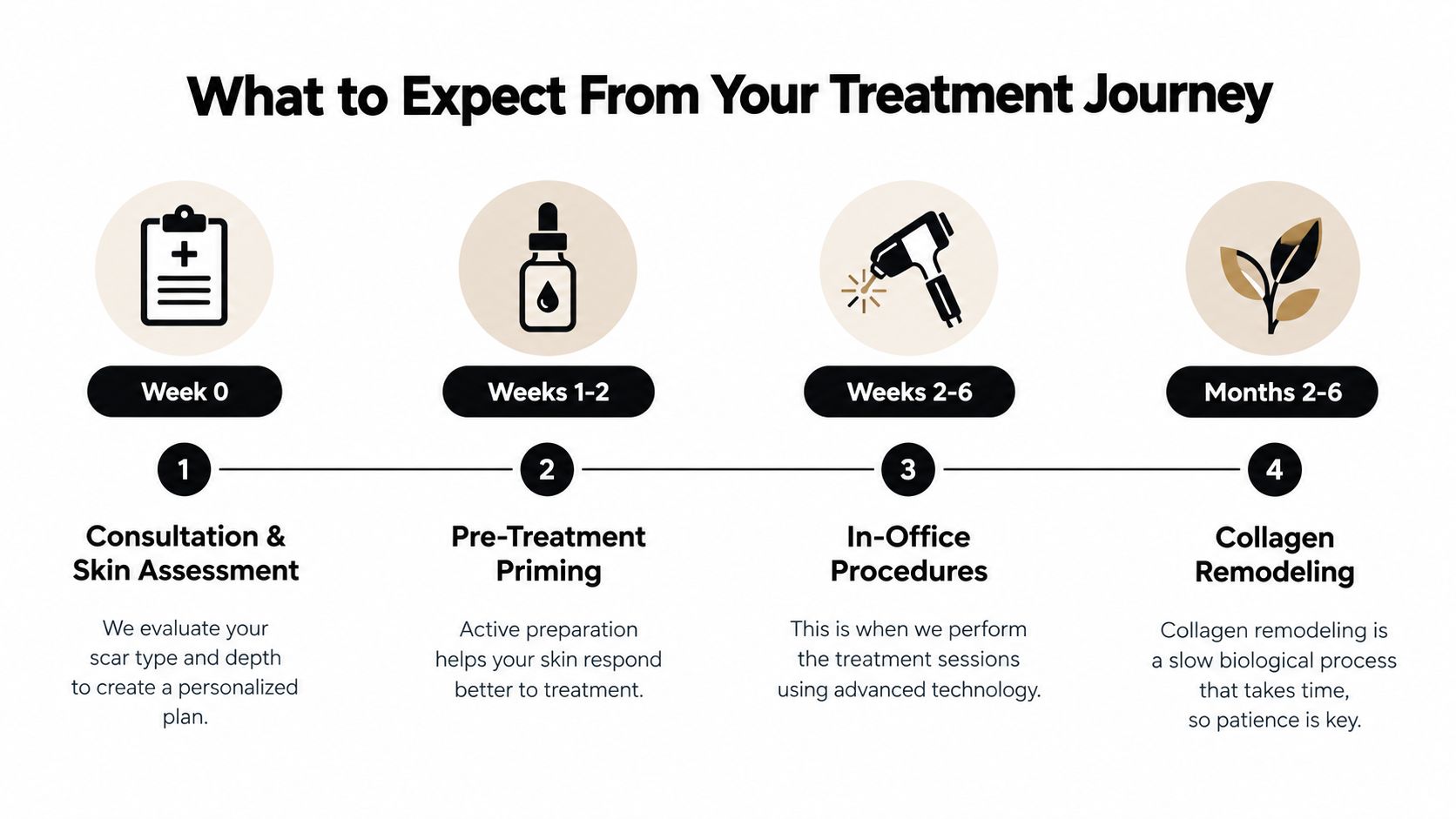
A patient usually wants one clear answer at the first visit: how long before the scars look better? The honest answer is that collagen remodelling takes time, and the skin does not change on demand. After treatment, redness, tightness, and flaking are common, then the deeper repair work starts to show gradually.
What the first appointment should cover
A proper consultation starts with scar classification, skin type, active acne status, and downtime. The point is to map the scar pattern before any device is chosen, because rolling scars, boxcar scars, and ice pick scars do not respond in the same way. In the NHS setting, more significant scarring is usually assessed in specialist care, and private clinics should be just as careful about whether the skin is ready for treatment.
A good practitioner will also explain the trade-offs. Subcision can release tethered rolling scars, but it may leave bruising or swelling for a short period. Fractional resurfacing can improve texture and edge definition, but it usually needs healing time before the next session. Needling can help broader textural change, yet deeper scars often need a more targeted plan.
Sessions are commonly spaced to allow recovery between appointments. That spacing matters, because treating again too soon can leave the skin inflamed rather than steadily remodelling. Some smaller scars soften a little over time on their own, so the first review is not always about starting another device straight away.
What results feel like in real life
Improvement is usually gradual, not dramatic overnight. The skin often looks calmer before it looks smoother, and the best changes tend to appear after repeated healing cycles have had time to stimulate new collagen. That is why staged review matters more than a one-off promise.
A realistic review appointment should ask a simple question, what change counts as meaningful progress for this scar type? If the clinic says the plan is working, it should be able to explain what it is seeing, flatter edges, less tethering, or a shallower contour. If it cannot name those changes, the treatment plan is too vague.
Some patients also need a pause between rounds because the skin barrier is still recovering. That is normal and often useful. It gives you and the clinician a clearer look at whether the improvement is coming from collagen change or just temporary swelling.
Useful expectation: if a clinic promises full clearance, treat that as a warning sign. A better question at review is, “What percentage improvement would you consider a success at session two?”
The patients who do best are usually willing to accept downtime, keep the plan staged, and review progress carefully. That is how scar revision becomes visible in a stable, useful way.
How to Choose the Right Local Clinic
A high-street beauty salon and a medical-grade clinic are not the same thing, even if both use the word “skin.” Acne scar treatment needs diagnostic thinking, not just equipment. The safest clinics start with history, scar mapping, and realistic consent before they ever talk about devices.

What to look for before you book
A strong provider should explain how they assess scar depth, skin tone, and active acne, then match those findings to treatment choice. If a clinic has a 3D scanner or structured skin analysis, that's useful because it gives a reference point for progress over time. In Leamington Spa, 3D Aesthetics Leamington Spa is one example of a clinic offering a complimentary consultation with a full 3D body scan and a range of facial resurfacing and microneedling services.
The practical value of that kind of setup is simple, it helps separate measurable change from hopeful guessing. If the clinic can't show you what it's measuring, it's harder to trust the outcome. If you're comparing providers, ask how they document scar type, how they review adverse effects, and how they adjust treatment if the skin reacts more strongly than expected.
Red flags that should slow you down
Avoid clinics that promise complete clearance, rush into aggressive treatment without a medical history, or speak as if every scar responds the same way. Acne scar care is too morphology-dependent for blanket claims. You should also be wary of anyone who can't explain what they do if the skin pigment changes, healing is delayed, or active breakouts flare after treatment.
A clinic's tone matters as much as its technology. Good practitioners are comfortable saying that some scars improve a lot, some improve partially, and some need combination work. That honesty is part of safety.
Practical rule: if the consultation feels like a sales pitch, keep looking.
After the first review, the conversation should include downtime, sequencing, and whether the plan is meant to treat the scar itself, the surrounding texture, or both. That's the level of detail you want before agreeing to any procedure.
Preparing for and Recovering From Your Procedure
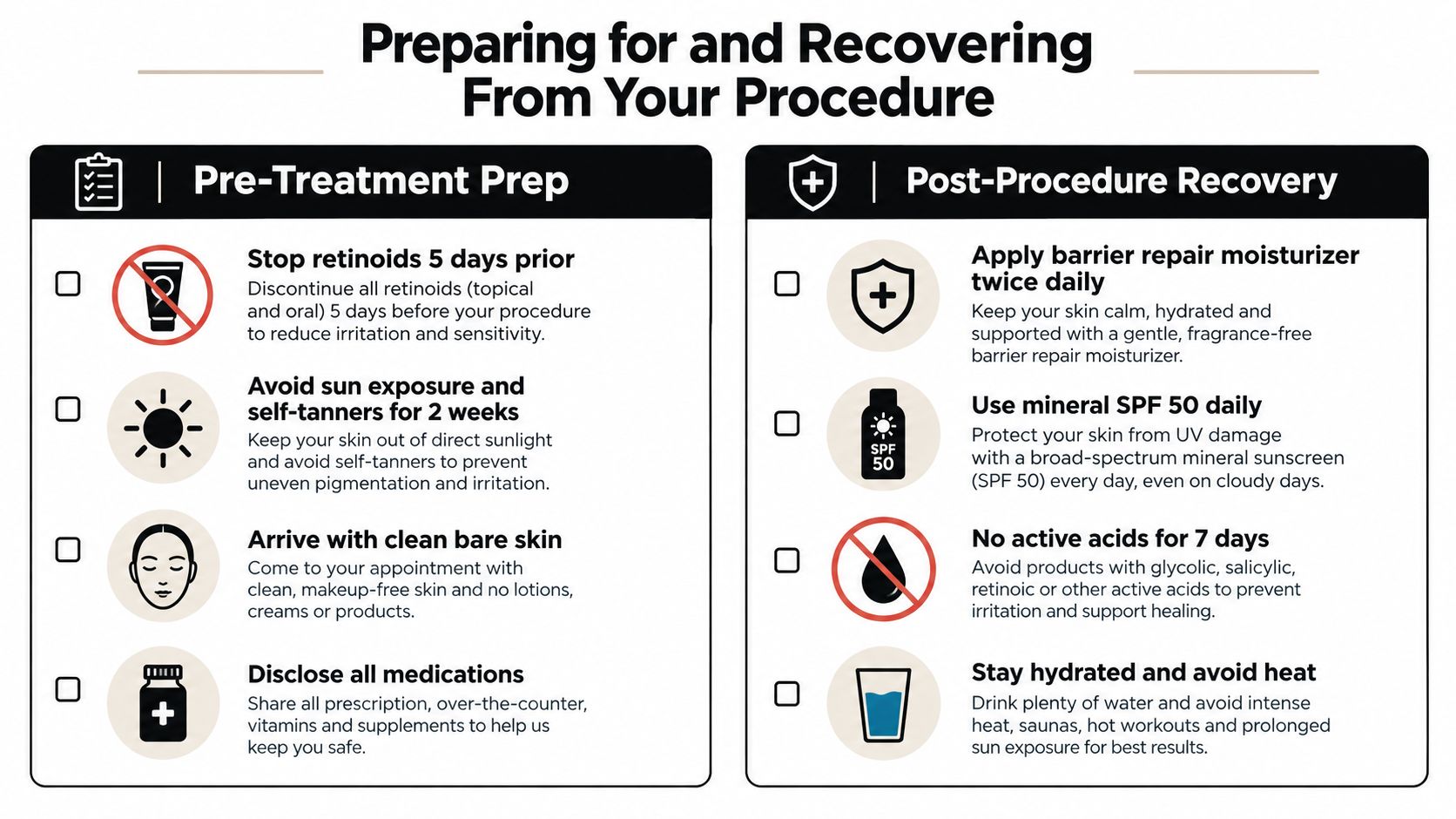
Skin prep is not cosmetic fluff. It changes how well the skin tolerates energy, how fast it settles, and how much irritation you carry into recovery. If you want a safer outcome, the weeks before treatment matter as much as the procedure day itself.
Before the appointment
Follow the clinic's instructions on active ingredients, because retinoids and strong acids can make skin more reactive if they're not paused appropriately. Avoiding sun exposure and self-tanners matters too, especially before resurfacing or peels, because pigment disturbance is harder to manage than temporary redness. Arriving with clean, bare skin and a full medication list helps the practitioner reduce avoidable risk.
After the procedure
Barrier repair comes first. Moisturiser, mineral SPF, and staying away from active acids for the advised period are not optional extras, they're part of the treatment. Heat, heavy exercise, and direct sun can keep the skin inflamed longer than necessary, which slows recovery and can increase the chance of uneven pigmentation.
For patients who like a structured aftercare guide, microneedling aftercare is a practical reference point for the kind of disciplined routine that supports healing. It's especially relevant because aftercare is where many people either protect their results or undermine them.
Recovery usually means some combination of redness, tightness, peeling, and a temporary rough phase before the skin smooths out. That doesn't mean the treatment failed. It means the skin is doing the work you asked it to do.
Frequently Asked Questions About Acne Scar Revision
Pain depends on the procedure. Microneedling is usually more tolerable than aggressive CO2 laser, though both can be managed with proper numbing and pacing. The bigger issue isn't whether it feels intense for a few minutes, it's whether the practitioner matches the treatment depth to the scar depth.
Private cost varies by device, area, and number of sessions, so it's better to ask for a written plan than a vague estimate. Acne scar treatment is usually treated as cosmetic, which means people often pay privately even though the scars came from a medical condition. That's one reason many patients also look for sensible home care, and resources like organic scar care with aloe can be useful for soothing support, though they won't remodel scar tissue.
Results are often long-lasting once the skin has built new collagen, but new acne can create new scars. So the answer to “is it permanent?” is usually that improvement can be durable, provided the acne stays controlled and the skin is protected well after treatment.
If you're comparing options for acne scar treatment near me, 3D Aesthetics Leamington Spa offers consultation-led scar assessment, fractional CO2 resurfacing, and 3D Dermaforce microneedling as part of a broader facial treatment pathway. Visit 3D Aesthetics Leamington Spa to discuss your scar type, recovery expectations, and the most suitable local treatment plan.
← Back to Home