
You've bought a home mask, read that LED has no side effects at all, and now you're wondering why your eyes ache or your skin feels tight afterwards. Or you're considering treatment in Leamington Spa and want a straighter answer before you book. We hear both versions at consultation every week. LED light therapy side effects are usually short lived, but they're not imaginary, and the useful questions are rarely about mild redness alone. They're about your medicines, your eyes, and whether the device in front of you is being used properly.
Table of Contents
- What LED Light Therapy Side Effects Actually Look Like in a Real Clinic
- The Three Wavelengths We Use and Where Each One Carries Risk
- How Often Side Effects Actually Happen
- Eye Safety and Device Quality the Headlines Miss
- Who Should Avoid LED Light Therapy or Need Extra Screening
- Aftercare and Warning Signs to Watch For
- Practical Takeaways and Common Questions Before You Book
What LED Light Therapy Side Effects Actually Look Like in a Real Clinic
Dermalux LED photobiomodulation (low level light used to support skin function without removing tissue) most commonly causes temporary warmth, mild redness, tightness or dryness, and occasionally headache or eye strain. That's the typical pattern we plan for in clinic. We don't describe Dermalux LED as free of side effects, because that claim stops clients telling us things we need to know, such as a new medicine or a history of light sensitivity.
Dermalux LED photobiomodulation doesn't use a photosensitising drug, doesn't break the skin surface, and doesn't deliver ultraviolet light in the way sunbeds do, so for a properly screened adult using a maintained clinic device with suitable eye protection, the expected reactions are usually limited to short lived warmth, redness, dryness, tightness, headache or eye strain that settle without further sessions being forced. That doesn't make Dermalux LED suitable for everyone, because photosensitising medicines, active photosensitive conditions, eye disease, seizure disorders, pregnancy where evidence is limited, and skin that hasn't healed after laser or a peel can change the decision. Safety therefore depends less on the word LED and more on your history, the wavelength and dose selected, eye protection, and whether treatment stops when symptoms persist.
Why hospital light treatment looks different
Photodynamic therapy, or PDT (treatment where a light activated medicine is applied or taken before light exposure), is not the same as cosmetic Dermalux LED. That's an important distinction when you're reading frightening lists online. The NHS guidance on photodynamic therapy identifies burning, stinging, redness, swelling, blistering, itching and scabbing as recognised skin reactions during that hospital treatment, with most settling shortly after the session ends.
We explain that difference at your free consultation because PDT is designed to create a stronger reaction. If you want wider context on how light is used in medical settings beyond aesthetics, this overview of light therapy for cancer support shows why the purpose, dose and clinical supervision change the risk conversation. In our clinic, we record the wavelength, session length and any symptoms, and we adjust or pause rather than pushing through a reaction.
What we ask before your first session
- Medicines and supplements: Bring an exact list, including herbal products, so we can check photosensitivity properly.
- Eye and headache history: Tell us about migraine, eye disease, recent eye procedures or strong light sensitivity.
- Recent skin treatment: Tell us about laser, peels, waxing or active inflammation so we don't treat skin that needs to heal first.
The Three Wavelengths We Use and Where Each One Carries Risk
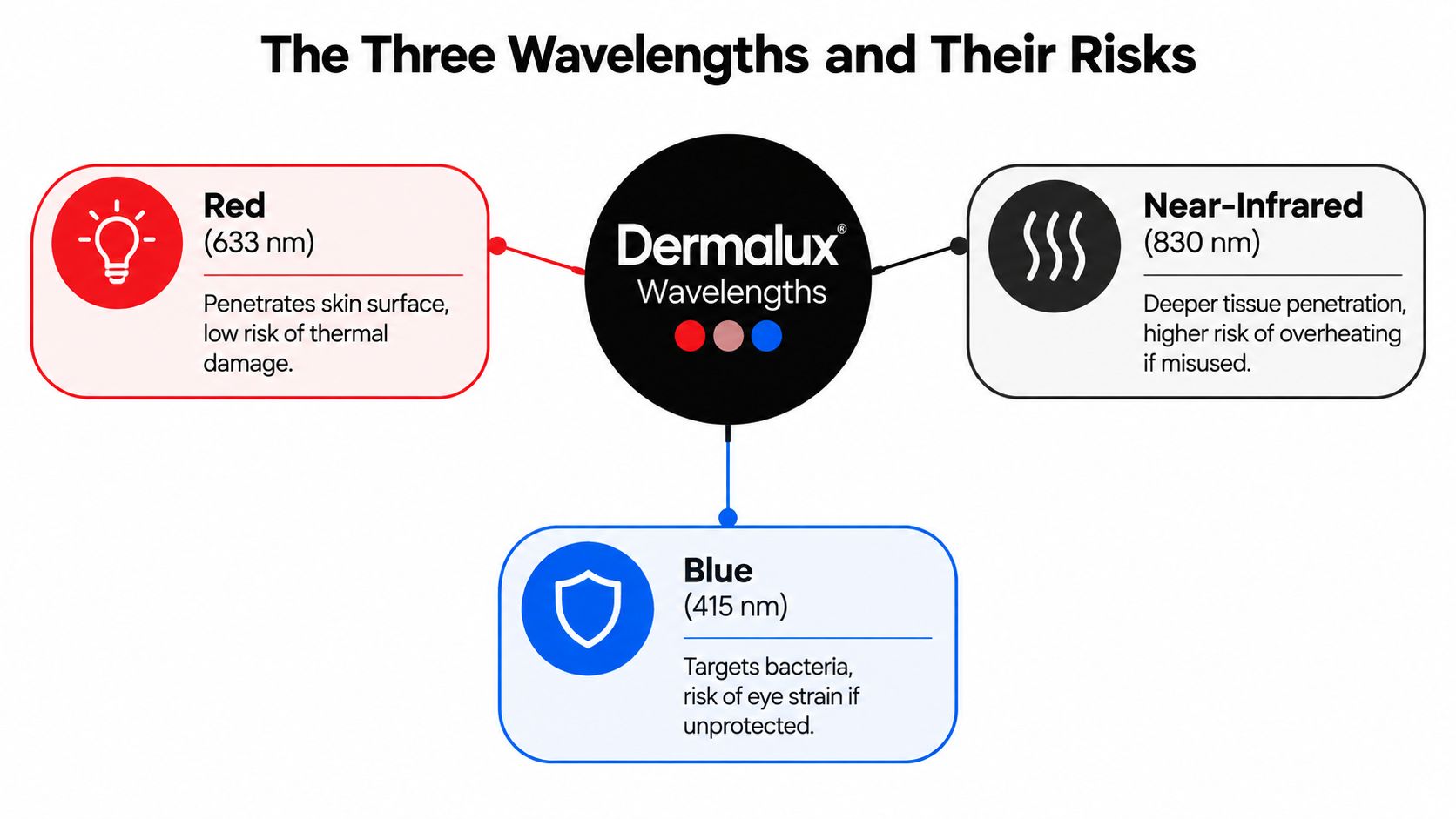
Dermalux LED uses blue around 415 nm, red around 633 nm and near-infrared around 830 nm, and each wavelength carries a slightly different safety question. Wavelength is measured in nanometres (nm), and it affects how far light travels and what it interacts with. Irradiance (the amount of light energy reaching an area of skin) matters just as much, because wavelength alone doesn't tell you the dose.
Red and near-infrared in practice
Red Dermalux LED is the wavelength we most often pair with general skin rejuvenation work, while near-infrared reaches deeper tissue. In our clinic we usually see warmth or a flushed look after these modes, which typically settles. Neither mode should feel like burning. If you feel sharp heat, increasing pain or marked swelling, we stop and reassess rather than assuming discomfort means it's working, and results vary from person to person.
The diagram below sets out the three wavelengths we discuss at consultation.
Why blue deserves extra caution
Blue Dermalux LED is used where surface bacteria and breakouts are part of the concern, but it's also the mode we discuss most carefully around eyes and photosensitivity. A UK Health Security Agency linked review of home photobiomodulation devices highlights blue wavelengths as a potential photo-retinopathy hazard (light related retinal injury) because of intracellular reactive oxygen species generation, and recommends extra caution around the eyes when manufacturer shielding is inadequate.
That evidence doesn't mean blue light automatically damages eyes during normal clinic use, and acute retinal damage from typical exposure has not been demonstrated in that safety guidance. It does mean we don't treat eye protection as optional, we check the fit before we start, and we're more cautious if you have eye disease, recent ocular treatment or strong photophobia (painful sensitivity to light).
If you're comparing clinics, ask three direct questions. Which wavelength will you use on me, at what distance and for how long? What eye protection will I wear? What symptom would make you stop the session? Our guide to what LED light therapy is and how the wavelengths differ covers the treatment basics if you want that background first.
How Often Side Effects Actually Happen
Dermalux LED side effects in cosmetic practice are most often mild and temporary, while blistering, infection, pigment change and scarring are much less frequent concerns. The strongest UK frequency figures available come from hospital PDT, not cosmetic LED, so we use them as an outer safety benchmark rather than pretending they describe a Dermalux facial exactly.
What the Oxford figures actually describe
Oxford University Hospitals reports treatment pain and inflammation as common effects of topical red light PDT, potentially affecting up to 1 in 10 people, with blistering, ulceration, bruising, hair changes, dermatitis, infection and pigmentation changes described as uncommon at roughly 1 in 100 people. Scarring is estimated at less than 1 in 100 people in UK evidence for PDT.
Those numbers need the context in bold. PDT includes a photosensitising medicine before the light is applied. Our Dermalux LED sessions don't. A stronger, drug driven skin reaction is expected with PDT, so transferring its percentages directly to a cosmetic LED mask or clinic panel would mislead you in the opposite direction from the usual marketing claim.
How we translate that into clinic language
| Reaction pattern | How we frame it in clinic |
|---|---|
| Warmth, flushing, mild swelling | Expected short term response, we monitor it and check it settles |
| Dryness, itching, tightness | A sign to review frequency, skincare and barrier recovery before the next session |
| Blistering, crusting, pigment change | Not something to treat through, we stop and assess |
| Eye pain or visual change | Stop treatment and seek clinical advice |
The irritation pathway matters over a course, not just after one visit. Royal Wolverhampton NHS guidance for home phototherapy lists itching and dry skin among expected effects, and that pattern informs how we space sessions. If redness, dryness or itching persists, we reduce frequency or pause. Booking the next session automatically is poor practice, and results vary from person to person.
Our working rule: If a reaction is getting worse at the point your next Dermalux LED session is due, you don't have that session until we've reviewed it.
That approach also helps us separate LED reactions from reactions to products used around treatment. Contact dermatitis (inflammation triggered by something touching the skin) can look like light sensitivity, but the cause and the solution are different. We therefore ask what you've applied before and after treatment, not just how the light felt. It's a slower conversation, but it prevents us blaming the wrong thing and repeating the same mistake at your next appointment in Leamington Spa.
Eye Safety and Device Quality the Headlines Miss
Dermalux LED eye safety depends on fit for purpose eye protection, controlled irradiance and honest screening, not on whether the session feels comfortable. Comfort is useful feedback, but comfort can't verify output. A panel can feel gentle while the eye protection fits badly, and a near-infrared mode can be hard to judge by brightness alone because you can't see it properly.
Watch this short overview before we go through the checks we use in clinic.
British Association of Dermatologists guidance, reflected in UK patient guidance on LED treatment, recommends that phototherapy devices, including handheld units, undergo medical physics evaluation and regular irradiance checks, and explicitly advises suitable eye protection plus medical consultation for clients with photosensitive epilepsy.
What we check that a home mask can't show you
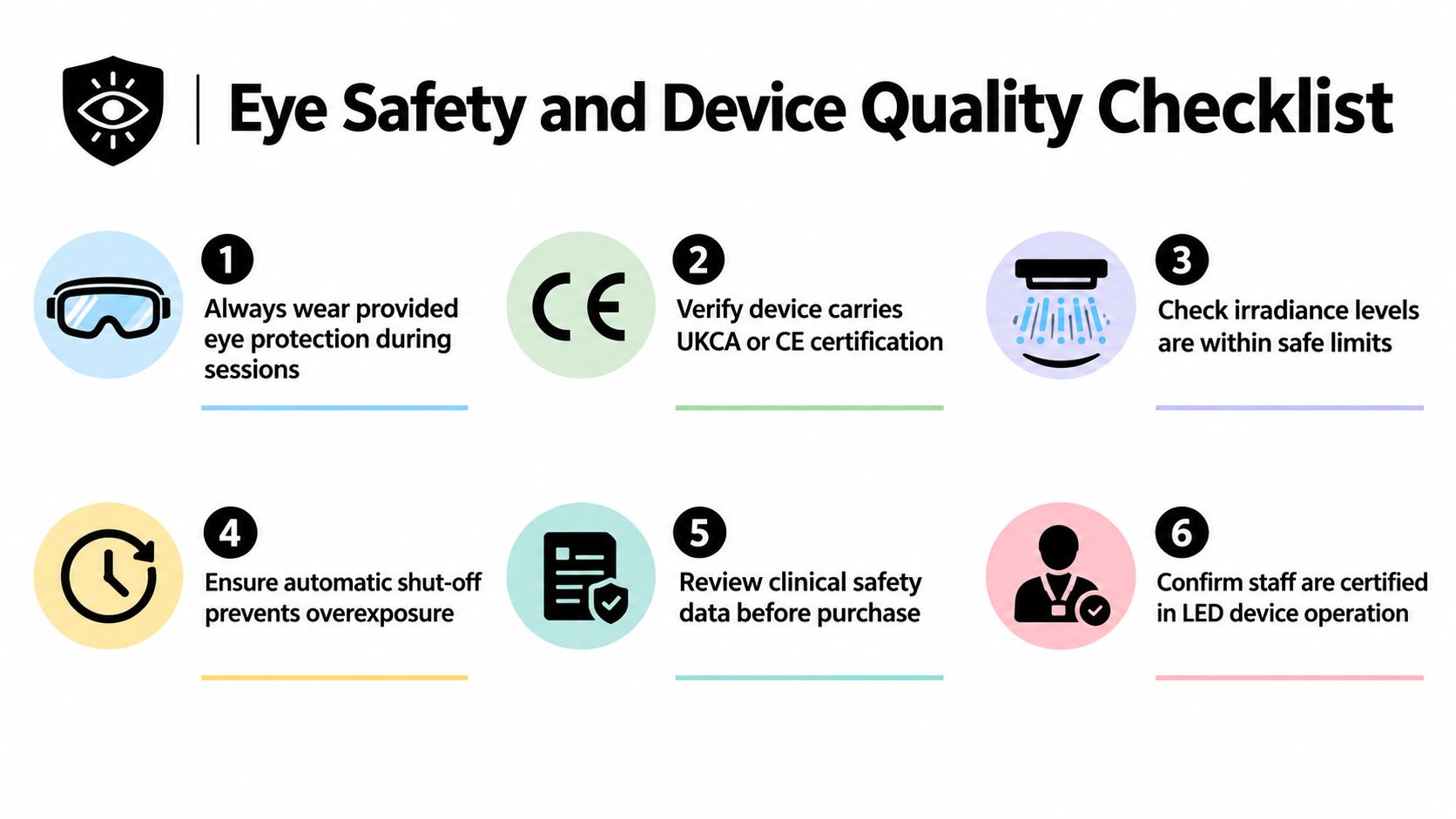
- Eye protection fit: We provide protection and check it hasn't shifted before the panel is positioned.
- Device distance and timing: We set both deliberately, rather than leaving you to judge dose by feel.
- Output checks: Clinic devices should be maintained and checked, because output can drift over time.
- Screening notes: We record migraine, seizure history, eye disease and light triggered symptoms before selecting a mode.
The checklist below summarises the questions we'd want answered before trusting any device, clinic or home based.
Home masks create a particular problem. The fit varies, the shielding around the eyes varies, and many people use them more often than directed because there's no practitioner stopping the session. That doesn't make every home device unsafe, but it does mean the risk calculation is yours alone. If you develop persistent eye pain, blurred vision that doesn't settle, marked photophobia or a severe headache pattern after LED, don't just switch colours and try again. Stop and get advice.
We also take migraine seriously even when there's no formal eye diagnosis. Bright visible light can cause temporary discomfort, and a client who arrives already sensitive to light needs a different plan from someone who tolerates bright light easily. Sometimes that plan is a shorter first exposure and review. Sometimes it's not treating that day.
Who Should Avoid LED Light Therapy or Need Extra Screening
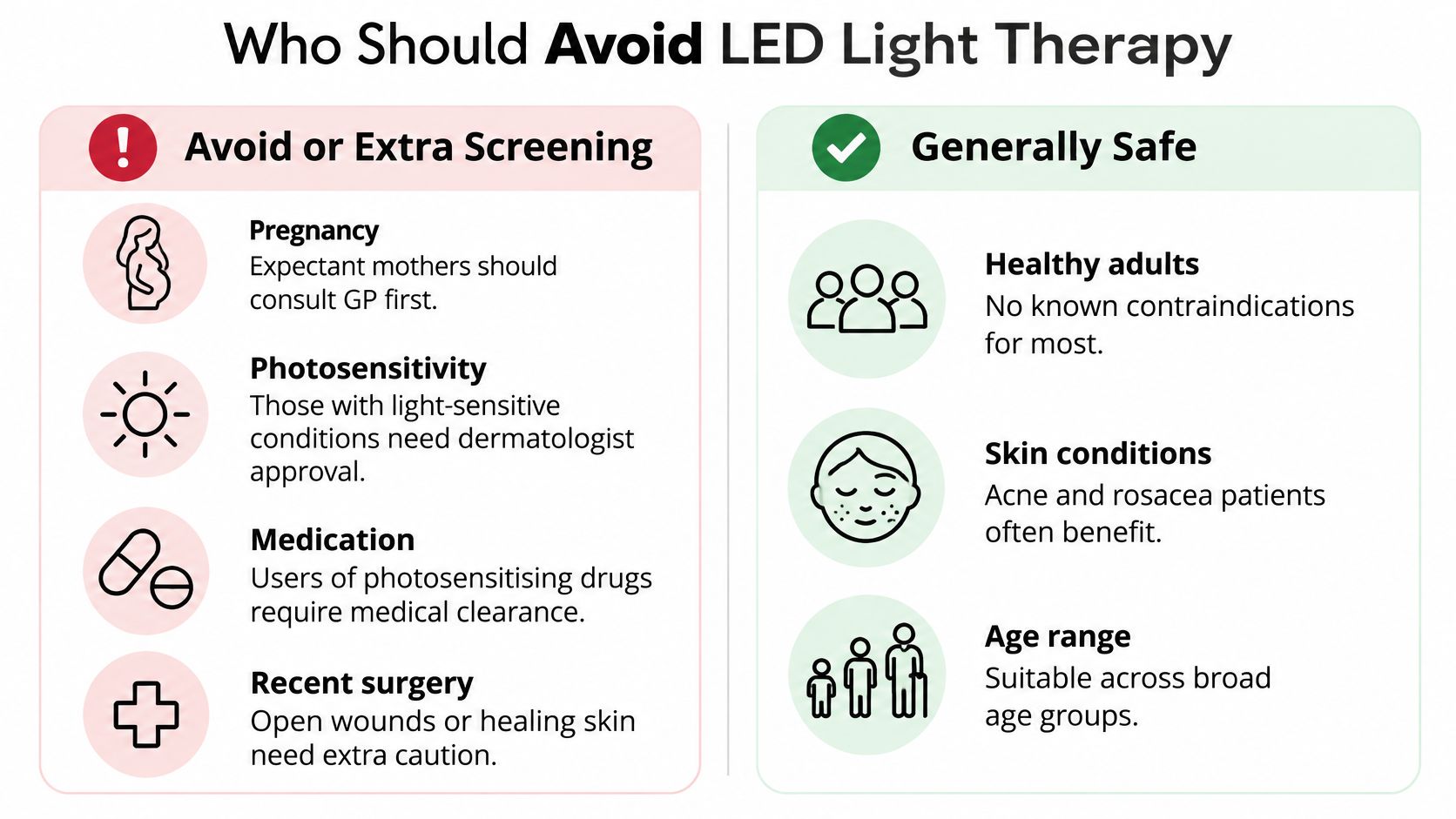
Dermalux LED is not suitable on the day for everyone, and we will decline or postpone treatment where medicines, photosensitivity, eye conditions or unhealed skin make the risk unclear. We'd rather lose a booking in Warwickshire than explain afterwards why we treated through a warning sign we should have acted on.
The medication question clients ask most
“Do I need to stop my prescription before LED treatment?” Our answer is no, not on your own. Bring the exact name and dose, and don't stop prescribed medicine without speaking to your prescriber or GP. The British Medical Laser Association notes, in its resources on laser and light safety, that most drug phototoxicity is associated with UVA, while reactions extending into visible light may occur up to approximately 460 nm, and recommends that medication and herbal product histories be recorded and treatment proceed cautiously when risk is uncertain.
That 460 nm detail is why a simple yes or no list isn't good enough. Blue light sits closer to that range than red or near-infrared, so the selected wavelength matters to the decision. Risk also depends on the medicine, the dose, the exposure time and your own reaction history. A photosensitising medicine doesn't automatically rule out every LED mode, but uncertainty should favour postponement and prescriber advice, not reassurance based on low heat.
The summary below shows the screening groups we talk through most often.
People we commonly postpone or refer first
We ask for medical clearance where there's photosensitive epilepsy (seizures triggered by light), significant eye disease, a recent eye procedure, or an active photosensitive disorder. We are cautious during pregnancy or breastfeeding where evidence is limited. We delay after laser skin resurfacing, CO2 fractional laser or a chemical peel until the skin has healed, because layering light onto inflamed skin makes reactions harder to read.
Retinoid use needs a proper conversation rather than a blanket refusal. We ask what you're using, how your barrier is coping, and whether you're currently peeling, sore or unusually reactive. If the skin is already irritated, a gentler route such as our 3D HydrO2 facial may be more sensible first, with LED reconsidered once your skin settles. Results vary from person to person, and timing is part of safety.
If we can't identify a medicine, can't assess a light sensitivity history, or can't provide suitable eye protection for your situation, we don't guess. We postpone.
Aftercare and Warning Signs to Watch For
Dermalux LED aftercare is simple, but persistent inflammation, blistering, infection or visual change means you stop sessions and get medical assessment. The first day or so tells us a lot. Mild warmth, slight flushing and a tight or dry feeling are the sensations clients most often describe to us, and they should be easing rather than building.
NHS 111 Wales lists headache, eye strain, tiredness, irritability, sleep disturbance and blurred vision as generally mild, short lived light therapy effects in Royal Wolverhampton NHS home phototherapy guidance. Short lived is the key phrase. Symptoms that persist, intensify or return more strongly after each session need review.
What to do after your session
- Keep skincare simple: Use gentle cleansing and moisturiser, and avoid introducing several new active products that evening.
- Use daily SPF: Protect treated skin outdoors, especially if it's flushed or you're having a course alongside other treatments.
- Note your symptoms: Tell us if headache, eye strain, dryness or sleep disturbance followed the session so we can adjust wavelength, duration or spacing.
- Don't layer treatments blindly: Ask before combining LED the same week with 3D Dermaforce RF microneedling or HIFU, because skin that's already stimulated may need recovery time.
The image below is a reminder that rest is part of recovery, but rest doesn't replace assessment if symptoms are wrong.

Call us before your next appointment if you develop blistering, crusting, spreading redness, swelling that worsens, signs of infection, or an unexpected change in pigmentation. For sudden eye pain, flashes, loss of vision or severe visual disturbance, seek urgent help rather than waiting for us to reopen, and these emergency eye care tips explain the symptoms that should never be watched at home. Where you're unsure and symptoms aren't settling, NHS 111 or your GP is the right route.
Practical Takeaways and Common Questions Before You Book
Dermalux LED is a reasonable option for many properly screened adults, but booking safely means bringing your medicine list, eye history and recent treatment history to consultation. Home masks don't carry an identical risk profile to our clinic panel because output checks, distance, timing and eye shielding are controlled differently. Comfort during a session isn't proof the dose is right.
If you're using retinoids, don't stop them in secret and don't assume we will refuse you. Tell us what you're using and how your skin is tolerating it. We see clients from Warwick and Kenilworth as well as locally, and our free AI Skin Scanner can start the conversation, but it doesn't replace our in person screening for light based treatment at 3D Aesthetics Leamington Spa.
You can read more about our Dermalux LED therapy in clinic, check our prices, then book your free consultation if you'd like us to assess suitability properly. Results vary from person to person, and we'll tell you plainly if LED is not the right next step.
If you're considering Dermalux LED and want an honest assessment of your medicines, eye history and skin before treatment, visit us at 3D Aesthetics Leamington Spa or call us on 01926 315764 to arrange your free consultation at 11 Guys Place East, Leamington Spa, Warwickshire CV32 4RG. We'll explain where LED fits alongside treatments such as our 3D HydrO2 facial or 3D Dermaforce RF microneedling, and we'll postpone treatment if screening tells us that's the safer decision.
← Back to Home