
You've probably seen LED masks everywhere lately. They pop up on Instagram, in online beauty shops, and in clinic treatment menus, often with glowing promises about clearer skin, fewer breakouts, and a fresher complexion. If you're wondering whether LED is a serious treatment or just another skincare trend, that's a sensible question.
As an aesthetic therapist, I find that many individuals aren't confused by the idea of light itself. They're confused by the gap between the polished marketing and the actual results. A clinic device such as Dermalux doesn't work in the same way as a low-powered mask bought for home use, even though both sit under the same broad label of LED light therapy.
What is LED light therapy, then? In simple terms, it's a non-invasive treatment that uses specific wavelengths of light to support skin processes such as calming inflammation, targeting acne-causing bacteria, and encouraging repair. It doesn't rely on heat, needles, or downtime, which is why it appeals to people who want a gentler option.
Table of Contents
- An Introduction to Modern Light-Based Skincare
- The Science of Light How LED Therapy Works
- A Spectrum of Solutions The Different Colours of Light
- Clinic vs Home Dermalux vs At-Home Masks
- Is LED Light Therapy Safe For Everyone
- Your LED Journey at 3D Aesthetics Leamington Spa
An Introduction to Modern Light-Based Skincare
Modern LED skincare didn't begin as a social media beauty craze. Its roots go back to 1990s NASA-powered research for wound healing and tissue regeneration, which helped drive the development of red and near-infrared LED devices for clinical use. That early medical interest matters because it tells you this technology was investigated as a treatment tool before it became a consumer gadget.
For acne, LED therapy was first clinically validated in the 1990s. A significant study later showed that blue LED light reduced acne lesions by up to 70% after 8 weeks of consistent treatment, and a UK-based clinical review reported that 68% of patients experienced significant improvement in acne severity after 12 weeks of blue LED sessions, with minimal adverse effects. Those figures come from the verified clinical evidence provided for this article.
That doesn't mean LED replaces every other treatment. It means it has earned a place as a useful option, especially for people who want something drug-free and low disruption. In the UK, the NHS and dermatology boards have increasingly recognised LED therapy as a safe, effective adjunct for mild-to-moderate acne, particularly when patients want to avoid systemic medication.
LED light therapy sits in a helpful middle ground. It's gentler than many aggressive procedures, but it's also more evidence-based than a lot of trend-led skincare gadgets.
People also ask whether LED is just for acne. It isn't. Clinically, different wavelengths are used for different goals, including inflammation control, healing support, and skin rejuvenation. In UK practice, clinics have increasingly adopted it into treatment plans for acne, wound healing, and skin rejuvenation, and hospitals in London, Manchester, and Birmingham have integrated LED devices into standard care protocols for skin and wound management according to the verified data above.
A good way to think about LED is this. It's not a miracle shortcut, and it's not nonsense. It's a tool, and like any tool, the result depends on the right wavelength, the right dosing, and whether you're using a professional system or a home-use version.
The Science of Light How LED Therapy Works
LED stands for light-emitting diode. In skin treatment, these diodes produce narrow bands of light at specific wavelengths. That specificity is important because skin doesn't respond the same way to every colour or every device.
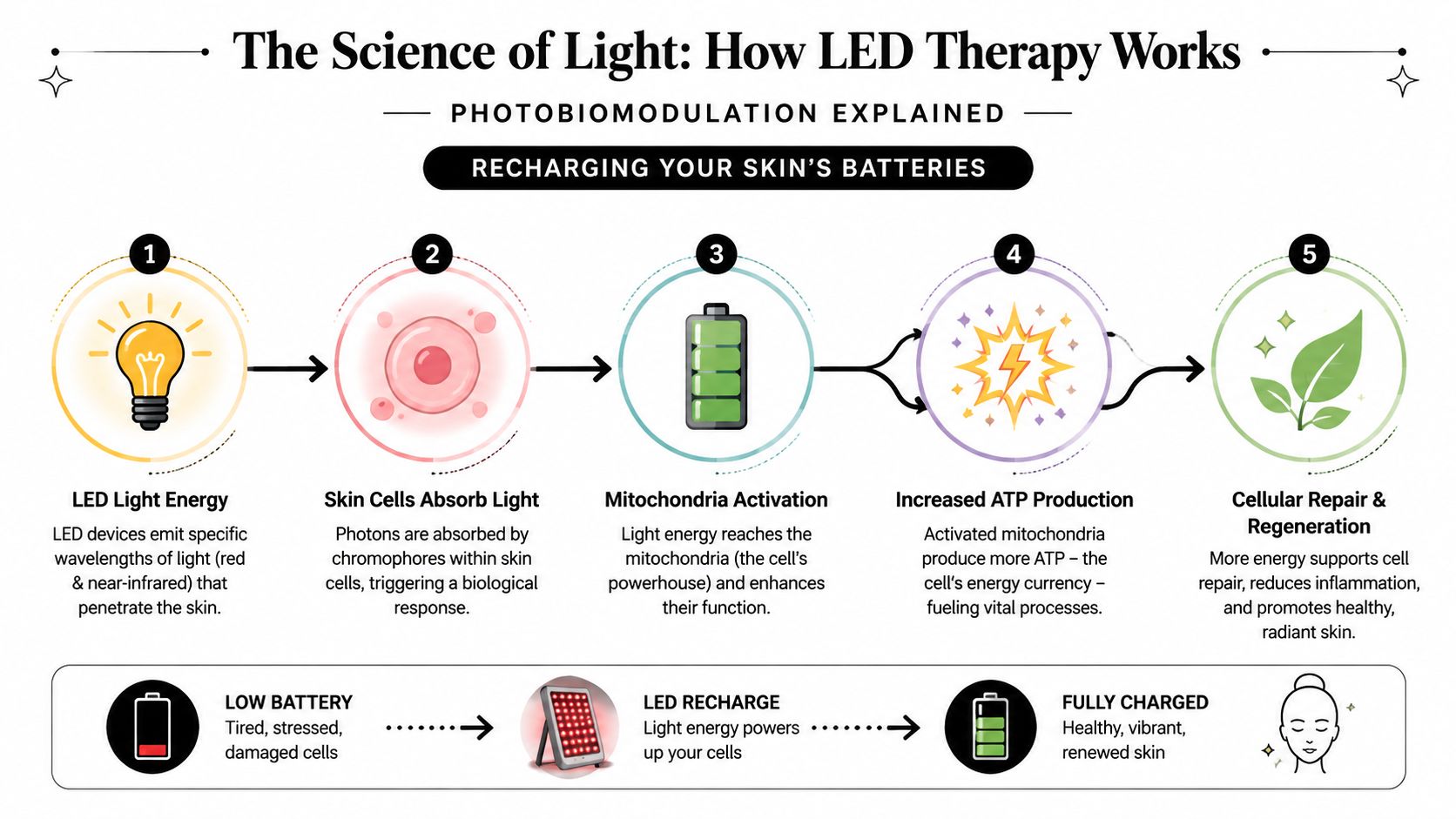
The easiest way to understand what is LED light therapy is to picture your skin cells as tiny rechargeable units. They already know how to repair, renew, and calm inflammation. They just don't always do those jobs efficiently, especially when skin is stressed, inflamed, or healing slowly. LED therapy delivers light energy that skin cells absorb, and that can support better cellular activity.
Why wavelength matters
The technical term you may hear is photobiomodulation. That sounds complicated, but the principle is straightforward. Light energy is absorbed by the skin, and that absorption can influence cell behaviour.
For skin applications, the most clinically supported wavelengths are red light at 630 to 660 nm and near-infrared light at 800 to 1200 nm, because these ranges are associated with photobiomodulation effects such as increased cellular energy, or ATP, according to this technical guide on LED light therapy wavelengths and dosing. The same guide notes that practical dosing depends on both irradiance and exposure time, with an irradiance target around 30 to 50 mW/cm².
That last point is where many readers get stuck. Wavelength tells you the type of light. Irradiance tells you how much useful light energy is reaching the skin over a given area. If a device has the right colour but very low output, results may be limited or slow.
If you've ever wondered why one LED treatment seems far more effective than another, this is often the reason. It isn't just “red light” in a vague sense. It's the precision of the wavelength, the consistency of delivery, and the dose reaching the skin.
Why clinic devices tend to do more
Professional devices are built to deliver controlled treatment parameters repeatedly. That matters when the goal is reproducible outcomes for acne, inflammation, or rejuvenation rather than a pleasant glow and a relaxing routine.
A home mask may still have a role, especially if you're patient and realistic. But if someone is trying to improve uneven texture, post-breakout irritation, or visible dullness, the quality of the light delivery changes what's possible. That's one reason people often combine LED with a broader skin plan, such as treatments and skincare aimed at improving skin texture.
Practical rule: The skin responds to the dose it receives, not the marketing on the box.
Another point that reassures many clients is safety. LED is non-ionising. Unlike UV light, it does not damage DNA or cause burns according to the verified clinical data provided for this article. That's why, when it's used correctly, LED is generally considered a low-risk option in both clinical and home settings.
A Spectrum of Solutions The Different Colours of Light
One reason LED can seem confusing is that people talk about “light therapy” as if it's one treatment. In practice, it's more like a toolkit. Different wavelengths are chosen for different skin concerns.
Here's a simple overview.
| Light Type | Wavelength | Primary Target | Key Benefits |
|---|---|---|---|
| Red | 630–660 nm | Skin repair pathways | Supports collagen-related repair, helps with visible signs of ageing, encourages healing |
| Blue | Approximately 400–470 nm | Cutibacterium acnes | Helps manage acne by targeting acne-causing bacteria |
| Near-infrared | 800–1200 nm | Deeper tissue support | Helps calm inflammation and supports recovery |
Red light for repair and visible ageing
Red light is the most commonly discussed wavelength in relation to fine lines, healing, and skin vitality. In the verified data for this article, a UK clinical trial involving 300 participants found that red LED phototherapy increased collagen and elastic fibre production by 30% after 12 weeks, with measurable improvements in skin firmness and wrinkle reduction confirmed via skin biopsies.
That's one reason red LED is commonly used when skin looks tired, feels fragile, or needs support after more intensive procedures. It doesn't act like filler or a resurfacing laser. It works in a quieter way by supporting the skin's own repair mechanisms.
A separate peer-reviewed home-use study of a 637 nm + 854 nm LED device found statistically significant improvement in skin elasticity at 6 and 8 weeks versus control, with no adverse reactions or pain recorded, according to this PubMed-listed home-use LED study. That's encouraging, but it also fits the broader pattern of LED being a gradual treatment rather than an instant transformation.
Blue light for acne-prone skin
Blue light has a very different job. It's used mainly for acne because it targets acne-causing bacteria, specifically Cutibacterium acnes. The verified evidence provided for this article states that blue LED light at approximately 400 to 470 nm reduced acne lesions by up to 70% after 8 weeks of consistent treatment.
That statistic helps explain why LED became established in acne care. For some people, especially those with mild-to-moderate breakouts, it offers a non-invasive option that doesn't rely on antibiotics.
Blue light isn't always used on its own. In clinic settings, it's often paired with red light so the treatment can address both the bacterial side of acne and the inflammatory side at the same time.
Near-infrared light for deeper calming support
Near-infrared sits just beyond visible red light. You usually can't see it in the same way, but it's valued because it penetrates to a greater depth.
In the verified data, near-infrared LED at 800 to 1000 nm has been validated for pain relief and muscle recovery, with UK sports medicine units reporting a 65% reduction in post-exercise inflammation among athletes using LED therapy. In aesthetics, that deeper calming effect is one reason near-infrared is often chosen for sensitive, reactive, or recovering skin.
If your concern is breakouts, blue light often matters most. If your concern is healing or visible ageing, red and near-infrared usually matter more.
When clients ask which colour they need, the honest answer is that it depends on the problem we're trying to treat. The colour isn't cosmetic. It's functional.
Clinic vs Home Dermalux vs At-Home Masks
Most buying decisions arise when someone sees a clinic treatment menu and a home LED mask online, and both appear to promise similar things. The important difference is that they don't usually deliver the same level of treatment.
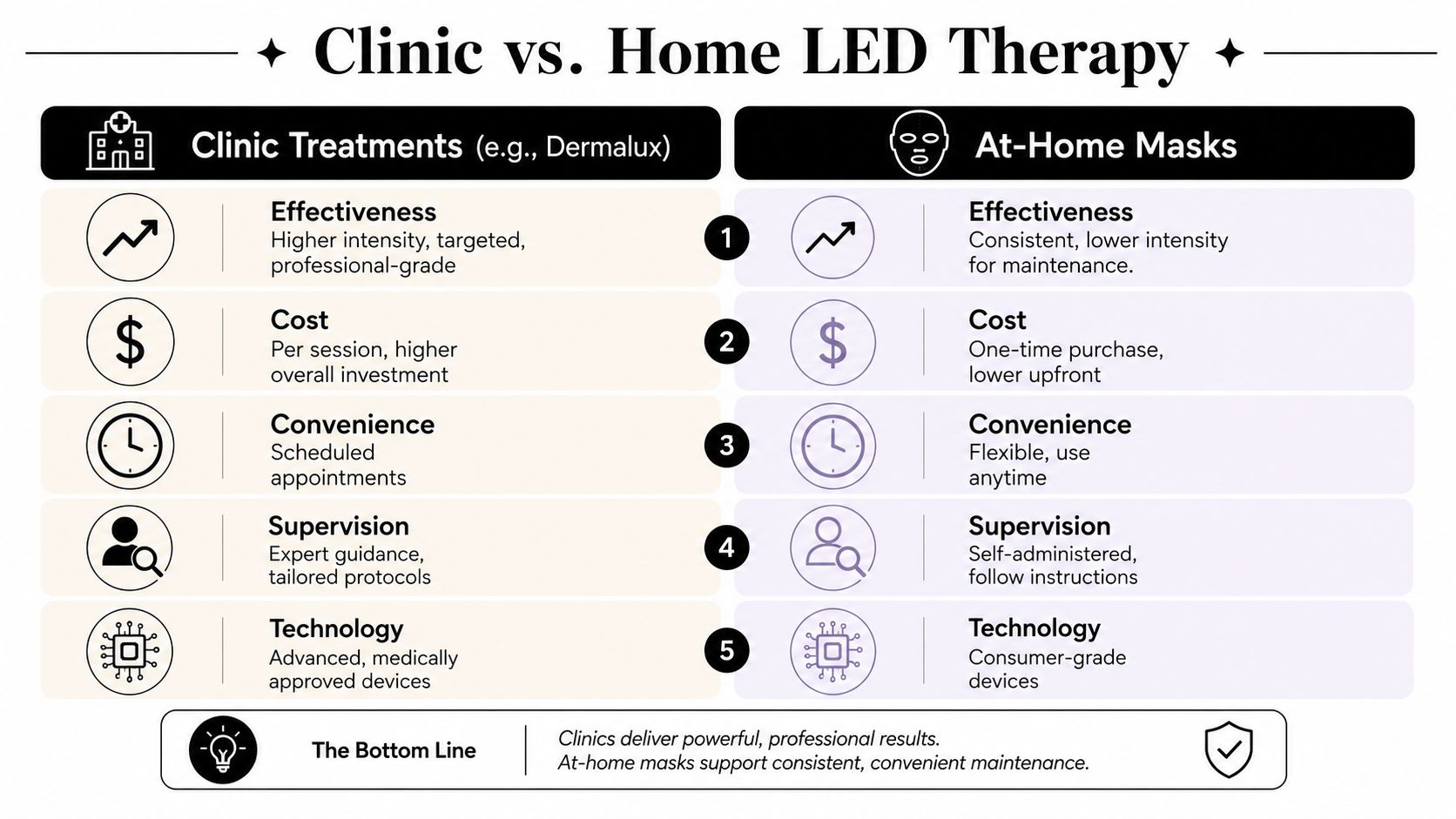
Professional systems such as Dermalux are designed for clinical use. They aim for tighter control over wavelength accuracy, treatment consistency, and power delivery. That doesn't mean every home mask is useless. It means the two categories serve different purposes.
What home devices can realistically do
Home-use LED devices make sense for people who want convenience and are willing to be consistent. You can use them on your own schedule, and for some users they can fit nicely into a maintenance routine.
The evidence we have supports a cautious view. A home-use study showed improvement in skin elasticity over 8 weeks, but broader expert guidance is more reserved. The American Academy of Dermatology notes that dermatologist-grade red light is more powerful, and Harvard Health says there are still no large studies showing LED devices are more effective than existing treatments, as summarised in this Harvard Health review of LED devices for skin.
That matters if you're deciding where to spend your money. A home mask may be reasonable for gentle upkeep. It's less convincing if you're hoping it will match a clinic protocol for active acne, significant inflammation, or more visible signs of ageing.
To make that comparison easier, this short video gives a useful visual sense of how LED treatments are positioned in practice.
When a clinic treatment makes more sense
A clinic treatment usually makes more sense in these situations:
- You want stronger guidance: A therapist can choose the right light mode and treatment plan for your concern.
- Your skin is reactive or complex: Acne, redness, post-procedure healing, and combination concerns often need a more customized approach.
- You don't want guesswork: Professional protocols reduce the trial-and-error that often comes with consumer devices.
- You need momentum: If your goal is visible improvement rather than casual maintenance, clinic-grade systems are better placed to deliver that.
Here's the practical summary. Home devices are often about convenience and consistency. Clinic systems are about precision and treatment strength. If you want a realistic expectation, think of home LED as supportive and clinic LED as corrective.
Is LED Light Therapy Safe For Everyone
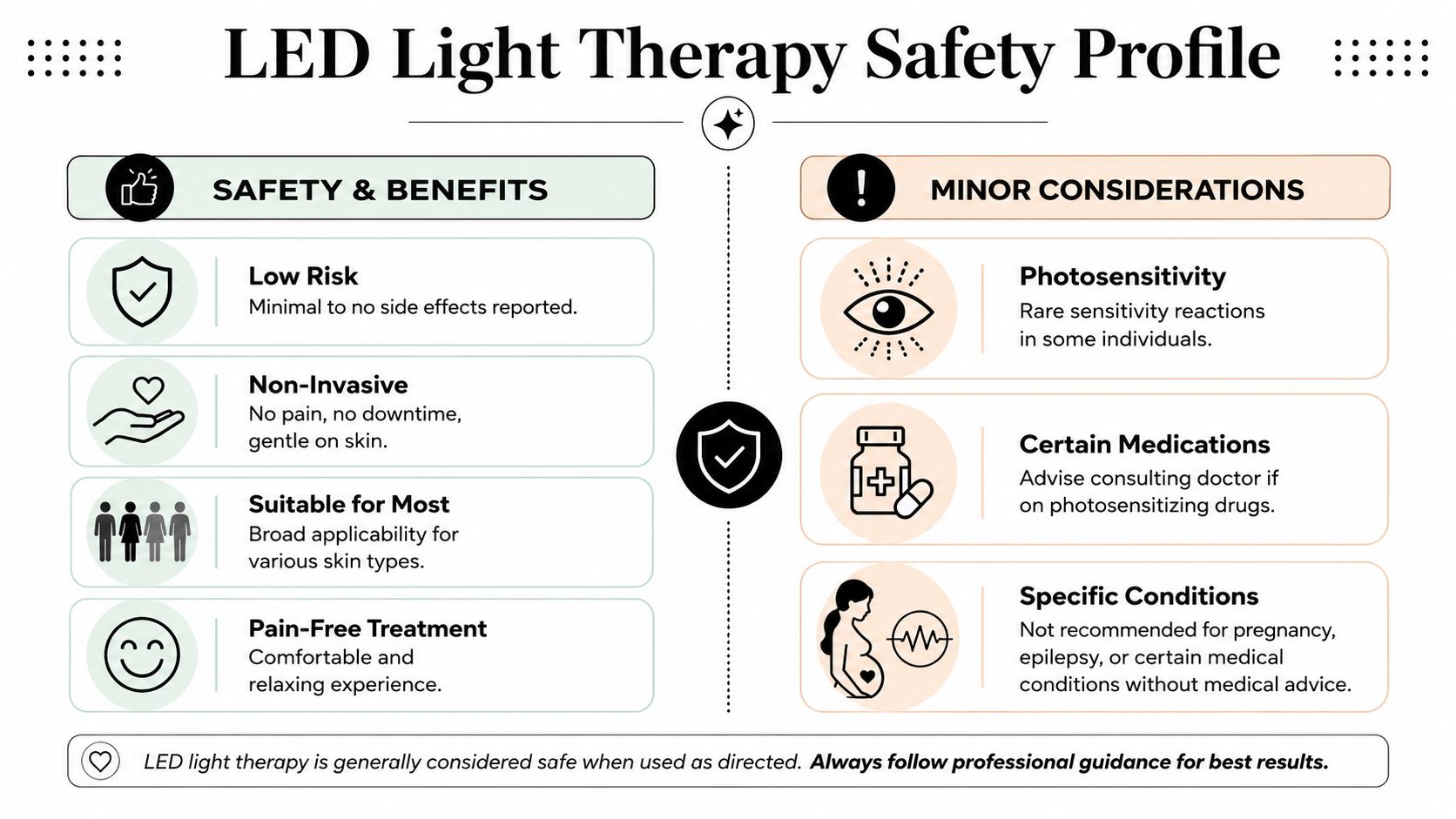
LED therapy has a strong safety reputation, and that's one reason it's become so popular in both aesthetics and dermatology. It's non-invasive, there's usually little to no downtime, and treatments are generally comfortable.
Why LED has a strong safety profile
The key reason LED is considered gentle is that it doesn't work like UV tanning light and it doesn't rely on deliberate injury to trigger change. According to the verified data provided for this article, LED is non-ionising and does not cause cancer or DNA damage, unlike UV exposure.
That's reassuring for anyone nervous about the word “light” in a treatment setting. Many clients expect heat, peeling, or irritation. LED doesn't usually behave like that. Clients often experience very little sensation while lying under the device during a session.
Most clients describe LED as one of the easiest treatments to tolerate because it doesn't ask the skin to recover from trauma.
Who needs extra caution
Safe for many doesn't mean suitable for everyone. Proper screening is therefore essential.
The American Academy of Dermatology advises that red-light therapy can interact with medications that increase light sensitivity. WebMD also notes that people with darker skin tones may be more sensitive to light and can develop dark spots after sessions if treatment isn't managed carefully, as explained in this AAD guidance on red-light therapy safety.
You should pause and ask for professional advice if any of these apply:
- You take photosensitising medication: Some antibiotics, acne medications, and other prescriptions can increase sensitivity to light.
- You have a history of pigment changes: This matters particularly if your skin is prone to post-inflammatory dark marks.
- You have an eye condition or light sensitivity issue: Eye protection and treatment choice may need adjusting.
- You're treating facial redness or sensitivity: If that sounds familiar, professional assessment is sensible before starting, especially if your concern overlaps with conditions discussed in options such as rosacea laser treatment.
A consultation should always cover your medical history, current skincare, medication use, and skin response patterns. That step isn't admin. It's part of making LED safe and useful for you.
Your LED Journey at 3D Aesthetics Leamington Spa
Once you understand what LED can and can't do, the next question is usually practical. What does a professional treatment journey look like, and how do you decide if it fits your skin goals?
What a professional treatment plan looks like
At 3D Aesthetics Leamington Spa's Dermalux LED therapy page, the treatment is presented as part of a clinical, non-surgical skin offering rather than a standalone beauty gimmick. That distinction matters. Professional LED works best when it's chosen for a clear reason, such as acne support, calming irritation, or helping skin recover after other procedures.
A typical clinic journey starts with consultation. Your therapist looks at what you want to improve, what your skin has been doing recently, what products you use, and whether there are any contraindications. From there, the light mode and treatment schedule can be matched to the concern rather than guessed.
Some people only need LED as a supportive treatment. Others use it alongside facials, acne management, or recovery-focused skin plans. The treatment itself is straightforward. You lie comfortably while the device is positioned over the area, and the session is usually relaxing.
What to expect from your appointments
Results with LED tend to reward consistency. That's true in clinic and at home, although clinic systems usually aim to achieve more per session because of the difference in device capability discussed earlier.
You shouldn't expect your skin to look dramatically different after one appointment unless the main benefit is calming and comfort. For acne and rejuvenation, changes usually build gradually. That's why a therapist will normally frame LED as a course-based treatment or part of ongoing maintenance.
If you're researching clinics, it also helps to choose providers who explain treatments clearly online and make their process easy to understand. For anyone interested in how clinics improve that visibility, this guide to local SEO for medical practices gives useful context on how people find reputable treatment providers in their area.
The best LED plan is the one that matches your skin concern, your timeline, and your willingness to stay consistent.
The simplest takeaway is this. LED light therapy is a credible, evidence-backed treatment, but the device, protocol, and supervision make a real difference. If you want convenience, a home device may support maintenance. If you want a more targeted plan with realistic oversight, professional treatment is usually the better route.
If you're considering LED light therapy and want advice based on your skin rather than a generic sales pitch, book a consultation with 3D Aesthetics Leamington Spa. You'll get clear guidance on whether professional LED is the right fit, what results are realistic, and how it can work within a broader treatment plan.
← Back to Home