

You catch your reflection in the bathroom mirror, tilt your face towards the light, and there they are again. The pores across your nose, cheeks, or forehead seem more obvious than they did last month. You've probably already tried the usual advice: clay masks, pore strips, salicylic acid cleansers, maybe a retinol that promised “refined texture”. Sometimes those steps help a little. Often, they don't help enough.
That frustration is understandable. Pores are normal skin structures, not flaws. They're small openings in the skin connected to hair follicles and oil glands, and they play an important role in keeping skin functioning properly. The problem isn't having pores. The issue is when they become more visible, stretched, congested, or shadowed by oil and uneven texture.
Many individuals looking for the best treatment for enlarged pores aren't starting from zero. They're usually at the point where home care has plateaued. That's where clearer guidance matters. A good pore treatment plan depends on why your pores look enlarged in the first place, how much change you want, and whether you're willing to move beyond products into clinical treatment.
A strong routine still matters, especially if you want any treatment result to last. If you need a refresher on why consistency changes skin over time, this guide on why a skincare routine matters is a useful starting point.
Table of Contents
- Introduction Why We Obsess Over Our Pores
- The Root Causes of Enlarged Pores
- Effective At-Home Skincare Regimens
- A Guide to Advanced Clinical Treatments
- How to Choose the Right Pore Treatment for You
- Your Treatment Journey and Essential Aftercare
- Frequently Asked Questions and Your Next Steps
Introduction Why We Obsess Over Our Pores
Pores attract attention because they sit in the centre of the face, exactly where light hits first. A bit of oil, some congestion, or early collagen loss can make them suddenly look more noticeable in photos and magnifying mirrors. That can feel disproportionate to the issue itself, but it's very common. People often describe enlarged pores as making skin look rough, shiny, tired, or older, even when the skin is otherwise healthy.
The difficult part is that pore advice online tends to flatten everything into one category. It treats all enlarged pores as if they respond the same way to the same serum. They don't. A pore that looks larger because it's packed with oil needs a different approach from a pore that's widened because surrounding collagen has weakened.
That's also why some skincare gives only mild improvement. If the root problem sits deeper in the skin structure, topical products can maintain the surface but won't fully tighten the opening.
Enlarged pores usually improve most when the treatment matches the cause, not when the product has the loudest marketing.
For many people, the best treatment for enlarged pores isn't one single product or one single machine. It's a plan. Sometimes that plan starts at home. Sometimes it moves into non-surgical clinical treatment, especially when the issue is stubborn texture, oil gland activity, or skin laxity.
The Root Causes of Enlarged Pores
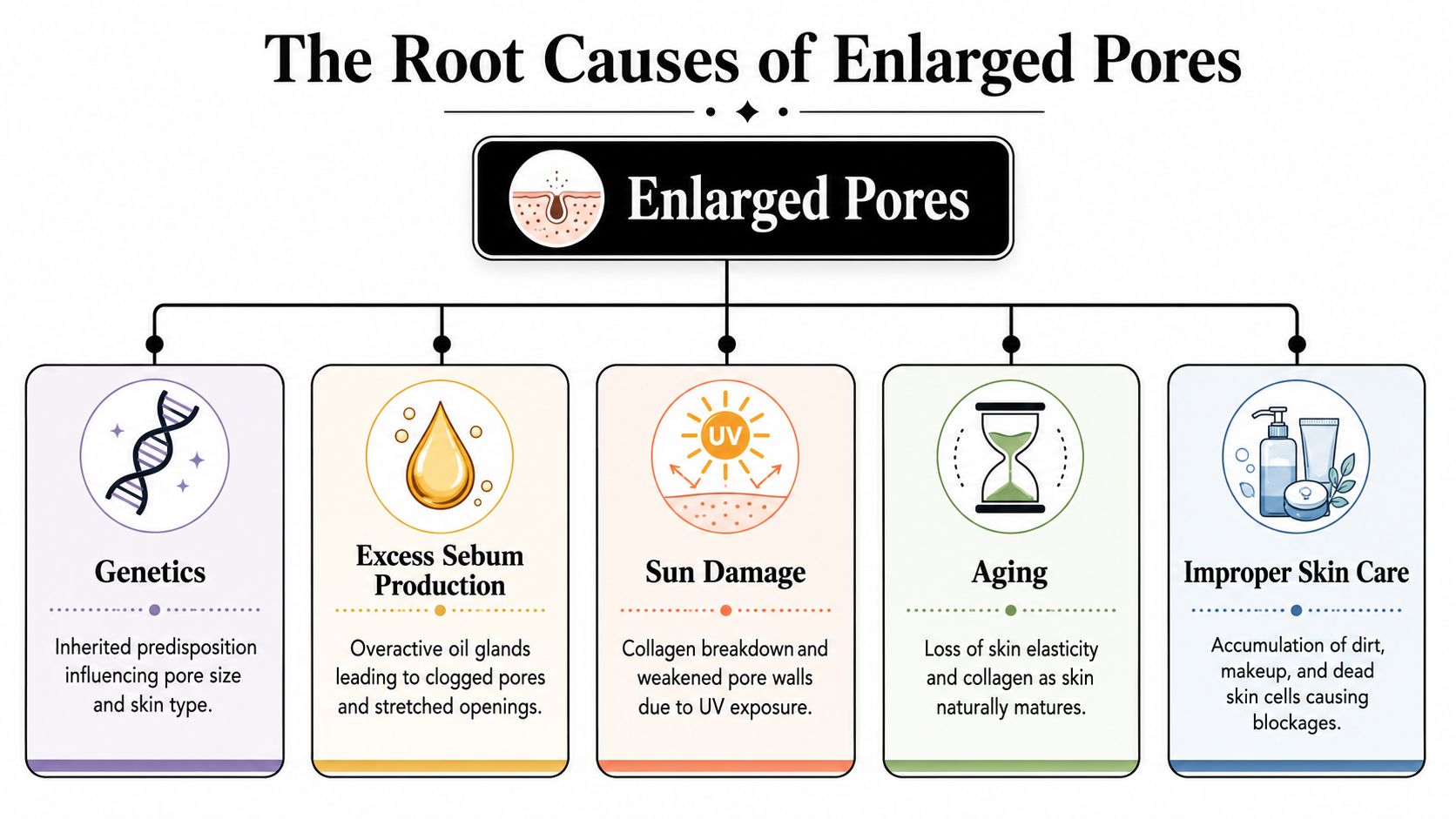
Not all enlarged pores come from poor skincare. In clinic, that's one of the first misunderstandings to clear up. You can cleanse properly, use active ingredients, and still have visible pores because several different mechanisms affect how they look.
Why pore size is partly written into your skin
Some people are more prone to visible pores. Genetics influence skin type, oil activity, and the baseline size of pore openings. If one or both parents had oily skin and noticeable pores around the T-zone or cheeks, there's a fair chance you'll see a similar pattern.
That doesn't mean nothing can improve. It means your treatment goals should be realistic. You're not trying to erase pores. You're trying to make them look tighter, cleaner, and less obvious.
Improper skin care can also make the problem look worse. Heavy products, inconsistent cleansing, sleeping in makeup, and over-exfoliating can all leave pores either clogged or irritated. Both situations increase visibility. A congested pore casts more shadow. An irritated skin barrier often produces more oil and reacts badly to strong treatments.
For people who want to support their skin from the inside as well as the outside, these wellness insights for healthy skin add helpful context around food choices that support overall skin health.
What stretches a pore over time
The second major driver is excess sebum production. Oil itself doesn't create a pore, but when sebaceous glands are active, pores can look fuller and wider. Add dead skin cells into the mix and the opening becomes more visible, especially on the nose and inner cheeks.
Then there's ageing. As skin matures, collagen and elastin support begin to decline. The wall around each pore becomes less firm, so the opening doesn't hold its shape as tightly. These pores often look elongated or slightly drooped rather than merely blocked.
Sun damage accelerates that process. UV exposure contributes to breakdown in the structural fibres that keep skin resilient. Over time, pores can appear looser, especially if the skin has also become rough or uneven in texture.
A simple way to think about it is this:
| Cause | What happens in skin | How pores tend to look |
|---|---|---|
| Genetics | Natural skin type and pore structure | Consistently visible, often from a younger age |
| Excess oil | Sebum and debris fill the pore | Larger, shinier, more congested |
| Ageing | Collagen support weakens | Wider, stretched, sometimes oval |
| Sun damage | Structural support breaks down further | Rough texture with more obvious pore edges |
| Improper skincare | Build-up or barrier irritation | Clogged, inflamed, or persistently visible |
Effective At-Home Skincare Regimens
Home care still has a place. It's often the right starting point if your pores are mild to moderate, mainly linked to oil, blackheads, or surface texture. It's also essential maintenance after professional treatment. What it won't do, in most cases, is produce major structural tightening if collagen loss is the underlying cause.
What home care can do well
Salicylic acid (BHA) is useful when pores look fuller because they're congested. It's oil-soluble, so it works inside the pore lining rather than only on the skin surface. That makes it a sensible choice for blackheads, shine, and roughness around the nose and forehead.
Retinoids help by increasing skin cell turnover and supporting a smoother surface over time. They're often helpful when pores sit alongside uneven texture, post-acne changes, or early signs of ageing. The drawback is tolerance. Many people use them too often, too quickly, then end up red, flaky, and more aware of their skin than before.
Niacinamide is a good supporting ingredient when your skin is oily but reactive. It's often easier to tolerate than stronger acids or retinoids and fits well into a routine focused on balancing the skin rather than stripping it. If you want a consumer-friendly breakdown, Healtsy's guide to niacinamide explains why it remains such a practical option.
Vitamin C is the at-home ingredient with the clearest cited data in this article. A 2022 clinical study found that a topical vitamin C formulation significantly improved the appearance of enlarged pores by stimulating collagen production, with visual pore size reduced by up to 15 to 20% over 8 to 12 weeks in treated participants, according to Medical News Today's summary of the study.
Practical rule: If a product stings, peels, and leaves your skin shiny-red, that isn't proof it's working. For pores, a calmer routine usually performs better over time.
A routine that makes sense in real life
A sensible pore-focused routine often looks like this:
- Morning cleanse lightly: Use a gentle cleanser, not something that leaves skin squeaky.
- Add one balancing step: Niacinamide or vitamin C can fit here, depending on your skin goals.
- Protect daily: Sunscreen matters because UV exposure worsens structural change.
- Use BHA a few times weekly: Enough to clear congestion, not so often that skin becomes irritated.
- Introduce retinoids slowly: Start with fewer applications and build only if skin tolerates it.
If you're trying to improve both pores and rough texture, this guide on how to improve skin texture helps connect those concerns in a more practical routine.
The key trade-off is simple. Home care is accessible, lower commitment, and worth doing. But if you've been consistent and the pores still look stretched, age-related, or unchanged, products may be maintaining the problem rather than transforming it.
A Guide to Advanced Clinical Treatments
When topical skincare stops delivering, clinical treatment becomes the serious option. The focus then moves from “keeping pores clear” to changing the structure around them. For stubborn enlarged pores, especially on the cheeks, non-surgical treatments that stimulate collagen or target sebaceous activity usually outperform routine skincare.
Here's the broad comparison first.
Quick comparison of the main options
| Treatment | How it works | Best suited to | Sessions | Downtime | Cost range |
|---|---|---|---|---|---|
| RF microneedling | Creates controlled micro-injury while delivering heat into the skin | Enlarged pores, texture, mild laxity, acne-marked skin | A course is commonly advised | Usually mild to moderate | Varies by device, area, and provider |
| Fractional CO2 resurfacing | Resurfaces skin while driving collagen remodelling | More advanced texture change, sun damage, acne scarring | Often fewer sessions than gentler options | More noticeable recovery | Usually higher than gentler treatments |
| HIFU | Uses focused ultrasound at depth to tighten tissue | Pores linked to laxity rather than congestion | Depends on assessment | Usually minimal surface downtime | Varies by area and treatment depth |
| Chemical peels | Exfoliate and renew the surface layers | Mild congestion and dull texture | Usually repeated | Usually low to mild | Often lower entry cost |
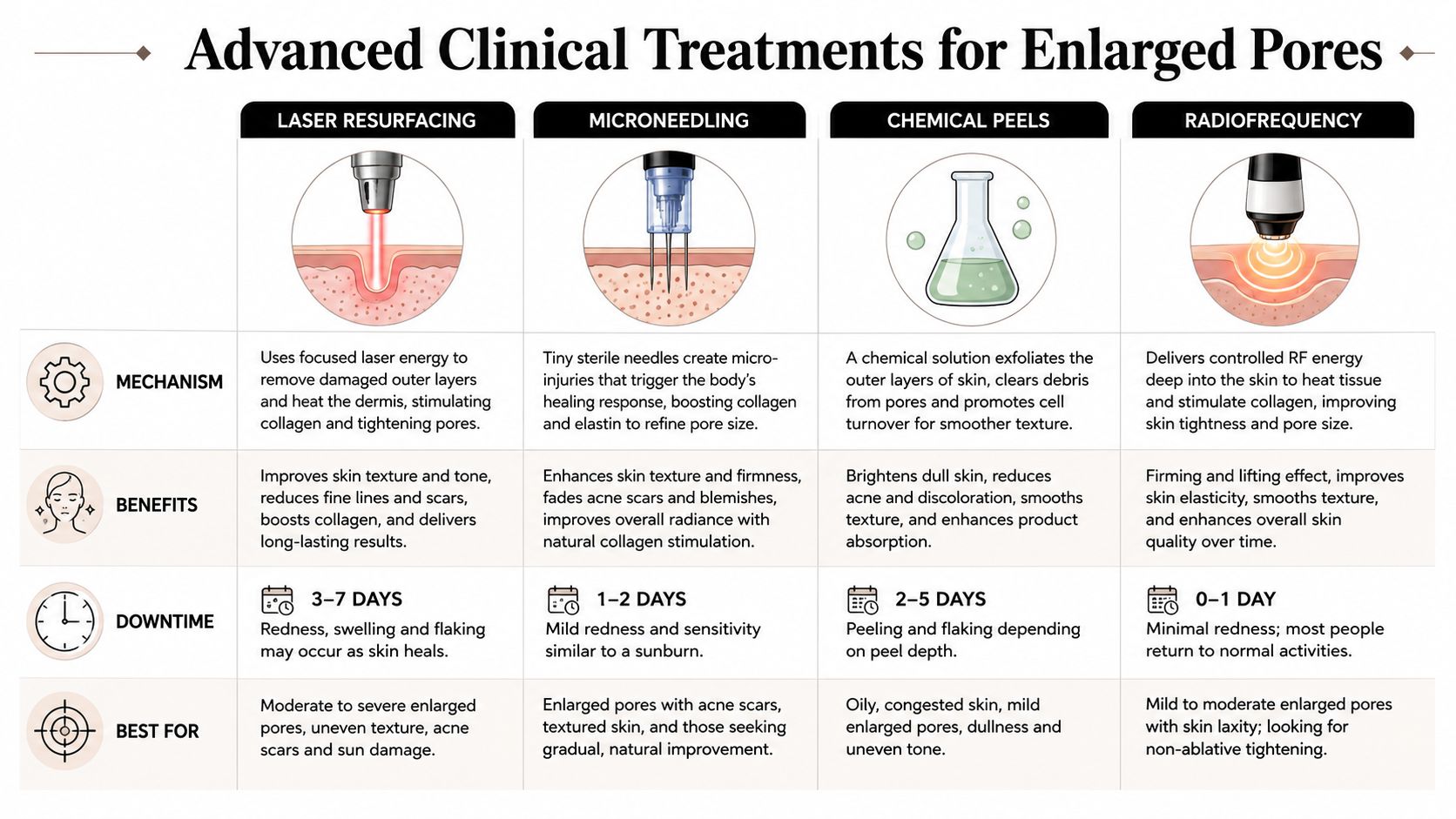
A visual summary can help if you're weighing the options side by side.
Radiofrequency microneedling
For many adults asking about the best treatment for enlarged pores, radiofrequency microneedling is the strongest non-surgical middle ground between skincare and more aggressive resurfacing. It uses fine needles to create controlled channels in the skin while radiofrequency energy heats the deeper layers. That combination encourages collagen remodelling and can also help reduce the influence of enlarged sebaceous glands.
Clinical benchmark data shows that combination therapies involving radiofrequency microneedling can reduce pore area by 20 to 30% over 3 to 4 sessions, according to the 2024 review indexed on PubMed. The same review notes that these approaches offer structural change that topical agents don't typically provide.
In practical terms, this suits people whose pores are visible across the cheeks, paired with rough texture, post-acne irregularity, or early skin laxity. Downtime is usually manageable compared with ablative laser resurfacing, but it's still a treatment, not a facial. Expect transient redness, sensitivity, and a short healing window.
If you're considering this route specifically, the clinic page for 3D microneedling treatments outlines how this category of treatment is used for texture and pore concerns.
A useful walkthrough of device-based skin rejuvenation is below.
Fractional CO2 resurfacing
Fractional CO2 resurfacing sits further up the intensity scale. It works by creating controlled columns of injury in the skin, prompting a stronger resurfacing and remodelling response. This makes it more relevant when enlarged pores are only one part of the picture and the bigger complaint is significant texture irregularity, acne scarring, or photodamage.
The trade-off is downtime. You need to be realistic about redness, recovery, and aftercare. It can produce more noticeable change than lighter treatments, but it demands more commitment and won't suit every skin type, schedule, or tolerance level.
If your pores bother you mainly because the surrounding skin looks rough, scarred, or sun-damaged, resurfacing may be more logical than chasing another serum.
HIFU for laxity-driven pores
HIFU isn't the first thing many people associate with pores, but it can be a valuable option when pore visibility is being driven by loss of firmness rather than congestion. Focused ultrasound reaches deeper structural layers and encourages tightening without disrupting the skin surface in the same way as resurfacing treatments.
Recent UK clinical data indicates that non-invasive devices such as HIFU and RF microneedling can achieve a 30 to 40% permanent pore size reduction by stimulating deep collagen. This contradicts many consumer guides, which often frame pores as purely a skincare issue, despite significant improvements stemming from collagen-focused clinical work.
HIFU is usually a better fit for someone whose pores have become more apparent with age, especially if they've noticed skin loosening around the mid-face. It's less useful for heavily congested pores full of oil and debris. In those cases, you need a different strategy.
How to Choose the Right Pore Treatment for You
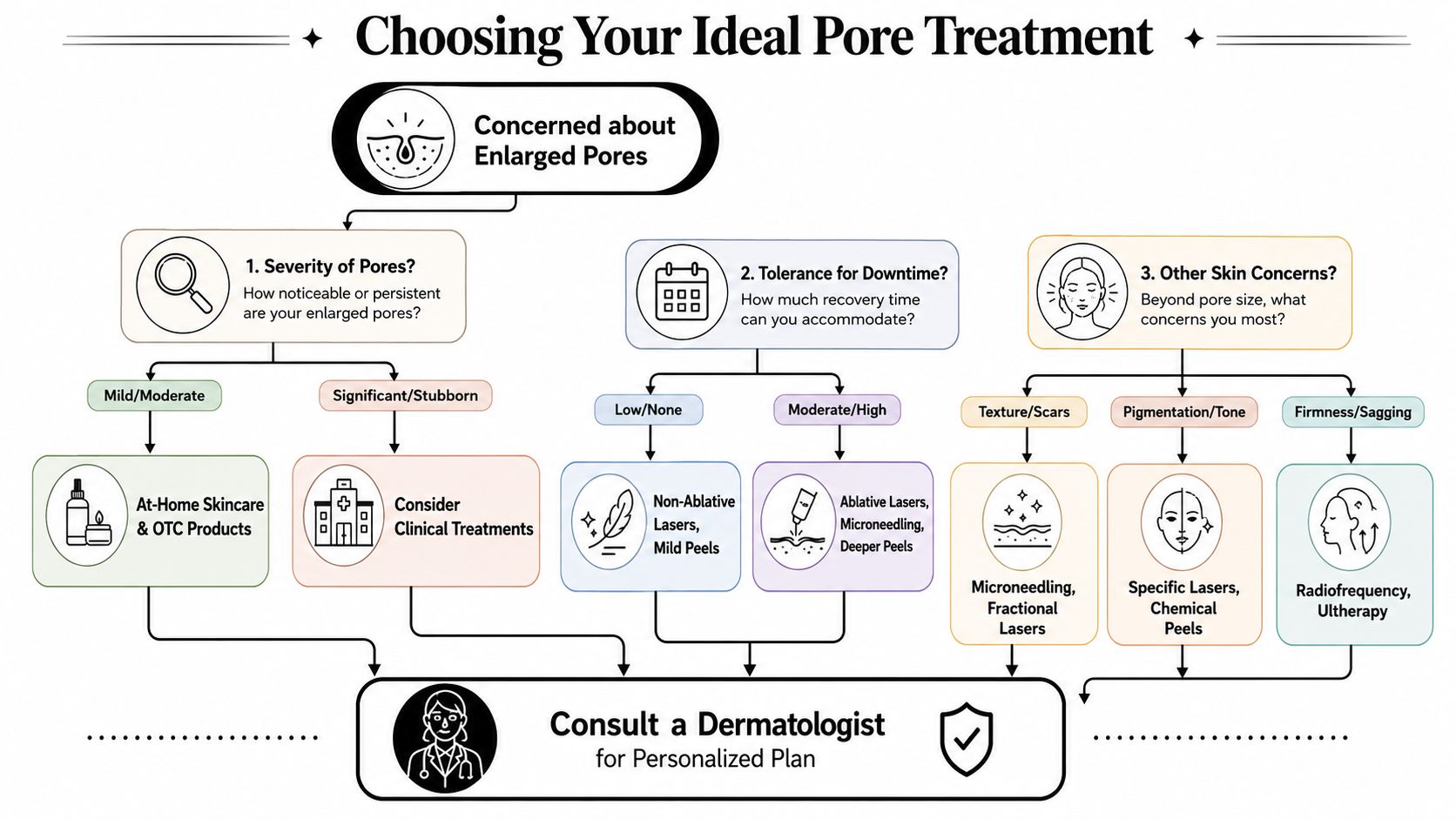
The right plan depends less on the word “pores” and more on the pattern behind them. Two people can both say they want smaller-looking pores and need completely different treatments.
If your pores are oily and congested
If your primary concern is shine, blackheads, and clogged pores, and your priority is lower cost with minimal disruption, start with at-home care or lighter clinic support. That usually means a disciplined routine with BHA, sensible cleansing, sunscreen, and possibly niacinamide or a retinoid if your skin tolerates it.
This route is sensible when the pores are most obvious on the nose and central forehead and when they look “full” rather than loose. It's also a good starting point if you're younger and haven't yet tried a structured routine consistently.
What usually doesn't help here is hopping between harsh products. Scrubs, pore strips, and aggressive acids can make skin look temporarily cleaner while irritating the barrier and increasing oil rebound.
If your pores look stretched or oval
If your primary concern is pores across the cheeks that look stretched, elongated, or more visible with age, and your priority is visible change, collagen-stimulating treatment usually makes more sense than another topical product.
RF microneedling and HIFU are pertinent here. Recent UK clinical data shows that RF microneedling devices such as 3D Dermaforce can achieve a 30 to 40% permanent pore size reduction by stimulating deep collagen. That makes them a strong non-laser option for people who've already done the skincare part and need structural improvement.
A common mistake is assuming all visible pores are blocked pores. They're not. If the opening has widened because surrounding support has weakened, exfoliation alone won't fully solve it.
If you want change without much downtime
If your priority is improvement with a manageable recovery period, RF microneedling often offers the best balance. It addresses texture and pore appearance more meaningfully than standard home care, but usually without the level of downtime associated with stronger resurfacing options.
If you're willing to accept more recovery in exchange for stronger resurfacing, fractional CO2 may be more appropriate, especially if acne scarring or pronounced texture are part of the concern.
A simple way to decide is to ask these questions:
- What bothers you most: Oiliness, rough texture, scarring, or looseness?
- How long have you already tried skincare: Weeks is different from many months of consistency.
- How much downtime can you realistically manage: A weekend, several days, or longer?
- Do you want maintenance or correction: Those are different goals.
The best treatment for enlarged pores is the one that matches the biology of your skin, not the one most often recommended on social media.
Your Treatment Journey and Essential Aftercare
Clinical treatment works best when the process is handled properly from consultation through recovery. The treatment itself matters, but the assessment and aftercare often determine how smooth the journey feels and how well the skin responds.
What happens before treatment
A proper consultation should look at more than the pore itself. Skin type, oil production, texture, redness, acne history, sensitivity, pigment risk, current skincare, sun exposure habits, and any tendency to scar all influence what's appropriate.
Before treatment, clients are usually advised to simplify their routine. That often means pausing irritating actives for a short period if the practitioner recommends it, avoiding over-exfoliation, and arriving with the skin calm rather than inflamed. The exact instructions vary with the treatment chosen, which is why generic online advice often falls short.
During the procedure, expectations should be clear. Some treatments feel warm. Some create more noticeable heat or prickling. Some involve visible redness immediately afterwards. None of that should be a surprise if the consultation has been done properly.
What helps skin heal well afterwards
Aftercare is where many people either protect their investment or unwittingly reverse part of it. Freshly treated skin needs support, not experimentation.
The basics are straightforward:
- Keep cleansing gentle: Use a non-stripping cleanser and lukewarm water.
- Hydrate the barrier: Stick to bland, soothing moisturisers if your practitioner advises them.
- Avoid active overload: Don't rush back into acids, scrubs, or retinoids before the skin is ready.
- Take sun protection seriously: UV exposure can interfere with healing and compromise results.
- Leave the skin alone: Picking, squeezing, or rubbing prolongs inflammation.
Healing also doesn't always look dramatic. Sometimes the early stage is a little redness, tightness, or dryness. Sometimes improvement in pores comes gradually as collagen remodelling develops over time.
The safest mindset is to treat post-procedure skin like healing skin, not like skin that needs more correction.
Frequently Asked Questions and Your Next Steps
Can you permanently shrink your pores
You can't remove pores, and no ethical practitioner should suggest otherwise. What you can do is reduce how visible they look. The most lasting improvement tends to come from treatments that change oil gland activity or rebuild support around the pore, rather than just exfoliating the surface.
Are clinical treatment results permanent
Some improvement can be long lasting, especially when treatment stimulates deeper collagen. But skin continues to age, produce oil, and respond to sun exposure and lifestyle. In practice, results are best thought of as durable but still influenced by maintenance and ongoing skin behaviour.
Does diet and lifestyle really affect enlarged pores
Yes, sometimes more than people expect. A 2022 UK study found that 45% of adults with enlarged pores reported worsening symptoms after consuming high-fat and sugary diets. This sits alongside wider lifestyle factors such as pollution exposure in urban areas, which can contribute to collagen breakdown and make pores look more obvious. That combination is one reason standard skincare advice can feel incomplete.
When should you stop trying products and book a consultation
If you've been consistent with skincare and your pores still look stretched, age-related, or unchanged, it's time for a professional assessment. The same applies if your pores are tied to acne scarring, texture changes, or skin laxity. Those concerns usually need a treatment plan, not another product swap.
If enlarged pores are affecting your confidence and home care has taken you as far as it can, a personalised consultation is the sensible next step. 3D Aesthetics Leamington Spa offers in-depth consultations with full assessment of skin concerns, helping you understand whether your pore visibility is driven by congestion, texture change, or loss of firmness, and which non-surgical treatment path fits your skin, lifestyle, and goals.