

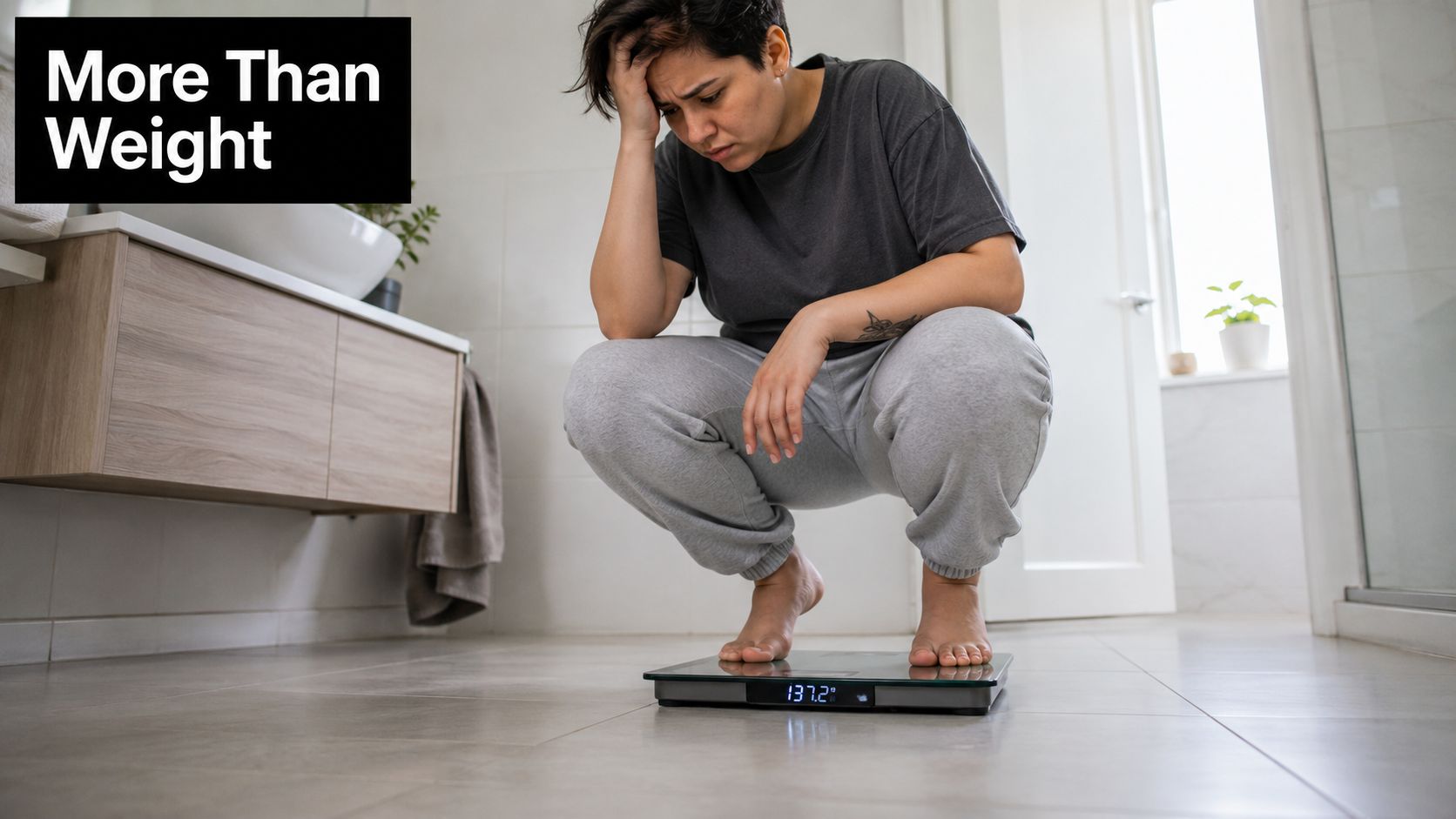
You've probably had this moment already. You've eaten better, moved more, maybe even watched your portions carefully, then stepped on the scale and felt deflated because the number barely changed. Or it changed, but your clothes still don't fit the way you expected.
In clinic, that's one of the most common frustrations I hear. The problem usually isn't effort. It's measurement. A scale tells you how heavy you are. It doesn't tell you what that weight is made of, where fat is being stored, or whether your current body profile matches your health goals and body-contouring goals.
That's where body composition analysis becomes useful. It turns a vague number into a practical picture. Instead of asking, “How much do I weigh?” we ask better questions. How much of that weight is fat mass? How much is lean mass? Is fat sitting just under the skin, or deeper around the organs? Are you holding your shape evenly, or are there patterns that explain stubborn areas?
Table of Contents
- Why Your Bathroom Scale Does Not Tell the Whole Story
- What Is Body Composition Analysis
- Common Methods for Measuring Body Composition
- How to Interpret Your Body Composition Results
- From Data to Action How Results Inform Your Treatment Plan
- Your 3D Body Scan Journey at 3D Aesthetics Leamington Spa
Why Your Bathroom Scale Does Not Tell the Whole Story
A bathroom scale only measures total body weight. It can't separate fat, muscle, bone, and water. That means two people can weigh exactly the same, wear the same clothes size, and still have very different body shapes, health risks, and treatment needs.
BMI has the same limitation. It uses height and weight, but it doesn't tell us whether weight is coming from lean tissue or fat, and it doesn't show where fat is distributed. In body contouring, that distinction matters because stubborn lower abdominal fat, flank fullness, and visceral fat are not the same issue.
A useful UK benchmark comes from a landmark 2018 UK study. It found that body composition analysis was 3.5 times more accurate at predicting metabolic risk than BMI, and that people with a “normal” BMI but high visceral fat had a 34% increased risk of cardiovascular events. That work helped drive NICE toward recommending body composition metrics as a primary screening tool.
Why the same weight can mean different things
Think about two clients who both say, “I only want to lose a stone's worth of look, not necessarily a stone on the scale.” One may carry more lean mass and only have a few localised fat pockets. The other may have less muscle support and a higher fat proportion overall.
The scale treats them as similar. Clinically, they're not similar at all.
A body scan helps answer questions like:
- Is the issue overall fat mass or localised stubborn fat?
- Is muscle low enough that body shape looks soft even without major weight gain?
- Could hidden fat distribution be affecting health as well as appearance?
- Will inch loss be a better target than weight loss?
Practical rule: If your shape, clothes fit, and mirror don't match the scale, the scale is missing part of the story.
Why this matters for treatment choices
Clients often assume a disappointing scale result means nothing is working. Sometimes the opposite is true. You may be improving body shape while holding steady in weight because your proportions are changing.
That's why I don't treat the number on the scale as the final answer. I treat it as one data point. Body composition analysis gives context, and that context is what lets us build a plan that matches your actual body rather than a rough estimate.
What Is Body Composition Analysis
Body composition analysis is a way of breaking total body weight into its main parts. Instead of one lump sum, you get a more useful breakdown of what your body is carrying.
The easiest way to think about it is like a business balance sheet. Total weight is the headline figure. Body composition is the detailed accounting behind it. Once you can see the breakdown, you can make better decisions.
The four main components
Many individuals are looking at some combination of these:
- Fat mass. This is all the fat tissue in the body. Some of it sits under the skin, which often affects visible shape. Some sits deeper, especially around the abdomen.
- Lean mass. This includes muscle and other fat-free tissues. In a body-contouring consultation, muscle matters because it influences shape, firmness, and metabolic demand.
- Bone mass. Bone isn't usually the focus for aesthetic change, but it's part of your total body composition picture.
- Body water. Hydration can affect how some body composition tools read your results, which is why preparation matters.
If you only look at total weight, all of those get merged into one number. That's why people can become confused. They might lose fat, gain a little muscle, and conclude they've made no progress because their weight didn't move much.
Why clients find this more helpful than weight alone
The main value is clarity. Body composition analysis helps separate these common scenarios:
- You're lighter, but still not happy with body shape. That can happen when weight drops without enough change in local fat pattern or muscle tone.
- You're the same weight, but look noticeably different. That often reflects improved fat-to-lean balance.
- You look slim in clothes, but still carry abdominal fullness. That may suggest a distribution issue rather than a simple weight issue.
Your goal usually isn't “weigh less” in the abstract. It's to change how your body is proportioned, feels, and looks.
What the report is really trying to show you
A good report doesn't just say whether you're above or below an arbitrary line. It helps answer practical questions:
- Where are you carrying the most visible fat?
- Is there enough lean tissue to support a firmer silhouette?
- Are your left and right sides broadly balanced?
- Does your plan need fat reduction, muscle support, skin tightening, or a combination?
That's why body composition analysis is useful in clinic. It turns vague concerns like “my stomach won't shift” or “I feel soft everywhere” into something we can interpret and act on.
Common Methods for Measuring Body Composition
Different tools measure body composition in different ways. Some are built for fast, practical use in clinic. Others are designed as reference standards. The right choice depends on what you're trying to learn, how often you want to track change, and how detailed the reading needs to be.
Why the method matters
If a client wants a quick view of body fat, lean mass, shape changes, and progress over time, a practical scan can be enough. If the priority is the highest clinical precision for compartment-level assessment, a more advanced imaging method may be more appropriate.
A DXA body composition reference point matters here because DXA is the clinical gold standard with less than 1% precision error, and it can quantify visceral adipose tissue, which is important because higher VAT levels correlate with a 2.4-fold higher risk of type 2 diabetes in UK adults. That's the benchmark other methods are often judged against.

Body Composition Analysis Methods Compared
| Method | How It Works | Accuracy | Pros | Cons |
|---|---|---|---|---|
| BIA | Sends a small electrical current through the body and estimates body composition from resistance patterns | Useful and accessible, but readings can shift with hydration and routine factors | Fast, non-invasive, convenient, suitable for repeat tracking | Less detailed than DXA, sensitive to preparation |
| DXA | Uses low-dose X-rays to separate fat, lean tissue, and bone | Clinical gold standard, with less than 1% precision error for fat mass | Detailed regional analysis, strong clinical benchmark | Less accessible for routine repeat use, clinical setting required |
| Hydrostatic weighing | Estimates body density through underwater measurement | Traditionally respected for density-based assessment | Can be informative in specialist settings | Inconvenient, not practical for most clients |
| Skinfold calipers | Measures pinched subcutaneous fat at selected sites | Depends heavily on operator skill | Low cost, portable | Limited view, less suitable for full body profile |
What we use in practice
In day-to-day aesthetic consultations, the method has to be clinically useful and realistic. That means it should be quick, comfortable, repeatable, and able to show trends over time.
That's why clinics often use BIA-based scanning systems alongside circumference and visual assessment. They help us translate data into a treatment discussion without sending every client for hospital-style imaging. If you're interested in how scan-based tools fit into body assessments more broadly, this AI posture analysis guide is a helpful companion read because posture and body shape often interact in ways clients don't expect.
For clients who want to understand how scan technology is used in an aesthetics setting, our guide to taking machine body measurements gives more context on how these readings support consultation decisions.
The best method isn't always the most complex one. It's the one that answers the right question reliably enough to guide your next step.
Here's the practical takeaway. DXA is the reference standard. BIA is often the practical workhorse for repeat tracking. Skinfolds can still have a place, but they're limited. For most non-surgical contouring clients, what matters most is using one sensible method consistently, with proper preparation, so progress can be interpreted properly.
How to Interpret Your Body Composition Results
The first time you look at a body composition report, it can feel more technical than it really is. Most clients don't need to memorise every figure. They need to know which numbers matter most for their goal and what those numbers mean in plain English.
A good consultation turns the report into a conversation. We're not staring at data for its own sake. We're using it to explain why your body is responding the way it is.
Start with this visual guide before looking at the finer detail.

The numbers most clients should focus on first
Body fat percentage tells you what proportion of your total weight is fat. This is often the number people jump to first, but it makes more sense when paired with other measures. A body fat percentage on its own doesn't show where fat is sitting.
Lean body mass gives you the other side of the picture. If lean mass is lower than expected, the body can look less defined even when weight isn't especially high. That's one reason some clients feel “soft” despite not being very heavy.
Visceral fat matters because it refers to deeper abdominal fat stored around internal organs. In clinic, we pay attention to this because it changes the conversation from cosmetic frustration alone to broader metabolic context.
This short video can help make those report categories easier to recognise when you see them on screen.
Where people often misread the report
A common mistake is assuming that one “good” result cancels out the rest. For example, someone may be pleased that their weight is not particularly high, but still have a body fat pattern that explains why they struggle with abdominal shape or feel uncomfortable in fitted clothing.
Another area that deserves attention is Fat Mass Index, or FMI. Unlike BMI, it adjusts fat mass for height, which makes it more useful for understanding body fatness without confusing it with frame size. The FMI guidance cited here notes that the NHS and British Dietetic Association favour FMI over BMI, and that a 1.0 unit increase in FMI correlates with a 12% increase in insulin resistance.
Clinical reading: If weight looks ordinary but FMI is climbing, that can signal a problem the scale has hidden.
You may also see Lean Mass Index, or LMI. This helps show whether you have enough lean tissue for strength, support, and a firmer overall shape. In aesthetic terms, low lean mass can explain why some clients need more than fat reduction alone.
Helpful questions to ask when reviewing your report are:
- What is my main issue? Overall fat, localised fat, low muscle support, or skin laxity?
- Are my concerns visible in the data? This reassures many clients that what they've noticed in the mirror is real and measurable.
- Which metric should I track most closely? Not everyone should focus on the same number.
- What change would count as meaningful progress for my goal? Sometimes that's shape, not weight.
Once you understand those points, the scan stops feeling like a sheet of numbers and starts functioning as a map.
From Data to Action How Results Inform Your Treatment Plan
A body scan is only useful if it changes what we do next. In a consultation, I'm not interested in collecting numbers and leaving them there. I want the scan to narrow the treatment choices so the plan fits the body in front of me.
Different scan patterns lead to different plans
Take a client whose scan and measurements suggest localised subcutaneous fat around the abdomen and flanks, with a reasonably stable lean mass profile. That person may be a sensible candidate for fat freezing because the problem is targeted fullness rather than a general lack of muscle tone.
A different client may show a softer silhouette with relatively low muscular support. In that case, treatments that stimulate muscle activity can make more sense as part of the plan, because reducing fat alone might not create the firmer outline they want.
Other patterns matter too:
- Stubborn pockets with good overall proportion might suit focused contouring options such as body HIFU or ultrasound cavitation.
- Visible dimpling or looser skin quality may point us toward radio frequency or shockwave support rather than fat reduction alone.
- A body profile with multiple concerns often needs sequencing, not a single treatment category.
If you're comparing modalities before a consultation, our page on non-surgical fat reduction treatments outlines the main categories clients usually ask about.
Why one treatment rarely suits everyone
People often go wrong when choosing from social media posts or generic advice. They pick the treatment they've heard of, rather than the treatment their body profile suggests.
One client's “stubborn belly fat” may be mainly pinchable subcutaneous fat. Another client uses the same phrase but has a different mix of abdominal fat pattern, lower muscle tone, and skin laxity. They shouldn't get identical recommendations.
At this stage, nutrition and lifestyle context still matter. Not because they replace treatment, but because they shape how well the body responds. If you're reviewing supplements as part of a broader plan, this guide to understanding ketone supplements and BHB is a useful background read for the questions clients often bring into clinic.
One clinic-based option used for this kind of planning is 3D Aesthetics Leamington Spa, where a consultation includes a scan to help match findings with treatments such as cryolipolysis, ultrasound cavitation, 3D Powersculpt, body HIFU, shockwave, or radio frequency based on the client's pattern rather than guesswork.
A scan doesn't replace clinical judgement. It sharpens it.
The most effective plans are usually the ones that admit something simple. Body shape concerns are often mixed concerns. Fat, muscle, and skin don't change in the same way or at the same speed. The scan helps us decide what to treat first, what to combine, and what progress should realistically look like.
Your 3D Body Scan Journey at 3D Aesthetics Leamington Spa
Most clients are relieved by how straightforward the process is. There's no invasive test, no discomfort, and no need to guess what the machine is doing. The purpose is simple. Create a baseline, review the findings with you, and connect those findings to your personal goals.

What happens on the day
You'll be guided through a quick preparation process so the reading is as consistent as possible. Comfortable, close-fitting clothing is usually the easiest option because bulky layers can interfere with shape capture.
The scan itself is fast and non-invasive. It records body shape and measurement data, then presents a report that can be discussed straight away. If you want to see how the service fits into the wider consultation pathway, the clinic's 3D body scanning information page shows what the appointment is designed to capture.
During the review, a therapist will connect the report back to what brought you in. That might be lower abdominal fullness, love handles, cellulite, post-weight-loss softness, or a general sense that your body shape has changed and you're not sure why.
How your scan becomes your baseline
The baseline matters because progress is easier to trust when you can see it. Clients often notice changes in fit, firmness, and silhouette before they notice a dramatic change on the scale.
That's why repeat scanning is helpful. It lets us compare your current picture with your starting point rather than relying on memory. You're not left wondering whether things are changing. You can track them in a more structured way.
A strong consultation should leave you with three things:
- Clear understanding of what the scan is showing
- Realistic next steps based on your priorities
- A way to measure progress that isn't tied only to body weight
That's the value of body composition analysis in a clinic setting. It turns uncertainty into a plan.
If you'd like a clearer picture of what your weight, shape, and stubborn areas are really telling you, book a consultation with 3D Aesthetics Leamington Spa. A body scan can help turn vague frustration into practical next steps, whether your goal is inch loss, firmer definition, or a more personalised non-surgical treatment plan.