
You've lost the weight, your clothes fit differently and your health may have changed, but the mirror still shows a lower abdomen, upper arms or thighs that don't look as firm as you expected. That can feel discouraging, particularly when diet and exercise have taken real effort. Loose skin after weight loss isn't a sign that you've done anything wrong.
At our clinic in Leamington Spa, the first question is always anatomical: are we looking at residual fat, redundant skin, or a combination of both? The answer determines whether non-surgical body contouring is realistic, or whether we should advise a surgical assessment instead. Results vary from person to person, so our role is to set out what each option can and can't do before you commit.
Table of Contents
- Why does skin not always shrink after major weight loss?
- When is the right time to start body contouring?
- Surgical removal versus non-surgical skin tightening
- Which non-surgical treatments target residual fat and laxity?
- How does a 3D body scan personalise your treatment plan?
- Does contouring help you maintain your weight loss long-term?
- What are the most common questions about post-weight-loss care?
Why does skin not always shrink after major weight loss?
Skin doesn't always retract after major weight loss because rapid or substantial weight reduction can stretch it beyond its ability to recoil fully. UK NHS bariatric guidance explains that loose or redundant skin commonly affects the abdomen, breasts, arms, thighs, hips and limbs after surgery, while diet and exercise may improve muscle tone and appearance but can't completely remove established excess skin. Read the NHS guidance from the Bristol Weight Management and Bariatric Service for the clinical distinction between weight loss and residual skin.
The speed and scale of weight reduction matter. The same NHS source reports average excess-weight loss after one year of approximately 40% for gastric banding, 50% for sleeve gastrectomy and 70% for gastric bypass. Large-volume reduction can leave skin with less structural support and limited ability to follow the new body shape.
Fat and redundant skin are different tissues
Residual subcutaneous fat is soft tissue beneath the skin. Redundant skin is tissue that hangs, folds or gathers because it no longer contracts adequately. A treatment that reduces fat volume can sometimes improve the outline beneath the skin, but it won't excise a hanging abdominal apron or recreate substantial recoil.
That distinction is central to body contouring after weight loss. Body contouring addresses shape after weight has changed, whereas weight-loss treatment addresses body mass itself. Our article about excess skin after dramatic weight loss discusses why the two concerns shouldn't be treated as interchangeable.
The explanation of how Inlet Plastic Surgery treats loose skin is also useful if you want to understand why surgical skin removal differs from non-surgical tightening. We're happy to discuss the difference, but we won't describe a fat-reduction treatment as a substitute for surgery when the dominant issue is hanging skin.
Why exercise can't solve every contour concern
Strength training can support muscle beneath a softer area and may improve posture, movement and overall appearance. It can't remove skin that has become redundant. This is why someone can maintain healthy habits and still feel uncomfortable with folds around the abdomen, arms or thighs.
A 2012 survey of UK bariatric surgeons found that 92% of responding surgeons recognised functional problems from excess skin after major weight loss, while 96% believed body-contouring treatment should be NHS-funded in specific cases. The survey also found that only 66% consistently counselled patients about these issues before bariatric surgery, according to the published UK surgeon survey.
Those figures don't mean every person needs surgery. They do show why an honest assessment should consider comfort, movement, irritation and wellbeing, not just a tape-measure reading.
When is the right time to start body contouring?
The right time to start body contouring is after your weight has stabilised and your health is suitable for the proposed treatment. UK post-weight-loss pathways commonly use a BMI of 28 or below and weight stability for 12 months as commissioning criteria in selected cases, while some NHS protocols require sustained weight loss for at least six months before referral. These criteria are described in UK body-contouring clinical guidance.
We don't use timing as a sales deadline. If your weight is still changing, the shape we assess today may not be the shape you have later. Further loss can create additional laxity, while regain can add volume to areas we're trying to measure and treat.
What we check before recommending treatment
A sensible consultation starts with more than the area you'd like to change. We consider:
- Weight history: We ask whether your current weight has remained broadly stable and whether further loss is planned.
- Skin quality: We look at how much laxity exists, whether folds hang and how the tissue behaves when you stand and move.
- Fat distribution: We assess whether a localised fat pocket is the main concern or whether skin is the dominant issue.
- Symptoms: Recurrent irritation, ulceration, infection, difficulty walking or restricted daily activity need appropriate medical assessment.
- General health: Surgical history, nutrition, mobility and other relevant factors may affect the safest route.
For surgical pathways, the reason for waiting is practical as well as medical. Large operations create extensive wounds, and ongoing weight fluctuation can increase wound tension, alter the final contour and leave further laxity. Higher BMI is also associated with greater postoperative risk, as outlined in the UK guidance above.
When waiting is the safer recommendation
We may advise you to pause if you're actively losing weight, have not yet reached a sustainable routine, or expect a major change in body size. That isn't a rejection of your goal. It gives us a more reliable starting point and reduces the chance that you pay for a treatment designed around a temporary shape.
People with recurrent infections, significant skin-fold problems or restricted mobility should seek medical advice rather than relying on a non-surgical appointment alone. NHS policies can differ locally. For example, a Birmingham and Solihull NHS policy requires applicants for non-cosmetic excess-skin surgery to be aged 18 or over, to have lost at least 50% of their original excess weight, and to have maintained that weight for at least two years, alongside documented functional impact or persistent infections despite treatment. See the Birmingham and Solihull NHS abdominal and groin policy for its specific criteria.
Surgical removal versus non-surgical skin tightening
Surgery is the route for substantial hanging skin, while non-surgical treatment is better suited to localised fat and mild to moderate laxity. Non-surgical fat reduction may reduce a pocket of adipose tissue, but it can't cut away a skin apron or reliably restore major skin recoil. That boundary is important in our Leamington Spa consultations.
Excess folds can restrict movement and daily activities and may contribute to irritation, ulceration and infection. UK guidance from the British Association of Plastic, Reconstructive and Aesthetic Surgeons notes that approximately one-third of patients after major weight loss may have adipocutaneous tissue that fails to contract adequately. Documented functional problems can make contouring reconstructive in purpose rather than merely cosmetic.
Surgical vs Non-Surgical Contouring
| Concern | Surgical Route | Non-Surgical Route |
|---|---|---|
| Hanging abdominal skin | A surgeon may assess abdominoplasty or another skin-removal procedure | Not appropriate for excising a substantial skin fold |
| Localised residual fat | Surgical options may be considered after specialist assessment | Fat freezing or cavitation may target selected fat pockets |
| Mild skin laxity | Surgical review may still be appropriate if laxity is extensive | Radiofrequency or body HIFU may offer modest firming |
| Folds causing infection or restricted movement | GP and specialist referral are appropriate | We shouldn't treat this as a routine aesthetic fat concern |
| Surface texture and cellulite | Surgical treatment may not address every surface concern | Radiofrequency, body sculpting or selected combination plans may help the appearance |
Who we turn away
We won't recommend non-surgical treatment when the main problem is a large, hanging fold that needs removal. We'll also advise medical assessment if you describe recurrent infections, ulceration, severe irritation or meaningful restriction during walking and everyday activity.
A non-surgical plan may make sense when you can pinch a defined fat pocket, the skin still has some recoil and your expectation is improvement rather than a surgical-style transformation. Our comparison of fat freezing and liposuction explains why reducing fat and removing skin are different procedures.
We're a non-surgical clinic, so we don't perform abdominoplasty, arm lifts, thigh lifts or body lifts. If your assessment suggests that surgery is the only realistic route, we'll say so plainly and advise you to discuss referral options with your GP or an appropriately qualified surgeon.
Which non-surgical treatments target residual fat and laxity?
Fat freezing targets selected fat pockets, while skin-tightening treatments target laxity and texture, so the best option depends on which tissue is driving the concern. Results vary from person to person, and no non-surgical treatment should be presented as a way to remove major redundant skin.
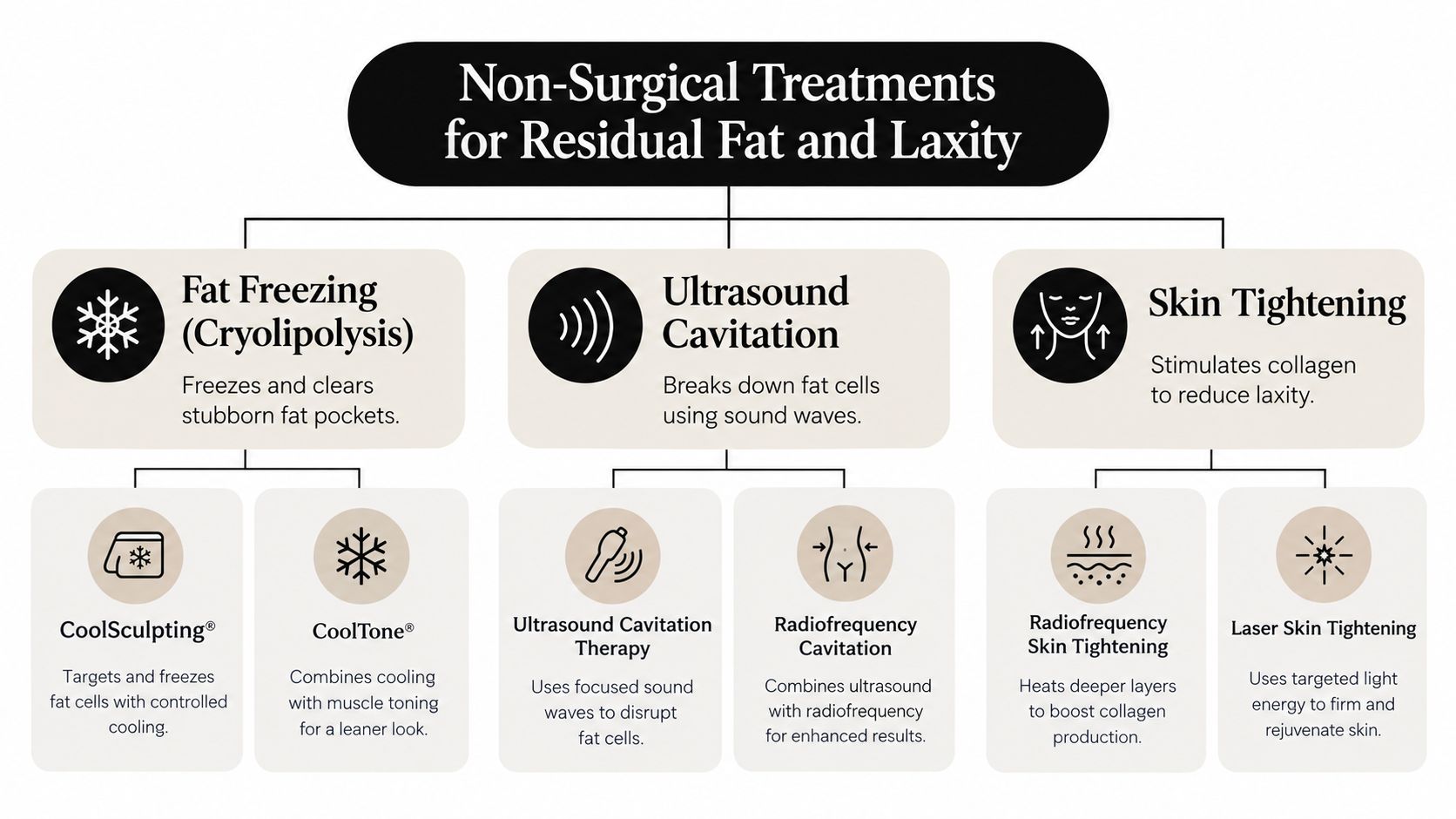
A client might arrive with a lower-abdominal pocket that remains after weight loss, plus softer skin around the same area. We'd separate those concerns rather than label everything as “stubborn fat”. The non-surgical fat-removal treatment page gives an overview of the options we discuss during assessment.
Treatments for residual fat
Fat freezing, also called cryolipolysis, cools selected fatty tissue so the body can clear treated fat cells over time. It's intended for localised pockets, not general weight loss and not a hanging skin fold.
Ultrasound cavitation uses sound-wave energy to target selected adipose tissue. It may suit someone seeking a body-sculpting approach for a localised area, but it isn't a skin excision method and results vary from person to person.
3D Powersculpt is used within our body-contouring portfolio to support muscle stimulation and shaping. It may be considered when the aim includes improving the appearance of a treatment area alongside lifestyle habits, but it can't replace medical weight management or surgical removal of redundant skin.
Treatments for laxity and texture
Body HIFU, meaning High-Intensity Focused Ultrasound, delivers focused ultrasound energy below the skin to support a tightening response. It's more appropriate for selected laxity than for a substantial apron of skin.
Radiofrequency, or RF, uses controlled heat to support collagen remodelling in the skin. We may discuss RF when laxity, texture or cellulite is more relevant than a large fat pocket.
Our body sculpting plans can combine modalities, but combination doesn't mean unlimited treatment. We first decide whether the tissue can respond to a non-surgical approach and whether your goal is proportionate to that starting point.
For example, someone with a modest fat pocket and mild laxity might discuss fat freezing followed by RF or body HIFU. Someone with severe hanging skin, repeated skin-fold infections or restricted movement should be directed towards medical and surgical advice instead.
How does a 3D body scan personalise your treatment plan?
A 3D body scan creates an objective baseline of your shape, circumferences and surface profile, helping us distinguish localised fat from redundant skin and track change more consistently. A tape measure is useful, but it only samples selected points. Three-dimensional imaging gives us a broader view of the area we're discussing.
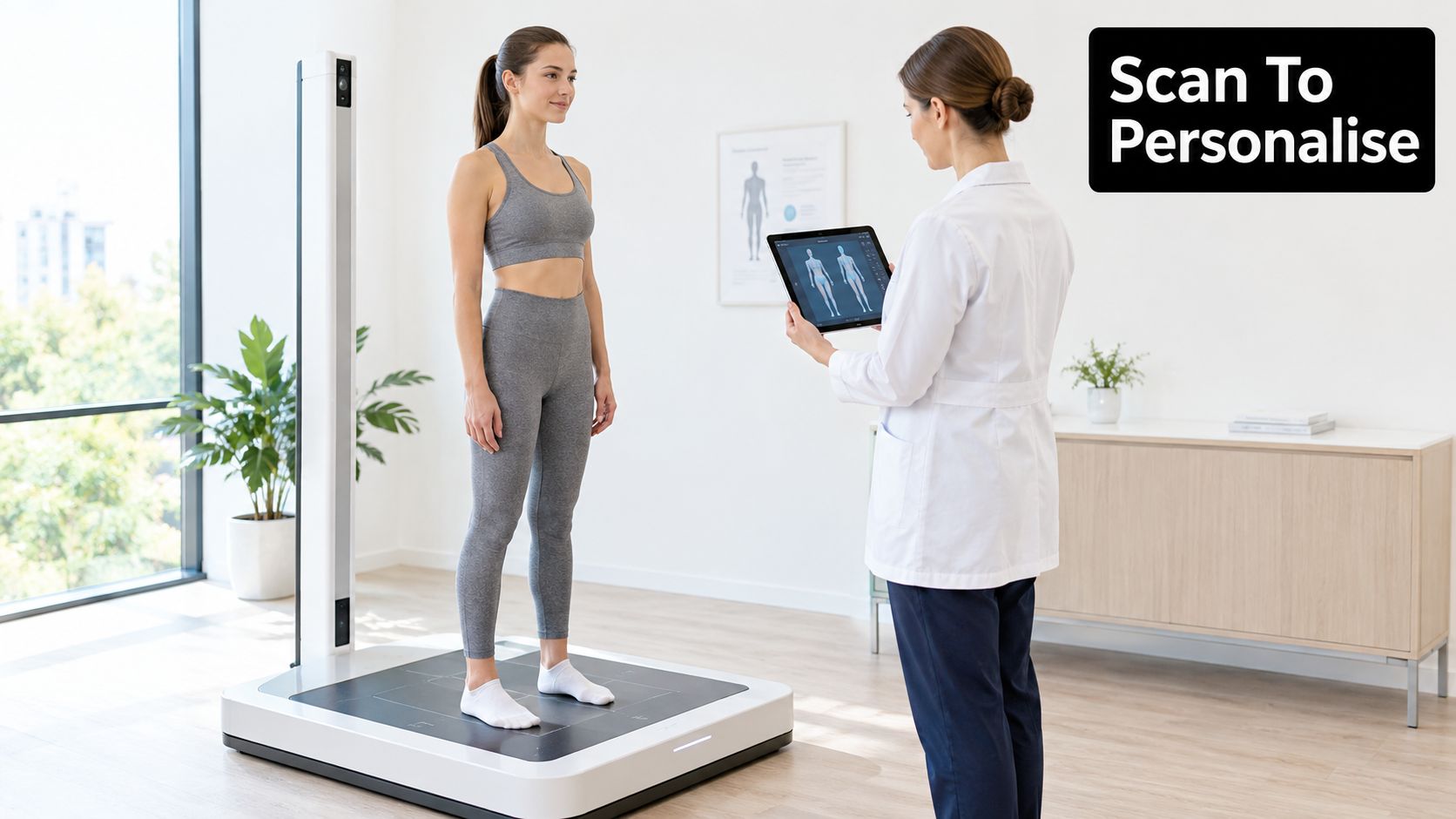
Our complimentary scan consultation starts with your goals and weight history. We then examine the area, discuss skin quality and record measurements before deciding whether treatment is sensible. The scan isn't a diagnosis, and it can't predict an outcome. It gives us a clearer starting point for planning and comparison.
What the scan helps us assess
A structured scan can help us document:
- Circumferences: Measurements at consistent locations can show whether a treated area changes over time.
- Surface shape: The scan can highlight asymmetry, folds and contour differences that are difficult to judge from one angle.
- Tissue distribution: The visual profile helps us discuss whether a concern appears more related to fat volume or skin laxity.
- Progress tracking: Repeating measurements under comparable conditions gives a more useful record than relying on photographs or memory alone.
Our body measurement tracking service explains how objective measurements can support a treatment plan. The wider concept of assessing body composition is also covered in this practical guide to understanding body composition testing.
We see clients from Leamington Spa, Warwick and Kenilworth at our Warwickshire clinic. A scan can be especially helpful when you've already lost significant weight and feel unsure whether another treatment will address the actual problem.
Here's a short look at how digital body analysis can support a consultation:
The scan won't tell us that a treatment will work, and we won't use it to manufacture a promise. It helps us say, “This is the area we can target,” or, “The dominant issue is redundant skin, so you need a different conversation.” That clarity protects your time, your money and your expectations.
Does contouring help you maintain your weight loss long-term?
Body contouring may support confidence, comfort and quality of life after weight loss, but it isn't a weight-loss treatment and it doesn't prevent regain by itself. Excess skin can affect clothing, movement, exercise confidence and body image, even when someone has maintained healthy habits.
A large longitudinal study of 5,620 post-bariatric patients across 24,604 assessments found that patients who later underwent body-contouring surgery maintained improvements in health-related quality of life and appearance satisfaction for up to 10 years, while patients who had bariatric surgery alone reported declining scores after the first one to two years. The NHS Health Research Authority research summary about loose skin after bariatric surgery also describes the physical and psychological effects associated with excess skin.
Earlier comparative evidence reported greater five-year weight-loss maintenance among patients who received body contouring, but that finding doesn't prove that contouring itself prevents regain. Improved mobility or confidence may help some people stay engaged with exercise and daily routines, while others still need nutritional, behavioural or medical support.
Body contouring should therefore be treated as one part of a long-term health journey. If your weight is changing or you've reached a plateau, reading about a plateau in weight loss may help you identify when professional support is more appropriate than aesthetic treatment.
What are the most common questions about post-weight-loss care?
How many sessions does body contouring take? The number of sessions depends on the treatment, area and assessment, and we'll only recommend a plan after reviewing your scan and goals. Results vary from person to person.
Is there downtime after non-surgical contouring? Non-surgical treatments generally aim to involve limited disruption, but temporary redness, tenderness or swelling can occur depending on the modality. We'll explain the expected recovery for your chosen treatment before proceeding.
Who isn't suitable for treatment? People with substantial hanging skin, active skin-fold problems, unexplained symptoms or changing weight may need medical or surgical advice rather than a non-surgical plan.
How do I start? Book a complimentary consultation so we can assess residual fat, laxity and weight stability instead of choosing a treatment from a photograph. You can contact our clinic at 11 Guys Place East, Leamington Spa, Warwickshire CV32 4RG, or call 01926 315764.
At 3D Aesthetics Leamington Spa, we offer a complimentary consultation with our AI Skin Scanner and 3D body scanning to assess residual fat, skin laxity and realistic non-surgical options. Visit 3D Aesthetics Leamington Spa to arrange an assessment, or call 01926 315764 if you'd like to discuss whether fat freezing, cavitation, 3D Powersculpt, body HIFU or RF is appropriate for your post-weight-loss concerns.
← Back to Home