
A single full-face fractional CO2 session in the UK typically falls between roughly £700 and £2,000, with smaller areas starting from about £250 and full multi-area packages often reaching £3,000 or more. That range is broad because clinics price the treatment by area, depth, practitioner, location, and whether you book one session or a course.
You may be looking at two quotes that appear to describe the same procedure, yet one says £750 and another says £1,800. Both could be reasonable. The important question is whether they include the same treatment area, laser intensity, clinician expertise, anaesthetic, aftercare, and follow-up.
If you're comparing clinics in Leamington Spa, Warwick, Coventry or further afield, don't choose from the headline figure alone. Read the quote as a treatment plan with a price attached.
Table of Contents
- UK CO2 Laser Resurfacing Prices: Real Ranges by Treatment Area
- How Fractional CO2 Resurfacing Actually Works
- The Five Factors That Move Your Quote Up or Down
- Single Sessions vs Treatment Courses
- What a Good Quote Should Include
- CO2 Laser Resurfacing Pricing in and Around Leamington Spa
- Making a Confident Decision and Getting Clear Answers
UK CO2 Laser Resurfacing Prices: Real Ranges by Treatment Area
A quote for CO2 resurfacing can run from about £100 for one small scar area to £4,250 for full-face treatment at a London skin clinic. Those figures describe very different procedures, so comparing the headline price alone will mislead you. The UK CO2 laser pricing guide shows how widely published UK prices vary.
For a single full-face fractional CO2 treatment, a practical UK range is roughly £700 to £2,000. Published prices include full-face packages around £750, while higher-cost clinics and treatment guides list full-face ablative fractional CO2 at £1,500 to £3,500 per treatment.
The treatment area explains much of the spread. Smaller zones require less laser time and fewer consumables. Published examples include about £100 for a single scar area, £150 for smokers' lines, and approximately £250 to £500 for smaller-area resurfacing.
| Treatment scope | Typical price range | What to check |
|---|---|---|
| Single scar or small targeted area | From about £100 to £250 | Confirm whether this covers one scar, one zone, or a set treatment time |
| Smaller-area resurfacing | About £250 to £550 | Often used for perioral, periorbital or partial-face treatment |
| Full-face fractional CO2 | Roughly £700 to £2,000 | Depth, device, clinician and location affect the fee |
| Full face at higher-cost clinics | About £1,500 to £3,500 | May reflect stronger settings or a higher-cost provider model |
| Face, neck and décolletage | About £1,350 and upwards | Multiple areas require more treatment time and consumables |
The UK examples span more than 40 times from a small scar area to premium full-face treatment. That difference does not prove that a cheaper clinic is poor value or that an expensive clinic is better. It shows why you must compare the treatment scope, laser depth, clinician involvement and aftercare package.
For readers in Leamington Spa, use London pricing as an upper reference point rather than a local benchmark. Regional clinics may charge less because their premises and operating costs differ, while a higher local quote may reflect consultant-led care, more detailed planning or longer follow-up. Ask whether the price includes consultation, anaesthetic, treatment, aftercare products and review appointments.
Practical rule: Accept a lower quote only after confirming that it covers the same area, intensity, clinician time and aftercare as the higher quote.
The postcode matters, but it should not decide the booking. The practitioner's training, proposed settings and access to follow-up matter more than the label “London” or “regional clinic”.
How Fractional CO2 Resurfacing Actually Works
A CO2 laser uses a 10,600 nanometre wavelength that is absorbed by water in the skin. The energy removes or vaporises selected skin tissue and creates controlled thermal columns. The healing response then encourages new skin formation and collagen remodelling.
Fractional delivery changes how much skin receives that energy. Instead of treating the entire surface continuously, the laser creates a pixel-like pattern of treated columns with untreated skin between them. Those surrounding areas help support healing, which generally makes fractional treatment more manageable than fully ablative full-field resurfacing.
The word “fractional” doesn't mean every treatment is gentle. A practitioner can adjust the density, energy and depth of the columns. A superficial treatment may target mild uneven texture, while a deeper setting may be selected for acne scarring, pronounced wrinkles or more significant photodamage. More aggressive treatment demands tighter patient selection, careful settings and stronger aftercare.
Why depth changes the fee
There are several practical intensity levels:
- Superficial fractional treatment usually suits modest texture or tone concerns and may involve less treatment time.
- Mid-depth fractional resurfacing delivers a stronger skin-remodelling stimulus and requires more planning.
- Deep fractional treatment is more demanding, particularly for scars and deeper lines, because settings must be chosen carefully.
- Fully ablative resurfacing treats the entire surface within the selected area and carries a more intensive recovery profile.
A clinic charging more for a deeper treatment isn't just adding a premium for the same appointment. It may be allocating more energy, more passes, more clinical oversight and more aftercare. You can read how fractional CO2 laser treatment is described in Leamington Spa before asking a clinic to explain exactly which approach it recommends.
Fractional resurfacing is a medical aesthetic procedure, not a standard facial. The laser platform, settings and operator all affect the result. Ask for those details in writing rather than assuming that “fractional CO2” describes a fixed level of treatment.
The Five Factors That Move Your Quote Up or Down
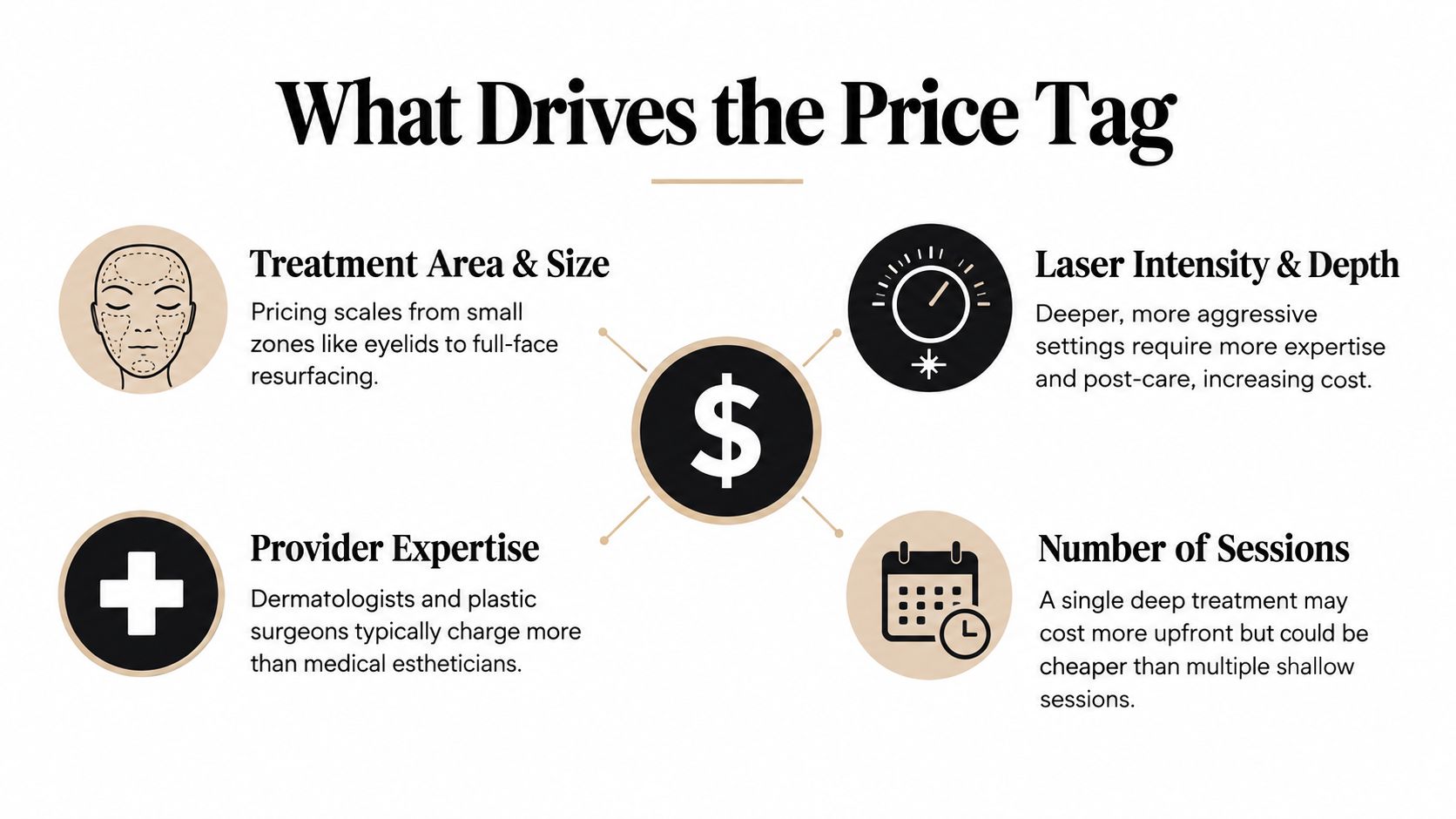
The quote usually follows five variables. Treat them as a checklist, because each one can change the price without changing the treatment's marketing name.
1. Treatment area
A full face takes more passes, preparation and clinician time than a small area around the mouth or a single scar. Cheeks may be priced separately from the periorbital region, and adding the neck or décolletage creates a larger treatment field.
The published UK prices reflect this structure. Full face and neck packages have been listed around £900, while face, neck and décolletage packages have reached approximately £1,350. Smaller zones remain materially cheaper, often starting in the lower hundreds. These examples appear in the UK CO2 resurfacing price information.
2. Depth and intensity
A light texture refresh and an aggressive scar treatment shouldn't cost the same. Deeper work may require additional passes, more energy delivery, stronger topical anaesthetic, more preparation and closer review.
Ask the practitioner to describe the intended depth in plain English. If the quote only says “full-face CO2” without explaining the treatment intensity, you can't make a meaningful comparison.
3. Number of sessions
Some concerns respond meaningfully to one treatment, while deeper acne scarring or extensive photodamage may lead to a staged plan. A course can reduce the effective per-session price, but it also commits you to a larger total payment.
Don't accept a course recommendation without asking what the practitioner expects each session to achieve and how the plan would change if the first treatment produces enough improvement.
4. Clinic model and practitioner
A consultant-led dermatology or plastic surgery clinic will often charge more than a high-volume medical aesthetic setting. That difference may reflect credentials, insurance, consultation time, equipment, facility standards and follow-up access.
Price should follow competence, not celebrity branding. Ask who will perform the treatment, what medical registration they hold, how often they perform CO2 resurfacing and who manages complications if healing doesn't go as expected.
5. Geography
Central London clinics can sit at the upper end of the UK market because of premises, staffing and operating costs. Regional clinics may quote less for a comparable area and protocol, but you still need to compare the actual device, clinician and aftercare.
| Pricing factor | How it lowers cost | How it raises cost | Typical impact |
|---|---|---|---|
| Treatment area | Small zone or one scar | Full face, neck and décolletage | Often the most visible difference |
| Laser depth | Superficial fractional settings | Deep fractional or fully ablative work | More expertise, passes and aftercare |
| Session count | One suitable treatment | Staged course for scars or photodamage | Higher total spend, possible package saving |
| Provider model | Regional independent clinic | Consultant-led or premium city clinic | Changes professional and overhead fees |
| Location | Midlands or other regional setting | Central London premises | Affects the clinic's cost base and quoted fee |
The invoice isn't built from a simple per-minute formula. Larger zones need more energy delivery, chair time and consumables, so the price can rise non-linearly as the treatment expands. A quote is credible when the clinic can explain those inputs clearly.
Single Sessions vs Treatment Courses
A single full-face fractional session commonly sits around £700 to £2,000 in the UK, based on the published ranges cited earlier. A course costs more overall, but the clinic may reduce the effective price per session when you pay in advance.
One UK clinic lists partial-face CO2 at £550 for one session and £1,320 for a three-session course. That makes the course rate £440 per session, with an overall saving of £330. For one treatment area, the same clinic lists £750 for one session or £1,800 for three, reducing the effective rate to £600 per session and saving £450. Those examples are available in the SKN Clinics CO2 treatment pricing.
| Treatment scope | Single session | 2-session course | 3-session course | Effective per-session saving |
|---|---|---|---|---|
| Partial face example | £550 | Not specified | £1,320 | £110 per session versus the single rate |
| One-area example | £750 | Not specified | £1,800 | £150 per session versus the single rate |
| Scar-focused course | From £500 per session | Depends on plan | Depends on plan | Confirm the clinic's written package terms |
| Full-face treatment | About £700 to £2,000 | Depends on provider | Depends on provider | Ask for the total and effective rate |
The right choice depends on the problem. A single session may be sensible for a measured texture refresh. Scar remodelling or more substantial photodamage may need staged treatment, but the clinician should explain why before asking for a deposit.
Don't let a discount turn into an unnecessary course. Ask whether the sessions have a defined clinical purpose, how far apart they'll be scheduled, and whether you can stop after the first appointment if the improvement is sufficient.
Before paying upfront: Read the cancellation, expiry and refund terms. A package may be non-refundable if you pause treatment, change your mind or become unsuitable for a later session.
Smaller-area courses can be more accessible than full-face packages, especially when the target is a defined scar or stretch mark rather than general facial resurfacing. You can review how CO2 laser may be used for stretch marks and then ask whether your concern needs a course or a single targeted session.
What a Good Quote Should Include
A proper quote should let you compare treatment plans without guessing. If a clinic gives you one unexplained figure, ask for an itemised version before paying a deposit.
Your consultation checklist
Confirm these points in writing:
- Consultation and assessment: Check whether the consultation is charged separately, whether skin analysis is included, and whether the fee is deducted from treatment.
- Treatment scope: The quote should name the exact areas, such as full face, cheeks, perioral region, periorbital region, neck or décolletage.
- Device and settings: Ask for the laser brand or platform, the planned treatment type and how the practitioner will determine depth and density.
- Anaesthetic: Clarify whether topical numbing cream is included and whether anything additional is charged.
- Immediate care: Confirm whether cooling, dressings and the first post-treatment application are part of the fee.
- Aftercare and review: Look for written instructions, recommended products and a planned follow-up appointment.
Ask about prescription-only aftercare creams, extra passes and additional zones before the procedure starts. Some clinics also bill revision sessions separately if the result falls short of the agreed treatment plan, so the policy should be clear rather than discussed after the fact.
The device name matters, but it isn't a guarantee of quality. Platforms such as Lumenis UltraPulse, DEKA and Fraxel re:pair may appear in clinic discussions, yet the operator's assessment and settings remain central to the treatment. Ask who will use the device and what training they have completed.
VAT inclusion should also appear on the quote. So should the practitioner's name, professional credentials, appointment length, payment schedule and cancellation terms.
A useful comparison test: Put three written quotes side by side and remove the prices. If you can't tell what each clinic plans to treat, the quotes aren't detailed enough.
Clinics and medical practices also need organised records for consultations, consent and follow-up. If you're researching tools that help providers handle clinical notes, AI medical scribe pricing offers a separate reference point, although it isn't a substitute for checking the clinic's own treatment documentation.
CO2 Laser Resurfacing Pricing in and Around Leamington Spa
Leamington Spa readers should expect regional pricing rather than automatically applying central London figures. A full-face fractional CO2 treatment locally may sit around £700 to £1,500, while some higher-cost London providers charge £2,000 or more for comparable full-face work. The difference reflects clinic overheads and provider models, not a guaranteed difference in results.
Warwickshire clinics commonly include independent medical aesthetic practices and a smaller number of dermatologist-led services. Treatments may be performed by GMC-registered doctors, NMC-registered nurses or experienced practitioners, so ask for the individual's credentials rather than relying on the clinic's general description.
The local consultation process is usually more useful than a remote price comparison. A face-to-face assessment allows the practitioner to examine acne scars, pigmentation, skin thickness, active inflammation and the actual area requiring treatment. Those details affect whether a clinic recommends light fractional resurfacing, deeper scar work or a different approach altogether.
Comparing nearby locations
Prices in Warwick, Kenilworth, Stratford-upon-Avon and Coventry may sit within a similar regional band. A clinic slightly farther away may quote less, but travel time and follow-up access should form part of your decision.
CO2 resurfacing needs sensible aftercare. If you travel to London or Birmingham for a lower headline price, you may find it harder to attend a prompt review or ask the treating team about unexpected redness, delayed healing or changes in pigmentation. That convenience has clinical value, particularly when the treatment is more aggressive.
Look for a consultation-first process, clear consent information and a cooling-off period before booking. A responsible provider should explain likely downtime, sun protection, contraindications and the possibility that your treatment plan may change after assessment.
For a Leamington Spa quote, ask five direct questions:
- What exact area does the price cover?
- What depth and fractional density are planned?
- Who will perform the treatment?
- What aftercare and review appointments are included?
- What happens if the clinician changes the plan on the day?
A local consultation won't make every quote cheap. It will make the comparison more honest.
Making a Confident Decision and Getting Clear Answers
The best-value CO2 treatment isn't the cheapest appointment. It's the quote that matches the problem, uses an appropriate intensity, identifies a qualified practitioner and includes enough aftercare to manage the recovery properly.
Start by separating the decision into five parts: area, depth, sessions, provider and aftercare. If one of those remains vague, the price isn't ready for comparison.
Three checks before booking
Request a written breakdown. Ask the clinic to itemise the treatment zones, device, anaesthetic, aftercare, review appointments, VAT and any package terms. Compare like with like, not one clinic's full-face quote with another clinic's partial-face offer.
Verify the practitioner. Confirm who will operate the laser, what registration they hold and what specific training or experience they have with CO2 resurfacing. A premium room and modern branding can't replace operator competence.
Ask about underperformance and complications. Find out whether a review is included, how the clinic handles delayed healing or pigmentation changes, and whether revision treatment is charged separately. The answer tells you more than a discount banner does.
Readers considering treatment for acne scarring can also review laser resurfacing for acne scars in Leamington Spa before arranging a consultation.
Questions patients often ask
How should I budget? Use the published UK bands as a starting point, then budget for the exact area and depth proposed. Smaller treatments may begin around £250, while full-face and multi-area work can move into the thousands, as shown by the UK clinic pricing benchmarks.
Should I budget for downtime? Yes. Consider time away from work, social plans, sun exposure and the cost of any recommended aftercare products. A cheaper treatment is poor value if you can't follow the recovery instructions.
What does an unusually low quote mean? Ask what has been excluded. It may cover only one small zone, use a lighter setting, omit anaesthetic or exclude follow-up. Low price isn't proof of poor care, but unexplained low price is a reason to investigate.
What if the clinic won't name the device? Don't book until you understand what platform will be used and who will operate it. A clinic doesn't need to sell you on brand names, but it should provide basic treatment information.
When is a second opinion worthwhile? Get one when clinics recommend different depths, when the price gap is substantial, or when you're being pushed into a pre-paid course before a proper assessment. A second consultation can prevent an expensive mismatch between your goals and the proposed treatment.
The UK clinic price comparisons from Eve Clinics reinforce the central point. Fees vary by area and purpose, with full-face treatment, face plus neck and scar-focused work occupying different pricing tiers. Choose the plan you understand, not the number that looks most attractive in an advert.
If you're comparing CO2 laser resurfacing prices in Leamington Spa, book a consultation with 3D Aesthetics Leamington Spa to discuss fractional CO2 options for texture, acne scarring and related skin concerns. The clinic provides consultation-led treatment planning, aftercare guidance and options based on the area and results you want.
← Back to Home