
You might be reading this because your skin still looks uneven no matter how good your skincare is. Maybe acne scars catch the light in the mirror, makeup sits oddly over rough texture, or sun damage has left patchy tone that doesn't shift with serums alone. That's often the point where people start looking at Fractional CO2 laser and wondering whether it's effective, or just another treatment with polished marketing.
The honest answer is that it can be very effective, but it isn't casual. It's a resurfacing treatment that works by creating controlled microscopic injury in the skin so your body replaces damaged tissue with fresher, smoother skin. That power is exactly why it helps with concerns like scars and texture. It's also why the planning, downtime, and aftercare matter so much.
Table of Contents
- How Fractional CO2 Laser Renews Your Skin
- What Skin Concerns Can This Treatment Address
- Your Treatment Journey at 3D Aesthetics
- Understanding Recovery Downtime and Expected Results
- Fractional CO2 Laser Versus Other Skin Treatments
- Is This Laser Treatment Right for You
- Your Questions Answered and Next Steps
How Fractional CO2 Laser Renews Your Skin
You look in the mirror and the problem is hard to pin down. Your skin does not necessarily look unhealthy, but it can seem uneven, crepey, rough in certain light, or marked by old acne changes that makeup never fully smooths over. Fractional CO2 laser is designed for that kind of concern because it works on both the skin's surface and the support structure underneath it.
Why CO2 works so well on skin
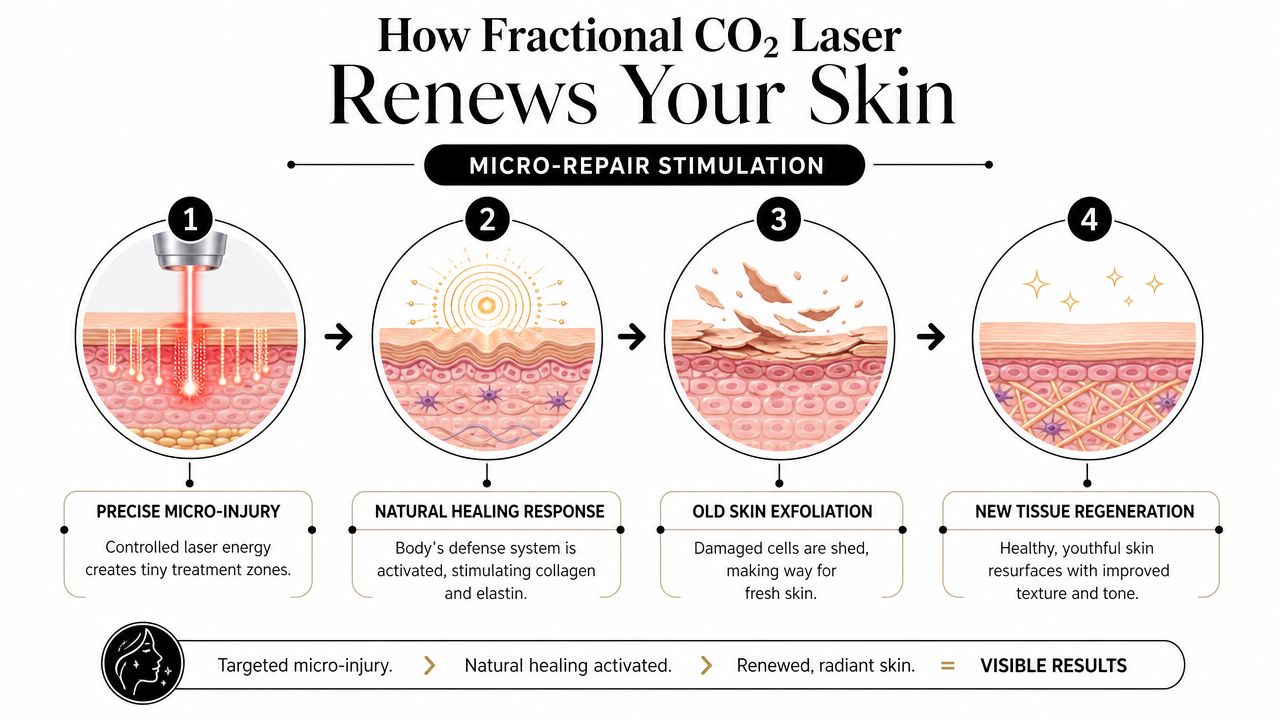
A CO2 laser uses a wavelength that is strongly absorbed by water in the skin. Since skin contains a great deal of water, the laser can treat tissue with a high level of precision. In practical terms, that allows a clinician to remove tiny areas of damaged skin in a controlled pattern rather than treating the whole surface uniformly.
Fractional treatment works like aerating compacted ground. Small channels are created, while the surrounding areas are left intact to help with repair. In skin, those channels are called micro-columns of ablation.
What fractional really means
The word ablative often sounds alarming to first-time patients. Here, it means the laser removes very small portions of skin. The word fractional means those tiny areas are spaced out in a grid, with untreated skin between them.
That spacing is a large part of why the treatment can be effective while still being manageable to recover from. The untreated skin acts as a reserve for healing. Fresh skin cells can move across the treated areas, and the deeper layers receive signals to produce new collagen during the weeks that follow.
Practical rule: Fractional CO2 creates controlled micro-injury so the skin repairs itself in a more organised way.
This is why the treatment may help with rough texture, fine lines, pore appearance, and certain types of scarring. It is not a magic polish applied in one afternoon. It is a resurfacing treatment that starts a healing response, and that response continues after the appointment.
In clinic, this is also why consultation matters so much. At 3D Aesthetics, the goal is not solely to say whether you are suitable for a laser. It is to assess how deep the problem sits, what your skin can realistically tolerate, and whether resurfacing is the right choice compared with other options for texture correction. If you are weighing up treatment routes for uneven skin, this guide on how to improve skin texture explains where laser resurfacing fits more clearly.
What Skin Concerns Can This Treatment Address
A resurfacing consultation usually starts with a very ordinary frustration. Your skin looks acceptable in some lighting, then uneven, marked, or tired in others. Makeup may sit oddly over acne marks. Fine lines may seem sharper around the eyes or mouth. Sun damage can leave the skin looking dull and patchy even when you are looking after it well at home.
Fractional CO2 laser is often considered when the problem is not only colour, but texture and structure. In simple terms, it is most helpful for concerns that sit partly below the surface, where creams can only do so much.
Acne scars and textured skin
Acne scarring is one of the commonest reasons people ask about this treatment in clinic. The reason is straightforward. A scar changes the skin's shape, not just its colour. If you picture the skin like a mattress, some scars create little dips, sharper edges, or uneven stitching underneath. Fractional CO2 aims to improve that uneven surface by encouraging the skin to rebuild in a smoother pattern.
This can help with:
- shallow boxcar scars
- rough texture left after repeated breakouts
- enlarged pore appearance linked with textural damage
- skin that looks uneven from side angles or under strong light
Results vary with scar type. Rolling and shallow scars often respond differently from very deep ice-pick scars, and some people need combination treatment rather than laser alone. That is one reason a clinic-led assessment matters. The goal is to work out whether resurfacing is likely to soften the problem you have, not the one social media says you have.
Fine lines, crepey skin, and photoageing
Fractional CO2 can also help skin that has become creased, coarse, or papery with age and sun exposure. This is different from temporary dryness. Dry skin can make lines look worse for a few days. Photoaged skin has a more established pattern of change. It may feel rough, look less reflective, and show lines that stay put even when the skin is well hydrated.
In those cases, resurfacing can improve the look of:
- fine lines around the mouth
- crêpey texture under the eyes or on the cheeks
- rough, weathered skin quality
- uneven surface change caused by cumulative sun exposure
The aim is usually not dramatic tightness. It is a fresher surface, smoother texture, and skin that catches the light more evenly.
If long-term UV change is one of your main concerns, this guide to sun damage skin treatment options compares resurfacing with other corrective approaches.
This video helps visualise the treatment goals:
Pigmentation and melasma
Pigmentation needs especially careful expectations. Some uneven tone improves well after resurfacing. Some types need caution, and melasma is the classic example. Melasma can be stubborn, hormonally influenced, and easily stirred up by heat or irritation. That means the question is not only, "Can laser lighten it?" but also, "Will laser keep it calm?"
For that reason, clinics in the UK usually assess pigmentation very carefully before recommending fractional CO2. A patchy, mixed picture is common. You may have sun spots, post-inflammatory marks from acne, and a melasma tendency at the same time. Each behaves differently, so treatment planning has to be specific.
If pigment is your main concern, a consultation should cover your history of recurrence, sun exposure, skin tone, and how easily you mark after inflammation. In some cases, resurfacing is suitable. In others, a gentler route is safer.
Stretch marks and selected scars
Stretch marks and some surgical or traumatic scars may also improve, particularly when the biggest issue is texture rather than colour. The laser cannot make altered skin identical to surrounding untreated skin, but it may help the area look less abrupt and feel smoother.
For scars, improvement often means:
- softer edges
- less visible indentation or ridging
- a surface that reflects light more evenly
- better blending in normal day-to-day lighting
That last point matters. Many clients do not want perfection. They want the scar to stop drawing the eye first.
A good consultation will also be honest about what fractional CO2 is less likely to fix on its own. Deep tethered scars, active acne, ongoing melasma, or redness driven by visible blood vessels may need a different plan or a staged approach. That balanced view is especially useful in a clinic setting such as 3D Aesthetics, where the decision should be based on your skin history, 3D scan findings, and realistic recovery trade-offs, rather than on a generic promise that one laser treats everything.
Your Treatment Journey at 3D Aesthetics
Individuals tend to feel calmer once they know the order of events. The unknown is often more stressful than the treatment itself. In a clinic setting, the process should feel structured, not rushed.
Consultation and skin mapping
A proper consultation starts with your concern, not the machine. You might say, “My acne marks look shallow from the front but obvious from the side,” or “My skin tone is patchy and makeup clings around my cheeks.” Those details matter because different concerns need different settings and sometimes different treatments altogether.
At 3D Aesthetics Leamington Spa, clients receive a complimentary consultation that includes a full 3D scan to assess concerns, personalise a plan, and track change over time. In practical terms, that gives both you and the therapist a more objective starting point. It also helps separate what feels emotionally very noticeable from what's technically treatable with resurfacing.
A consultation usually covers:
- Your skin history such as acne, pigmentation, previous peels, or sensitivity.
- Your healing pattern including whether you tend to mark easily or develop post-inflammatory pigmentation.
- Your real-life timing because downtime is easier to manage if it's planned around work, events, and sun exposure.
Treatment day in real terms
On the day, your skin is cleansed and prepared. A topical anaesthetic is usually applied to improve comfort. Once the skin is numb enough, the clinician performs the treatment in passes chosen for your concern and tolerance.
What does it feel like? The sensation is often described as heat, prickling, or a hot snapping sensation rather than sharp ongoing pain. Some areas, such as around the mouth, can feel more intense than the cheeks. The session itself is usually more manageable than people expect because the preparation does a lot of the heavy lifting.
The treatment room experience should feel methodical. Eye protection, skin preparation, comfort measures, and aftercare instructions aren't extras. They're part of safe resurfacing.
Going home with a plan
Immediately afterwards, the skin often looks red and feels hot, similar to a strong sunburn. You may also feel tightness as the initial swelling starts. Before you leave, the clinician should explain exactly how to cleanse, moisturise, protect the skin barrier, and avoid anything that could interrupt healing.
That aftercare period isn't cosmetic fussiness. It's part of the treatment. The skin has been intentionally injured in a controlled way, and the quality of that recovery has a direct effect on comfort, appearance, and final outcome.
Follow-up matters too. Some clients need reassurance that what they're seeing is normal. Others need adjustments to skincare, timing for their next session, or advice on whether they'd be better served by combining resurfacing with another texture treatment rather than increasing intensity.
Understanding Recovery Downtime and Expected Results
This is the part many clinic pages soften. Fractional CO2 is often marketed as having “minimal downtime”, but expert consensus is more nuanced. Recovery is more involved than non-ablative options, and the downtime you experience depends heavily on the settings used, with a real trade-off between recovery burden and improvement, especially for deeper scars or wrinkles, as discussed in this expert review on laser resurfacing and recovery.
What the first week usually feels like
A useful way to think about downtime is to separate healing from social recovery. Your skin may be safe and progressing normally while still looking obviously treated.
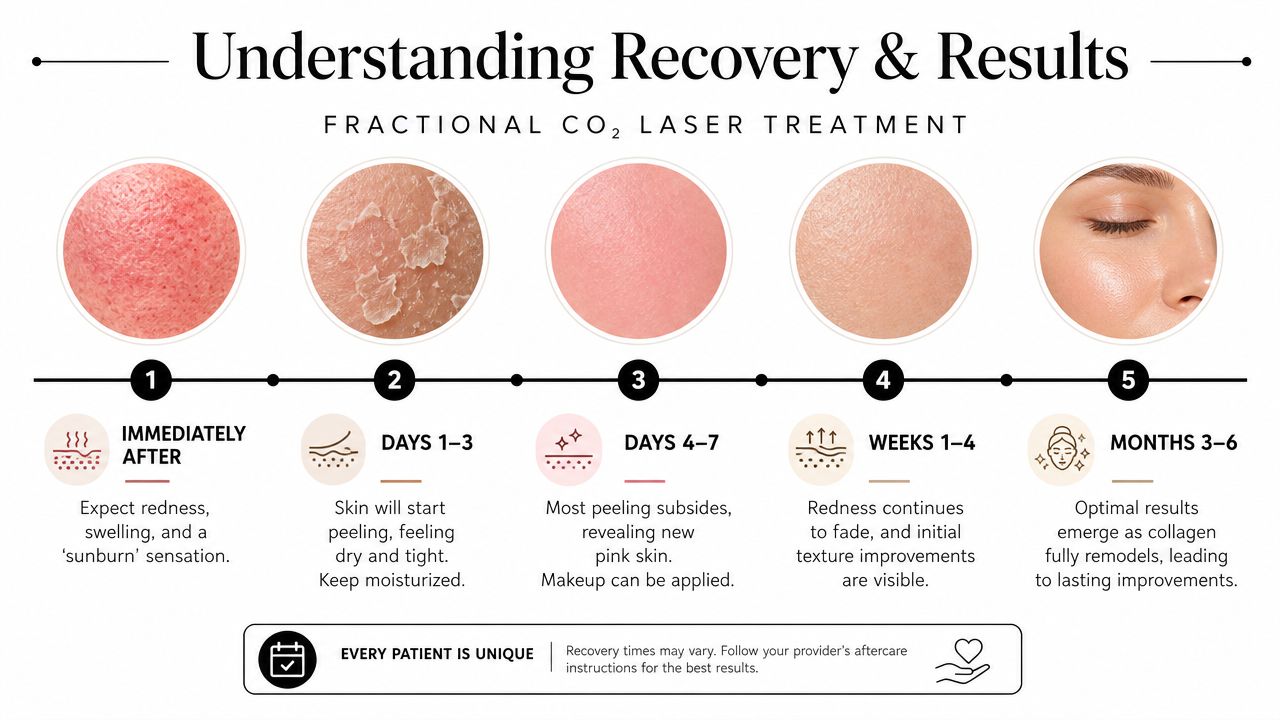
- Immediately after treatment the skin usually feels hot, tight, and red.
- Days 1 to 3 are often the most uncomfortable. Redness, swelling, dryness, and a rough sandpapery feel are common.
- Days 4 to 7 often bring visible flaking or peeling as old damaged skin sheds and newer pink skin appears beneath.
Some people can work from home comfortably during this stage. Others prefer to keep their diary light until the peeling settles.
Don't judge the final result during the first week. Early redness and texture change are part of the process, not a sign that the treatment has “gone wrong”.
When results start to show
Initial changes often show up before the full benefit does. Once peeling settles, many people notice the skin looks fresher, smoother, and more reflective. Scars may already seem softer because the surface is more even.
Deeper remodelling takes longer. Collagen change unfolds gradually, so improvement continues after the obvious peeling phase is over. That delayed benefit is one reason this treatment remains popular despite the downtime. You're not only resurfacing the top layer. You're asking the skin to rebuild.
A realistic expectation looks like this:
| Stage | What you may notice |
|---|---|
| First days | Heat, redness, swelling, tightness |
| End of first week | Peeling settles, fresh pink skin appears |
| Following weeks | Texture begins to look more refined |
| Later healing period | Scar softening and smoother tone become more noticeable |
The key point is simple. Faster recovery usually means gentler treatment. More dramatic correction often asks more of you in aftercare and patience.
Fractional CO2 Laser Versus Other Skin Treatments
It helps to compare this treatment with the options people are usually deciding between. Most clients aren't choosing in a vacuum. They're trying to work out whether they need a stronger resurfacing treatment or whether something gentler would suit their skin, budget, and calendar better.
How the options differ in practice
Microneedling is often chosen for texture, mild acne scarring, and general collagen support. It usually suits people who want less downtime, but it may be less suitable when scars are deeper or the skin needs more dramatic resurfacing.
Non-ablative lasers aim to stimulate change without removing columns of skin in the same way. They're often easier to fit around work because recovery tends to be lighter, but they may not give the same level of correction for pronounced textural issues.
Deep chemical peels resurface skin through controlled chemical exfoliation rather than laser energy. They can be useful for some pigmentation and surface damage concerns, but they don't offer the same pattern-based precision as fractional delivery.
If your priority is scar-focused resurfacing rather than general rejuvenation, this page on CO2 laser scar removal shows where a targeted CO2 approach fits.
Comparing skin resurfacing treatments
| Treatment | Best For | Typical Downtime | Results Timeline |
|---|---|---|---|
| Fractional CO2 laser | Deeper acne scars, etched texture, photoageing, selected scars | Noticeable recovery with redness, dryness, and peeling; intensity varies by settings | Surface improvement appears first, deeper remodelling continues over time |
| Microneedling | Mild to moderate texture concerns, maintenance, collagen support | Usually lighter than ablative resurfacing | Gradual improvement across a course of treatments |
| Non-ablative lasers | Clients prioritising shorter recovery and subtle rejuvenation | Usually shorter recovery than fractional CO2 | Builds more gently and often suits staged improvement |
| Deep chemical peels | Surface texture and some pigment concerns | Can involve visible peeling and social downtime | Improves as peeling resolves and skin tone normalises |
A practical way to decide is to ask one question. Are you trying to achieve the most visible change you can reasonably recover from, or the least disruption you can comfortably repeat? Fractional CO2 usually sits closer to the first category.
Is This Laser Treatment Right for You
You are usually deciding between two things at once. You want enough treatment strength to make a visible difference, but you also need a plan your skin can recover from safely. Fractional CO2 works best when those two parts match.
A good consultation should test that fit properly. In a UK clinic setting, that often means looking at more than the scar or line itself. Skin tone, healing history, recent sun exposure, work and social commitments, and how well you can follow aftercare all matter. At 3D Aesthetics, the decision is part of the wider assessment process rather than a quick yes or no based on one concern.
Who often benefits most
This treatment often suits people who are aiming for a clear change in skin texture, not a short-lived freshening effect. That includes clients with acne scarring, etched sun damage, crepey texture around the eyes or mouth, and selected surgical or traumatic scars.
It also suits people who can be realistic about the end point. Fractional CO2 can improve roughness, soften lines, and reduce the depth contrast in scars. It does not replace untouched skin with brand new skin. A better way to picture it is renovation rather than replacement. The skin is encouraged to rebuild in a more organised way over time.
People tend to be happier with treatment when they can say yes to these questions:
- Am I bothered by texture, scars, or deeper lines enough to accept visible recovery?
- Can I protect my skin from sun and heat while it heals?
- Can I follow the aftercare exactly, even if the skin feels tight, dry, or flaky for a while?
- Am I looking for improvement rather than perfection?
Who may need more caution, preparation, or a different treatment
Fractional CO2 is selective treatment, and that is a good sign. Caution is often needed for people with darker skin tones, a history of post-inflammatory hyperpigmentation, very reactive skin, active acne inflammation, infection in the treatment area, or a pattern of difficult healing. In those cases, the safest plan may involve preparing the skin first, choosing gentler settings, spacing treatment carefully, or choosing another method altogether.
Timing matters too.
If you have a beach holiday booked, a wedding approaching, or a period when you cannot look visibly red or flaky, it may be better to wait. The same applies if you know you will struggle to avoid sun exposure or cannot keep up with cleansing, moisturising, and strict protection while the skin barrier is recovering.
The best candidate is not simply the person with the right concern. It is the person with the right concern, the right skin behaviour, and the right recovery window.
One more point is easy to miss. The same scar can be treated very differently on two different people. That is why a proper consultation matters so much. A careful clinician is not being cautious for the sake of it. They are trying to judge how much change is realistic, how much downtime is acceptable, and whether fractional CO2 is the safest way to get there.
If a clinic presents this treatment as suitable for nearly everyone, treat that as a warning. Good resurfacing plans are personalised, honest, and sometimes selective.
Your Questions Answered and Next Steps
Does it hurt
It can be uncomfortable, but it is generally well-tolerated when the skin is properly numbed first. You should expect heat and a stinging or prickling sensation rather than a completely sensation-free treatment.
How many sessions might I need
That depends on the concern, the severity, your skin type, and how aggressively it's safe to treat. Some people see worthwhile change after one session. Others do better with a staged plan, especially for scarring or pigmentation where gradual progress is safer and more realistic.
What does it cost
Cost varies by treatment area, treatment depth, and the level of clinician time involved. The most useful way to judge value is to look at the full picture, not just the session price. Ask what's included in consultation, aftercare support, and follow-up.
When should I book
Book when you can protect your skin from sun, allow visible recovery time, and follow aftercare properly. If you've got a wedding, holiday, or major work event close by, it's usually better to plan around that rather than squeeze treatment in and hope for the best.
Fractional CO2 laser can be an excellent option for the right concern and the right person. The benefit comes from careful assessment, thoughtful settings, honest downtime planning, and disciplined aftercare.
If you'd like a personalised view of whether resurfacing is suitable for your skin, book a consultation with 3D Aesthetics Leamington Spa. A proper assessment can clarify whether Fractional CO2 laser is the right fit for your goals, what recovery is likely to look like in your case, and whether a different treatment path would make more sense.
← Back to Home