
If you're searching for fat freezing in Leeds, are you comparing treatments for a particular pocket of fat, or hoping the treatment will help you lose weight? That distinction matters more than the discount, the machine's name or the photographs on a clinic's website.
We're 3D Aesthetics Leamington Spa, based in Warwickshire, not Leeds. Our approach is to start with suitability, explain the limits and leave room for you to decide against treatment. Here's how we'd judge the evidence, costs and consultation before making that decision.
Table of Contents
- What is fat freezing and how does it work?
- Who should have fat freezing and who should avoid it?
- What are the side effects of fat freezing and when should I get help?
- How long do fat freezing results take to appear?
- How much does fat freezing cost in Leeds?
- How does fat freezing compare with other non-surgical options?
- What questions do Leeds readers ask about fat freezing?
- How do I check a Leeds clinic before I book a consultation?
What is fat freezing and how does it work?
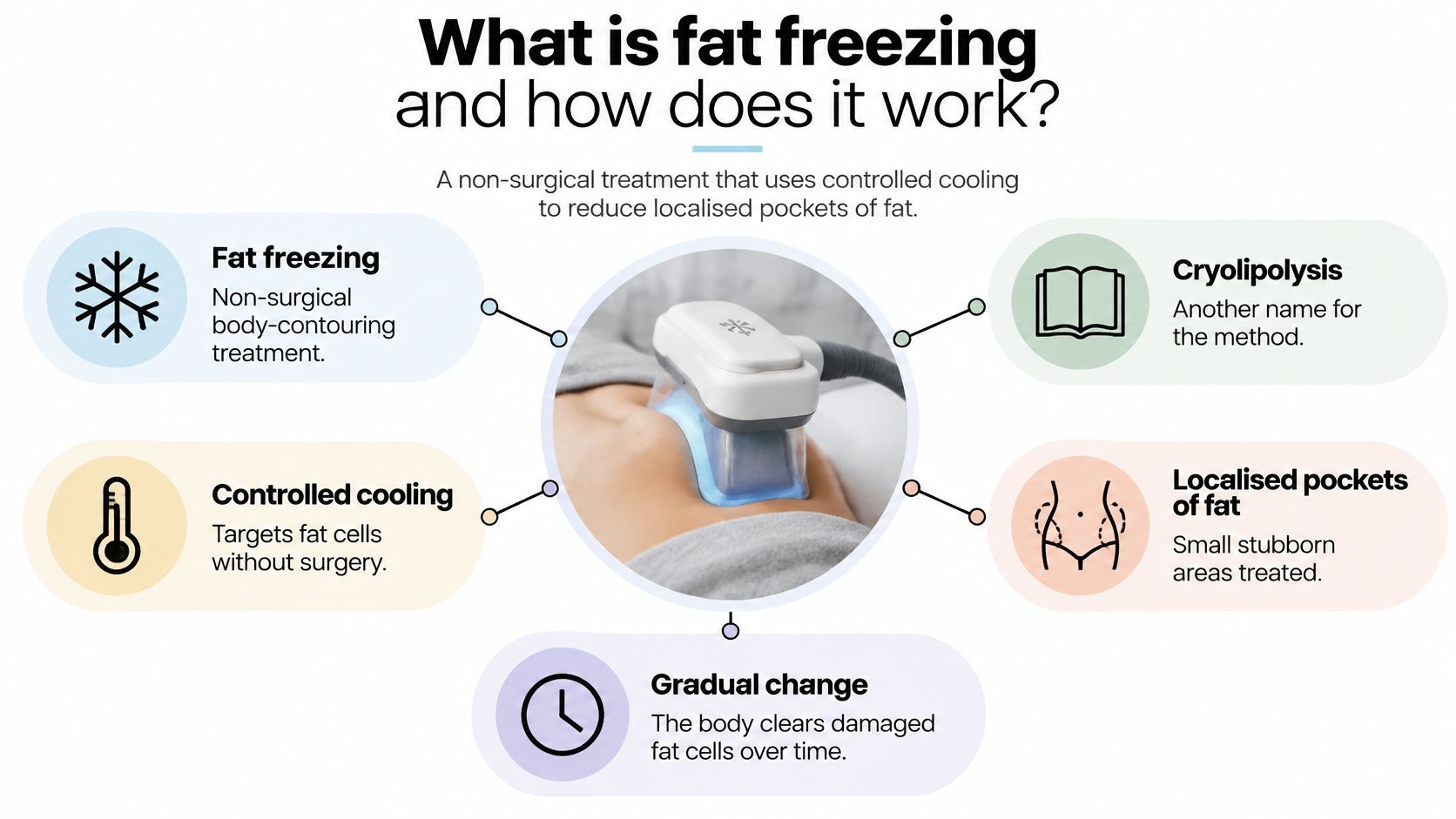
Fat freezing, also called cryolipolysis, meaning fat reduction through controlled cooling, is a non-surgical treatment for selected pockets of superficial fat. The UK Government's guidance on non-surgical cosmetic procedures explains that fat cells are more sensitive to cold than surrounding tissues, allowing cooling to affect them selectively. Think of an applicator chilling one layer of padding while largely sparing the tissue around it, although that selectivity doesn't remove the possibility of injury. The British College of Aesthetic Medicine describes the process as apoptosis, or programmed cell death, followed by clearance through the lymphatic system, part of the body's fluid-drainage and immune network. The intended change develops gradually rather than during the appointment, and results vary from person to person. The target is fat beneath the skin, not visceral fat, the deeper fat around internal organs.
What would that mean for an abdominal concern?
Say you're comfortable at your current weight but dislike a small abdominal fold over your waistband. We'd begin by asking you to identify that particular concern, rather than treating the whole abdomen as one interchangeable area.
The UK Government guidance describes controlled cooling as a localised procedure. That makes the shape and position of the proposed treatment area important: a machine's ability to cool tissue doesn't establish whether its applicator fits your concern.
The diagram summarises the intended process.
What should the explanation leave out?
We wouldn't describe fat freezing as melting fat, draining it away during the appointment or changing your whole body composition. Those descriptions don't match the gradual, targeted mechanism described by the UK Government and the British College of Aesthetic Medicine.
A useful starting question: Can you identify a particular fold of fat you'd like assessed, rather than a number you want to lose on the scales?
We offer fat freezing at our Leamington Spa clinic, but identifying a pinchable fold is only a starting point. A home pinch check isn't medical clearance, and it doesn't establish what treatment, if any, makes sense.
Who should have fat freezing and who should avoid it?
Fat freezing is generally considered for adults with a discrete, pinchable fat pocket near a stable weight, while the British College of Aesthetic Medicine does not recommend it for people with obesity or those trying to lose weight.
That's a meaningful boundary, not a disclaimer to tuck beneath an offer. We wouldn't sell a contouring appointment to someone whose main aim is overall weight reduction.
Who fat freezing suits, by situation
The British College of Aesthetic Medicine's patient guidance establishes the weight-loss exclusion. The UK Government guidance informs the screening approach below; the remaining deferrals are cautious consultation decisions, not a claim that a table can clear someone for treatment.
| Situation | Typically suitable? | Why |
|---|---|---|
| Pinchable fat pocket, stable weight | Often suitable after consultation | The intended target is superficial fat, not deep fat |
| Primary goal is weight loss or obesity | Not suitable | The British College of Aesthetic Medicine doesn't recommend treatment for these goals |
| Cold-related disorder | Not suitable without medical review | Cold exposure needs assessment against the condition and device instructions |
| Impaired sensation in the area | Not suitable pending medical assessment | Altered sensation must be addressed before cooling is considered |
| Skin condition or active infection in the treatment area | Usually deferred | The area needs assessment before an elective procedure |
| Pregnancy or breastfeeding | Ask your GP first | We wouldn't treat this as routine eligibility without medical advice |
| Stretch marks or loose skin | Not a fat-freezing target | Don't choose a fat-targeting procedure on the assumption that it will correct skin concerns |
What should screening involve?
We'd expect a written consultation record covering cold-related disorders, impaired sensation, relevant skin conditions and tissue anatomy, consistent with the safety approach outlined in the UK Government guidance. Bring your medical history and explain anything unusual about the proposed area, even if you're unsure whether it matters.
We'd also ask what you want to change and how you'll judge whether treatment was worthwhile. A clear cosmetic goal is more useful than an expectation that treatment will improve general health.
- If weight is the concern: Speak to your GP about NHS weight-management support rather than booking cosmetic contouring.
- If eligibility is uncertain: Resolve the medical question before paying for a treatment course.
- If you feel pressured: Leave without booking. A consultation should allow a genuine decision.
We turn away weight-loss enquiries from fat freezing and won't treat an unresolved safety concern as a sales objection.
What are the side effects of fat freezing and when should I get help?
Fat freezing can cause temporary numbness, redness, bruising and swelling that generally settle after a few days, according to the British College of Aesthetic Medicine's fat-freezing patient guidance, while unusual or worsening symptoms need assessment.
The organisation also lists rarer complications. Those risks belong in the consent discussion before treatment, not only in paperwork handed over afterwards.
Which effects need a clear explanation?
The British College of Aesthetic Medicine identifies paradoxical adipose hyperplasia, meaning treated fat increases in size instead of becoming smaller. It also lists uneven contour outcomes, nerve damage, blistering, frostbite-like symptoms and increased skin sensitivity; results vary from person to person.
These are different concerns, so a clinic shouldn't bundle them together as ordinary redness. In particular, a newly enlarging area deserves assessment rather than automatic reassurance that you need to wait longer.
Our fat-freezing safety guide is a useful starting point for preparing questions, but written information doesn't replace an individual consultation.
What should you do if something feels wrong?
We recommend a simple escalation plan rather than trying to diagnose yourself from photographs online.
- Contact the treating clinic promptly: Report persistent or increasing pain, swelling that concerns you, a growing treated area, blistering or a marked skin change.
- Use NHS 111 or your GP: Seek medical advice if symptoms are worsening, you feel unwell, or you can't obtain an appropriate assessment from the clinic.
- Seek emergency help: Don't wait for a cosmetic appointment if you believe you're seriously ill or facing an immediate medical emergency.
These are precautionary actions, not a way to distinguish every possible complication at home. You don't need to know the technical name for a problem before asking for help.
Don't let a promise about the eventual appearance persuade you to ignore a current symptom.
Before leaving, obtain written aftercare and a defined review route, including whom to contact outside normal opening hours. Keep dated photographs and your treatment details so the assessing clinician can understand what changed.
A clinic should be willing to review a concern after treatment. A planned measurement appointment isn't a reason to postpone assessment of pain, skin injury or enlargement.
How long do fat freezing results take to appear?
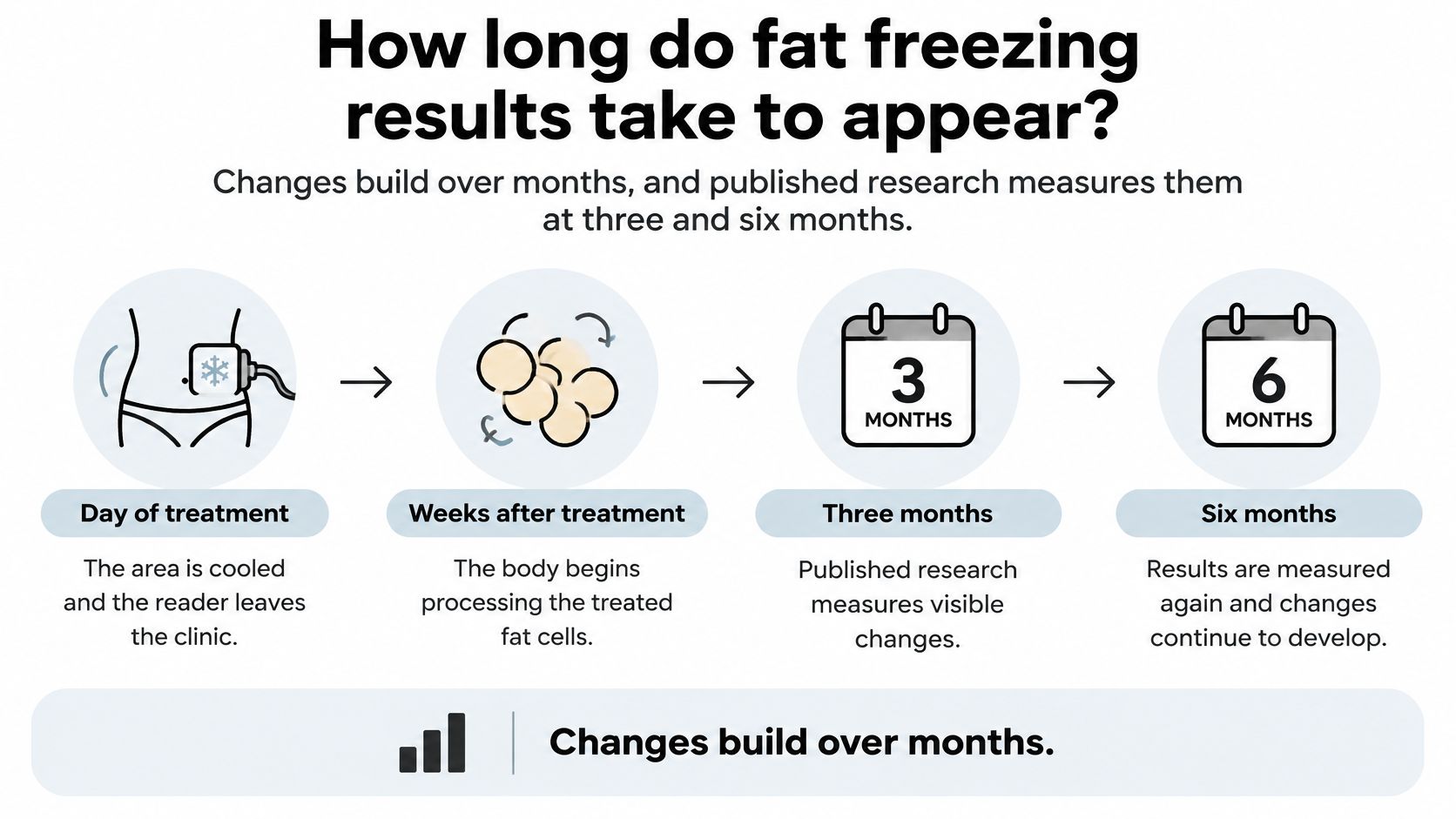
Fat freezing changes develop over months, with a peer-reviewed review of non-invasive lipolysis in the Journal of Cosmetic Dermatology reporting average circumference reductions of 2.81 cm at three months and 5.63 cm at six months; results vary from person to person.
Those are published averages, not a timetable or a prediction for your body. The same review reported average fat-layer thickness reductions of 0.95 cm and 1.31 cm at the respective assessments.
The timeline illustrates why we'd plan a review rather than judge the appointment on the day.
What should you record along the way?
Before cooling, agree on the exact area being assessed and take baseline photographs and measurements. Record where the tape sits, your posture and the camera position so a later comparison isn't just a different angle.
On the appointment day, treat the visit as the start of follow-up, not the final assessment. The British College of Aesthetic Medicine's description of temporary redness and altered sensation is a reason not to equate the immediate appearance with the eventual contour.
During the following weeks, follow the written aftercare and report concerns. The British College of Aesthetic Medicine describes gradual clearance of damaged cells during this period.
Why are different measurements important?
A circumference measurement describes the distance around an area. Fat-layer thickness describes a layer at a particular measurement site, so the two figures aren't interchangeable.
Our practical recommendation is to choose a consistent method before treatment and use it again at the planned assessments. Our body-measurement tracking guide explains how to make comparisons more useful.
- Photographs: Keep lighting, clothing, distance and posture consistent.
- Tape measurements: Use the same anatomical landmark without pulling the tape tighter.
- Body scanning: Where available, compare like-for-like scan records rather than isolated images.
This video can support your consultation preparation.
We'd arrange baseline measurements and reviews at the published assessment intervals, while making clear that results vary from person to person. Don't interpret a study average as an amount your clinic owes you.
How much does fat freezing cost in Leeds?
Fat freezing was listed at £250 for one area and £775 for six areas by Spire Aesthetics Leeds in 2025; those published prices may have changed.
These figures describe one provider's listing, not a Leeds-wide average. They also don't establish what another clinic means by an area or what an individual treatment plan includes.
Published fat freezing prices in Leeds
| Treatment | Published price | Source |
|---|---|---|
| One treatment area | £250 | Spire Aesthetics Leeds, 2025 |
| Six treatment areas | £775 | Spire Aesthetics Leeds, 2025 |
| Other Leeds providers | Obtain a current written quote | No comparable price established here |
A package can look cheaper without being the right purchase. If you only want one specific fold assessed, a larger package isn't automatically better value.
What should a quote actually tell you?
We'd compare the proposed treatment map, not just the headline price. Ask the clinic to mark the intended areas and explain whether the quoted plan involves separate applicator placements, separate visits or both.
- Consultation: Establish whether the suitability assessment is included before committing.
- Treatment coverage: Get a written description of what will be treated.
- Follow-up: Check whether review appointments are included and how concerns are handled.
- Additional costs: Ask what would trigger a further charge rather than assuming everything is covered.
Our body-contouring cost guide provides context for those comparisons. You can also consult our prices page, then confirm the applicable quote with us before booking; don't assume a website price has been independently checked on the day you read it.
Value check: A clear explanation of why you shouldn't buy more treatment can be more useful than a larger discount.
Price isn't evidence of a particular outcome, and results vary from person to person. We'd rather see a smaller, clearly justified plan than a prepaid course agreed before anyone has assessed the concern.
If you're travelling, include the practical cost of attending consultation and follow-up. Choosing a clinic you can realistically return to matters as much as comparing the first appointment.
How does fat freezing compare with other non-surgical options?
Fat freezing is a localised fat-contouring option, while cavitation, radiofrequency and combined body-sculpting plans are discussed for different concerns, not as interchangeable versions of the same appointment.
The UK Government guidance supports the controlled-cooling explanation. The other mechanisms below are our plain-English descriptions of the technologies, not claims that each option will deliver a particular change; results vary from person to person.
Non-surgical body treatments compared
| Option | How it works | Best suited to discussion about | Main limit |
|---|---|---|---|
| Fat freezing, or cryolipolysis | Controlled cooling selectively affects fat cells | A defined, pinchable fat pocket | Don't assume it will address loose skin |
| Ultrasound cavitation | Uses ultrasound energy directed at fat tissue | Broader-area inch-loss concerns | Needs assessment, not a universal fix |
| Radiofrequency | Uses energy to heat tissue as part of a skin-firming approach | Mild skin laxity, meaning looseness | Not the same approach as selectively cooling a fat pocket |
| Body-sculpting plan | Combines technologies selected after consultation | Mixed contour and skin concerns | The plan must follow the assessment and body scan |
Which concern should lead the discussion?
For a specific pinchable pocket, we'd discuss whether a targeted cooling approach matches the tissue and your expectations. The important question isn't whether cooling sounds more advanced than another technology.
For loose skin, we'd first make sure the discussion is about skin laxity rather than assume every visible fold is excess fat. Radiofrequency may enter that conversation, but we wouldn't translate a technology description into a promised degree of tightening.
For mixed concerns, a body scan can help document the starting point and support a clearer discussion. It doesn't replace a medical history or make every combination appropriate.
- Choose by concern: Name the feature you want assessed before choosing a machine.
- Separate the goals: Ask what the plan addresses and what it leaves unchanged.
- Keep expectations individual: Results vary from person to person.
Our guide to non-surgical fat reduction in the UK can help you prepare those questions.
If you're also reviewing everyday habits, Maximum Health Products' practical tips for reducing belly fat offer a separate lifestyle-reading resource, not evidence that a cosmetic procedure improves health. For a weight-management goal, we'd prioritise your GP's advice over a treatment comparison.
We wouldn't rank these options as best for everyone. A useful consultation ends with a justified recommendation, including no treatment when that's the sensible choice.
What questions do Leeds readers ask about fat freezing?
Fat freezing questions are best answered with the proposed area, medical history and expectations in mind, rather than a standard sales script.
What might the appointment involve?
Does fat freezing hurt? It can: Yahoo News' coverage of a 2025 review of 30 clinical trials involving 3,158 participants reported pain in 28.8% and numbness in 49.5%. We wouldn't describe the appointment as painless.
How many sessions will I need? The number should be agreed after assessment of the areas you want treated. A package size isn't a clinical reason to book that many appointments.
Can I have fat freezing on the NHS? We'd approach fat freezing as an elective cosmetic service, not an NHS weight-management route. Your GP is the appropriate starting point if your concern is weight or related health.
What should I know before choosing a location?
When will I see a difference? Published assessments consider changes over months rather than immediately after cooling. Results vary from person to person.
Is your fat-freezing clinic in Leeds? No. We're in Leamington Spa, Warwickshire, and also serve Warwick and Kenilworth; Leeds readers should compare local providers as well as considering travel.
Is fat freezing suitable for everyone? No. The British College of Aesthetic Medicine's exclusions and a proper safety assessment matter more than enthusiasm for treatment.
- Before booking: Write down your main concern and any medical questions.
- Before paying: Get the proposed plan, limits and follow-up arrangements in writing.
How do I check a Leeds clinic before I book a consultation?
A good consultation should help you decide whether fat freezing suits your concern, rather than just confirm a price. Ask the practitioner to explain why they recommend treatment for your specific area and what result is realistic. If your main goal is weight loss, fat freezing is not a weight-loss treatment.
What evidence should you check?
- Practitioner training: Ask who will assess and treat you, what training they have completed and whether it covers the device being used.
- Business identity: Check the clinic's legal identity and any registration it claims. Ask what that registration covers.
- Photographs: Compare posture, lighting, clothing and camera angle. Before-and-after images show individual outcomes, and results vary from person to person.
- Consultation records: Expect the practitioner to record your medical history, treatment area, starting measurements and expectations.
- Written arrangements: Ask for the consent information, aftercare instructions, contact details and terms for any additional treatment or cancellation.
Our guide to fat-freezing reviews explains why comments about customer service are different from evidence of assessment and follow-up. A positive review can inform your view of the experience, but it cannot establish whether treatment is right for you.
What would make us pause?
We'd pause if a practitioner recommends a package before assessing the area, brushes aside questions about complications or treats a weight-loss goal as a reason to proceed. Ask how the clinic assessed its before-and-after photographs, too.
Fat freezing uses cryolipolysis and is non-surgical and non-invasive, with no downtime. Results vary from person to person, so be wary of promises of a particular outcome.
3D Aesthetics Leamington Spa offers a complimentary consultation that includes a 3D body scan to assess concerns and personalise a treatment plan. If travelling from Leeds suits you, book your free consultation to discuss your concern before deciding whether to proceed.
3D Aesthetics Leamington Spa offers fat freezing and non-surgical body contouring at its Leamington Spa clinic. Visit 3D Aesthetics Leamington Spa to discuss a localised fat pocket, understand the treatment's limits and decide whether it suits your needs.
← Back to Home