

If you're reading this, there's a good chance you're tired of planning your life around hair. You shave, and it's back almost immediately. You wax, and you count down the days until the regrowth starts. You pluck a few facial hairs under bright bathroom lighting and wonder why they keep returning.
That frustration is usually what brings someone to a hair reduction treatment consultation. Not vanity. Relief. They want less maintenance, less irritation, and more predictability.
The biggest misunderstanding I hear is this: people often expect total, permanent hair removal everywhere, forever. That isn't how professional hair reduction works. The better way to think about it is long-term reduction, with a plan that matches your skin, your hair type, and your hormones. That matters even more if you have darker skin, tanned skin, or facial hair linked to hormonal changes such as PCOS.
Table of Contents
- Why Choose Hair Reduction Over Temporary Methods
- How Modern Hair Reduction Treatments Work
- Comparing the Best Hair Reduction Methods
- Who Is a Good Candidate for Hair Reduction
- The Complete Treatment Process Explained
- Expected Results and Long-Term Maintenance
- Your Hair Reduction Plan at 3D Aesthetics Leamington Spa
Why Choose Hair Reduction Over Temporary Methods
Most new clients tell the same story in slightly different ways. They're not necessarily bothered by hair itself. They're worn out by the upkeep. Legs before holidays. Underarms before the gym. Chin hairs that seem to appear overnight. Ingrowing hairs after shaving. Tender skin after waxing.
Temporary methods work at the surface. They manage what you can see right now. A professional hair reduction treatment aims deeper, at the follicle, so the hair comes back more slowly, more lightly, or in many follicles not at all. That's why it feels less like a quick fix and more like changing your routine at its source.
In the UK, this isn't a fringe service. Laser and light-based hair reduction sit within a professional aesthetics market worth about £3.2 billion, and the average session takes only 15 to 30 minutes, which helps explain why many people fit it into normal life rather than treating it as a major procedure (UK aesthetics market and session timing).
What clients usually want most
- Less daily maintenance so they're not constantly shaving or checking for regrowth
- Smoother-feeling skin with fewer bumps from repeated hair removal
- A longer-term plan instead of starting from scratch every week
- More confidence in specific areas such as underarms, bikini line, legs, face, chest, or back
Practical rule: If you're hoping never to see a single hair again, you may be disappointed. If you're hoping for much less hair and much less hassle, you're thinking about it the right way.
For many people, that shift is valuable. You stop asking, “How do I remove this today?” and start asking, “How do I reduce this over time?” If that sounds like where you are now, it helps to understand the options before booking any professional support for unwanted hair concerns.
How Modern Hair Reduction Treatments Work
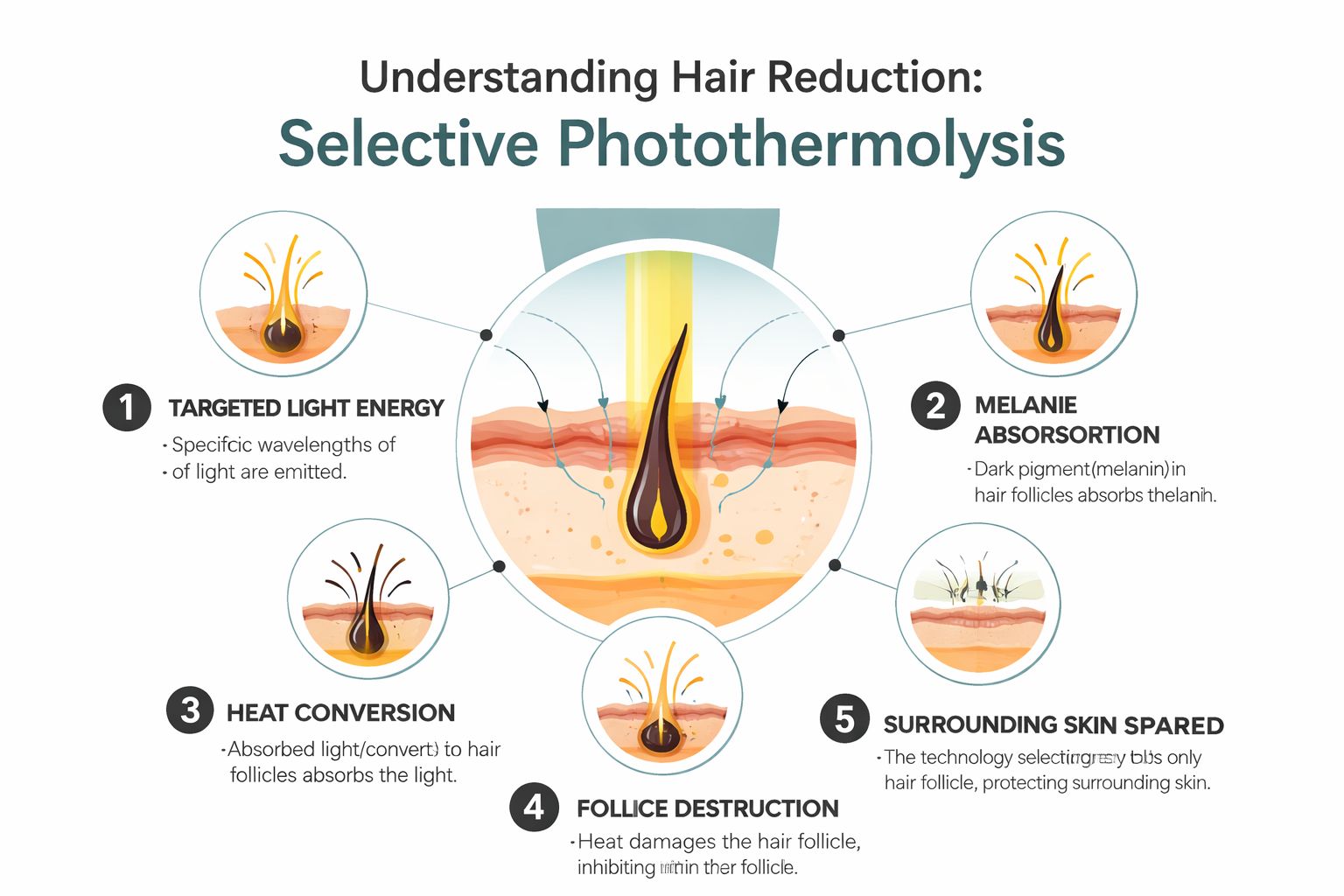
Hair reduction sounds complicated until you translate it into everyday language. The short version is simple. A device delivers energy to the hair follicle. That energy becomes heat. The heat damages the follicle enough to reduce future growth.
The basic science in plain English
The technical term is selective photothermolysis. That means the treatment is designed to target a specific structure, the pigment in the hair follicle, while limiting heat in the surrounding skin. Clinical literature describes this as matching the device wavelength to melanin in the follicle so thermal injury is concentrated in the hair bulb, with common systems including Nd:YAG (1064 nm), diode (808 to 810 nm), and Alexandrite (755 nm) (clinical overview of selective photothermolysis and wavelengths).
A simple analogy helps. It is like setting a sat nav for one house on a street. The treatment is trying to deliver heat to the follicle address, not to every bit of nearby skin.
If you like learning visually before a consultation, clear explainers can help. I often suggest looking at resources on ClipCreator.ai on educational video strategy because good health and beauty education works best when it breaks a process into simple, visual steps rather than flooding you with jargon.
How laser, IPL, and electrolysis differ
Laser uses a focused wavelength of light. It's precise and widely used for treating larger areas such as legs, underarms, back, and bikini lines. Different laser types suit different skin tones and hair characteristics.
IPL, or intense pulsed light, is not the same as a laser. It uses a broader band of light rather than one concentrated wavelength. That means it can be useful in some settings, but it behaves differently and is usually discussed separately from true laser systems.
Electrolysis works in a completely different way. A very fine probe is used to deliver electrical energy directly into the follicle. It doesn't rely on pigment in the same way light-based systems do, which is why some clients consider it for small areas or for hairs that are poor candidates for light-based treatment.
Good treatment isn't just about having a machine. It's about matching the machine, settings, and timing to the person in front of you.
That matching process matters. A dark, coarse underarm hair behaves differently from soft facial fluff. A client with very fair skin and dark hair isn't assessed the same way as someone with deep skin tones or recent sun exposure. The science is elegant, but in practice it comes down to careful judgement.
Comparing the Best Hair Reduction Methods
If you're choosing between laser, IPL, and electrolysis, the right answer depends on your hair type, your skin tone, the area being treated, and how much time you're willing to commit. There isn't one universal winner for every person.
Why repeat appointments matter
Hair doesn't all grow at the same time. Follicles move through cycles, and light-based treatment works best when hairs are in the active anagen growth phase. That's why an initial course typically needs 4 to 6 sessions spaced 4 to 6 weeks apart, with maintenance often needed every 6 to 12 months (growth cycle timing and session intervals).
A simple way to think about it is a classroom register. If only some students are present when you call the names, you need another session to catch the rest later.
Hair Reduction Technology Comparison
| Feature | Laser | IPL (Intense Pulsed Light) | Electrolysis |
|---|---|---|---|
| How it works | Focused light targets pigment in the follicle | Broad-spectrum light targets pigment less precisely | Electrical energy is delivered into individual follicles |
| Best for | People seeking reduction across small or large areas | People considering light-based treatment with a different technology profile | Very small areas or individual hairs |
| Hair type | Usually works best on darker, more visible hair | Often depends heavily on hair and skin contrast | Can be considered when pigment-targeting methods aren't ideal |
| Skin tone considerations | Device choice matters a lot, especially for darker skin | Careful assessment is needed | Not based on light absorption in the same way |
| Speed on larger areas | Usually practical for areas like legs, back, chest, underarms | Can cover areas fairly quickly | Slower because hairs are treated individually |
| Sensation | Often described as quick snaps or pinging | Similar light-heat sensation | More localised and repetitive in small zones |
| Typical course | Repeat sessions are standard | Repeat sessions are standard | Repeat visits are also usually needed |
| Goal | Long-term reduction | Long-term reduction | Follicle-by-follicle removal approach |
A lot of confusion comes from comparing methods by headline only. “Permanent.” “Painless.” “Fast.” Those words don't tell you enough. What matters is whether the method suits your actual concern.
For example, someone with dense underarm hair may prioritise speed and efficiency. Someone with a few isolated facial hairs may value precision more. Someone with mixed facial hair, including finer hairs, may need a more cautious discussion because not every hair type responds the same way.
If you're weighing two common clinic options side by side, this guide to laser hair removal vs electrolysis can help you think through the trade-offs in a more practical way.
Who Is a Good Candidate for Hair Reduction
Suitability starts with one key question. Is there enough of the right kind of target for the treatment to “see”? In light-based hair reduction, that target is pigment in the hair.
When skin and hair contrast helps
Traditionally, the easiest combination to treat has been darker terminal hair against lighter skin, because the contrast makes it easier to direct heat into the follicle rather than the surrounding skin. That doesn't mean other people can't be treated. It means assessment becomes more important.
Coarse hair usually responds more predictably than very fine, soft hair. Terminal hair gives the device something meaningful to target. Vellus hair, the lighter fluff you may notice on the face or body, is a different conversation and often needs more caution.
A good consultation should ask about:
- Your hair type including whether it is coarse, dark, fine, patchy, or hormonally stimulated
- Your skin tone and whether you tan easily or currently have a tan
- Your medical background including medication, active skin irritation, and any condition that affects healing
- Your expectations so the plan matches what you want, not what a marketing phrase suggests
Darker skin tones and hormonal facial hair need more care
Many online guides are too simplistic on this matter. For clients with darker skin, tanned skin, or hormonally-driven facial hair, longer wavelengths are preferred to reduce side effects, and poor outcomes on the face can be linked to tan, wrong wavelength choice, and treatment of vellus hair. The same review also notes the risk of paradoxical hair growth in the wrong circumstances, and highlights why this matters for conditions such as PCOS, which the NHS identifies as a common cause of hirsutism (review on darker skin, facial hair, wavelength choice, and paradoxical growth).
That sounds intimidating, but the lesson is reassuring. You don't need to avoid treatment. You need proper assessment.
Facial hair affected by hormones often improves more gradually, and it may need a longer-term management mindset rather than a one-and-done mindset.
For darker skin tones, providers often discuss longer wavelengths because they can treat the follicle more safely. For hormonally driven facial hair, I always encourage realistic expectations. You may get excellent reduction, but hormone-sensitive areas can be more persistent and may need occasional upkeep.
Men can benefit from the same careful planning, especially for beard shaping, chest, shoulders, and back. If that's your focus, this page on hair removal options for men gives a useful starting point.
The Complete Treatment Process Explained
Not knowing what happens on the day is one of the main reasons people delay booking. Once you understand the sequence, the process usually feels much less daunting.
Before your first appointment
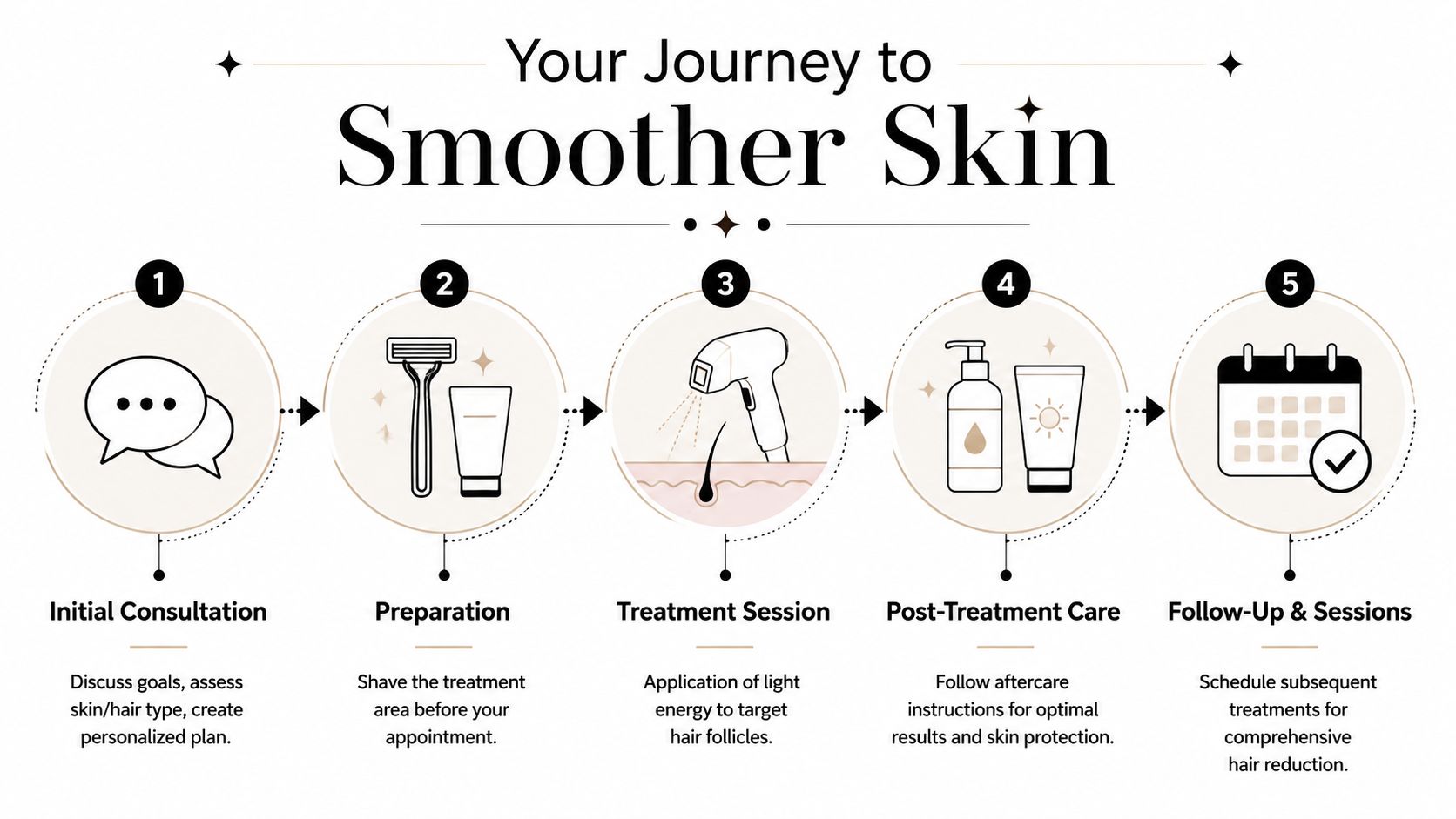
A proper consultation comes first. Your therapist assesses your skin tone, hair type, treatment area, medical history, and any recent tanning or skin sensitivity. This is also when you talk openly about your goal. Less shaving? Fewer ingrowns? Reduced facial hair? A cleaner bikini line? Different goals can change the plan.
Most clinics also patch test. That's a sensible safety step, especially if your skin is reactive, your tone is deeper, or you've never had a light-based treatment before.
What happens during treatment
On treatment day, the area is usually clean and freshly shaved. That often surprises people who assumed they should arrive with visible hair. For laser-based treatment, shaving is usually preferred because the energy needs to reach the follicle under the skin rather than being wasted on longer hair above it.
During the appointment, you'll wear protective eyewear if needed. The therapist places the handpiece against the skin and delivers pulses across the area in a structured pattern. Many clients describe the feeling as a quick elastic-band snap or a warm ping.
A standard plan usually involves about 6 to 8 sessions because follicles cycle asynchronously and need to be caught over time, which is why this multi-session model is standard practice (AAD guidance on session planning).
Aftercare and follow-up
Straight after treatment, mild redness or a warm, slightly sun-kissed feeling can happen. That's often temporary. What you do next matters because recently treated skin can be more reactive.
Common aftercare advice often includes:
- Avoid extra heat such as very hot baths, saunas, and intense exercise for a short period if your skin feels warm
- Protect the area from sun exposure and use SPF where appropriate
- Don't wax or pluck between sessions because the follicle needs to remain in place for future treatments
- Let shedding happen naturally if treated hairs begin working their way out over time
Aftercare matters as much as treatment day: calm skin tends to behave better, and better-behaved skin makes future sessions easier to plan.
Follow-up appointments are booked around the growth cycle of the area being treated. That spacing is intentional. More frequent isn't automatically better. The goal is to treat at the right time, not just as often as possible.
Expected Results and Long-Term Maintenance
This is the part clients most want honesty about. Laser hair removal is not permanent, but it can produce significant reduction. Cleveland Clinic notes that about six treatments spaced 6 to 8 weeks apart are typically needed, and many see about 10% to 25% reduction after the first treatment, with some regrowth later appearing thinner or lighter (Cleveland Clinic guidance on results and permanence).

What results usually feel like in real life
The first thing noticed isn't total smoothness. It's change. Hair may grow back more slowly. Some patches may become sparse earlier than others. Some hairs may seem finer, softer, or lighter.
That unevenness can make people think the treatment isn't working, when in fact it's behaving exactly as hair biology predicts. Different follicles respond at different times. Areas influenced by hormones, especially parts of the face, can be more stubborn than body areas with coarse terminal hair.
A realistic expectation sounds like this:
- Early stage means reduced regrowth, not finished results
- Middle stage often means obvious thinning and slower return
- Later stage usually means much less hair overall, with some follicles still needing attention
- Long term may include occasional top-ups rather than starting a full course again
Why maintenance is normal
Maintenance isn't a sign that treatment failed. It's part of the truth behind the phrase “permanent hair reduction.” Bodies change. Hormones shift. Some follicles recover partially, and some may begin producing hair later.
This short video gives a useful visual overview of what many people want to know before committing to a plan:
The people happiest with their outcome are usually the ones who go in with a maintenance mindset. If you expect reduction and easier upkeep, you're likely to feel pleased. If you expect a miracle after one or two appointments, you'll probably feel frustrated.
Your Hair Reduction Plan at 3D Aesthetics Leamington Spa
A good clinic plan should feel personal, not copied and pasted. That means your consultation looks at your hair pattern, your skin response, your goals, and whether light-based treatment is the right fit at all.
What a personalised plan should include
At 3D Aesthetics Leamington Spa, clients receive a complimentary consultation and a full 3D body scan as part of a broader evidence-led approach to non-surgical treatments. For hair reduction treatment, the useful part of that process is the conversation around suitability, patch testing, timing, and what kind of result is realistic for your area of concern.
You should expect your provider to discuss things such as:
- Your treatment goal because reducing dense body hair is different from managing hormonally driven facial hair
- Your skin safety especially if you have a deeper skin tone, recent tan, or sensitivity
- Your schedule so appointments can be spaced properly and you can stick to the plan
- Your maintenance outlook because long-term success is easier when you expect top-ups if needed
Choosing a clinic and taking the next step
Practical details matter more than people think. Easy booking, clear pre-care instructions, and responsive communication all make treatment feel less stressful. For clinic owners or solo beauty professionals improving that side of the client experience, tools that streamline calls for your beauty business can help reduce missed enquiries and make consultations easier to manage.
For you as a client, the next step is simple. Book a consultation. Ask direct questions. Bring up your concerns about permanence, darker skin, facial hair, PCOS, or regrowth. The right provider won't brush those aside. They'll build them into the plan.
If you're ready to talk through your options, book a consultation with 3D Aesthetics Leamington Spa. You can discuss your goals, patch test safely, and get a realistic treatment plan that fits your skin, hair, and routine.
← Back to Home